How Do Heat Engines Work Step by Step? Key Concepts Explained 2026
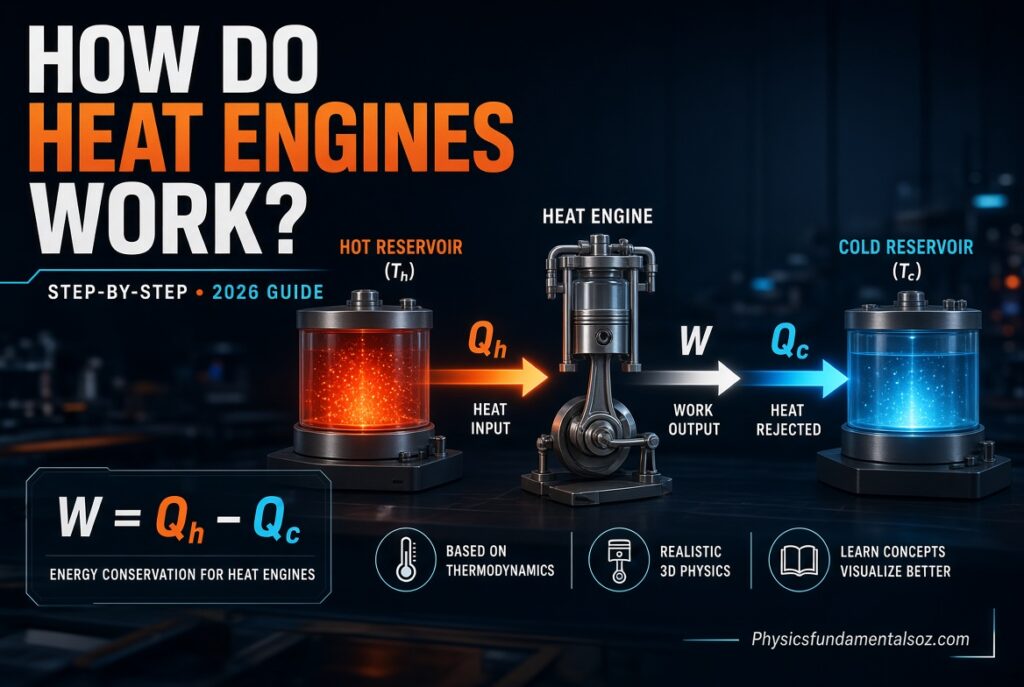
How Do Heat Engines Work Step by Step? A heat engine turns thermal energy into motion. It pulls in heat from a hot source, uses part of that heat to push a piston or spin a turbine, and dumps the leftover heat into a cooler place.
That one idea powers car engines, power plants, and steam turbines. Once you see the four-step cycle behind it, every version of a heat engine starts to look familiar.
Table of Contents
How Heat Engines Work
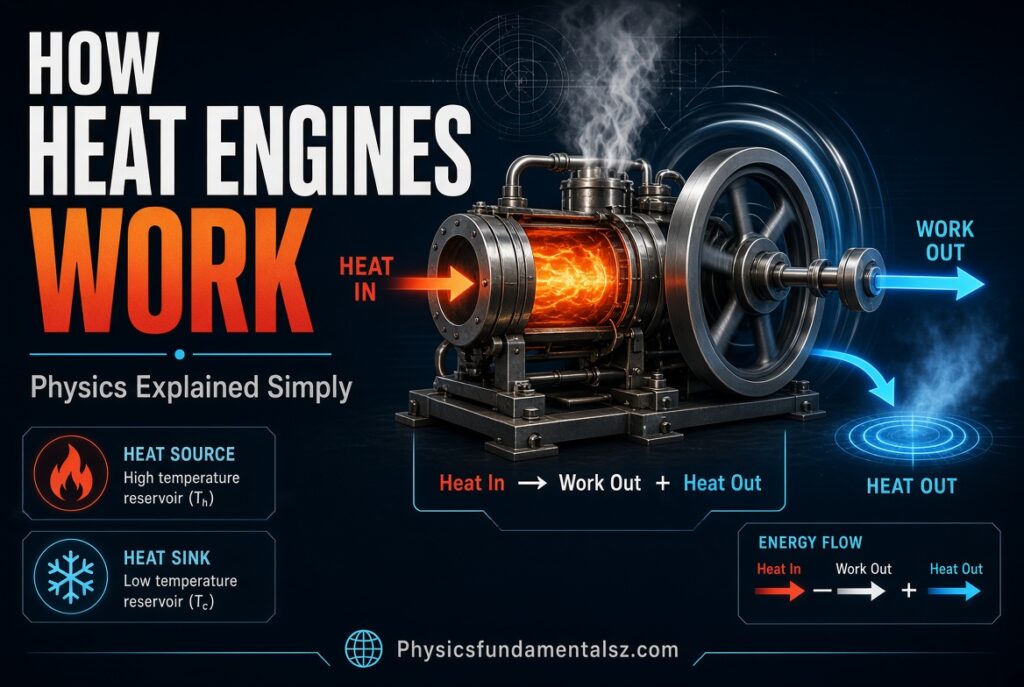
A heat engine works by absorbing heat from a hot reservoir, converting part of that heat into mechanical work, and releasing the remaining heat to a cold reservoir. This happens in a repeating cycle.
- Heat flows in from a high-temperature source
- A working fluid (gas, steam, or air-fuel mixture) expands and pushes a piston or turbine
- Some of that expansion energy becomes usable mechanical work
- Waste heat is exhausted to a low-temperature sink before the cycle repeats
What Is a Heat Engine?
A heat engine is any device that converts heat energy into mechanical work through a repeating cycle. It always needs two temperature levels to function: a hot source and a cold sink.
Examples include car engines, steam turbines, jet engines, and Stirling engines. Refrigerators and air conditioners are heat engines running in reverse.
The Core Idea Behind Every Heat Engine
Every heat engine relies on a simple truth from thermodynamics: heat naturally flows from hot to cold. Engineers exploit that flow to extract useful work along the way.
A working substance, usually a gas, steam, or air-fuel mixture, carries the heat through the cycle. As it expands, it pushes a piston or spins a turbine blade.
Why Two Temperatures Are Required
A single temperature can’t do useful work on its own. The engine needs a hot reservoir to supply energy and a cold reservoir to absorb what’s left over.
This temperature difference is what the second law of thermodynamics is built around, and it’s why no heat engine is ever 100% efficient.
How Do Heat Engines Work Step by Step
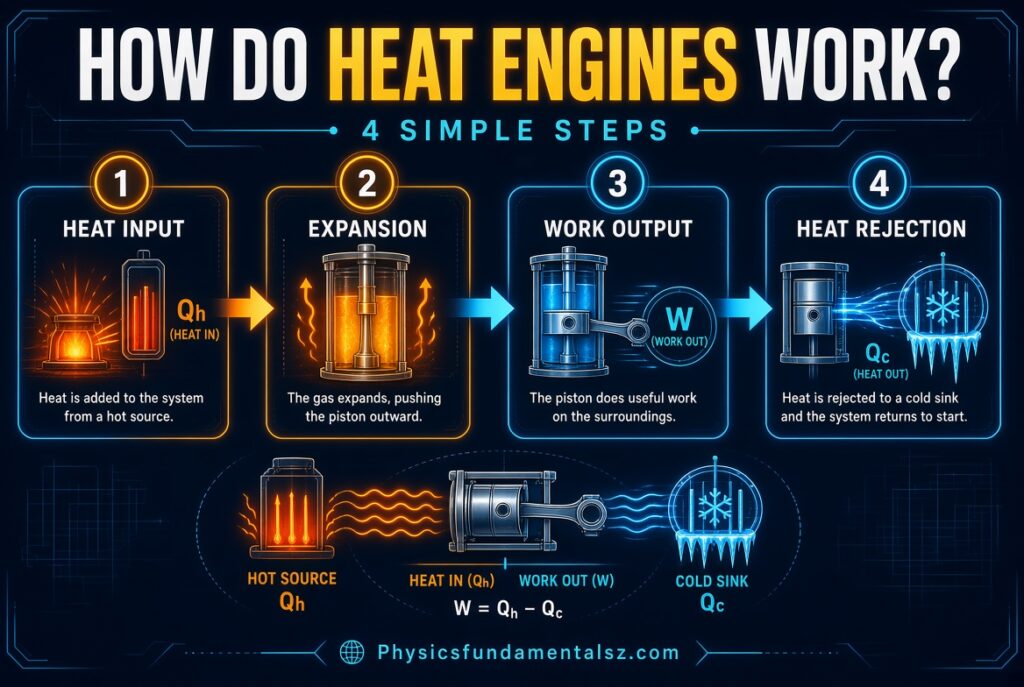
Here is the exact four-step cycle almost every heat engine follows, whether it’s a car engine or a steam power plant.
Step 1: Heat Absorption
The working fluid absorbs heat energy from a high-temperature source. In a car, this is the burning air-fuel mixture. In a power plant, it’s steam heated by burning coal or nuclear fission.
Step 2: Expansion and Work Output
As the fluid heats up, it expands rapidly. That expansion pushes a piston outward or spins turbine blades, converting thermal energy directly into mechanical motion.
Step 3: Heat Rejection
Once the fluid has done its work, it’s still warmer than the surroundings. The engine exhausts this leftover heat into a cold reservoir, such as the atmosphere or a cooling tower.
Step 4: Compression and Cycle Restart
The now-cooled fluid contracts back to its starting volume. The piston or system resets, and the cycle begins again, repeating hundreds or thousands of times per minute.
Key Takeaways
- Heat engines always move energy from hot to cold
- Only part of the absorbed heat becomes usable work
- The rest is unavoidably lost as waste heat
- The cycle repeats continuously to produce continuous motion
The Heat Engine Formula: Efficiency Explained
Efficiency tells you how much of the heat input actually becomes useful work. The formula is straightforward.
Efficiency (e) equals work output divided by heat input, or e = 1 − (Qc / Qh), where Qh is heat absorbed and Qc is heat rejected.
No real engine reaches 100% efficiency. Friction, heat loss, and the laws of thermodynamics always leave some energy on the table.
The Carnot Cycle: The Theoretical Best Case
The Carnot cycle describes the maximum possible efficiency any heat engine could achieve between two temperatures. Real engines never quite reach it.
It’s a benchmark, not a blueprint. Engineers use it to see how far a real design is from the theoretical ceiling.
Types of Heat Engines
Heat engines fall into two broad categories based on where the combustion or heating happens.
| Type | How It Works | Common Examples |
|---|---|---|
| Internal Combustion | Fuel burns inside the engine’s cylinders | Car engines, motorcycles, diesel trucks |
| External Combustion | Fuel burns outside, heating a separate working fluid | Steam engines, steam turbines, power plants |
| Stirling Engine | Uses trapped gas heated and cooled externally | Solar generators, quiet backup power units |
| Jet Engine | Continuous combustion drives a turbine and exhaust | Aircraft, some power generation turbines |
Internal Combustion Engines
Fuel and air mix and ignite directly inside the cylinder. This is the four-stroke cycle used in most cars: intake, compression, power, exhaust.
External Combustion Engines
Heat is generated outside the main working chamber, then transferred to a separate fluid like steam. Old steam locomotives and modern power plants both use this approach.
Stirling Engines
A Stirling engine moves gas between a hot side and a cold side without any combustion inside it. It’s quieter and can run on almost any heat source, including solar energy.
Real-World Applications of Heat Engines
Heat engines are everywhere once you start looking for them. They’re the reason most of modern transportation and electricity generation work at all.
- Gasoline and diesel engines in cars, trucks, and motorcycles
- Steam turbines in coal, gas, and nuclear power plants
- Jet engines in commercial and military aircraft
- Stirling engines in some solar-thermal and marine applications
Heat Engines vs Refrigerators: What’s the Difference
A refrigerator is essentially a heat engine running backward. Instead of using heat to produce work, it uses work to move heat from cold to hot.
| Feature | Heat Engine | Refrigerator |
|---|---|---|
| Goal | Produce mechanical work | Remove heat from a cold space |
| Energy Flow | Hot to cold, work released | Cold to hot, work absorbed |
| Example | Car engine, steam turbine | Fridge, air conditioner |
Common Mistakes People Make When Learning This Topic
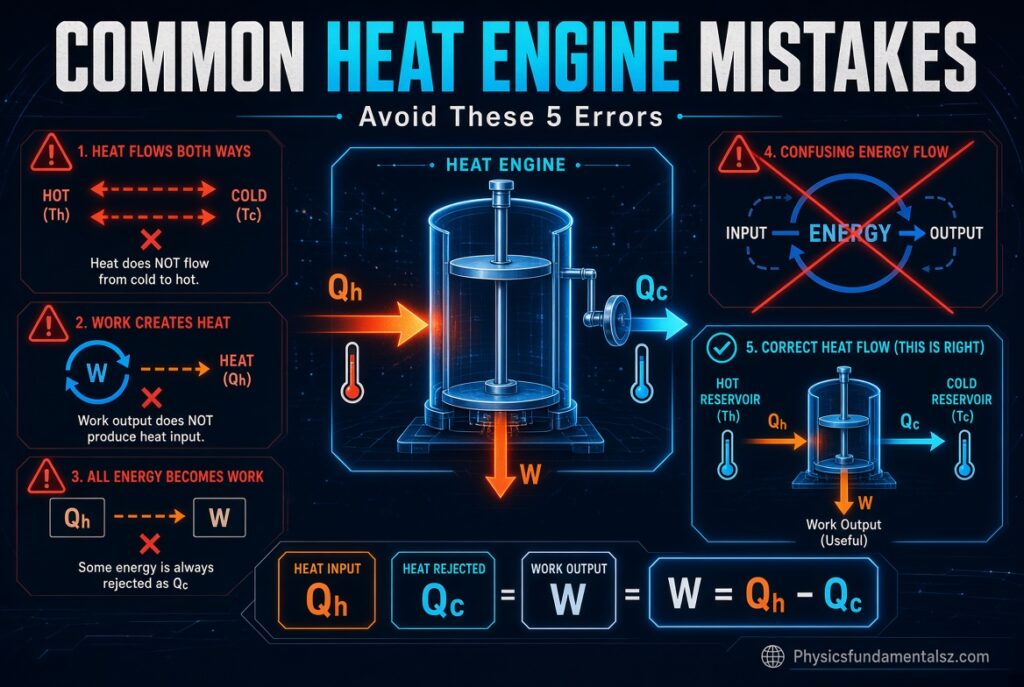
- Assuming an engine could ever reach 100% efficiency
- Forgetting that a cold reservoir is just as necessary as a hot one
- Mixing up internal and external combustion designs
- Ignoring that the Carnot cycle is a theoretical limit, not a real design
Expert Tips for Understanding Heat Engines Faster
- Picture the cycle as a loop, not a straight line, since the working fluid always returns to its starting state
- Compare a car engine to a steam turbine side by side to spot the shared four-step pattern
- Focus on where heat enters and exits before worrying about the math
- Use the efficiency formula only after the four-step cycle makes intuitive sense
Also Read:
- The First Law of Thermodynamics
- The Second Law of Thermodynamics
- The Kinetic Theory of Gases
- Heat Transfer: Conduction, Convection and Radiation
- Entropy Explained
- Entropy Explained for Beginners
- Specific Heat Capacity
- Ideal Gas Law: PV = nRT
- Ideal Gas Law Practice Problems With Answers
- Stress, Strain & Young’s Modulus
- What Is Energy?
- Newton’s Laws of Motion
- Conservation of Momentum
- Conservation of Momentum Real Life Examples
- What Is the Formula for Conservation of Momentum?
- What Is Centripetal Force With Examples?
- Projectile Motion: Complete Guide
- Projectile Motion Formula for Angled Launch
- Difference Between Speed and Velocity With Examples
- How to Calculate Acceleration From a Velocity Time Graph
- Wave Speed, Frequency & Wavelength
- How to Derive Wave Speed Formula?
- Transverse Waves Explained
- Mass Energy Equivalence Real Life Examples
- Nuclear Decay Equations Explained Simply
Frequently Asked Questions (FAQs)
What is a heat engine in simple terms?
A heat engine is a machine that converts heat into mechanical motion by moving energy from a hot source to a cold sink through a repeating cycle.
How do heat engines work step by step?
They absorb heat, use it to expand a working fluid and push a piston or turbine, release the leftover heat to a cold reservoir, then reset and repeat.
Why can’t a heat engine be 100% efficient?
The second law of thermodynamics requires some heat to always be rejected to a cold reservoir, so no real engine converts all input heat into work.
What is the working fluid in a heat engine?
It’s the substance that carries heat through the cycle, commonly air-fuel mixtures, steam, or another gas depending on the engine design.
What is the difference between internal and external combustion engines?
Internal combustion burns fuel inside the cylinder itself, while external combustion heats a separate working fluid outside the main chamber.
Is a car engine a heat engine?
Yes. A car engine is an internal combustion heat engine that converts burning fuel into mechanical motion through a four-stroke cycle.
What is the Carnot cycle?
It’s a theoretical model showing the maximum efficiency any heat engine could reach operating between two fixed temperatures.
Can a heat engine work with only one temperature?
No. A heat engine always needs both a hot source and a cold sink to produce continuous work.
What is an example of an external combustion engine?
Steam turbines in coal and nuclear power plants are classic external combustion heat engines.
How is a refrigerator related to a heat engine?
A refrigerator is a heat engine running in reverse, using work to move heat from a cold space to a warmer one.
What is the efficiency formula for a heat engine?
Efficiency equals work output divided by heat input, expressed as e = 1 − (Qc / Qh).
What are the four strokes in a car engine cycle?
Intake, compression, power, and exhaust, each corresponding to one movement of the piston in the four-step heat engine cycle.
Do all heat engines use pistons?
No. Turbines, such as those in jet engines and power plants, use spinning blades instead of pistons to extract work.
What is a Stirling engine?
A Stirling engine moves gas between hot and cold zones without internal combustion, making it quieter and adaptable to different heat sources.
Why do power plants need cooling towers?
Cooling towers act as the cold reservoir, absorbing the waste heat that every heat engine must reject to complete its cycle.
What type of energy conversion happens in a heat engine?
Thermal energy is converted into mechanical work, with some portion always lost as waste heat during the process.
Are jet engines heat engines?
Yes. Jet engines burn fuel continuously and use the expanding gas to drive a turbine and produce thrust, following the same hot-to-cold principle.
What limits the efficiency of a heat engine?
The temperature difference between the hot and cold reservoirs sets the theoretical limit, alongside real-world friction and heat losses.
How does temperature difference affect efficiency?
A larger gap between the hot and cold reservoir temperatures allows for higher possible efficiency, based on the Carnot limit.
What is waste heat in a heat engine?
Waste heat is the portion of absorbed energy that isn’t converted into work and must be released to the cold reservoir instead.
Conclusion
Heat engines all follow the same basic loop: absorb heat, expand a working fluid to create motion, release the leftover heat, then reset and repeat.
That single four-step cycle explains everything from a car’s engine to a nuclear power plant’s steam turbine. The details change, but the underlying physics never does.
Once you can trace heat moving from a hot source, through useful work, and out to a cold sink, you understand how every heat engine on the planet actually works.