Nuclear Decay Equations Explained Simply (2026 Beginner Guide)
An unstable atom is basically a ticking clock. Sooner or later it throws off a particle and turns into something else.
Nuclear Decay Equations Explained Simply are just the shorthand chemists and physicists use to track that transformation. They look intimidating at first, with all those little numbers stacked around element symbols.
Once you know the two rules that never change, mass number and charge always stay balanced, every equation becomes simple arithmetic.
Table of Contents
What Is a Nuclear Decay Equation?
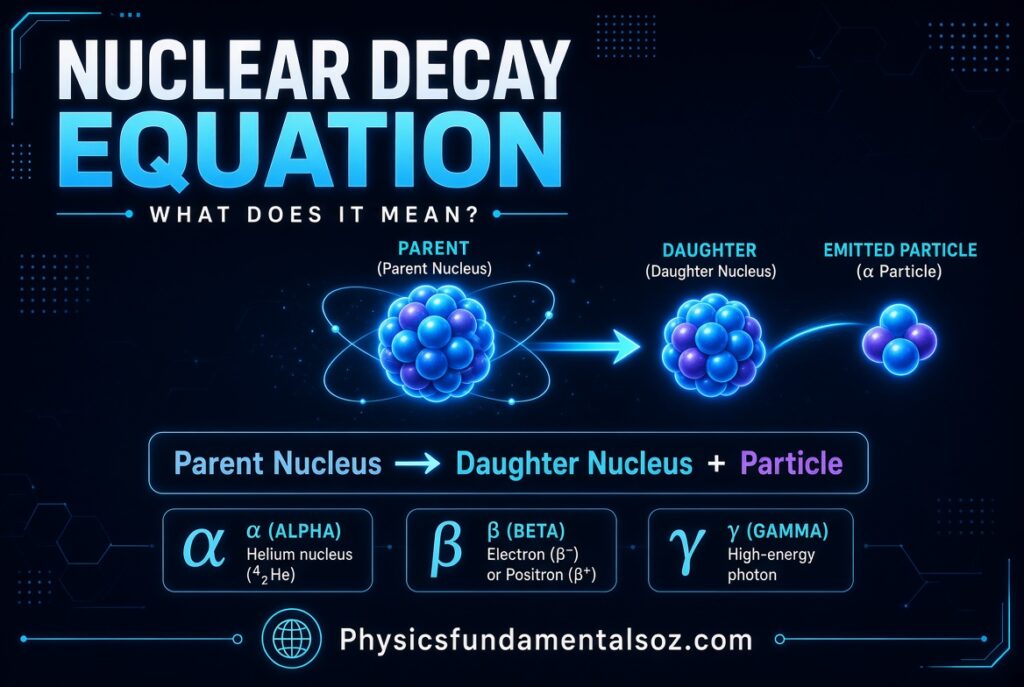
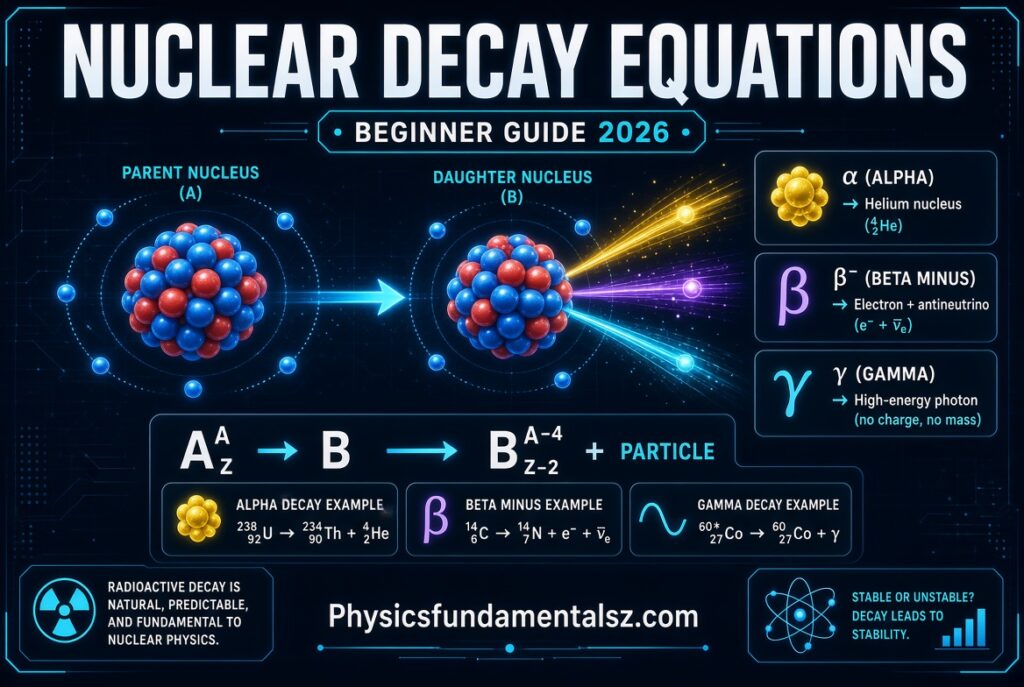
A nuclear decay equation shows an unstable nucleus (the parent) breaking down into a new nucleus (the daughter) plus a particle, such as an alpha particle, beta particle, or gamma ray.
Every nuclear equation must conserve two things on both sides of the arrow: the total mass number (A) and the total atomic number (Z). If those two totals match, the equation is balanced correctly.
What Nuclear Decay Actually Means
Every atom is identified by two numbers: the atomic number (protons) and the mass number (protons plus neutrons). Radioactive isotopes have a nucleus that is not stable.
An unstable nucleus releases energy and particles to reach a more stable arrangement of protons and neutrons. This spontaneous process is called radioactive decay or nuclear decay.
The original atom is called the parent nuclide. The new atom left behind is the daughter nuclide. In many cases, the daughter is still unstable and decays again, forming a decay chain.
The Notation You Need to Know
Every nuclide in a decay equation is written as ᴬZX, where X is the element symbol. A is the mass number, written as a superscript to the upper left. Z is the atomic number, written as a subscript to the lower left.
For example, uranium-238 is written as ²³⁸₉₂U. The 238 is the mass number and the 92 is the atomic number, since uranium always has 92 protons.
This notation matters because it gives you everything needed to balance the equation. You never need outside data once A and Z are visible.
The Two Golden Rules of Nuclear Decay Equations Explained Simply
Two conservation laws govern every nuclear decay equation, no matter which type of decay is involved.
- Conservation of mass number (A): the sum of the mass numbers on the left must equal the sum on the right.
- Conservation of atomic number (Z): the sum of the atomic (proton) numbers on the left must equal the sum on the right.
If both totals match after you write the products, the equation is balanced. If they do not match, something in the equation is wrong.
Alpha Decay Explained Simply
Alpha decay happens when a heavy, unstable nucleus ejects an alpha particle. An alpha particle is identical to a helium-4 nucleus, made of two protons and two neutrons.
Because the nucleus loses two protons and two neutrons, the mass number drops by 4 and the atomic number drops by 2.
General form: ᴬZX → ᴬ⁻⁴Z₋₂Y + ⁴₂He
Worked example, uranium-238: ²³⁸₉₂U → ²³⁴₉₀Th + ⁴₂He
Check the math: 238 = 234 + 4 on the mass side, and 92 = 90 + 2 on the atomic number side. Both balance, so the equation is correct.
Alpha decay is common in very heavy elements, generally anything with an atomic number above 83, because the strong nuclear force struggles to hold that many protons together.
Beta-Minus Decay Explained Simply
Beta-minus decay happens when a neutron inside the nucleus converts into a proton. That conversion emits an electron, historically called a beta particle, along with an antineutrino.
Since a neutron becomes a proton, the mass number stays the same but the atomic number increases by 1.
General form: ᴬZX → ᴬZ₊₁Y + ⁰₋₁e
Worked example, carbon-14: ¹⁴₆C → ¹⁴₇N + ⁰₋₁e
Check the math: 14 = 14 + 0, and 6 = 7 + (-1). Both sides balance. This exact reaction is the basis of carbon dating.
Beta-minus decay is typical of nuclei that have too many neutrons relative to protons for stability.
Beta-Plus Decay and Electron Capture
Nuclei with too many protons relative to neutrons stabilize differently. They use beta-plus decay or electron capture, and both lower the atomic number by 1.
In beta-plus decay, a proton converts into a neutron and emits a positron, the positively charged twin of the electron.
General form: ᴬZX → ᴬZ₋₁Y + ⁰₊₁e
In electron capture, the nucleus pulls in an inner orbital electron and combines it with a proton to make a neutron, releasing a neutrino.
General form: ᴬZX + ⁰₋₁e → ᴬZ₋₁Y
Both processes reduce the proton count without changing the mass number, and both compete with each other in proton-rich isotopes such as sodium-22.
Gamma Decay Explained Simply
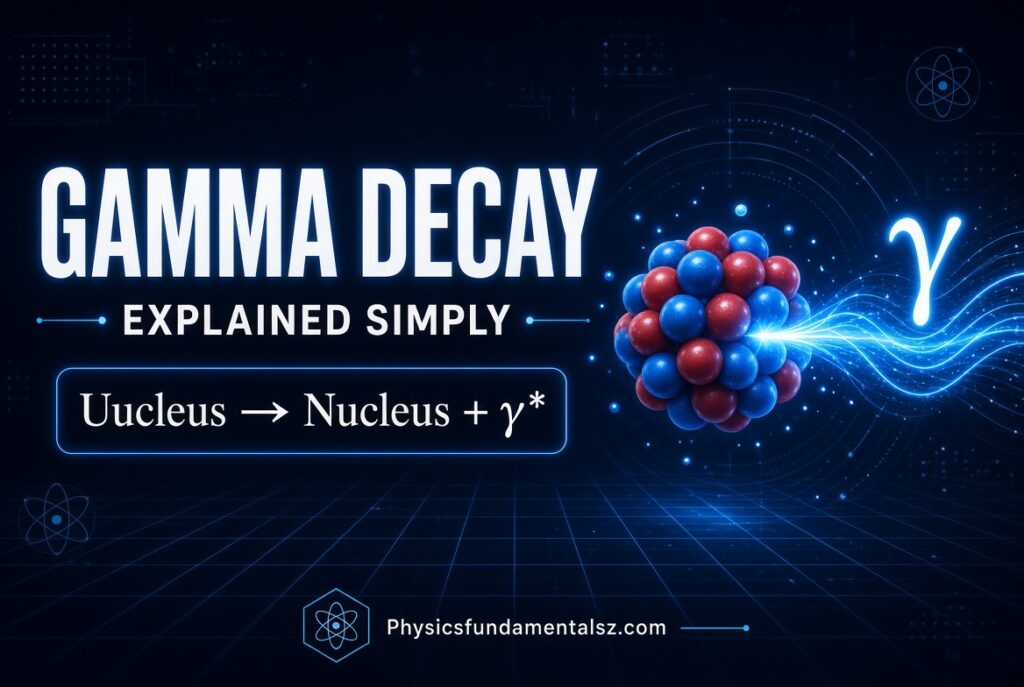
Gamma decay happens when a nucleus is left in an excited energy state after an earlier alpha or beta decay. The excited nucleus releases the extra energy as a high-energy photon called a gamma ray.
Gamma decay changes neither the mass number nor the atomic number. Only the energy state changes.
General form: ᴬZX* → ᴬZX + γ
The asterisk marks the excited state. A common example is cobalt-60, which beta-decays into excited nickel-60, then releases gamma rays as it settles down.
Nuclear Decay Types Compared
| Decay Type | Particle Emitted | Change in A | Change in Z |
|---|---|---|---|
| Alpha decay | Helium nucleus (⁴₂He) | −4 | −2 |
| Beta-minus decay | Electron (⁰₋₁e) | 0 | +1 |
| Beta-plus decay | Positron (⁰₊₁e) | 0 | −1 |
| Electron capture | Neutrino released | 0 | −1 |
| Gamma decay | Photon (γ) | 0 | 0 |
This table is worth bookmarking. Almost every homework problem on nuclear decay equations reduces to matching a described process against one of these five rows.
How to Balance a Nuclear Decay Equation, Step by Step
Balancing any nuclear decay equation follows the same short routine, regardless of which decay type is involved.
- Write the parent nuclide with its correct A and Z values.
- Identify the decay type from the wording or the particle given.
- Write the known particle emitted, using its standard A and Z.
- Subtract to find the daughter’s mass number and atomic number.
- Look up the element symbol matching the new atomic number.
- Confirm both totals match on each side of the arrow.
Following these steps in order removes the guesswork, even for students who find the notation confusing at first.
Worked Practice Problems
Problem 1: Radium-226 undergoes alpha decay. Write the balanced equation.
²²⁶₈₈Ra → ²²²₈₆Rn + ⁴₂He
Check: 226 = 222 + 4, and 88 = 86 + 2. Balanced.
Problem 2: Thorium-234 undergoes beta-minus decay. Write the balanced equation.
²³⁴₉₀Th → ²³⁴₉₁Pa + ⁰₋₁e
Check: 234 = 234 + 0, and 90 = 91 + (-1). Balanced.
Problem 3: Nitrogen-13 undergoes beta-plus decay. Write the balanced equation.
¹³₇N → ¹³₆C + ⁰₊₁e
Check: 13 = 13 + 0, and 7 = 6 + 1. Balanced.
Nuclear Decay Chains
A single decay rarely produces a stable atom right away. Heavy isotopes like uranium-238 pass through many decay steps before settling into a stable daughter.
Uranium-238 goes through 14 separate alpha and beta decays before finally becoming stable lead-206. This sequence is called the uranium decay series.
Each intermediate isotope in the chain has its own half-life, so the chain can take anywhere from fractions of a second to billions of years to complete.
Half-Life and Decay Equations
Half-life is the time it takes for half of a radioactive sample to decay. It is closely related to, but distinct from, the decay equation itself.
The decay equation tells you what an atom turns into. Half-life tells you how quickly a population of those atoms transforms on average.
Both ideas work together in real applications, such as dating fossils, sterilizing medical equipment, and calculating radiation safety timelines.
Common Mistakes When Writing Nuclear Decay Equations
- Forgetting to conserve atomic number: many students balance mass number but skip checking the proton count.
- Mixing up beta-minus and beta-plus: the sign on the emitted particle determines whether Z increases or decreases.
- Ignoring gamma decay after alpha or beta emission: a daughter left in an excited state still needs a gamma step.
- Misreading the periodic table: the new element symbol must match the new atomic number exactly, not the old one.
- Dropping the antineutrino or neutrino: these are usually omitted in basic equations but matter in advanced physics contexts.
Avoiding these five mistakes covers the vast majority of errors seen in introductory chemistry and physics coursework.
Real-World Applications of Nuclear Decay
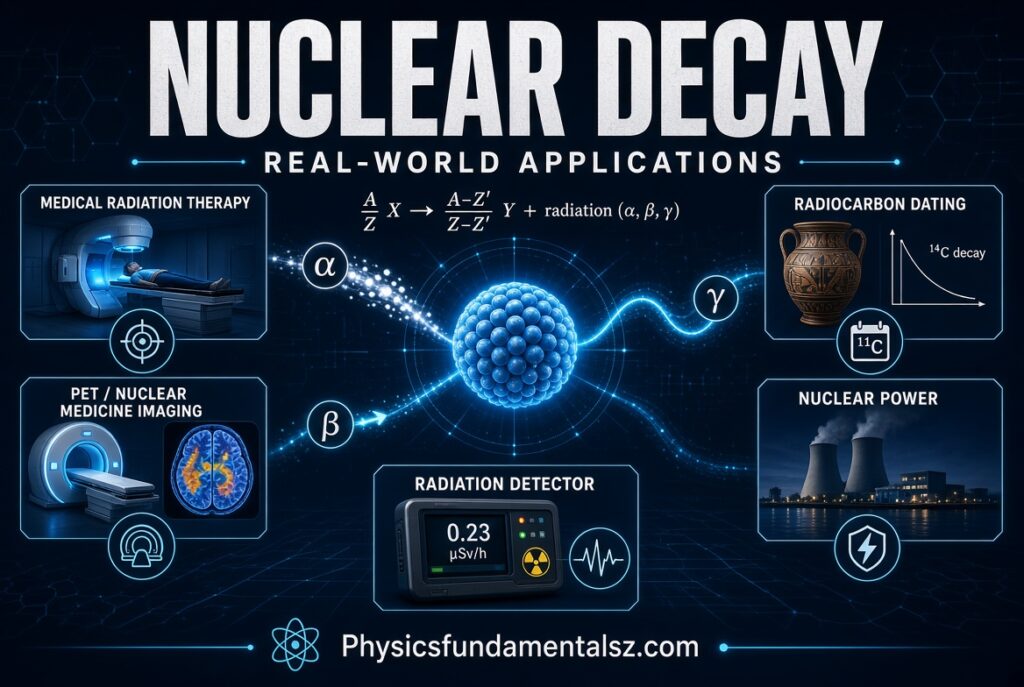
- Carbon dating: archaeologists use carbon-14 beta decay to estimate the age of organic remains.
- Cancer treatment: gamma emitters like cobalt-60 are used in targeted radiotherapy.
- Smoke detectors: many household detectors use alpha-emitting americium-241.
- Power generation: nuclear reactors rely on controlled decay and fission chains for energy.
- Medical imaging: short-lived isotopes such as technetium-99m are used in diagnostic scans.
Nuclear decay is not just a textbook topic. It quietly supports medicine, energy, archaeology, and consumer safety technology every day.
Also Read:
- Nuclear Decay Equations: Alpha, Beta & Gamma Decay Explained
- Half-Life Calculations: Formula & Worked Examples Explained
- Half Life Calculator With Steps: Formula, Examples & Full Guide 2026
- Mass-Energy Equivalence: E = mc² Derivation & Nuclear Applications
- E=mc2 Explained for Beginners (2026 Simple Guide)
- Bohr Model of the Atom: Energy Levels, Emission & Absorption Spectra
- Quantum Numbers: n, l, m_l, m_s and Electron Configuration
- Heisenberg Uncertainty Principle: ΔxΔp ≥ ℏ/2 — Explained Simply
- De Broglie Wavelength: λ = h/mv Formula, Derivation & Examples
- De Broglie Wavelength Calculator: Formula, Steps & Worked Examples 2026
- Photoelectric Effect Equation Explained (2026 Simple Guide)
- Photoelectric Effect Calculations: hf = work-function + KE_max
- Electric Charge and Coulomb’s Law: F = kq₁q₂/r² Explained
- Coulomb’s Law Calculations: F = kQ1Q2/r² Formula & Examples
- Electric Potential Energy: E = kQq/r, Work Done & Worked Examples
- Electric Current: I = Q/t, Drift Velocity & Ohm’s Law Connection
- Magnetic Field of a Current-Carrying Wire: B = μ0I/2πr
- Magnetic Flux and Faraday’s Law: Formula, Examples & Applications
- Lenz’s Law: The Direction of Induced Current Explained
- Electric Circuits & Kirchhoff’s Laws: KCL, KVL & Worked Examples
- Kirchhoff’s Laws Advanced: Solving Multi-Loop Circuits Step by Step
- Resistors in Series and Parallel: Formulas, Rules & Worked Examples
- Ohm’s Law Calculator Solve for Current: Formula, Steps & Examples 2026
- Conservation of Momentum
Frequently Asked Questions (FAQs)
What is a nuclear decay equation?
A nuclear decay equation shows an unstable parent nucleus transforming into a daughter nucleus plus an emitted particle, while keeping mass number and atomic number balanced on both sides.
What are the three main types of nuclear decay?
The three main types are alpha decay, beta decay, and gamma decay. Beta decay is further split into beta-minus, beta-plus, and electron capture.
How do you balance a nuclear decay equation?
Match the total mass number on both sides, then match the total atomic number on both sides. If both totals are equal, the equation is balanced correctly.
What particle is emitted in alpha decay?
Alpha decay emits an alpha particle, which is a helium-4 nucleus made of two protons and two neutrons, written as ⁴₂He.
What happens to mass number during beta decay?
Mass number does not change during beta decay. Only the atomic number changes, because a neutron converts to a proton or a proton converts to a neutron.
Why does gamma decay not change the element?
Gamma decay only releases excess energy as a photon. It does not change the number of protons or neutrons, so the element and isotope stay exactly the same.
What is the difference between alpha and beta decay?
Alpha decay emits a heavy helium nucleus and reduces mass number by 4. Beta decay emits a light electron or positron and does not change mass number at all.
What is a parent and daughter nuclide?
The parent nuclide is the original unstable atom before decay. The daughter nuclide is the new atom produced after the decay event occurs.
Is beta-minus decay the same as beta decay?
Beta decay is the general term. Beta-minus decay specifically refers to a neutron converting into a proton with electron emission, the most common beta process.
What is electron capture in nuclear decay?
Electron capture is when a nucleus absorbs an inner orbital electron, converting a proton into a neutron and releasing a neutrino, lowering the atomic number by 1.
How is carbon-14 dating related to decay equations?
Carbon-14 dating relies on the beta-minus decay of carbon-14 into nitrogen-14, a process with a known, measurable half-life used to estimate age.
What does the asterisk mean in a decay equation?
An asterisk next to an element symbol means the nucleus is in an excited energy state, typically right before it releases a gamma ray.
Why do heavy elements undergo alpha decay?
Heavy elements, generally those with atomic number above 83, have too many protons for the strong nuclear force to hold together stably, so they shed mass through alpha decay.
Can a nucleus decay more than once?
Yes. Many isotopes go through a decay chain, undergoing several alpha and beta decays in sequence before reaching a stable daughter isotope.
What is the uranium decay series?
The uranium decay series is the 14-step chain of decays that transforms uranium-238 into stable lead-206 through a mix of alpha and beta emissions.
Does gamma decay happen on its own?
Gamma decay almost always follows another decay event, such as alpha or beta decay, because it releases leftover energy from an excited daughter nucleus.
What is the general formula for alpha decay?
The general formula is ᴬZX → ᴬ⁻⁴Z₋₂Y + ⁴₂He, where the mass number drops by 4 and the atomic number drops by 2.
What is the general formula for beta-minus decay?
The general formula is ᴬZX → ᴬZ₊₁Y + ⁰₋₁e, where mass number stays the same and atomic number increases by 1.
How do you identify the daughter element?
Calculate the new atomic number after decay, then match that number to its element on the periodic table to identify the daughter element.
What is the neutron-to-proton ratio’s role in decay?
The neutron-to-proton ratio predicts which decay type an unstable nuclide will use. High ratios favor beta-minus decay, low ratios favor beta-plus decay or electron capture.
Are antineutrinos included in basic decay equations?
Basic classroom equations often omit the antineutrino or neutrino for simplicity, though advanced nuclear physics always includes them for full accuracy.
What is the difference between nuclear decay and nuclear fission?
Nuclear decay is a spontaneous, natural transformation of an unstable nucleus. Nuclear fission is typically an induced splitting of a heavy nucleus into two large fragments.
How is half-life connected to decay equations?
Half-life measures how fast a sample decays statistically, while the decay equation shows what each individual atom transforms into during that process.
Why is technetium-99m used in medical imaging?
Technetium-99m emits gamma rays with a short half-life, making it useful for imaging without changing the mass number or exposing patients to prolonged radiation.
What real-world devices rely on nuclear decay?
Smoke detectors, radiotherapy machines, medical imaging tools, and some power generators all rely on predictable, well-understood nuclear decay equations.
Conclusion
Nuclear decay equations become manageable once you treat them as simple accounting: mass number in equals mass number out, and atomic number in equals atomic number out.
Alpha decay drops both numbers, beta decay shifts the atomic number by one, and gamma decay changes neither. Everything else in this topic builds on those three patterns.
Practice a few problems using the steps above, and writing a balanced nuclear decay equation will start to feel as routine as balancing a chemical equation.