Specific Heat Capacity Explained: Formula, Examples, and Uses
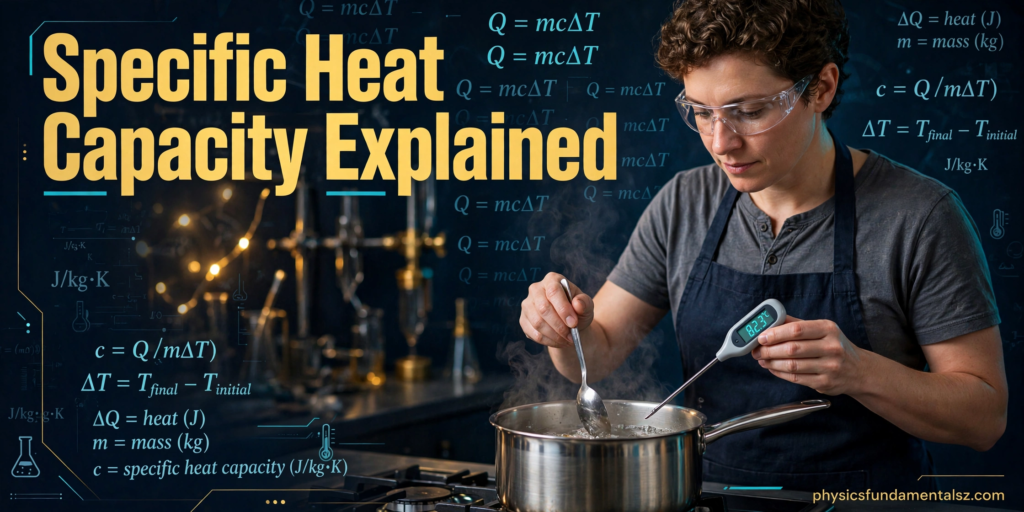
Have you ever wondered why a metal spoon left in hot soup becomes too hot to hold, while the soup itself stays at a comfortable drinking temperature for much longer?
Both the spoon and the soup are in contact with the same heat source, yet they warm up at very different rates. The explanation lies in a property called specific heat capacity.
Specific heat capacity tells us how much heat energy a material needs before its temperature rises. Some materials warm up quickly with only a small amount of heat. Others absorb a large amount of heat and barely change temperature at all.
This difference shapes everything from how oceans moderate the climate to how engineers choose coolants for engines and how cooks choose pans for the kitchen. Once you understand specific heat capacity, many everyday observations suddenly make sense.
In this guide, we will build the idea step by step. We will start with a simple definition, explain the formula Q = mcΔT, compare related terms that students often confuse, look at real values for common materials, work through numerical examples, and explore calorimetry, heating curves, and practical uses.
What Is Specific Heat Capacity?
Specific heat capacity is the amount of heat energy required to raise the temperature of one kilogram of a substance by one degree Celsius, or by one kelvin.
In simpler words, it measures how stubborn a material is about changing temperature. A material with a high specific heat capacity is stubborn: it needs a lot of heat before it warms up, and it releases a lot of heat as it cools down. A material with a low specific heat capacity is easily persuaded: a small amount of heat produces a large temperature rise.
Water is the classic example of a high specific heat capacity material. It takes a great deal of energy to warm water, which is why a kettle takes minutes to boil and why a swimming pool stays cool on a hot day. Metals such as copper and lead, by contrast, have low specific heat capacities. They heat up and cool down quickly.
This property is described as “specific” because it is defined per unit mass. It does not depend on how much of the material you have in total. One kilogram of water and ten kilograms of water have the same specific heat capacity, even though the larger mass needs ten times as much total heat to raise its temperature by the same amount.
That distinction matters. Specific heat capacity is an intensive property: it describes the material itself, not the size of the sample. Total heat capacity, which we will discuss shortly, is different because it does depend on mass.
It is also important to remember that heat and temperature are not the same thing. Heat is energy transferred because of a temperature difference, while temperature measures the average kinetic energy of particles. If you need a refresher, this guide to the difference between heat and temperature explains the distinction clearly.
The Formula: Q = mcΔT
The central equation for specific heat capacity is:
Q = mcΔT
This short formula contains a great deal of physics. Let us examine each symbol in turn.
What Each Symbol Means
Q is the heat energy transferred, measured in joules (J). If heat flows into the substance, Q is positive. If heat flows out of the substance as it cools, Q is negative. The sign tells you the direction of energy transfer, and it is one of the most common sources of mistakes in exam questions.
m is the mass of the substance, measured in kilograms (kg). This is a crucial detail. If a question gives mass in grams, you must convert it to kilograms before using this formula with the standard unit of specific heat capacity. Forgetting that conversion is another classic error.
c is the specific heat capacity, measured in joules per kilogram per degree Celsius, written as J/kg·°C. It is also written as J/(kg·K), because a change of one degree Celsius is exactly the same size as a change of one kelvin. The value of c depends on the material and, to a lesser extent, on its temperature and physical state.
ΔT is the change in temperature. The Greek letter delta, Δ, means “change in.” So ΔT is the final temperature minus the initial temperature. It can be measured in degrees Celsius or in kelvin, because we only care about the size of the change, not the absolute temperature scale. A rise from 20 °C to 30 °C is a ΔT of 10 °C, which is also a ΔT of 10 K.
Rearranging the formula gives two other useful forms:
c = Q / (mΔT)
This form is used when you know the heat supplied, the mass, and the temperature change, and you want to find the specific heat capacity of an unknown material.
ΔT = Q / (mc)
This form tells you how much the temperature will change when a known amount of heat is supplied to a known mass.
All three forms describe the same relationship. Choosing the right rearrangement is simply a matter of identifying which quantity the question asks for and which quantities you already know.
Units of Specific Heat Capacity
The standard unit, J/kg·°C, can be read as “joules of heat per kilogram for each degree of temperature change.” That reading is itself a definition in words.
Some textbooks use J/(kg·K) instead. These units are interchangeable for temperature changes, so do not be confused if you see either version. In older books you may also meet calories per gram per degree Celsius (cal/g·°C). One calorie is approximately 4.18 joules, so water has a specific heat capacity of about 1 cal/g·°C, which corresponds to about 4180 J/kg·°C.
For school and college physics, the joule-based unit is the standard. Always check the units in a question before substituting numbers. If mass is in grams and c is in J/kg·°C, convert the mass first. If c is given per gram, keep the mass in grams. Consistency is everything.
Specific Heat Capacity vs Heat Capacity vs Thermal Capacity
Students often mix up three closely related terms. They sound similar, but they are not identical.
Specific heat capacity (c) is heat per unit mass per degree. Its unit is J/kg·°C. It is a property of the material alone.
Heat capacity (C), sometimes called thermal capacity, is the total heat needed to raise the temperature of a particular object or sample by one degree. Its unit is J/°C. It depends on both the material and how much of it there is.
The relationship between them is simple:
C = mc
So a large object made of a material with a high specific heat capacity has a very large heat capacity. A small object made of the same material has a smaller heat capacity, even though its specific heat capacity is the same.
An analogy helps. Specific heat capacity is like the price per kilogram of apples. Heat capacity is like the total cost of the bag of apples you actually buy. The price per kilogram stays the same, but the total cost grows as the bag gets bigger.
In many textbooks, “thermal capacity” is used as a synonym for heat capacity. If you see both terms, treat them as the same idea unless your course defines them differently. The key distinction to hold onto is “specific” means per kilogram, while plain “heat capacity” means for the whole object.
This is also a good place to be careful about mass itself. Mass is not the same as weight, and exam questions sometimes test whether you know the difference. This explanation of the difference between mass and weight in physics is a useful companion to this section.
Why Water Has Such a High Specific Heat Capacity
Water has a specific heat capacity of about 4200 J/kg·°C, one of the highest of any common substance. Only a few substances, such as liquid ammonia and hydrogen gas, are higher. This single fact has enormous consequences for life on Earth.
At the molecular level, water molecules are held together by hydrogen bonds. When heat energy is supplied to water, much of that energy goes into loosening and breaking these bonds and increasing molecular motion in complex ways, rather than simply raising the temperature. As a result, water can absorb a great deal of energy before its temperature rises noticeably. When water cools, the reverse happens: hydrogen bonds reform and release large amounts of stored energy.
That molecular behaviour explains why water is such an effective temperature regulator.
Oceans, Climate, and Coastal Weather
Oceans cover about seventy percent of Earth’s surface, and they act as a giant thermal store. In summer, oceans absorb huge amounts of solar energy without warming very much. In winter, they slowly release that stored energy back into the atmosphere.
This is why coastal regions have milder climates than inland regions at the same latitude. A coastal city experiences smaller differences between summer and winter temperatures and between day and night temperatures, because the nearby sea buffers temperature changes. Inland deserts, with little water around, heat up fiercely during the day and cool rapidly at night.
The same principle explains why the sea is often warmer than the land in autumn, even after the air has cooled. The sea absorbed heat all summer and releases it slowly. In spring, the opposite happens: the sea is still cool from winter, so coastal areas warm up more slowly than inland areas.
Large lakes have a similar, smaller effect. Even a garden pond moderates the temperature of its surroundings slightly, though on a far smaller scale.
Table of Specific Heat Capacities for Common Materials
The table below gives standard textbook values at ordinary room temperature and pressure. Values vary slightly between sources depending on temperature and purity, so small differences in the last digits are normal and do not indicate an error.
| Material | Specific heat capacity (J/kg·°C) |
|---|---|
| Water (liquid) | 4200 |
| Ice (at 0 °C) | 2100 |
| Steam (at 100 °C) | 2000 |
| Aluminium | 900 |
| Iron | 450 |
| Copper | 390 |
| Lead | 130 |
| Glass | 840 |
| Wood (typical) | 1700 |
| Air (at constant pressure) | 1000 |
| Olive oil | 1970 |
| Ethanol | 2440 |
| Sand | 830 |
Reading the table tells a story. Water needs roughly ten times as much heat as copper to raise the same mass by the same temperature. Lead needs very little heat indeed, which is why a lead weight warms up quickly in sunlight.
Notice also that the same substance can have different values in different states. Ice has about half the specific heat capacity of liquid water, and steam is slightly lower again. This is a reminder that specific heat capacity depends on the physical state, not just the chemical identity.
Density is another material property that students sometimes confuse with specific heat capacity, but the two are unrelated. A dense material is not necessarily one with a high specific heat capacity. Lead is very dense yet has a low specific heat capacity, while water is moderately dense and has a very high one. This guide to what density means in physics keeps the two ideas separate.
Use this table for practice calculations, and remember that in an exam the values you need will usually be given in the question. Your job is to choose the right value and use it correctly, not to memorise every number.
Calorimetry and the Method of Mixtures
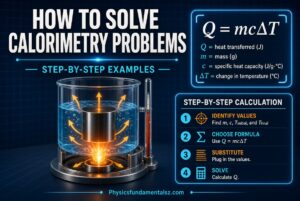
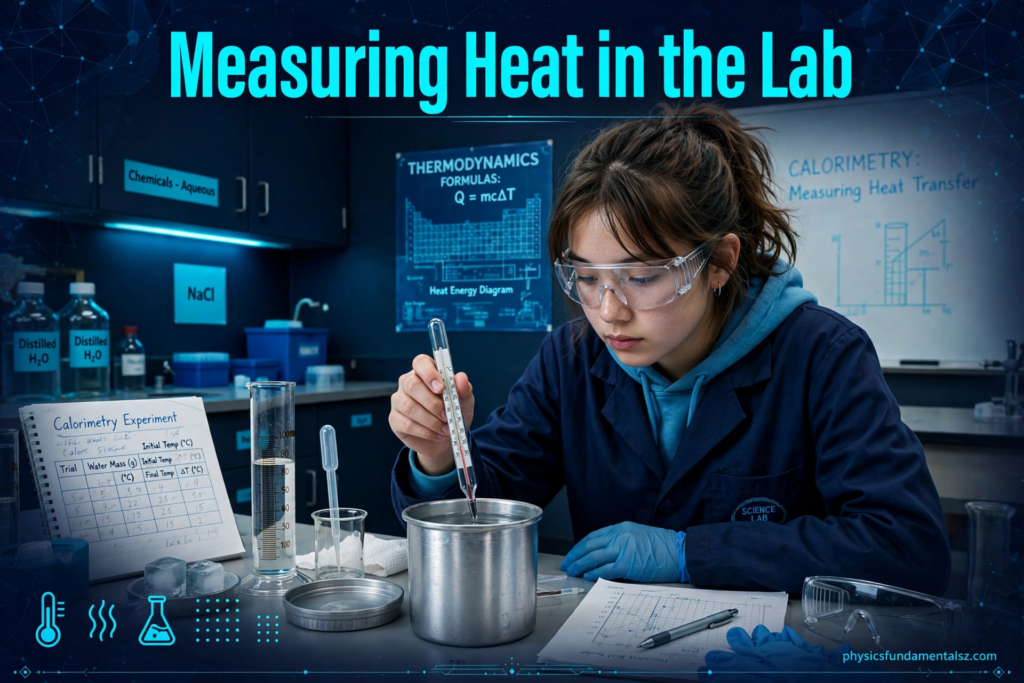
Calorimetry is the experimental measurement of heat transfer. A calorimeter is an insulated container, often with a thermometer and a stirrer, designed to minimise heat loss to the surroundings so that almost all the heat exchanged stays within the system being studied.
The method of mixtures is the classic calorimetry experiment. A hot object is placed into a cooler liquid, usually water, inside a calorimeter. Heat flows from the hot object to the cooler liquid until both reach the same final temperature, called the equilibrium temperature.
The principle behind the method is the conservation of energy:
Heat lost by the hot object = Heat gained by the cold liquid
Assuming no heat escapes to the surroundings, we can write:
m₁c₁(T₁ − T) = m₂c₂(T − T₂)
Here, m₁ and c₁ belong to the hot object, T₁ is its initial temperature, m₂ and c₂ belong to the cold liquid, T₂ is its initial temperature, and T is the final equilibrium temperature.
This equation is powerful because it lets you find an unknown specific heat capacity. If you know the masses, the initial temperatures, the final temperature, and the specific heat capacity of one substance, you can solve for the specific heat capacity of the other.
In practice, calorimeters are not perfect. Some heat is absorbed by the calorimeter itself, and some escapes despite insulation. Careful experiments account for the heat capacity of the calorimeter, or use corrections for heat loss. For school-level problems, you can usually assume the calorimeter absorbs negligible heat unless the question says otherwise.
Calorimetry is not just a laboratory technique. The same principle applies whenever two substances at different temperatures are mixed, from adding cold milk to hot coffee to industrial processes where hot and cold streams are combined.
Heating Curves and Phase Changes
So far we have assumed that adding heat always raises temperature. That is true within a single phase, but it is not true during a phase change.
Consider heating a block of ice at −20 °C. At first, the temperature rises steadily as heat is supplied. When the ice reaches 0 °C, it begins to melt. During melting, the temperature stays at 0 °C even though heat is still being supplied. Only when all the ice has melted does the temperature of the liquid water begin to rise again.
The same plateau appears at 100 °C when water boils. Heat is supplied, steam is produced, but the temperature of the boiling water remains at 100 °C until all the liquid has turned to gas.
The energy absorbed during a phase change is called latent heat. The word “latent” means hidden, because the energy is hidden in the change of state rather than showing up as a temperature rise. It breaks the bonds holding particles in their solid or liquid arrangement, rather than increasing their average kinetic energy.
This is why the formula Q = mcΔT cannot be used during a phase change. During melting or boiling, ΔT is zero, but Q is certainly not zero. A different formula applies:
Q = mL
Here, L is the specific latent heat, the energy needed to change the state of one kilogram of the substance without changing its temperature. For melting, L is the specific latent heat of fusion. For boiling, it is the specific latent heat of vaporisation.
A heating curve therefore has two kinds of sections: sloping sections, where temperature rises and Q = mcΔT applies, and flat sections, where temperature is constant and Q = mL applies. A complete heating problem may require both formulas in sequence, for example warming ice, melting it, then warming the resulting water.
Understanding this distinction is essential. Many exam questions deliberately combine a temperature change with a phase change to test whether you know which formula to use at each stage.
Worked Numerical Examples
Worked examples are the fastest way to turn the formula into a skill. Work through each one slowly, and try covering the solution before reading it.
Example 1: Heating Water
Question: How much heat is needed to raise the temperature of 2 kg of water from 20 °C to 80 °C? Take the specific heat capacity of water as 4200 J/kg·°C.
Solution:
First, list what you know. Mass m = 2 kg. Specific heat capacity c = 4200 J/kg·°C. Temperature change ΔT = 80 − 20 = 60 °C.
Now substitute into Q = mcΔT.
Q = 2 × 4200 × 60 = 504,000 J.
That is 504 kJ. Notice how large the answer is. Heating even a modest amount of water by sixty degrees takes half a megajoule, which is why kettles draw so much power.
Example 2: Finding a Temperature Rise
Question: A 500 g aluminium block absorbs 4500 J of heat. By how much does its temperature rise? Take the specific heat capacity of aluminium as 900 J/kg·°C.
Solution:
First, convert the mass to kilograms. 500 g = 0.5 kg. This step is essential, and skipping it is the most common error in this type of question.
We need ΔT, so rearrange the formula: ΔT = Q / (mc).
ΔT = 4500 / (0.5 × 900) = 4500 / 450 = 10 °C.
The block warms by ten degrees. The same heat supplied to 0.5 kg of water would raise its temperature by only about 2.1 °C, because water’s specific heat capacity is far higher.
Example 3: Finding an Unknown Specific Heat Capacity
Question: A 0.2 kg metal sample is heated to 100 °C and then placed in 0.3 kg of water at 20 °C in a calorimeter. The final equilibrium temperature is 24 °C. Calculate the specific heat capacity of the metal. Take the specific heat capacity of water as 4200 J/kg·°C and ignore the heat capacity of the calorimeter.
Solution:
Heat lost by the metal = Heat gained by the water.
Heat gained by the water = m × c × ΔT = 0.3 × 4200 × (24 − 20) = 0.3 × 4200 × 4 = 5040 J.
Heat lost by the metal = m × c × ΔT = 0.2 × c × (100 − 24) = 0.2 × c × 76 = 15.2c.
Setting them equal: 15.2c = 5040, so c = 5040 / 15.2 = 331.6 J/kg·°C, approximately 332 J/kg·°C.
This value is close to that of copper or brass, which is a useful sanity check. If your answer had come out as 5000 J/kg·°C, you would know something had gone wrong.
Example 4: Comparing Two Materials
Question: Equal masses of copper and water, each 1 kg, both at 20 °C, are each supplied with 10,000 J of heat. What is the final temperature of each?
Solution:
For water: ΔT = Q / (mc) = 10,000 / (1 × 4200) = 2.38 °C. Final temperature = 22.38 °C.
For copper: ΔT = 10,000 / (1 × 390) = 25.64 °C. Final temperature = 45.64 °C.
The same heat produces a temperature rise more than ten times larger in copper than in water. This comparison captures the whole idea of specific heat capacity in a single pair of numbers.
Example 5: Cooling and Negative Heat
Question: A 3 kg iron block cools from 200 °C to 50 °C. How much heat does it release? Take the specific heat capacity of iron as 450 J/kg·°C.
Solution:
ΔT = final − initial = 50 − 200 = −150 °C. The negative sign shows cooling.
Q = mcΔT = 3 × 450 × (−150) = −202,500 J.
The negative sign means 202,500 J of heat leaves the block. In words, the block releases about 203 kJ. Either the signed value or the statement “202,500 J released” is acceptable, provided you make the direction clear.

Factors Affecting Specific Heat Capacity
Specific heat capacity is mainly determined by the material, but several factors can change its value.
Material and molecular structure. Different substances store thermal energy in different ways. Substances with complex molecules, or with strong intermolecular forces such as hydrogen bonds, generally have higher specific heat capacities because energy can be stored in more modes of motion and in loosening bonds.
Physical state. As the table shows, ice, liquid water, and steam have different values. In general, the specific heat capacity of a substance changes when it changes state, because the arrangement and freedom of its particles change.
Temperature. Specific heat capacity is not perfectly constant. For most solids, it decreases at very low temperatures and rises slightly with temperature at ordinary temperatures. For gases, it depends on whether the gas is heated at constant pressure or constant volume. School problems usually ignore these variations and treat c as constant over the temperature range involved.
For liquids and solids at ordinary pressures, the effect of pressure is small enough to ignore in most school calculations.
Common Mistakes and Exam Traps
Specific heat capacity questions are straightforward once you know the traps. Here are the ones that catch students most often.
Forgetting to convert grams to kilograms. If c is in J/kg·°C, mass must be in kilograms. A mass of 250 g is 0.25 kg, not 250. This single mistake can throw an answer off by a factor of a thousand.
Getting the sign of ΔT wrong. ΔT is always final temperature minus initial temperature. For heating, it is positive. For cooling, it is negative. If a question asks how much heat is “released” or “lost,” the answer is often given as a positive number with the word “released” carrying the direction. Be consistent and state the direction in words.
Confusing heat with temperature. Adding the same heat to two different materials does not produce the same temperature rise. Temperature is a measure of average particle kinetic energy, while heat is energy in transit. For a clear treatment of this distinction, see the guide on the difference between heat and temperature.
Using Q = mcΔT during a phase change. During melting or boiling, temperature does not change, so this formula gives zero, which is wrong. Use Q = mL for the phase change itself, and Q = mcΔT only for the sections where temperature actually changes.
Mixing up heat capacity and specific heat capacity. If a question gives you the heat capacity of an object in J/°C, do not multiply by mass again. Heat capacity already includes the mass. Multiply by mass only when you are given the specific heat capacity in J/kg·°C.
Using the wrong material’s value. In a mixture problem, each substance has its own c. The hot metal and the cold water do not share a value. Label your quantities carefully, for example m₁ and c₁ for one substance and m₂ and c₂ for the other.
Ignoring the calorimeter. At advanced levels, the calorimeter itself absorbs heat. If a question gives the heat capacity of the calorimeter, include it on the appropriate side of the energy balance. If it does not, assume it is negligible.
Rounding too early. Keep several significant figures through intermediate steps and round only at the end. Rounding ΔT to a whole number halfway through a mixture calculation can shift the final answer noticeably.
If you check units, signs, and mass conversions before you finish, you will avoid most lost marks on this topic.
Real-World Uses of Specific Heat Capacity
Specific heat capacity is not an abstract classroom quantity. Engineers, cooks, doctors, and climate scientists use it every day.
Coolants in Engines and Power Stations
Water is the most common coolant because its high specific heat capacity lets it absorb large amounts of heat from an engine or a reactor without its own temperature rising dangerously. Car radiators circulate a water-based coolant mixture around the engine, carrying heat away to the radiator where it is released to the air.
In power stations, water carries heat from the reactor or furnace to turbines. Its ability to store and transport energy efficiently makes the whole system practical. Antifreeze is added in cold climates to lower the freezing point, and corrosion inhibitors protect the metal parts, but water remains the main working fluid because of its thermal properties.
Cooking and Kitchen Equipment
A cast iron pan heats slowly but retains heat well, which makes it excellent for searing. A thin aluminium pan heats quickly and responds fast to changes in burner setting, which suits delicate sauces. The choice is, in part, a choice about specific heat capacity and mass combined.
Water’s high specific heat capacity also explains cooking times. Boiling pasta requires sustained heat input because water absorbs so much energy before and during boiling. A lid on the pot reduces heat loss to the air, so more of the burner’s energy goes into the water and the cooking time falls.
Oil, with a specific heat capacity roughly half that of water, heats up much faster than water for the same heat input. That is why oil in a frying pan reaches cooking temperature quickly, and also why hot oil is dangerous: its temperature can rise very high, very fast.
Frequently Asked Questions
What is specific heat capacity in simple words?
Specific heat capacity is how much heat energy one kilogram of a substance needs to warm up by one degree. A high value means the substance warms slowly and cools slowly. A low value means it warms quickly and cools quickly.
What is the formula for specific heat capacity?
The formula is Q = mcΔT, where Q is heat energy in joules, m is mass in kilograms, c is specific heat capacity in J/kg·°C, and ΔT is the temperature change. Rearranged, c = Q / (mΔT) gives the specific heat capacity when the other quantities are known.
Why does water have a high specific heat capacity?
Water molecules are linked by hydrogen bonds. Much of the heat supplied to water goes into loosening these bonds and increasing molecular motion in several ways, rather than raising temperature directly. This lets water absorb and store large amounts of energy with only a modest temperature change.
What is the difference between specific heat capacity and heat capacity?
Specific heat capacity is per kilogram and describes the material, with units J/kg·°C. Heat capacity is for a particular object, with units J/°C, and equals mass times specific heat capacity. A larger object has a larger heat capacity but the same specific heat capacity as a smaller object made of the same material.
Does specific heat capacity change with temperature?
It can change slightly with temperature, and it changes more noticeably with physical state. Ice, liquid water, and steam have different values. In school problems, specific heat capacity is usually treated as constant over the temperature range in the question, and the value to use is normally given.
Why is the specific heat capacity of a gas different at constant pressure and constant volume?
When a gas is heated at constant pressure, it expands and does work on its surroundings, so extra heat is needed for the same temperature rise. At constant volume, no expansion work is done, so less heat is needed. This is why gas tables give two values, often labelled Cp and Cv.
Can specific heat capacity be negative?
No. Specific heat capacity itself is always positive for ordinary materials. A negative sign in a calculation comes from ΔT or Q, indicating cooling or heat loss, not from a negative value of c.
How is specific heat capacity used in real life?
It is used to choose coolants, design heating and cooling systems, select cooking equipment, build thermally efficient buildings, store solar energy, and understand climate. Anywhere temperature control matters, specific heat capacity is part of the design calculation.
Conclusion
Specific heat capacity is one of those ideas that is simple to state and rich in consequences.
A single number, the heat needed per kilogram per degree, explains why the sea moderates the climate, why a metal spoon heats faster than the soup it sits in, why engineers choose water as a coolant, and why a storage heater can warm a room long after it was switched off.
If you remember the formula Q = mcΔT, keep your units consistent, watch the sign of ΔT, and never apply it during a phase change, you have the tools to solve most problems on this topic.
For further reading, Khan Academy’s lessons on specific heat and heat transfer give clear worked examples, HyperPhysics from Georgia State University provides concise reference tables and explanations, and NASA’s educational pages on Earth’s oceans and climate show the planetary consequences of water’s high specific heat capacity in action. Links to these authoritative sources are included below for students who want to go deeper.
Further Reading
- Khan Academy: Heat and temperature
- HyperPhysics, Georgia State University: Specific Heat
- NASA: Ocean and Climate
- University of Colorado, PhET: Energy Forms and Changes