Stress, Strain & Young’s Modulus: E = sigma/epsilon Formula & Examples
Every material you touch, from a steel beam to a rubber band, responds to force in a predictable way.
Understanding stress, strain, and Young’s modulus is the foundation for describing exactly how much a material stretches, compresses, or deforms under load, and at what point it stops behaving elastically and starts to fail.
If you are new to the broader topic of forces and motion, it helps to first understand Newton’s Laws of Motion, since every stress applied to a material is ultimately a force following those same laws.
Table of Contents
What Is Stress in Physics?

Stress is defined as the internal restoring force generated inside a material per unit area, in response to an external load. In simple terms, stress tells you how concentrated a force is across a material’s cross section.
The formula for stress is:
Stress (σ) = Force (F) / Area (A)
The SI unit of stress is the Pascal (Pa), which is equivalent to one Newton per square metre (N/m²). In engineering contexts, stress is often expressed in megapascals (MPa) or gigapascals (GPa) because the values involved with metals and ceramics are usually very large.
Types of Stress
There are three main categories of stress that show up repeatedly in mechanics of materials:
- Tensile stress: occurs when a force stretches or pulls a material apart, increasing its length.
- Compressive stress: occurs when a force pushes a material inward, shortening it.
- Shear stress: occurs when equal and opposite forces act parallel to a surface, causing layers of the material to slide past one another.
Tensile stress is the most common starting point for learning stress strain Young’s modulus because it maps directly onto the classic stretched wire or rod experiment used in most physics courses.
What Is Strain in Physics?
Strain measures how much a material deforms relative to its original dimensions when stress is applied. Unlike stress, strain has no units, since it is simply a ratio of two lengths.
The formula for strain is:
Strain (ε) = Change in Length (ΔL) / Original Length (L)
Because strain is a ratio, it is often expressed as a decimal or a percentage. A strain value of 0.02, for example, means the material has stretched by two percent of its original length.
Tensile Strain vs Compressive Strain
Just as stress can be tensile or compressive, strain follows the same pattern:
- Tensile strain describes elongation under a stretching force.
- Compressive strain describes shortening under a squeezing force.
Both quantities are essential inputs for calculating the elastic modulus of a material, which brings us to Young’s modulus itself.
What Is Young’s Modulus?
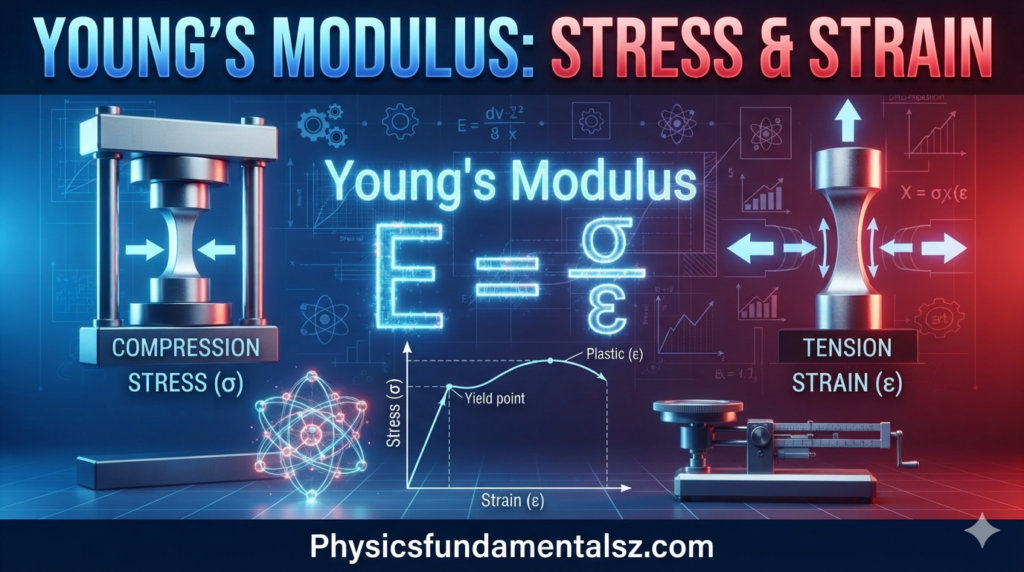
Young’s modulus, sometimes called the modulus of elasticity, is a measure of a material’s stiffness. It quantifies how much a material resists elastic deformation when a stress is applied, and it does not depend on the shape or size of the object, only on the material itself.
The Young’s modulus formula is:
Young’s Modulus (E) = Stress (σ) / Strain (ε)
Since stress is measured in Pascals and strain is dimensionless, Young’s modulus also carries units of Pascals, typically expressed in gigapascals (GPa) for solids like metals and ceramics.
This relationship was first described by the British physicist and physician Thomas Young in the early nineteenth century, which is why the constant of proportionality bears his name.
Why Young’s Modulus Matters
A high Young’s modulus means a material is stiff and resists stretching, while a low Young’s modulus means a material is flexible and stretches easily under the same stress. This single number allows engineers and physicists to compare wildly different materials on equal footing.
For a deeper look at how forces produce restoring effects inside stretched materials, the article on Hooke’s Law and Springs explains the same linear stress strain relationship from the perspective of spring constants.
The Stress-Strain Curve Explained
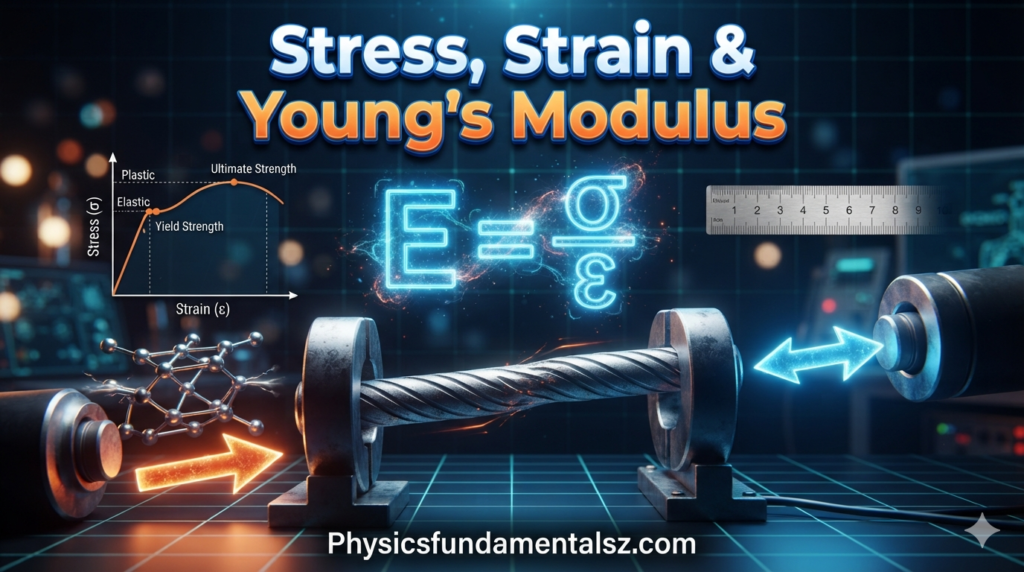
The stress-strain curve is a graph plotting stress on the vertical axis against strain on the horizontal axis, generated by pulling a test sample in a tensile testing machine until it fractures. This curve is one of the most useful tools in materials science because it reveals several critical properties in a single image.
Key Regions of the Stress-Strain Curve
- Elastic region: at low stress, strain increases in direct proportion to stress. This is the region where Hooke’s law applies and where Young’s modulus is calculated as the slope of the line.
- Proportional limit: the point beyond which stress and strain are no longer directly proportional.
- Elastic limit: the maximum stress a material can withstand and still return to its original shape once the load is removed. Beyond this point, deformation becomes permanent.
- Yield point: the stress at which the material begins to deform plastically, meaning it will not fully recover even after the load is removed.
- Ultimate tensile strength: the maximum stress the material can bear before beginning to neck and thin out.
- Breaking stress (fracture point): the stress at which the material finally fractures.
Understanding each of these regions is essential for predicting how a material will behave under real-world loads, whether it is a bridge cable, a bone, or a phone screen.
Elastic vs Plastic Deformation
Deformation within the elastic region is temporary. Once the applied stress is removed, the material springs back to its original length, storing and releasing elastic potential energy in the process. You can explore this energy relationship in more depth in the guide on What Is Energy, which covers how energy is stored and transferred across different physical systems.
Deformation beyond the elastic limit is called plastic deformation, and it is permanent. The material does not return to its original shape even when the stress is fully removed.
Hooke’s Law and Its Connection to Young’s Modulus

Hooke’s law states that within the elastic limit, the extension of a material is directly proportional to the applied force. This is the same underlying principle that produces the straight-line region of the stress-strain curve, and it directly leads to the formula for Young’s modulus.
Combining the definitions of stress and strain, Young’s modulus can also be expressed as:
E = (F × L) / (A × ΔL)
where F is the applied force, L is the original length, A is the cross sectional area, and ΔL is the change in length. This expanded formula is especially useful when solving textbook problems that give you raw measurements rather than pre-calculated stress and strain values.
Young’s Modulus Values for Common Materials
Different materials have wildly different Young’s modulus values, which is why a steel rod feels rigid while a rubber band feels stretchy under the exact same force.
| Material | Approximate Young’s Modulus |
|---|---|
| Rubber | 0.01 to 0.1 GPa |
| Nylon | 2 to 4 GPa |
| Wood | 10 to 15 GPa |
| Concrete | 25 to 30 GPa |
| Aluminium | 69 GPa |
| Copper | 110 to 130 GPa |
| Steel | 190 to 210 GPa |
| Diamond | approximately 1,220 GPa |
Notice the enormous range, spanning several orders of magnitude between soft polymers and rigid crystalline structures like diamond. This is why Young’s modulus is such a powerful comparative tool across engineering and materials science.
Ductile Materials vs Brittle Materials
Materials generally fall into two broad categories based on how they behave near the point of fracture.
- Ductile materials, such as most metals, undergo significant plastic deformation before breaking. They stretch and neck visibly, giving a warning sign before failure.
- Brittle materials, such as ceramics and glass, fracture with little or no plastic deformation. The stress-strain curve for a brittle material rises almost linearly before snapping suddenly at the breaking stress.
This distinction matters enormously in engineering design, since ductile materials tend to fail more predictably and safely than brittle ones.
Worked Example: Calculating Young’s Modulus
Consider an iron rod with a cross sectional area of 2 square metres. A tensile force of 500 Newtons is applied to both ends, and the rod stretches from an original length of 4 metres to 4.002 metres.
Step 1: Calculate stress
Stress = Force / Area = 500 N / 2 m² = 250 Pa
Step 2: Calculate strain
Strain = ΔL / L = 0.002 m / 4 m = 0.0005
Step 3: Calculate Young’s modulus
E = Stress / Strain = 250 / 0.0005 = 500,000 Pa
This simplified numeric example illustrates the mechanics of the calculation, though real rods of iron have a much higher Young’s modulus in practice, generally around 200 GPa, since actual test conditions involve far smaller strains for a given stress.
If you want to practice similar force and motion calculations interactively, the physics calculators let you plug in known values and instantly see every formula used along the way.
Factors That Affect Young’s Modulus
Several physical factors influence how a material’s Young’s modulus behaves in practice, even though the value is generally treated as a constant for a given material at a given temperature.
- Temperature: most materials become less stiff as temperature rises, lowering the modulus of elasticity.
- Atomic and molecular bonding: materials with stronger interatomic bonds, like diamond, exhibit a much higher Young’s modulus than materials with weaker bonds, like rubber.
- Microstructure: grain size, crystal structure, and the presence of impurities can all shift the effective stiffness of a real-world sample.
- Direction of loading: some materials, particularly composites and wood, are anisotropic, meaning their Young’s modulus differs depending on the direction the force is applied relative to the material’s internal structure.
Real-World Applications of Stress, Strain, and Young’s Modulus

The stress strain Young’s modulus relationship is not just an abstract classroom concept. It underpins how engineers select materials for almost every physical structure and product.
- Civil engineering: bridges, buildings, and towers are all designed using known Young’s modulus values to ensure they flex within safe limits under wind and load.
- Aerospace engineering: aircraft components rely on high strength to weight ratios, which depend heavily on a material’s stiffness and elastic limit.
- Biomechanics: bones, tendons, and ligaments all have their own characteristic Young’s modulus, which helps researchers understand injury thresholds and design better prosthetics.
- Consumer electronics: the glass and metal in a smartphone are chosen partly based on how they perform on the stress-strain curve under repeated bending and impact.
Common Mistakes When Learning Stress, Strain, and Young’s Modulus
Students frequently confuse a few related ideas when first encountering this topic, so it helps to clear them up directly.
- Confusing stress with force: stress accounts for the area over which a force acts, while force alone does not.
- Forgetting that strain has no units: since strain is a ratio of two lengths, the units cancel out completely.
- Assuming Young’s modulus changes with object shape: Young’s modulus is a property of the material itself, not the specific object made from it. A thick steel rod and a thin steel wire share the same Young’s modulus, even though they behave differently under load overall.
- Mixing up the elastic limit and the yield point: these are closely related but not identical, and advanced material science treats them as distinct thresholds.
Frequently Asked Questions (FAQs)
What is the formula for Young’s modulus?
Young’s modulus equals stress divided by strain, or E = σ / ε, and can also be written as E = (F × L) / (A × ΔL).
What is the SI unit of Young’s modulus?
The SI unit of Young’s modulus is the Pascal (Pa), commonly expressed as gigapascals (GPa) for solid engineering materials.
Is Young’s modulus the same as stiffness?
Young’s modulus is a direct measure of stiffness for a given material, though overall structural stiffness also depends on the object’s shape and dimensions, not the material property alone.
What happens beyond the elastic limit?
Beyond the elastic limit, a material undergoes permanent plastic deformation and will not return to its original shape once the applied stress is removed.
Which material has the highest Young’s modulus?
Diamond has one of the highest known Young’s modulus values, at approximately 1,220 GPa, reflecting its extremely strong covalent bonding structure.
Final Thoughts
Stress, strain, and Young’s modulus together form one of the most practical relationships in all of physics and engineering, connecting a simple applied force to a precise, measurable material response. Once you understand how the stress-strain curve behaves across the elastic and plastic regions, you gain the ability to predict how virtually any material, from a steel cable to a human bone, will respond under load.
To keep building your foundation in classical mechanics, continue with Hooke’s Law and Springs or explore the full Classical Mechanics topic hub for related concepts like kinetic energy and work done in physics.