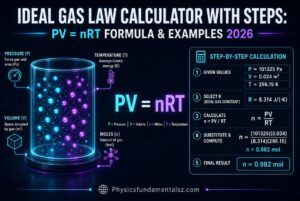
Ideal Gas Law Practice Problems With Answers (2026 Study Guide)
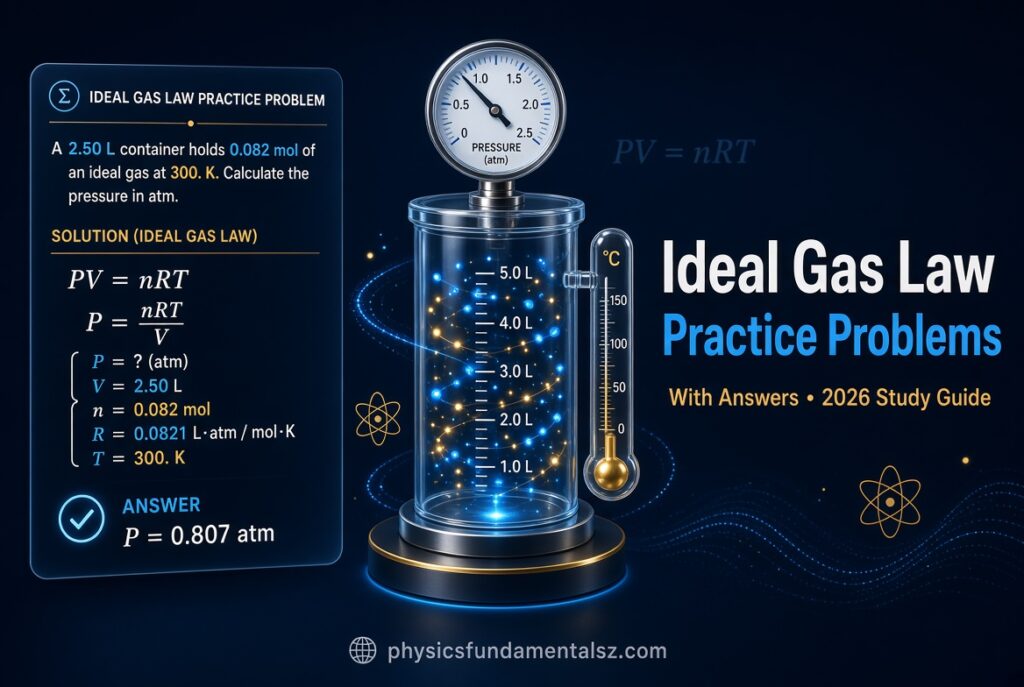
Pressure, volume, temperature, and moles all sound simple on their own, but the moment they show up together in one equation, most students freeze. Ideal gas law practice problems with answers are the fastest way to break that habit.
Table of Contents
What Is the Ideal Gas Law?
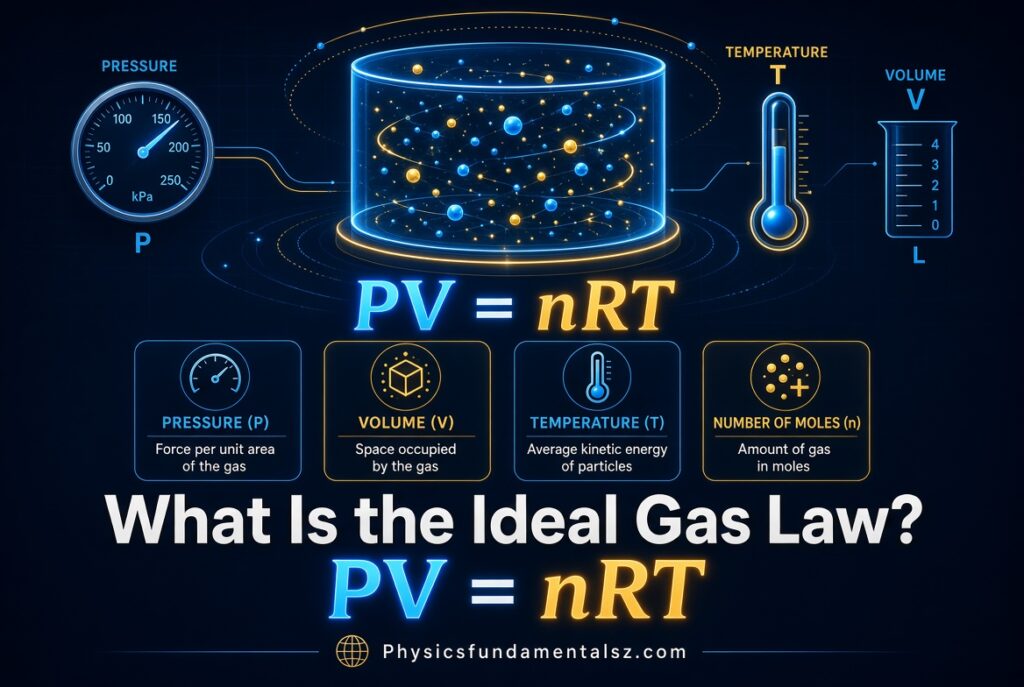
The ideal gas law is the equation PV = nRT, which links pressure (P), volume (V), moles of gas (n), and temperature (T) through the gas constant R.
It applies to a gas that behaves “ideally,” meaning its particles don’t interact much and take up negligible space. Most real gases follow this closely at normal temperatures and pressures.
The Ideal Gas Law Formula and Constant
The formula is written as PV = nRT. Each rearrangement lets you solve for whichever variable is unknown.
- P = nRT / V
- V = nRT / P
- n = PV / RT
- T = PV / nR
The gas constant R has two common values depending on your units. Use R = 0.0821 L·atm/(mol·K) when pressure is in atmospheres, or R = 8.314 J/(mol·K) when pressure is in pascals.
Units You Must Convert Before Solving
Getting the units right is the single biggest source of mistakes in these problems. Check this table before plugging numbers into the formula.
| Variable | Common Units | Conversion Needed |
|---|---|---|
| Pressure | atm, kPa, torr, mmHg | 1 atm = 101.325 kPa = 760 torr |
| Volume | L, mL, m³ | 1 L = 1000 mL |
| Temperature | Kelvin only | °C + 273 = K |
| Moles | mol | grams ÷ molar mass |
Temperature must always be in Kelvin. Forgetting this conversion is the most common reason students get the wrong answer.
How to Solve Ideal Gas Law Problems in 4 Steps
Follow the same routine every time and these problems become mechanical rather than confusing.
- Step 1: List every given value and identify the unknown.
- Step 2: Convert units so pressure, volume, and temperature match your chosen R.
- Step 3: Rearrange PV = nRT to isolate the unknown variable.
- Step 4: Plug in numbers, calculate, and check that the units cancel correctly.
Beginner Ideal Gas Law Practice Problems With Answers
These problems use PV = nRT directly, with no unit conversions required.
Problem 1: A gas sample has a volume of 2.0 L, a pressure of 1.5 atm, and a temperature of 300 K. How many moles of gas are present?
Using n = PV / RT: n = (1.5 × 2.0) / (0.0821 × 300) = 3.0 / 24.63.
Answer: n ≈ 0.122 mol
Problem 2: What volume does 0.500 mol of gas occupy at 1.00 atm and 273 K?
Using V = nRT / P: V = (0.500 × 0.0821 × 273) / 1.00 = 11.20 L.
Answer: V ≈ 11.2 L
Problem 3: Find the pressure exerted by 2.00 mol of gas in a 10.0 L container at 350 K.
Using P = nRT / V: P = (2.00 × 0.0821 × 350) / 10.0 = 57.47 / 10.0.
Answer: P ≈ 5.75 atm
Problem 4: A 1.00 mol sample of gas occupies 25.0 L at 1.00 atm. What is its temperature?
Using T = PV / nR: T = (1.00 × 25.0) / (1.00 × 0.0821) = 304.5.
Answer: T ≈ 304.5 K (about 31.4°C)
Intermediate Practice Problems (With Unit Conversions and Molar Mass)
These problems require converting grams to moles or handling temperatures given in Celsius.
Problem 5: A 3.00 L container holds gas at 2.50 atm and 27°C. How many moles are present?
First convert temperature: 27°C + 273 = 300 K. Then n = (2.50 × 3.00) / (0.0821 × 300) = 7.50 / 24.63.
Answer: n ≈ 0.305 mol
Problem 6: What volume does 5.00 g of oxygen gas (O₂, molar mass 32.0 g/mol) occupy at STP?
Convert mass to moles: n = 5.00 / 32.0 = 0.1563 mol. Then V = (0.1563 × 0.0821 × 273) / 1.00.
Answer: V ≈ 3.50 L
Problem 7: An 8.00 g sample of CO₂ (molar mass 44.0 g/mol) is held at 1.00 atm and 350 K. Find its volume.
n = 8.00 / 44.0 = 0.1818 mol. V = (0.1818 × 0.0821 × 350) / 1.00.
Answer: V ≈ 5.23 L
Problem 8: A gas sample at 760 torr, 2.00 L, and 298 K — how many moles are present?
Convert pressure: 760 torr = 1.00 atm. Then n = (1.00 × 2.00) / (0.0821 × 298).
Answer: n ≈ 0.0817 mol
Advanced Ideal Gas Law Practice Problems With Answers
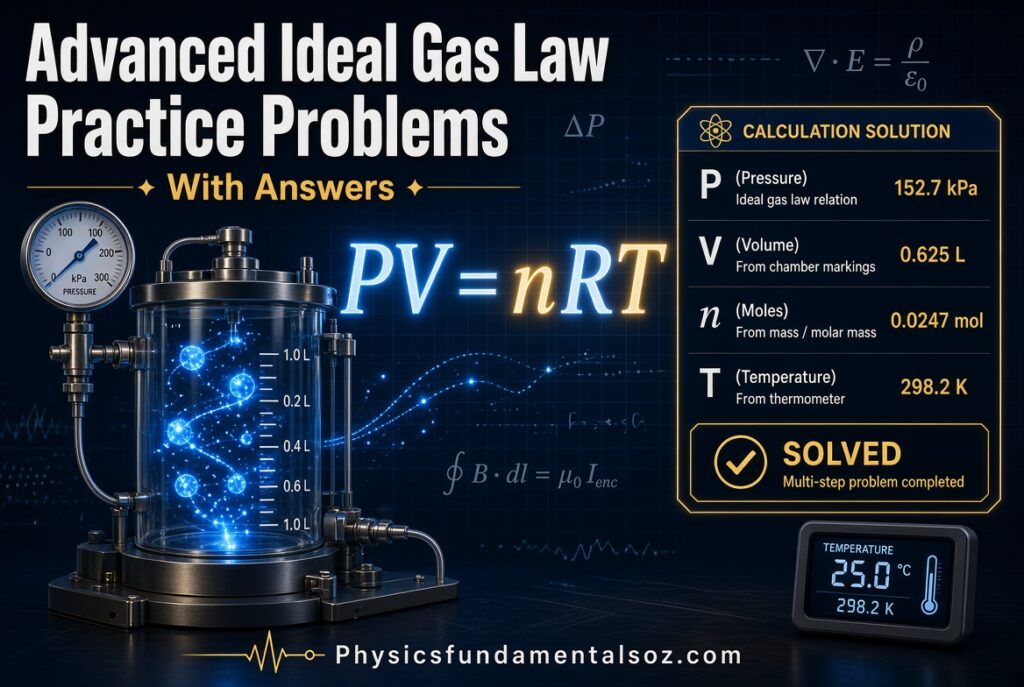
These involve finding molar mass, gas density, or combining two states of the same gas sample.
Problem 9: A 4.50 g gas sample occupies 3.00 L at 1.20 atm and 310 K. What is its molar mass?
First find moles: n = (1.20 × 3.00) / (0.0821 × 310) = 3.60 / 25.45 = 0.1414 mol. Then molar mass = mass / n = 4.50 / 0.1414.
Answer: M ≈ 31.8 g/mol
Problem 10: Find the density of nitrogen gas (N₂, M = 28.0 g/mol) at 2.00 atm and 300 K.
Using density d = PM / RT: d = (2.00 × 28.0) / (0.0821 × 300) = 56.0 / 24.63.
Answer: d ≈ 2.27 g/L
Problem 11: A gas at 1.00 atm, 2.0 L, and 300 K expands to a new state at 1.5 atm and 350 K. Find the new volume.
Using the combined gas law P₁V₁/T₁ = P₂V₂/T₂: V₂ = (1.00 × 2.0 × 350) / (300 × 1.5) = 700 / 450.
Answer: V₂ ≈ 1.56 L
Problem 12: A sealed container holds gas at 2.00 atm and 400 K. It’s cooled at constant volume to 250 K. Find the new pressure.
Since volume and moles stay constant: P₂ = P₁ × (T₂ / T₁) = 2.00 × (250 / 400).
Answer: P₂ ≈ 1.25 atm
Common Mistakes to Avoid
Most errors in these problems come from a small handful of repeated slip-ups.
- Using Celsius instead of Kelvin for temperature.
- Mixing pressure units (torr, atm, kPa) within the same equation.
- Forgetting to convert grams into moles before using PV = nRT.
- Using the wrong value of R for the units given.
- Rounding too early instead of carrying full precision through the calculation.
Real-World Applications of the Ideal Gas Law
The ideal gas law isn’t just a textbook formula — it shows up constantly in everyday and industrial settings.
Scuba divers use it to predict how tank pressure changes with depth and temperature. Car engineers rely on it to model how engine cylinders behave during combustion.
Weather balloons expand as atmospheric pressure drops, a direct consequence of PV = nRT. Even a bag of chips puffs up on an airplane for the same reason.
Ideal Gas Law vs. Other Gas Laws
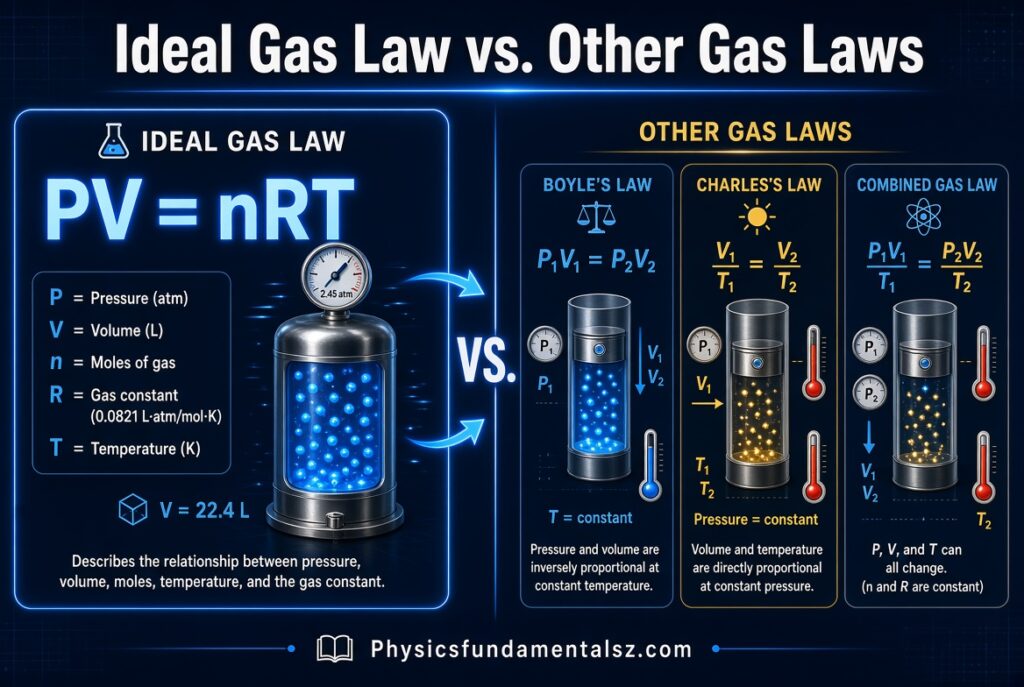
It helps to see how the ideal gas law relates to the simpler laws it replaces.
| Law | Variables Held Constant | Formula |
|---|---|---|
| Boyle’s Law | Temperature, moles | P₁V₁ = P₂V₂ |
| Charles’s Law | Pressure, moles | V₁/T₁ = V₂/T₂ |
| Gay-Lussac’s Law | Volume, moles | P₁/T₁ = P₂/T₂ |
| Combined Gas Law | Moles only | P₁V₁/T₁ = P₂V₂/T₂ |
| Ideal Gas Law | Nothing held constant | PV = nRT |
Also Read:
- Ideal Gas Law Calculator With Steps: PV = nRT Formula & Examples 2026
- What Is Energy?
- Entropy Explained for Beginners Easy Guide 2026
- Newton’s Laws of Motion
- What Is Centripetal Force With Examples? (Formula + Guide) 2026
- Conservation of Momentum
- Conservation of Momentum Real Life Examples (2026 Guide)
- What Is the Formula for Conservation of Momentum? 2026
- Momentum Calculator Physics: Formula, Steps & Worked Examples
- How to Calculate Acceleration From a Velocity Time Graph 2026
- Projectile Motion Complete Guide
- Projectile Motion Formula for Angled Launch Explained (2026 Guide)
- Projectile Motion Calculator With Angle: Formulas & Worked Examples 2026
- Difference Between Speed and Velocity With Examples (2026 Guide)
- Transverse Waves Explained
- Wave Speed, Frequency & Wavelength
- Wave Speed Calculator Frequency Wavelength: Formula, Steps & Worked Examples 2026
- How to Derive Wave Speed Formula? Full Derivation Guide 2026
- Mass-Energy Equivalence: E = mc² Derivation & Nuclear Applications
- Mass Energy Equivalence Real Life Examples (2026 Guide)
- Half Life Calculator With Steps: Formula, Examples & Full Guide 2026
- Half-Life Calculations: Formula & Worked Examples Explained
- Nuclear Decay Equations Explained Simply (2026 Beginner Guide)
- Photoelectric Effect Equation Explained (2026 Simple Guide)
- Bohr Model of the Atom: Energy Levels, Emission & Absorption Spectra
Frequently Asked Questions (FAQs)
What is the ideal gas law formula?
The ideal gas law formula is PV = nRT, where P is pressure, V is volume, n is moles, R is the gas constant, and T is temperature in Kelvin.
What value of R should I use?
Use R = 0.0821 L·atm/(mol·K) when pressure is in atmospheres and volume is in liters. Use R = 8.314 J/(mol·K) when working in SI units with pascals.
Why does temperature have to be in Kelvin?
The ideal gas law is derived from relationships that only hold true on an absolute temperature scale. Celsius includes negative values that would break the proportionality.
How do I find moles if I’m only given grams?
Divide the mass in grams by the substance’s molar mass in g/mol. The result is the number of moles you plug into PV = nRT.
What’s the difference between the ideal gas law and the combined gas law?
The combined gas law compares two states of the same fixed amount of gas, so moles cancel out. The ideal gas law works for a single state and requires you to know the moles directly.
Can the ideal gas law be used for real gases?
Yes, it gives accurate results for most real gases at normal temperatures and pressures. It becomes less accurate at very high pressure or very low temperature, where gases deviate from ideal behavior.
What is STP in gas law problems?
STP stands for Standard Temperature and Pressure, defined as 273 K (0°C) and 1 atm. One mole of an ideal gas occupies about 22.4 L at STP.
How do I convert torr or mmHg to atmospheres?
Divide the pressure value by 760, since 760 torr (or mmHg) equals exactly 1 atm.
What units does volume need to be in?
Volume should be in liters when using R = 0.0821 L·atm/(mol·K). Convert milliliters to liters by dividing by 1000.
How do I find the density of a gas using PV = nRT?
Rearrange the formula to d = PM / RT, where M is the molar mass. This gives density directly without needing to calculate moles first.
Why is my answer’s unit wrong after solving?
This usually means one of your input units doesn’t match the version of R you chose. Recheck pressure, volume, and temperature units before recalculating.
Is the ideal gas law only for chemistry class?
No, it also appears in physics courses covering thermodynamics and kinetic theory. Engineers and scientists use it in fields like meteorology, aerospace, and mechanical design.
What happens if pressure and temperature both change at once?
You can either use the combined gas law if moles stay fixed, or apply PV = nRT twice and solve simultaneously if moles also change.
How many significant figures should my final answer have?
Match the number of significant figures in your least precise given value. Most textbook problems expect three significant figures unless stated otherwise.
Do I need a calculator with scientific notation for these problems?
A basic scientific calculator is enough for almost all ideal gas law practice problems. Scientific notation only becomes necessary for very large or very small mole quantities.
Conclusion
The ideal gas law becomes far less intimidating once you memorize PV = nRT and practice the same four-step process on different problems. Start with the beginner set above, move through the intermediate examples, and finish with the advanced molar-mass and density questions once you feel confident.
Keep a units-conversion table nearby while you practice, since unit mismatches cause more wrong answers than the math itself. With enough repetition, solving for pressure, volume, temperature, or moles becomes second nature for any exam or homework set.