Newton’s Law of Universal Gravitation: F = Gm₁m₂/r² Full Guide
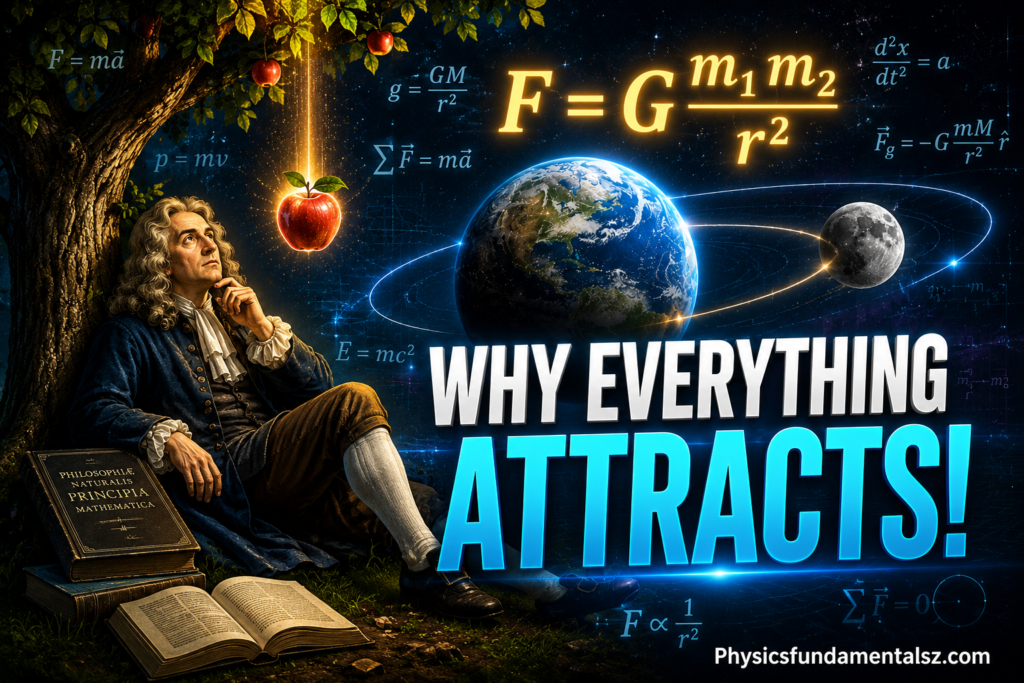
Every apple that falls, every planet that orbits, and every tide that rises is governed by one deceptively simple idea. Newton’s Law of Universal Gravitation states that every particle in the universe attracts every other particle with a force that depends only on their masses and the distance between them.
It is one of the most important results in the history of science, and it still forms the foundation of how we understand Newton’s laws of motion, orbital mechanics, and gravity itself.
Table of Contents
What Is Newton’s Law of Universal Gravitation?

Newton’s law of universal gravitation is a physical law formulated by Sir Isaac Newton in his 1687 work Philosophiae Naturalis Principia Mathematica. It states that every object with mass attracts every other object with mass through a force that is:
- Directly proportional to the product of the two masses
- Inversely proportional to the square of the distance between their centers of mass
This means that heavier objects pull harder, and objects that are farther apart pull on each other with much less force. The law is called “universal” because Newton proposed that the same force pulling an apple to the ground also keeps the Moon in orbit around Earth and the planets in orbit around the Sun. This single insight unified terrestrial gravity and astronomical motion for the first time, which is why historians often call it the first great unification in physics.
The Newton’s Law of Universal Gravitation Formula Explained
The mathematical form of the law of gravitation is written as:
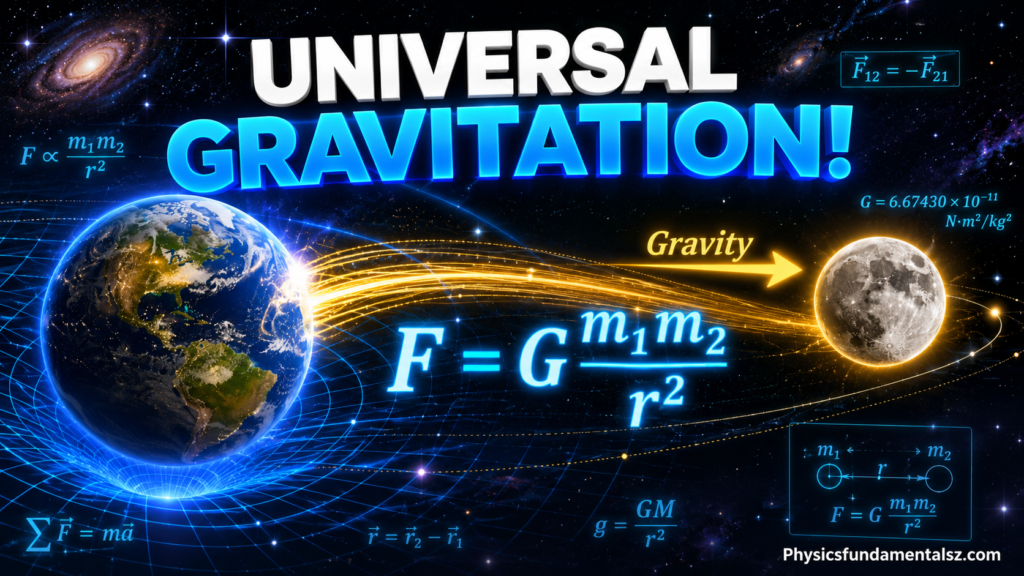
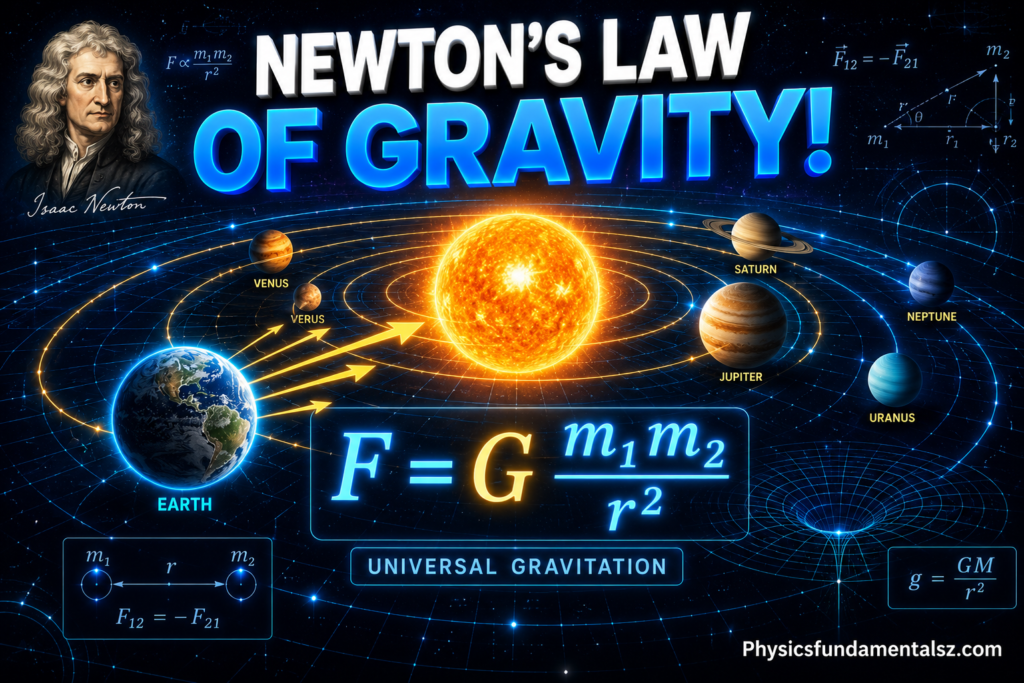
F = G(m1 m2) / r²
Where each symbol represents a specific physical quantity in the gravitational force formula.
Understanding the Variables (F, G, m1, m2, r)
- F is the gravitational force of attraction between the two objects, measured in newtons (N)
- m1 and m2 are the masses of the two objects, measured in kilograms (kg)
- r is the distance between the centers of mass of the two objects, measured in meters (m)
- G is the universal gravitational constant
This equation tells us that the force of gravity between two objects grows when either mass increases, and shrinks rapidly as the distance between them grows, since the distance is squared in the denominator.
The Universal Gravitational Constant (G) Value
The gravitational constant G has a measured value of approximately:
G = 6.674 x 10⁻¹¹ N·m²/kg²
This value is extremely small, which explains why gravitational attraction between everyday objects, like two people standing next to each other, is far too weak to notice. Gravity only becomes significant when at least one of the masses involved is astronomically large, such as a planet, moon, or star. The value of G was not part of Newton’s original work. It was measured over a century later by the English physicist Henry Cavendish using a torsion balance experiment, and his result also allowed scientists to calculate the mass of the Earth for the first time.
How Newton Discovered the Law of Universal Gravitation
The Apple Story and Newton’s Insight
According to popular history, Newton’s idea was sparked when he saw an apple fall from a tree and wondered why it always fell straight down rather than sideways or upward. He reasoned that the Earth itself must be exerting a pulling force on the apple. This is the same conceptual leap covered in our guide to Newton’s laws of motion, since gravitation and motion are two sides of the same mechanical framework.
Connecting Earthly Gravity to Kepler’s Laws of Planetary Motion
Newton’s real breakthrough was extending this idea beyond Earth. He proposed that if gravity could act on a tree, it might reach the Moon, and if it could reach the Moon, it might reach every planet and star in the universe. Using this reasoning, Newton was able to mathematically derive Kepler’s laws of planetary motion, which had previously been based purely on observation rather than a physical cause. This connection between a falling apple and orbiting planets is what makes the law of universal gravitation such a landmark achievement.
Derivation of Newton’s Law of Universal Gravitation
Newton derived the law using a combination of observation and mathematical reasoning rather than a single formal proof. The logical steps are as follows:
- The force causing an object to fall must depend on the mass of that object, since heavier objects require more force to accelerate at the same rate (a concept tied directly to Newton’s second law of motion).
- By Newton’s third law, if the Earth pulls on the apple, the apple must pull back on the Earth with an equal and opposite force. This means the force must also depend on the mass of the Earth.
- Comparing the fall of an apple near Earth’s surface with the orbital motion of the Moon, Newton found that the strength of gravity decreases with the square of the distance, giving the inverse square relationship.
Combining these three observations produces the complete gravitational force formula: force proportional to both masses, and inversely proportional to the square of the separation distance.
The Inverse Square Law Explained
The inverse square law is one of the most important secondary concepts within Newton’s law of universal gravitation. It means that if the distance between two objects doubles, the gravitational force between them does not simply halve. Instead, it drops to one quarter of its original strength. If the distance triples, the force drops to one ninth.
This relationship explains why astronauts on the International Space Station still experience gravity (they are only a few hundred kilometers from Earth’s surface, which is negligible compared to Earth’s radius), while gravitational effects from distant stars are practically undetectable on Earth despite their enormous mass.
Newton’s Law of Universal Gravitation vs Newton’s Laws of Motion
It is easy to confuse the law of gravitation with Newton’s three laws of motion, but they describe different things. The laws of motion describe how any force, of any kind, affects the motion of an object (F = ma). Newton’s law of universal gravitation, on the other hand, describes one specific type of force: the attractive force between masses. In practice, the two work together. Gravity provides the force, and the laws of motion describe how that force changes an object’s velocity and path, which is also central to understanding projectile motion and orbital paths.
Gravitational Force Between Two Objects: Worked Examples
Example 1: Force Between Earth and an Object
Suppose we want to calculate the gravitational force between Earth (mass approximately 5.972 x 10²⁴ kg) and a 70 kg person standing on its surface (radius approximately 6.371 x 10⁶ m).
Using F = G(m1 m2) / r²:
F = (6.674 x 10⁻¹¹) x (5.972 x 10²⁴ x 70) / (6.371 x 10⁶)²
F ≈ 686 N
This is essentially the person’s weight, which shows how Newton’s law of universal gravitation connects directly to the everyday concept of weight versus mass.
Example 2: Force Between Two People
Now consider two people, each with a mass of 70 kg, standing 1 meter apart.
F = (6.674 x 10⁻¹¹) x (70 x 70) / (1)²
F ≈ 3.27 x 10⁻⁷ N
This force is so small it cannot be felt, which is why we do not notice ourselves gravitationally attracting other people or nearby objects in daily life. Only when one mass is planetary in scale does the force of gravity become noticeable.
The Shell Theorem and Spherical Objects
One elegant result Newton proved alongside his gravitation law is called the shell theorem. It states that a spherically symmetric object, like a planet or star, attracts external objects exactly as if all of its mass were concentrated at a single point at its center. This is why we can treat the entire mass of Earth as being located at its center when calculating gravitational force, even though that mass is actually spread throughout the entire planet. The shell theorem also shows that inside a uniform hollow spherical shell, the net gravitational force is zero, a surprising but well proven consequence of the law.
Applications of Newton’s Law of Universal Gravitation
Tides
The gravitational pull of the Moon, and to a lesser extent the Sun, on Earth’s oceans is what creates tides. Because the side of Earth closer to the Moon experiences a stronger pull than the far side, water is stretched into two bulges, producing the rise and fall of tides throughout the day.
Satellite Motion and Orbits
Every satellite orbiting Earth, including the ones used for GPS and communication, stays in orbit because gravitational force provides the centripetal force needed for circular motion. This connects directly to the concepts explained in our guide on circular motion and centripetal force, where gravity acts as the constant inward pull that keeps an orbiting object curving around a planet instead of flying off in a straight line.
Escape Velocity
Escape velocity is the minimum speed an object needs to break free from a planet’s gravitational pull without further propulsion. It is derived directly from Newton’s law of universal gravitation combined with the conservation of energy, since the kinetic energy of the escaping object must equal the gravitational potential energy holding it back.
Limitations of Newton’s Law of Universal Gravitation
While remarkably accurate for most practical situations, Newton’s law of gravitation does have limitations:
- It fails to fully explain the orbit of Mercury, whose perihelion shifts slightly more than Newtonian mechanics predicts
- It cannot account for gravitational time dilation, or the bending of light by massive objects like stars
- It struggles to explain the rotation curves of spiral galaxies, where stars at the edges orbit faster than the law predicts, a mystery that has led scientists to propose dark matter
These gaps do not make the law wrong. They simply mark the boundary of where it applies best, which is at everyday speeds and gravitational strengths far from extremely massive or fast moving objects.
Newton’s Law of Gravitation vs Einstein’s General Relativity
In 1915, Albert Einstein introduced general relativity, which redefined gravity not as a force acting at a distance, but as the curvature of space and time caused by mass and energy. General relativity successfully explains the anomalies that Newton’s law could not, such as Mercury’s orbit and the bending of starlight around the Sun.
Despite this, Newton’s law of universal gravitation remains in everyday use because it is far simpler to calculate and gives results that are accurate enough for engineering, spaceflight trajectories, and most physics coursework. General relativity is only required when dealing with extremely strong gravitational fields, such as near black holes, or when extreme precision is needed, such as in GPS satellite calculations.
Frequently Asked Questions (FAQs)
What is Newton’s law of universal gravitation in simple words?
It states that every object with mass pulls on every other object with mass, with a force that grows with their combined mass and shrinks quickly as they move farther apart.
What is the formula for Newton’s law of universal gravitation?
F = G(m1 m2) / r², where F is gravitational force, G is the gravitational constant, m1 and m2 are the two masses, and r is the distance between their centers.
What is the value of the gravitational constant G?
G is approximately 6.674 x 10⁻¹¹ N·m²/kg².
Who discovered the law of universal gravitation?
Sir Isaac Newton, who published it in 1687 in his work Philosophiae Naturalis Principia Mathematica.
Is Newton’s law of gravitation still used today?
Yes. It remains accurate enough for the vast majority of real world calculations, including spacecraft trajectories, satellite orbits, and everyday engineering, even though general relativity provides a more complete description for extreme conditions.
Conclusion
Newton’s law of universal gravitation remains one of the most elegant results in physics because it connects something as ordinary as a falling apple to the motion of entire planetary systems.
By understanding the gravitational force formula, the role of the gravitational constant, and the inverse square relationship, you gain insight into everything from tides to satellite orbits to escape velocity.
To keep building your foundation in mechanics, explore our guides on Newton’s laws of motion, circular motion and centripetal force, centre of gravity, and conservation of energy, or try our physics calculators to solve gravitational force problems step by step.