Conservation of Energy: Law, Forms & Worked Examples
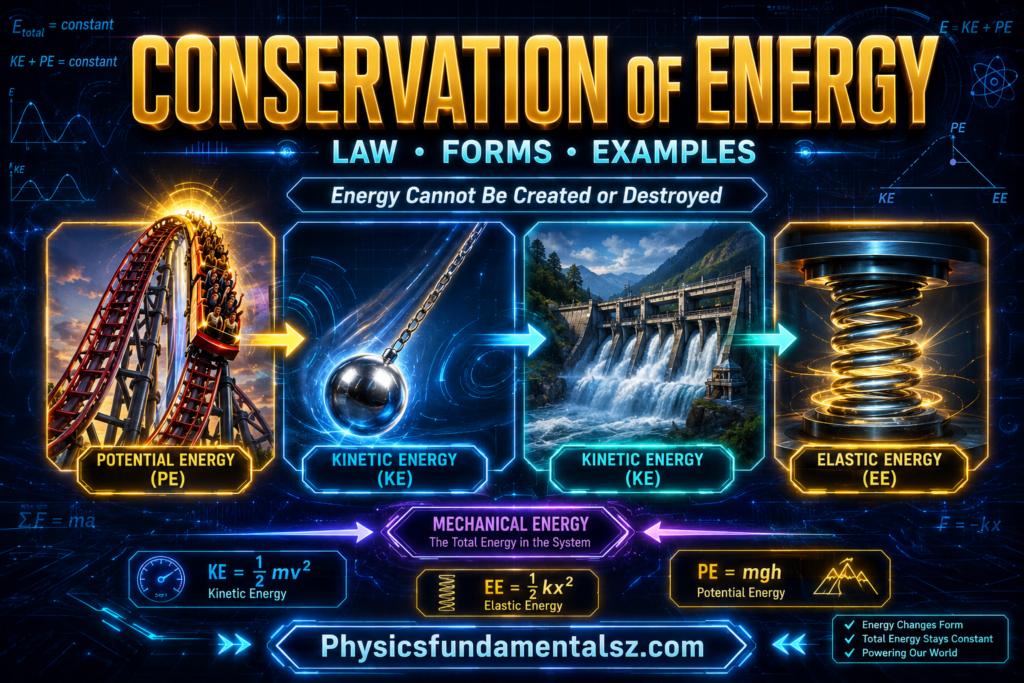
Energy is at the center of almost every physical process in the universe, and the conservation of energy is the single rule that ties all of it together.
Whether a ball rolls down a hill, a car brakes at a red light, or a star burns through its fuel, the total energy involved never disappears. It only changes form.
If you are new to the idea of energy itself, it helps to start with our guide on what energy actually is before diving into how it behaves when it moves between forms.
Table of Contents
What Is Conservation of Energy?
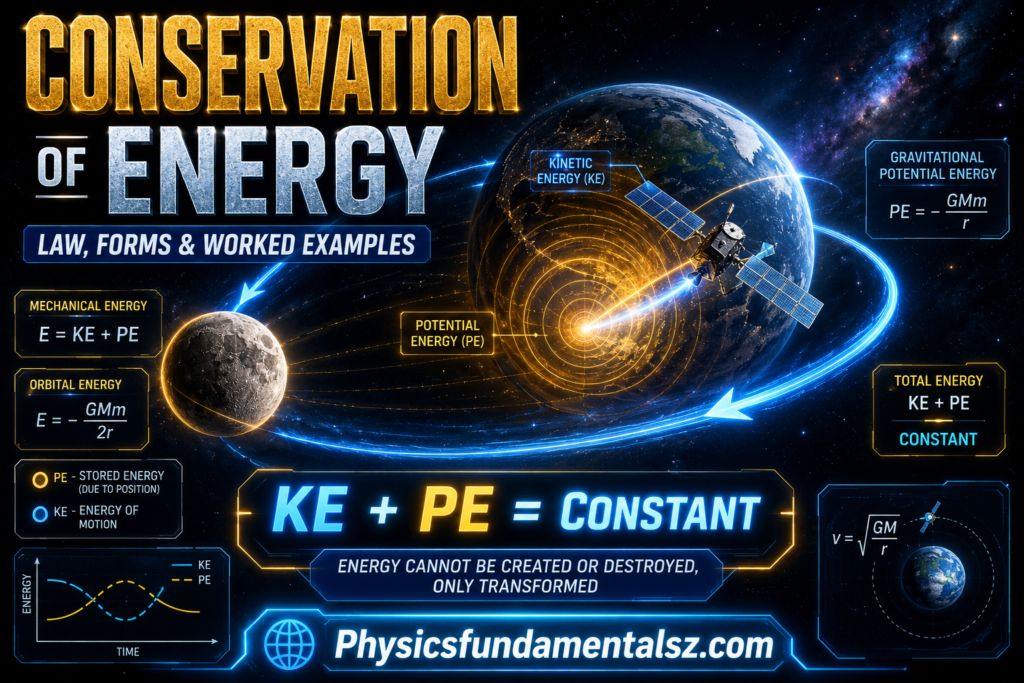
The conservation of energy states that the total energy in an isolated system remains constant over time. Energy is neither created nor destroyed within that system. It simply transforms from one type to another, such as kinetic energy converting into potential energy, or chemical energy converting into heat and motion.
This is not a rule scientists invented to make textbooks tidy. It is an empirical law, confirmed repeatedly through experiment, and no experiment has ever shown it to be violated. From falling objects to nuclear reactions, the same principle applies at every scale.
Why Conservation of Energy Matters in Physics
Conservation of energy is one of the three foundational conservation laws in physics, alongside the conservation of mass and the conservation of momentum. Together, these laws let physicists predict the outcome of a system without tracking every individual force acting on it. Instead of solving complicated equations of motion step by step, you can simply compare the total energy before and after an event.
This is why energy conservation shows up everywhere: roller coaster design, car crash safety testing, rocket launches, and even the way your body converts food into movement.
The Law of Conservation of Energy Explained
The law of conservation of energy is often summarized as follows: energy cannot be created or destroyed, it can only be converted from one form to another. In a truly isolated system, meaning one with no external forces or energy exchange, the total energy at the start of any process equals the total energy at the end.
This law applies to every branch of physics, not just mechanics. It appears in thermodynamics as the first law of thermodynamics, in electromagnetism through the behavior of electric and magnetic fields, and even in modern physics through Einstein’s mass energy relationship, where mass itself is treated as a concentrated form of energy.
The First Law of Thermodynamics and Energy Conservation
The first law of thermodynamics is essentially the conservation of energy applied to heat and work. It states that the change in a system’s internal energy equals the heat added to the system minus the work done by the system. This connects thermal energy, mechanical work, and internal energy into one consistent framework.
For a deeper look at how heat and energy interact in physical systems, our thermodynamics section covers the underlying principles in more depth.
Conservation of Energy Formula
The most common form of the conservation of energy formula used in mechanics is:
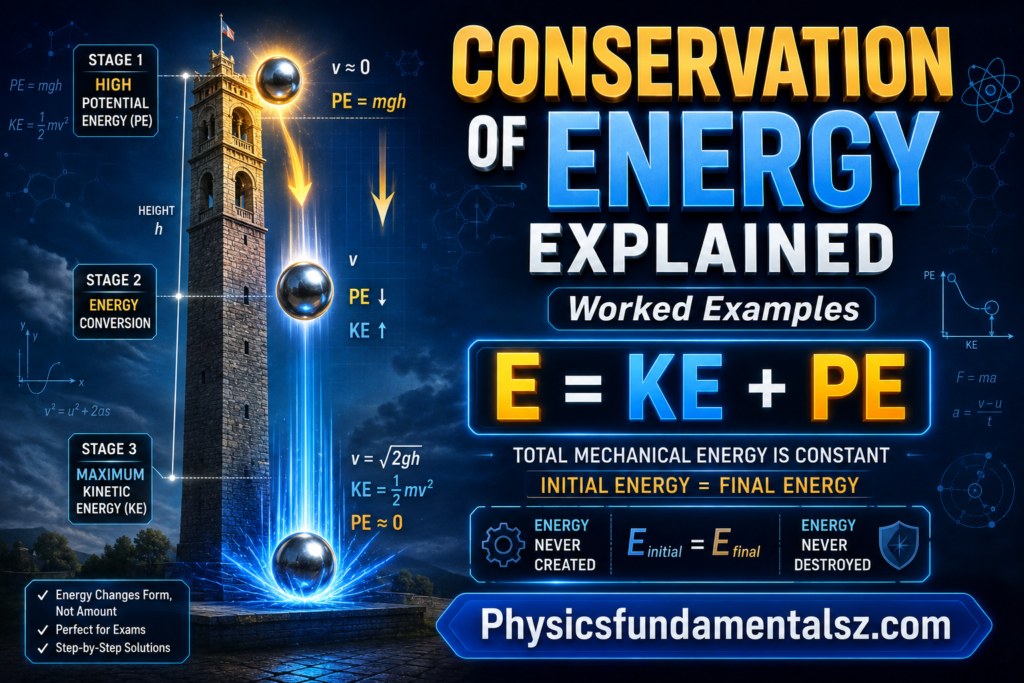
Total Mechanical Energy (E) = Kinetic Energy (KE) + Potential Energy (PE)
And since total mechanical energy stays constant in an isolated system with no friction or air resistance:
KE₁ + PE₁ = KE₂ + PE₂
Where the subscript 1 refers to the initial state of the system and subscript 2 refers to the final state. Expanded using standard physics notation, this becomes:
½mv₁² + mgh₁ = ½mv₂² + mgh₂
Here, m is mass, v is velocity, g is the acceleration due to gravity, and h is height above a reference point.
Breaking Down the Formula
- Kinetic energy (KE) is the energy of motion, calculated as KE = ½mv². If you want the full derivation and worked problems around this formula, see our guide on what energy actually is, which covers kinetic energy in detail.
- Potential energy (PE), specifically gravitational potential energy, is calculated as PE = mgh. It represents stored energy due to an object’s position in a gravitational field.
- Total mechanical energy is simply the sum of the two, and this sum stays fixed as long as no external, non-conservative force like friction acts on the system.
This formula is the backbone of nearly every energy conservation problem you will encounter in an introductory physics course.
Conservation of Energy Examples
Understanding the law is one thing, but seeing it in action makes it far more intuitive. Below are some of the clearest conservation of energy examples used in physics education.
Example 1: A Ball Dropped From a Height
When you drop a ball from a certain height, it starts with maximum potential energy and zero kinetic energy, since it has not yet started moving. As it falls, potential energy converts into kinetic energy. Right before it hits the ground, nearly all of that potential energy has become kinetic energy. Add the two together at any point during the fall, ignoring air resistance, and the total stays the same throughout.
Example 2: A Pendulum Swinging Back and Forth
A swinging pendulum is a classic conservation of energy example. At the highest point of its swing, it briefly has zero velocity and maximum potential energy. As it swings downward, potential energy converts to kinetic energy, reaching maximum kinetic energy and minimum potential energy at the lowest point. It then rises on the other side, converting kinetic energy back into potential energy. If you want to see this exact behavior derived mathematically, our article on the simple pendulum walks through the full time period formula.
Example 3: A Roller Coaster
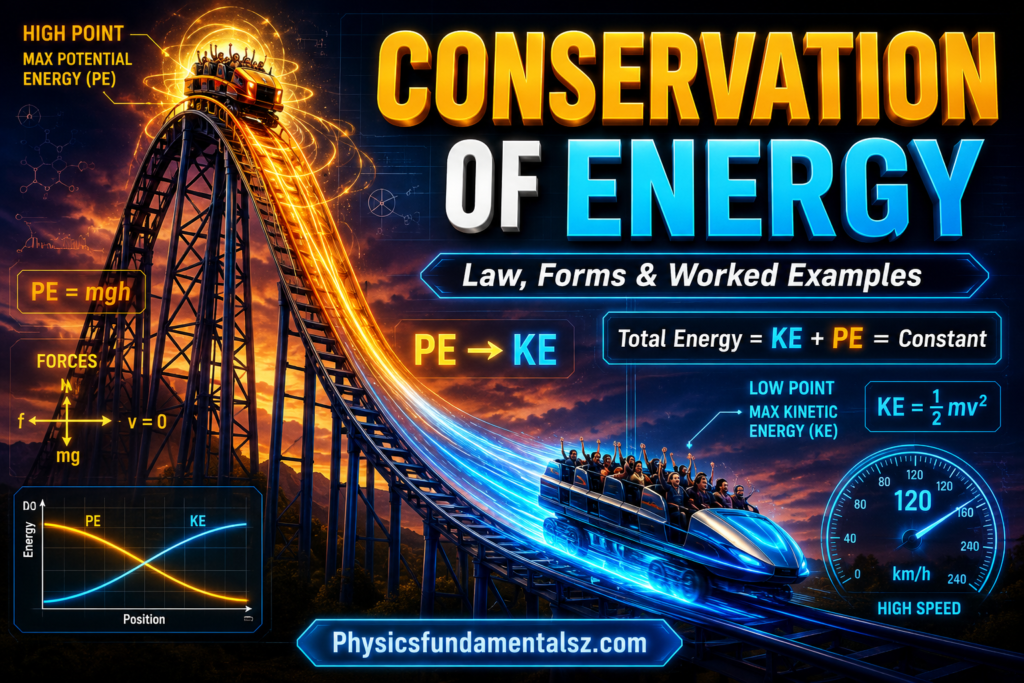
Roller coasters are essentially energy conservation machines. The initial climb up the first hill uses an external motor to build up gravitational potential energy. After that, the coaster runs on the conversion between potential and kinetic energy alone, which is why the first hill is always the tallest one on the track. Every following hill must be shorter, since some energy is inevitably lost to friction and air resistance along the way.
Example 4: Projectile Motion
In projectile motion, an object launched into the air trades kinetic energy for potential energy as it rises, and trades potential energy back for kinetic energy as it falls. The horizontal component of velocity stays constant in ideal conditions, since gravity only acts vertically. For a complete breakdown of the equations governing this kind of motion, see our full guide on projectile motion.
Example 5: A Car Braking to a Stop
When a car brakes, its kinetic energy does not vanish. It converts into heat energy in the brake pads and tires, and sound energy from friction. This is a real world example of energy conservation involving non-mechanical forms of energy, showing that the law applies far beyond simple motion problems.
Conservation of Energy vs Conservation of Momentum
Students often confuse conservation of energy with conservation of momentum, since both apply during collisions and interactions between objects. The key difference is this: momentum is always conserved in a closed system regardless of the type of collision, while kinetic energy is only conserved in elastic collisions. In inelastic collisions, kinetic energy converts into heat, sound, or deformation, even though momentum is still conserved.
To understand this distinction more thoroughly, our detailed guide on conservation of momentum explains how the two laws work together and where they diverge.
Types of Energy Involved in Conservation
Conservation of energy is not limited to kinetic and potential energy alone. A complete picture includes several forms of energy that can convert into one another:
- Kinetic energy, the energy of motion
- Potential energy, including gravitational and elastic potential energy
- Thermal energy, associated with the temperature and internal motion of particles
- Chemical energy, stored in molecular bonds and released during reactions
- Electrical energy, associated with moving electric charges
- Nuclear energy, released during fission or fusion reactions, connected to Einstein’s mass energy equivalence
In any isolated system, the sum of all these energy types remains constant, even when energy shifts dramatically between categories.
Common Misconceptions About Conservation of Energy
Misconception 1: Energy Conservation Means Energy Never Changes
Energy conservation does not mean energy stays in the same form. It means the total amount stays fixed while individual forms of energy freely convert into one another.
Misconception 2: Energy Loss Violates the Law
When people say a system “loses energy” due to friction or air resistance, the energy has not actually disappeared. It has been converted into heat and sound, which are simply less useful or harder to recover forms of energy. The law of conservation of energy still holds; the energy has just spread into a form that is difficult to reuse.
Misconception 3: Conservation of Energy and Conservation of Momentum Are the Same Thing
As covered above, these are two separate laws with different conditions. Momentum conservation applies broadly to closed systems, while mechanical energy conservation only holds strictly in the absence of non-conservative forces like friction, or in elastic collisions specifically.
Real World Applications of Conservation of Energy
Conservation of energy is not just a theoretical concept confined to physics classrooms. It directly shapes how engineers design systems.
Renewable energy systems, such as hydroelectric dams, rely on converting gravitational potential energy from stored water into kinetic energy and then into electrical energy. Vehicle safety design uses crumple zones to convert kinetic energy into deformation and heat during a crash, reducing the force transferred to passengers. Power plants convert chemical or nuclear energy into thermal energy, then mechanical energy through turbines, and finally electrical energy for distribution.
Understanding these transformations is central to nearly every field of engineering and applied physics, which is why conservation of energy remains one of the first major topics taught after Newton’s laws of motion. If you have not yet covered the foundational laws of motion behind these interactions, our guide to Newton’s laws of motion is a good place to build that base first.
How to Solve Conservation of Energy Problems
Most conservation of energy problems follow a consistent approach:
- Identify the system and confirm whether it can be treated as isolated, meaning no external energy is added or removed.
- Define the initial and final states, noting the height, velocity, and any other relevant energy forms at each point.
- Write the energy balance equation, setting total initial energy equal to total final energy.
- Account for any energy losses, such as friction or air resistance, if the system is not perfectly isolated.
- Solve for the unknown variable, whether that is final velocity, maximum height, or another quantity.
This method works whether you are solving a simple falling object problem or a more complex system involving multiple energy transformations. If you want to check your calculations quickly, our physics calculators let you plug in known values and see every formula used in the solution.
Frequently Asked Questions (FAQs)
What is the simplest definition of conservation of energy?
Energy cannot be created or destroyed, only converted from one form to another, and the total energy in an isolated system stays constant.
What is the formula for conservation of energy?
The standard mechanical energy form is KE₁ + PE₁ = KE₂ + PE₂, or written out fully, ½mv₁² + mgh₁ = ½mv₂² + mgh₂.
Is conservation of energy the same as the first law of thermodynamics?
They are closely related. The first law of thermodynamics is essentially conservation of energy applied specifically to heat, work, and internal energy in thermodynamic systems.
Does friction violate the conservation of energy?
No. Friction converts kinetic energy into heat and sound rather than destroying it, so the total energy in the system remains unchanged even though usable mechanical energy decreases.
What is a real life example of conservation of energy?
A roller coaster is one of the clearest examples, since it converts gravitational potential energy into kinetic energy and back again throughout the ride, with small losses to friction along the track.
Final Thoughts
The conservation of energy is one of the most powerful ideas in all of physics because it applies universally, from a bouncing ball to the interior of a star.
Once you understand how kinetic and potential energy trade places, and how the conservation of energy formula lets you predict outcomes without tracking every force involved, a huge portion of classical mechanics becomes far more intuitive.
Explore our other core concept guides, including what energy is and conservation of momentum, to build a complete picture of how motion, energy, and force connect across physics.