Kinetic Energy Calculator Physics: Formula, Steps & Real-World Examples 2026
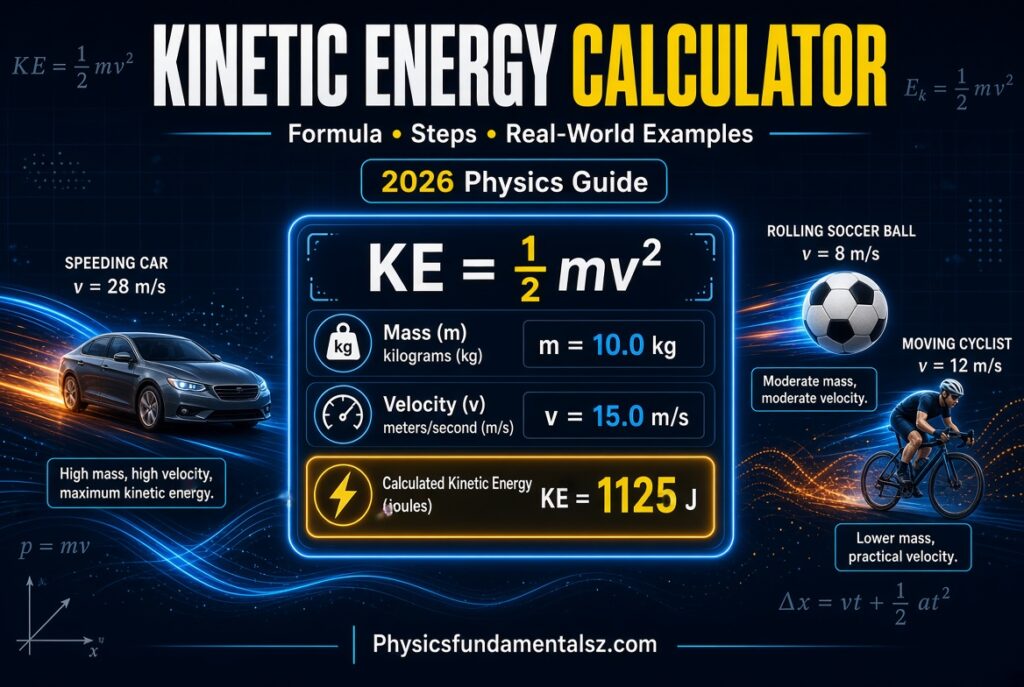
A kinetic energy calculator physics tool lets you find the energy of any moving object in seconds. Instead of rearranging formulas by hand, you simply enter mass and velocity and get an instant, accurate result.
Table of Contents
What Is a Kinetic Energy Calculator Physics Tool?
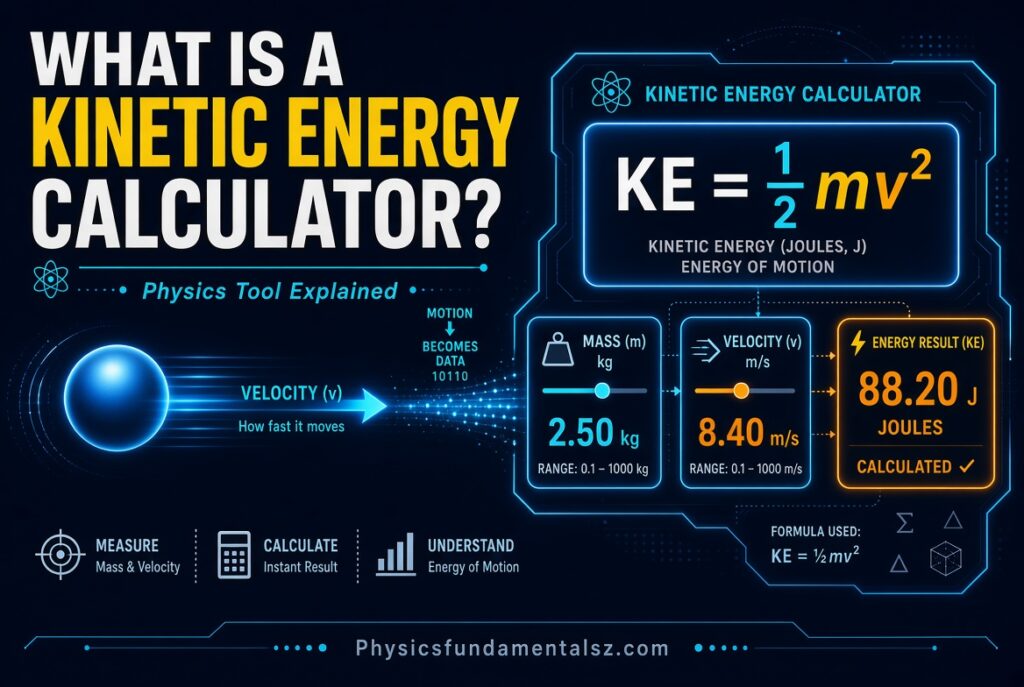
A kinetic energy calculator physics tool is an online solver built around one equation: KE = ½mv². It takes mass and velocity as inputs and returns the energy of motion in joules.
Students, teachers, and engineers use it to skip manual arithmetic and check homework, lab results, or design calculations instantly.
The Kinetic Energy Formula Explained
The core formula is KE = ½ × m × v², where m is mass in kilograms and v is velocity in meters per second. The result comes out in joules, the SI unit of energy.
The key detail is that velocity is squared. Double the speed of an object and its kinetic energy doesn’t double — it quadruples.
This is exactly why a car crash at highway speed is so much more destructive than one at parking-lot speed, even though the speed difference might only be a few multiples.
How to Use a Kinetic Energy Calculator (Step-by-Step)
Using the tool takes just three quick steps, and it works the same way whether you’re solving for energy, mass, or velocity.
- Enter the object’s mass in kilograms (or convert from grams, pounds, or tons).
- Enter the object’s velocity in meters per second (or convert from mph, km/h, or ft/s).
- Hit calculate to instantly see the kinetic energy in joules.
Most calculators also let you flip the equation around, so you can solve for mass or velocity if kinetic energy is the value you already know.
Worked Example: Calculating Kinetic Energy
Take a 1,000 kg car traveling at 20 m/s, which is about 45 mph. Plugging into KE = ½mv² gives KE = ½ × 1,000 × 20² = 200,000 joules, or 200 kJ.
Now double the speed to 40 m/s. The kinetic energy jumps to 800 kJ — four times higher, not two — purely because velocity is squared in the formula.
Solving for Mass or Velocity Instead
Sometimes you already know the kinetic energy and need to find mass or velocity instead. The formula simply rearranges.
To find mass: m = 2KE / v². To find velocity: v = √(2KE / m). A kinetic energy calculator physics tool handles both rearrangements automatically, so you never have to do the algebra yourself.
Kinetic Energy vs Potential Energy
Kinetic energy is the energy of motion, while potential energy is stored energy based on position, like height above the ground. In a closed system, the two constantly convert into each other.
A roller coaster at the top of a hill has maximum potential energy and almost zero kinetic energy. At the bottom of the drop, that relationship flips completely.
Real-World Applications of Kinetic Energy
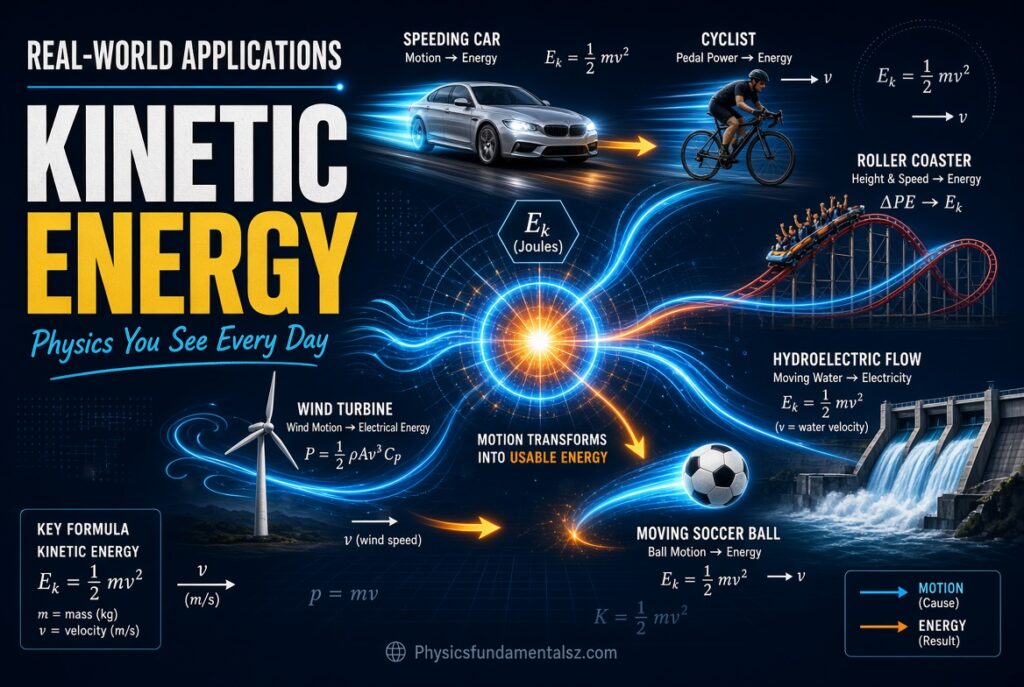
Kinetic energy isn’t just a textbook concept — it shows up in engineering, sports, and everyday safety decisions.
- Automotive safety: stopping distances and crash-energy absorption both depend directly on kinetic energy.
- Sports physics: the speed of a cricket ball, baseball, or golf swing determines how much energy transfers on impact.
- Renewable energy: wind turbines convert the kinetic energy of moving air into electricity.
- Roller coasters: every drop and hill is a trade between kinetic and potential energy.
- Particle physics: accelerators push particles to extremely high kinetic energies to study matter at its smallest scales.
Rotational Kinetic Energy for Rolling Objects
Objects that roll, like wheels or balls, split their energy between straight-line motion and spinning motion. The full formula becomes KE = ½mv² + ½Iω², where I is the moment of inertia and ω is angular velocity.
This is why a rolling solid sphere carries more total kinetic energy than a sliding object at the same speed — part of that energy is tied up in the spin.
Common Mistakes When Calculating Kinetic Energy
A few small errors show up again and again when people calculate kinetic energy by hand.
- Forgetting to square the velocity, not just multiply it.
- Mixing unit systems, like entering mass in pounds but velocity in m/s.
- Assuming doubling speed doubles energy, when it actually quadruples it.
- Ignoring rotational energy for rolling or spinning objects.
A kinetic energy calculator physics tool automatically avoids these errors by handling unit conversion and the squaring step for you.
Kinetic Energy at Relativistic Speeds
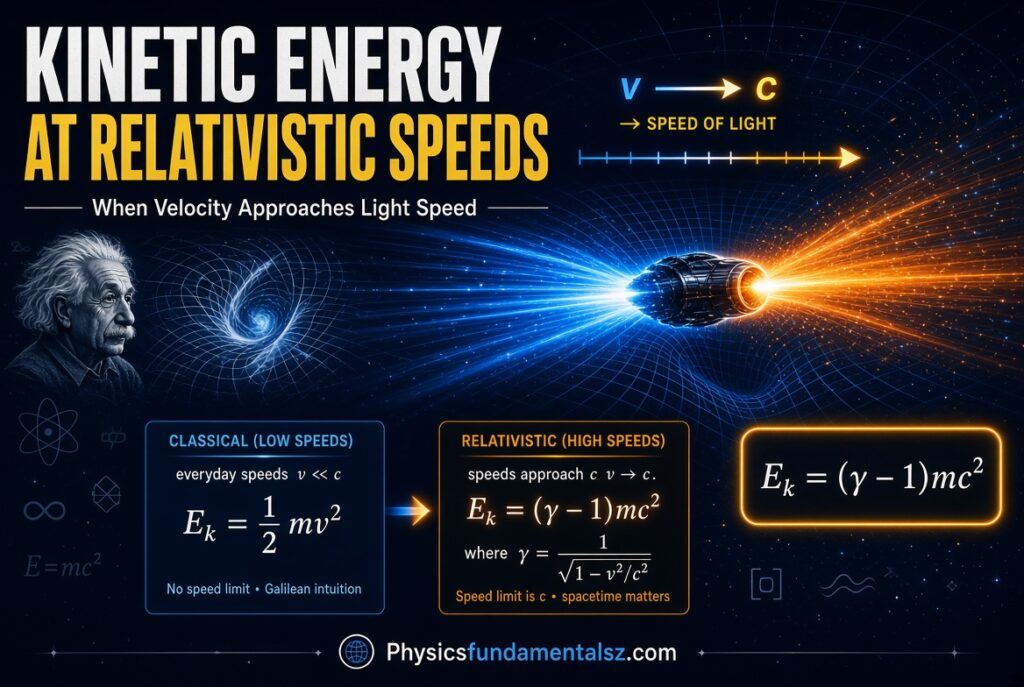
The classical formula KE = ½mv² only works at everyday speeds. Once an object approaches the speed of light, physicists switch to the relativistic formula KE = (γ − 1)mc², where γ is the Lorentz factor.
This matters in particle accelerators like the LHC, where particles reach energies measured in teraelectronvolts and classical mechanics no longer gives accurate answers.
Also Read:
- Ohm’s Law Calculator Solve for Current: Formula, Steps & Examples 2026
- Half Life Calculator With Steps: Formula, Examples & Full Guide 2026
- Wave Speed Calculator Frequency Wavelength: Formula, Steps & Worked Examples 2026
- Momentum Calculator Physics: Formula, Steps & Worked Examples
- Ideal Gas Law Calculator With Steps: PV = nRT Formula & Examples 2026
- Projectile Motion Calculator With Angle: Formulas & Worked Examples 2026
- Heisenberg Uncertainty Principle: ΔxΔp ≥ ℏ/2 — Explained Simply
- Bohr Model of the Atom: Energy Levels, Emission & Absorption Spectra
- De Broglie Wavelength: λ = h/mv Formula, Derivation & Examples
- Half-Life Calculations: Formula & Worked Examples Explained
- Electric Potential Energy: E = kQq/r, Work Done & Worked Examples
- Electric Current: I = Q/t, Drift Velocity & Ohm’s Law Connection
- Magnetic Field of a Current-Carrying Wire: B = μ0I/2πr
- Electric Circuits & Kirchhoff’s Laws: KCL, KVL & Worked Examples
- Kirchhoff’s Laws Advanced: Solving Multi-Loop Circuits Step by Step
- Lenz’s Law: The Direction of Induced Current Explained
- Magnetic Flux and Faraday’s Law: Formula, Examples & Applications
- Ohm’s Law and Temperature: How Resistance Really Changes With Heat
- Resistors in Series and Parallel: Formulas, Rules & Worked Examples
- Power in Electrical Circuits: P = IV = I²R = V²/R Explained
- Doppler Effect Explained: Formula, Examples & Applications
- Simple Harmonic Motion: Formula, Pendulums & Energy Explained
- Newton’s Law of Universal Gravitation: F = Gm₁m₂/r² Full Guide
- Hooke’s Law F = kx: Spring Constant, Elastic PE & 3 Worked Examples
- Buoyancy & Archimedes’ Principle: F = ρVg Formula & Worked Examples
Frequently Asked Questions (FAQs)
What is the formula used by a kinetic energy calculator physics tool?
The standard formula is KE = ½mv², where mass is in kilograms and velocity is in meters per second. The result is given in joules.
Why does velocity have a bigger effect than mass on kinetic energy?
Because velocity is squared in the formula while mass is not. Doubling mass doubles energy, but doubling velocity quadruples it.
Can a kinetic energy calculator physics tool solve for mass or velocity?
Yes, most tools let you rearrange the formula to solve for mass or velocity if kinetic energy is already known. You just need any two of the three variables.
What unit does kinetic energy come out in?
Kinetic energy is measured in joules (J) in the SI system. Some calculators also offer kilojoules, calories, or BTUs as alternate units.
Does a heavier object always have more kinetic energy?
Not necessarily. A lighter, faster object can easily have more kinetic energy than a heavier, slower one, since speed matters far more due to the squared term.
How is kinetic energy different from momentum?
Momentum is p = mv and scales linearly with velocity, while kinetic energy scales with velocity squared. This is why stopping distance grows so quickly as speed increases.
What is rotational kinetic energy?
Rotational kinetic energy is the energy an object has due to spinning, calculated as ½Iω². Rolling objects have both translational and rotational kinetic energy at once.
Why does kinetic energy matter for car crashes?
Crash energy scales with velocity squared, so a small increase in speed leads to a much larger increase in impact energy. This is a key reason speed limits matter so much for safety.
Is the classical kinetic energy formula always accurate?
No. At speeds close to the speed of light, the classical formula breaks down and the relativistic formula KE = (γ − 1)mc² must be used instead.
How do wind turbines use kinetic energy?
Wind turbines convert the kinetic energy of moving air into rotational energy, then into electricity. Power output scales with the cube of wind speed, which is why turbine placement matters so much.
What’s a simple real-life example of kinetic energy?
A baseball weighing 0.145 kg moving at 40 m/s has a kinetic energy of about 116 joules, calculated using KE = ½ × 0.145 × 40².
Can kinetic energy ever be negative?
No. Since mass and velocity squared are always positive, kinetic energy is always zero or positive, never negative.
Why do roller coasters feel fastest at the bottom of a drop?
Because that’s the point where nearly all the potential energy from the top has converted into kinetic energy. Speed, and therefore kinetic energy, peaks at the lowest point.
Do units need to match before using the calculator?
Most calculators handle unit conversion automatically, but it’s good practice to double-check that mass and velocity are in compatible unit systems before calculating.
Is kinetic energy the same for all objects moving at the same speed?
No. Kinetic energy also depends on mass, so a truck and a bicycle moving at the same speed will have very different kinetic energies.
Conclusion
A kinetic energy calculator physics tool takes the guesswork out of one of the most important formulas in classical mechanics. Once you understand that KE = ½mv² and that velocity’s effect is squared, every real-world example — from car crashes to wind turbines — starts to make intuitive sense.
Whether you’re solving for energy, mass, or velocity, the calculator gets you an accurate answer instantly, so you can spend more time understanding the physics and less time doing arithmetic.