Hooke’s Law F = kx: Spring Constant, Elastic PE & 3 Worked Examples

Hookes law and springs go hand in hand, since this single equation, F = kx, explains why a spring pushes back when you stretch it and how much energy it stores while doing so.
Robert Hooke discovered this relationship in the 17th century, and it still forms the backbone of everything from car suspensions to bathroom scales.
Table of Contents
What Is Hooke’s Law?

Hooke’s law states that the force needed to stretch or compress a spring is directly proportional to the distance it is displaced from its natural length. The relationship holds as long as the spring stays within its elastic limit.
In simple terms, pull a spring twice as far and it pulls back with twice the force. This proportional behavior is what makes springs so predictable and useful in engineering and everyday devices.
The Hooke’s Law Formula: F = kx
The formula for Hooke’s law is written as:
F = kx
Where each symbol represents a specific physical quantity:
| Symbol | Meaning | SI Unit |
|---|---|---|
| F | Restoring force exerted by the spring | Newtons (N) |
| k | Spring constant (stiffness of the spring) | Newtons per meter (N/m) |
| x | Displacement from the spring’s natural length | Meters (m) |
A negative sign is often added to the equation, written as F = -kx, to show that the restoring force always acts opposite to the direction of displacement. If you stretch a spring to the right, the spring pulls back to the left.
This same idea connects closely to Newton’s third law, since the spring’s restoring force is a direct reaction to the force you apply. If you want a refresher on how forces and motion relate more broadly, our guide on Newton’s Laws of Motion covers the full foundation.
Understanding the Spring Constant (k)
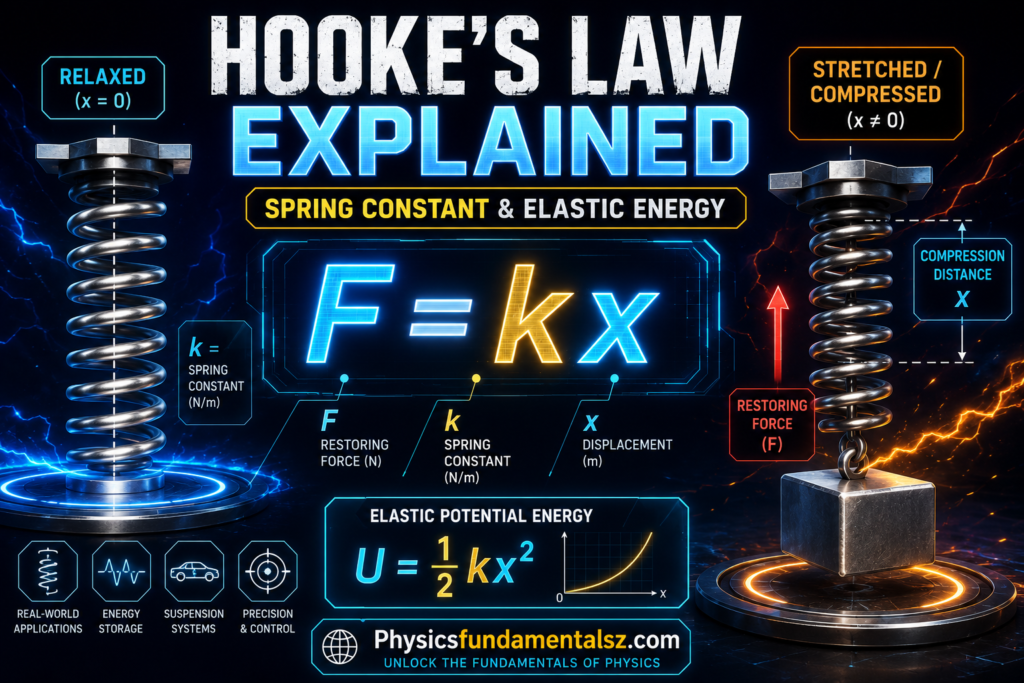
The spring constant, often called the force constant, tells you how stiff a spring is. A high spring constant means the spring is stiff and resists stretching. A low spring constant means the spring is soft and stretches easily under small forces.
The spring constant is measured in newtons per meter (N/m) and depends on factors including the material of the spring, its thickness, the number of coils, and the coil diameter.
How to Find the Spring Constant
You can rearrange the Hooke’s law formula to solve for k directly:
k = F / x
Simply divide the applied force by the resulting displacement. This method is commonly used in lab experiments where students hang known weights on a spring and measure how far it stretches.
If you want to skip the manual math, our Hooke’s Law Calculator finds the restoring force and stored energy of a stretched spring instantly, and shows every formula used along the way.
Elastic Potential Energy in Springs
When a spring is stretched or compressed, it stores energy. This stored energy is called elastic potential energy, and it is released when the spring is allowed to return to its natural length.
The formula for elastic potential energy is:
PE = ½kx²
Where PE is the elastic potential energy in joules, k is the spring constant, and x is the displacement.
Elastic potential energy is closely related to the broader concept of stored energy in physics. For a wider look at how different forms of energy behave and convert into one another, see our guide on What Is Energy?
Why the Formula Has a Factor of ½
The ½ appears in the elastic potential energy formula because the force applied to a spring is not constant. As you stretch the spring further, the force needed increases linearly. The average force over the entire stretch works out to half the maximum force, which is why the energy formula includes that factor.
The Elastic Limit and When Hooke’s Law Breaks Down

Hooke’s law only applies within a spring’s elastic limit, which is the maximum point up to which the spring can be stretched or compressed and still return to its original shape.
Beyond the elastic limit, the spring undergoes permanent deformation, and the straight-line relationship between force and displacement no longer holds. At this point the material has entered its plastic deformation region.
This concept overlaps with the science of stress and strain in materials more broadly. If you are curious how elasticity applies to solid materials beyond springs, our article on Stress, Strain & Young’s Modulus walks through the deeper material science behind elastic behavior.
Springs in Series and Parallel
Springs are rarely used alone in real systems. When multiple springs are combined, their effective spring constant changes depending on the arrangement.
Springs Connected in Series
For springs connected end to end in series, the combined spring constant is found using:
1/k(total) = 1/k1 + 1/k2 + 1/k3…
A series combination always produces a softer overall spring, meaning the combined spring constant is lower than any individual spring in the chain.
Springs Connected in Parallel
For springs connected side by side in parallel, the combined spring constant is simply the sum of each individual constant:
k(total) = k1 + k2 + k3…
A parallel combination always produces a stiffer overall spring than any single spring used alone.
Real-World Applications of Hooke’s Law and Springs
Hookes law and springs appear in far more places than a physics classroom. Understanding the formula helps explain how many everyday devices actually work.
Vehicle Suspension Systems
Car and motorcycle suspensions use springs to absorb shocks from uneven roads. Engineers select a spring constant that is stiff enough to support the vehicle’s weight but soft enough to smooth out bumps, balancing comfort against control.
Mechanical Weighing Scales
Old-style bathroom and kitchen scales convert the displacement of an internal spring into a weight reading. Since the spring stretches proportionally to the load, the scale can be calibrated once and trusted to read accurately every time.
Mattress and Furniture Springs
Mattress coils and furniture springs are engineered with a specific spring constant chosen to match a target comfort and support level. A softer mattress uses springs with a lower k value, while firmer support comes from a higher one.
Diving Boards and Trampolines
Diving boards and trampolines rely on elastic restoring force to launch a person upward. The board or trampoline surface stores elastic potential energy when compressed by a jumper’s weight, then releases that energy as kinetic energy on the way back up.
Door Closers and Retractable Pens
Small coiled springs inside door closers and retractable pens are governed by the same F = kx relationship as any larger spring. The same principles that describe a car suspension also explain why a pen click mechanism resets predictably every time.
Common Mistakes When Applying Hooke’s Law
Students frequently make a handful of predictable errors when working through Hooke’s law problems. Watching for these can save significant time on homework and exams.
Mixing Up Units
The spring constant formula requires displacement in meters, not centimeters or millimeters. Forgetting to convert units before plugging numbers into F = kx is one of the most common sources of incorrect answers.
Forgetting the Elastic Limit
Applying F = kx beyond a spring’s elastic limit gives a result that does not match real behavior, since the spring has already deformed permanently. Always check whether a problem states the spring is within its proportional region.
Confusing Force and Energy Formulas
It is easy to accidentally use PE = ½kx² when a problem is only asking for restoring force, or vice versa. Reading the question carefully to identify whether it wants force in newtons or energy in joules avoids this mix-up.
How to Read a Force vs Displacement Graph

A force versus displacement graph for a spring obeying Hooke’s law produces a straight line passing through the origin. The slope of that line is equal to the spring constant, k.
The area under this line, up to any given displacement, represents the elastic potential energy stored in the spring at that point. This graphical relationship is exactly why the elastic potential energy formula includes the factor of one half, since the area of a triangle is half its base multiplied by its height.
Once a spring passes its elastic limit, the graph curves away from that straight line, visually showing where Hooke’s law stops applying.
3 Worked Examples Using Hooke’s Law
Below are three step-by-step examples that show how to apply the Hooke’s law formula and the elastic potential energy formula in practice.
Example 1: Finding the Restoring Force
A spring has a spring constant of 250 N/m. It is stretched by 0.12 meters from its natural length. Find the restoring force.
Using F = kx:
F = 250 × 0.12
F = 30 N
The spring pulls back with a force of 30 newtons.
Example 2: Finding the Spring Constant
A force of 45 N stretches a spring by 0.09 meters. Find the spring constant.
Using k = F / x:
k = 45 / 0.09
k = 500 N/m
The spring has a stiffness of 500 newtons per meter.
Example 3: Finding Elastic Potential Energy
A spring with a spring constant of 400 N/m is compressed by 0.05 meters. Find the elastic potential energy stored in the spring.
Using PE = ½kx²:
PE = ½ × 400 × (0.05)²
PE = ½ × 400 × 0.0025
PE = 0.5 J
The spring stores 0.5 joules of elastic potential energy.
Hooke’s Law and Simple Harmonic Motion
Hookes law and springs also form the foundation of simple harmonic motion, since any system where the restoring force is proportional to displacement will oscillate back and forth in a predictable, repeating pattern.
A mass attached to a spring bouncing up and down is a textbook example of simple harmonic motion, closely related to the way a pendulum swings. To compare the two systems side by side, our guide on the Simple Pendulum explains the formula, time period, and full derivation for oscillating motion.
Quick Reference Table
| Concept | Formula | Unit |
|---|---|---|
| Restoring force | F = kx | Newtons (N) |
| Spring constant | k = F / x | N/m |
| Elastic potential energy | PE = ½kx² | Joules (J) |
| Series springs | 1/k(total) = 1/k1 + 1/k2 | N/m |
| Parallel springs | k(total) = k1 + k2 | N/m |
Frequently Asked Questions (FAQs)
What is Hooke’s law in simple terms?
Hooke’s law says the force needed to stretch or compress a spring is proportional to how far it is displaced. It is written as F = kx, where k is the spring constant and x is the displacement.
What does the spring constant k represent?
The spring constant represents how stiff a spring is, measured in newtons per meter. A higher k value means the spring is harder to stretch or compress.
What is the formula for elastic potential energy?
Elastic potential energy is calculated using PE = ½kx². This gives the energy stored in the spring in joules.
Why is there a negative sign in F = -kx?
The negative sign shows that the restoring force always acts opposite to the direction of displacement. It indicates direction, not a reduction in magnitude.
What happens when a spring passes its elastic limit?
Beyond the elastic limit, the spring deforms permanently and does not return to its original shape. Hooke’s law no longer applies accurately in this region.
What units are used for the spring constant?
The spring constant is measured in newtons per meter, written as N/m. This unit reflects how much force is needed per unit of displacement.
How do springs in series differ from springs in parallel?
Springs in series produce a lower combined spring constant, making the system softer overall. Springs in parallel produce a higher combined spring constant, making the system stiffer.
Does Hooke’s law apply to all materials?
Hooke’s law applies to elastic materials within their proportional limit, not just metal springs. Rubber bands and certain plastics also follow this relationship up to a point.
How is Hooke’s law related to simple harmonic motion?
A spring’s restoring force being proportional to displacement is exactly what creates simple harmonic motion. This is why mass-spring systems oscillate in smooth, repeating cycles.
Where is Hooke’s law used in real life?
Hooke’s law is used in vehicle suspensions, weighing scales, mattress springs, and retractable pens. Any device relying on predictable spring behavior depends on this same F = kx relationship.
Conclusion
Hookes law and springs form one of the simplest yet most powerful relationships in physics, captured entirely in the equation F = kx. Once you understand the spring constant, calculating restoring force and elastic potential energy becomes straightforward.
The three worked examples above show how the same formula applies whether you are solving for force, spring constant, or stored energy. Remember that Hooke’s law only holds within a spring’s elastic limit, beyond which the relationship breaks down permanently.
Whether you are studying for an exam or exploring how suspension systems and scales work, mastering F = kx gives you a foundation that connects directly to energy conservation and simple harmonic motion. Try the Hooke’s Law Calculator to check your own practice problems instantly.