Electric Charge and Coulomb’s Law: F = kq₁q₂/r² Explained
Electric Charge and Coulomb’s Law: Rub a balloon on your hair and it clings to the wall for minutes afterward. Walk across a carpet in winter and a doorknob delivers a small shock.
Both moments are electric charge announcing itself — and the same underlying rule, Coulomb’s law, tells you exactly how hard two charges push or pull on each other.
Electric charge is a fundamental property of matter that comes in two types, positive and negative, and it is conserved, quantized, and additive.
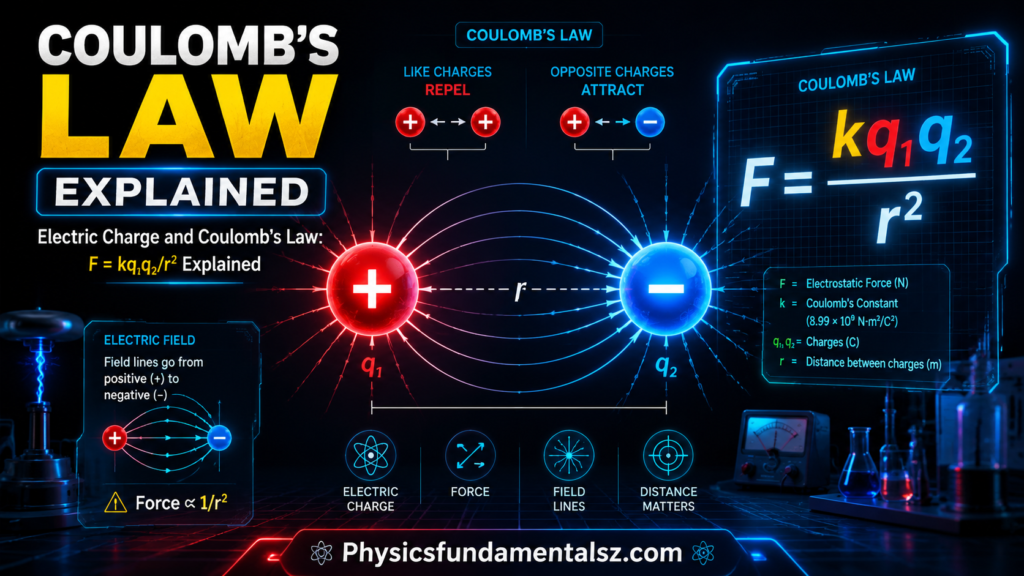
Coulomb’s law states that the electrostatic force between two point charges is directly proportional to the product of their magnitudes and inversely proportional to the square of the distance between them: F = k·|q₁q₂| / r².
Table of Contents
What Is Electric Charge?
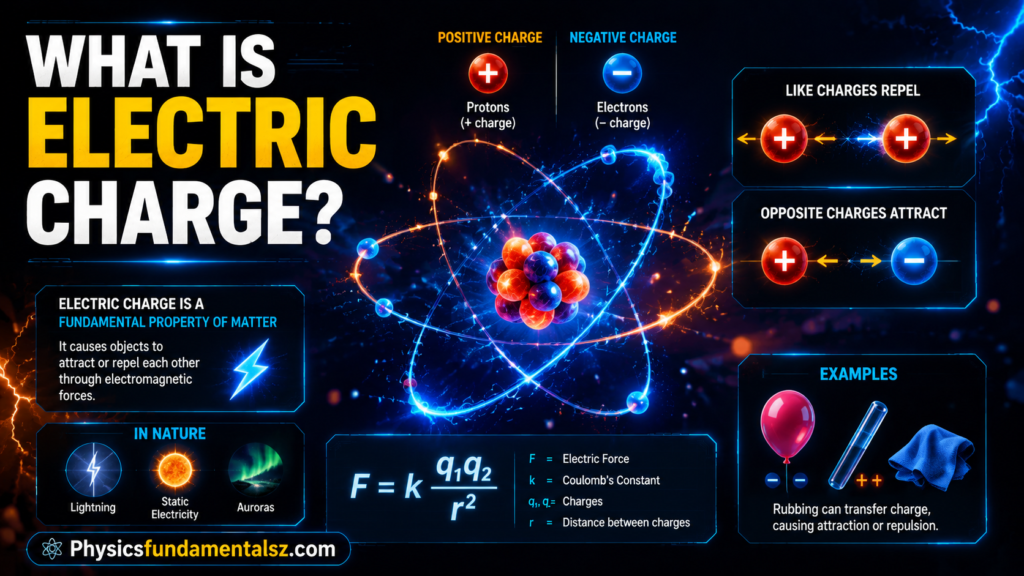
Electric charge is a basic physical property carried by matter that causes it to experience — and produce — electric and magnetic forces. Charge comes in exactly two types, arbitrarily labeled positive and negative. Electrons carry negative charge, protons carry positive charge, and most everyday objects are electrically neutral because they contain equal amounts of both.
The Three Properties of Electric Charge
Every top physics course anchors on the same three rules. Understanding them is what separates a memorized formula from real intuition about electric charge and Coulomb’s law.
Additivity of Charge
Charge adds up like a simple scalar. If an object has several charged particles inside it, its net charge is just the algebraic sum of all of them — positive charges add, negative charges subtract.
Conservation of Charge
The total electric charge of an isolated system never changes. Charge can move from one object to another — by friction, contact, or induction — but it cannot be created or destroyed. This is why rubbing a balloon on your hair doesn’t create charge; it transfers electrons from your hair to the balloon.
Quantization of Charge
Charge always comes in whole-number multiples of the elementary charge, e = 1.602 × 10⁻¹⁹ C. You can have a charge of 3e or −5e, but never 2.5e. A single coulomb is actually an enormous amount of charge — about 6.24 × 10¹⁸ elementary charges — which is why everyday static charges are measured in microcoulombs (µC) or nanocoulombs (nC).
Conductors and Insulators
How freely charge can move through a material determines whether it’s a conductor or an insulator.
| Material Type | Charge Behavior | Examples |
|---|---|---|
| Conductor | Charges move freely throughout the material | Copper, silver, aluminum, salt water |
| Insulator | Charges stay put where they’re placed | Glass, rubber, plastic, dry wood |
| Semiconductor | Charge mobility is in between and controllable | Silicon, germanium |
Charging can happen by friction (rubbing two materials together), conduction (direct contact with a charged object), or induction (bringing a charged object near a neutral one, causing internal charge redistribution without contact).
What Is Coulomb’s Law?
Coulomb’s law, published by French physicist Charles-Augustin de Coulomb in 1785, is the mathematical rule that quantifies the electrostatic force between two stationary point charges.
The Coulomb’s Law Formula
$$F = k \dfrac{|q_1 q_2|}{r^2}$$
What Each Symbol Means
| Symbol | Meaning | Unit |
|---|---|---|
| F | Electrostatic (Coulomb) force | newtons (N) |
| q₁, q₂ | Magnitudes of the two charges | coulombs (C) |
| r | Distance between charge centers | meters (m) |
| k | Coulomb’s constant | N·m²/C² |
The Coulomb Constant (k) and Permittivity of Free Space (ε₀)
The Coulomb constant is:
$$k = \dfrac{1}{4\pi\varepsilon_0} \approx 8.99 \times 10^9 \ \text{N·m}^2/\text{C}^2$$
where ε₀, the permittivity of free space, is approximately 8.854 × 10⁻¹² C²/(N·m²). This constant depends on the medium between the charges — in air it’s essentially the same as in a vacuum, but inside a dielectric material the effective force drops.
Key idea: k is a huge number, which is why even a tiny charge of just 1 coulomb produces a force of about 9 billion newtons on an identical charge just 1 meter away — an enormous, non-physical scale for everyday objects. That’s why real-world charges are almost always microcoulombs or smaller.
Direction of the Electrostatic Force
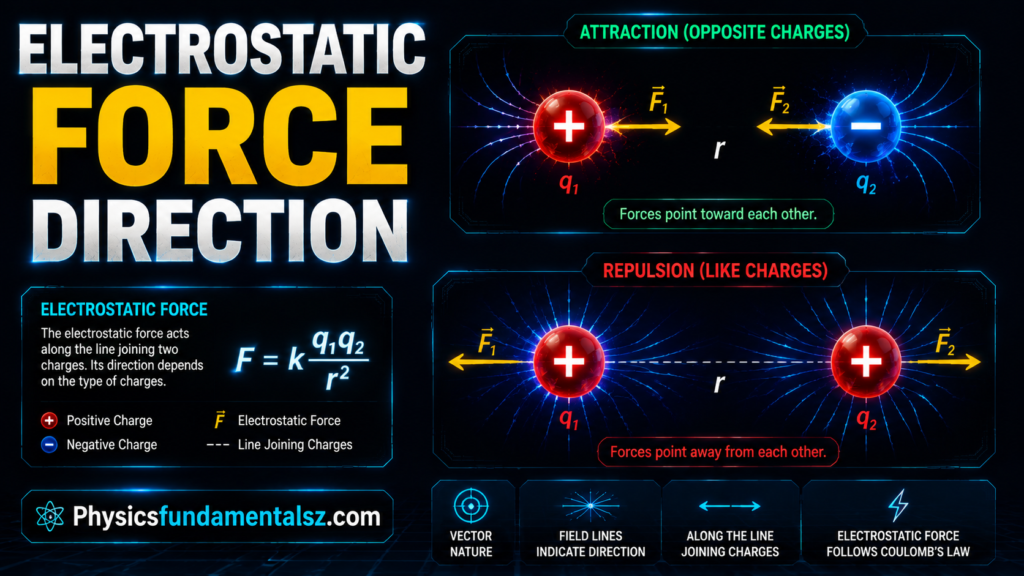
Coulomb’s law as written gives you the magnitude of the force. The direction follows a simple rule:
- Like charges repel (two positives, or two negatives, push apart).
- Unlike charges attract (a positive and a negative pull together).
The force always acts along the straight line connecting the two charges — never at an angle to it — which mirrors how gravity acts along the line joining two masses.
Coulomb’s Law for Multiple Charges (Superposition Principle)
When more than two charges are present, the net force on any one charge is the vector sum of the individual forces from every other charge, calculated one pair at a time with Coulomb’s law and then added together.
Steps to solve a multi-charge problem:
- Identify the charge you’re solving for and every other charge acting on it.
- Calculate the Coulomb force from each other charge individually, using F = k|q₁q₂|/r².
- Break each force into x- and y-components if the charges aren’t in a straight line.
- Add the components separately, then combine them into a net force magnitude and direction.
Worked Examples
Example 1 — Two Point Charges
Two charges, q₁ = +2 µC and q₂ = +3 µC, are separated by 0.5 m. Find the force between them.
$$F = (8.99\times10^9) \dfrac{(2\times10^{-6})(3\times10^{-6})}{(0.5)^2} \approx 0.216\ \text{N (repulsive)}$$
Example 2 — Finding an Unknown Distance
Two charges of +4 µC and −4 µC experience a force of 1.44 N. Find their separation.
Rearranging F = kq₁q₂/r² gives r = √(kq₁q₂/F) ≈ 0.316 m.
Example 3 — Net Force from Three Charges
A charge of +1 µC sits between two other charges of +2 µC (0.2 m to its left) and −2 µC (0.2 m to its right), all on a line. Calculate both individual forces (both point rightward here, since the left charge repels and the right charge attracts in the same direction), then add them directly since they’re collinear, to find the total force on the center charge.
Coulomb’s Law vs. Newton’s Law of Gravitation
| Feature | Coulomb’s Law | Newton’s Law of Gravitation |
|---|---|---|
| Formula | F = k·q₁q₂/r² | F = G·m₁m₂/r² |
| Governs | Force between electric charges | Force between masses |
| Nature | Attractive or repulsive | Always attractive |
| Constant | k ≈ 8.99 × 10⁹ N·m²/C² | G ≈ 6.674 × 10⁻¹¹ N·m²/kg² |
| Relative strength | Vastly stronger at atomic scale | Vastly weaker at atomic scale |
| Depends on | Charge magnitude | Mass |
Both are inverse-square laws, and both act along the line joining the two objects — but Coulomb’s law is the one that can push things apart, not just pull them together.
Real-World Applications of Coulomb’s Law
- Ionic bonding in chemistry: the attraction between a positive and negative ion in a salt crystal is a direct Coulomb’s law interaction.
- Photocopiers and laser printers: electrostatically charged drums attract oppositely charged toner particles.
- Electrostatic precipitators: used in factory smokestacks to charge and then attract pollution particles out of exhaust gas.
- Van de Graaff generators: demonstrate charge buildup and the resulting Coulomb forces in classrooms.
- Lightning formation: charge separation in storm clouds builds up until the electrostatic force overcomes air’s insulating properties, producing a discharge.
- Atomic stability: the attractive Coulomb force between the nucleus and electrons is what keeps atoms from flying apart.
Common Mistakes When Applying Coulomb’s Law
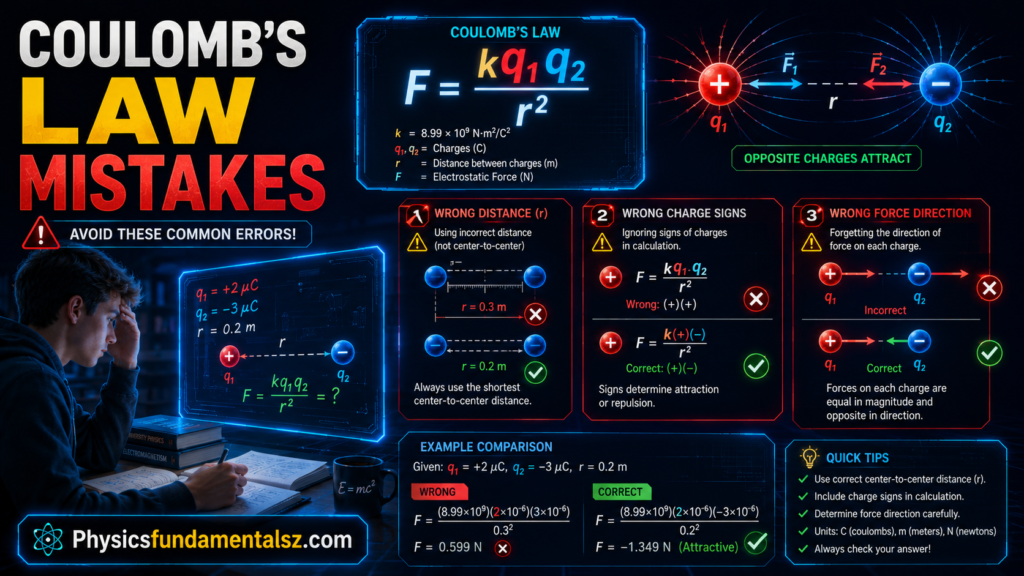
- Forgetting to convert units — charges given in µC or nC must be converted to coulombs before plugging into the formula.
- Mixing up charge and current — charge (C) is a quantity; current (A) is charge flow per second. They are related but not interchangeable.
- Ignoring direction — the formula gives magnitude only; you must separately reason about attraction vs. repulsion.
- Adding forces as scalars when charges aren’t collinear — always use vector components when charges are arranged in two dimensions.
- Using r as the distance between object edges instead of centers — Coulomb’s law strictly applies to point charges (or the centers of uniformly charged spheres).
Related Articles
Keep building your electromagnetism foundations with these guides from Physics Fundamentals:
- Coulomb’s Law Calculations: F = kQ1Q2/r² Formula & Examples
- Electric Field and Potential
- Electric Potential Energy: E = kQq/r, Work Done & Worked Examples
- Electric Current: I = Q/t, Drift Velocity & Ohm’s Law Connection
- Capacitors and Capacitance: C = Q/V Formula, Energy Storage & Examples
- Magnetic Fields and Forces
- Magnetic Field of a Current-Carrying Wire: B = μ0I/2πr
- Electric Circuits & Kirchhoff’s Laws: KCL, KVL & Worked Examples
- Kirchhoff’s Laws Advanced: Solving Multi-Loop Circuits Step by Step
- Lenz’s Law: The Direction of Induced Current Explained
- Magnetic Flux and Faraday’s Law: Formula, Examples & Applications
- Ohm’s Law and Temperature: How Resistance Really Changes With Heat
- Electromagnetic Waves: Speed, Spectrum & Wave Properties
- Work Done in Physics
- Free Fall and Terminal Velocity
- Terminal Velocity: Why Objects Stop Accelerating & Calculations
- Projectile Motion
- Projectile Motion Range: R = v²sin2θ/g & Optimum Angle 45°
- Vectors and Scalars: Definitions, Examples & Vector Addition
- Boyle’s, Charles’ & Gay-Lussac’s Gas Laws: Formulas & Examples
- Thermal Energy & Internal Energy: Heat, Temperature & Q = mcΔT
- Diffraction: Single Slit, Diffraction Gratings & dsinθ = nλ Explained
- Snell’s Law: n₁sinθ₁ = n₂sinθ₂, Derivation & Total Internal Reflection
- Interference of Waves: Constructive, Destructive & Superposition Explained
- Physics Fundamentals: The Complete Guide to Core Concepts, Laws, and Equations
Frequently Asked Questions (FAQs)
1. What is electric charge in simple words?
Electric charge is a property of matter that causes objects to attract or repel each other through electric forces. It comes in two types — positive and negative.
2. What is Coulomb’s law in simple words?
Coulomb’s law says the force between two charges gets stronger when the charges are bigger, and weaker very quickly as they move apart, following an inverse-square relationship.
3. What is the formula for Coulomb’s law?
F = k·|q₁q₂|/r², where k is Coulomb’s constant, q₁ and q₂ are the charges, and r is the distance between them.
4. What is the SI unit of electric charge?
The coulomb (C) is the SI unit of electric charge.
5. What is the value of Coulomb’s constant?
k ≈ 8.99 × 10⁹ N·m²/C², sometimes written as 9.0 × 10⁹ N·m²/C² for simplicity.
6. What is the elementary charge?
The elementary charge, e = 1.602 × 10⁻¹⁹ C, is the smallest unit of free charge, carried by a single proton or electron.
7. Why do like charges repel and unlike charges attract?
This is a fundamental property of the electromagnetic force; same-sign charges push apart to minimize their interaction energy, while opposite-sign charges pull together.
8. Is Coulomb’s law an inverse-square law?
Yes. Doubling the distance between two charges reduces the force to one-quarter of its original value.
9. Does Coulomb’s law apply to moving charges?
Coulomb’s law strictly applies to stationary (static) point charges. Moving charges also generate magnetic effects, which require additional laws beyond Coulomb’s law.
10. What is the difference between electric charge and electric current?
Charge (measured in coulombs) is a quantity of electricity; current (measured in amperes) is the rate at which charge flows past a point per second.
11. Can electric charge be created or destroyed?
No. The law of conservation of charge states that the total charge of an isolated system stays constant; charge can only be transferred, not created or destroyed.
12. What does charge quantization mean?
It means charge always exists in whole-number multiples of the elementary charge — you can never have a fraction of an electron’s charge on its own.
13. What is the difference between a conductor and an insulator?
In a conductor, charges move freely through the material; in an insulator, charges stay fixed where they are placed.
14. How is Coulomb’s law similar to Newton’s law of gravitation?
Both are inverse-square laws that act along the line joining two objects, but Coulomb’s law depends on charge and can attract or repel, while gravity depends on mass and is always attractive.
15. What happens to the electrostatic force if the distance is doubled?
The force drops to one-quarter of its original value, since force is inversely proportional to the square of the distance.
16. What is the permittivity of free space?
ε₀ ≈ 8.854 × 10⁻¹² C²/(N·m²) is a constant that describes how easily an electric field can pass through a vacuum; it’s directly related to the Coulomb constant.
17. How do you calculate the net force from multiple charges?
Using the superposition principle: calculate the force from each charge individually with Coulomb’s law, then add all the forces as vectors.
18. Why is Coulomb’s law only valid for point charges?
Because the formula assumes all charge is concentrated at a single location; for extended or irregularly shaped charged objects, the force must be found using calculus-based integration instead.
19. What are some real-life applications of Coulomb’s law?
Photocopiers, electrostatic precipitators, Van de Graaff generators, lightning formation, and the ionic bonds that hold salts together all rely on the electrostatic force described by Coulomb’s law.
20. How many electrons make up one coulomb of charge?
About 6.24 × 10¹⁸ electrons make up one coulomb, which is why a coulomb is considered a very large amount of charge in everyday contexts.
Key Takeaways
- Electric charge is additive, conserved, and quantized — the three properties that govern every interaction it takes part in.
- Coulomb’s law, F = k·|q₁q₂|/r², quantifies the electrostatic force between two point charges as directly proportional to the charge product and inversely proportional to distance squared.
- Like charges repel; unlike charges attract — and the force always acts along the line joining the two charges.
- For more than two charges, use the superposition principle: calculate each pairwise force, then add them as vectors.
- Coulomb’s law and Newton’s law of gravitation share the same inverse-square structure but differ in what they act on and whether they can repel.