Mass Energy Equivalence Real Life Examples (2026 Guide)
Mass Energy Equivalence Real Life Examples: Einstein’s equation E=mc² is not just chalkboard math. It shows up every time the sun rises, every time a hospital runs a PET scan, and every time a nuclear plant lights up a city.
By the end, you will know exactly where mass turns into energy in the real world, and why you never notice it happening in your coffee cup.
Table of Contents
What Is Mass Energy Equivalence?
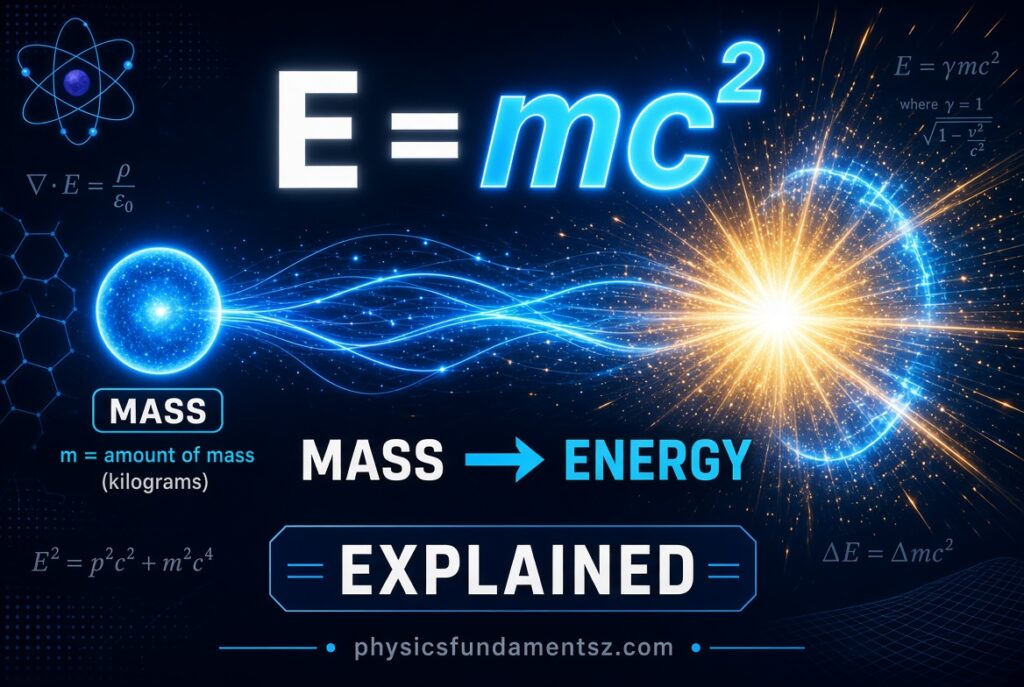
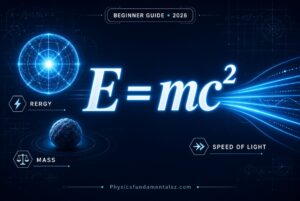
Mass energy equivalence means mass and energy are two forms of the same thing. Einstein’s formula E=mc² shows that a small amount of mass can convert into a huge amount of energy.
The conversion factor is c², the speed of light squared. Because c is so large, even a tiny mass loss releases an enormous amount of energy.
This single idea explains sunlight, nuclear power, atomic bombs, medical scans, and even tiny corrections inside your phone’s GPS chip.
Why Real-Life Examples Matter
Reading the formula E=mc² on a page does not make it feel real. Seeing it inside a nuclear reactor, a dying star, or a hospital scanner does.
Real-world examples turn an abstract equation into something you can picture. They also answer the question most students actually ask: where does this show up outside a textbook?
The sections below cover the most important categories, ranked from the most powerful to the most subtle.
1. Nuclear Power Plants
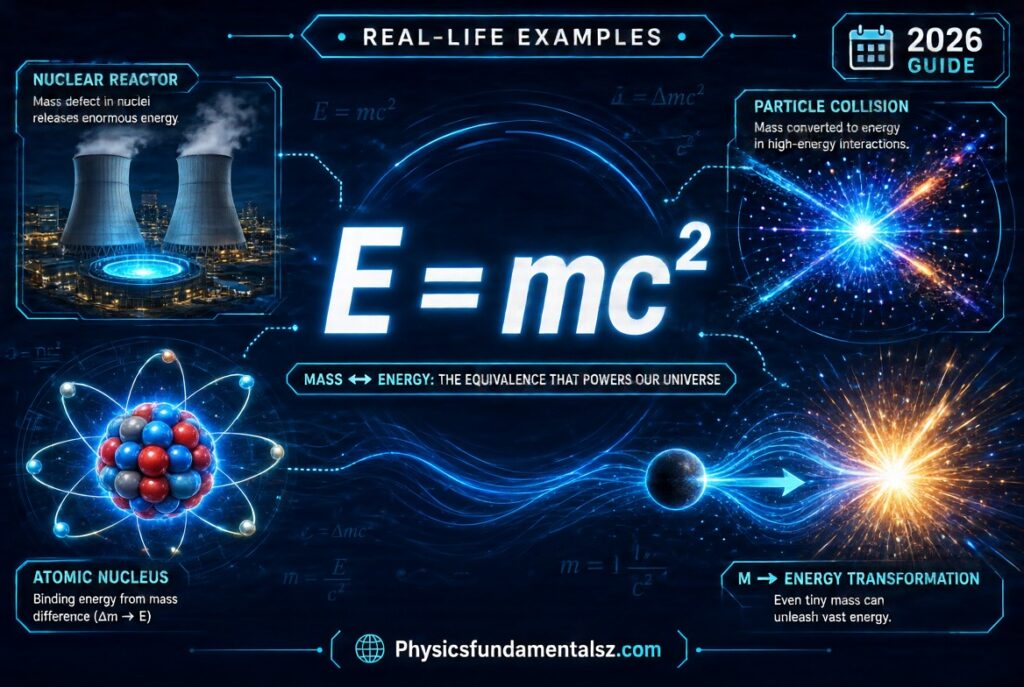
Nuclear power plants split heavy uranium or plutonium atoms in a process called fission. The resulting fragments weigh slightly less than the original nucleus.
That missing mass becomes heat, which boils water, spins a turbine, and generates electricity. A single fuel pellet the size of a fingertip can power a home for months.
This is one of the clearest mass energy equivalence real life examples because the mass loss is measurable and the output is visible on a power grid.
2. Nuclear Weapons
Atomic bombs use the same fission principle as power plants, but the reaction runs uncontrolled in a fraction of a second. Less than a gram of nuclear material was converted during the 1945 Hiroshima and Nagasaki explosions.
That tiny mass loss released energy equivalent to thousands of tons of TNT. It remains the most dramatic demonstration of E=mc² in human history.
Hydrogen bombs go further, using fusion instead of fission for an even larger mass-to-energy conversion.
3. The Sun and Stars
Every star, including the sun, is a giant fusion reactor. Hydrogen nuclei crush together under gravity and fuse into helium.
The helium produced weighs slightly less than the hydrogen that went into it. That mass difference radiates outward as sunlight and heat.
The sun converts roughly 4 million tons of mass into energy every single second, and it has been doing this for over 4.5 billion years.
4. PET Scans and Medical Imaging
Positron Emission Tomography, or PET scanning, relies directly on mass-energy equivalence. A radioactive tracer emits positrons, the antimatter twin of electrons.
When a positron meets an electron in the body, both particles annihilate completely into pure energy in the form of gamma rays. Scanners detect these rays to build a 3D image.
Doctors use this real-world application of E=mc² every day to detect cancer, heart disease, and brain disorders.
5. Particle Accelerators
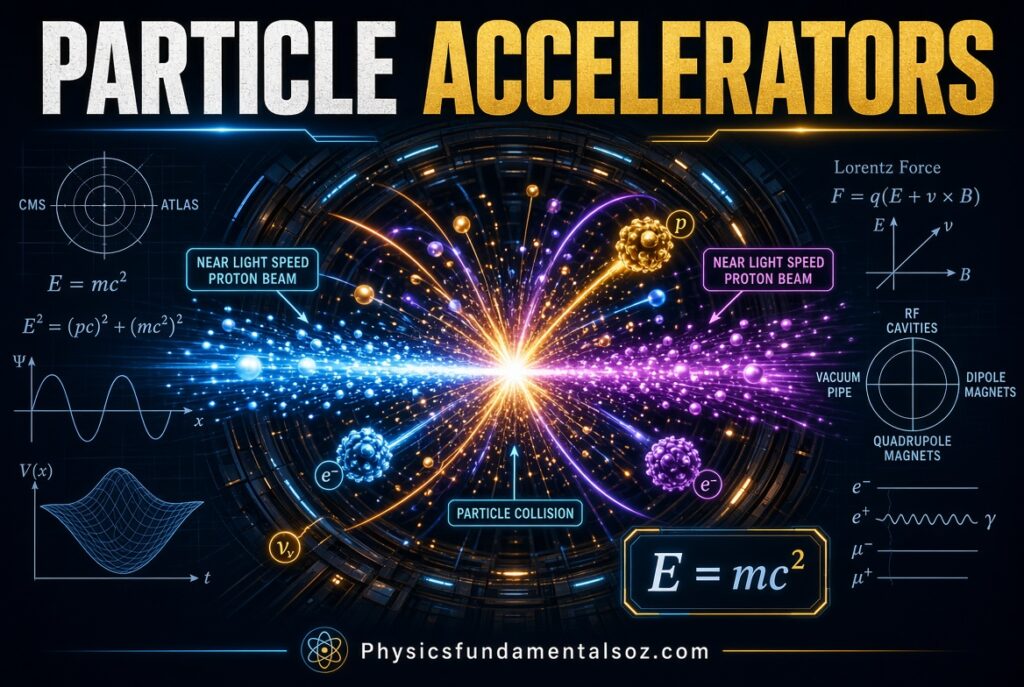
Machines like the Large Hadron Collider slam particles together at nearly the speed of light. The kinetic energy of the collision can convert into brand-new particles with mass.
This is mass-energy equivalence running in reverse: energy becoming mass instead of mass becoming energy. It is how physicists discovered the Higgs boson in 2012.
Accelerators prove that the relationship between mass and energy works in both directions, not just one.
6. Mass Defect and Nuclear Binding Energy
Every atomic nucleus weighs slightly less than the sum of its individual protons and neutrons. This missing mass is called the mass defect.
That defect is not lost. It became the binding energy that holds the nucleus together in the first place.
Engineers and physicists calculate mass defect to predict exactly how much energy a nuclear reaction will release before it ever happens.
7. Matter-Antimatter Annihilation
When a particle meets its antiparticle, both are destroyed and their entire combined mass converts into energy. There is no more efficient reaction known in physics.
This process happens naturally in PET scanners and in cosmic ray collisions high in the atmosphere. Scientists also recreate it in laboratories using particle traps.
Antimatter annihilation converts 100 percent of mass into energy, compared to less than 1 percent for typical fission reactions.
8. GPS Satellites and Relativity
GPS satellites orbit at high speed and experience weaker gravity than devices on the ground. Both effects shift how fast time passes for the satellite’s clock.
While this is mostly a time-dilation effect from relativity, it is built on the same framework that produced mass-energy equivalence. Without correcting for it, GPS location errors would grow by several miles per day.
This example shows how deeply Einstein’s relativity, including E=mc², is woven into everyday technology.
9. Everyday Chemical Reactions
Burning wood, charging a battery, or striking a match also involves tiny amounts of mass converting to energy. The scale is just far too small to measure with ordinary tools.
A campfire loses roughly one billionth of a gram of mass as it burns. Standard kitchen scales cannot detect a change that small.
This is why mass-energy equivalence feels invisible in daily life, even though it is technically happening around you constantly.
Comparison Table of Examples
| Example | Type of Reaction | Approximate Mass-to-Energy Efficiency |
|---|---|---|
| Nuclear power plant | Fission | About 0.1% of mass converted |
| Atomic bomb | Fission | About 0.1% to 1% of mass converted |
| The sun | Fusion | About 0.7% of mass converted |
| PET scan annihilation | Matter-antimatter | 100% of mass converted |
| Particle accelerator | Energy to mass | Reverse conversion |
| Chemical reaction (fire) | Chemical bonding | Roughly one-billionth of mass converted |
Common Mistakes People Make
Many learners assume mass-energy equivalence only applies to nuclear physics. In reality, it applies to every object and every reaction, just at scales too small to notice outside nuclear or particle physics.
Another common mistake is thinking mass “disappears.” It does not disappear; it transforms into energy, which is still tracked and conserved under the wider law of mass-energy conservation.
Expert Tips for Understanding E=mc² Faster
Start with the sun and nuclear power before tackling antimatter or particle accelerators. These two examples have the clearest, most visible outcomes.
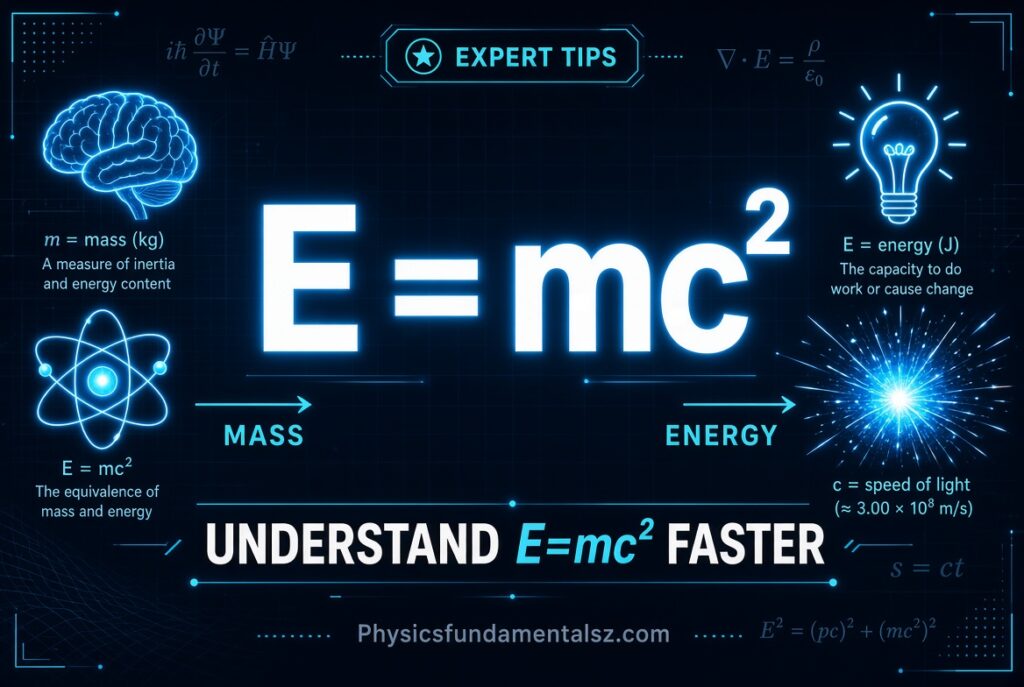
Picture c² as a massive multiplier, not just a number. That single mental shift explains why tiny masses release such enormous energy.
Use real masses and a calculator once the concept clicks. Converting one gram of matter and comparing it to a city’s daily power use makes the scale unforgettable.
Also Read:
- Mass-Energy Equivalence: E = mc² Derivation & Nuclear Applications
- E=mc2 Explained for Beginners (2026 Simple Guide)
- Nuclear Decay Equations: Alpha, Beta & Gamma Decay Explained
- Nuclear Decay Equations Explained Simply (2026 Beginner Guide)
- Half-Life Calculations: Formula & Worked Examples Explained
- Half Life Calculator With Steps: Formula, Examples & Full Guide 2026
- Photoelectric Effect Equation Explained (2026 Simple Guide)
- Photoelectric Effect Calculations: hf = work-function + KE_max
- Bohr Model of the Atom: Energy Levels, Emission & Absorption Spectra
- Quantum Numbers: n, l, m_l, m_s and Electron Configuration
- De Broglie Wavelength: λ = h/mv Formula, Derivation & Examples
- De Broglie Wavelength Calculator: Formula, Steps & Worked Examples 2026
- Heisenberg Uncertainty Principle: ΔxΔp ≥ ℏ/2 — Explained Simply
- What Is Energy?
- Kinetic Energy Calculator Physics: Formula, Steps & Real-World Examples 2026
- Conservation of Momentum
- What Is the Formula for Conservation of Momentum? 2026
- Momentum Calculator Physics: Formula, Steps & Worked Examples
- Newton’s Laws of Motion
- Projectile Motion: Complete Guide
- Projectile Motion Calculator With Angle: Formulas & Worked Examples 2026
- Electric Charge and Coulomb’s Law: F = kq₁q₂/r² Explained
- Coulomb’s Law Calculations: F = kQ1Q2/r² Formula & Examples
- Ideal Gas Law Calculator With Steps: PV = nRT Formula & Examples 2026
- Transverse Waves Explained
Frequently Asked Questions (FAQs)
What is mass-energy equivalence in simple terms?
Mass-energy equivalence means mass and energy are interchangeable forms of the same thing. Einstein’s formula E=mc² describes exactly how much energy a given mass represents.
What is the most famous real-life example of E=mc²?
The sun is usually considered the most famous example. It converts about 4 million tons of mass into energy every second through nuclear fusion.
Do nuclear power plants really use E=mc²?
Yes. Nuclear fission releases energy because the fission products weigh slightly less than the original uranium nucleus, and that lost mass becomes heat.
How much mass converts to energy in an atomic bomb?
Less than one gram of nuclear material converted during the Hiroshima bombing, yet it released energy equal to roughly 15,000 tons of TNT.
Does mass-energy equivalence apply to everyday objects?
Yes, technically it applies to everything. The mass changes in ordinary chemical reactions are just too small to measure with normal equipment.
Why does the sun not run out of mass quickly?
The sun is enormous, containing about 2 x 10^30 kilograms of mass. Even losing 4 million tons per second only depletes a tiny fraction of its total mass over billions of years.
What is mass defect?
Mass defect is the difference between the mass of a nucleus and the combined mass of its individual protons and neutrons. That missing mass equals the nuclear binding energy.
How do PET scans use mass-energy equivalence?
A PET scanner detects gamma rays produced when a positron and an electron annihilate. Their entire combined mass converts completely into energy during that collision.
Can energy convert back into mass?
Yes. Particle accelerators do this by smashing particles together at extremely high speeds, converting kinetic energy into new particles with mass.
What is the significance of c² in the equation?
c² is the speed of light squared, roughly 90 quadrillion in SI units. This huge multiplier explains why a small amount of mass equals a massive amount of energy.
Is E=mc² only relevant to nuclear physics?
No. It underlies fusion in stars, fission in reactors, particle physics, medical imaging, and even small relativistic corrections used in GPS technology.
How much energy is in one kilogram of matter?
One kilogram of matter, if fully converted, would release about 90 quadrillion joules. That is enough energy to power a large city for years.
Did Einstein discover this through experiments?
No. Einstein derived mass-energy equivalence mathematically in 1905 as a consequence of his special theory of relativity, not through direct experimentation.
What is the difference between fission and fusion?
Fission splits a heavy nucleus into smaller pieces, while fusion combines light nuclei into a heavier one. Both release energy because the products weigh less than the starting materials.
Why don’t we notice mass loss when burning fuel?
The mass converted during chemical combustion is far smaller than what any household scale can detect, often just a billionth of a gram.
Does GPS actually depend on E=mc²?
GPS depends more directly on time dilation from relativity than on mass-energy equivalence itself, but both come from the same theoretical framework Einstein developed.
What real-world technology proves E=mc² is correct?
Nuclear power plants, PET scanners, and particle accelerators all operate exactly as E=mc² predicts, which is strong ongoing experimental proof.
Is antimatter annihilation the most efficient energy source?
Yes. Matter-antimatter annihilation converts 100 percent of the mass into energy, far higher than fission or fusion reactions.
How is mass-energy equivalence used in astronomy?
Astronomers use it to calculate how stars generate energy, how supernovae release radiation, and how black holes and neutron stars form from mass compression.
What should a beginner study before mass-energy equivalence?
A beginner should first understand basic energy concepts and Newton’s laws of motion before moving into relativity and mass-energy equivalence.
Conclusion
Mass-energy equivalence is not confined to physics textbooks. It powers the sun, runs nuclear reactors, fuels hospital scanners, and even shapes the accuracy of GPS satellites overhead.
Once you connect E=mc² to these real examples, the equation stops feeling abstract. It becomes a working description of how energy actually moves through the universe.
Keep exploring the linked guides above to build a complete, connected understanding of modern physics from the ground up.