E=mc2 Explained for Beginners (2026 Simple Guide)
E=mc2 Explained for Beginners: You have seen it on t-shirts, chalkboards, and movie posters. E=mc2 is probably the most famous equation ever written, yet most people cannot explain what it actually says.
Table of Contents
What Is E=mc2?
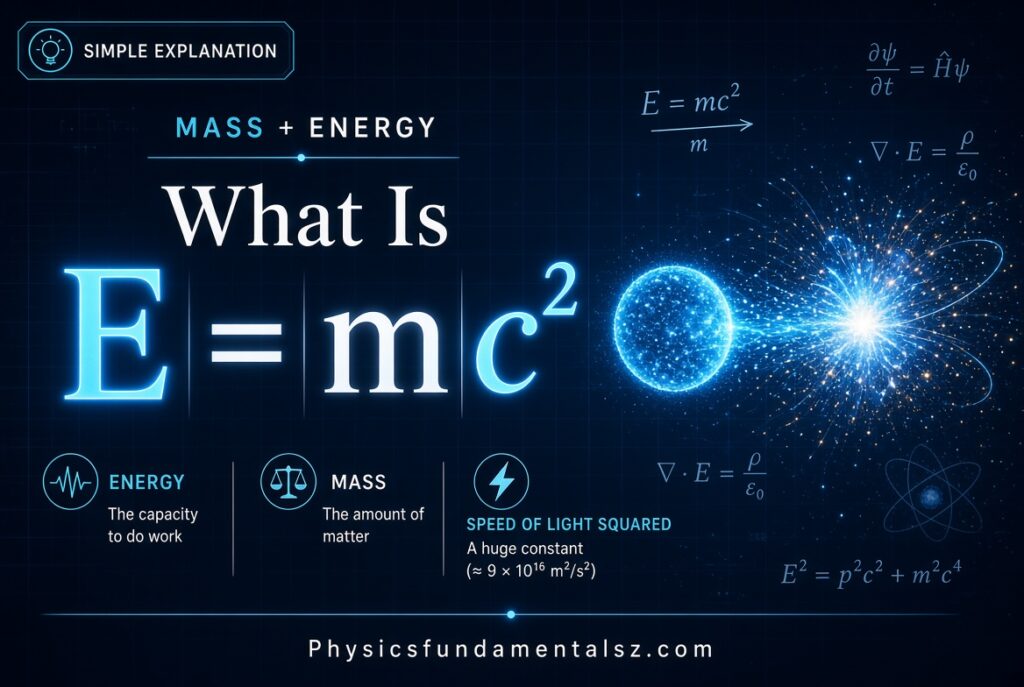
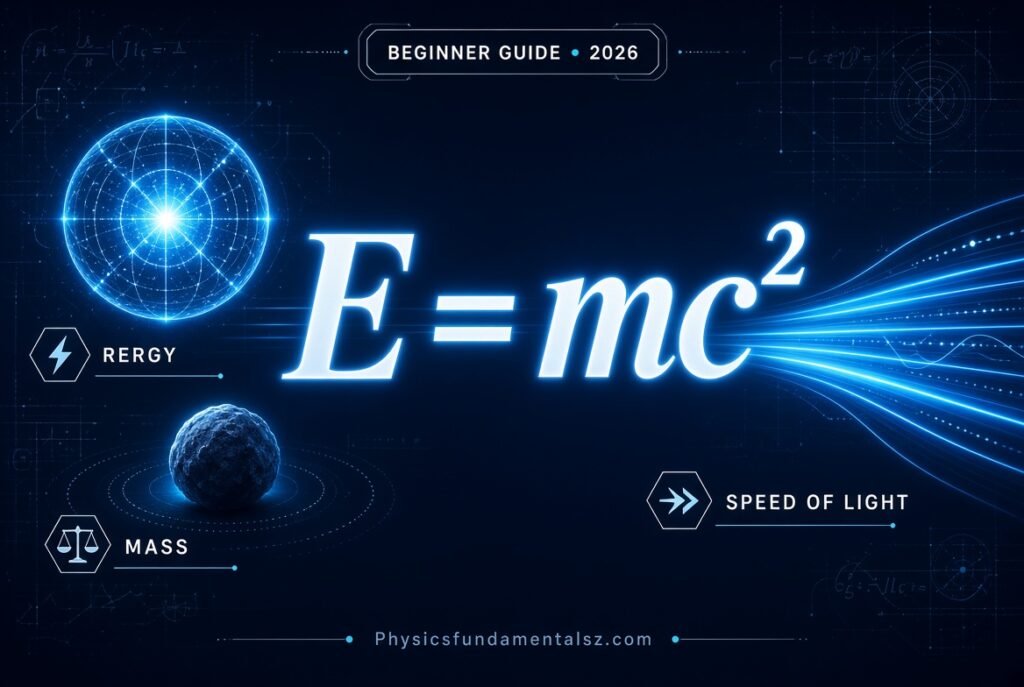
E=mc2 says that energy (E) and mass (m) are two forms of the same thing. You convert one into the other by multiplying mass by the speed of light squared (c2).
Even a tiny amount of mass equals a massive amount of energy, because the speed of light is such a large number.
This single idea, called mass-energy equivalence, explains everything from nuclear power to why stars shine.
What Does E=mc2 Actually Mean?
At its core, the equation says that mass and energy are the same physical entity and can change into each other. Before this idea, scientists thought mass and energy were two completely separate things.
Einstein showed they are really the same currency, just measured in different units. Mass is a “frozen” or highly concentrated form of energy.
Breaking Down Each Symbol: E, m, and c
Each letter in the formula stands for a specific physical quantity, and getting these right is the first step to understanding the whole idea.
- E stands for energy, measured in joules (J).
- m stands for mass, measured in kilograms (kg).
- c stands for the speed of light in a vacuum, about 299,792,458 meters per second.
- c² means the speed of light multiplied by itself, an enormous number.
Physicists treat the case of each letter as meaningful, so writing “e = MC²” instead of “E = mc²” would technically be incorrect.
Why C Is Squared
Squaring the speed of light turns an already huge number into an almost incomprehensibly larger one. That is the whole reason a small mass releases so much energy.
Think of it like a conversion rate between two currencies. If the exchange rate between “mass” and “energy” is roughly 90,000,000,000,000,000 joules per kilogram, one paperclip’s worth of mass would release enough energy to power a city for weeks if fully converted.
E=mc2 Explained for Beginners: A Short History of the Equation
E=mc2 did not appear out of nowhere. It grew out of a much bigger idea that Einstein was working through in 1905.
Einstein’s 1905 Papers
Einstein submitted his special relativity paper, “On the Electrodynamics of Moving Bodies,” in June 1905, and followed it three months later with a short paper asking whether the energy content of a body depends on how much inertia it has.
That second, three-page paper contained the seed of E=mc2, though the tidy symbolic form we use today came slightly later, in follow-up work.
Who Else Contributed
Einstein gets the credit, but he was not working in a vacuum. The idea that mass and energy are interchangeable existed before Einstein, even though he was the one who framed it precisely.
Other physicists of the era were circling similar ideas about electromagnetic mass and energy. Einstein’s contribution was tying it all together into one clean, universal law.
The Basic Idea: Mass and Energy Are the Same Thing
Before special relativity, mass and energy were treated as separate properties in physics. Einstein’s insight flipped that assumption completely.
Mass is essentially “congealed” or locked-up energy. Under the right conditions, that locked-up energy can be released and converted into heat, light, or motion.
Rest Energy Explained
Even an object sitting perfectly still on a table has energy locked inside it, simply because it has mass. In special relativity, the energy of a body at rest is equal to mc², so every object with mass carries “rest energy” that could, in principle, be converted into other forms of energy.
This was a radical idea. Nobody before Einstein imagined that a motionless brick was quietly storing an enormous amount of potential energy.
A Simple Example With Numbers
Picture lifting a book off a table and placing it on a higher shelf. That small increase in height very slightly increases its energy, and therefore its mass, by an amount too tiny to measure with ordinary scales.
A baseball thrown by a professional pitcher gains roughly seven-trillionths of a kilogram of extra mass from the energy of the throw, an amount far below what any instrument today can detect.
The effect is real, but at everyday energy levels, it is invisible. You only notice mass-energy conversion at nuclear scales.
How Scientists Derived E=mc2 (Simplified)
You do not need advanced calculus to follow the logic, only a willingness to think about energy and mass as interchangeable “units” of the same thing.
Special relativity starts from two rules: the laws of physics look the same for everyone moving at a constant speed, and light always travels at the same speed no matter how fast you are moving.
From those two rules, physicists worked out that adding energy to an object also adds mass to it, in a fixed ratio set by c². Add one unit of energy, and you add 1/c² units of mass. Flip that relationship around, and one unit of mass equals c² units of energy, which is exactly E=mc2.
Real-World Applications of E=mc2
This is not just a chalkboard curiosity. E=mc2 explains and powers several technologies you interact with, directly or indirectly, almost every day.
Nuclear Power Plants
Nuclear reactors split uranium atoms apart in a process called fission. The resulting particles weigh slightly less than the original atom, and that missing mass reappears as heat.
That heat boils water, spins turbines, and generates electricity for millions of homes.
Nuclear Weapons
The same mass-to-energy conversion that makes nuclear power possible also makes nuclear weapons possible. In both cases, matter is directly converted into energy.
The difference is speed and control: a reactor releases energy gradually, while a weapon releases it almost instantly.
The Sun and Every Other Star
Stars generate light and heat through nuclear fusion, fusing hydrogen into helium deep in their cores. The helium produced weighs slightly less than the hydrogen that made it.
That tiny missing mass, multiplied by c², is why the sun has been shining for roughly 4.6 billion years.
Medical Imaging and Nuclear Medicine
PET scans (positron emission tomography) rely directly on mass-energy equivalence. A radioactive tracer releases positrons that collide with electrons, and the pair annihilates completely into pure energy in the form of gamma rays.
Doctors detect those gamma rays to build detailed images of organs and tumors.
GPS Satellites and Particle Accelerators
Global positioning satellites move fast enough, and sit far enough from Earth’s gravity, that relativistic effects from Einstein’s broader theory must be corrected for every day, or GPS coordinates would drift by miles.
Particle accelerators like the Large Hadron Collider also rely on mass-energy equivalence, converting energy from collisions into brand-new particles with real mass.
Common Misconceptions About E=mc2
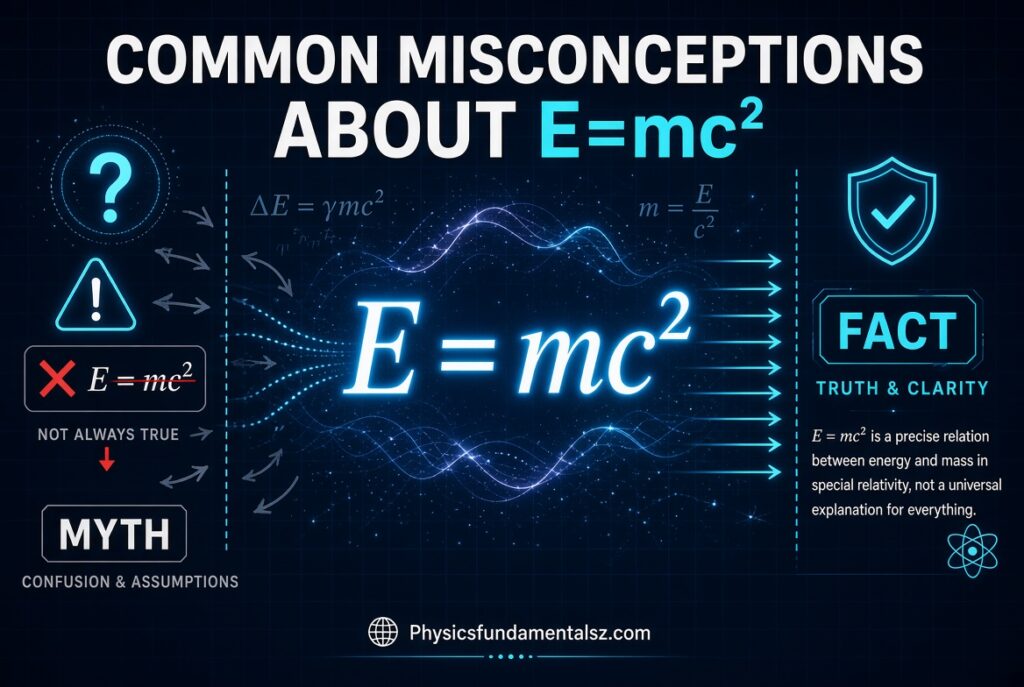
A few myths about this equation are so widespread that they are worth clearing up directly.
“It Only Applies to Nuclear Reactions”
E=mc2 applies to every object with mass, all the time, not just uranium atoms in a reactor. Ordinary chemical reactions convert mass to energy too, just in amounts far too small to notice.
“Mass Just Disappears Into Nothing”
Mass does not vanish. It transforms into another form of energy, such as heat, light, or kinetic energy, following the strict rule of conservation of energy.
“E=mc2 Means Nothing Can Travel Faster Than Light”
That rule comes from a related but different part of special relativity, not directly from this equation. E=mc2 itself is simply an accounting rule between mass and energy.
“Einstein Invented the Whole Idea From Scratch”
As covered above, related ideas about mass and energy circulated before 1905. Einstein’s real achievement was proving the relationship applies universally, to everything with mass.
E=mc2 vs Other Famous Physics Equations
| Equation | What It Describes | Field |
|---|---|---|
| E = mc² | Mass-energy equivalence | Special relativity |
| F = ma | Force equals mass times acceleration | Classical mechanics |
| E = ½mv² | Kinetic energy of a moving object | Classical mechanics |
| p = mv | Momentum of a moving object | Classical mechanics |
| ΔxΔp ≥ ℏ/2 | Limits on measuring position and momentum together | Quantum mechanics |
Quick Reference Table: Key Terms and Units
| Term | Symbol | Unit | Meaning |
|---|---|---|---|
| Energy | E | Joules (J) | The capacity to do work |
| Mass | m | Kilograms (kg) | The amount of matter in an object |
| Speed of light | c | Meters per second (m/s) | A universal constant, about 3 x 10⁸ m/s |
| Rest energy | mc² | Joules | Energy contained in mass at rest |
| Fission | — | — | Splitting a heavy atom to release energy |
| Fusion | — | — | Joining light atoms to release energy |
Step-by-Step: How to Calculate Energy Using E=mc2
Follow these steps whenever you want to convert a mass into its energy equivalent.
- Write down the mass in kilograms. For example, m = 0.001 kg (one gram).
- Square the speed of light: c² = (299,792,458 m/s)² ≈ 8.99 x 10¹⁶ m²/s².
- Multiply mass by c²: E = 0.001 x 8.99 x 10¹⁶.
- Read the result in joules: roughly 8.99 x 10¹³ joules, enough to power thousands of homes for a day.
Mistakes Beginners Make When Learning E=mc2
Watch out for these common stumbling blocks as you study the equation further.
- Forgetting to square the speed of light before multiplying.
- Mixing up mass (kilograms) with weight (a force measured in newtons).
- Assuming the equation only matters for physicists, not everyday technology.
- Believing the equation predicts what causes mass-energy conversion, when it only describes the ratio.
Expert Tips for Building Real Intuition
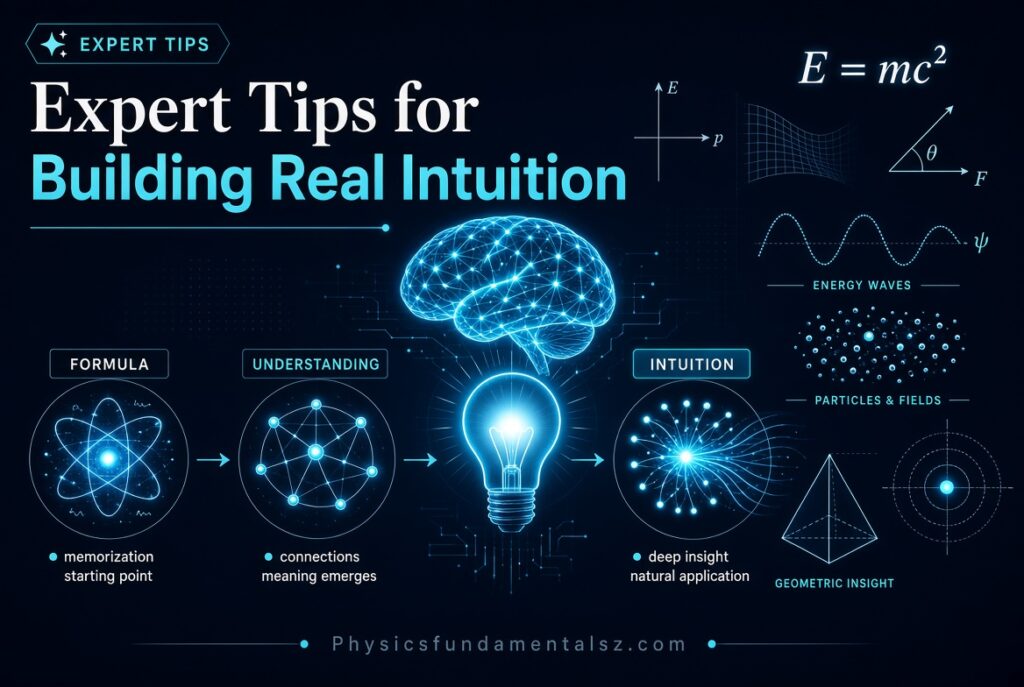
- Picture mass and energy as two currencies with a fixed, extreme exchange rate rather than as opposites.
- Start with rest energy before tackling the full relativistic energy equation used at high speeds.
- Practice with small, round numbers first, like one gram, before working with real isotopes.
- Connect the formula to something concrete, such as how the sun makes light, to make it stick.
Also Read:
- Mass-Energy Equivalence: E = mc² Derivation & Nuclear Applications
- What Is Energy?
- Newton’s Laws of Motion
- Conservation of Momentum
- Momentum Calculator Physics: Formula, Steps & Worked Examples
- Kinetic Energy Calculator Physics: Formula, Steps & Real-World Examples
- De Broglie Wavelength: λ = h/mv Formula, Derivation & Examples
- De Broglie Wavelength Calculator: Formula, Steps & Worked Examples
- Half-Life Calculations: Formula & Worked Examples Explained
- Half Life Calculator With Steps: Formula, Examples & Full Guide
- Nuclear Decay Equations: Alpha, Beta & Gamma Decay Explained
- Photoelectric Effect Calculations: hf = work-function + KE_max
- Bohr Model of the Atom: Energy Levels, Emission & Absorption Spectra
- Quantum Numbers: n, l, m_l, m_s and Electron Configuration
- Heisenberg Uncertainty Principle: ΔxΔp ≥ ℏ/2 — Explained Simply
- Electric Charge and Coulomb’s Law: F = kq₁q₂/r² Explained
- Coulomb’s Law Calculations: F = kQ1Q2/r² Formula & Examples
- Electric Potential Energy: E = kQq/r, Work Done & Worked Examples
- Capacitors and Capacitance: C = Q/V Formula, Energy Storage & Examples
- Ohm’s Law Calculator Solve for Current: Formula, Steps & Examples
- Ideal Gas Law Calculator With Steps: PV = nRT Formula & Examples
- Wave Speed, Frequency & Wavelength
- Wave Speed Calculator Frequency Wavelength: Formula, Steps & Worked Examples
- Transverse Waves Explained
- Projectile Motion Complete Guide
- Projectile Motion Calculator With Angle: Formulas & Worked Examples
Frequently Asked Questions (FAQs)
What does E=mc2 mean in simple terms?
It means energy and mass are two forms of the same thing, and you can convert between them by multiplying mass by the speed of light squared.
Who came up with E=mc2?
Albert Einstein introduced the idea in his 1905 papers on special relativity, building on earlier scientific work about mass and energy.
What does the “c” in E=mc2 stand for?
The letter c stands for the speed of light in a vacuum, roughly 299,792,458 meters per second.
Why is the speed of light squared in the equation?
Squaring c produces an enormous conversion factor, which is why even a tiny amount of mass equals a huge amount of energy.
Is E=mc2 only about nuclear bombs?
No. It applies to all matter and energy everywhere, including stars, power plants, medical scanners, and ordinary chemical reactions.
Can E=mc2 be used in everyday life?
Indirectly, yes. GPS satellites, nuclear power, and PET scans all rely on principles connected to mass-energy equivalence.
How much energy does one gram of mass contain?
About 8.99 x 10¹³ joules, roughly the energy released by a small nuclear explosion.
Does E=mc2 mean matter can be created from nothing?
No. Energy can convert into matter and back again, but total energy is always conserved; nothing is created from true nothing.
What is the difference between E=mc2 and kinetic energy?
E=mc2 describes rest energy stored in mass itself, while kinetic energy (½mv²) describes energy from motion. At everyday speeds, E=mc2 dominates the total.
Why did it take so long for scientists to discover this?
Mass and energy conversions are far too small to detect at everyday energy levels, so the effect stayed hidden until relativity theory revealed it mathematically.
Is E=mc2 proven?
Yes. It has been confirmed repeatedly through nuclear reactions, particle physics experiments, and precise measurements of mass loss during fission and fusion.
What happens to mass when energy is released?
The object’s rest mass decreases by an amount exactly equal to the energy released, divided by c squared.
Does E=mc2 apply to light itself?
Light has no rest mass, but it does carry energy and momentum, which is described by a related, more complete version of the equation.
How is E=mc2 used in nuclear power plants?
Fission splits heavy atoms into smaller ones that weigh slightly less; that missing mass converts into heat, which generates electricity.
How is E=mc2 connected to the sun?
The sun fuses hydrogen into helium, and the tiny mass lost in that process becomes the light and heat we feel on Earth.
Can humans ever use E=mc2 for space travel?
In theory, converting mass directly into energy could power spacecraft at close to light speed, but no practical technology exists to do this safely yet.
What is rest energy?
Rest energy is the energy an object has purely because it has mass, even while sitting completely still.
Is E=mc2 part of general relativity or special relativity?
It comes from special relativity, Einstein’s 1905 theory dealing with objects moving at constant speeds.
Why is E=mc2 considered so important in physics?
It unified two concepts, mass and energy, that scientists had always treated as completely separate, reshaping modern physics and technology.
What units does E=mc2 use?
Energy in joules, mass in kilograms, and the speed of light in meters per second, in the standard SI system.
Does E=mc2 explain black holes?
Not directly, but mass-energy equivalence is essential to general relativity, the theory that does explain how black holes form and behave.
How accurate is E=mc2 in real experiments?
Extremely accurate. Particle physics experiments confirm the relationship to a very high degree of precision, matching predicted mass and energy changes closely.
Conclusion
E=mc2 explained for beginners really comes down to one idea: mass and energy are the same thing, just measured differently.
Once that clicks, the equation stops looking like a mysterious formula and starts looking like a simple accounting rule between two forms of the same currency.
From power plants to the sun overhead, this one hundred-and-twenty-year-old idea still quietly powers the modern world.