Difference Between Fission and Fusion With Examples: How Splitting and Joining Atoms Release Energy 2026
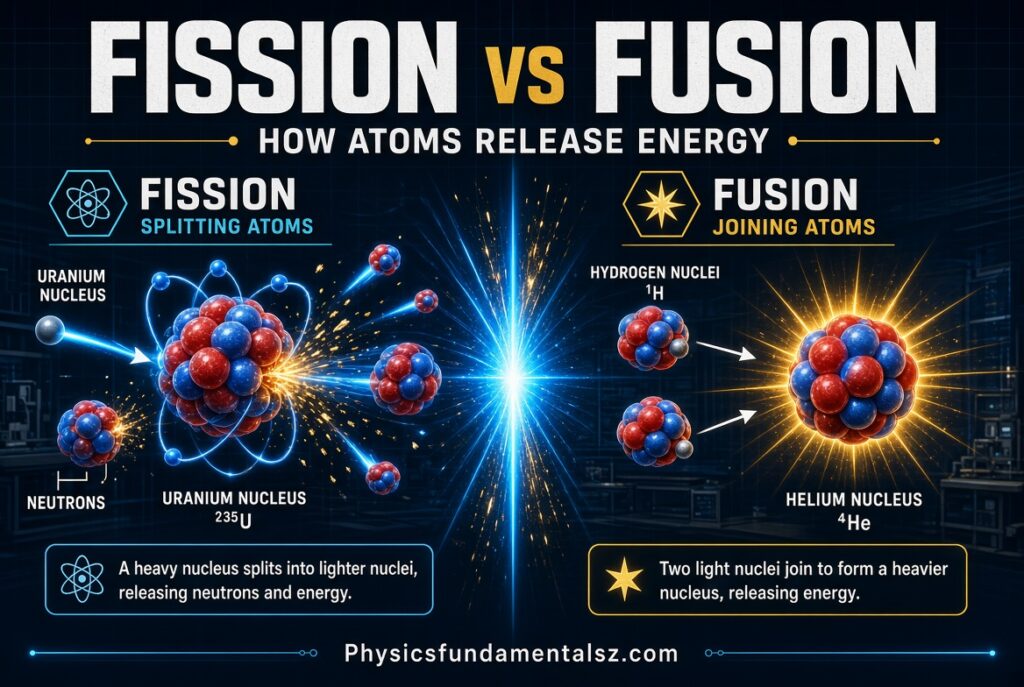
The difference between fission and fusion is simple to state. Fission splits one heavy nucleus into smaller nuclei. Fusion joins two light nuclei into a heavier one. Both processes release energy because the products are more tightly bound than the starting nuclei.
Nuclear power plants and the first atomic bombs use fission. The Sun, the stars, and hydrogen bombs use fusion. Experimental reactors such as ITER and the National Ignition Facility are trying to bring fusion to Earth as a clean power source.
The difference between fission and fusion with examples matters in physics class, in energy policy, and in the news. Fission is a mature technology that already supplies a large share of the world’s low-carbon electricity. Fusion is a scientific and engineering challenge that has produced real milestones but not yet a working power plant.
Table of Contents
Fission vs Fusion in One Table
Nuclear fission is the splitting of a heavy atomic nucleus, such as uranium-235, into two or more lighter nuclei, releasing energy and neutrons. Nuclear fusion is the combining of two light nuclei, such as deuterium and tritium, into a heavier nucleus, releasing energy.
| Feature | Nuclear fission | Nuclear fusion |
|---|---|---|
| What happens | A heavy nucleus splits | Light nuclei join together |
| Typical fuel | Uranium-235, plutonium-239 | Deuterium and tritium, or hydrogen |
| Energy per reaction | About 200 MeV | About 17.6 MeV (D-T) |
| Energy per kilogram of fuel | About 8 × 10¹³ J | About 3.4 × 10¹⁴ J (D-T) |
| Conditions needed | Neutrons, ordinary temperatures | More than 100 million °C |
| Chain reaction | Yes | No |
| Main example in nature | Oklo natural reactor | The Sun and other stars |
| Main use today | Nuclear power plants, submarines, weapons | Research reactors, hydrogen bombs |
| Long-lived waste | Yes, spent fuel and fission products | Much less, but activated materials remain |
| Meltdown risk | Possible without cooling | No runaway chain reaction |
| Commercial status | In use worldwide | Experimental |
What Is Nuclear Energy and Where Does It Come From?
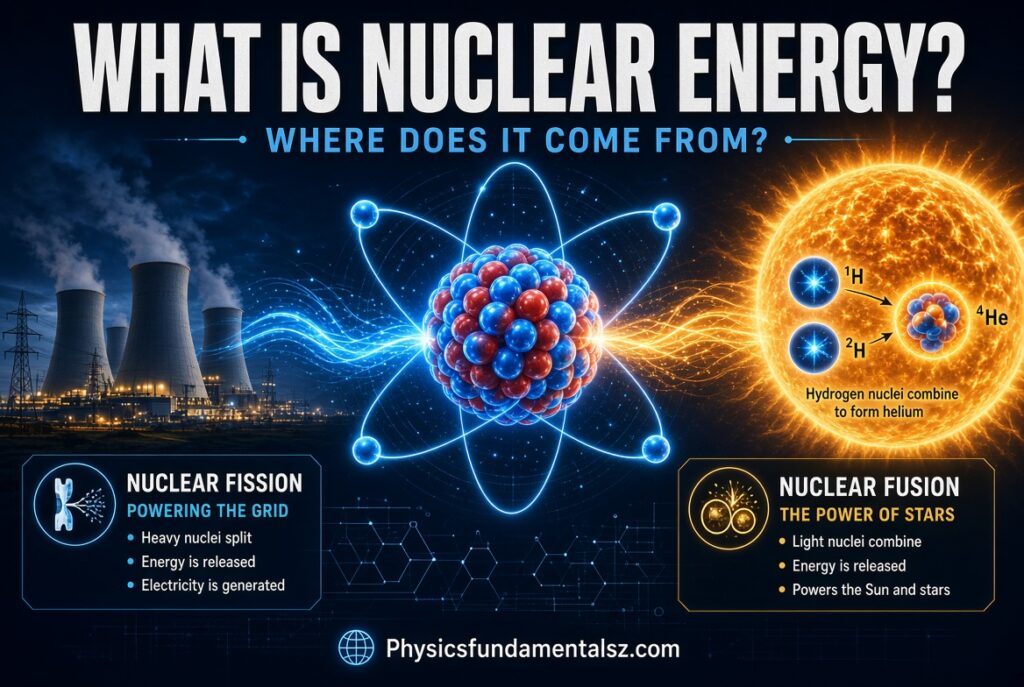
Nuclear energy is the energy stored in the nucleus of an atom. The nucleus holds protons and neutrons together against the repulsion between the positive protons. The force that does this is the strong nuclear force.
When a nucleus rearranges into a more stable form, some of that stored energy is released. Both fission and fusion are ways of doing that rearrangement.
Binding Energy and Mass Defect
The nucleus has a little less mass than the separate protons and neutrons that make it up. The missing mass is called the mass defect. It has been converted into the energy that binds the nucleus.
The energy equals the mass defect times the speed of light squared, from Einstein’s equation E = mc². The binding energy tells you how hard it would be to pull the nucleus apart.
Binding Energy Per Nucleon
To compare nuclei of different sizes, physicists divide the binding energy by the number of nucleons (protons plus neutrons). Nuclei with a higher binding energy per nucleon are more stable.
The curve of binding energy per nucleon rises quickly for light nuclei, peaks near iron-56 and nickel-62 at about 8.8 MeV per nucleon, and then falls slowly for heavy nuclei.
| Nucleus | Binding energy per nucleon (approx.) |
|---|---|
| Hydrogen-2 (deuterium) | 1.1 MeV |
| Hydrogen-3 (tritium) | 2.8 MeV |
| Helium-4 | 7.1 MeV |
| Iron-56 | 8.8 MeV |
| Barium-141, krypton-92 (fission products) | About 8.4 to 8.5 MeV |
| Uranium-235 | 7.6 MeV |
Why Both Processes Release Energy
Fission moves a heavy nucleus toward the peak. Uranium-235 sits at about 7.6 MeV per nucleon, and its fission products sit at about 8.5 MeV. The gain is roughly 0.9 MeV per nucleon, and across 235 nucleons that is about 200 MeV.
Fusion moves a light nucleus toward the peak from the other side. Helium-4 has far more binding energy per nucleon than hydrogen isotopes. The gain is large per nucleon, though fewer nucleons take part in each reaction.
The Role of E = mc²
The tiny mass lost in each reaction turns into kinetic energy of the products. In fission of uranium-235, about 0.2 atomic mass units disappear, which equals about 200 MeV. In D-T fusion, about 0.019 atomic mass units disappear, which equals about 17.6 MeV.
What Is Nuclear Fission?
Nuclear fission is a reaction in which a heavy nucleus splits into two or more smaller nuclei, called fission fragments. The reaction also releases free neutrons and a large amount of energy. It was discovered in 1938 by Otto Hahn and Fritz Strassmann, and explained by Lise Meitner and Otto Frisch.
Fission happens naturally in a few isotopes, but it is usually triggered by a neutron striking a fissile nucleus.
How Fission Works Step by Step
- A slow neutron is absorbed by a uranium-235 nucleus.
- The nucleus becomes uranium-236, which is unstable and wobbles like a liquid drop.
- The nucleus splits into two fragments, such as barium-141 and krypton-92.
- Two or three new neutrons are released.
- The fragments fly apart at high speed and heat the surrounding material.
- Gamma rays and radioactive decay add more heat.
A Typical Fission Equation
n + U-235 → Ba-141 + Kr-92 + 3n + energy
Check the numbers. The mass numbers on the left add to 236 (1 + 235). On the right they add to 236 (141 + 92 + 3). The atomic numbers balance too: 92 = 56 + 36.
This is only one of many possible outcomes. Fission of uranium-235 produces dozens of different fragment pairs.
Fissile vs Fertile Materials
A fissile isotope can split after absorbing a slow neutron. Uranium-235, plutonium-239, and uranium-233 are fissile.
A fertile isotope cannot fission easily, but it can absorb a neutron and turn into a fissile one. Uranium-238 turns into plutonium-239 this way. Thorium-232 turns into uranium-233.
The Chain Reaction
The neutrons released by one fission can trigger more fissions. This self-sustaining process is called a chain reaction. If each fission causes on average exactly one more fission, the reactor is critical and runs at a steady power.
If each fission causes more than one, the reaction grows. That is what happens in a nuclear weapon. If it causes fewer than one, the reaction fades.
Critical Mass
The critical mass is the smallest amount of fissile material that can sustain a chain reaction. If the sample is too small, too many neutrons escape from the surface before they hit another nucleus.
The critical mass depends on the material, its shape, purity, and surroundings.
Moderators and Control Rods
Fission neutrons come out fast, but uranium-235 captures slow neutrons far more easily. Reactors use a moderator such as water, heavy water, or graphite to slow the neutrons down.
Control rods made of neutron-absorbing materials such as boron, cadmium, or hafnium are pushed into the core to reduce the reaction rate. Pulling them out lets the reaction speed up.
Where the Energy Goes
About 200 MeV is released per fission. Most of it, roughly 168 MeV, is carried by the kinetic energy of the fragments. The rest goes to neutrons, gamma rays, and later radioactive decay of the fragments.
The fragments quickly slow down inside the fuel, and their motion becomes heat. That heat boils water and drives a steam turbine in a power plant.
What Is Nuclear Fusion?
Nuclear fusion is a reaction in which two light nuclei combine to form a heavier nucleus. The reaction releases energy because the new nucleus is more tightly bound than the original ones.
Fusion powers the Sun. In its core, hydrogen nuclei fuse into helium and give off the light and heat that make life on Earth possible.
The Coulomb Barrier
Nuclei carry positive charge, so they repel each other. To fuse, they must get close enough, about one femtometer apart, for the strong nuclear force to take over. This repulsion is called the Coulomb barrier.
At that distance, the electric potential energy between two protons is about 1.4 MeV. That is much more than the typical thermal energy of particles, even in very hot matter.
How Fusion Gets Around the Barrier
Two effects help. First, at high temperatures, a small fraction of particles move much faster than average. Second, quantum tunneling lets particles pass through the barrier even when they lack enough energy to go over it.
Together, these allow fusion to happen at temperatures far below what the barrier alone would demand. In the Sun’s core, the temperature is about 15 million kelvin, and fusion still works.
Why Fusion Needs Extreme Heat
On Earth, scientists cannot wait billions of years like the Sun does. They need much higher temperatures to get a useful reaction rate in a small machine. The easiest reaction, deuterium-tritium fusion, works best at around 100 to 200 million degrees Celsius.
At those temperatures, matter exists as plasma, a hot gas of charged particles. No solid container can touch it.
The Main Fusion Reaction for Power Plants
D + T → He-4 (3.5 MeV) + n (14.1 MeV)
Deuterium and tritium are both isotopes of hydrogen. The reaction produces a helium-4 nucleus and a fast neutron, together carrying 17.6 MeV of energy. The neutron carries most of it.
Other Fusion Reactions
| Reaction | Energy released | Notes |
|---|---|---|
| D + T → He-4 + n | 17.6 MeV | Easiest to ignite, makes fast neutrons |
| D + D → He-3 + n | 3.3 MeV | Needs higher temperature |
| D + D → T + p | 4.0 MeV | Needs higher temperature |
| D + He-3 → He-4 + p | 18.3 MeV | Makes few neutrons, He-3 is scarce |
| p + B-11 → 3 He-4 | 8.7 MeV | Almost no neutrons, very hard to ignite |
Fusion in the Sun
The Sun mostly fuses hydrogen into helium through the proton-proton chain. The net result is four protons becoming one helium-4 nucleus, along with positrons and neutrinos, releasing about 26.7 MeV.
The Sun converts about four million tonnes of mass into energy every second. Even so, it is a slow process per unit volume. The Sun’s core produces only a few hundred watts per cubic meter, similar to a compost heap. It works because the core is enormous.
Plasma Confinement
To get net energy from fusion, you must keep the fuel hot and dense long enough for enough reactions to occur. This is described by the Lawson criterion. For D-T fusion, the product of density, temperature, and confinement time must exceed a target value.
Scientists use three main approaches: magnetic confinement in tokamaks and stellarators, inertial confinement with lasers or pulsed power, and hybrid methods.
Difference Between Fission and Fusion: Detailed Comparison
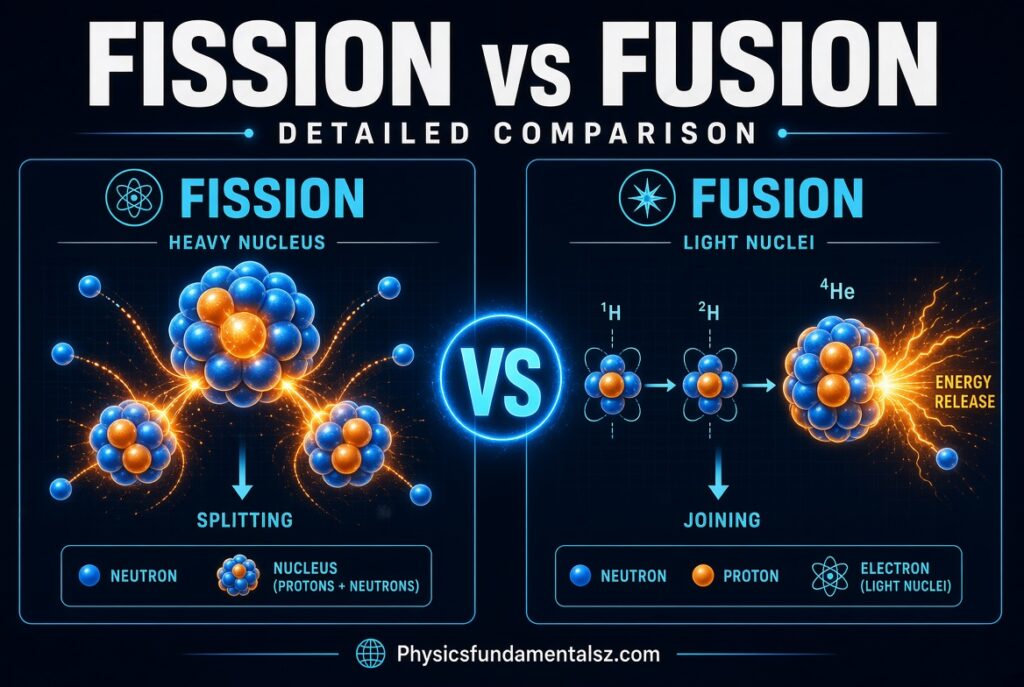
The table at the top gave the short version. Here is each difference explained in detail, with the reasoning behind it.
Difference in the Basic Process
Fission divides. A heavy nucleus absorbs a neutron, becomes unstable, and breaks into two medium-sized nuclei. Fusion unites. Two light nuclei overcome their repulsion and merge into one heavier nucleus.
Think of fission as cracking a large, overloaded structure into stable pieces. Think of fusion as pressing small pieces together until they lock.
Difference in Fuel
Fission uses heavy, rare, and radioactive elements. Uranium-235 makes up only about 0.7 percent of natural uranium, so it must be enriched for most reactors. Plutonium-239 is made inside reactors from uranium-238.
Fusion uses light elements. Deuterium is abundant in seawater, at about one hydrogen atom in 6,400. Tritium is rare in nature and must be bred from lithium inside the reactor.
Difference in Energy Released
One uranium-235 fission releases about 200 MeV. One deuterium-tritium fusion releases 17.6 MeV. Per reaction, fission wins by about a factor of 11.
Per kilogram of fuel, fusion wins. Fusion reactions involve very light nuclei, so a kilogram contains many more of them. D-T fuel releases roughly four times as much energy per kilogram as uranium-235.
| Measure | Fission (U-235) | Fusion (D-T) |
|---|---|---|
| Energy per reaction | About 200 MeV | 17.6 MeV |
| Energy per kilogram of fuel | About 8.2 × 10¹³ J | About 3.4 × 10¹⁴ J |
| Ratio per kilogram | 1 | About 4 |
| Compared with coal (24 MJ/kg) | About 3.4 million times | About 14 million times |
Difference in Conditions Required
Fission can happen at ordinary temperatures. A neutron is all it takes. A power reactor’s coolant runs at around 300°C, which is warm but not extreme.
Fusion needs temperatures of tens to hundreds of millions of degrees. The fuel must also be confined at high density long enough to react. That is why fusion is so hard to achieve on Earth.
Difference in Chain Reaction and Control
Fission can sustain itself through a chain reaction. Engineers control it with control rods and moderators. If control is lost, the reaction can run away and the core can overheat.
Fusion has no chain reaction. It continues only while the plasma stays hot, dense, and confined. If anything goes wrong, the plasma cools within seconds and the reaction stops.
Difference in Products
Fission produces two medium-mass fragments, free neutrons, and gamma rays. Many of the fragments are radioactive. Some last for decades or longer.
Fusion produces helium, a stable and harmless gas, along with fast neutrons. The neutrons can make the reactor walls radioactive over time, but the main product is not radioactive.
Difference in Radioactive Waste
Spent fission fuel contains fission products and heavy elements such as plutonium. Some stay hazardous for thousands of years. Handling and storing them is a major challenge.
Fusion waste is mostly activated structural material. Its radioactivity is expected to decay over decades to a century or so, depending on the materials chosen. Tritium, a radioactive fuel, must also be handled carefully.
Difference in Safety
Fission reactors need active and passive cooling systems. After shutdown, the fuel still produces decay heat. Accidents such as Three Mile Island, Chernobyl, and Fukushima showed what can happen when cooling fails.
Fusion reactors hold only a few grams of fuel in the chamber at any moment. They cannot melt down in the same way. Their hazards are tritium inventory and activated materials.
Difference in Natural Occurrence
Fission occurs naturally only in rare cases. About two billion years ago, natural reactors operated in what is now Oklo, Gabon. Fusion occurs everywhere in the universe, in every star.
Difference in Weapons
Fission powers atomic bombs. Fusion powers hydrogen bombs, which use a fission explosion to create the heat and pressure needed to trigger fusion. Modern thermonuclear weapons use both.
Difference in Current Status
Fission supplies about 9 percent of the world’s electricity and a large share of low-carbon power. Fusion has not yet produced net electricity. Research devices have achieved important milestones, but power plants are still years away.
Side-by-Side Comparison Table: 20 Differences
| No. | Point | Fission | Fusion |
|---|---|---|---|
| 1 | Definition | Splitting of a heavy nucleus | Joining of light nuclei |
| 2 | Typical fuel | U-235, Pu-239 | Deuterium, tritium |
| 3 | Fuel source | Mined and enriched uranium | Seawater and lithium |
| 4 | Energy per reaction | About 200 MeV | 17.6 MeV (D-T) |
| 5 | Energy per kg | About 8.2 × 10¹³ J | About 3.4 × 10¹⁴ J |
| 6 | Starting trigger | A neutron | Extreme heat and pressure |
| 7 | Temperature | Ordinary, coolant near 300°C | Over 100 million °C |
| 8 | Chain reaction | Yes | No |
| 9 | Moderator needed | Often | No |
| 10 | Control method | Control rods | Plasma conditions |
| 11 | Main products | Fragments, neutrons, gamma rays | Helium, neutrons |
| 12 | Radioactive waste | Long-lived | Shorter-lived |
| 13 | Meltdown risk | Yes | No |
| 14 | Greenhouse gas emissions in operation | None | None |
| 15 | Occurs in nature | Rarely (Oklo) | In every star |
| 16 | Weapons | Atomic bomb | Hydrogen bomb |
| 17 | Reactor example | Pressurized water reactor | Tokamak, stellarator |
| 18 | Fuel scarcity | Uranium is finite | Deuterium is abundant, tritium must be bred |
| 19 | Technology readiness | Commercial | Experimental |
| 20 | Proliferation concern | Higher | Lower |
Examples of Nuclear Fission
Fission is widely used. These examples cover energy, defense, science, and nature.
Example 1: Nuclear Power Plants
Commercial reactors split uranium-235 to heat water, make steam, and spin turbines. Hundreds of power reactors operate worldwide. In the United States, nuclear plants supply roughly one-fifth of the electricity.
The two newest U.S. units, Vogtle Units 3 and 4 in Georgia, began commercial operation in 2023 and 2024. They use the AP1000 pressurized water reactor design.
Example 2: Naval Reactors
Nuclear submarines and aircraft carriers use small fission reactors. They let ships run for years without refueling and without needing air for combustion. This is why nuclear submarines can stay submerged for months.
Example 3: The Hiroshima and Nagasaki Bombs
The bomb dropped on Hiroshima on August 6, 1945, used uranium-235 and released about 15 kilotons of TNT equivalent. The Nagasaki bomb on August 9 used plutonium-239 and released about 21 kilotons.
Less than one kilogram of the uranium in the Hiroshima bomb actually underwent fission. That is how powerful the process is.
Example 4: Breeder Reactors
Fast breeder reactors use fast neutrons to convert uranium-238 into plutonium-239. They can produce more fissile fuel than they consume. A few have operated, including prototypes in France, Russia, and Japan.
Example 5: Research Reactors and Medical Isotopes
Research reactors produce neutron beams for studying materials. They also make isotopes for medicine, such as molybdenum-99, which decays into technetium-99m. This isotope is used in millions of diagnostic scans every year.
Example 6: The Oklo Natural Reactors
About two billion years ago, uranium deposits in Gabon reached the conditions for sustained fission. Groundwater acted as a moderator. The reactors ran on and off for about 100,000 years or more. They are a natural example of a fission chain reaction.
Example 7: Induced Fission of Uranium-235
A slow neutron hits uranium-235 and it splits. One of many possible reactions is n + U-235 → Ba-141 + Kr-92 + 3n. Another is n + U-235 → Xe-140 + Sr-94 + 2n.
Example 8: Plutonium-239 Fission
Plutonium-239, made from uranium-238, also fissions with slow neutrons. It releases slightly more energy per fission than uranium-235 and produces more neutrons per fission, about 2.9 compared with about 2.4.
Example 9: Thorium Fuel Cycle
Thorium-232 absorbs a neutron and becomes uranium-233, which is fissile. India has long pursued thorium-based reactors because of its large thorium reserves.
Examples of Nuclear Fusion
Fusion is far more common in the universe but much rarer on Earth. These examples cover nature, weapons, and research.
Example 1: The Sun
The Sun fuses about 600 million tonnes of hydrogen into helium every second. The reaction is the proton-proton chain. About 4 million tonnes of mass become energy each second.
This energy has powered the Sun for about 4.6 billion years and will last for several billion more.
Example 2: Other Stars
Larger stars fuse hydrogen through the CNO cycle, which uses carbon, nitrogen, and oxygen as catalysts. When hydrogen runs out, stars fuse helium into carbon and oxygen. The most massive stars continue up to iron.
Elements heavier than iron cannot be made by fusion that releases energy. They are made in supernovae and neutron star mergers.
Example 3: Hydrogen Bombs
Thermonuclear weapons use a fission bomb to compress and heat fusion fuel. The first full test, Ivy Mike in 1952, yielded about 10.4 megatons. Castle Bravo in 1954 yielded about 15 megatons. The Soviet Tsar Bomba in 1961 reached about 50 megatons.
Example 4: Tokamaks
A tokamak uses a doughnut-shaped magnetic field to confine plasma. The design came from Soviet scientists in the 1950s. The Joint European Torus (JET) in the United Kingdom produced a record 69 megajoules of fusion energy over five seconds before it shut down in 2023.
Example 5: Stellarators
A stellarator uses twisted magnetic coils to confine plasma without a large current in the plasma. Wendelstein 7-X in Germany is the largest example and has set records for sustained plasma performance.
Example 6: The National Ignition Facility
In December 2022, the National Ignition Facility (NIF) in California used 192 laser beams to heat a small D-T fuel capsule. It produced 3.15 megajoules of fusion energy from 2.05 megajoules of laser energy on the target. That was the first time a fusion experiment produced more energy than the laser energy delivered to the target.
Later experiments have produced higher yields, including shots in the range of 5 to 8.6 megajoules. The facility’s lasers still draw far more energy from the grid than the fusion yield, so it does not produce net electricity.
Example 7: ITER
ITER is a large international tokamak under construction in southern France. Its goal is to produce about 500 megawatts of fusion power from about 50 megawatts of heating power, a gain of 10. Its schedule has been revised several times, and research operations are now planned for the mid-2030s.
Example 8: Private Fusion Companies
Companies such as Commonwealth Fusion Systems, Helion, TAE Technologies, and others are developing compact fusion designs. They use high-temperature superconducting magnets, pulsed systems, or alternative fuels. Their claims and timelines vary, and none has yet delivered net electricity.
Example 9: Fusors and Lab Devices
A fusor is a small table-top device that uses electric fields to accelerate ions into each other. Hobbyists and labs have built them. They achieve fusion in tiny amounts but use far more energy than they produce.
Worked Calculations: Fission vs Fusion Energy
Numbers make the comparison concrete. Here are the key calculations.
Calculation 1: Mass Defect in a Uranium-235 Fission
Use the reaction n + U-235 → Ba-141 + Kr-92 + 3n. Atomic masses in unified atomic mass units: neutron 1.008665, U-235 235.043930, Ba-141 140.914411, Kr-92 91.926156.
Mass before: 1.008665 + 235.043930 = 236.052595 u.
Mass after: 140.914411 + 91.926156 + 3 × 1.008665 = 235.866562 u.
Mass defect: 236.052595 − 235.866562 = 0.186033 u.
Energy: 0.186033 × 931.5 MeV/u ≈ 173 MeV.
The average over all fission outcomes, including later radioactive decays, is about 200 MeV.
Calculation 2: Energy From One Kilogram of Uranium-235
One fission releases about 200 MeV = 200 × 1.602 × 10⁻¹³ J = 3.2 × 10⁻¹¹ J.
Atoms in 1 kg of U-235: (1,000 g ÷ 235 g/mol) × 6.022 × 10²³ ≈ 2.56 × 10²⁴.
Energy: 2.56 × 10²⁴ × 3.2 × 10⁻¹¹ ≈ 8.2 × 10¹³ J.
That is about 82 terajoules, or 23 gigawatt-hours of heat.
Calculation 3: Comparing With Coal
Coal releases about 24 MJ per kilogram. Divide 8.2 × 10¹³ by 2.4 × 10⁷ and you get about 3.4 million. One kilogram of fully fissioned uranium-235 equals about 3,400 tonnes of coal.
Calculation 4: Mass Defect in D-T Fusion
Use D + T → He-4 + n. Masses: D 2.014102 u, T 3.016049 u, He-4 4.002603 u, n 1.008665 u.
Mass before: 5.030151 u.
Mass after: 5.011268 u.
Mass defect: 0.018883 u.
Energy: 0.018883 × 931.5 ≈ 17.6 MeV.
Calculation 5: Energy From One Kilogram of D-T Fuel
Each reaction consumes one deuteron and one triton, a total mass of about 5.03 u. Reactions per kilogram: 1 kg ÷ (5.03 × 1.6605 × 10⁻²⁷ kg) ≈ 1.2 × 10²⁶.
Energy per reaction: 17.6 MeV = 2.82 × 10⁻¹² J.
Total: 1.2 × 10²⁶ × 2.82 × 10⁻¹² ≈ 3.4 × 10¹⁴ J.
That is about four times the energy of fissioning the same mass of uranium-235.
Calculation 6: The Sun’s Energy Output
The Sun’s luminosity is about 3.8 × 10²⁶ W. Dividing by c² = 9 × 10¹⁶ m²/s² gives the mass converted per second: 3.8 × 10²⁶ ÷ 9 × 10¹⁶ ≈ 4.2 × 10⁹ kg/s, or about 4.2 million tonnes per second.
Calculation 7: How Many Fissions Power a 100 W Bulb for One Second?
Energy needed: 100 J. Energy per fission: 3.2 × 10⁻¹¹ J.
Fissions: 100 ÷ (3.2 × 10⁻¹¹) ≈ 3.1 × 10¹².
About three trillion fissions per second are needed. That sounds large, but it is a tiny amount of uranium, about 1.2 nanograms.
Calculation 8: The Coulomb Barrier Estimate
The electric potential energy of two protons at a distance r is U = (1.44 MeV·fm) ÷ r. At r = 1 fm, U = 1.44 MeV.
Thermal energy at 15 million kelvin is kT ≈ 1.3 keV. That is more than a thousand times smaller than the barrier. The Sun fuses protons anyway because of quantum tunneling and the high-energy tail of the particle distribution.
Types of Fission Reactors
Not all fission reactors are the same. They differ in fuel, moderator, and coolant. Knowing the main types gives a clearer picture of how fission power works in practice.
Pressurized Water Reactor (PWR)
The PWR is the most common type. Ordinary water acts as both moderator and coolant. It is kept under high pressure so it does not boil in the core. Hot water from the core transfers heat to a separate loop that makes steam.
Boiling Water Reactor (BWR)
In a BWR, the water boils in the core itself, and the steam goes straight to the turbine. The design is simpler, but the turbine handles slightly radioactive steam.
CANDU Reactor
The CANDU design, developed in Canada, uses heavy water as moderator and natural uranium as fuel. Heavy water absorbs fewer neutrons, so no enrichment is needed.
Fast Breeder Reactor
A fast reactor has no moderator. Fast neutrons convert uranium-238 into plutonium-239, so the reactor can make more fuel than it uses. Liquid sodium is a common coolant.
Small Modular Reactors (SMRs)
SMRs are smaller reactors, often built in a factory and shipped to a site. Designers hope they will cut construction cost and time. Several designs are under development or in early deployment.
| Reactor type | Moderator | Coolant | Fuel |
|---|---|---|---|
| PWR | Light water | Light water | Enriched uranium |
| BWR | Light water | Light water | Enriched uranium |
| CANDU | Heavy water | Heavy water | Natural uranium |
| Fast breeder | None | Liquid metal (often sodium) | Plutonium and uranium |
| Graphite-moderated | Graphite | Gas or water | Natural or enriched uranium |
The Nuclear Fuel Cycle
Fission fuel goes through several stages from mine to storage. Each one has its own cost, safety, and policy questions.
Mining and Milling
Uranium ore is mined and chemically processed into a concentrate called yellowcake. Kazakhstan, Canada, and Australia are among the largest producers.
Enrichment and Fuel Fabrication
Natural uranium has about 0.7 percent uranium-235. Enrichment raises this to 3 to 5 percent for most power reactors. Some advanced designs use high-assay low-enriched uranium (HALEU) at 5 to 20 percent. The enriched uranium is made into ceramic pellets and loaded into metal tubes called fuel rods.
In the Reactor
Fuel assemblies stay in the core for several years. As the uranium-235 is used up, fission products build up and reduce the reaction rate. Part of the fuel is replaced at regular intervals.
Spent Fuel
Spent fuel is very radioactive and hot. It is first stored in water pools for several years, then often moved to dry casks. Some countries reprocess it to recover plutonium and uranium. Others plan to store it deep underground.
How a Fusion Power Plant Would Work
Fusion plants do not exist yet, but the main ideas are well studied. A plant would heat fuel to extreme temperatures, confine it, capture the neutron energy, and breed tritium.
Magnetic Confinement: Tokamaks and Stellarators
Charged particles follow magnetic field lines. A donut-shaped magnetic cage keeps hot plasma away from the walls. Tokamaks use a plasma current to help shape the field. Stellarators use twisted external coils instead.
Modern designs use superconducting magnets, which carry current with almost no resistance. New high-temperature superconductors allow stronger fields and smaller machines.
Inertial Confinement
Inertial confinement compresses a tiny fuel pellet very quickly with lasers or other drivers. The fuel reaches high density and temperature for a fraction of a nanosecond, long enough for fusion to occur before the pellet flies apart. The National Ignition Facility uses this approach.
The Lawson Criterion and Gain
The Lawson criterion sets the conditions for net energy. For D-T fusion, the triple product of density, temperature, and energy confinement time needs to exceed roughly 3 × 10²¹ keV·s/m³.
The fusion gain, Q, is the ratio of fusion power to heating power. Q = 1 is called scientific breakeven. Q greater than 1 means the plasma gives out more fusion energy than the heating put in. A power plant needs a much higher Q and must also account for the energy used by the whole facility.
Tritium Breeding
Tritium has a half-life of about 12.3 years, so it does not occur naturally in useful amounts. A fusion plant would breed it by surrounding the plasma with lithium. A neutron striking lithium-6 makes helium and tritium: n + Li-6 → He-4 + T.
The plant must breed at least as much tritium as it burns. This is one of the main engineering challenges.
Turning Heat Into Electricity
Neutrons from D-T fusion carry about 80 percent of the energy. They deposit it as heat in a blanket around the plasma. A coolant carries the heat to a steam generator and turbine, just as in a fission plant.
Safety: Fission vs Fusion
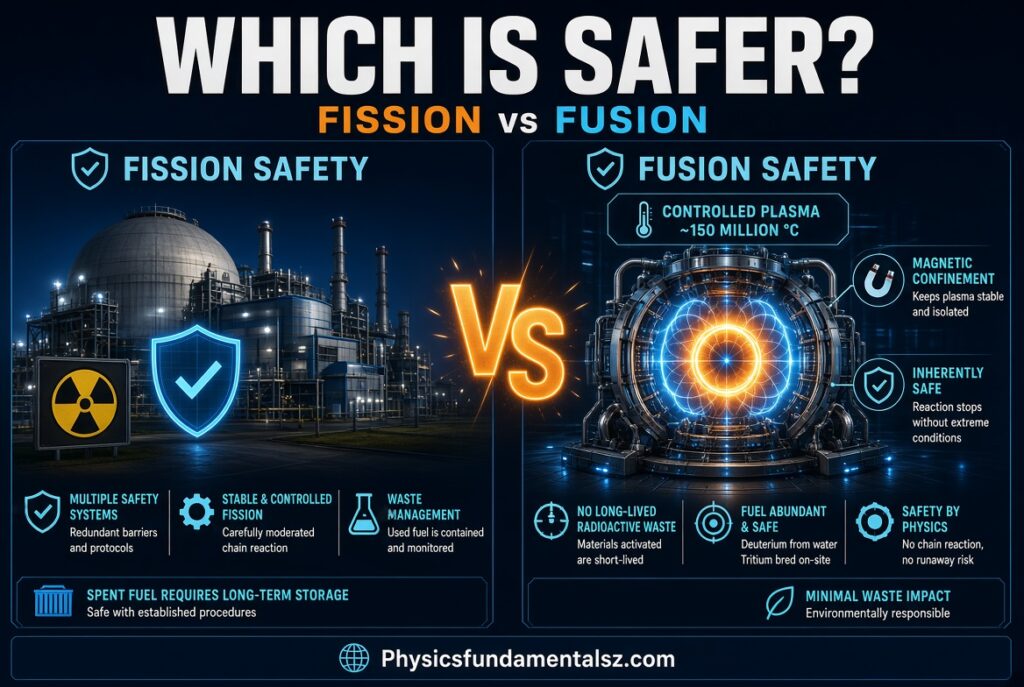
Safety is one of the biggest differences between the two. The risks come from different physics.
Fission Safety Challenges
A fission core holds many tonnes of fuel and a huge inventory of radioactive material. Even after the chain reaction stops, the fission products keep producing decay heat. Cooling must continue for days.
If cooling fails, fuel can overheat and melt. Modern designs add passive safety systems that work without power or operator action.
Notable Fission Accidents
| Accident | Year | What happened |
|---|---|---|
| Three Mile Island, USA | 1979 | Partial core meltdown, small off-site release |
| Chernobyl, Ukraine | 1986 | Explosion and fire, large release, rated level 7 |
| Fukushima Daiichi, Japan | 2011 | Tsunami disabled cooling, three cores melted, rated level 7 |
These accidents led to major safety reforms. Nuclear power still has one of the lowest death rates per unit of energy produced, according to many comparative studies, though accidents have serious local and long-term effects.
Fusion Safety Features
Fusion cannot run away. The plasma is so thin that the reactor holds only a few grams of fuel at a time. If something fails, the plasma cools and the reaction stops within seconds.
There is no chain reaction and no decay-heat meltdown scenario like in fission.
Fusion Hazards That Remain
The main hazards are tritium, which is radioactive and can leak, and the activation of reactor materials by neutrons. Designers are working on low-activation steels and other materials to limit this.
Nuclear Waste: Fission vs Fusion
Waste is another sharp contrast. It is one of the main reasons many people are interested in fusion.
Fission Waste
Fission produces fission products and heavy elements called actinides. Some isotopes decay quickly, while others last a long time.
| Isotope | Half-life | Notes |
|---|---|---|
| Iodine-131 | About 8 days | Health concern in accidents |
| Strontium-90 | About 29 years | Behaves like calcium in the body |
| Cesium-137 | About 30 years | Spreads widely in accidents |
| Plutonium-239 | About 24,100 years | Fissile, long-lived |
| Technetium-99 | About 211,000 years | Weakly radioactive, long-lived |
High-level waste needs long-term isolation. Several countries are building deep geological repositories. Finland’s Onkalo repository is the most advanced example.
Fusion Waste
Fusion does not create fission products. Its direct product, helium, is inert. But neutrons make reactor components radioactive, mostly with isotopes that decay in decades. Careful material choice can reduce the long-term burden.
Tritium as a Fuel and a Waste
Tritium is both a fuel and a radioactive substance. Its half-life of about 12.3 years means it decays fairly fast. Plants would recycle it in a closed loop, but they must manage leaks and permeation through metals.
Environmental Impact and Climate
Both fission and fusion produce no carbon dioxide during operation. They differ in mining, waste, and land use.
Carbon Emissions
Fission plants emit very little carbon over their life cycle, mainly from mining, construction, and fuel processing. Life-cycle studies place nuclear among the lowest-emission sources, comparable to wind and below solar in many analyses.
Fusion plants would also have near-zero operating emissions. Their life-cycle emissions would depend on construction materials and fuel supply.
Land and Resource Use
Nuclear plants use little land for the energy they produce. Fission needs uranium mining, which has its own environmental effects. Fusion needs lithium for tritium breeding and rare materials for magnets and walls.
Water Use
Both types of plant produce heat and need cooling. Many use river, lake, or sea water. Dry cooling is possible but less efficient.
Advantages and Disadvantages of Nuclear Fission
| Advantages | Disadvantages |
|---|---|
| Proven technology, in use for decades | Produces long-lived radioactive waste |
| Reliable, round-the-clock power | Risk of accidents and meltdowns |
| Very low carbon emissions in operation | High construction cost and long build times |
| Very high energy density | Uranium mining and finite resource |
| Small land footprint | Proliferation risk from enrichment and reprocessing |
| Supports grid stability | Public concern and political opposition |
Advantages and Disadvantages of Nuclear Fusion
| Advantages | Disadvantages |
|---|---|
| Abundant fuel from seawater and lithium | Not yet commercially available |
| No chain reaction, no meltdown | Extreme conditions are hard to maintain |
| No long-lived high-level waste | Neutron damage to reactor walls |
| Very high energy per kilogram | Tritium supply and handling |
| No carbon emissions in operation | Very high research and construction costs |
| Lower proliferation risk | Net electricity still unproven |
Fission vs Fusion in Nuclear Weapons
Both reactions are used in weapons, but in different ways. The physics is the same as in the reactors, but without control.
Fission Weapons
An atomic bomb brings fissile material together in a supercritical mass. A gun-type design shoots one piece of uranium-235 into another. An implosion design uses conventional explosives to squeeze a plutonium-239 core.
The chain reaction grows exponentially for a fraction of a microsecond, and the core blows itself apart.
Fusion Weapons
A hydrogen bomb has two stages. A fission explosion releases X-rays that compress and heat fusion fuel, often lithium deuteride. Fusion then releases energy and fast neutrons, which can cause extra fission in a surrounding uranium jacket.
This fission-fusion-fission design is how the largest bombs reach megaton yields.
Why Weapon Physics Matters for Energy
The difference shows an important point. Fission can be made explosive by sustaining a chain reaction. Fusion needs a fission trigger or a huge laser to start, and a power plant’s fusion process is nothing like a bomb.
Current Status and Future of Fission and Fusion
The two technologies sit at very different stages. Understanding where each stands helps you judge news stories about them.
Where Fission Stands Today
Fission supplies about a tenth of the world’s electricity. Countries such as France rely on it for most of their power. Several nations are building new reactors, extending the life of old ones, and developing small modular reactors.
Challenges include cost, construction delays, waste policy, and public acceptance.
Where Fusion Stands Today
Fusion has reached important scientific milestones. The National Ignition Facility has repeatedly produced more fusion energy than the laser energy delivered to the fuel. JET set an energy record for magnetic confinement. Chinese tokamaks have held plasma for long durations.
ITER is under construction and aims to show a gain of 10. A commercial power plant would still need to prove continuous operation, tritium breeding, durable materials, and competitive cost.
Timelines
Fusion timelines have repeatedly slipped. Many private companies aim for pilot plants in the 2030s. Government programs often point to the 2040s or later for commercial power. Treat any specific date with caution.
Do We Have to Choose?
No. Most energy planners see fission as a near-term source of low-carbon power and fusion as a possible long-term addition. Some concepts even combine them, such as fusion-fission hybrids that use fusion neutrons to burn nuclear waste.
Common Misconceptions About Fission and Fusion
Several ideas about nuclear energy are widely believed but not accurate. Clearing them up helps.
“Fusion Is Just Fission in Reverse”
Not exactly. Both release energy, but they move toward the same peak in binding energy from opposite sides. They involve different forces, fuels, and conditions.
“Fusion Produces No Radioactive Material”
Fusion makes very little long-lived waste, but it does use radioactive tritium and activates reactor materials. The waste problem is smaller, not zero.
“Fission Reactors Can Explode Like Atomic Bombs”
A power reactor cannot explode like a nuclear bomb. Its fuel is enriched to only a few percent, which cannot sustain a rapid explosive chain reaction. Accidents can still cause steam or hydrogen explosions and release radioactivity.
“Fusion Is Always Thirty Years Away”
That joke reflects past delays, but real progress has been made. Ignition at NIF and record plasma performance in several devices show the science works. The challenge now is engineering and economics.
“The Sun Is Burning Like a Fire”
The Sun does not burn in the chemical sense. It does not use oxygen. It shines because of nuclear fusion in its core.
Practice Problems With Answers
Try these before checking the answers.
Problem 1
Is the reaction n + U-235 → Ba-141 + Kr-92 + 3n a fission or a fusion reaction? Check that the mass numbers balance.
Answer: It is fission. Left side: 1 + 235 = 236. Right side: 141 + 92 + 3 = 236. The mass numbers balance.
Problem 2
Is D + T → He-4 + n a fission or a fusion reaction? Does the mass number balance?
Answer: It is fusion. Left: 2 + 3 = 5. Right: 4 + 1 = 5. The mass numbers balance.
Problem 3
A fusion reaction has a mass defect of 0.0189 u. How much energy is released in MeV?
Answer: 0.0189 × 931.5 ≈ 17.6 MeV.
Problem 4
How many fissions per second are needed for a reactor producing 3,000 MW of heat, if each fission releases 3.2 × 10⁻¹¹ J?
Answer: 3 × 10⁹ J/s ÷ 3.2 × 10⁻¹¹ J = about 9.4 × 10¹⁹ fissions per second.
Problem 5
Approximately how much uranium-235 does that reactor fission in one day?
Answer: Fissions per day: 9.4 × 10¹⁹ × 86,400 ≈ 8.1 × 10²⁴. Moles: 8.1 × 10²⁴ ÷ 6.022 × 10²³ ≈ 13.5 mol. Mass: 13.5 × 235 g ≈ 3.2 kg per day.
Problem 6
Name two differences in fuel between fission and fusion.
Answer: Fission uses heavy elements such as uranium-235 and plutonium-239. Fusion uses light elements such as deuterium and tritium. Fission fuel is mined and enriched. Fusion fuel comes from seawater and lithium.
Problem 7
Why does a fission chain reaction need a moderator in many reactors?
Answer: Fission neutrons are fast, while uranium-235 absorbs slow neutrons much more readily. A moderator slows the neutrons to thermal energies so they can cause more fissions.
Problem 8
Why can a fusion reactor not melt down like a fission reactor?
Answer: The plasma holds only a tiny amount of fuel and there is no chain reaction. If confinement fails, the plasma cools quickly and fusion stops. There is also no large inventory of fission products producing decay heat.
Energy Density: How Nuclear Fuels Compare With Chemical Fuels
Nuclear reactions release millions of times more energy per kilogram than chemical reactions. This table shows the scale. Values are approximate.
| Fuel | Energy per kilogram | Compared with coal |
|---|---|---|
| Coal | About 24 MJ | 1 |
| Natural gas | About 55 MJ | About 2 |
| Gasoline | About 46 MJ | About 2 |
| Hydrogen (burned) | About 120 MJ | About 5 |
| Uranium-235 (fully fissioned) | About 82,000,000 MJ | About 3,400,000 |
| Deuterium-tritium (fully fused) | About 340,000,000 MJ | About 14,000,000 |
Why the Gap Is So Large
Chemical reactions rearrange electrons, which carry energy of a few electron-volts per atom. Nuclear reactions rearrange the nucleus, which carries energy of millions of electron-volts per reaction. That is a million-fold difference per reaction.
This is why a small amount of nuclear fuel can power a city. It is also why the safety and security rules around nuclear materials are so strict.
Timeline of Key Discoveries in Fission and Fusion
The history of the two reactions shows how the science developed.
| Year | Event |
|---|---|
| 1905 | Einstein publishes E = mc² |
| 1920 | Arthur Eddington suggests stars shine by fusing hydrogen |
| 1932 | James Chadwick discovers the neutron |
| 1938 | Hahn and Strassmann find fission in uranium |
| 1939 | Meitner and Frisch explain fission, and Hans Bethe describes stellar fusion |
| 1942 | Enrico Fermi’s team starts the first controlled chain reaction, Chicago Pile-1 |
| 1945 | First atomic bomb tests and use in war |
| 1951 | Experimental Breeder Reactor I produces the first electricity from fission |
| 1952 | First hydrogen bomb test, Ivy Mike |
| 1954 | The Obninsk plant in the Soviet Union connects to a grid |
| 1985 | ITER is proposed at a summit between the United States and the Soviet Union |
| 2006 | ITER partners sign the agreement to build it |
| 2022 | NIF achieves fusion ignition |
How to Remember the Difference Between Fission and Fusion
A few simple tricks make the two terms easy to keep straight.
Word Clues
Fission sounds like “fissure,” a crack or split. Fusion sounds like “fuse,” as in joining things together. A heavy nucleus splits in fission. Light nuclei fuse in fusion.
The Size Rule
Heavy nuclei undergo fission. Light nuclei undergo fusion. The dividing line is iron. Below it, fusion releases energy. Above it, fission releases energy.
The Place Rule
Fission happens in reactors on Earth. Fusion happens in the Sun. Experimental fusion machines try to copy the Sun.
Fission vs Fusion vs Radioactive Decay
Students often confuse fission with radioactive decay. Both involve unstable nuclei, but they differ.
| Feature | Radioactive decay | Fission | Fusion |
|---|---|---|---|
| Trigger | Spontaneous | Usually a neutron | High temperature and pressure |
| Change in nucleus | Emits alpha, beta, or gamma | Splits into two large fragments | Merges into a heavier nucleus |
| Rate control | Fixed by half-life | Controlled by neutron flux | Controlled by plasma conditions |
| Energy per event | Small, about 1 to 10 MeV | About 200 MeV | About 3 to 20 MeV |
| Example | Uranium-238 alpha decay | Uranium-235 with a neutron | Deuterium plus tritium |
Spontaneous Fission
Some heavy nuclei, such as californium-252, can split on their own without a neutron. This is spontaneous fission. It is a rare form of decay and is used in some neutron sources.
Why We Cannot Simply Use Fusion Bombs for Power
Hydrogen bombs prove fusion works at scale, so people often ask why we cannot use them for energy. The answer is that bombs release energy all at once and need a fission trigger.
Controlled vs Uncontrolled Release
A power plant needs a steady, controlled output. A bomb delivers its energy in a fraction of a microsecond. Reproducing the bomb’s conditions in a controlled way is the problem fusion research tries to solve.
The Trigger Problem
Bombs use a fission explosion to reach fusion temperatures. A power plant cannot do that repeatedly. It must reach those temperatures with magnets, lasers, or other drivers instead.
How to Balance Nuclear Equations for Fission and Fusion
Nuclear equations follow two rules. The total mass number (top number) must match on both sides. The total atomic number (bottom number) must also match.
Example 1: A Fission Equation
n + U-235 → Xe-140 + Sr-94 + 2n
Mass numbers: 1 + 235 = 236 on the left. 140 + 94 + 2 = 236 on the right. They balance.
Atomic numbers: 0 + 92 = 92 on the left. 54 + 38 = 92 on the right. They balance.
Example 2: Finding a Missing Fission Product
n + U-235 → Ba-144 + X + 3n
Mass number of X: 236 − 144 − 3 = 89.
Atomic number of X: 92 − 56 = 36.
The element with atomic number 36 is krypton, so X is Kr-89.
Example 3: A Fusion Equation
D + D → He-3 + n
Mass numbers: 2 + 2 = 4 on the left. 3 + 1 = 4 on the right.
Atomic numbers: 1 + 1 = 2 on the left. 2 + 0 = 2 on the right.
Example 4: The First Step of the Proton-Proton Chain
p + p → D + e⁺ + ν
Mass numbers: 1 + 1 = 2 on the left. 2 + 0 + 0 = 2 on the right.
Atomic numbers: 1 + 1 = 2 on the left. 1 + 1 + 0 = 2 on the right. A positron carries charge +1, and the neutrino carries none.
This step is very slow. It turns a proton into a neutron through the weak force, which is why the Sun burns its fuel gradually over billions of years.
Example 5: Tritium Breeding
n + Li-6 → He-4 + T
Mass numbers: 1 + 6 = 7 on the left. 4 + 3 = 7 on the right.
Atomic numbers: 0 + 3 = 3 on the left. 2 + 1 = 3 on the right.
A Power Plant Example: How Much Uranium Does a Reactor Fission?
Take a large reactor that produces 1,000 megawatts of electricity. A typical plant converts about one-third of its heat into electricity, so the reactor produces about 3,000 megawatts of heat.
The Calculation
Each fission releases about 3.2 × 10⁻¹¹ J. A heat output of 3 × 10⁹ W needs about 9.4 × 10¹⁹ fissions per second.
Over one day, that comes to about 8.1 × 10²⁴ fissions, which equals about 3.2 kg of uranium-235 fissioned.
Putting It in Perspective
The reactor needs only about three kilograms of fissioned uranium per day. A coal plant of the same size burns many thousands of tonnes of coal per day. The fuel loaded into the reactor is much larger, because it contains mostly uranium-238 and stays in the core for years.
This comparison explains why nuclear fuel logistics are so different from coal or gas. Small volumes of fuel supply huge amounts of energy.
Key Takeaways: Difference Between Fission and Fusion With Examples
- Fission splits a heavy nucleus. Fusion joins light nuclei.
- Both release energy by moving nuclei toward higher binding energy per nucleon.
- Fission releases about 200 MeV per reaction. D-T fusion releases 17.6 MeV.
- Per kilogram, fusion fuel releases about four times more energy than uranium-235.
- Fission works with neutrons at ordinary temperatures. Fusion needs temperatures above 100 million °C.
- Fission has a chain reaction and can melt down. Fusion has neither.
- Examples of fission include nuclear power plants, naval reactors, and the Hiroshima and Nagasaki bombs.
- Examples of fusion include the Sun, hydrogen bombs, tokamaks, and the National Ignition Facility.
- Fission waste stays dangerous for thousands of years. Fusion waste is much shorter-lived.
- Fission is a mature technology. Fusion is still experimental.
Also Read:
- Mass-Energy Equivalence: E = mc² Derivation & Nuclear Applications
- Mass Energy Equivalence Real Life Examples (2026 Guide)
- Nuclear Decay Equations: Alpha, Beta & Gamma Decay Explained
- Half-Life Calculations: Formula & Worked Examples Explained
- Half Life Calculator With Steps: Formula, Examples & Full Guide 2026
- Special Relativity Explained
- Bohr Model of the Atom: Energy Levels, Emission & Absorption Spectra
- Quantum Numbers: n, l, m_l, m_s and Electron Configuration
- De Broglie Wavelength: λ = h/mv Formula, Derivation & Examples
- Photoelectric Effect Calculations: hf = work-function + KE_max
- Heisenberg Uncertainty Principle: ΔxΔp ≥ ℏ/2 — Explained Simply
- Work-Energy Theorem: Complete Guide with Formula, Derivation, and Examples
- The Kinetic Theory of Gases
- The First Law of Thermodynamics
- The Second Law of Thermodynamics
- Thermal Energy & Internal Energy: Heat, Temperature & Q = mcΔT
- Heat Transfer: Conduction, Convection and Radiation
- Entropy Explained for Beginners Easy Guide 2026
- How to Solve Calorimetry Problems Step by Step: Formulas, Worked Examples and Practice 2026
- Real Life Examples of Conduction Convection Radiation: Everyday Heat Transfer Explained 2026
- Why Does Sweat Cool You Down Physics Explanation: The Science of Evaporative Cooling 2026
- Physics Fundamentals: The Complete Guide to Core Concepts, Laws, and Equations
Frequently Asked Questions (FAQs)
What is the main difference between fission and fusion?
Fission splits a heavy nucleus into smaller nuclei. Fusion joins light nuclei into a heavier one. Both release energy because the products are more tightly bound than the starting nuclei.
What is nuclear fission with an example?
Nuclear fission is the splitting of a heavy nucleus. In a reactor, a neutron strikes uranium-235, which splits into fragments such as barium-141 and krypton-92, plus neutrons and about 200 MeV of energy.
What is nuclear fusion with an example?
Nuclear fusion is the joining of light nuclei. In the Sun, hydrogen nuclei fuse into helium. In experimental reactors, deuterium and tritium fuse to form helium-4 and a neutron, releasing 17.6 MeV.
Which releases more energy, fission or fusion?
Per reaction, fission releases more: about 200 MeV against 17.6 MeV for D-T fusion. Per kilogram of fuel, fusion releases more, about four times as much as uranium-235 fission.
Why does fusion need such high temperatures?
Nuclei are positively charged and repel each other. They must get extremely close for the strong nuclear force to bind them. High temperatures give nuclei the speed to overcome the repulsion, and quantum tunneling helps.
Why does fission not need high temperatures?
Neutrons carry no charge, so they are not repelled by the nucleus. A slow neutron can enter a uranium-235 nucleus easily and trigger it to split.
What fuels does fission use?
Fission uses heavy fissile isotopes such as uranium-235, plutonium-239, and uranium-233. Reactors typically use uranium enriched to 3 to 5 percent uranium-235.
What fuels does fusion use?
The easiest fusion fuel is a mix of deuterium and tritium. Deuterium comes from seawater, and tritium is bred from lithium. Stars fuse ordinary hydrogen.
Where does fission happen naturally?
It is rare. About two billion years ago, natural fission reactors operated in uranium deposits at Oklo in Gabon, where groundwater acted as a moderator.
Where does fusion happen naturally?
Fusion powers the Sun and all other stars. In the Sun’s core, hydrogen fuses into helium at about 15 million kelvin.
What is a chain reaction?
A chain reaction is a process where the products of one reaction trigger further reactions. In fission, neutrons released by one split cause other nuclei to split. Fusion does not have a chain reaction.
What is critical mass?
Critical mass is the smallest amount of fissile material that can sustain a chain reaction. Below it, too many neutrons escape. Its value depends on the material, shape, and surroundings.
What is the role of control rods in a fission reactor?
Control rods absorb neutrons and regulate the reaction rate. They are made of materials such as boron, cadmium, or hafnium. Inserting them slows the reaction, and withdrawing them lets it speed up.
What is a moderator in a nuclear reactor?
A moderator slows fast neutrons so they are more likely to cause fission in uranium-235. Common moderators include light water, heavy water, and graphite.
Is fusion safer than fission?
Fusion has no chain reaction and no meltdown, and it produces much less long-lived waste. It still uses radioactive tritium and activates reactor materials. Modern fission designs are also much safer than older ones.
Does fusion produce nuclear waste?
It produces far less long-lived waste than fission. The main product is helium. Neutrons make reactor components radioactive, but most of that activity decays in decades to a century.
Does fission produce radioactive waste?
Yes. Fission creates radioactive fission products and heavy elements. Some stay hazardous for thousands of years, so spent fuel needs careful storage or disposal.
Can a fusion reactor explode or melt down?
No chain reaction exists in a fusion reactor, and the plasma holds very little fuel. If confinement or heating fails, the plasma cools and the reaction stops. Other hazards, such as tritium leaks, still need control.
Can a nuclear power plant explode like an atomic bomb?
No. Reactor fuel is not enriched enough to sustain an explosive chain reaction. Serious accidents can still release radioactivity and cause steam or hydrogen explosions.
What is a hydrogen bomb?
A hydrogen bomb is a thermonuclear weapon. A fission explosion compresses and heats fusion fuel, usually lithium deuteride. The fusion reactions add energy and neutrons that can trigger more fission.
What was the National Ignition Facility result?
In December 2022, NIF produced 3.15 megajoules of fusion energy from 2.05 megajoules of laser energy on the target. Later shots reached higher yields. The facility still uses far more electricity than it produces.
What is ITER?
ITER is a large international tokamak being built in southern France. It aims to produce about 500 megawatts of fusion power from about 50 megawatts of heating, a gain of 10. It will not generate electricity.
When will fusion power be available?
No one can say for certain. Research devices show progress, but a commercial plant needs sustained operation, tritium breeding, durable materials, and competitive cost. Timelines have slipped before.
How much energy does one fission of uranium-235 release?
About 200 MeV, or 3.2 × 10⁻¹¹ joules, including energy from later radioactive decay of the fragments. A single reaction pair like Ba-141 and Kr-92 releases about 173 MeV directly.
How much energy does D-T fusion release?
It releases 17.6 MeV. The helium-4 nucleus carries 3.5 MeV, and the neutron carries 14.1 MeV.
How is energy released in fission and fusion explained by physics?
Both reactions convert a small amount of mass into energy according to E = mc². The products have more binding energy per nucleon than the starting nuclei, so the extra energy appears as kinetic energy and radiation.
What is binding energy per nucleon?
It is the energy needed to remove a nucleon from the nucleus, averaged over all nucleons. It peaks near iron-56 and nickel-62. Reactions that move nuclei toward this peak release energy.
Why can fusion not release energy beyond iron?
Iron and nickel have the most tightly bound nuclei. Fusing heavier nuclei would require energy instead of releasing it. Heavier elements form in supernovae and neutron star mergers.
Do fission and fusion produce greenhouse gases?
Neither process emits carbon dioxide during operation. Fission has small life-cycle emissions from mining, construction, and fuel processing. Fusion plants would have similarly low operating emissions.
Which is better for the future, fission or fusion?
Fission is available now and provides low-carbon electricity. Fusion could offer abundant fuel and less waste but is still under development. Many energy planners expect both to matter, at different times.
Conclusion
The difference between fission and fusion comes down to direction. Fission splits a heavy nucleus such as uranium-235 into lighter pieces. Fusion joins light nuclei such as deuterium and tritium into a heavier one. Both release energy because they move matter toward more tightly bound nuclei.
Fission needs only a neutron and runs at moderate temperatures, which is why it powers reactors today. It also leaves long-lived waste and needs strong safety systems. Fusion needs temperatures above 100 million degrees, which is why it remains a research challenge. It has no chain reaction and far less long-lived waste.
Real examples make the contrast clear. Fission runs power plants, submarines, and the bombs of 1945. Fusion runs the Sun, hydrogen bombs, and experiments such as JET, NIF, and ITER. Per kilogram of fuel, fusion releases about four times as much energy as fission.
Understanding both gives you a solid base for reading energy news and physics problems. Fission is the proven tool of the present. Fusion is the ambitious goal of the future.