Projectile Motion Formula for Angled Launch Explained (2026 Guide)
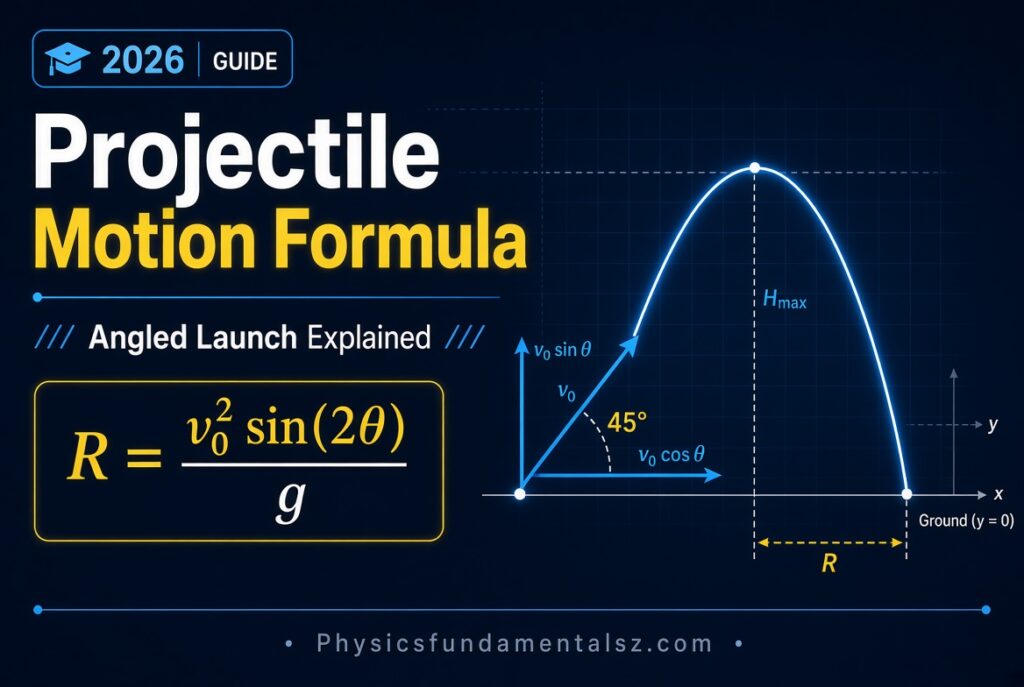
When you throw a ball, kick a football, or fire a cannon at an angle, its path bends into a curve called a parabola. The projectile motion formula for angled launch is the set of equations that predicts exactly where that object goes, how high it climbs, and how long it stays in the air.
Table of Contents
What Is Projectile Motion at an Angle?
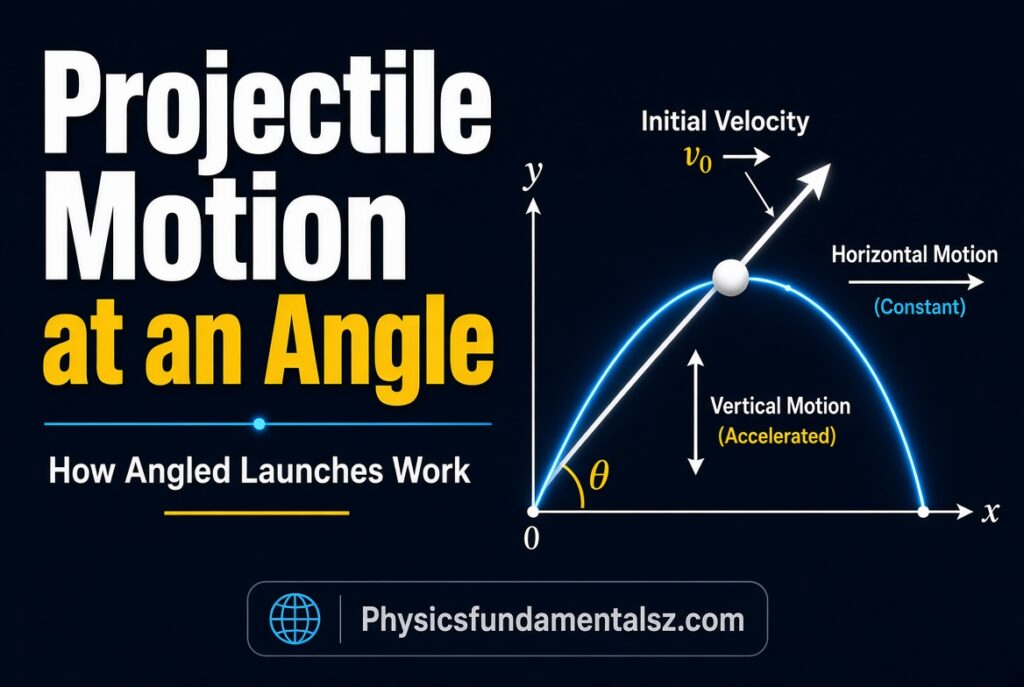
Projectile motion at an angle happens when an object is launched with some upward direction, not straight up or purely sideways. Gravity is the only force acting on it once it leaves the launcher, assuming air resistance is ignored.
The motion is really two separate motions happening at the same time. Horizontally, the object moves at a constant speed. Vertically, it slows down, stops, then speeds up again under gravity.
Projectile Motion Formula for Angled Launch
Quick Answer: The Core Projectile Motion Formulas
If you just need the formulas, here they are in one place.
- Horizontal velocity: Vx = V0 cos θ
- Vertical velocity: Vy = V0 sin θ
- Time of flight: T = 2V0 sin θ / g
- Maximum height: H = (V0 sin θ)² / 2g
- Horizontal range: R = V0² sin(2θ) / g
V0 is the initial speed, θ is the launch angle, and g is the acceleration due to gravity, about 9.8 m/s² on Earth.
Breaking the Initial Velocity Into Components
Every angled launch starts the same way. You split the initial velocity into a horizontal part and a vertical part using basic trigonometry.
- Horizontal component: Vx = V0 cos θ
- Vertical component: Vy = V0 sin θ
This split matters because horizontal motion and vertical motion behave completely differently once the object is in the air.
Why Horizontal and Vertical Motion Are Treated Separately
Horizontal motion has no acceleration acting on it, since gravity only pulls straight down. That means Vx stays constant for the entire flight.
Vertical motion is different. Gravity constantly slows the object on the way up and speeds it up on the way down, which is why the vertical velocity keeps changing.
Time of Flight Formula
Time of flight is how long the projectile stays in the air before landing back at launch height. For a launch and landing at the same height, the formula is:
T = 2V0 sin θ / g
This comes from the fact that the object takes exactly as long to rise as it does to fall, so you can double the time to reach maximum height.
Maximum Height Formula
Maximum height is the highest point the projectile reaches during its flight. At that instant, the vertical velocity is momentarily zero.
H = (V0 sin θ)² / 2g
A steeper launch angle sends the object higher, even if it doesn’t travel as far horizontally.
Horizontal Range Formula
Range is the total horizontal distance the projectile covers before it lands. This is usually the number people care about most in real-world problems.
R = V0² sin(2θ) / g
Because of the sin(2θ) term, a 45-degree angle produces the maximum range for a given launch speed, assuming no air resistance.
Deriving the Angled Launch Equations Step by Step
The formulas above aren’t arbitrary. They come directly from the standard kinematic equations applied separately to each direction.
Step 1: Write the position equations.
x = (V0 cos θ) t y = (V0 sin θ) t − ½ g t²
Step 2: Find time of flight by setting y = 0.
Solving y = 0 for t gives t = 0 (the launch moment) and t = 2V0 sin θ / g (the landing moment).
Step 3: Substitute time of flight into the x equation.
Plugging T back into x = (V0 cos θ) t produces the range formula, R = V0² sin(2θ) / g, after applying the identity 2 sin θ cos θ = sin(2θ).
Worked Example: Angled Launch Calculation
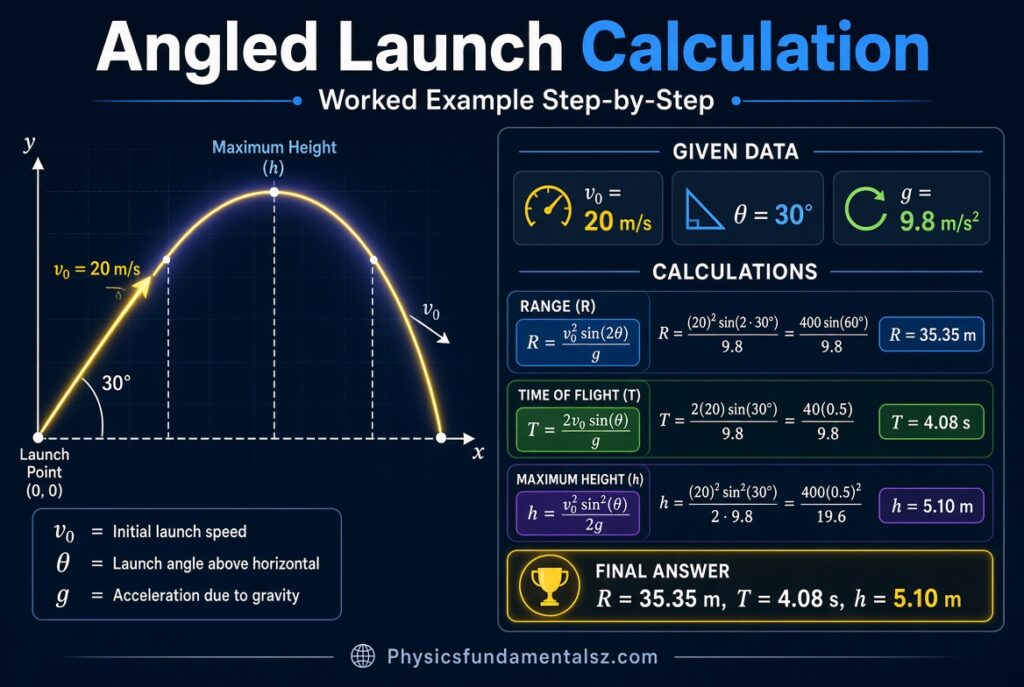
Consider a ball launched at 20 m/s at an angle of 30 degrees above the horizontal, on level ground.
Step 1: Find the velocity components.
Vx = 20 cos 30° = 17.3 m/s Vy = 20 sin 30° = 10 m/s
Step 2: Calculate time of flight.
T = 2(10) / 9.8 = 2.04 seconds
Step 3: Calculate maximum height.
H = (10)² / (2 × 9.8) = 5.1 meters
Step 4: Calculate range.
R = (20)² sin(60°) / 9.8 = 35.3 meters
Why 45 Degrees Gives Maximum Range
Range depends on sin(2θ), and sine reaches its largest value of 1 when the angle inside it is 90 degrees. That happens exactly when 2θ = 90°, or θ = 45°.
This is why 45 degrees is the go-to answer for maximum-distance problems, as long as the launch and landing heights match and air resistance is ignored.
Complementary Angles Produce the Same Range
Two launch angles that add up to 90 degrees, like 30° and 60°, produce the same range for the same launch speed. Only the height and time of flight change between them.
The steeper angle sends the object higher and keeps it airborne longer, while the shallower angle stays lower and lands sooner, but both cover the same horizontal distance.
Launching From a Height
Real problems often involve launching from a platform, cliff, or hand above ground level, not from the ground itself. In that case, the simple time-of-flight formula no longer applies directly.
Instead, you solve the quadratic equation y = y0 + (V0 sin θ) t − ½ g t² for t, using the initial height y0, then use the positive root as the actual time of flight.
Factors That Affect Projectile Motion at an Angle
Several variables control the shape and distance of the trajectory.
- Launch angle: determines how the range and height trade off against each other.
- Initial speed: a higher V0 increases both range and maximum height.
- Gravity: stronger gravity shortens time of flight and reduces range.
- Launch height: launching from above ground level increases both range and time of flight.
- Air resistance: ignored in the basic formulas, but it reduces real-world range and height.
Common Mistakes When Using the Angled Launch Formula
A handful of errors come up again and again with this topic.
- Forgetting to convert the angle to the correct mode. Calculators must be set to degrees or radians correctly, or every trig value will be wrong.
- Applying the simple time-of-flight formula to unequal heights. This formula only works when launch and landing heights are the same.
- Mixing up sin and cos for the components. Vertical motion uses sin θ, horizontal motion uses cos θ, not the other way around.
- Ignoring g’s sign convention. Keeping gravity as a positive constant in the standard formulas, rather than mixing positive and negative directions, avoids confusion.
Real-World Applications of Angled Projectile Motion
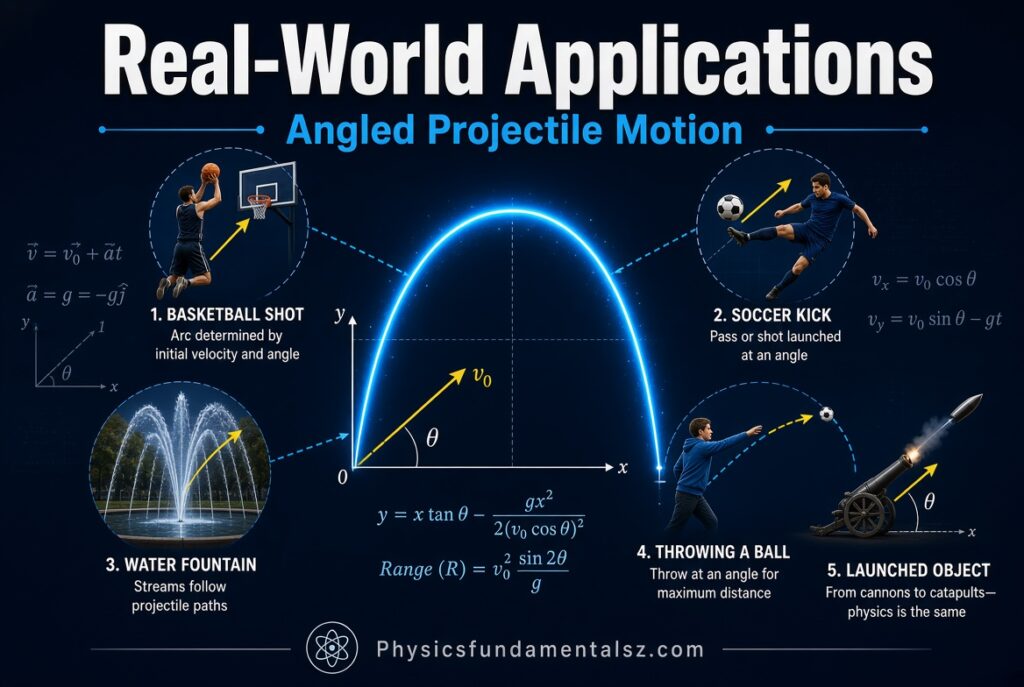
This formula set isn’t just a textbook exercise. It shows up constantly outside the classroom.
- Sports: predicting how far a thrown javelin, kicked football, or shot basketball will travel.
- Ballistics: calculating the trajectory of artillery shells and bullets.
- Engineering: designing water fountains, sprinkler systems, and even amusement park rides.
- Space science: early trajectory calculations for rockets and payloads rely on the same core principles before orbital mechanics takes over.
Also Read:
- Projectile Motion Calculator With Angle: Formulas & Worked Examples
- Simple Pendulum: Definition, Formula, Time Period, and Derivation
- Stress, Strain & Young’s Modulus Explained
- Difference Between Speed and Velocity With Examples
- Mass Energy Equivalence Real Life Examples
- Nuclear Decay Equations Explained Simply
- How to Derive Wave Speed Formula
- Photoelectric Effect Equation Explained
- What Is the Formula for Conservation of Momentum?
- E=mc2 Explained for Beginners
- De Broglie Wavelength Calculator: Formula, Steps & Worked Examples
- Kinetic Energy Calculator Physics: Formula, Steps & Examples
- Ohm’s Law Calculator Solve for Current
- Half Life Calculator With Steps: Formula & Full Guide
- Wave Speed Calculator Frequency Wavelength
- Momentum Calculator Physics: Formula, Steps & Worked Examples
- Ideal Gas Law Calculator With Steps: PV = nRT Formula
- Heisenberg Uncertainty Principle Explained Simply
- Bohr Model of the Atom: Energy Levels & Spectra
- De Broglie Wavelength: Formula, Derivation & Examples
- Half-Life Calculations: Formula & Worked Examples
- Mass-Energy Equivalence: E = mc² Derivation & Applications
- Capacitors and Capacitance: C = Q/V Formula & Examples
- Electric Potential Energy: Formula & Worked Examples
- Electric Current: I = Q/t, Drift Velocity & Ohm’s Law
Frequently Asked Questions (FAQs)
What is the formula for projectile motion at an angle?
The core formulas are Vx = V0 cos θ, Vy = V0 sin θ, T = 2V0 sin θ / g, H = (V0 sin θ)² / 2g, and R = V0² sin(2θ) / g.
What angle gives the maximum range in projectile motion?
A launch angle of 45 degrees gives the maximum range, assuming the object lands at the same height it was launched from and air resistance is ignored.
Do 30 and 60 degree launches give the same range?
Yes. Any two angles that add up to 90 degrees, such as 30° and 60°, produce the same horizontal range for the same launch speed.
How do you find the time of flight for an angled launch?
Use T = 2V0 sin θ / g when launch and landing heights are equal. For unequal heights, solve the full position equation as a quadratic instead.
What is the maximum height formula in projectile motion?
Maximum height is H = (V0 sin θ)² / 2g, calculated using only the vertical component of the initial velocity.
Why is horizontal velocity constant in projectile motion?
Gravity acts only in the vertical direction, so there is no horizontal acceleration once the object leaves the launcher, keeping Vx constant throughout the flight.
What happens to vertical velocity at maximum height?
At maximum height, the vertical velocity is momentarily zero before gravity pulls the object back down.
How does launch angle affect range and height together?
A steeper angle increases maximum height but can reduce range beyond 45 degrees, while a shallower angle increases range up to 45 degrees but reduces height.
Can projectile motion formulas be used for launches from a height?
Not directly with the simple time-of-flight formula. You need the full quadratic equation for vertical position to account for the extra drop distance.
What is the range formula when launch and landing heights differ?
R = Vx multiplied by the time of flight found from solving the quadratic y = y0 + (V0 sin θ) t − ½ g t² = 0 for t.
Does mass affect projectile motion?
No. Mass cancels out of all the standard projectile motion formulas, so heavier and lighter objects follow the same trajectory under gravity alone.
What value of gravity should I use in these formulas?
Use g = 9.8 m/s² for Earth-based problems unless a different value is specified for another planet or a more precise regional figure.
Is air resistance included in these formulas?
No. The standard formulas assume no air resistance. Real-world range and height are usually slightly lower once drag is factored in.
How do you calculate the components of initial velocity?
Multiply the initial speed by cosine of the angle for the horizontal component and by sine of the angle for the vertical component.
What is the difference between projectile motion and horizontal launch?
A horizontal launch has zero initial vertical velocity, so it is really a projectile motion problem where the launch angle is zero degrees.
Why do some problems use two answers from the quadratic formula?
The quadratic time equation naturally produces two roots, but only the positive time value makes physical sense for the projectile’s flight.
What units should be used in projectile motion formulas?
Use meters for distance, meters per second for velocity, seconds for time, and meters per second squared for gravity to keep all formulas consistent.
How is projectile motion related to parabolic motion?
The path traced by a projectile launched at an angle is a parabola, which is why the terms “projectile motion” and “parabolic motion” are often used together.
Can this formula predict the landing point on uneven ground?
Only with modification. The basic formulas assume flat, level ground, so uneven terrain requires solving the vertical position equation for the actual landing height.
What real-world fields use the angled launch formula most?
Sports science, ballistics, mechanical engineering, and early-stage rocketry all rely on the same core projectile motion equations covered in this guide.
Conclusion
The projectile motion formula for angled launch turns a curved, seemingly complex path into a predictable, solvable problem once you split velocity into horizontal and vertical components.
With the range, height, and time of flight formulas in hand, plus a clear grasp of why 45 degrees maximizes distance, you can solve almost any angled launch problem confidently, from a thrown ball to a fired projectile.