Nuclear Decay Equations: Alpha, Beta & Gamma Decay Explained
An unstable nucleus doesn’t just sit there forever — sooner or later it transforms, spitting out radiation and becoming a different element entirely.
Nuclear decay equations are how physicists and chemists write that transformation down precisely, tracking exactly what’s emitted and what nucleus is left behind.
A nuclear decay equation shows an unstable “parent” nucleus transforming into a “daughter” nucleus plus emitted radiation.
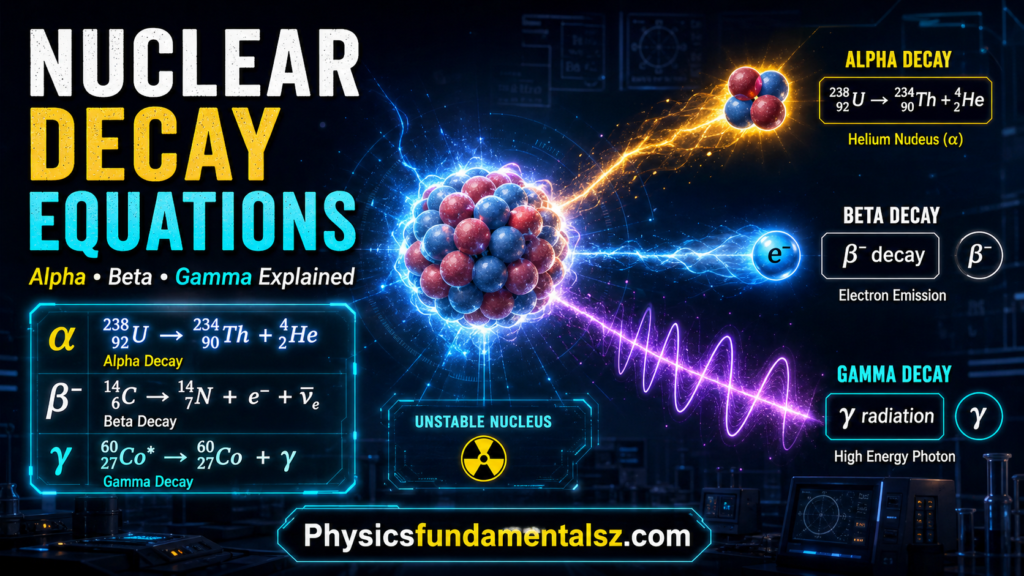
Every valid equation must conserve both mass number (A) and atomic number (Z) on both sides — alpha decay reduces A by 4 and Z by 2, beta-minus decay increases Z by 1 with no change in A, and gamma decay changes neither.
Table of Contents
What Are Nuclear Decay Equations?
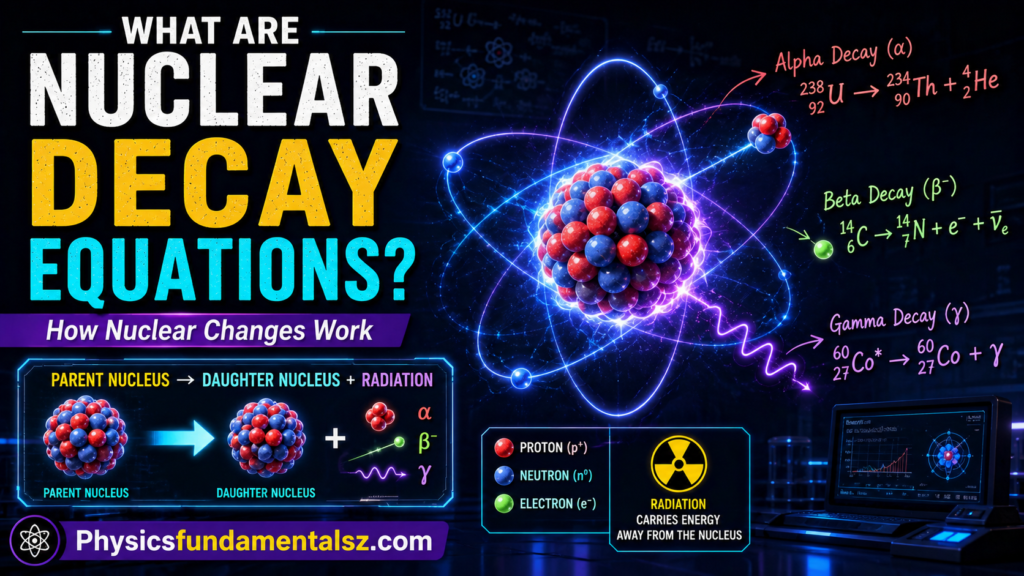
A nuclear decay equation is a symbolic representation of radioactivity: an unstable parent nucleus breaks down into a daughter nucleus while emitting a particle or a burst of energy. Unlike chemical equations, which only rearrange electrons, nuclear decay equations describe the nucleus itself changing — sometimes becoming a completely different element.
Nuclide Notation: What ᴬ_Z X Means
Every nucleus in a decay equation is written using nuclide notation: ᴬ_Z X, where X is the element symbol, A is the mass number (protons + neutrons), and Z is the atomic number (number of protons). For example, uranium-238 is written ²³⁸₉₂U.
The Two Conservation Laws Every Decay Equation Must Obey
Every nuclear decay equation — no matter which type — must satisfy two conservation laws simultaneously. Master these two rules and you can balance any decay equation you encounter.
Conservation of Mass Number (A)
The total number of nucleons (protons + neutrons) must be identical on both sides of the equation. This reflects the underlying conservation of baryon number, a fundamental law of particle physics.
Conservation of Atomic Number / Charge (Z)
The total number of protons — equivalently, the total electric charge — must also be identical on both sides. This reflects conservation of charge, which holds in every known physical process.
Key idea: These aren’t arbitrary bookkeeping rules. They are the entire method. If both A and Z balance on both sides of your equation, the equation is valid — full stop.
Alpha Decay
Alpha decay occurs when a nucleus emits an alpha particle — a helium-4 nucleus made of two protons and two neutrons.
The Alpha Decay Equation
$$^A_Z X \rightarrow , ^{A-4}_{Z-2} Y + , ^4_2\text{He}$$
Alpha decay reduces the mass number by 4 and the atomic number by 2. Alpha particles are heavy and slow-moving compared to other radiation, and can be stopped by a sheet of paper or a few centimeters of air.
Worked Example — Uranium-238 to Thorium-234
$$^{238}{92}\text{U} \rightarrow , ^{234}{90}\text{Th} + , ^4_2\text{He}$$
Check: mass numbers 238 = 234 + 4 ✓. Atomic numbers 92 = 90 + 2 ✓. The equation balances.
Beta Decay
Beta decay comes in two forms, both driven by the weak nuclear force converting one nucleon into another.
Beta-Minus Decay Equation
In beta-minus (β⁻) decay, a neutron converts into a proton, emitting an electron (the beta particle) and an antineutrino.
$$^A_Z X \rightarrow , ^A_{Z+1} Y + , ^0_{-1}e$$
Mass number stays the same; atomic number increases by 1, since a neutron became a proton.
Beta-Plus Decay Equation
In beta-plus (β⁺) decay — also called positron emission — a proton converts into a neutron, emitting a positron and a neutrino.
$$^A_Z X \rightarrow , ^A_{Z-1} Y + , ^0_{+1}e$$
Mass number stays the same; atomic number decreases by 1.
Worked Example — Thorium-234 to Protactinium-234
$$^{234}{90}\text{Th} \rightarrow , ^{234}{91}\text{Pa} + , ^0_{-1}e$$
Check: mass numbers 234 = 234 ✓. Atomic numbers 90 = 91 + (−1) ✓. This is beta-minus decay.
Gamma Decay
Gamma decay emits a high-energy photon (a gamma ray) from a nucleus in an excited state, allowing it to settle into its ground state.
The Gamma Decay Equation
$$^A_Z X^* \rightarrow , ^A_Z X + \gamma$$
The asterisk denotes an excited state. Unlike alpha and beta decay, gamma decay changes neither the mass number nor the atomic number — the daughter is the exact same isotope, just at a lower energy.
Worked Example — Barium-137m to Barium-137
$$^{137}{56}\text{Ba}^* \rightarrow , ^{137}{56}\text{Ba} + \gamma$$
This is the decay of the metastable isomer barium-137m, a common gamma-ray source used in classroom demonstrations.
Key idea: Gamma emission frequently accompanies alpha and beta decay, since the daughter nucleus is often produced in an excited state and needs to shed the extra energy as a gamma ray.
Alpha vs. Beta vs. Gamma Decay Comparison Table
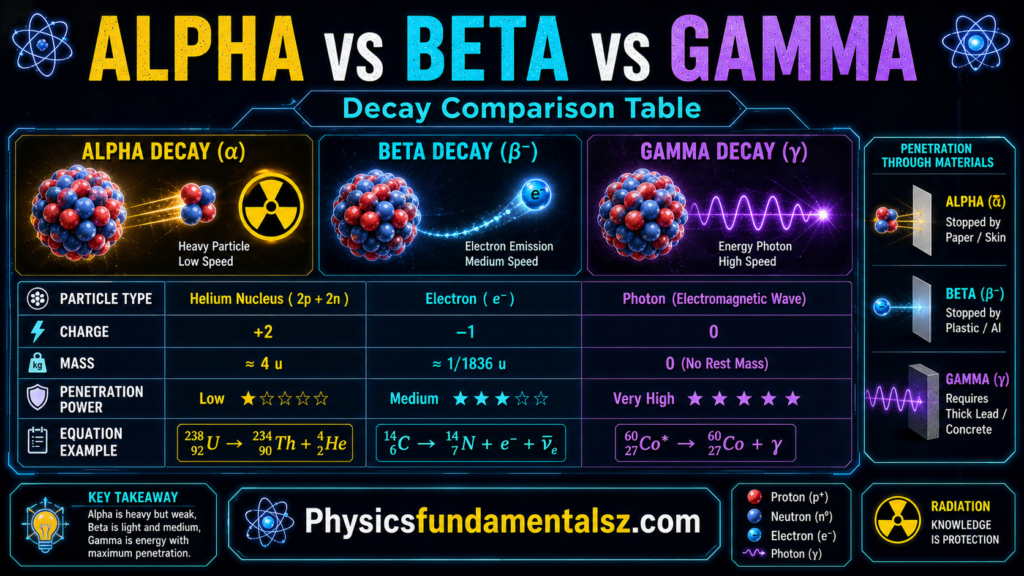
| Feature | Alpha (α) | Beta-minus (β⁻) | Beta-plus (β⁺) | Gamma (γ) |
|---|---|---|---|---|
| Emitted particle | ⁴₂He nucleus | Electron + antineutrino | Positron + neutrino | High-energy photon |
| Change in A | −4 | 0 | 0 | 0 |
| Change in Z | −2 | +1 | −1 | 0 |
| Underlying force | Strong force (tunneling) | Weak force | Weak force | Electromagnetic force |
| Penetrating power | Low (stopped by paper) | Moderate (stopped by aluminum) | Moderate | High (needs lead/concrete) |
| Typical use | Smoke detectors | Medical tracers, dating | PET scan tracers | Radiotherapy, sterilization |
How to Balance Any Nuclear Decay Equation (Step-by-Step)
- Write the parent nucleus in nuclide notation, ᴬ_Z X.
- Identify the type of decay (given or determined from the emitted particle).
- Apply the correct A and Z shift for that decay type (see the table above).
- Solve for the daughter nucleus’s A and Z, then look up which element that Z corresponds to.
- Double-check: add up A on both sides, then add up Z on both sides — both totals must match exactly.
The Radioactive Decay Law and Half-Life
Beyond writing individual decay equations, physicists also need to describe how fast a sample decays over time. That’s what the radioactive decay law and half-life are for.
The N = N₀e^(−λt) Formula
$$N(t) = N_0 e^{-\lambda t}$$
Here N₀ is the initial number of radioactive nuclei, N(t) is the number remaining after time t, and λ is the decay constant — a fixed probability-per-unit-time specific to each isotope. Activity, the rate of decay measured in becquerels (1 Bq = 1 decay per second), follows the same exponential form: A(t) = A₀e^(−λt).
Relating Decay Constant and Half-Life
$$t_{1/2} = \frac{\ln 2}{\lambda} \approx \frac{0.693}{\lambda}$$
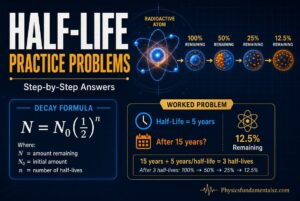
The half-life is the time required for exactly half of a sample’s nuclei to decay. After one half-life, 50% remains; after two half-lives, 25% remains; after n half-lives, the fraction remaining is (½)ⁿ.
Decay Chains
Many isotopes don’t reach stability in a single step — they pass through a sequence of decays called a decay chain until they finally become a stable isotope.
Worked Example — Uranium-238 to Lead-206
Uranium-238 undergoes a chain of 14 sequential decays — a mix of alpha and beta emissions — before finally reaching stable lead-206. The first step is the alpha decay shown earlier (U-238 → Th-234); each subsequent step follows the same conservation rules until the chain terminates at ²⁰⁶₈₂Pb, which is stable and decays no further.
Real-World Applications
- Radiometric dating: carbon-14’s known half-life (~5,730 years) lets archaeologists date organic material up to roughly 50,000 years old.
- Medical imaging: PET scans rely on beta-plus (positron) emitters injected into the body to visualize metabolic activity.
- Cancer radiotherapy: gamma-ray-emitting isotopes are used to target and destroy cancerous tissue.
- Smoke detectors: many household smoke detectors use a small americium-241 alpha source to ionize air and detect smoke particles.
- Nuclear power: understanding decay chains and half-lives is essential for reactor fuel management and spent-fuel storage planning.
- Geological dating: uranium-lead dating uses the full uranium-238-to-lead-206 decay chain to date rock formations billions of years old.
Common Mistakes When Writing Nuclear Decay Equations
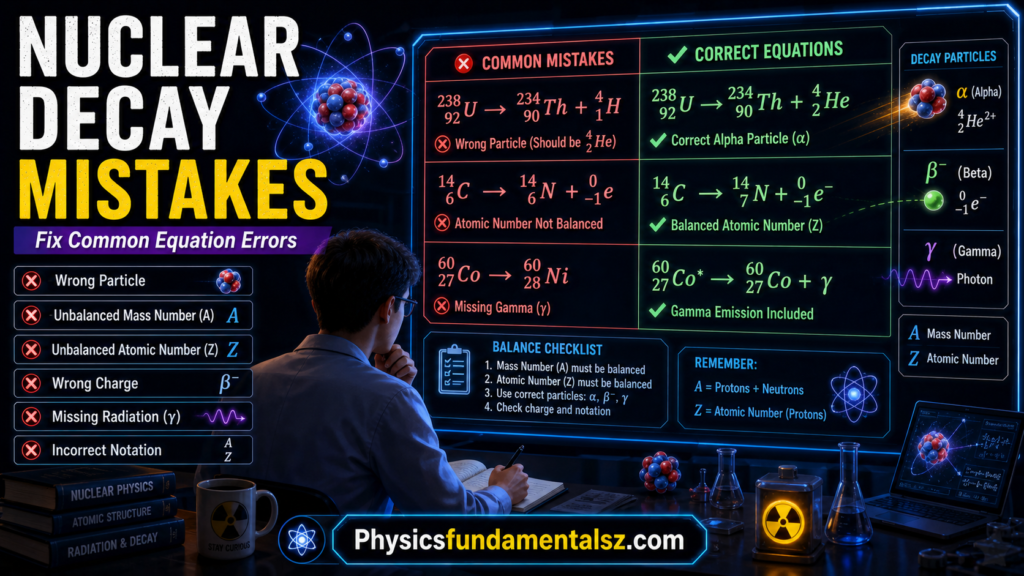
- Forgetting to subtract from both A and Z in alpha decay — always subtract 4 from A and 2 from Z, not just one or the other.
- Confusing beta-minus with beta-plus — check whether the isotope is neutron-rich (favors β⁻) or proton-rich (favors β⁺) before assuming the direction.
- Omitting the gamma ray when the daughter is left in an excited state — many alpha and beta decays are incomplete without an accompanying gamma emission.
- Treating gamma decay as changing the element — it never does; A and Z stay exactly the same, only energy is released.
- Mixing up decay constant and half-life — they’re inversely related (λ = ln2/t½), not equal to each other.
Related Articles
Keep building your physics foundations with these guides from Physics Fundamentals:
- Coulomb’s Law Calculations: F = kQ1Q2/r² Formula & Examples
- Capacitors and Capacitance: C = Q/V Formula, Energy Storage & Examples
- Electric Potential Energy: E = kQq/r, Work Done & Worked Examples
- Electric Current: I = Q/t, Drift Velocity & Ohm’s Law Connection
- Magnetic Field of a Current-Carrying Wire: B = μ0I/2πr
- Electric Circuits & Kirchhoff’s Laws: KCL, KVL & Worked Examples
- Kirchhoff’s Laws Advanced: Solving Multi-Loop Circuits Step by Step
- Lenz’s Law: The Direction of Induced Current Explained
- Magnetic Flux and Faraday’s Law: Formula, Examples & Applications
- Ohm’s Law and Temperature: How Resistance Really Changes With Heat
- Young’s Double-Slit Experiment: Fringe Formula, Proof & Applications
- Diffraction: Single Slit, Diffraction Gratings & dsinθ = nλ Explained
- Electromagnetic Waves: Speed, Spectrum & Wave Properties
- Interference of Waves: Constructive, Destructive & Superposition Explained
- Standing Waves & Resonance: Nodes, Antinodes & Harmonics Explained
- Polarisation of Light: Malus’s Law I = I₀cos²θ & Applications
- Snell’s Law: n₁sinθ₁ = n₂sinθ₂, Derivation & Total Internal Reflection
- Wave Superposition: Adding Waves, Phase & Interference Patterns
- Boyle’s, Charles’ & Gay-Lussac’s Gas Laws: Formulas & Examples
- Thermal Energy & Internal Energy: Heat, Temperature & Q = mcΔT
- Free Fall and Terminal Velocity
- Magnetic Fields and Forces
- Terminal Velocity: Why Objects Stop Accelerating & Calculations
- Vectors and Scalars: Definitions, Examples & Vector Addition
- Physics Fundamentals: The Complete Guide to Core Concepts, Laws, and Equations
Frequently Asked Questions(FAQs)
1. What is a nuclear decay equation?
A nuclear decay equation shows an unstable parent nucleus transforming into a daughter nucleus while emitting radiation, written using nuclide notation to track mass number and atomic number.
2. What are the three main types of nuclear decay?
Alpha decay, beta decay (beta-minus and beta-plus), and gamma decay.
3. What is emitted during alpha decay?
An alpha particle, which is a helium-4 nucleus made of two protons and two neutrons.
4. How does alpha decay change the mass number and atomic number?
Mass number decreases by 4, and atomic number decreases by 2.
5. What is emitted during beta-minus decay?
An electron and an antineutrino, produced when a neutron converts into a proton.
6. How does beta-minus decay change the atomic number?
Atomic number increases by 1, while mass number stays the same.
7. What is beta-plus decay?
Also called positron emission, it occurs when a proton converts into a neutron, emitting a positron and a neutrino, decreasing atomic number by 1.
8. Does gamma decay change the element?
No. Gamma decay releases only energy as a photon; both mass number and atomic number stay exactly the same.
9. What are the two conservation laws every decay equation must follow?
Conservation of mass number (A) and conservation of atomic number/charge (Z).
10. What does the asterisk (*) mean in a nuclear equation?
It denotes that the nucleus is in an excited state, about to release energy as a gamma ray to reach its ground state.
11. What is the formula for the radioactive decay law?
N(t) = N₀e^(−λt), where N₀ is the initial number of nuclei, λ is the decay constant, and t is elapsed time.
12. How are half-life and decay constant related?
t½ = ln2/λ ≈ 0.693/λ — a shorter half-life corresponds to a larger decay constant.
13. What is a decay chain?
A sequence of successive decays an unstable isotope undergoes before finally reaching a stable isotope, such as uranium-238 decaying through 14 steps to stable lead-206.
14. How do you determine whether an isotope will undergo beta-minus or beta-plus decay?
Neutron-rich isotopes typically undergo beta-minus decay, while proton-rich (neutron-poor) isotopes typically undergo beta-plus decay.
15. What is activity in the context of radioactive decay?
Activity is the rate of decay, measured in becquerels (Bq), where 1 Bq equals one decay per second.
16. Why do many decays also emit gamma rays?
Because the daughter nucleus is often produced in an excited state after alpha or beta decay, and it releases the extra energy as a gamma photon to reach its ground state.
17. What is the half-life of carbon-14?
Approximately 5,730 years, which is why carbon-14 dating works well for organic material up to about 50,000 years old.
18. What stops alpha, beta, and gamma radiation respectively?
A sheet of paper stops alpha particles, a few millimeters of aluminum stops beta particles, and thick lead or concrete is needed to significantly reduce gamma rays.
19. What is the difference between nuclear decay and nuclear fission?
Nuclear decay is the spontaneous transformation of a single unstable nucleus, while nuclear fission is the splitting of a heavy nucleus into two smaller nuclei, usually triggered by neutron bombardment.
20. How do you calculate the number of nuclei remaining after several half-lives?
Use N = N₀(½)ⁿ, where n is the number of half-lives elapsed, or equivalently N = N₀e^(−λt) for non-whole-number half-life intervals.
Key Takeaways
- Nuclear decay equations track how an unstable parent nucleus transforms into a daughter nucleus while emitting radiation.
- Every valid decay equation must conserve both mass number (A) and atomic number (Z) — this is the entire balancing method.
- Alpha decay: A drops by 4, Z drops by 2. Beta-minus: A unchanged, Z rises by 1. Beta-plus: A unchanged, Z falls by 1. Gamma: neither A nor Z changes.
- The radioactive decay law, N = N₀e^(−λt), and its half-life relationship t½ = 0.693/λ describe how fast a sample decays over time.
- Real isotopes often decay through multi-step chains, like uranium-238’s 14-step path to stable lead-206.