Which Is Harder AP Physics 1 or AP Physics C? Difficulty, Math, Exam Format, and Score Data Compared 2026
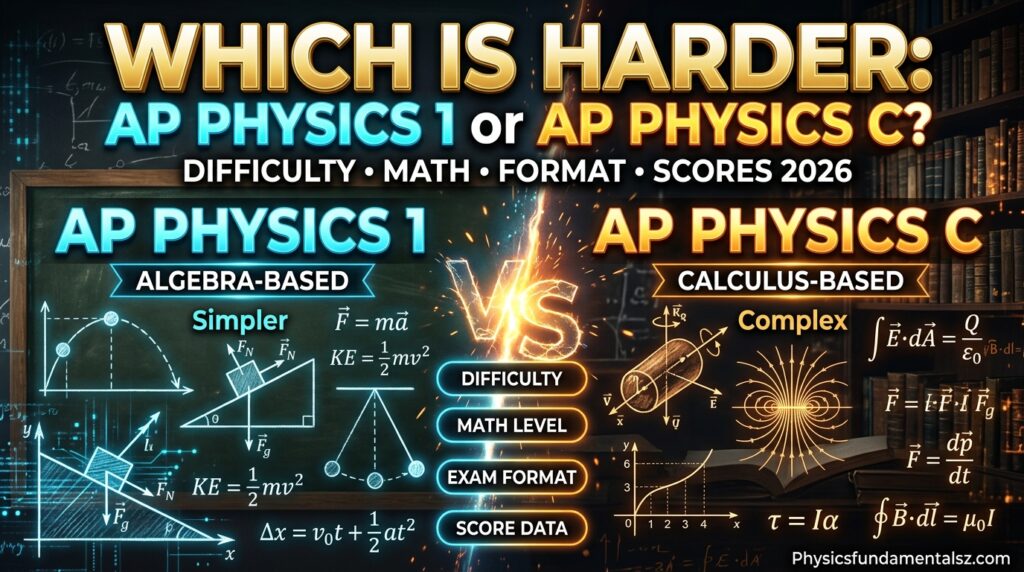
Here is a puzzle that surprises almost every student who looks at the numbers. AP Physics C uses calculus, which sounds like the harder option. Yet in recent years, a smaller share of AP Physics 1 students have earned a passing score than students in either AP Physics C exam.
So which is harder AP Physics 1 or AP Physics C? The honest answer is that they are hard in different ways. One makes you think in words and reasoning. The other makes you think in equations and calculus.
The right choice depends on your math background, your college plans, and how you like to learn. Picking the wrong one can cost you a semester of stress. Picking the right one can set you up for college physics.
Table of Contents
Which Is Harder, AP Physics 1 or AP Physics C?

AP Physics C is harder mathematically because it requires calculus. AP Physics 1 is often harder conceptually for students who are new to physics, because it emphasizes explaining ideas in words and working without numbers.
Based on official College Board data, a lower share of AP Physics 1 students earn a 3 or higher than AP Physics C students. But the groups are very different, so you cannot compare the percentages fairly.
The Verdict at a Glance
| Factor | AP Physics 1 | AP Physics C |
|---|---|---|
| Math level | Algebra and basic trigonometry | Calculus required |
| Main challenge | Conceptual reasoning and explanation | Calculus-based derivations and depth |
| Typical student | Many first-time physics students | Students already strong in math |
| Recent pass rate (3+) | About 68% in 2026 | About 72% (Mechanics) and 75% (E&M) in 2026 |
| Easier for you if | You prefer algebra and reasoning | You are comfortable with calculus |
What Are AP Physics 1 and AP Physics C?
The College Board offers four AP physics courses. Understanding where each one fits makes the comparison clearer.
AP Physics 1 and AP Physics 2 are algebra-based. AP Physics C has two separate courses, Mechanics and Electricity and Magnetism, and both are calculus-based.
AP Physics 1: Algebra-Based
AP Physics 1 is an algebra-based, introductory college-level course. According to the College Board, it is equivalent to a first-semester introductory college course in algebra-based physics.
Students should have completed geometry and be taking Algebra II or an equivalent course at the same time. Basic trigonometry is used, and it can be learned during the course.
AP Physics C: Mechanics
AP Physics C: Mechanics is a calculus-based, college-level course. The College Board describes it as equivalent to a semester-long introductory calculus-based college course.
Students should have taken or be taking calculus at the same time. The course covers kinematics, Newton’s laws, work, energy and power, linear momentum, rotation, oscillations, and gravitation.
AP Physics C: Electricity and Magnetism
AP Physics C: Electricity and Magnetism, often called E&M, is the second calculus-based course. It follows Mechanics and covers electric charge and fields, Gauss’s law, electric potential, circuits, magnetic fields, and electromagnetic induction.
Like Mechanics, it is equivalent to a semester-long calculus-based college course.
Where AP Physics 2 Fits
AP Physics 2 is the second algebra-based course. It is not part of this comparison, but it is useful to know it exists if you want to continue algebra-based physics after Physics 1.
Side-by-Side Comparison: AP Physics 1 vs AP Physics C
This table summarizes the key differences based on College Board course materials.
| Feature | AP Physics 1 | AP Physics C: Mechanics | AP Physics C: E&M |
|---|---|---|---|
| Math required | Algebra and basic trigonometry | Calculus (taken or concurrent) | Calculus (taken or concurrent) |
| College equivalent | First-semester algebra-based physics | Semester-long calculus-based mechanics | Semester-long calculus-based E&M |
| Number of units | 8 | 7 | 6 |
| Main topics | Mechanics and fluids | Mechanics with calculus | Electricity and magnetism with calculus |
| Exam length | 3 hours | 3 hours | 3 hours |
| Multiple choice | 42 questions, 85 minutes | 42 questions, 85 minutes | 42 questions, 85 minutes |
| Free response | 4 questions, 95 minutes | 4 questions, 95 minutes | 4 questions, 95 minutes |
| Calculator | Allowed on both sections | Allowed on both sections | Allowed |
| Hands-on lab time | 25% of instructional time | 25% of instructional time | Lab required |
The exam format is now very similar across these courses. The College Board updated the number of multiple-choice questions and the timing, effective with the May 2027 exam.
The Free-Response Question Types
The College Board’s current overviews list four free-response question types for both Physics 1 and Physics C: Mechanics.
| Question | Type | Points |
|---|---|---|
| Question 1 | Mathematical Routines | 10 |
| Question 2 | Translation Between Representations | 12 |
| Question 3 | Experimental Design and Analysis | 10 |
| Question 4 | Qualitative/Quantitative Translation | 8 |
Because the format is shared, the difference in difficulty comes mostly from the content and the math.
Difficulty Factor 1: The Math
Math is the most obvious difference. It is also the one that matters most for most students.
AP Physics 1 stays within algebra and trigonometry. AP Physics C uses derivatives and integrals throughout.
What Physics 1 Math Looks Like
You solve equations, work with ratios, read graphs, and break vectors into components. You also use proportional reasoning, such as finding what happens to a result when a mass doubles.
If you are comfortable with algebra, the math is manageable. The challenge is choosing the right idea, not performing heavy calculations.
What Physics C Math Looks Like
You use calculus to describe motion with changing acceleration, to find work done by variable forces, and to find rotational inertia by integration. In E&M, you use integration to find fields and potentials.
Students who are not yet comfortable with calculus often find this the biggest hurdle.
Same Idea, Two Levels
Consider how each course treats a force that changes with position.
In Physics 1, you might use a graph of force versus position and find the work as the area under the curve. In Physics C, you write the work as an integral of force with respect to position.
For a spring, the work to stretch it from rest is the integral of kx from 0 to x, which equals one-half kx squared. Physics 1 students often reach the same result using the area of a triangle.
Difficulty Factor 2: Conceptual Reasoning
Do not assume algebra-based means easy. AP Physics 1 puts heavy weight on explaining why things happen.
Many questions ask you to justify an answer in words or compare situations without numbers.
Why Physics 1 Feels Hard
Students must construct arguments, draw diagrams, describe experiments, and reason about proportions. Memorizing formulas is not enough.
A student who is strong at plugging numbers into equations can still struggle here.
Why Physics C Also Demands Reasoning
The Physics C: Mechanics sample question in the College Board overview asks students to derive an expression, draw a graph, and begin from a fundamental physical principle. That is reasoning with mathematics, not just calculation.
Physics C assumes you can handle the concepts. It then asks you to go deeper with calculus.
A Shared Skill
Both courses reward the same habits: draw first, choose a principle, define a system, and check whether the answer makes sense. Students who build these habits do well in either.
For a refresher on foundations, see our guide to Newton’s laws of motion.
Difficulty Factor 3: Content and Depth
The courses cover different material and different depth. Knowing the unit list helps you see what you would be signing up for.
AP Physics 1 Units
According to the College Board, the course has eight units:
- Kinematics
- Force and Translational Dynamics
- Work, Energy, and Power
- Linear Momentum
- Torque and Rotational Dynamics
- Energy and Momentum of Rotating Systems
- Oscillations
- Fluids
Force and Translational Dynamics and Work, Energy, and Power carry the most weight on the multiple-choice section, at 18 to 23 percent each.
AP Physics C: Mechanics Units
The Mechanics course has seven units with the same names as the first seven Physics 1 units. Fluids is not part of the list.
The difference is depth. The same topics, such as energy and rotation, are treated with calculus.
AP Physics C: E&M Units
E&M has six units, numbered 8 through 13 in the College Board’s continuous numbering across the two Physics C courses. It begins with electric charges and fields and Gauss’s law, and moves through electric potential, conductors and capacitors, circuits, magnetic fields, and electromagnetic induction.
The topics are new to most students, and the math is more abstract.
Topic Comparison
| Topic | Physics 1 | Physics C: Mechanics | Physics C: E&M |
|---|---|---|---|
| Kinematics | Yes | Yes (with calculus) | No |
| Forces and Newton’s laws | Yes | Yes (with calculus) | No |
| Work, energy, and power | Yes | Yes (with calculus) | No |
| Momentum | Yes | Yes | No |
| Rotation and torque | Yes | Yes | No |
| Oscillations | Yes | Yes | No |
| Fluids | Yes | No | No |
| Electric fields and Gauss’s law | No | No | Yes |
| Circuits and capacitors | No | No | Yes |
| Magnetism and induction | No | No | Yes |
Difficulty Factor 4: Exam Format and Timing

The exam structure no longer separates the two courses very much. That makes the content the deciding factor.
Both Physics 1 and Physics C: Mechanics list 42 multiple-choice questions in 85 minutes and 4 free-response questions in 95 minutes. Physics C: E&M lists the same numbers on its exam page.
Pacing
With 85 minutes for 42 multiple-choice questions, you have about 2 minutes per question. With 95 minutes for 40 free-response points, you have roughly 2.4 minutes per point.
In Physics C, the free-response derivations can take longer, especially when integration is needed.
Format Notes
The College Board describes the E&M exam as hybrid digital. Multiple-choice questions are answered in Bluebook and free-response answers are handwritten in a booklet, according to its exam page.
Always check the official exam page for the latest format details before test day.
Reference Materials
Reference materials are provided for these exams. You still need to know how and when to use each equation.
Difficulty Factor 5: What the Score Data Shows
Score data gives a useful, if imperfect, picture. The College Board publishes the percentage of students earning each score every year.
Treat the numbers carefully, because the students who take each exam are not the same.
2026 Score Distributions
The College Board’s 2026 distributions, rounded to whole numbers, show the following.
| Exam | 5 | 4 | 3 | 2 | 1 | 3 or higher |
|---|---|---|---|---|---|---|
| AP Physics 1 | 19% | 24% | 25% | 15% | 17% | 68% |
| AP Physics C: Mechanics | 20% | 25% | 27% | 17% | 11% | 72% |
| AP Physics C: E&M | 24% | 24% | 27% | 17% | 8% | 75% |
Earlier Years for Context
The year 2024 stands out. The College Board reported that only 47.3 percent of AP Physics 1 students scored a 3 or higher, with 26.6 percent earning a 1.
In 2025, the Physics 1 passing rate rose to 67.3 percent.
| Year | Physics 1 (3+) | Physics C: Mechanics (3+) | Physics C: E&M (3+) |
|---|---|---|---|
| 2024 | 47.3% | 76.3% | 71.6% |
| 2025 | 67.3% | 73.2% | 72.9% |
| 2026 | 68% | 72% | 75% |
What the Numbers Suggest
Physics 1 has consistently had a larger share of 1s than Physics C. In 2026 it was 17 percent, compared with 11 percent for Mechanics and 8 percent for E&M.
That suggests more Physics 1 students struggle to reach a passing score. It does not prove the exam itself is harder.
Why You Cannot Compare Directly
AP Physics C students usually have strong math preparation, since calculus is a prerequisite or corequisite. Many chose a more demanding course on purpose.
Physics 1 is open to a wider range of students, including many seeing physics for the first time. Different populations produce different statistics.
Difficulty Factor 6: Who Takes Each Course
Student background matters as much as content. The same exam can feel very different depending on who you are.
Typical Physics 1 Student
Physics 1 is often a first physics course. Students may be in tenth or eleventh grade and may be new to ideas like vectors and energy conservation.
Some will plan to study biology, health, or a non-STEM field. Others will continue to Physics 2 or Physics C.
Typical Physics C Student
Physics C students are often in or beyond calculus and planning to study engineering, physics, or another quantitative field. Many have already taken a first physics course.
This means the class tends to move faster and expects stronger math from day one.
Class Culture
In a Physics C class, you may be surrounded by students who are comfortable with calculus. That can motivate you, or it can feel intimidating if you are not as confident.
In a Physics 1 class, you are more likely to be learning alongside students at different levels.
Difficulty Factor 7: Workload and Pacing
Both courses are challenging. They are challenging in different rhythms.
Physics 1 spreads eight units across a school year and includes hands-on labs. Physics C: Mechanics covers seven units, and the College Board describes it as a full-year course.
Time for Depth
Because Physics C: Mechanics has fewer units, many classes spend more time on each topic. That extra time is needed for the calculus.
If you are both new to physics and new to calculus, the combination can feel heavy.
Taking Both Physics C Exams
E&M follows Mechanics in the College Board’s design. Some students take both courses in the same year or in consecutive years.
That workload is significant, so plan carefully with your school counselor.
Worked Examples: The Same Topic at Two Levels
Seeing the same topic in both courses shows why Physics C feels harder to some students and easier to others.
Example 1: Motion With Changing Acceleration
An object starts at rest with an acceleration that increases with time as a = 6t, where t is in seconds and a is in meters per second squared.
In Physics 1, the standard constant-acceleration equations do not apply, so a problem like this would usually be handled with a graph. In Physics C, you integrate: velocity is the integral of 6t, which gives v = 3t², and position is the integral of v, which gives x = t³.
Example 2: Work Done by a Spring
Find the work needed to stretch a spring with constant k from its natural length to a stretch x.
Physics 1: the force rises linearly from 0 to kx, so the work is the area of a triangle, one-half kx². Physics C: write W as the integral of kx dx from 0 to x, which gives the same result with a clear derivation.
Example 3: Rotational Inertia of a Rod
Find the rotational inertia of a uniform rod of mass M and length L about one end.
Physics 1 students typically use or recognize a given value. Physics C students derive it: I is the integral of x² dm, where dm = (M/L) dx. Integrating from 0 to L gives I = ML²/3.
Example 4: Electric Field of a Sphere
In Physics C: E&M, you use Gauss’s law to find the electric field outside a uniformly charged sphere. The symmetry lets you pull E out of the integral, so the total flux equals E times the surface area, 4πr².
Setting that equal to the enclosed charge divided by ε₀ gives E = kQ/r². This derivation is a core Physics C skill and has no Physics 1 counterpart.
What These Examples Show
Physics C does not necessarily ask for more physics ideas. It asks you to derive results from first principles using calculus.
If you enjoy that, Physics C can feel natural. If not, Physics 1 may feel more comfortable.
Which Is Harder for Different Types of Students?

The best way to decide is to match the courses to your own strengths.
| Student type | Likely easier choice | Why |
|---|---|---|
| Strong at calculus, enjoys math | AP Physics C | Calculus makes many ideas cleaner |
| Comfortable with algebra, new to calculus | AP Physics 1 | No calculus needed |
| First time studying physics | AP Physics 1 | Builds concepts step by step |
| Planning to study engineering or physics | AP Physics C | Aligns with calculus-based college courses |
| Planning to study biology or health sciences | AP Physics 1 | Matches algebra-based college courses |
| Dislikes long written explanations | AP Physics C | More equation-based, though still explanation-heavy |
| Dislikes heavy algebra and derivations | AP Physics 1 | Less formal derivation |
If You Struggle With Math
If calculus is a weak area, Physics C will feel much harder. Physics 1 is the safer starting point.
If You Struggle With Writing Explanations
Physics 1 puts a lot of weight on justification in words. Practice explaining ideas aloud and writing short arguments.
Both courses ask for this to some degree, so building the skill helps either way.
Is Physics C: Mechanics or E&M Harder?
If you choose Physics C, you may wonder which exam is harder. The answer varies by student.
Mechanics builds on everyday motion, so it feels more intuitive. E&M deals with fields you cannot see, and many students find the ideas more abstract.
What the Scores Suggest
In 2026, 75 percent of E&M students earned a 3 or higher, compared with 72 percent in Mechanics. E&M also had a larger share of 5s, at 24 percent versus 20 percent.
The groups differ, though. Students who take E&M often already completed Mechanics, so they may be more experienced.
Content Challenges
Mechanics challenges include rotation, energy methods, and differential equations in oscillations. E&M challenges include Gauss’s law, potential, circuits, and induction.
For a taste of E&M problem solving, try our guide to finding equivalent capacitance in series and parallel.
Should You Take Physics 1 Before Physics C?
There is no single rule. Many students take Physics 1 first to build conceptual foundations, then move on to Physics C. Others go straight to Physics C if they already have strong math and some physics background.
Course availability also matters. Some schools offer only one of the options.
Taking Physics 1 First
Physics 1 gives you time to learn vectors, forces, energy, and graphs without calculus. It prepares you well for Physics C: Mechanics.
Going Straight to Physics C
This can work if you are already taking calculus and are ready for a fast pace. Be prepared to learn physics and calculus together.
Talk to your teacher about expectations, and look at past course outlines.
Taking Physics C and Physics 2
Some students pursue both pathways. If you do, check that the schedule is realistic and that you can manage the workload.
College Credit and Placement
Credit policies depend on the college. The College Board provides a credit policy search tool so you can check specific schools.
Engineering and physics programs often expect calculus-based physics. Biology and health programs often use algebra-based physics, though policies vary.
How to Check Credit Policies
- Search the College Board credit policy tool for each school on your list.
- Look at the college’s own AP credit page.
- Ask an admissions or academic advising office if you are unsure.
Why This Matters for Your Choice
If you plan to major in engineering, a calculus-based course may fit your degree plan better. If you plan to study something outside the physical sciences, an algebra-based credit may be all you need.
What Makes Each Course Hard? A Realistic Look
Every course has its pain points. Knowing them helps you plan.
Hardest Parts of AP Physics 1
- Explaining answers clearly in words.
- Reasoning without numbers.
- Experimental design and data analysis.
- Combining ideas from several units.
- Fluids and rotation for students who have not seen them before.
Hardest Parts of AP Physics C
- Using calculus fluently in physics problems.
- Deriving expressions rather than just using them.
- Differential equations in oscillations.
- Abstract ideas in E&M such as flux and induction.
- Speed and depth of the course.
Common Myths About AP Physics 1 and AP Physics C
A few misunderstandings can lead students to choose poorly.
“Physics C Is Always Harder”
Not always. It uses calculus, but students who are strong in math may find derivations clearer than long verbal arguments.
“Physics 1 Is Easy Because It Is Algebra-Based”
Algebra-based does not mean easy. The exam demands strong reasoning and explanation skills.
“A Higher Pass Rate Means an Easier Exam”
Pass rates depend on who takes the exam. Physics C students are a more math-prepared group, so the numbers cannot be compared directly.
“You Need Physics 1 Before Physics C”
Not necessarily. It depends on your school and your math background. Some students go straight to Physics C.
How to Decide: A Simple Checklist
Use these questions to make your choice.
- Have you taken calculus or are you taking it now? If not, choose Physics 1.
- Do you enjoy deriving formulas and working with integrals? If yes, lean toward Physics C.
- Is this your first physics course? If yes, Physics 1 is often the better start.
- Are you planning to study engineering or physics? If yes, consider Physics C.
- What does your target college offer credit for? Check the credit policy search.
- What does your school offer, and what is your schedule like? Be realistic about workload.
Talk to People Who Know
Ask your physics teacher, your math teacher, and your counselor. If possible, talk to older students who took the course.
Tips for Success in Either Course

Whichever you choose, a few habits matter.
Practice Regularly
Do a little each week instead of cramming. Spaced practice builds lasting skill.
Draw and Explain
Sketch diagrams and explain solutions in words. Both courses reward clear representations and reasoning.
Build Your Math Foundation
Review algebra for Physics 1 or calculus basics for Physics C. Small gaps in math cause big problems in physics.
Learn From Mistakes
Keep an error log and review it. Patterns in your mistakes show where to focus.
Use Good Resources
Use the College Board’s course materials, your teacher’s guidance, and clear explainers. Our physics calculators and physics games can help you test ideas and build intuition.
Strengthen Core Topics
Review key ideas like projectile motion, conservation of momentum, the work-energy theorem, and what energy is. They appear in both courses.
Learn Oscillations Early
Springs and pendulums show up in both exams. Our guide to the simple pendulum is a good place to start.
Authoritative Sources for Further Reading
For official information, consult AP Central and AP Students from the College Board. They publish course and exam descriptions, exam updates, score distributions, and the credit policy search tool.
Check the exam pages for AP Physics 1, AP Physics C: Mechanics, and AP Physics C: Electricity and Magnetism before you register, since formats can change from year to year.
Also Read:
- Newton’s Laws of Motion
- Projectile Motion
- Conservation of Momentum
- Work-Energy Theorem: Complete Guide with Formula, Derivation, and Examples
- What Is Energy?
- Simple Pendulum: Definition, Formula, Time Period, and Derivation
- How to Find Equivalent Capacitance in Series and Parallel: Formulas, Steps, and Solved Examples 2026
- Special Relativity Explained
- Mass-Energy Equivalence: E = mc² Derivation & Nuclear Applications
- Wave Speed, Frequency & Wavelength
- Transverse Waves Explained
- How to Solve Doppler Effect Problems Step by Step: Formulas, Sign Rules, and Worked Examples 2026
- How to Calculate Decibel Levels from Sound Intensity: Formula, Steps, and Worked Examples 2026
- How to Calculate Thermal Expansion of a Metal Rod: Formula, Steps and Worked Examples 2026
- How to Solve Calorimetry Problems Step by Step: Formulas, Worked Examples and Practice 2026
- Real Life Examples of Conduction Convection Radiation: Everyday Heat Transfer Explained 2026
- Real Life Examples of Total Internal Reflection: Everyday Life, Nature, Technology, and Medicine 2026
- Why Does a Straw Look Bent in Water Refraction? The Science Behind the Bent Straw Illusion 2026
- Photoelectric Effect Calculations: hf = work-function + KE_max
- Bohr Model of the Atom: Energy Levels, Emission & Absorption Spectra
- Nuclear Decay Equations: Alpha, Beta & Gamma Decay Explained
- Half-Life Calculations: Formula & Worked Examples Explained
Frequently Asked Questions (FAQs)
Which is harder, AP Physics 1 or AP Physics C?
AP Physics C is harder mathematically because it requires calculus. AP Physics 1 is often harder conceptually for students new to physics because it emphasizes reasoning and explanation. Which feels harder depends on your math and physics background.
Is AP Physics C harder than AP Physics 1?
For most students with weaker math, yes. Physics C uses calculus and goes deeper. For students strong in calculus, it can feel more natural than the explanation-heavy Physics 1.
Does AP Physics C require calculus?
Yes. The College Board says students should have taken or be taking calculus at the same time as Physics C: Mechanics. Calculus is used throughout the course.
Can I take AP Physics C without taking AP Physics 1 first?
Yes, many students do. It depends on your school, your math level, and your teacher’s expectations. Talk to your teacher about whether you are ready.
What is the pass rate for AP Physics 1?
In 2026, the College Board reported about 68 percent of students scored a 3 or higher. In 2025 it was 67.3 percent, and in 2024 it was 47.3 percent.
What is the pass rate for AP Physics C: Mechanics?
In 2026, about 72 percent scored a 3 or higher. It was 73.2 percent in 2025 and 76.3 percent in 2024.
What is the pass rate for AP Physics C: E&M?
In 2026, about 75 percent scored a 3 or higher. It was 72.9 percent in 2025 and 71.6 percent in 2024.
Why is the AP Physics 1 pass rate lower than AP Physics C?
Part of the reason is who takes the exams. Physics C students usually have stronger math backgrounds and often chose a more demanding path. Physics 1 is open to a wider group of students.
Is AP Physics 1 harder than AP Physics 2?
The two are different. Physics 1 has had lower passing rates in recent years, but Physics 2 covers new topics and builds on Physics 1. Many students find Physics 2 easier because they already know the basics.
How many units are in AP Physics 1?
There are eight: Kinematics, Force and Translational Dynamics, Work, Energy, and Power, Linear Momentum, Torque and Rotational Dynamics, Energy and Momentum of Rotating Systems, Oscillations, and Fluids.
How many units are in AP Physics C: Mechanics?
There are seven. They cover kinematics, force and translational dynamics, work, energy and power, linear momentum, torque and rotational dynamics, energy and momentum of rotating systems, and oscillations.
How many units are in AP Physics C: E&M?
There are six, numbered 8 through 13 in the College Board’s continuous numbering across the two Physics C courses.
How long is the AP Physics 1 exam?
The exam is 3 hours. Section I has 42 multiple-choice questions in 85 minutes, and Section II has 4 free-response questions in 95 minutes.
How long is the AP Physics C exam?
According to the College Board’s current overview, AP Physics C: Mechanics is 3 hours, with 42 multiple-choice questions in 85 minutes and 4 free-response questions in 95 minutes. The E&M exam page lists the same format.
Can I use a calculator on these exams?
Yes. The College Board allows a four-function, scientific, or graphing calculator on both sections of the Physics 1 and Physics C: Mechanics exams. Calculators are also permitted for E&M.
Which one is better for engineering majors?
Engineering programs usually expect calculus-based physics, so Physics C is often a better fit. Always check the credit policy of the schools you are interested in.
Which one is better for pre-med students?
Pre-med students often take algebra-based or calculus-based physics in college, depending on the school. Physics 1 may be enough, but check the requirements of your target programs.
Do colleges give credit for AP Physics 1 and AP Physics C?
Many do, but policies vary. Use the College Board’s credit policy search or check each college’s website.
Is AP Physics C: Mechanics easier than E&M?
Many students find Mechanics more intuitive because it deals with everyday motion. E&M is more abstract, with fields and induction. Difficulty varies from student to student.
Should I take both AP Physics C exams?
If you plan a physics or engineering path and can manage the workload, it can be a strong choice. Plan carefully with your counselor.
How much math do I need for AP Physics 1?
Algebra and basic trigonometry. The College Board recommends geometry completed and Algebra II taken at the same time.
What is the hardest part of AP Physics 1?
Many students say it is explaining their reasoning in words and working with problems that have no numbers. Experimental design and combining ideas from different units also cause trouble.
What is the hardest part of AP Physics C?
Using calculus fluently inside physics problems is the biggest challenge. Derivations, differential equations in oscillations, and abstract E&M ideas follow close behind.
How should I choose between AP Physics 1 and AP Physics C?
Consider your math level, whether this is your first physics course, your intended major, your school’s offerings, and your college’s credit policies. When in doubt, talk to your teacher and counselor.
Conclusion
So, which is harder AP Physics 1 or AP Physics C? Physics C is harder in math because it uses calculus throughout. Physics 1 can be harder in reasoning because it asks you to explain ideas, not just calculate.
The numbers add a twist. In recent years, a smaller share of Physics 1 students earned a 3 or higher than students in either Physics C exam, but the student groups are very different, so the gap does not tell the whole story.
The best choice is the one that matches your math skills, your goals, and your school’s options. If you are new to physics or not yet comfortable with calculus, Physics 1 is a strong start. If you are ready for calculus and aiming for engineering or physics, Physics C is a powerful next step.
Whichever you pick, steady practice, clear reasoning, and a habit of learning from mistakes will carry you farther than any shortcut.