Archimedes Principle Explained: Buoyancy, Formula, Examples
Have you ever stepped into a swimming pool and felt strangely light?
Your body did not suddenly lose mass. The water was pushing you upward. That upward push has a name, and it follows a rule discovered more than two thousand years ago.
This article explains Archimedes’ principle in plain language. You will learn what buoyant force is, why it exists, how to calculate it, and how to use it to solve exam problems without mixing up the common traps.
By the end, you should be able to explain why a steel ship floats, why a stone sinks, why an iceberg hides most of its bulk below the surface, and why you feel lighter in water than on land.

What Is Archimedes’ Principle in Simple Words?
Archimedes’ principle says that when an object is immersed in a fluid, the fluid exerts an upward force on it. That upward force is equal to the weight of the fluid displaced by the object.
A fluid, in physics, means a liquid or a gas. Water is a fluid. Air is also a fluid, although its buoyant effect is usually much smaller because air is far less dense than water.
The word “displaced” is important. When you lower an object into water, it pushes some water out of the way. The volume of water pushed aside is the displaced volume. Archimedes’ principle connects that displaced fluid to the upward force.
In short form, the principle is:
The buoyant force equals the weight of the displaced fluid.
That one sentence explains floating, sinking, apparent weight loss, and several measuring instruments. The rest of this article unpacks it piece by piece.
It is worth pausing on the word “weight” here. Buoyant force is a force, measured in newtons. It is equal to the weight of the displaced fluid, not to the mass of that fluid. Weight is mass times gravitational field strength, so the two ideas are linked but not identical. If you need a refresher on that distinction, the difference between mass and weight is worth revisiting before you tackle numerical problems.
The Eureka Story: Legend, Not Literal History
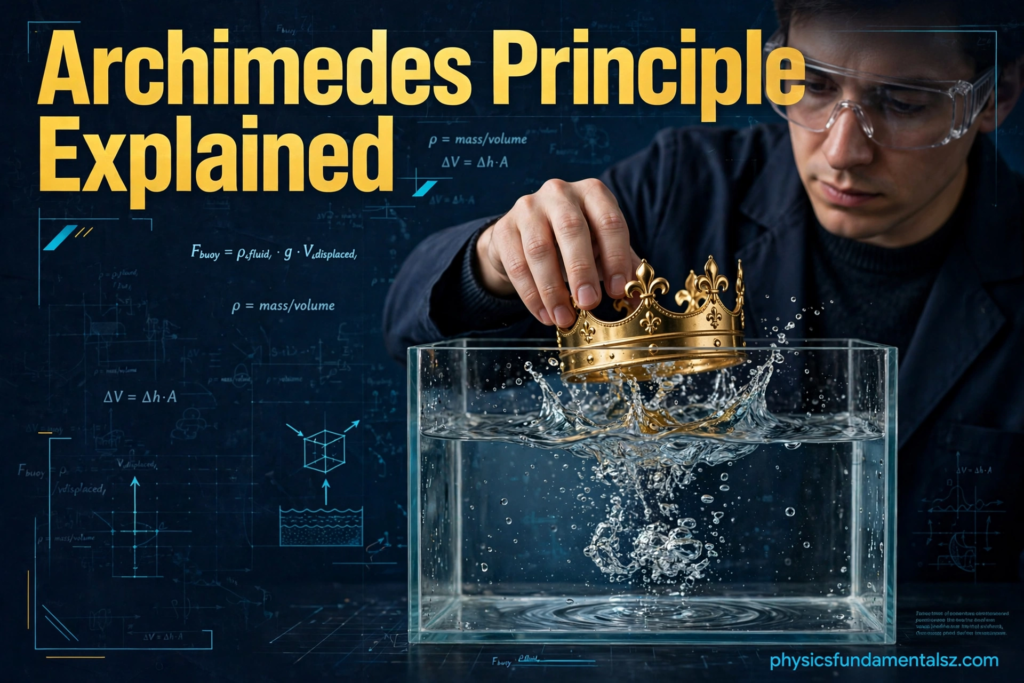
According to legend, King Hiero II of Syracuse suspected that a goldsmith had replaced some gold in his crown with cheaper silver. He asked Archimedes to test the crown without damaging it.
Archimedes, so the story goes, noticed the water level rise as he stepped into a bath. He realised that the volume of water displaced equalled the volume of his body under the water, and ran through the streets shouting “Eureka!”, meaning “I have found it!”
Historians do not treat this as a literal, documented account; it was written down long after Archimedes lived. The insight itself is sound, however: an irregular object displaces a volume of fluid equal to its own submerged volume. Once you know the volume and the mass, you can find the density, and pure gold has a different density from a gold-silver mixture. We return to this crown test as a worked example later.
What Is Buoyant Force?
Buoyant force, often written as F_b, is the net upward force exerted by a fluid on an object immersed in it.
It acts on every object in a fluid, whether the object floats, sinks, or stays suspended in the middle. A sinking stone still experiences buoyant force. It simply experiences a downward gravitational force that is larger.
Buoyant force does not depend on the object’s weight alone. It depends on the fluid and on how much fluid the object displaces. That is why a large, hollow ship can experience an enormous buoyant force, while a small, dense pebble experiences only a tiny one.
Students sometimes imagine buoyancy as a special property of water, or as something that only “switches on” for floating objects. Neither idea is correct. Buoyancy is a consequence of pressure in a fluid, and it is always present when an object is immersed.
Think of a beach ball held underwater. You can feel the upward push on your hands. Let go, and the ball shoots upward. That push was there all along. Holding the ball down simply added a downward force to balance it.
Similarly, a submarine does not create buoyancy from nothing when it wants to rise. It changes how much water it displaces, or changes its average density, so that the balance of forces tips in favour of the upward push that was always acting.
Why Does Buoyant Force Exist? Pressure Difference Explained
The reason is pressure, and pressure in a fluid increases with depth.
Imagine a rectangular block fully submerged in water. Water presses on all sides. The side pressures cancel out, because the leftward push on one side is balanced by the rightward push on the other side at the same depth.
The top and bottom are different. The bottom is deeper, so the pressure there is greater than at the top. The upward force on the bottom face is therefore larger than the downward force on the top face, and the difference is the buoyant force.
Another way to picture it: before the object arrived, that same space was filled with water, which was not sinking because the surrounding water pushed up on it with a force equal to its weight. Replace that water with an object of the same volume, and the surrounding water still pushes up with the same force. That force equals the weight of the displaced fluid, whatever the object’s shape.
If you want a stronger foundation for this reasoning, it helps to be confident about what density means in physics, since density appears in every buoyancy calculation that follows.
The Formula: F_b = ρVg
The formula for buoyant force is:
F_b = ρVg
F_b is the buoyant force, in newtons (N). The Greek letter rho, ρ, is the density of the fluid, not the object, in kilograms per cubic metre (kg/m³). Fresh water is about 1,000 kg/m³, seawater about 1,025 kg/m³, and air at sea level only about 1.2 kg/m³, which is why air buoyancy is usually tiny.
V is the volume of fluid displaced, in cubic metres (m³). For a fully submerged object, this equals the object’s volume. For a partially submerged floating object, it equals only the submerged part. This distinction is one of the most common exam traps.
g is the acceleration due to gravity, about 9.8 m/s² near Earth’s surface, often approximated as 10 m/s² in school problems. Use the value your question specifies.
Density times volume gives the mass of displaced fluid, and times g gives its weight, so the formula is simply “buoyant force equals the weight of the displaced fluid” in symbols. Its direction is upward. A denser fluid therefore gives a larger buoyant force, which is why it is easier to float in the sea than in a freshwater pool.
Float, Sink, or Stay Suspended? The Three Conditions
Whether an object floats, sinks, or stays suspended depends on comparing its weight with the buoyant force.
If buoyant force exceeds weight, the net force is upward and the object rises until part of it emerges. As it emerges, displaced volume falls, so buoyant force falls, until the two forces balance and it floats.
If weight exceeds the maximum possible buoyant force — the value when fully submerged — the object sinks. If buoyant force exactly equals weight when fully submerged, the net force is zero and the object remains suspended. This is neutral buoyancy, used by fish and submarines to hover.
For a fully submerged object, this force comparison becomes a density comparison. If the object’s average density is less than the fluid density, it floats; if greater, it sinks; if equal, it stays suspended. Note “average”: a steel ship floats not because steel is less dense than water, but because the ship as a whole, including the air inside its hull, has an average density below that of water.
The density rule is a handy shortcut, but for partially submerged objects or problems with extra forces, return to the forces themselves.
Apparent Weight and Apparent Weight Loss
When you weigh an object in water, the scale reading is less than the reading in air. This is called apparent weight, and the difference is the apparent weight loss.
Apparent weight is the weight that a scale actually measures when other forces are acting. In water, the object experiences its true weight downward and the buoyant force upward. The scale only needs to support the difference, so it reads a smaller value.
Mathematically, apparent weight equals true weight minus buoyant force, assuming the object is held still and no other forces act. If the object is floating freely, its apparent weight is zero in the sense that no scale is supporting it — the buoyant force alone balances its weight.
Apparent weight loss is simply the amount by which the reading drops. That amount equals the buoyant force, which by Archimedes’ principle equals the weight of the displaced fluid. This is a very useful result, because it lets you measure buoyant force with an ordinary spring balance: weigh the object in air, weigh it in water, and subtract.
Students sometimes say that an object “loses weight” in water, as if its mass or its gravitational pull had changed. That language is misleading. The object’s mass is unchanged, and Earth’s gravitational pull on it is essentially unchanged. What changes is the net force that a support must provide, because the fluid is now helping to hold it up.
This idea also explains why lifting a heavy rock underwater feels easier than lifting it on land. You are not fighting the rock’s full weight. The water is carrying part of it for you. Once the rock leaves the water, the buoyant force almost disappears — air buoyancy is negligible by comparison — and you suddenly feel its full weight.
Measuring Density with Archimedes’ Principle
Archimedes’ principle gives a practical way to find the density of an irregular object, which is exactly the problem in the crown legend.
The method is straightforward. First, measure the object’s mass with a balance. Second, find its volume by measuring the volume of water it displaces. Third, divide mass by volume to get density.
In a school laboratory, volume is often found by the displacement method: fill a measuring cylinder with water, note the level, lower the object in, and note the new level. The difference in levels, multiplied by the cylinder’s cross-sectional area or read directly from the scale, is the displaced volume.
A more precise method uses apparent weight loss. Weigh the object in air and then suspended in water. The loss in weight equals the weight of the displaced water. Dividing that weight by g gives the mass of displaced water, and dividing by the density of water gives the displaced volume, which equals the object’s volume if it is fully submerged. Then density is mass divided by volume.
This method is powerful because it works for objects whose shape makes direct measurement difficult. A crown, a gemstone, or a lump of metal can all be tested without cutting or melting them. Jewellers, geologists, and quality-control laboratories still use versions of this idea today.
It also has limits worth knowing. The object must not dissolve in the fluid, absorb it, or trap air bubbles on its surface, because any of those effects changes the displaced volume. For porous materials, a different fluid or a coating may be needed. And the measurement is only as good as the balance and the volume reading, so careful technique matters more than expensive equipment.
Worked Example 1: A Stone Underwater
Let us work through a simple numerical example step by step.
A stone has a volume of 0.002 m³ and a mass of 5.0 kg. It is fully submerged in fresh water, where the density is 1,000 kg/m³. Take g as 10 m/s² for simplicity. Find the buoyant force and the apparent weight.
First, find the weight of the stone. Weight equals mass times g, so 5.0 kg × 10 m/s² = 50 N downward.
Next, find the buoyant force. The stone is fully submerged, so the displaced volume equals the stone’s volume, 0.002 m³. Using F_b = ρVg, we get 1,000 kg/m³ × 0.002 m³ × 10 m/s² = 20 N upward.
Finally, find the apparent weight. Apparent weight equals true weight minus buoyant force, so 50 N − 20 N = 30 N. A spring balance holding the stone underwater would read 30 N, compared with 50 N in air. The apparent weight loss is 20 N, exactly equal to the buoyant force.
Notice the pattern. The stone still sinks if released, because its weight of 50 N exceeds the maximum buoyant force of 20 N. The water helps, but not enough to hold it up. That is the normal situation for a dense, compact object.
Worked Example 2: The Crown-Style Density Problem
Now for the classic problem type that examiners love.
A metal object has a mass of 1.20 kg. When suspended in water, a spring balance reads 10.5 N. Take g as 10 m/s² and the density of water as 1,000 kg/m³. Find the density of the metal, and decide whether it could be pure gold, whose density is about 19,300 kg/m³.
Start with the weight in air. Weight equals mass times g, so 1.20 kg × 10 m/s² = 12.0 N.
The balance in water reads 10.5 N, so the apparent weight loss is 12.0 N − 10.5 N = 1.5 N. This loss equals the buoyant force, so F_b = 1.5 N.
Use the buoyant force formula to find the displaced volume. Rearranging F_b = ρVg gives V = F_b ÷ (ρg) = 1.5 N ÷ (1,000 kg/m³ × 10 m/s²) = 1.5 ÷ 10,000 = 0.00015 m³. Since the object is fully submerged, this is also the object’s volume.
Now find the density. Density equals mass divided by volume, so 1.20 kg ÷ 0.00015 m³ = 8,000 kg/m³.
That is far below the density of pure gold, 19,300 kg/m³. The object cannot be pure gold. It might be another metal, or a mixture, but the crown-style test has done its job: it has revealed that the material is not what it was claimed to be, without damaging the object.
This example shows why the method is so useful. You never needed to know the object’s shape. You only needed two balance readings and the density of water.
Worked Example 3: A Floating Block and an Iceberg
Floating problems test a different skill: using equilibrium to find the submerged fraction.
Consider a wooden block with a volume of 0.040 m³ and a density of 600 kg/m³, floating in fresh water of density 1,000 kg/m³. What fraction of the block is submerged, and what volume sits below the surface?
Because the block floats in equilibrium, the buoyant force equals its weight. Its mass is density times volume, so 600 kg/m³ × 0.040 m³ = 24 kg. Its weight is 24 kg × 10 m/s² = 240 N, using g = 10 m/s².
The buoyant force must also be 240 N. Using F_b = ρVg, with ρ as the water density, we have 240 N = 1,000 kg/m³ × V_submerged × 10 m/s². Solving gives V_submerged = 240 ÷ 10,000 = 0.024 m³.
The fraction submerged is 0.024 m³ ÷ 0.040 m³ = 0.60, or 60 percent. In general, the fraction submerged equals the object’s density divided by the fluid’s density, which here is 600 ÷ 1,000 = 0.60. That shortcut is worth remembering, but only use it for a freely floating object in equilibrium.
The iceberg version of the same idea is famous. Ice has a density of about 917 kg/m³, and seawater has a density of about 1,025 kg/m³. The submerged fraction is therefore about 917 ÷ 1,025 ≈ 0.89, or roughly 89 percent. That is why only about a tenth of an iceberg is visible above the waterline, and why the phrase “tip of the iceberg” means a small visible part of a much larger hidden problem.
Note what the iceberg example does not say. It does not say that 89 percent of the iceberg’s mass is underwater in some mysterious way. It says that 89 percent of its volume is submerged, because that is the volume needed to displace enough seawater to balance its weight. Volume fraction and mass fraction are different ideas, and keeping them separate will save you marks.

Why Ships Float: Average Density and Displacement
A ship is made largely of steel, about 7,800 kg/m³, nearly eight times denser than water. A solid block of steel sinks, but a ship floats because it is not solid: its hull encloses a large volume of air, so its average density — total mass divided by total volume, including air spaces — is less than that of water.
Naval architects call the mass of water a floating ship displaces its “displacement”. Loading cargo increases the ship’s mass, so it must displace more water and sits lower. Load lines painted on the hull show the maximum safe depth; fresh water is less dense than seawater, so a ship sits lower in a river than in the sea for the same load.
A damaged ship sinks when water floods the hull and replaces the air, raising average density above that of water. For the gravitational force behind weight itself, Newton’s law of universal gravitation is a useful companion topic.
Submarines: Controlling Buoyancy on Purpose
A submarine is a ship that can choose whether to float, sink, or hover, and it does so by changing its average density.
A submarine has ballast tanks that can be filled with water or emptied with compressed air. When the tanks are filled with water, the submarine’s mass increases while its volume stays almost the same, so its average density rises above that of seawater and it sinks. When compressed air blows the water out, the mass falls, the average density drops below that of seawater, and it rises.
For neutral buoyancy, the crew adjusts the ballast so that the average density exactly matches the seawater density. The submarine then hovers at depth, with buoyant force balancing weight. Small adjustments, or the use of diving planes while moving, allow fine control.
This is a beautiful illustration of Archimedes’ principle in action, because nothing about the surrounding water changes. The buoyant force at a given submerged volume stays the same. What changes is the submarine’s weight, and therefore the balance of forces.
Fish do something similar with a swim bladder, a gas-filled organ whose volume they can adjust. Expanding the bladder increases the fish’s volume without much change in mass, lowering its average density and helping it rise. Compressing the bladder has the opposite effect. The physics is the same, even though the biology is very different.
Hot Air Balloons: Buoyancy in Air
Archimedes’ principle applies to gases as well as liquids, and a hot air balloon is the clearest example.
A balloon displaces a large volume of air. The buoyant force equals the weight of that displaced air. If the balloon, its basket, and its passengers weigh less than the displaced air, the net force is upward and the balloon rises.
Heating the air inside the balloon lowers its density, because warm air expands. The total mass inside the envelope therefore falls, while the volume displaced stays roughly the same. The balloon’s average density drops below that of the surrounding cool air, and it lifts off.
This is why hot air balloons are so large. Air is about 800 times less dense than water, so displacing enough air to lift a person requires an enormous volume. A balloon that looks oversized is actually just big enough to displace a useful weight of air.
Helium balloons work on the same principle, but for a different reason. Helium is naturally far less dense than air, so even a small balloon displaces air heavier than itself. The buoyant force exceeds its weight, and it rises without any heating.
The same reasoning explains why a hot air balloon cannot rise forever. As altitude increases, the surrounding air becomes less dense, so the weight of displaced air falls. Eventually the buoyant force equals the total weight, and the balloon levels off. Pilots control altitude by adjusting the temperature inside the envelope, which changes the balloon’s average density.
Hydrometers and Other Measuring Instruments
A hydrometer uses Archimedes’ principle to measure a liquid’s density. It is a sealed glass tube with a weighted bulb and a graduated stem. In a denser liquid, less submerged volume is needed to displace a weight of liquid equal to the hydrometer’s weight, so it floats higher; in a less dense liquid, it sinks lower. The liquid level on the stem gives a direct density reading.
Mechanics use hydrometers to check battery acid, brewers use them to measure sugar concentration, and a related instrument, the lactometer, checks milk. A ship’s load line works the same way at large scale, and even testing whether an egg is fresh uses buoyancy: a fresh egg sinks, while an older egg, which has lost moisture and gained air, is more likely to float.
Common Mistakes and Exam Traps
Archimedes’ principle is simple to state and easy to get wrong under exam pressure. Watch for these traps.
First, using the object’s volume instead of the displaced volume. For a fully submerged object they are equal, but for a floating object only the submerged part counts.
Second, using the object’s density instead of the fluid’s density in F_b = ρVg. The rho in the formula is the fluid density; the object’s density matters for its weight, not directly for buoyant force.
Third, confusing mass and weight. Mass is in kilograms; weight and buoyant force are in newtons. A result in kilograms is the mass of displaced fluid, not the force — multiply by g to finish.
Fourth, assuming sinking objects experience no buoyant force. Every immersed object does. Sinking means weight wins; floating means buoyant force balances weight.
Fifth, forgetting that apparent weight loss equals the buoyant force, not the object’s weight. A scale in water reads true weight minus buoyant force.
Finally, round only at the end. Buoyancy problems involve small volumes and densities in the thousands, so early rounding can shift the final answer noticeably.
How Archimedes’ Principle Connects to Other Physics
Archimedes’ principle connects to pressure, density, and forces, and examiners often combine topics.
Pressure is the foundation: without pressure increasing with depth, there would be no net upward force. Density is the bridge: it links mass and volume, appears in the formula, and determines the float-or-sink condition. Forces and equilibrium provide the method: draw weight down and buoyant force up, then apply equilibrium or find the net force.
Fluid flow provides a contrast. Bernoulli’s principle describes pressure changes in moving fluids, while Archimedes’ principle describes the net force on an object in a fluid at rest or moving slowly. If the question is about floating, sinking, or apparent weight, think Archimedes; if the fluid is moving fast, think Bernoulli.
Frequently Asked Questions
What is Archimedes’ principle in one sentence?
Archimedes’ principle states that the upward buoyant force on an object immersed in a fluid is equal to the weight of the fluid displaced by the object.
Does buoyant force act on sinking objects?
Yes. Every immersed object experiences buoyant force. A sinking object experiences it too, but its weight is larger than the maximum buoyant force, so the net force is downward and it sinks.
Why do ships float if steel is denser than water?
A ship floats because its average density, including the air inside its hull, is less than the density of water. A solid block of steel sinks, but a hollow steel ship displaces enough water to balance its weight while only partly submerged.
What is the difference between displaced volume and object volume?
Displaced volume is the volume of fluid pushed aside by the object. For a fully submerged object, it equals the object’s volume. For a partially submerged floating object, it equals only the submerged part of the object’s volume.
Why do you feel lighter in water?
You feel lighter because the water exerts an upward buoyant force that supports part of your weight. Your mass and your true weight are unchanged. A scale underwater reads your apparent weight, which is your true weight minus the buoyant force.
How does a submarine sink and rise?
A submarine changes its average density using ballast tanks. Filling the tanks with water increases its mass and average density, so it sinks. Blowing the water out with compressed air decreases its mass and average density, so it rises. Matching the seawater density gives neutral buoyancy.
Why does an iceberg float mostly underwater?
Ice has a density of about 917 kg/m³ and seawater about 1,025 kg/m³, so the submerged fraction is about 917 divided by 1,025, roughly 89 percent. Only about 11 percent of the iceberg’s volume sits above the surface.
Does Archimedes’ principle work in air?
Yes. Air is a fluid, so it exerts a buoyant force equal to the weight of displaced air. The effect is usually small because air density is low, but it becomes important for balloons and airships, which displace a very large volume of air.
What is apparent weight loss?
Apparent weight loss is the difference between an object’s weight in air and its apparent weight in a fluid. It equals the buoyant force, which equals the weight of the displaced fluid. It is measured by weighing the object in air and then in the fluid and subtracting.
Conclusion
Archimedes’ principle is one of those rare physics ideas that is both simple to state and endlessly useful.
A single sentence — buoyant force equals the weight of displaced fluid — explains why ships float, why stones sink, why submarines hover, why balloons rise, and why you feel lighter in a swimming pool. Behind that sentence sits a clear physical reason: pressure increases with depth, so the fluid pushes up harder on the bottom of an object than it pushes down on its top.
For exams, the discipline is just as simple. Use the fluid density in F_b = ρVg, use the displaced volume rather than the object’s volume, keep mass and weight in their correct units, and compare buoyant force with weight before deciding whether an object floats, sinks, or stays suspended.
Learn those habits, practise the three worked examples until the steps feel natural, and Archimedes’ principle will stop being a formula to memorise and become a tool you can trust.
For further reading, the explanations at Khan Academy on buoyant force and Archimedes’ principle and HyperPhysics on buoyancy give clear, student-friendly treatments with diagrams, while NASA’s pages on buoyancy and aerodynamics provide authoritative background on how the same ideas apply to flight and floating bodies.