Bernoulli’s Principle Explained: Equation, Examples & Everyday Uses
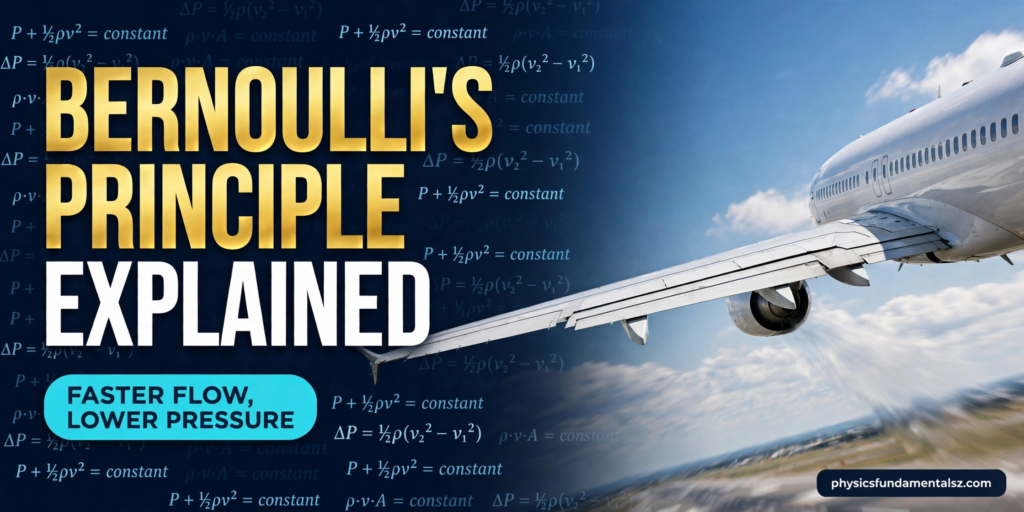
An airplane weighing hundreds of tonnes lifts off the ground and stays in the air. A shower curtain billows inward when the water runs. A truck passes you on the highway and your car seems to tug towards it. A perfume bottle sprays a fine mist when you squeeze the bulb. All four phenomena trace back to one idea, published by the Swiss mathematician Daniel Bernoulli in 1738: when a fluid speeds up, its pressure drops.
Bernoulli’s principle is one of the most quoted — and most misquoted — ideas in physics. This guide explains it properly: the principle itself, the equation behind it, the assumptions it rests on, where it genuinely explains things (and where it does not), worked problems, and the devices built on it.
What Is Bernoulli’s Principle? The Simple Definition
Definition box: Bernoulli’s principle states that for a steady, incompressible, non-viscous fluid flowing along a streamline, an increase in the fluid’s speed is accompanied by a decrease in its pressure (or in the fluid’s potential energy). Faster flow means lower pressure; slower flow means higher pressure.
In plain language: where a fluid moves quickly, it pushes less hard on its surroundings. Where it moves slowly, it pushes harder. That pressure difference is a real force, and engineers exploit it in wings, pipes, carburettors, spray bottles, and chimneys.
The principle is really a statement of energy conservation for flowing fluids. A fluid parcel has three kinds of energy per unit volume: pressure energy, kinetic energy (from its motion), and gravitational potential energy (from its height). If no energy is added or lost, the total stays constant — so if kinetic energy rises, pressure energy must fall. That trade-off is the entire principle.
Bernoulli’s Equation
For a fluid of density ρ flowing steadily, Bernoulli’s equation along a streamline is:
P + ½ρv² + ρgh = constant
where:
- P is the static pressure of the fluid
- ρ (rho) is the fluid density
- v is the flow speed
- g is the acceleration due to gravity (9.81 m/s²)
- h is the height above a reference level
Each term is an energy per unit volume, measured in pascals (which are joules per cubic metre). The term ½ρv² is called the dynamic pressure, and ρgh is the gravitational potential energy per unit volume.
Comparing two points (1 and 2) on the same streamline, the equation becomes:
P₁ + ½ρv₁² + ρgh₁ = P₂ + ½ρv₂² + ρgh₂
If the fluid flows horizontally, so h₁ = h₂, the height terms cancel and the equation simplifies to:
P₁ + ½ρv₁² = P₂ + ½ρv₂²
This simplified form is the one used in most textbook problems — and it shows the principle nakedly: if v goes up, P must come down, and vice versa.
The Assumptions Behind the Principle
Bernoulli’s equation is powerful but it is not universal. It rests on four assumptions, and exam questions love to test whether you know them:
- Steady flow: the flow pattern does not change with time at any point. Turbulent, churning flow breaks the equation.
- Incompressible fluid: the density stays constant. This holds well for liquids and for gases at low speeds (below about a third of the speed of sound).
- Non-viscous (inviscid) fluid: there is no friction between fluid layers. Real fluids have some viscosity, so the equation is an approximation.
- Flow along a streamline: the equation compares points on the same streamline, not points in different streams.
When these assumptions fail, the equation gives wrong answers. Blood flow in narrow arteries, for instance, is viscous and pulsatile, so Bernoulli’s equation alone does not describe it well. Always check the assumptions before applying the equation.
How Bernoulli’s Principle Works: The Intuition
Imagine water flowing through a pipe that narrows. The same volume of water must pass every cross-section each second — this is the continuity equation, A₁v₁ = A₂v₂, where A is the cross-sectional area. In the narrow section, the area is smaller, so the water must speed up to get the same volume through.
Now apply energy conservation. The water in the narrow section has more kinetic energy per unit volume, so it must have less pressure energy. The pressure in the narrow section drops. If you attach vertical tubes (manometers) to the wide and narrow sections, the water level in the narrow section’s tube sits lower — a direct, visible measurement of the pressure drop.
This is the Venturi effect, and it is the most direct demonstration of Bernoulli’s principle. A Venturi meter, used to measure fluid flow rates in industry, is exactly this arrangement with a pressure gauge instead of a visible tube.

How Airplane Wings Generate Lift
The classic application — and the classic source of misconceptions — is the airplane wing. Here is the correct story.
What Bernoulli’s principle actually contributes
An aircraft wing (airfoil) is shaped so that air flowing over the top surface travels faster than air flowing underneath, and the wing is also angled slightly upward (the angle of attack). Faster air above means lower pressure above; slower air below means higher pressure below. The pressure difference pushes the wing upward. That is lift, and Bernoulli’s principle describes the pressure-speed relationship involved.
The misconception to avoid
A very common textbook explanation claims that air over the top must travel a longer path and therefore must speed up to “rejoin” the air underneath at the trailing edge — the so-called equal transit time theory. This is wrong. Air over the top does not rejoin the air underneath, and there is no rule requiring it to. The air over the top speeds up because of the wing’s shape and angle, which turn the airflow and create a pressure field. The equal transit explanation is still found in some textbooks, but it is physically incorrect, and good exam answers avoid it.
The fuller picture
Lift is fully explained only by combining Bernoulli’s principle with Newton’s third law: the wing deflects air downward, and the air pushes the wing upward in reaction. Both descriptions are valid and consistent — Bernoulli describes the pressure field, Newton describes the momentum change. A complete answer mentions both. For more on the forces involved, see our guide to what causes terminal velocity in free fall and why air resistance increases with speed.
The Venturi Effect and Its Applications
The Venturi effect — pressure dropping where a tube narrows — is Bernoulli’s principle in its purest practical form. It appears in:
- Venturi meters: measure the flow rate of water, gas, or chemicals in pipes by comparing pressures in wide and narrow sections.
- Carburettors: in older engines, air rushing through a narrowed throat drops in pressure and sucks fuel into the airstream.
- Spray bottles and perfume atomisers: fast air blown across a tube’s opening lowers the pressure there, drawing liquid up the tube and breaking it into a fine spray.
- Chimneys: wind blowing across the top of a chimney lowers the pressure there, helping draw smoke upward.
- Aspirators: laboratory water pumps use a fast water jet to create suction.
- Shower curtains: fast-moving shower water drags air with it, lowering the pressure inside the shower and pushing the curtain inward. The same effect makes a truck’s passing disturb a nearby car.
More Everyday Examples
A curveball curves
A spinning baseball drags a thin layer of air around with it. On one side, the spin adds to the airflow speed; on the other side, it subtracts. The faster side has lower pressure, so the ball is pushed towards that side and curves. The same Magnus effect lets footballers bend free kicks and tennis players hit topspin shots that dip sharply.
Why shower curtains attack you
As noted above, the shower stream speeds up the air inside the shower, lowering its pressure relative to the bathroom air outside. The higher outside pressure pushes the curtain inwards. It is Bernoulli’s principle in your bathroom, every morning.
Trucks and overtaking cars
When a large truck passes a small car, the air squeezed between them speeds up, and its pressure drops. The higher pressure on the car’s far side pushes it towards the truck. Drivers feel this as a sideways tug. Keeping a safe gap matters precisely because the effect strengthens as the gap narrows.
Sailing into the wind
A sail works like a vertical wing. Air moving across the curved sail speeds up on one side, creating a pressure difference that pulls the boat forward — even partly into the wind. Modern racing yachts exploit this so effectively that they can sail faster than the wind itself.
The floating ping-pong ball
Blow air upward through a funnel or from a hair dryer and a ping-pong ball floats stably in the stream. The fast-moving air has lower pressure, and if the ball drifts sideways, the slower surrounding air pushes it back into the stream. It is a striking classroom demonstration of Bernoulli’s principle and pressure balance.

Bernoulli’s Principle vs Related Ideas
| Concept | What it says | Relation to Bernoulli |
|---|---|---|
| Continuity equation (A₁v₁ = A₂v₂) | Volume flow rate is constant in a pipe | Explains why fluid speeds up in a narrowing |
| Bernoulli’s principle | Faster flow means lower pressure | Energy conservation along a streamline |
| Archimedes’ principle | Buoyant force equals weight of displaced fluid | Different effect — about floating, not flow |
| Pascal’s principle | Pressure applied to a confined fluid spreads equally | About static fluids, not moving ones |
| Torricelli’s law | Efflux speed v = √(2gh) | A special case of Bernoulli’s equation |
Torricelli’s law deserves a note: it describes how fast water exits a hole in a tank, and it drops out of Bernoulli’s equation directly by comparing the surface of the water with the exit hole. It is a favourite exam derivation, so practise it. For the buoyancy side of fluid physics, see our guide on how to calculate buoyant force step by step.
Worked Examples
Example 1: Pressure drop in a narrowing pipe
Water flows through a horizontal pipe. In the wide section, the speed is 1.0 m/s and the pressure is 200 kPa. In the narrow section, the speed is 3.0 m/s. What is the pressure in the narrow section? Take the density of water as 1,000 kg/m³.
Solution: For horizontal flow, P₁ + ½ρv₁² = P₂ + ½ρv₂².
P₂ = P₁ + ½ρ(v₁² − v₂²) = 200,000 + ½(1,000)(1² − 3²) = 200,000 + 500(1 − 9) = 200,000 − 4,000 = 196,000 Pa = 196 kPa.
The pressure drops by 4 kPa where the water speeds up — exactly as Bernoulli’s principle predicts.
Example 2: Speed from a pressure difference (Venturi meter)
A Venturi meter measures a pressure difference of 5,000 Pa between the wide section (speed 2.0 m/s) and the narrow section. What is the speed in the narrow section? Take water density as 1,000 kg/m³.
Solution: P₁ − P₂ = ½ρ(v₂² − v₁²), so 5,000 = 500(v₂² − 4). That gives v₂² − 4 = 10, so v₂² = 14 and v₂ = √14 ≈ 3.74 m/s. The narrow section flows at about 3.7 m/s.
Example 3: Torricelli’s law — draining tank
Water drains from a hole 5.0 m below the surface of a large open tank. What is the exit speed?
Solution: Applying Bernoulli between the surface (speed ≈ 0, pressure = atmospheric) and the hole (pressure = atmospheric, height 5.0 m lower): ½ρv² = ρgh, so v = √(2gh) = √(2 × 9.81 × 5.0) = √98.1 ≈ 9.9 m/s. This is Torricelli’s law, and notice it is the same speed as a body falling 5.0 m — energy conservation again.
Example 4: Lift pressure difference
Air flows over an aircraft wing at 80 m/s and under it at 60 m/s. Estimate the pressure difference between the lower and upper surfaces. Take air density as 1.2 kg/m³.
Solution: ΔP = ½ρ(v_top² − v_bottom²) = ½(1.2)(80² − 60²) = 0.6(6,400 − 3,600) = 0.6 × 2,800 = 1,680 Pa. A difference of about 1.7 kPa across a large wing area produces an enormous total lift force — multiply by wing area to see why.
Example 5: Height change in a pipe
Water flows up a pipe from a point where its speed is 2.0 m/s and pressure is 150 kPa to a point 3.0 m higher where its speed is 1.0 m/s. What is the pressure at the higher point? Take water density as 1,000 kg/m³.
Solution: P₂ = P₁ + ½ρ(v₁² − v₂²) + ρg(h₁ − h₂) = 150,000 + 500(4 − 1) + 1,000 × 9.81 × (−3) = 150,000 + 1,500 − 29,430 = 122,070 Pa ≈ 122 kPa. Both the height gain and the speed change matter; forgetting the ρgh term is a common error.
Common Mistakes to Avoid
- Using the equal transit time explanation for lift: air over a wing does not need to rejoin air underneath. This explanation is wrong and markers notice.
- Applying Bernoulli across different streamlines: the equation compares points on the same streamline.
- Forgetting the height term: ρgh matters whenever the fluid changes elevation.
- Applying it to turbulent or viscous flow: the equation assumes steady, non-viscous flow.
- Confusing pressure with force: pressure is force per unit area. A small pressure difference over a huge wing area is a huge force.
- Assuming faster air always “sucks”: it is the pressure difference that produces the force, not suction as a separate phenomenon.
- Ignoring compressibility at high speeds: for gases approaching the speed of sound, density changes and the simple equation fails.
Expert Tips for Exams
- Always write the full equation first, then cancel the terms that do not apply (horizontal means h cancels; open to atmosphere means P = atmospheric on both sides).
- For pipe problems, use the continuity equation first to find the unknown speed, then Bernoulli to find the pressure.
- For lift questions, mention both Bernoulli’s pressure difference and Newton’s third law for a complete answer.
- Watch your units: pressure in pascals, density in kg/m³, speed in m/s. A kPa left unconverted is a lost mark.
- If a problem says “horizontal pipe,” the ρgh terms vanish immediately — say so.
Quick Summary
- Bernoulli’s principle: faster fluid flow means lower pressure, from energy conservation along a streamline.
- Bernoulli’s equation: P + ½ρv² + ρgh = constant.
- Assumptions: steady, incompressible, non-viscous flow along a streamline.
- The Venturi effect is the cleanest demonstration; airplane lift, spray bottles, chimneys, and curveballs are applications.
- The equal transit time explanation of lift is wrong — avoid it.
Deriving Bernoulli’s Equation from Energy Conservation
Bernoulli’s equation is not a separate law of nature — it falls out of the work-energy theorem applied to a moving fluid. Consider a small fluid element travelling along a streamline. Three things can do work on it or store energy in it: pressure forces from neighbouring fluid, gravity, and its own motion.
The pressure at the back of the element pushes it forward, doing work; the pressure at the front resists, doing negative work. The net pressure work, plus the change in gravitational potential energy as the element rises or falls, equals the change in its kinetic energy. Divide the whole statement by the element’s volume and you get P + ½ρv² + ρgh = constant. Every term is an energy density, and the equation simply says that energy is conserved along the streamline.
This derivation also shows why the equation fails when friction matters: viscosity does negative work on the fluid element, draining energy into heat, so the total is no longer constant. In long pipes, engineers add a “head loss” term to account for exactly that drain.
The Pitot Tube: Measuring Airspeed with Bernoulli
A Pitot tube is the device that tells pilots how fast they are flying, and it is pure Bernoulli. The tube has two openings: one facing into the airflow, where the air is brought to rest (stagnation point), and one on the side, where the air flows past at full speed. NASA’s Glenn Research Center explains the equation and its restrictions in its beginner’s guide (Bernoulli’s Equation). The pressure difference between the two openings, fed into Bernoulli’s equation, gives the airspeed directly: v = √(2ΔP / ρ).
Pitot tubes are used on every aircraft, and also to measure flow in wind tunnels, ventilation ducts, and racing cars. They are simple, have no moving parts, and are remarkably accurate — as long as the air density is known, which is why aircraft also measure air temperature and altitude to correct the reading.
Bernoulli’s Principle in Medicine
Blood is a fluid, so Bernoulli’s principle shows up in the body too — with important caveats, because blood is viscous and pulsatile. In a narrowed artery (stenosis), blood speeds up through the constriction and its pressure drops. The lower pressure can encourage the vessel wall to collapse further inward, worsening the narrowing in a dangerous feedback loop.
Doctors also use the principle in reverse: Doppler ultrasound measures blood flow speed, and a simplified Bernoulli equation (ΔP = 4v², with v in m/s and ΔP in mmHg) estimates the pressure drop across a heart valve. This quick estimate helps cardiologists judge how severe a valve narrowing is without invasive surgery.
Aneurysms show the opposite effect. Where an artery bulges wider, blood slows down and pressure rises against the weakened wall, which can worsen the bulge. The interplay of speed and pressure in vessels is a live clinical concern, not just a textbook exercise.
Bernoulli in Sports: More Than Curveballs
The Magnus effect from spinning balls is the best-known sports example, but Bernoulli’s principle appears all over sport. A golf ball’s dimples create a turbulent boundary layer that changes the airflow pattern around it, affecting both drag and lift. A football’s curved free kick uses spin to create a pressure difference across the ball. A discus and a javelin are shaped to generate lift as they fly. Even a table-tennis player’s topspin serve dips because the spinning ball drags air faster over its top surface, lowering the pressure there and pulling the ball downward.
Sailing deserves a special mention. A yacht’s sail generates a pressure difference like a wing, and the keel generates a sideways force that stops the boat sliding sideways. The combination lets racing yachts sail at angles and speeds that seem to defy common sense — including, with modern foiling designs, speeds several times the wind speed.
Limitations and Real-World Corrections
Bernoulli’s equation is an idealisation, and engineers know exactly where it breaks:
- Viscosity: real fluids lose energy to friction, especially in long pipes and narrow tubes. Engineers add head-loss terms.
- Turbulence: chaotic, unsteady flow violates the steady-flow assumption.
- Compressibility: gases at high speeds change density, so the incompressible form fails. Compressible-flow versions of the equation exist for jet engines and rockets.
- Rotation: the equation applies along a single streamline. Comparing points in different streams, or in rotating flow, needs care.
- Unsteady flow: starting, stopping, or pulsing flows need the unsteady Bernoulli equation, which adds a time-dependent term.
None of this diminishes the principle. It means that, like all good physics, it has a domain where it works beautifully and boundaries that a careful user respects.
Everyday Experiments You Can Try at Home
Bernoulli’s principle is unusually easy to demonstrate with household items, and trying these makes the idea stick far better than reading about it.
The paper strip test: Hold a strip of paper just below your lower lip and blow steadily over the top surface. The strip rises. The fast air above it has lower pressure, and the still air below pushes the strip up. It is a wing in miniature.
The two balloons test: Hang two balloons a few centimetres apart and blow air between them. Instead of being pushed apart, the balloons move together — the fast air between them is at lower pressure than the still air outside.
The ping-pong ball in a funnel: Place a ping-pong ball in a funnel and blow hard through the narrow end. Counter-intuitively, the ball stays in the funnel instead of blowing out. The fast air around the ball is at lower pressure, and the surrounding still air holds it in place.
The floating ball: Aim a hair dryer upward and balance a ping-pong ball in the airstream. It hovers stably because any sideways drift meets higher-pressure still air that pushes it back. This is the same stability that keeps a wing’s airflow attached.
Each of these is a safe classroom demonstration, and together they show that Bernoulli’s principle is not an abstraction — it is a force you can feel with a strip of paper and your own breath.
Bernoulli and Newton: The Lift Debate Settled
Students sometimes hear that “Bernoulli’s explanation of lift is wrong and Newton’s is right,” or the reverse. Both claims are misleading. Lift can be described in two equivalent ways. Bernoulli’s description tracks pressure: faster air above the wing means lower pressure above, and the pressure difference pushes the wing up. Newton’s description tracks momentum: the wing deflects air downward, so the air exerts an equal and opposite upward force on the wing.
These are not competing theories; they are two views of the same physics, connected by the fact that pressure differences are what accelerate the air downward in the first place. A complete, high-scoring answer mentions both and notes that neither works alone without the wing’s angle of attack and shape turning the airflow. What is genuinely wrong is only the equal transit time story — the idea that air must speed up to rejoin its partner on the other side. Discard that one claim, and the rest of the Bernoulli story stands.
Bernoulli in Nature: Wind, Water, and Weather
Bernoulli’s principle shapes the natural world as well as machines. Wind blowing over a hill speeds up at the crest, lowering the pressure there — one reason hilltops are windier and why roofs can lift off in storms when fast wind passes over them while the air inside the house stays still and at higher pressure.
Prairie dogs and burrowing animals exploit the same effect: their burrows have entrances at different heights, and wind blowing faster over the taller mound lowers the pressure there, drawing fresh air through the tunnel system. It is passive ventilation, powered by Bernoulli.
In rivers, water speeds up through narrow channels and the pressure drops, which affects erosion patterns and the way sediment is carried. In the atmosphere, fast-moving air in a jet stream sits alongside slower air, and the pressure differences between them help steer weather systems. Wherever a fluid speeds up, the pressure story follows.
Frequently Asked Questions
1. What is Bernoulli’s principle in simple words?
Bernoulli’s principle says that when a fluid flows faster, its pressure drops. Fast-moving air or water pushes less hard on its surroundings than slow-moving fluid does.
2. What is Bernoulli’s equation?
Bernoulli’s equation is P + ½ρv² + ρgh = constant, where P is pressure, ρ is fluid density, v is flow speed, g is gravity, and h is height. It expresses energy conservation for a flowing fluid.
3. How does Bernoulli’s principle explain airplane lift?
Air moves faster over the top of a wing than underneath, so pressure is lower on top. The higher pressure below pushes the wing up. Combined with the downward deflection of air (Newton’s third law), this produces lift.
4. What is the Venturi effect?
The Venturi effect is the drop in pressure that occurs when a fluid flows through a narrowed section of pipe and speeds up. It is a direct consequence of Bernoulli’s principle.
5. Is the equal transit time explanation of lift correct?
No. Air flowing over a wing does not need to meet up with air flowing underneath, and it does not speed up for that reason. The air speeds up because of the wing’s shape and angle of attack.
6. What are the assumptions of Bernoulli’s principle?
The flow must be steady, the fluid incompressible, the fluid non-viscous, and the comparison must be along a single streamline. Real flows approximate these conditions to varying degrees.
7. Why does a shower curtain move inward?
Fast shower water drags air with it, lowering the air pressure inside the shower. The higher-pressure air outside pushes the curtain inward.
8. How does a perfume spray bottle work?
Squeezing the bulb blows fast air across the top of a tube, lowering the pressure there. The higher pressure on the liquid’s surface pushes it up the tube, where the fast air breaks it into a fine spray.
9. What is dynamic pressure?
Dynamic pressure is ½ρv², the kinetic energy per unit volume of a flowing fluid. It is the term in Bernoulli’s equation that grows when the fluid speeds up.
10. Can Bernoulli’s principle be applied to gases?
Yes, for gases at low speeds where density changes are negligible — roughly below a third of the speed of sound. At higher speeds, compressibility corrections are needed.
11. Why does a curveball curve?
A spinning ball drags air with it, making the airflow faster on one side than the other. The faster side has lower pressure, so the ball is pushed sideways — the Magnus effect.
12. What is Torricelli’s law?
Torricelli’s law states that water exits a hole in a tank at speed v = √(2gh), where h is the depth of the hole below the surface. It is a special case of Bernoulli’s equation.
13. Does Bernoulli’s principle explain why trucks pull cars sideways?
Yes. Air squeezed between a passing truck and a car speeds up, its pressure drops, and the higher pressure on the car’s far side pushes it towards the truck.
14. What is the difference between Bernoulli’s principle and Archimedes’ principle?
Bernoulli’s principle concerns moving fluids and the pressure-speed trade-off. Archimedes’ principle concerns static fluids and the buoyant force on immersed objects. They describe different situations.
15. How do Venturi meters measure flow rate?
A Venturi meter compares pressure in a wide section and a narrow section of pipe. The pressure difference, via Bernoulli’s equation, reveals the flow speed, and the continuity equation converts that to a volume flow rate.
16. Why does a chimney draw smoke upward?
Wind blowing across the chimney top lowers the pressure there. The higher pressure at the fireplace pushes smoke up and out through the chimney.
17. Can Bernoulli’s principle explain how sails work?
Yes. A sail acts like a vertical wing: air speeds up on one side, pressure drops, and the resulting force pulls the boat forward, even partly against the wind.
18. What happens to Bernoulli’s equation in turbulent flow?
In turbulent flow, the steady-flow assumption fails, energy is lost to eddies and friction, and Bernoulli’s equation no longer gives accurate results. Engineers then use empirical corrections.
19. Why do roofs lift off in hurricanes?
Fast wind blowing over a roof lowers the air pressure above it, while the still air inside the house remains at higher pressure. The pressure difference pushes the roof upward, sometimes with enough force to tear it off. Opening windows does not equalise this effectively; the real protection is strong roof fixings.
20. How does a carburettor use Bernoulli’s principle?
Air rushing through the carburettor’s narrowed throat speeds up and drops in pressure. The low pressure draws fuel from a small jet into the airstream, mixing fuel and air before they enter the engine’s cylinders. Modern cars use fuel injection instead, but the physics is the same.
Conclusion
Bernoulli’s principle is energy conservation wearing a fluid’s clothes. Faster flow means more kinetic energy per unit volume, so pressure energy must fall — and that single trade-off explains wings, Venturi meters, spray bottles, curveballs, and shower curtains. Learn the equation, respect its assumptions, and retire the equal transit myth, and you will handle any Bernoulli problem with confidence.
To explore further, read our guides to what is density in physics, what is kinetic energy, and how to calculate buoyant force step by step.
Further reading: Khan Academy’s Bernoulli’s equation lessons, the HyperPhysics fluid mechanics pages from Georgia State University, and NASA’s beginner’s guide to aerodynamics (Bernoulli’s Equation) all offer interactive demonstrations and practice problems.