Difference Between Speed and Velocity With Examples (2026 Guide)
Difference Between Speed and Velocity With Examples: Speed and velocity sound like the same thing in everyday talk. In physics, they are not.
Speed tells you how fast something moves. Velocity tells you how fast and in which direction.
Table of Contents
Difference Between Speed and Velocity With Examples
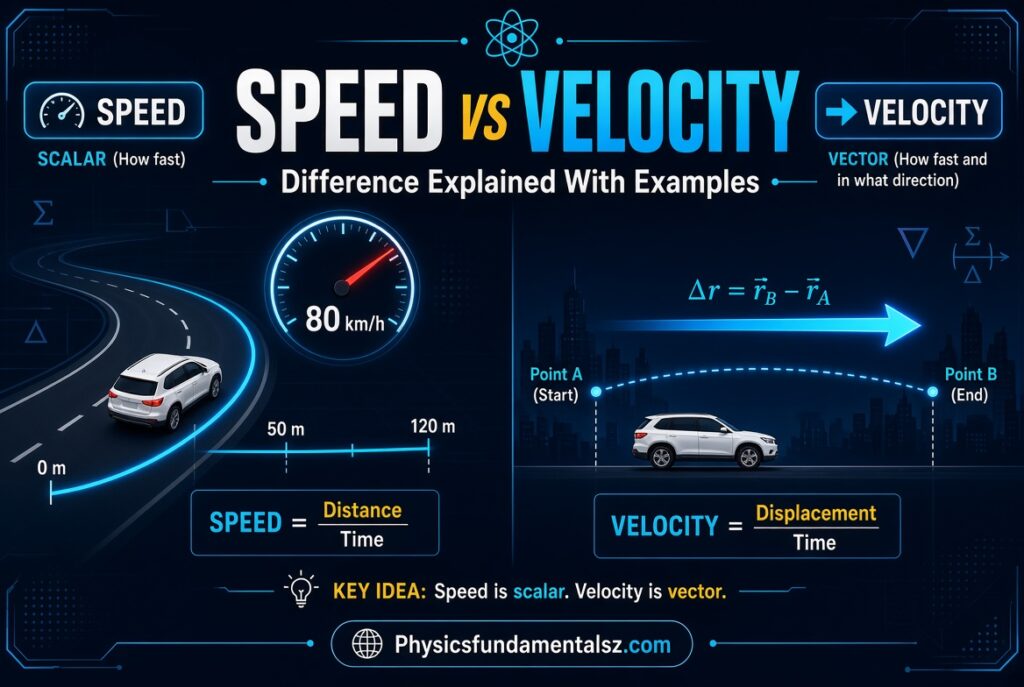
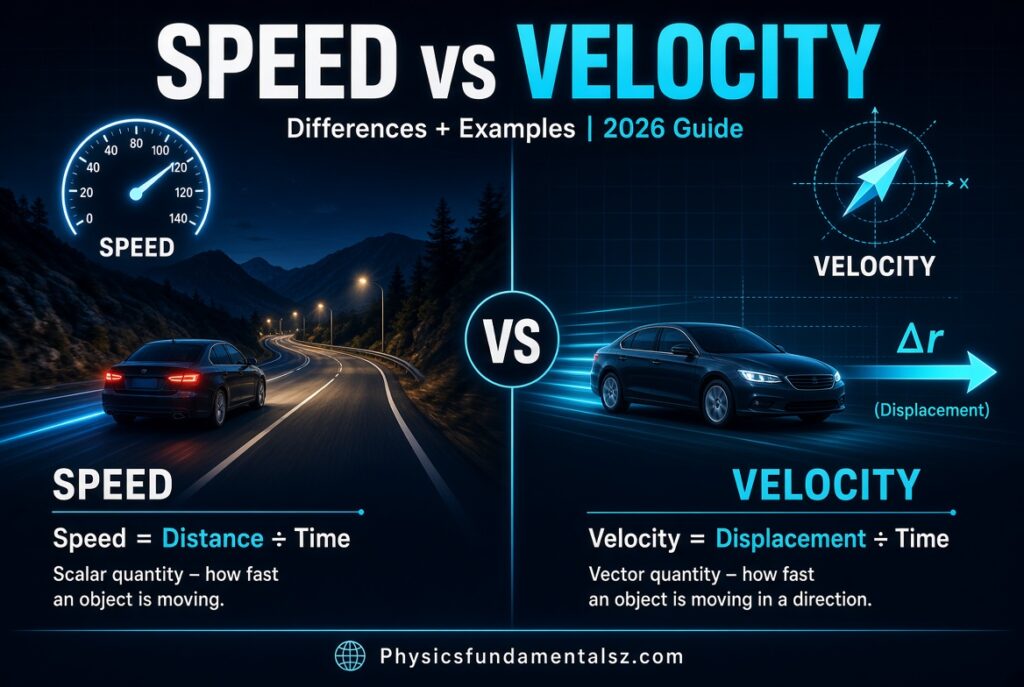
Speed is a scalar quantity — it only has magnitude, no direction.
Velocity is a vector quantity — it has both magnitude and direction.
A car moving at 60 km/h has a speed. A car moving at 60 km/h north has a velocity.
What Is Speed?
Speed is the rate at which an object covers distance over time.
It is calculated as total distance divided by total time. Speed is always a positive number or zero.
Formula: Speed = Distance ÷ Time (s = d/t)
If a runner covers 100 meters in 10 seconds, their speed is 10 m/s. Direction never enters the calculation.
What Is Velocity?
Velocity is the rate at which an object changes its position, or displacement, over time.
It includes direction, so velocity can be positive, negative, or even zero, depending on the path taken.
Formula: Velocity = Displacement ÷ Time (v = Δx/t)
If that same runner finishes 100 meters east in 10 seconds, their velocity is 10 m/s east.
Speed vs Velocity: Key Differences Table
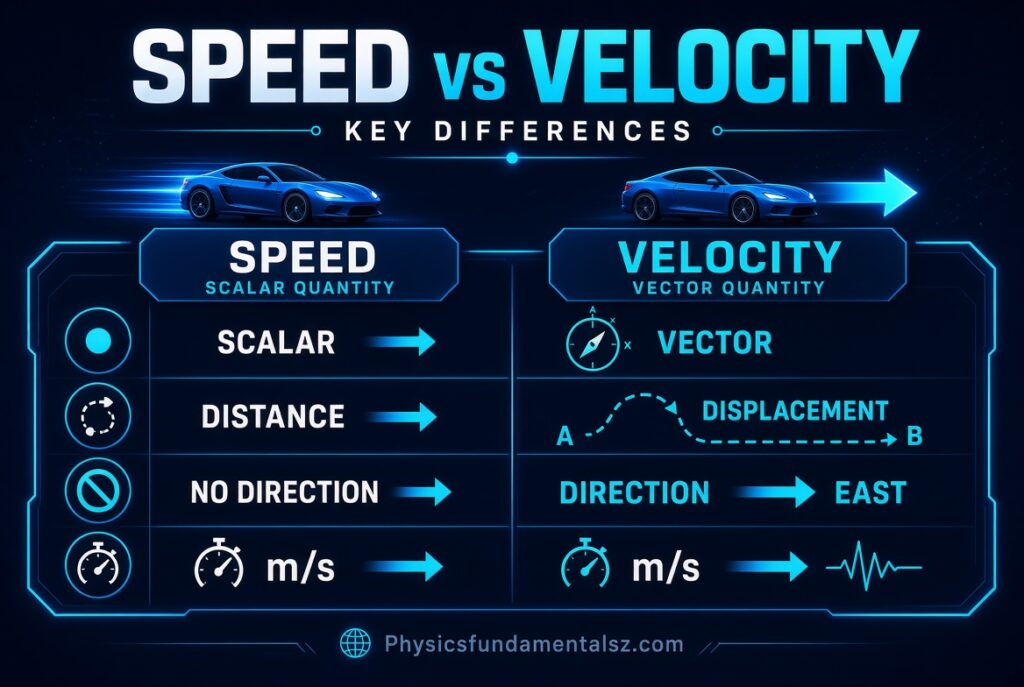
| Aspect | Speed | Velocity |
|---|---|---|
| Quantity type | Scalar | Vector |
| Depends on | Distance | Displacement |
| Direction | Not included | Included |
| Value | Always positive or zero | Can be positive, negative, or zero |
| SI unit | m/s | m/s |
| Formula | d/t | Δx/t |
| Example | 40 km/h | 40 km/h north |
Difference Between Speed and Velocity With Examples
Real examples make the difference between speed and velocity with examples much easier to remember than definitions alone.
Example 1 — Straight-line motion: A cyclist rides 5 km due north in 30 minutes. Speed is 10 km/h, and velocity is also 10 km/h north, since the path is a straight line.
Example 2 — Round trip: A jogger runs 2 km out and 2 km back to the same spot in 40 minutes. Average speed is 6 km/h, but average velocity is zero, because displacement is zero.
Example 3 — Circular track: A race car completes one full lap at a constant 200 km/h. Its speed stays constant, but its velocity keeps changing because direction changes every instant.
Example 4 — Changing direction: A ball thrown straight up has decreasing speed on the way up, zero speed at the peak, and increasing speed coming down — while its velocity flips sign at the top.
How Speed and Velocity Relate to Each Other
Instantaneous speed always equals the magnitude of instantaneous velocity, since there is no path to accumulate at a single instant.
Average speed and average velocity magnitude are usually different, and average speed is always greater than or equal to average velocity’s magnitude.
This is why a runner’s average speed on a looped track can be high while their average velocity is zero.
Common Mistakes Students Make
Many students treat speed and velocity as interchangeable words, which causes errors in exam problems involving direction.
- Forgetting that velocity needs a direction, not just a number.
- Confusing distance (used for speed) with displacement (used for velocity).
- Assuming velocity is always larger than speed, when average speed is usually the larger value.
- Ignoring sign changes in one-dimensional velocity problems.
Real-World Applications
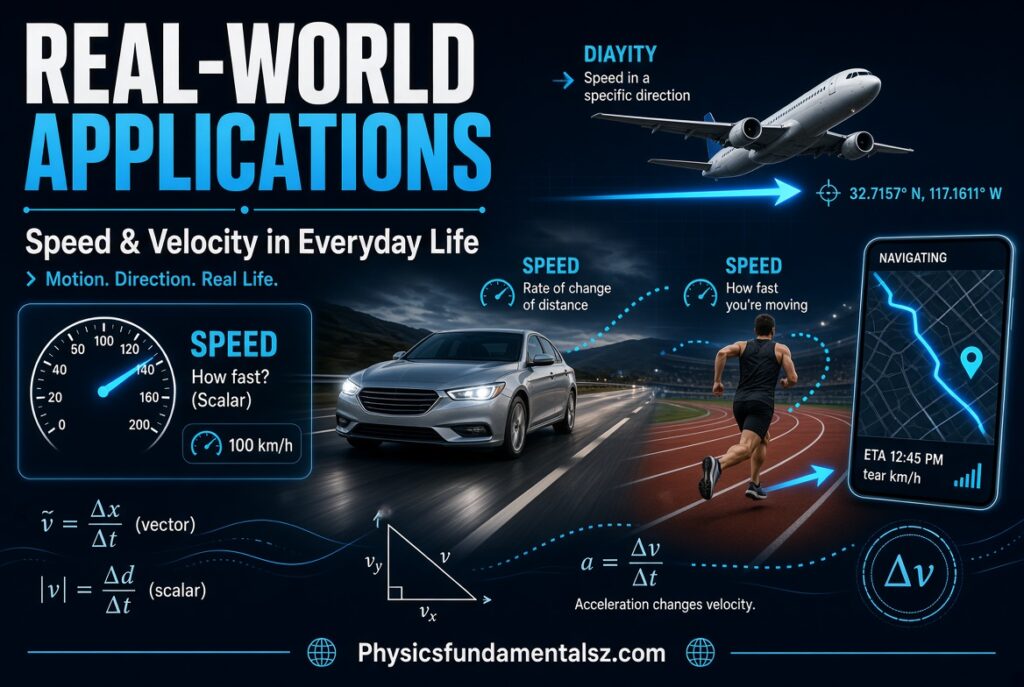
Understanding the difference between speed and velocity with examples matters far beyond the classroom.
- Aviation: Pilots track velocity, not just speed, to account for wind direction affecting the flight path.
- Sports science: Coaches measure velocity in sprinting to analyze direction changes in agility drills.
- Vehicle safety: Airbag systems respond to sudden changes in velocity, not just speed.
- Space navigation: Spacecraft trajectories rely entirely on velocity vectors, since direction is critical for orbit calculations.
Also Read:
- Velocity vs Speed
- Vectors and Scalars: Definitions, Examples & Vector Addition
- The SUVAT Equations
- Acceleration in Physics
- Free Fall and Terminal Velocity
- Terminal Velocity: Why Objects Stop Accelerating & Calculations
- Projectile Motion: The Complete Guide
- Projectile Motion Range: R = v²sin2θ/g & Optimum Angle 45°
- Projectile Motion Calculator With Angle: Formulas & Worked Examples 2026
- Why Is Projectile Motion a Parabola?
- Speed of Light: The Ultimate Guide to c, the Cosmic Speed Limit
- Physics Fundamentals: The Complete Guide to Core Concepts, Laws, and Equations
- Circular Motion and Centripetal Force
- Simple Harmonic Motion
- Hooke’s Law and Springs
- Work Done in Physics
- Friction Force Explained
- Angular Momentum
- Torque in Physics
- Kinetic Energy
- Power in Physics
- Momentum and Impulse
- What Is the Formula for Conservation of Momentum? 2026
- Conservation of Momentum
- Newton’s Laws of Motion
- Wave Speed, Frequency & Wavelength
Frequently Asked Questions (FAQs)
What is the main difference between speed and velocity?
Speed measures how fast an object moves without direction. Velocity measures how fast and in which direction it moves.
Is speed a scalar or vector quantity?
Speed is a scalar quantity. It has only magnitude and no direction component.
Is velocity a scalar or vector quantity?
Velocity is a vector quantity. It has both magnitude and a specific direction.
Can speed and velocity have the same value?
Yes. In straight-line motion with no change in direction, speed and velocity have the same numerical value.
Can velocity be negative?
Yes. Velocity can be negative when motion happens in the direction opposite to the chosen positive direction.
Can speed be negative?
No. Speed is always zero or positive, since it only measures distance covered over time.
What is the formula for speed?
Speed equals total distance divided by total time, written as s = d/t.
What is the formula for velocity?
Velocity equals displacement divided by time, written as v = Δx/t.
What is the difference between distance and displacement?
Distance is the total path length traveled. Displacement is the straight-line change in position, including direction.
Why is average speed higher than average velocity in a round trip?
Because distance traveled adds up along the path, while displacement can shrink or become zero if you return to the start.
What is an example of speed without velocity?
A car’s speedometer reading, like 80 km/h, shows speed only, since it gives no direction.
What is an example of velocity with examples in daily life?
A plane flying 500 km/h northeast has a velocity, since both magnitude and direction are specified.
Does velocity change in circular motion even at constant speed?
Yes. In circular motion, direction changes constantly, so velocity changes even though speed stays the same.
What are the SI units for speed and velocity?
Both speed and velocity are measured in meters per second (m/s) in the SI system.
Is instantaneous speed equal to instantaneous velocity’s magnitude?
Yes. At any single instant, speed always equals the magnitude of velocity, since there is no path to accumulate.
How do you calculate average velocity?
Average velocity equals total displacement divided by total time taken for that displacement.
How do you calculate average speed?
Average speed equals total distance traveled divided by the total time taken.
Why does direction matter in physics problems?
Direction determines the sign and vector nature of quantities like velocity, force, and acceleration, affecting how they combine.
Can two objects have the same speed but different velocities?
Yes. Two cars moving at 50 km/h in opposite directions have the same speed but opposite velocities.
What is uniform velocity?
Uniform velocity means an object covers equal displacement in equal time intervals, moving in a constant direction at a constant rate.
What is variable velocity?
Variable velocity occurs when either the speed, the direction, or both keep changing over time.
How does velocity apply to projectile motion?
Projectile motion involves velocity components in both horizontal and vertical directions, which combine to describe the full path.
Why do pilots care about velocity rather than just speed?
Pilots need velocity because wind direction can push a plane off course even if its airspeed stays constant.
What is relative velocity?
Relative velocity is the velocity of one object as observed from another moving object’s frame of reference.
Is acceleration related to speed or velocity?
Acceleration is the rate of change of velocity, so it accounts for changes in both speed and direction.
Conclusion
Speed and velocity look similar on paper, but the difference between speed and velocity with examples shows how direction changes everything.
Speed is scalar and depends on distance. Velocity is vector and depends on displacement.
Once you separate the two, motion problems in exams and real life become far easier to solve correctly.