The SUVAT Equations
Drop a ball, brake a car, launch a rocket at steady thrust — all of these are motion under constant acceleration, and all of them can be solved with one compact toolkit. Physics students call it SUVAT, after the five quantities that describe such motion. Master these and a huge slice of mechanics opens up.
What the five letters mean
Each letter stands for one quantity describing motion along a straight line:
- s — displacement (how far, and in which direction, the object has moved), in metres
- u — initial velocity, in metres per second
- v — final velocity, in metres per second
- a — acceleration, in metres per second squared
- t — time elapsed, in seconds
The whole framework relies on one condition: the acceleration a must be constant. If a changes during the motion, SUVAT no longer applies and you need calculus instead.
The four equations
There are four standard SUVAT equations. Each one deliberately leaves out a different variable, so whichever quantity you do not know, there is an equation that avoids it.
The first links velocity to time. The second gives displacement from time. The third connects velocities to displacement without time — invaluable when you do not know how long something took. The fourth uses the average velocity ½(u + v).
You always know three of the five SUVAT quantities and want a fourth. Pick the equation that contains your three knowns and your unknown — and conveniently leaves out the fifth quantity you neither know nor want.
Where the equations come from
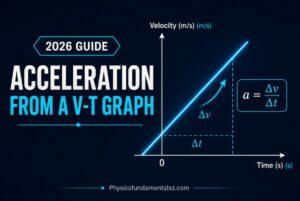
These are not magic; they follow from the definitions of velocity and acceleration. Acceleration is the rate of change of velocity, so v = u + a·t simply says the velocity grows by a each second. Displacement is the area under a velocity-time graph; for constant acceleration that graph is a straight line, and the area of the resulting trapezium gives s = ½(u + v)·t. Combine and rearrange these two and the other equations drop out. Seeing them as graph areas, rather than formulas to memorise, makes them far easier to recall.
A worked example
A car travelling at 20 m/s brakes with a constant deceleration of 5 m/s². How far does it travel before stopping?
Here u = 20, v = 0 (it stops), a = −5 (deceleration is negative). We do not know and do not need the time, so use the third equation:
The car needs 40 metres to stop. Notice how doubling the speed would quadruple the stopping distance, because s depends on u². This is why speed limits matter so much for road safety.
The crucial role of signs
SUVAT works in one dimension, and direction is encoded by the sign of each quantity. Before you start, choose a positive direction and stick to it throughout. A common setup for vertical motion is to call “up” positive, which makes gravity’s acceleration g ≈ 9.8 m/s² negative.
- An object thrown upward has positive u but negative a.
- At its highest point v = 0, but a is still −9.8 m/s² — gravity never switches off.
- A negative answer for s means the object ended up below where it started.
Most SUVAT mistakes are sign errors, not algebra errors. Decide your positive direction first and label every number accordingly. For the deeper “why” behind that downward acceleration, see free fall and gravity, and you can check answers quickly with our SUVAT calculator.
When SUVAT does not apply
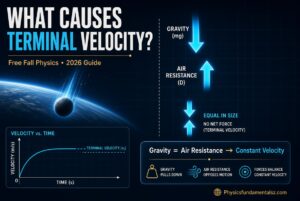
The equations assume motion in a straight line with unchanging acceleration. They fail for circular motion, for objects experiencing air resistance that grows with speed, or for anything where the force varies. In those cases you turn to Newton’s laws and calculus. But for the enormous range of problems involving steady acceleration, SUVAT is fast, reliable and elegant.
Frequently asked questions
Do I have to memorise all four equations?
It helps, but you really only need to remember two — v = u + a·t and s = ½(u + v)·t — because the other two can be derived from them by substitution. Many students find that reassuring.
What is the difference between displacement and distance?
Displacement (s) is the straight-line change in position, with direction; distance is the total path length travelled. A ball thrown up and caught again has zero displacement but a nonzero distance. SUVAT always uses displacement.
Can I use SUVAT for a falling object?
Yes, as long as air resistance is negligible, so the acceleration stays constant at g ≈ 9.8 m/s² downward. Just set a = g, choose your sign convention, and proceed as usual.