Difference Between Distance and Displacement in Physics
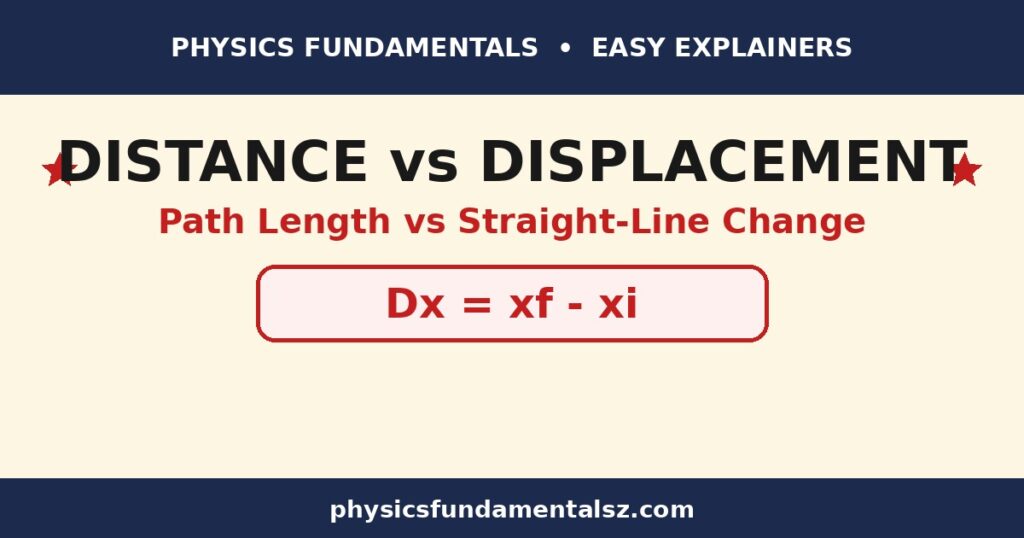
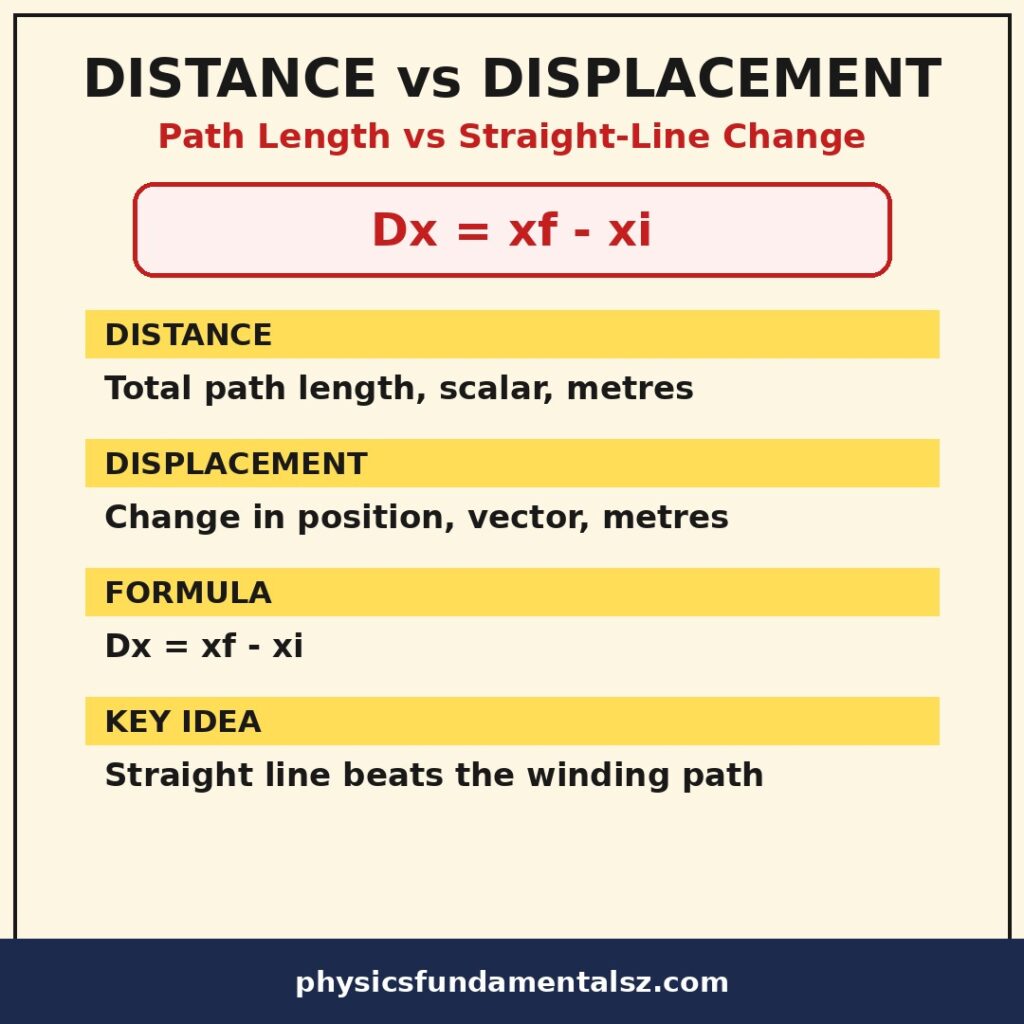
Quick answer: Distance is the total length of the path you actually travel. Displacement is the straight-line change in position from start to finish, including direction. Distance is a scalar with no direction. Displacement is a vector, so direction matters.
Distance and displacement look like twins at first glance. Students mix them up in almost every early mechanics test. The mix-up is understandable, because in everyday speech people use the two words as if they mean the same thing.
In physics, they do not mean the same thing. The difference between distance and displacement is one of the most tested ideas in introductory mechanics. It also unlocks speed, velocity, acceleration, and vector work later on. Get this distinction right now, and a large part of motion physics becomes much easier.
This guide explains both quantities from the ground up. You will learn clear definitions, formulas, worked examples, graphs, and real-world uses. You will also see the classic exam traps, with short practice steps you can use before a test.
What Is Distance in Physics?
Distance is the total length of the path travelled by an object. It counts every step, turn, and detour. It never asks which direction you went. It only asks how much ground you covered.
Imagine walking from your front door to a shop two streets away. You take a detour around roadworks, then double back for a forgotten wallet. Your distance is the full length of that winding walk. It is longer than the straight-line gap between your door and the shop door.
Distance is always zero or positive. It can never be negative. It grows whenever you move, even if you return to your starting point. A runner who completes a full lap of a track has travelled a real distance, even though she ends where she began.
The symbol for distance is usually s or d. Its SI unit is the metre (m). Kilometres are common for longer journeys. In equations, distance is often written without an arrow, because it has no direction to show.
Distance answers a simple question: “How far did I travel along my actual path?” That question is different from asking where you ended up. Keep that question in mind throughout this guide.
What Is Displacement in Physics?
Displacement is the change in position of an object. It is measured in a straight line from the starting point to the finishing point. It also carries a direction, such as east, left, or upward.
Use the same walk to the shop. Your displacement is the straight-line arrow from your front door to the shop door. It ignores the detour and the double-back. It only cares about the net change in position.
Displacement can be positive, negative, or zero. The sign shows direction along a chosen axis. A displacement of zero means the object finished exactly where it started, however long its journey was. That result surprises many beginners, but it follows directly from the definition.
The symbol for displacement is usually s with an arrow, Δx, or Δr. Its SI unit is also the metre (m). Direction can be given with words, a compass bearing, or a positive or negative sign. In one dimension, the sign alone often carries the direction.
Displacement answers a different question: “How far, and in which direction, am I from where I started?” That question is the heart of vector thinking in physics. For more on vectors, see our guide to vectors and scalars.
Distance vs Displacement at a Glance
The table below gives the fastest possible comparison. Read it once, then study each row in the sections that follow.
| Feature | Distance | Displacement |
|---|---|---|
| Definition | Total path length travelled | Straight-line change in position |
| Type | Scalar quantity | Vector quantity |
| Direction | None | Required |
| Value range | Zero or positive only | Positive, negative, or zero |
| Path dependence | Depends on the path taken | Depends only on start and end points |
| Symbol | s or d | Δx, Δr, or s with arrow |
| SI unit | Metre (m) | Metre (m) |
| Example | 500 m walked around a block | 300 m east from the start |
This table is worth memorising. Many multiple-choice questions test one row at a time. If you can recall the table, you can answer most of them in seconds.
Scalar or Vector: Why the Difference Matters
A scalar quantity has magnitude only. A vector quantity has magnitude and direction. Distance belongs to the first group. Displacement belongs to the second.
This is not a small bookkeeping detail. It changes how you add quantities. Distances add by simple arithmetic. You add 3 m and 4 m to get 7 m, whatever the directions were. The OpenStax University Physics textbook treats vectors and scalars with the same distinction, and Khan Academy’s physics course gives free worked practice on vector addition.
Displacements add as vectors. Walking 3 m east and then 4 m north does not give a displacement of 7 m. It gives a displacement of 5 m at an angle north of east. The path length is 7 m, but the displacement is 5 m. That single example captures the whole topic.
Vectors also change how you describe motion over time. Dividing distance by time gives speed, a scalar. Dividing displacement by time gives velocity, a vector. The same split runs through much of mechanics, so learning it here pays off repeatedly. Our comparison of speed and velocity builds directly on this idea.
Position, Path, and Reference Points
Position tells you where an object is relative to a chosen origin. The origin is a reference point, such as a school gate, a goalpost, or the zero mark on a ruler. Positions are measured from that origin along a chosen axis.
Distance cares about the whole path between positions. Displacement cares only about the first and last positions. Two runners can take very different routes between the same two points. Their distances will differ. Their displacements will be identical.
Choosing the origin does not change either quantity. Move the origin, and both positions shift by the same amount. Their difference stays the same. The path length also stays the same. This is why displacement is often written as a change, Δx = x final − x initial.
Direction also needs a convention. In one dimension, teachers usually call one direction positive and the opposite direction negative. East might be positive and west negative. Up might be positive and down negative. State your convention before you calculate, and keep it fixed for the whole problem.
The Distance Formula
Distance has no single universal formula, because it depends on the path. In practice, you add up the lengths of each part of the journey. If an object travels several straight sections, distance is the sum of those section lengths.
Distance = length of section 1 + length of section 2 + length of section 3, and so on.
For motion at constant speed, distance can also be found from speed and time. Distance = speed × time. This works when speed does not change during the interval. For changing speed, the area under a speed-time graph gives the distance travelled.
On a curved path, distance is the length of the curve itself. A car driving around a circular track covers a distance equal to the circumference for one full lap. The circumference is 2πr, where r is the radius of the circle. Half a lap covers half the circumference, and so on.
There is no shortcut that turns displacement into distance. You must know, or reconstruct, the path. Exam questions often give the path in words, in a diagram, or in stages. Read each stage carefully before adding lengths together.
The Displacement Formula
Displacement in one dimension has a simple formula. Subtract the initial position from the final position.
Δx = x final − x initial
The Greek letter Δ (delta) means “change in”. The result carries a sign. A positive result means displacement in the positive direction. A negative result means displacement in the negative direction.
Consider a student who starts at position +2 m and walks to position +9 m. Her displacement is 9 − 2 = +7 m. She moved 7 m in the positive direction. Now suppose she walks from +9 m back to +2 m. Her displacement is 2 − 9 = −7 m. The distance is 7 m in both cases, but the displacement flips sign.
In two dimensions, displacement is found with components. Measure the east-west change and the north-south change separately. Then combine them with Pythagoras’ theorem to get the magnitude. Use trigonometry to find the direction angle. Worked examples later in this guide show each step.
For motion in a straight line at constant velocity, displacement can also be found from velocity and time. Displacement = velocity × time. Velocity includes direction, so the result is a proper vector. This mirrors the distance formula, with a vector replacing a scalar.
Worked Example 1: Walking Around the Block
A student walks 60 m east, then 80 m north, then 60 m west, then 80 m south. She returns to her starting point.
Distance is the sum of all four legs: 60 + 80 + 60 + 80 = 280 m. She really did walk 280 m. Her legs ache accordingly. Displacement is different. She ends where she started, so her displacement is 0 m. The straight-line change in position is zero.
This example is a favourite in exams because it looks hard and is simple. Students who add the legs for both quantities get the distance right and the displacement wrong. Always ask yourself where the object finished relative to where it started.
A useful check is to track position step by step. After leg one, she is 60 m east of the start. After leg two, she is 60 m east and 80 m north. After leg three, she is 80 m north. After leg four, she is back at the origin. The final position equals the initial position, so displacement must be zero.
Worked Example 2: The Round Trip
A cyclist rides 12 km to a friend’s house and then rides 12 km back home along the same road.
Distance = 12 + 12 = 24 km. Displacement = 0 km, because the start and end points are the same place. The cyclist’s odometer would show 24 km. A straight-line arrow from start to finish would have zero length.
Round trips appear in many forms: a swimmer doing laps, a delivery driver returning to base, a pendulum swinging back. In each case, distance grows with every leg. Displacement resets whenever the object returns to its starting point.
Teachers sometimes ask for displacement after only the outward leg. That answer is 12 km toward the friend’s house. The return leg then cancels it. Read the question’s time window carefully. Displacement depends on which start and end moments you choose.
Worked Example 3: Back and Forth on a Straight Track
A toy car starts at the 0 m mark. It drives to the 10 m mark, reverses to the 4 m mark, then drives forward to the 8 m mark.
Distance = 10 m + 6 m + 4 m = 20 m. Each leg counts, including the reversal. Displacement = 8 − 0 = +8 m. Only the endpoints matter for displacement. The middle journey is irrelevant to the final answer.
This pattern explains why distance is always greater than or equal to the magnitude of displacement. Extra wandering can only add to the path length. It can never increase the straight-line gap beyond the path length itself. The straight line is the shortest route between two points.
A common error is to use the final position as the displacement without subtracting the initial position. That works only when the object starts at zero. In general, always subtract. The formula Δx = x final − x initial protects you from that slip.
Worked Example 4: A Two-Dimensional Journey
A hiker walks 3 km east and then 4 km north. What are her distance and displacement?
Distance = 3 + 4 = 7 km. Displacement needs vector addition. The east and north legs form the sides of a right-angled triangle. The displacement is the hypotenuse.
Magnitude = √(3² + 4²) = √(9 + 16) = √25 = 5 km. The direction is found with an angle. Tan θ = opposite ÷ adjacent = 4 ÷ 3. That gives θ ≈ 53° north of east. So displacement is 5 km at 53° north of east.
The 3-4-5 triangle is a classic. Exam setters love it because the numbers come out clean. Learn to recognise 3-4-5 and 5-12-13 triangles. They save time and reduce arithmetic slips under pressure.
Notice the pattern again: distance 7 km, displacement magnitude 5 km. The straight line is shorter than the walked path. Direction completes the answer. A displacement answer without direction is incomplete in two dimensions.
Worked Example 5: Position Coordinates
A delivery robot starts at position (2 m, 3 m) on a warehouse floor. It ends at position (8 m, 7 m). Its actual path is 14 m long because it weaved between shelves.
Displacement in the x-direction: 8 − 2 = 6 m. Displacement in the y-direction: 7 − 3 = 4 m. Magnitude = √(6² + 4²) = √52 ≈ 7.2 m. Direction: tan θ = 4 ÷ 6, so θ ≈ 34° above the x-axis.
Distance is 14 m, given by the path. Displacement magnitude is about 7.2 m. The robot’s navigation system cares about both. Distance matters for battery use and wear. Displacement matters for knowing where the robot is relative to its dock.
Coordinate problems reward a calm, step-by-step approach. Find each component change first. Then combine components. Then add direction. Never jump straight to Pythagoras without finding the components.
Distance and Displacement on Graphs
Graphs make the difference visible. A position-time graph plots position against time. The displacement over an interval is the change in the position value. Read the final position, subtract the initial position, and you have it.
A distance-time graph plots total distance travelled against time. Its value only ever rises or stays flat. It never falls, because distance never decreases. The slope of a distance-time graph gives speed.
A position-time graph can rise and fall. A falling section means the object is moving back toward smaller positions. The slope gives velocity, including its sign. A horizontal section means the object is at rest. Its position is constant, so displacement is zero during that section, while distance also stays constant.
Velocity-time graphs add another view. The area under a velocity-time graph gives displacement, with areas below the axis counted as negative. The area under a speed-time graph gives distance, with all areas counted as positive. Mixing these two rules up is a common exam error. Keep the graph type and the quantity straight.
Practice reading graphs by asking two questions for each interval. First, where did the object start and end? Second, how much path did it cover in between? The first answer gives displacement. The second gives distance. The Physics Classroom tutorial on distance and displacement works through the same graph-reading skills with interactive examples.
When Are Distance and Displacement Equal?
Distance and displacement are equal in magnitude only in one special case. The object must move in a straight line in one direction, without turning back. Then the path and the straight line are the same thing.
A car driving steadily east for 5 km has distance 5 km and displacement 5 km east. The magnitudes match. The displacement answer still needs its direction. The distance answer does not.
In every other case, distance is greater than the magnitude of displacement. Any turn, curve, or reversal makes the path longer than the straight-line gap. The more wandering, the bigger the gap between the two numbers.
This rule gives a fast sanity check. If you calculate a displacement magnitude larger than the distance, something is wrong. Stop and re-check. Either the path length is undercounted or the displacement is overcounted. Physics answers must respect this basic geometry.
Negative Displacement and Direction Signs
Negative displacement does not mean “less than nothing”. It means displacement in the negative direction. The minus sign is a direction label, not a judgement about size.
Suppose north is positive. A displacement of −40 m means 40 m south. A displacement of +40 m means 40 m north. Both have magnitude 40 m. They point opposite ways.
Students sometimes drop the sign and report only the magnitude. That loses information. In one dimension, the sign is the direction. Keep it in your answer unless the question asks for magnitude only.
The same logic applies to velocity. Negative velocity means motion in the negative direction. Speed, by contrast, is never negative. This mirrors the distance-displacement split exactly. Scalars stay non-negative. Vectors carry signs and directions.
Distance, Displacement, Speed, and Velocity
Distance pairs with speed. Displacement pairs with velocity. The two pairs share the same relationship. Divide by time, and the first pair gives a scalar rate, while the second gives a vector rate.
Average speed = total distance ÷ total time. Average velocity = displacement ÷ total time. A round trip has a real average speed but zero average velocity. That contrast often appears in exam questions, because it tests whether you truly understand both ideas.
Instantaneous speed is the magnitude of instantaneous velocity. At any instant, a moving object has a speed and a velocity with the same magnitude. Over an interval, however, average speed and average velocity can differ sharply. The interval matters.
Our guides to velocity and acceleration and work and power extend these ideas. Motion physics builds in layers, and this layer is the foundation.
Vectors, Components, and Resultant Displacement
In two or three dimensions, displacement is handled with components. Break each leg of a journey into east-west and north-south parts. Add the parts in each direction separately. Then combine the totals into a resultant vector.
This method works for any number of legs. It also works when legs point at angles. Use cosine for the adjacent component and sine for the opposite component, relative to the stated angle. Keep a clear diagram beside your working. A sketch prevents most sign errors.
The resultant displacement is the single vector that has the same effect as all the legs combined. It runs straight from start to finish. Its magnitude is always less than or equal to the total distance. Its direction is found from the components with trigonometry.
Displacement vectors can also be added head-to-tail. Place the tail of the second vector at the head of the first. The resultant runs from the start of the first to the end of the last. This picture matches the journey itself, which makes it easy to visualise. HyperPhysics from Georgia State University shows vector addition diagrams for the same cases.
Real-World Uses of Distance and Displacement
Navigation systems use both quantities every day. A satnav measures the distance along roads, because that is what the driver will actually travel. It also tracks displacement from the starting point, because that shows progress toward the destination. The two numbers answer different questions for the driver.
Sports analysis uses the same split. A footballer’s total distance run shows workload and fitness. Her displacement from kick-off shows almost nothing, because she returns to similar areas repeatedly. Coaches therefore track total distance, sprint distance, and position heat maps separately. Each measure serves a different purpose.
Surveyors and engineers care deeply about displacement. When a bridge expands in heat, the change in position of its ends matters. The path the metal took to get there does not. GPS receivers likewise report position changes, which are displacements, with high precision.
Robotics and drones need both ideas in software. A drone’s flight controller tracks displacement to hold position against wind. Its battery manager tracks distance flown to estimate remaining charge. Confusing the two in code would send the drone to the wrong place or drain its battery unexpectedly.
Astronomy uses displacement on a grand scale. A planet’s displacement over half an orbit is twice the orbital radius, straight across the Sun. Its distance travelled over the same half-orbit is half the circumference. Both numbers describe the same motion, but they answer different questions about it.
Common Mistakes to Avoid
The most common mistake is treating distance and displacement as synonyms. They share a unit, the metre, but they are different physical quantities. One is a scalar, the other is a vector. Saying they are the same throws away direction entirely.
A second mistake is reporting displacement without direction. “5 m” is not a complete displacement answer in two dimensions. “5 m north-east” is complete. In one dimension, keep the sign. The sign is the direction in compact form.
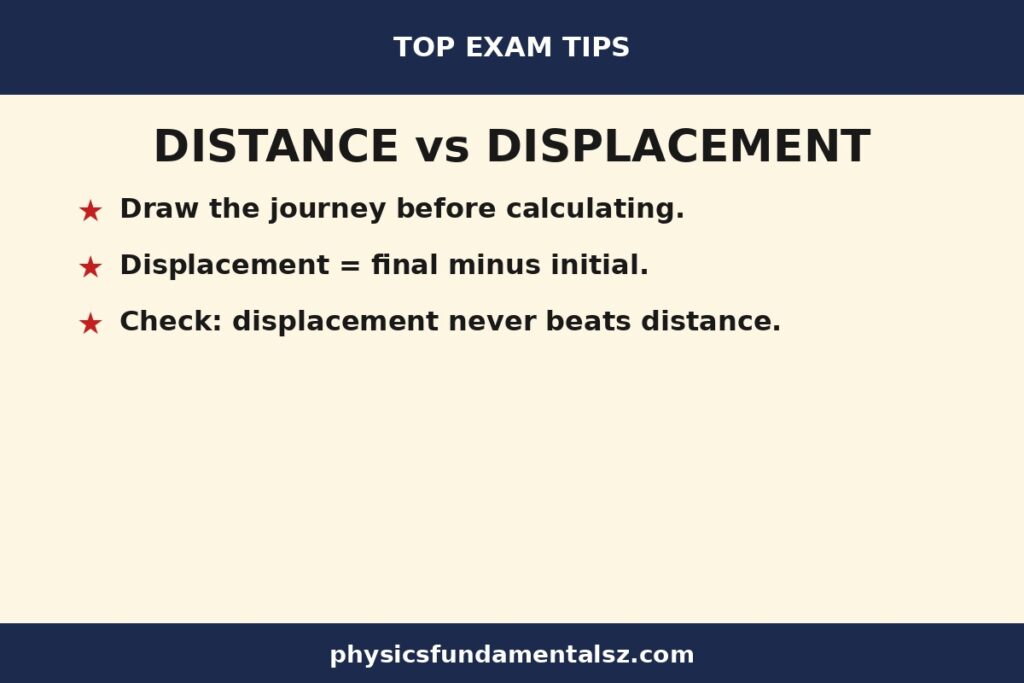
A third mistake is using the final position instead of the change in position. Displacement is final minus initial. Students who forget to subtract get the wrong answer whenever the start is not at zero. Write the formula down every time until it becomes automatic.
A fourth mistake is adding displacements as if they were distances. Walking 3 m east and 4 m west gives a displacement of 1 m west, not 7 m. The directions must be respected. Draw the journey before adding anything.
A fifth mistake is confusing displacement with the path on a position-time graph. The graph’s shape shows how position changed, but displacement is only the net vertical change between two times. The length of the curve on the graph is not the distance travelled either. Read values off the axes, and calculate from them.
Expert Tips for Exams
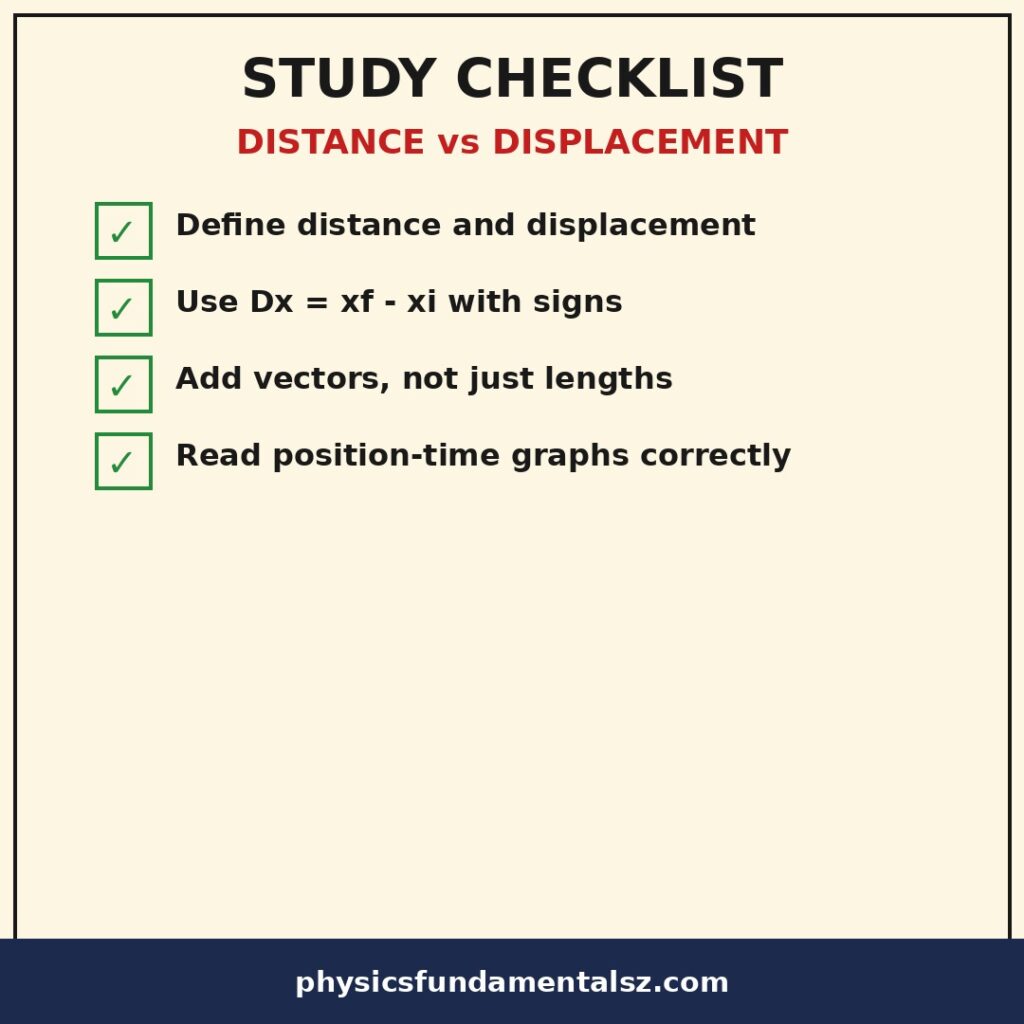
Start every problem with a diagram. Mark the start point, the end point, and each leg. Label directions and lengths. A good diagram turns a word problem into a picture problem, which is far easier to solve.
Write down what you are asked to find. If the question asks for distance, add path lengths. If it asks for displacement, find the net change in position. Many errors come from answering the wrong question well.
Check your answer against the golden rule. The magnitude of displacement must never exceed the distance. If it does, re-check your working. This single check catches a large share of arithmetic and concept errors.
Use units and signs consistently. Keep metres with metres and kilometres with kilometres. Convert before calculating, not after. Keep your direction convention fixed throughout the problem, and state it in your answer. The lecture notes and problems in MIT OpenCourseWare Physics I use the same conventions for position, displacement, and sign choices.
Practise the 3-4-5 triangle and simple component problems until they feel routine. Speed comes from familiarity, not from rushing. In an exam, a calm method beats a fast guess every time.
For revision, explain the difference aloud in one sentence each. Distance: “How much ground did I cover?” Displacement: “Where did I end up, relative to where I started?” If you can say both without hesitating, you understand the topic.
Frequently Asked Questions
What is the difference between distance and displacement in simple words?
Distance is how much ground you cover along your actual path. Displacement is how far you end up from your starting point, in a straight line, with direction. A winding walk has a long distance but may have a short displacement.
Is distance a scalar or a vector?
Distance is a scalar quantity. It has magnitude only and no direction. That is why distances add by simple arithmetic, whatever direction each leg pointed in.
Is displacement a scalar or a vector?
Displacement is a vector quantity. It has both magnitude and direction. Direction can be given as a compass direction, an angle, or a positive or negative sign in one dimension.
What is the formula for distance?
Distance is the sum of the lengths of all parts of the path. For constant speed, distance = speed × time. There is no single formula that works without knowing the path, because distance depends on the route taken.
What is the formula for displacement?
In one dimension, displacement Δx = x final − x initial. In two dimensions, find the change in each coordinate, then combine them with Pythagoras’ theorem and trigonometry for direction.
Can displacement be zero while distance is not zero?
Yes. Any journey that ends where it started has zero displacement. The distance is the full path length. A full lap of a running track is the classic example: real distance, zero displacement.
Can displacement be negative?
Yes. A negative displacement means displacement in the negative direction along your chosen axis. The minus sign carries direction information. The magnitude is still a positive length.
Can distance be negative?
No. Distance is never negative. It measures a length of path, and lengths are zero or positive. If a calculation gives negative distance, an error has been made.
When is distance equal to displacement?
Distance equals the magnitude of displacement only when motion is in a straight line in a single direction, with no turns or reversals. Then the path and the straight-line gap are the same length.
What is the SI unit of distance and displacement?
Both are measured in metres (m) in the SI system. Kilometres, centimetres, and millimetres are also used. The shared unit is one reason students confuse them, but the quantities remain different.
How do distance and displacement relate to speed and velocity?
Average speed = total distance ÷ time. Average velocity = displacement ÷ time. Speed is a scalar, velocity is a vector. A round trip can have a large average speed and zero average velocity.
What is displacement in a position-time graph?
Displacement over an interval is the change in position value: final position minus initial position. Read both values from the vertical axis and subtract. The slope of the graph gives velocity, not displacement.
How do you find displacement from a velocity-time graph?
Displacement is the signed area under the velocity-time graph. Areas above the time axis count as positive. Areas below count as negative. Distance is the total area with all parts counted as positive.
What is an example of distance and displacement in daily life?
Walking to school by a winding route covers a long distance. The displacement is the shorter straight-line gap between home and school, with a direction. A taxi meter charges by distance travelled, while a map app also shows the straight-line gap.
Does displacement depend on the path taken?
No. Displacement depends only on the starting and finishing positions. Many different paths between the same two points share the same displacement. Their distances differ.
What is the difference between position and displacement?
Position is where an object is relative to an origin at one moment. Displacement is the change in position between two moments. Position is a location, displacement is a shift from one location to another.
How do you calculate displacement in two dimensions?
Find the change in the x-coordinate and the change in the y-coordinate. Combine them with Pythagoras’ theorem for magnitude. Use tan θ = Δy ÷ Δx for the direction angle. Always state both magnitude and direction.
Why do students confuse distance and displacement?
Everyday language uses the words loosely, and both share the metre as a unit. Physics gives them precise, different meanings. The confusion usually clears once students work through round-trip and back-and-forth examples.
Conclusion
Distance and displacement are two different answers to two different questions. Distance asks how much path you covered. Displacement asks where you ended up, relative to where you started, and in which direction.
Distance is a scalar, always zero or positive, and depends on the whole path. Displacement is a vector, can be positive, negative, or zero, and depends only on the endpoints. The magnitude of displacement can never exceed the distance travelled.
Master this distinction, and the rest of motion physics becomes clearer. Speed and velocity, acceleration, and vector addition all build on it. Practise with round trips, back-and-forth motion, and two-dimensional journeys until the method feels natural.
For your next step, revise speed versus velocity and velocity versus acceleration. Both guides use the ideas from this article. Then try explaining distance and displacement to a friend in one sentence each. If you can teach it, you know it.