What Is the Formula for Conservation of Momentum? 2026
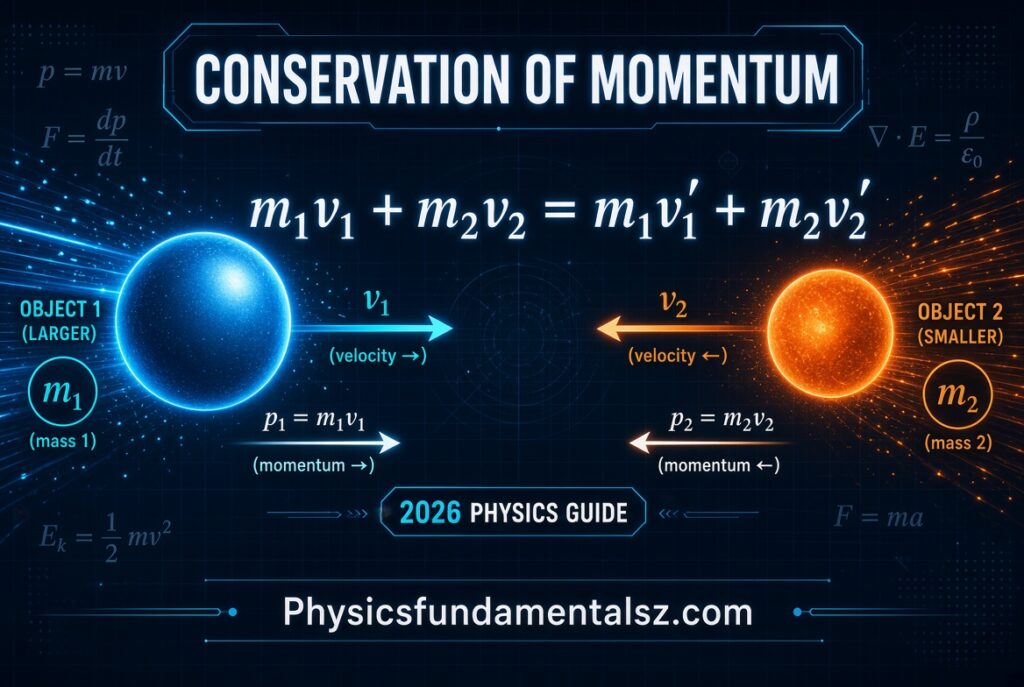
What Is the Formula for Conservation of Momentum? The formula for conservation of momentum is m₁u₁ + m₂u₂ = m₁v₁ + m₂v₂. It says the total momentum of a closed system before an interaction equals the total momentum after it.
Momentum itself is mass times velocity, written as p = mv. When two or more objects interact with no outside force acting on them, their combined momentum never changes, even though individual objects can speed up, slow down, or change direction.
Table of Contents
What Is the Formula for Conservation of Momentum
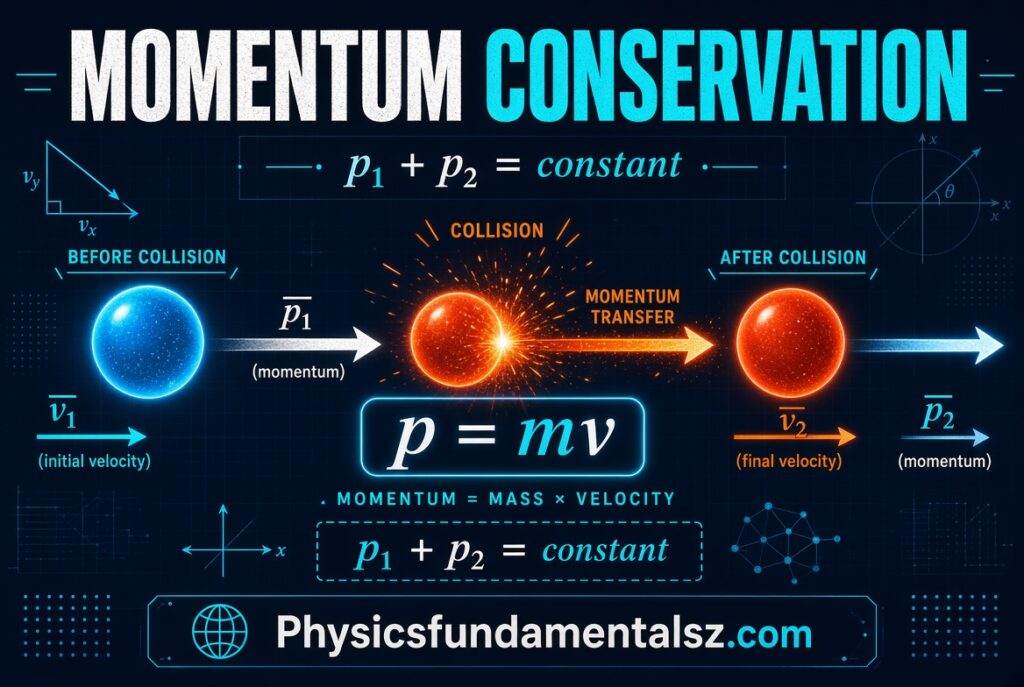
For a closed, isolated system, total momentum before an event equals total momentum after it.
Formula: m₁u₁ + m₂u₂ = m₁v₁ + m₂v₂
Here, m is mass, u is velocity before the interaction, and v is velocity after it.
What Does Conservation of Momentum Mean?
Conservation of momentum is a law of physics stating that the total momentum of an isolated system stays constant over time. No external force means no net change in total momentum.
Momentum is a vector, so direction matters as much as speed. A ball moving right and one moving left do not simply add together in magnitude.
Think of two skaters pushing off each other. One skater moves left, the other moves right, but the combined momentum of the pair stays exactly zero, matching what it was before they pushed.
Why Momentum Is Conserved
Momentum conservation is not an assumption. It follows directly from Newton’s third law: every action has an equal and opposite reaction.
When two objects collide, the force object A exerts on object B is equal and opposite to the force B exerts on A. Those forces act for the same amount of time, so the momentum lost by one object equals the momentum gained by the other.
Add those changes together and they cancel out. That is why the system’s total momentum never changes when no outside force is involved.
The Formula for Conservation of Momentum
One-Dimensional Collision Formula
For two objects colliding and moving along a single line, the formula is:
m₁u₁ + m₂u₂ = m₁v₁ + m₂v₂
- m₁, m₂ = mass of object 1 and object 2
- u₁, u₂ = velocity of each object before the collision
- v₁, v₂ = velocity of each object after the collision
Every term uses consistent units, typically kilograms for mass and meters per second for velocity, so momentum comes out in kg·m/s.
Vector Form for Two Dimensions
Real collisions often happen at an angle, not in a straight line. In that case, momentum must be conserved separately along each axis.
Σp_x (before) = Σp_x (after) Σp_y (before) = Σp_y (after)
You break every velocity into x and y components, apply the formula on each axis, then combine the results using the Pythagorean theorem if you need a final magnitude and direction.
General Form for Any Number of Objects
For a system with many objects, the law extends naturally:
Σ(m₁v₁ + m₂v₂ + … + mₙvₙ)before = Σ(m₁v₁ + m₂v₂ + … + mₙvₙ)after
This is the same rule used to analyze rocket propulsion, particle collisions, and multi-body explosions.
Deriving the Conservation of Momentum Formula
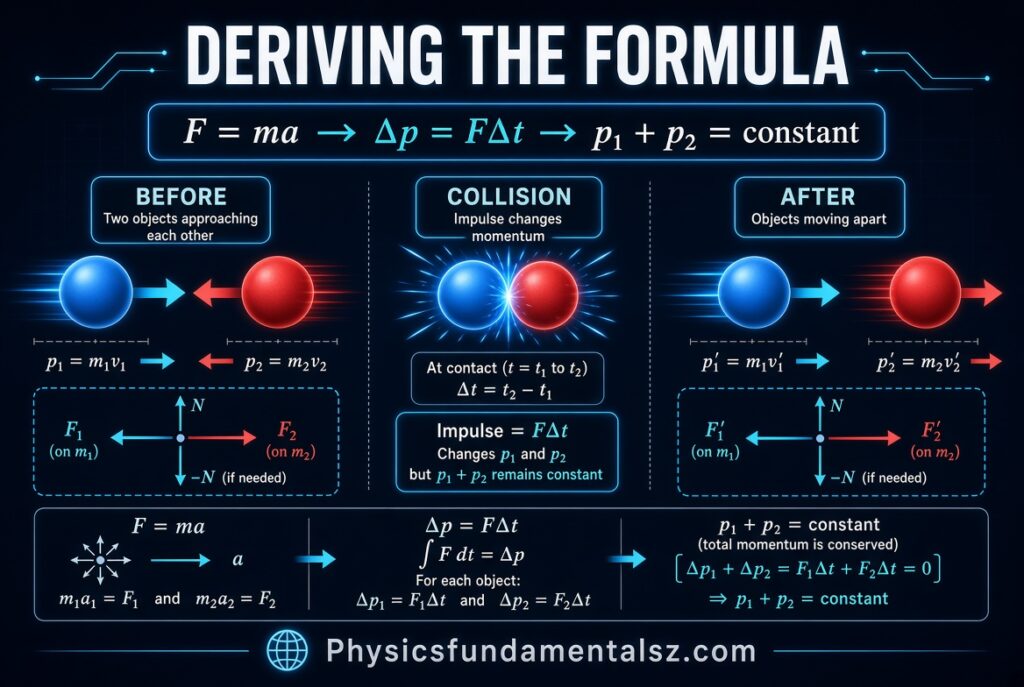
The derivation starts from Newton’s second and third laws, and it only takes a few steps.
- During a collision, object 1 exerts force F on object 2, and object 2 exerts force −F on object 1 (Newton’s third law).
- Both forces act for the same time interval, Δt, during contact.
- Impulse equals force times time, so the momentum change of each object is Δp₁ = FΔt and Δp₂ = −FΔt.
- Adding these gives Δp₁ + Δp₂ = 0, meaning the total change in momentum is zero.
- If total change is zero, total momentum before equals total momentum after.
That five-step chain is the entire logical backbone behind the formula.
Elastic vs. Inelastic Collisions
Momentum is conserved in every type of collision. Kinetic energy is not always conserved, and that difference defines the collision type.
| Collision Type | Momentum Conserved? | Kinetic Energy Conserved? | Example |
|---|---|---|---|
| Elastic | Yes | Yes | Billiard balls colliding |
| Inelastic | Yes | No | Car crash with crumpling metal |
| Perfectly Inelastic | Yes | No (maximum energy loss) | Two clay balls sticking together |
Perfectly Inelastic Collision Formula
When two objects stick together after colliding, the formula simplifies to:
m₁u₁ + m₂u₂ = (m₁ + m₂)v
Here v is the single shared final velocity of the combined mass.
Worked Example
A 2 kg cart moving at 3 m/s collides with a stationary 1 kg cart, and they stick together.
Using m₁u₁ + m₂u₂ = (m₁ + m₂)v: (2)(3) + (1)(0) = (2 + 1)v, so 6 = 3v, giving v = 2 m/s.
The combined cart moves forward at 2 m/s right after impact, and total momentum stays at 6 kg·m/s throughout.
Real-World Applications
- Rocket launches: Exhaust gas is pushed downward, so the rocket is pushed upward with equal and opposite momentum.
- Car safety design: Crumple zones extend collision time, which lowers peak force without changing total momentum transferred.
- Billiards and sports: Cue ball impacts transfer momentum to the target ball based on this exact formula.
- Firearms recoil: The bullet’s forward momentum is matched by the gun’s backward momentum.
- Astrophysics: Momentum conservation explains planetary formation, supernova ejecta, and orbital mechanics.
Conservation of Momentum vs. Conservation of Energy
These two laws are often confused, but they track different quantities.
| Aspect | Conservation of Momentum | Conservation of Energy |
|---|---|---|
| Quantity tracked | mass × velocity (vector) | Total energy (scalar) |
| Applies to | All collisions | All isolated systems |
| Always conserved in collisions? | Yes | Only in elastic collisions |
| Formula | m₁u₁ + m₂u₂ = m₁v₁ + m₂v₂ | KE + PE = constant |
Momentum is always conserved in a closed system. Kinetic energy can convert into heat, sound, or deformation, so it is only conserved in elastic collisions.
Common Mistakes to Avoid
- Forgetting that momentum is a vector, so direction and sign matter.
- Mixing up “before” and “after” velocities when plugging into the equation.
- Assuming kinetic energy is conserved in every collision; it usually is not.
- Ignoring external forces like friction, which break the closed-system assumption.
- Using inconsistent units, such as mixing grams with kilograms mid-calculation.
How to Solve a Momentum Conservation Problem
- Define the system. Decide which objects are included and confirm no external force acts on them.
- Assign a positive direction. Pick one direction as positive and keep signs consistent throughout.
- List known values. Write down every mass and every velocity before and after the event.
- Apply the formula. Use m₁u₁ + m₂u₂ = m₁v₁ + m₂v₂, or the simplified version for objects that stick together.
- Solve for the unknown. Rearrange algebraically and check that your final units are kg·m/s or m/s as expected.
Expert Tip

Always sanity-check your answer against the direction of motion. If a calculation gives a final velocity pointing the “wrong” way with no physical reason for it, recheck your sign convention before trusting the number.
Also Read:
- Newton’s Laws of Motion Explained
- Angular Momentum Explained
- Momentum Calculator Physics: Formula, Steps & Worked Examples
- What Is Energy?
- Kinetic Energy Calculator Physics: Formula, Steps & Real-World Examples
- Projectile Motion: Complete Guide
- Projectile Motion Calculator With Angle
- Wave Speed, Frequency & Wavelength
- Transverse Waves Explained
- Wave Speed Calculator: Frequency & Wavelength
- Mass-Energy Equivalence: E = mc² Derivation & Nuclear Applications
- E=mc2 Explained for Beginners
- Ideal Gas Law Calculator With Steps
- Electric Charge and Coulomb’s Law
- Coulomb’s Law Calculations: Formula & Examples
- Electric Potential Energy: Formula & Worked Examples
- Capacitors and Capacitance: Formula & Energy Storage
- Ohm’s Law Calculator: Solve for Current
- De Broglie Wavelength: Formula, Derivation & Examples
- De Broglie Wavelength Calculator
- Heisenberg Uncertainty Principle Explained Simply
- Bohr Model of the Atom: Energy Levels & Spectra
- Photoelectric Effect Calculations
- Quantum Numbers Explained
- Half-Life Calculations: Formula & Worked Examples
Frequently Asked Questions (FAQs)
What is the formula for conservation of momentum?
The formula is m₁u₁ + m₂u₂ = m₁v₁ + m₂v₂. It states total momentum before an interaction equals total momentum after it, as long as no external force acts on the system.
What is momentum measured in?
Momentum is measured in kilogram-meters per second, kg·m/s, when mass is in kilograms and velocity is in meters per second.
Is momentum a vector or a scalar?
Momentum is a vector. It has both magnitude and direction, and the direction of an object’s velocity is also the direction of its momentum.
Does conservation of momentum apply to all collisions?
Yes. Momentum is conserved in elastic, inelastic, and perfectly inelastic collisions, as long as the system is closed and isolated from outside forces.
Is kinetic energy always conserved along with momentum?
No. Kinetic energy is only conserved in elastic collisions. In inelastic collisions, some kinetic energy converts into heat, sound, or deformation.
What is the difference between elastic and inelastic collisions?
In elastic collisions, both momentum and kinetic energy are conserved. In inelastic collisions, momentum is conserved but kinetic energy is not.
What happens to momentum in a perfectly inelastic collision?
The colliding objects stick together and move with one shared final velocity. Total momentum is still conserved, using m₁u₁ + m₂u₂ = (m₁ + m₂)v.
Can momentum be negative?
Yes. A negative sign simply means the object is moving in the direction chosen as negative, based on your reference frame.
What is the law of conservation of momentum in simple words?
If no outside force pushes or pulls on a group of objects, their total momentum stays the same no matter how they interact with each other.
How is the conservation of momentum formula derived?
It comes from Newton’s third law. Equal and opposite forces act for the same time during a collision, so the momentum changes of the two objects cancel exactly.
What is an example of conservation of momentum in daily life?
A person jumping off a stationary skateboard is a common example. The skateboard shoots backward with momentum equal and opposite to the person’s forward momentum.
Why is momentum conserved in an explosion?
Before the explosion, total momentum may be zero if the object was at rest. Afterward, the fragments fly apart in different directions, but their momenta still sum to zero.
What is the formula for momentum itself?
Momentum is p = mv, where p is momentum, m is mass, and v is velocity.
How do you find final velocity using conservation of momentum?
Rearrange m₁u₁ + m₂u₂ = m₁v₁ + m₂v₂ to solve for the unknown velocity, plugging in known masses and the other three velocities.
Does conservation of momentum apply in two dimensions?
Yes. You apply the formula separately to the x-component and the y-component of velocity, since momentum along each axis is conserved independently.
What are the two conditions required for momentum to be conserved?
The system must be closed, meaning no mass enters or leaves it, and it must be isolated, meaning no net external force acts on it.
Is momentum conserved in rocket propulsion?
Yes. The rocket’s forward momentum is always equal and opposite to the momentum of the exhaust gas expelled backward.
How does conservation of momentum relate to Newton’s third law?
Conservation of momentum is a direct mathematical consequence of Newton’s third law, since every force has an equal and opposite reaction force acting for the same time.
What units should be used in the conservation of momentum formula?
Use SI units for consistency: kilograms for mass and meters per second for velocity, giving momentum in kg·m/s.
Can conservation of momentum be applied to systems with more than two objects?
Yes. The total momentum of any number of objects before an interaction equals the total momentum of all of them after it, as long as the system stays closed and isolated.
Conclusion
The formula for conservation of momentum, m₁u₁ + m₂u₂ = m₁v₁ + m₂v₂, is one of the most reliable tools in physics because it holds true in every collision type.
It comes straight from Newton’s third law, applies in one dimension, two dimensions, and multi-object systems, and it never fails as long as the system stays closed and isolated.
Once you can identify the masses, the before-and-after velocities, and the correct sign convention, solving any momentum problem becomes a matter of careful bookkeeping rather than guesswork.