Capacitors and Capacitance: C = Q/V Formula, Energy Storage & Examples
Every camera flash, every laptop charger, every heartbeat restarted by a defibrillator relies on a component most people walk past a thousand times without noticing.
That component is the capacitor, and the property that decides how useful it is in any given circuit is called capacitance.
Understanding capacitors and capacitance is one of the most important steps in mastering electromagnetism — it connects directly to electric fields, voltage, and energy storage, and it shows up constantly in AP Physics, electrical engineering courses, and everyday electronics.
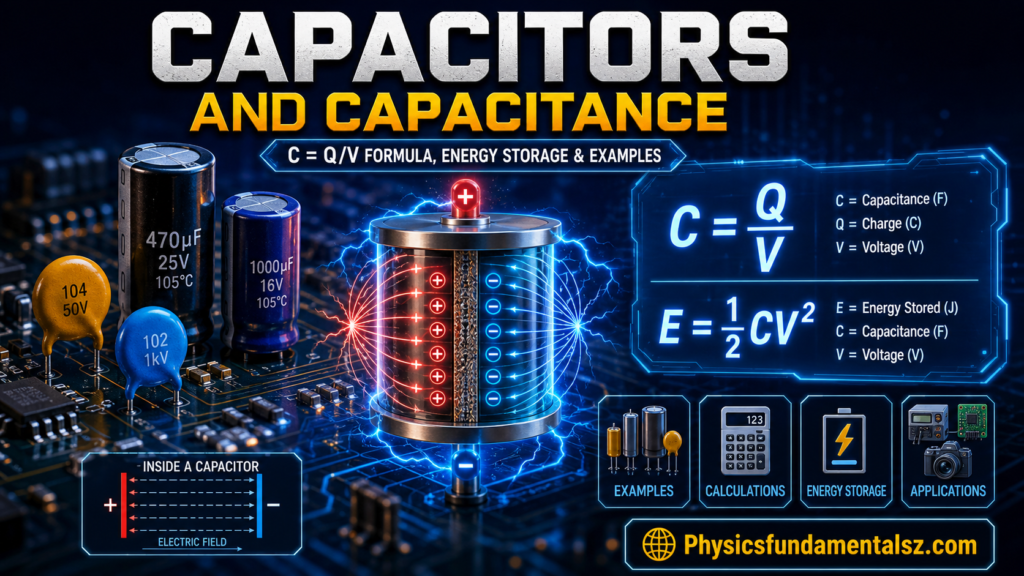
A capacitor is a device that stores electrical energy by holding equal and opposite charges on two conductive plates separated by an insulator (dielectric). Capacitance (C) measures how much charge a capacitor can store per volt applied, given by C = Q/V, and is measured in farads (F).
Table of Contents
What Is a Capacitor?
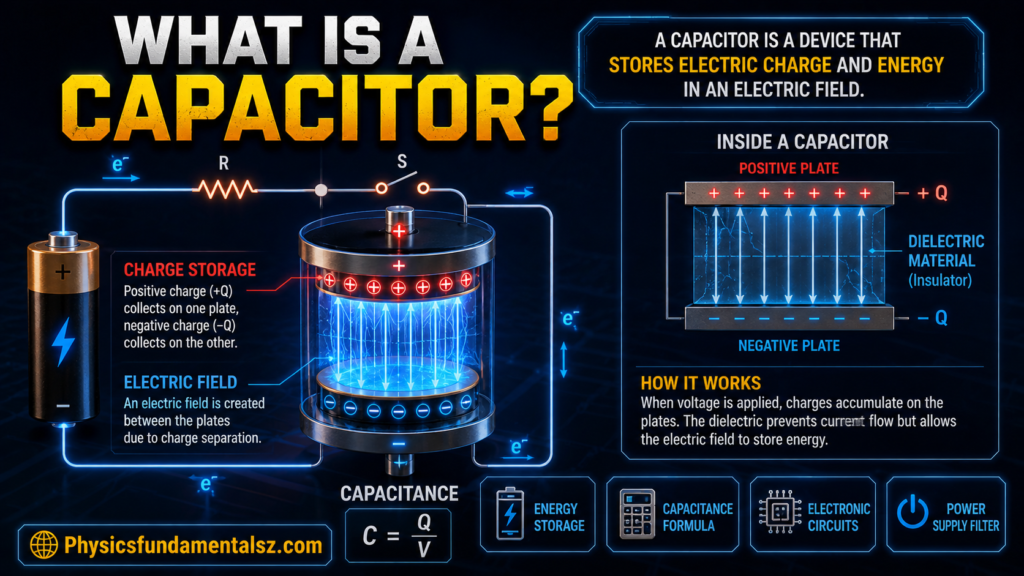
A capacitor is a passive electronic component that stores electrical energy in an electric field. It consists of two conductive plates (electrodes) separated by an insulating material called a dielectric — which can be air, ceramic, plastic film, or an oxide layer, depending on the type.
When a voltage source is connected across a capacitor, electrons flow onto one plate and away from the other. This builds up an equal and opposite charge on each plate — +Q on one, −Q on the other — even though no charge actually crosses the gap between them.
Capacitors used to be called condensers, a name that survives today in the automotive and audio world (the condenser microphone, for example).
Key takeaway: A capacitor never lets charge physically pass through the gap between its plates. It stores energy by separating charge, not by conducting it.
What Is Capacitance?
Capacitance is the measure of a capacitor’s ability to store charge for a given voltage. A capacitor with high capacitance stores a large amount of charge even at low voltage; one with low capacitance needs a much higher voltage to store the same charge.
Capacitance depends only on the physical characteristics of the capacitor — the size of the plates, the distance between them, and the dielectric material used. It does not depend on the charge or voltage applied; those two quantities simply scale together to keep the ratio (capacitance) constant.
The Capacitance Formula: C = Q/V
The defining relationship for capacitance is:
C = Q / V
| Symbol | Meaning | Unit |
|---|---|---|
| C | Capacitance | Farad (F) |
| Q | Magnitude of charge on each plate | Coulomb (C) |
| V | Voltage (potential difference) across the plates | Volt (V) |
Rearranging gives the two companion formulas used constantly in circuit problems:
- Q = CV — the charge stored, given capacitance and voltage.
- V = Q/C — the voltage across the capacitor, given charge and capacitance.
Worked Example: Basic Capacitance Calculation
Problem: A capacitor stores 6.0 × 10⁻⁴ C of charge when connected to a 12 V battery. Find its capacitance.
Solution:
- Formula: C = Q/V
- Substitute: C = (6.0 × 10⁻⁴ C) / (12 V)
- Result: C = 5.0 × 10⁻⁵ F, or 50 microfarads (µF)
The Farad: Unit of Capacitance
The SI unit of capacitance is the farad (F), named after English scientist Michael Faraday. One farad is a very large amount of capacitance — a 1 F capacitor stores 1 coulomb of charge for every 1 volt applied.
Because a farad is so large, most real-world capacitors are rated in much smaller units:
| Unit | Symbol | Value in Farads |
|---|---|---|
| Millifarad | mF | 10⁻³ F |
| Microfarad | µF | 10⁻⁶ F |
| Nanofarad | nF | 10⁻⁹ F |
| Picofarad | pF | 10⁻¹² F |
Key takeaway: Household electronics almost always use capacitors in the microfarad, nanofarad, or picofarad range — full-farad “supercapacitors” are a specialized exception used for rapid energy storage.
The Parallel Plate Capacitor
The simplest and most widely taught capacitor design is the parallel plate capacitor — two flat conducting plates of equal area, separated by a small gap filled with a dielectric (or vacuum).
Its capacitance is given by:
C = εA / d
| Symbol | Meaning | Unit |
|---|---|---|
| C | Capacitance | Farad (F) |
| ε | Permittivity of the dielectric between the plates | F/m |
| A | Overlapping area of the plates | m² |
| d | Distance (separation) between the plates | m |
Worked Example: Parallel Plate Capacitor
Problem: A parallel plate capacitor has plates of area 0.02 m² separated by 1.0 mm of air (permittivity of free space ε₀ = 8.85 × 10⁻¹² F/m). Find its capacitance.
Solution:
- Formula: C = εA/d
- Substitute: C = (8.85 × 10⁻¹²)(0.02) / (0.001)
- Simplify: C = (1.77 × 10⁻¹³) / (0.001)
- Result: C ≈ 1.77 × 10⁻¹⁰ F, or about 177 picofarads
Factors That Affect Capacitance
Three physical factors control how much capacitance a parallel plate capacitor has:
- Plate area (A): Larger plates can hold more charge at the same voltage, so capacitance increases as area increases.
- Plate separation (d): Bringing the plates closer strengthens the attraction between opposite charges, increasing capacitance. Capacitance is inversely proportional to separation.
- Dielectric material (ε): Inserting an insulating material between the plates increases capacitance beyond what air or vacuum alone would allow, because the dielectric partially cancels the internal electric field.
Key takeaway: Capacitance increases with larger plates, smaller gaps, and better dielectric materials — and it is completely independent of the applied voltage or the amount of charge currently stored.
Dielectrics and the Dielectric Constant
A dielectric is an insulating material placed between a capacitor’s plates. When an electric field is applied, the molecules in the dielectric shift slightly — a process called polarization — creating an internal field that partially opposes the plates’ own field. This lets the capacitor hold more charge at the same voltage.
The dielectric constant (κ, or relative permittivity) describes how much a material boosts capacitance compared to a vacuum:
C = κC₀
where C₀ is the capacitance with vacuum between the plates.
| Dielectric Material | Approximate Dielectric Constant (κ) |
|---|---|
| Vacuum | 1.00 |
| Air | ≈ 1.0006 |
| Paper | ≈ 3.5 |
| Glass | 4–10 |
| Mica | 5–7 |
| Ceramic | 6–8,000 (varies widely by formulation) |
| Tantalum oxide | ≈ 26 |
Key takeaway: A higher dielectric constant means more capacitance packed into the same physical size — which is exactly why modern electronics use ceramic and tantalum dielectrics instead of air.
Types of Capacitors
Capacitors come in many physical forms, each suited to different capacitance ranges, voltages, and applications.
| Capacitor Type | Typical Capacitance Range | Common Use Case |
|---|---|---|
| Ceramic capacitor | pF to µF | Filtering, decoupling in circuit boards |
| Electrolytic capacitor | µF to mF | Power supply smoothing, bulk energy storage |
| Tantalum capacitor | µF range | Compact, stable capacitance in small devices |
| Film capacitor | nF to µF | Audio equipment, precision timing circuits |
| Variable capacitor | pF range | Radio tuning circuits |
| Supercapacitor | F range | Rapid charge/discharge, backup power |
Charging and Discharging a Capacitor
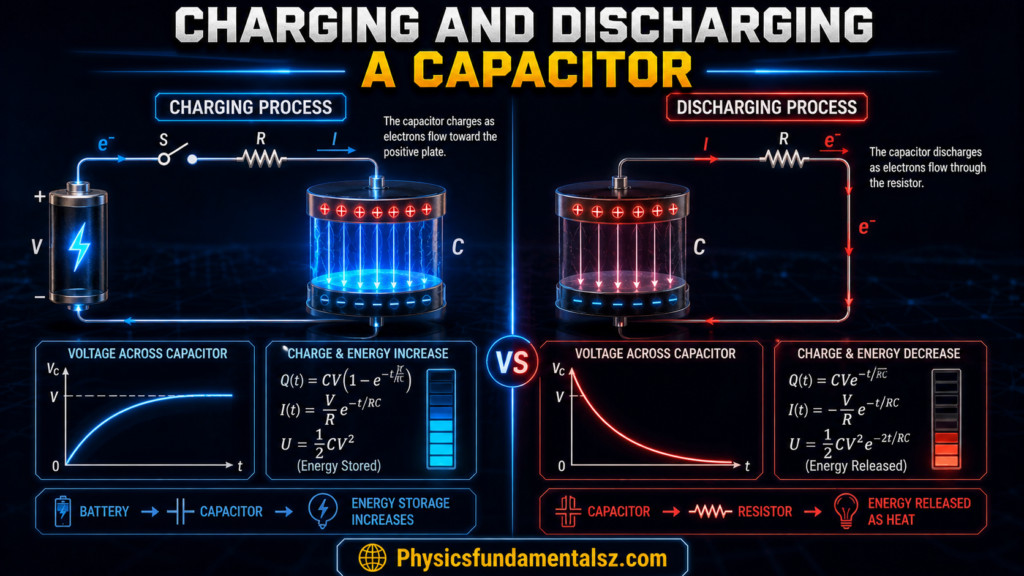
When a capacitor is connected to a battery through a resistor, it doesn’t charge instantly — charge builds up gradually, following an exponential curve described by the RC time constant:
τ = RC
where τ (tau) is the time constant in seconds, R is resistance in ohms, and C is capacitance in farads. After one time constant, a capacitor reaches about 63% of full charge (or discharges to about 37% of its starting charge); after five time constants, it is considered essentially fully charged or discharged.
Key takeaway: The RC time constant is why capacitors can shape timing behavior in circuits — it is the basis for timers, camera flash delays, and debounce circuits.
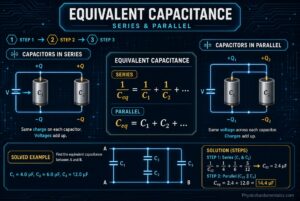
Capacitors in Series and Parallel
Just like resistors, capacitors can be combined — but their combination rules are the opposite of resistors.
Comparison Table: Series vs. Parallel Capacitors
| Configuration | Equivalent Capacitance Formula | Voltage Across Each Capacitor | Charge on Each Capacitor |
|---|---|---|---|
| Series | 1/C_total = 1/C₁ + 1/C₂ + … | Divides (adds to total voltage) | Same on every capacitor |
| Parallel | C_total = C₁ + C₂ + … | Same across every capacitor | Divides (adds to total charge) |
Worked Example: Capacitors in Series
Problem: Two capacitors, 4.0 µF and 6.0 µF, are connected in series. Find the equivalent capacitance.
Solution:
- Formula: 1/C_total = 1/C₁ + 1/C₂
- Substitute: 1/C_total = 1/4.0 + 1/6.0 = 0.25 + 0.1667 = 0.4167
- Result: C_total ≈ 2.4 µF
Worked Example: Capacitors in Parallel
Problem: The same two capacitors, 4.0 µF and 6.0 µF, are connected in parallel instead. Find the equivalent capacitance.
Solution:
- Formula: C_total = C₁ + C₂
- Substitute: C_total = 4.0 + 6.0
- Result: C_total = 10.0 µF
Key takeaway: Series combinations always reduce total capacitance below the smallest individual value; parallel combinations always increase it above the largest individual value.
Energy Stored in a Capacitor
A charged capacitor stores electric potential energy in the field between its plates. The energy stored is given by:
U = ½CV² = ½QV = Q²/2C
| Symbol | Meaning | Unit |
|---|---|---|
| U | Energy stored | Joules (J) |
| C | Capacitance | Farad (F) |
| V | Voltage across the capacitor | Volt (V) |
| Q | Charge stored | Coulomb (C) |
Worked Example: Energy Stored in a Capacitor
Problem: A 50 µF capacitor is charged to 200 V. Find the energy stored.
Solution:
- Formula: U = ½CV²
- Substitute: U = 0.5 × (50 × 10⁻⁶) × (200)²
- Simplify: U = 0.5 × (50 × 10⁻⁶) × 40,000
- Result: U = 1.0 J
Key takeaway: Doubling voltage quadruples the stored energy, since energy depends on V², while doubling capacitance only doubles the stored energy at a fixed voltage.
Capacitor vs. Battery
Capacitors and batteries both store electrical energy, but they do it in fundamentally different ways.
| Feature | Capacitor | Battery |
|---|---|---|
| Energy storage method | Electric field between plates | Chemical reaction |
| Charge/discharge speed | Extremely fast (seconds or less) | Slower (minutes to hours) |
| Energy density | Lower | Higher |
| Power density | Higher | Lower |
| Lifespan | Very high (many thousands of cycles) | Limited by chemical degradation |
| Typical role | Short bursts of energy, filtering, timing | Sustained power delivery |
Real-World Applications
Capacitors and capacitance are not just textbook material — they are working components inside devices used every day.
- Camera flashes: Charge slowly from a battery, then discharge almost instantly to power a brief, bright flash.
- Power supply smoothing: Large electrolytic capacitors smooth out fluctuating DC voltage after rectification.
- Defibrillators: Store a large amount of energy in a capacitor bank, then release it rapidly to deliver a controlled shock that can restart a heart’s rhythm.
- Touchscreens: Capacitive touchscreens detect a finger by measuring the small change in capacitance where skin contacts the screen.
- Radio tuning: Variable capacitors let a receiver select a specific frequency by adjusting capacitance in a tuning circuit.
- Memory backup: Small capacitors and supercapacitors hold volatile memory or real-time clocks active briefly during power loss.
Common Mistakes to Avoid

- Confusing capacitance with charge. Capacitance (C) is a fixed property of the capacitor itself; charge (Q) and voltage (V) can vary while their ratio stays constant.
- Mixing up the series and parallel formulas. Remember: capacitors in series behave like resistors in parallel, and vice versa — the reciprocal rule applies to series capacitance, not parallel.
- Forgetting units when calculating energy. Capacitance must be in farads and voltage in volts for U = ½CV² to give an answer directly in joules; mismatched prefixes (µF vs F) are a frequent source of errors.
- Assuming capacitance depends on voltage. It doesn’t — capacitance depends only on geometry and dielectric material, not on how much charge or voltage is currently applied.
- Ignoring the dielectric’s role. Skipping the dielectric constant when comparing two capacitors with identical plate size and spacing will give the wrong capacitance value.
Related Articles
- Electric Potential Energy: E = kQq/r, Work Done & Worked Examples
- Electric Current: I = Q/t, Drift Velocity & Ohm’s Law Connection
- Electric Circuits & Kirchhoff’s Laws: KCL, KVL & Worked Examples
- Kirchhoff’s Laws Advanced: Solving Multi-Loop Circuits Step by Step
- Lenz’s Law: The Direction of Induced Current Explained
- Ohm’s Law and Temperature: How Resistance Really Changes With Heat
- Resistors in Series and Parallel: Formulas, Rules & Worked Examples
- Power in Electrical Circuits: P = IV = I²R = V²/R Explained
- Electromagnetic Waves: Speed, Spectrum & Wave Properties
- Ohm’s Law Explained: V = IR
- Electric Charge and Coulomb’s Law Explained
- Magnetic Fields and Forces
- Electric Field and Potential
- Electromagnetic Induction
- Conservation of Energy: Law, Forms & Worked Examples
- Thermal Energy & Internal Energy: Heat, Temperature & Q = mcΔT
- Gravitational Potential Energy: GPE = mgh Formula, Derivation & Examples
- Wave Superposition: Adding Waves, Phase & Interference Patterns
Frequently Asked Questions (FAQs)
What is a capacitor?
A capacitor is a passive electronic component that stores electrical energy in an electric field, using two conductive plates separated by an insulating dielectric.
What is capacitance?
Capacitance is the measure of a capacitor’s ability to store charge per unit of voltage applied, defined as C = Q/V.
What is the formula for capacitance?
C = Q/V, where C is capacitance in farads, Q is charge in coulombs, and V is voltage in volts.
What is the SI unit of capacitance?
The farad (F), named after Michael Faraday. Most real capacitors are rated in microfarads, nanofarads, or picofarads.
What is the formula for a parallel plate capacitor?
C = εA/d, where ε is the permittivity of the dielectric, A is plate area, and d is the distance between the plates.
How does plate area affect capacitance?
Capacitance increases as plate area increases, since larger plates can hold more charge at the same voltage.
How does plate separation affect capacitance?
Capacitance is inversely proportional to plate separation — moving the plates closer together increases capacitance.
What is a dielectric?
A dielectric is an insulating material placed between a capacitor’s plates that increases capacitance by partially opposing the internal electric field.
Does capacitance depend on voltage?
No. Capacitance is a fixed property determined by geometry and dielectric material; charge and voltage change together while their ratio (capacitance) stays constant.
How do you calculate capacitors in series?
Use the reciprocal formula: 1/C_total = 1/C₁ + 1/C₂ + …, which always produces a total smaller than the smallest individual capacitor.
How do you calculate capacitors in parallel?
Simply add the individual capacitances: C_total = C₁ + C₂ + …
What is the formula for energy stored in a capacitor?
U = ½CV², where U is energy in joules, C is capacitance in farads, and V is voltage in volts.
What is the RC time constant?
τ = RC is the time it takes a capacitor to reach about 63% of full charge (or fall to 37% of its charge during discharge) in a resistor-capacitor circuit.
What is the difference between a capacitor and a battery?
A capacitor stores energy in an electric field and charges/discharges quickly; a battery stores energy chemically and delivers it more slowly but at higher energy density.
Can a capacitor store energy indefinitely?
In theory, an ideal capacitor holds its charge indefinitely once disconnected; in practice, slight leakage current causes real capacitors to lose charge gradually over time.
Why do capacitors block DC but allow AC?
Once fully charged, a capacitor no longer allows current to flow under a steady DC voltage, but its charge continuously reverses under an alternating voltage, letting AC signals pass through.
What are the main types of capacitors?
Common types include ceramic, electrolytic, tantalum, film, variable, and supercapacitors, each suited to different capacitance ranges and applications.
What is a supercapacitor?
A supercapacitor is a capacitor with an unusually high capacitance (often in the farad range), used for rapid charge and discharge cycles and short-term backup power.
How is a capacitor different from a resistor?
A resistor dissipates electrical energy as heat, while a capacitor stores electrical energy in a field and can release it later without permanent loss.
What happens when a capacitor is fully charged?
Once fully charged under a steady DC voltage, the voltage across the capacitor equals the source voltage, and current effectively stops flowing.
Why is capacitance important in circuit design?
Capacitance determines how a component filters signals, stores energy, sets timing behavior, and interacts with resistors and inductors throughout a circuit.
What is the dielectric constant?
The dielectric constant (κ) is a number describing how much a material increases a capacitor’s capacitance compared to having a vacuum between the plates.
How does a capacitive touchscreen work?
It detects a finger by measuring the small, localized change in capacitance that occurs when skin — an imperfect conductor — comes near the screen’s conductive layer.
Key Takeaways
- A capacitor stores electrical energy by holding equal and opposite charges on two plates separated by a dielectric.
- Capacitance is defined as C = Q/V and is measured in farads, with real components typically rated in µF, nF, or pF.
- A parallel plate capacitor’s capacitance follows C = εA/d — larger plates, smaller gaps, and stronger dielectrics all increase capacitance.
- Capacitors in series always combine to less than the smallest value; capacitors in parallel simply add together.
- Energy stored in a capacitor is U = ½CV², making stored energy far more sensitive to voltage than to capacitance.
- Capacitors underlie technology from camera flashes and defibrillators to touchscreens and power supply smoothing — turning a simple formula into everyday engineering.