Kirchhoff’s Law Practice Problems: Step-by-Step Solved Examples (2026 Guide)
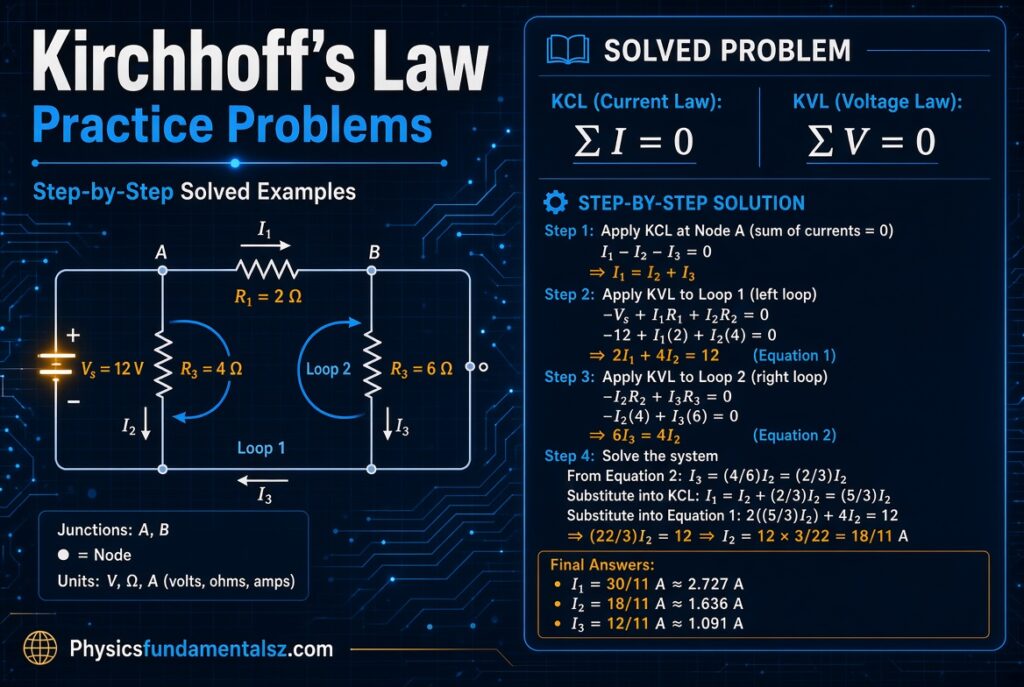
Struggling to turn a circuit diagram into an answer? Kirchhoff’s law practice problems trip up most students not because the laws are hard, but because nobody shows the exact order of steps to follow.
Table of Contents
What Are Kirchhoff’s Laws? Quick Definition
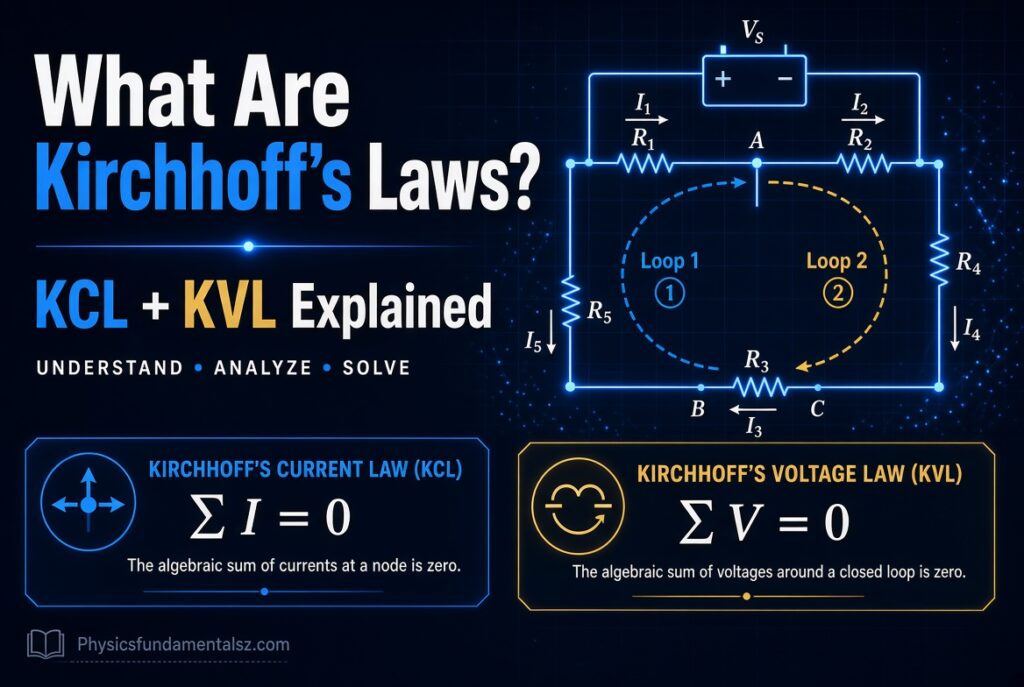
Kirchhoff’s laws are two rules used to analyze electric circuits. The first tracks current at a junction, and the second tracks voltage around a loop.
Together they let you solve for unknown currents and voltages in circuits that are too complex for Ohm’s law alone.
Kirchhoff’s Current Law (KCL) Explained
Kirchhoff’s Current Law states that the total current entering a junction equals the total current leaving it. This comes directly from conservation of charge.
Charge cannot pile up at a point in a circuit, so whatever flows in must flow out.
KCL Formula
The formula is written as ΣI(in) = ΣI(out), or equivalently, the algebraic sum of currents at a node equals zero.
How to Apply KCL at a Junction
Pick a junction, label every current flowing in and out, then set the sum of incoming currents equal to the sum of outgoing currents.
If a current’s true direction is opposite to your guess, the math will simply return a negative value.
Kirchhoff’s Voltage Law (KVL) Explained
Kirchhoff’s Voltage Law states that the sum of all voltage changes around any closed loop in a circuit equals zero. This comes from conservation of energy.
A charge that travels all the way around a loop and returns to its starting point must end up with the same potential energy it started with.
KVL Formula
The formula is written as Σv(k) = 0 for any closed loop, where each v(k) is a voltage rise or drop across one component.
How to Apply KVL Around a Loop
Choose a direction to travel around the loop, add EMF as a rise if you pass from − to +, and subtract each resistor’s voltage as a drop if you travel in the assumed current direction.
Add up every term and set the total equal to zero.
Kirchhoff’s Law Practice Problems: Step-by-Step Method
Every kirchhoff’s law practice problem can be solved using the same five-step method, no matter how complex the circuit looks.
Step 1: Label the Junctions
Mark every point where three or more wires meet. These are your nodes.
Step 2: Assign Current Directions
Draw an arrow for each unknown current in any direction you choose. A wrong guess only produces a negative sign later, not a wrong answer.
Step 3: Write KCL Equations
At each junction, write one equation setting incoming current equal to outgoing current.
Step 4: Write KVL Equations
For each independent loop, add up the EMFs and voltage drops going around it and set the sum to zero.
Step 5: Solve the System
You now have a system of linear equations. Solve it using substitution, elimination, or matrix methods to find every unknown current.
Solved Kirchhoff’s Law Practice Problems

These fully worked kirchhoff’s law practice problems follow the same five-step method above, from simplest to hardest.
Problem 1: Single Loop Circuit
A single loop has a 12 V battery in series with a 2 Ω resistor and a 4 Ω resistor. Find the current.
Using KVL: 12 − I(2 + 4) = 0, so I = 2 A. The voltage drop across the 2 Ω resistor is 4 V, and across the 4 Ω resistor is 8 V.
Problem 2: Two-Loop Circuit With Two Batteries
Left loop: 10 V battery with a 1 Ω resistor. Right loop: 6 V battery with a 2 Ω resistor. Both loops share a 4 Ω resistor carrying current I3 = I1 + I2.
Left loop KVL: 10 − I1(1) − I3(4) = 0. Right loop KVL: 6 − I2(2) − I3(4) = 0.
Solving the system gives I3 ≈ 1.86 A, I1 ≈ 2.57 A, and I2 ≈ −0.71 A. The negative sign on I2 means that current actually flows opposite to the assumed direction.
Problem 3: Junction Rule With Three Branches
At a node, 3 A and 5 A flow in, while 2 A and an unknown current I3 flow out. Find I3.
Using KCL: 3 + 5 = I3 + 2, so I3 = 6 A.
Problem 4: RC Circuit With Kirchhoff’s Rules
A 15 V battery is connected in series with a 2,000 Ω resistor and a 0.25 µF capacitor. Find the time constant and the maximum charge.
Time constant: τ = RC = 2,000 × 0.25 × 10⁻⁶ = 5 × 10⁻⁴ s, or 0.5 ms. Maximum charge: Q = CV = 0.25 × 10⁻⁶ × 15 = 3.75 µC.
Problem 5: Finding Potential Difference Between Two Points
Between points A and B sits a 6 V battery (+ terminal toward B) and a 5 Ω resistor carrying 2 A from A to B. Find V(AB).
Moving from A to B: gain 6 V through the battery, then drop 10 V (I × R) across the resistor. So V(B) − V(A) = 6 − 10 = −4 V, meaning V(AB) = 4 V.
Common Mistakes in Kirchhoff’s Law Practice Problems
- Forgetting that a negative current result is still a valid, correct answer.
- Mixing up voltage rises and drops when traveling around a loop.
- Reusing the same loop twice instead of finding an independent one.
- Skipping the junction rule entirely in a multi-loop circuit.
- Not double-checking units (V, A, Ω) before solving the system.
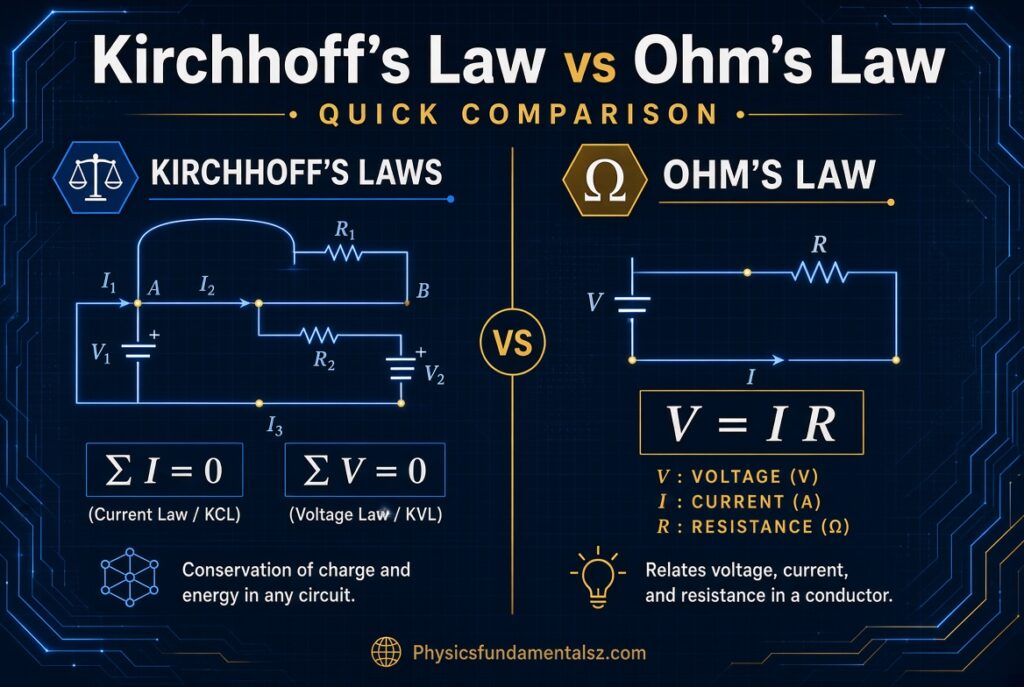
Kirchhoff’s Law vs Ohm’s Law: Quick Comparison
| Ohm’s Law | Kirchhoff’s Law | |
|---|---|---|
| What it relates | V, I, and R for one component | Current at nodes, voltage around loops |
| Best used for | Single resistor or simple series circuit | Multi-loop, multi-branch circuits |
| Formula | V = IR | ΣI = 0 (KCL), Σv = 0 (KVL) |
| Based on | Resistance behavior | Conservation of charge and energy |
Also Read:
- Circular Motion and Centripetal Force
- Physics Fundamentals: The Complete Guide
- Net Force Explained
- Potential Energy Explained
- Momentum and Impulse Collisions
- Mechanical Energy: ME = KE + PE
- Escape Velocity Explained
- Impulse and Momentum
- Conservation of Energy
- Bernoulli’s Principle
- Centripetal vs Centrifugal Force
- Centre of Gravity vs Centre of Mass
- Buoyancy and Archimedes’ Principle
- What Is Centripetal Force With Examples?
- Conservation of Momentum Real Life Examples
- What Is the Formula for Conservation of Momentum?
- Pressure in Fluids
- Terminal Velocity Explained
- Constructive and Destructive Interference Examples
- Entropy Explained for Beginners
- Ideal Gas Law Practice Problems With Answers
- Nuclear Decay Equations Explained Simply
- Mass Energy Equivalence Real Life Examples
- Right Hand Rule for Magnetic Field Explained
Frequently Asked Questions (FAQs)
What is Kirchhoff’s law in simple terms?
Kirchhoff’s laws are two rules for analyzing circuits: current in equals current out at any junction, and voltage changes around any closed loop add up to zero.
How many equations do I need for a Kirchhoff’s law practice problem?
You need one KCL equation per independent junction and one KVL equation per independent loop, enough total equations to match the number of unknown currents.
What does a negative current mean in Kirchhoff’s law problems?
It means the current actually flows opposite to the direction you originally assumed. The magnitude of your answer is still correct.
Is Kirchhoff’s law the same as Ohm’s law?
No. Ohm’s law relates voltage, current, and resistance for a single component, while Kirchhoff’s laws describe how current and voltage behave across an entire circuit.
Why do we need Kirchhoff’s laws if we already have Ohm’s law?
Ohm’s law alone cannot solve circuits with multiple loops or branches. Kirchhoff’s laws provide the extra equations needed to solve for every unknown current.
What is the difference between KCL and KVL?
KCL applies at a single point (a junction) and is based on conservation of charge. KVL applies around a full loop and is based on conservation of energy.
How do you know which direction to assign a current?
Any direction works as a starting guess. If it’s wrong, the solved value will simply come out negative.
Can Kirchhoff’s laws be used on AC circuits?
Yes, with impedance replacing resistance and phasors representing voltage and current, the same two laws still apply.
What is a junction in Kirchhoff’s current law?
A junction, or node, is any point in a circuit where three or more wires connect.
What is a loop in Kirchhoff’s voltage law?
A loop is any closed path in a circuit that starts and ends at the same point without repeating a section already counted.
How do you solve a two-loop circuit using Kirchhoff’s laws?
Write one KCL equation at the shared junction, one KVL equation for each loop, then solve the resulting system of equations simultaneously.
Do Kirchhoff’s laws work for capacitors?
Yes. KVL still applies, treating the capacitor’s voltage as Q/C, which is essential for solving RC circuit problems.
What is the sign convention in Kirchhoff’s voltage law?
Moving from − to + across a source is a voltage rise, added as positive. Moving in the direction of assumed current through a resistor is a voltage drop, subtracted as negative.
Why does my Kirchhoff’s law answer not match the textbook?
Check your sign convention and current directions first. A flipped sign on one term is the most common cause of a mismatched answer.
What tools can I use to check Kirchhoff’s law practice problems?
A circuit simulator or an online Kirchhoff’s law calculator can verify your hand-solved currents and voltages.
Are Kirchhoff’s laws only for physics class?
No, they are also used in electrical engineering, circuit design, and troubleshooting real-world electronics.
How many independent loop equations does a circuit need?
The number of independent loops equals the number of branches minus the number of nodes, plus one.
What happens if I pick the wrong loop direction in KVL?
Nothing breaks. As long as you stay consistent with signs throughout that loop, the final numeric answers come out correct.
Can Kirchhoff’s laws be applied to a single resistor circuit?
Yes, but for a single loop with one resistor, Kirchhoff’s voltage law simplifies down to Ohm’s law.
What is the time constant in a Kirchhoff’s law RC problem?
The time constant τ = RC tells you how quickly a capacitor charges or discharges through a resistor.
Conclusion
Kirchhoff’s law practice problems become manageable once you follow the same five-step method every time: label junctions, assign currents, write KCL, write KVL, then solve the system.
Work through the five solved examples above, then test yourself with fresh numbers until the process feels automatic.