Right Hand Rule for Magnetic Field Explained (Direction, Formulas & Examples)
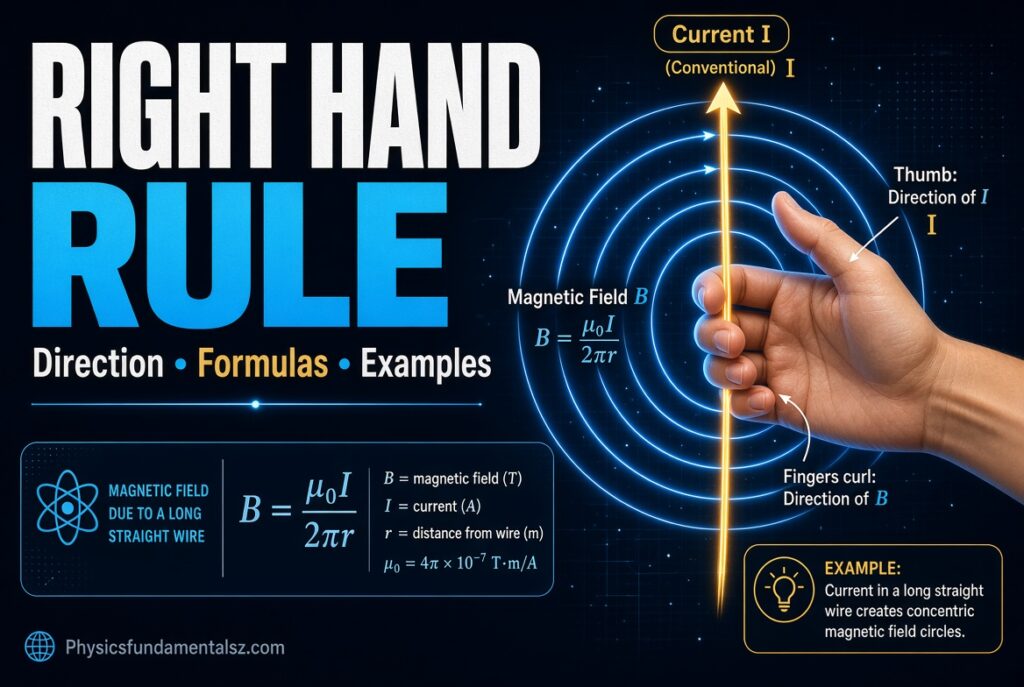
Right Hand Rule for Magnetic Field Explained is a fundamental concept in electromagnetism used to determine the direction of the magnetic field produced by an electric current.
It provides a simple way to visualize the relationship between current flow and the surrounding magnetic field. By positioning the right hand with the thumb pointing in the direction of conventional current, the curled fingers indicate the direction of the magnetic field around a straight conductor.
This principle also applies to current-carrying coils and solenoids, helping explain how magnetic fields form and interact with electric currents.
Table of Contents
What Is the Right Hand Rule? Right Hand Rule for Magnetic Field Explained

Definition: The right hand rule is a memory aid for finding the direction of magnetic fields and magnetic forces. For the field around a straight wire, point your right thumb along the conventional current. Your curled fingers then show how the magnetic field circles the wire.
For magnetic force: point your fingers along the field (B), your thumb along the velocity (v), and your palm faces the force (F) on a positive charge.
Reverse the force for a negative charge such as an electron.
Key Takeaways
- The rule uses your right hand and conventional current (positive to negative).
- The field around a wire forms circles, and your curled fingers trace them.
- A coil behaves like a bar magnet, and your thumb points to its north pole.
- The magnetic force is perpendicular to both the velocity and the field.
- Negative charges feel a force opposite to the one the rule predicts for positive charges.
- A charge moving parallel to the field feels no magnetic force.
What Is the Right Hand Rule in Magnetism?
Magnetism works in three dimensions. Field, current and force all point in different directions, so numbers alone are not enough. You need a quick way to keep the directions straight.
That is the job of the right hand rule. It is a shortcut for the vector cross product, which uses a right-handed coordinate system.
Why Physics Needs a Hand Rule
In 1820, Hans Christian Ørsted showed that an electric current deflects a compass needle. Current creates a magnetic field. The field does not point along the wire, though. It wraps around it.
Hand rules turn that sideways, circling behavior into something you can picture and check.
Conventional Current vs Electron Flow
The right hand rule assumes conventional current. That is the flow of positive charge from the positive terminal toward the negative terminal.
Electrons actually move the opposite way. If you follow electron flow, use your left hand or flip the final answer.
Reading Dot and Cross Symbols
Diagrams show 3D directions on a flat page using two symbols.
| Symbol | Meaning | Memory trick |
|---|---|---|
| ⊙ (dot in a circle) | Vector points out of the page toward you | You see the tip of an arrow |
| ⊗ (cross in a circle) | Vector points into the page away from you | You see the tail feathers of an arrow |
The Three Right Hand Rules at a Glance
| Rule | What it finds | Thumb shows | Fingers show |
|---|---|---|---|
| Right-hand grip rule | Field around a straight wire | Direction of current | Curl of the magnetic field |
| Right-hand coil (solenoid) rule | Field and poles of a coil | Direction of B inside the coil (north pole) | Curl of the current around the loops |
| Right-hand force rule | Force on a moving charge or current | Force (three-finger version) or velocity (palm version) | Field and velocity or current |
Right Hand Rule 1: Field Around a Straight Wire
This is the grip rule. It answers the question, “Which way does the magnetic field circle a current-carrying wire?”
How to Apply It
- Point your right thumb in the direction of the conventional current.
- Curl your fingers around the wire as if gripping it.
- Your fingertips point in the direction of the magnetic field at every point around the wire.
Looking at the Wire End-On
Suppose the wire runs straight toward you. Current out of the page (⊙) gives a counterclockwise field. Current into the page (⊗) gives a clockwise field.
Swap the current direction and the circulation flips.
Field Strength Around a Wire
The field weakens with distance from the wire. For a long, straight wire: B = μ₀I ÷ (2πr).
Here μ₀ = 4π × 10⁻⁷ T·m/A, I is current in amperes and r is distance in meters.
Right Hand Rule 2: Field of a Coil or Solenoid
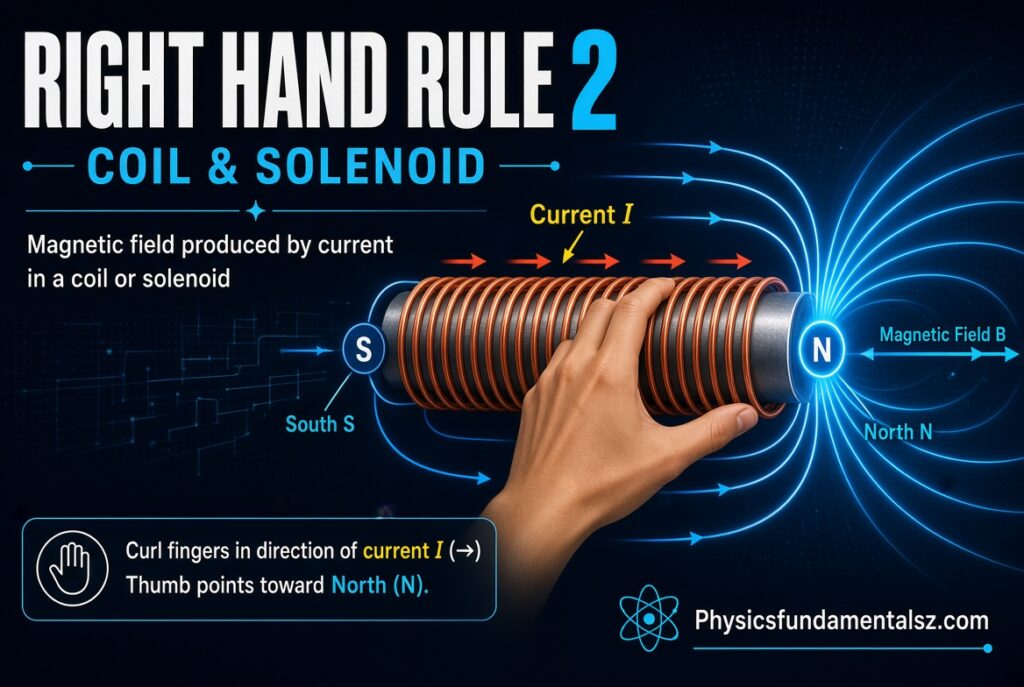
A solenoid is a wire wound into a coil. Each loop adds to the field inside, so the coil acts like a bar magnet.
How to Apply It
- Curl your right fingers in the direction the current flows around the loops.
- Your thumb points along the field inside the coil.
- The end your thumb points toward is the north pole.
Field Strength Inside a Solenoid
For a long solenoid: B = μ₀nI, where n is turns per meter.
More turns per meter or more current gives a stronger field. Reversing the current swaps the poles.
Right Hand Rule 3: Force on a Moving Charge or Current
A magnetic field pushes on moving charges. The push is sideways to both the motion and the field.
The Formula and Direction
The magnetic force is F = qv × B. Its size is F = qvB sinθ, where θ is the angle between v and B.
The force is largest at 90° and zero when the charge moves along the field (θ = 0° or 180°).
Method A: The Three-Finger Version
Hold your right index finger, middle finger and thumb at right angles to each other.
- Index finger: velocity (v) or current (I)
- Middle finger: magnetic field (B)
- Thumb: force (F) on a positive charge
Method B: The Flat-Hand (Palm) Version
Some teachers prefer the open-hand version. It is the same rule with different labels.
- Fingers point along the magnetic field (B).
- Thumb points along the velocity (v) or current.
- Palm faces the direction of the force (F) on a positive charge.
Negative Charges
The rule gives the force on a positive charge. For an electron or any negative charge, reverse the result. The force points the opposite way.
Force on a Current-Carrying Wire
A current is a stream of moving charges, so a wire in a field feels a force. Its size is F = BIL sinθ, where L is the length of wire inside the field.
Use the same three-finger method with your index finger along the current.
How to Use the Right Hand Rule on Any Problem
Follow this routine for consistent results.
- Identify the task. Are you finding a field, a force or a current direction?
- Check the charge sign. Note whether it is positive, negative or conventional current.
- Choose the rule. Use the grip rule for a wire, the coil rule for a solenoid or the force rule for motion in a field.
- Orient your right hand. Match the known directions to the correct fingers.
- Read the answer and adjust. Reverse the result if the charge is negative.
Worked Examples
Example 1: Field Around a Straight Wire
A long straight wire carries 10 A upward. Find the field 5 cm away and its direction.
B = μ₀I ÷ (2πr) = (4π × 10⁻⁷ × 10) ÷ (2π × 0.05) = 4.0 × 10⁻⁵ T (40 μT).
Direction: point your thumb up and curl your fingers. Viewed from above, the field circulates counterclockwise.
For comparison, Earth’s field is roughly 25 to 65 μT depending on location.
Example 2: Poles of a Solenoid
A solenoid has 1,000 turns per meter and carries 2 A.
B = μ₀nI = 4π × 10⁻⁷ × 1,000 × 2 ≈ 2.5 × 10⁻³ T (about 2.5 mT).
If the current circulates clockwise as seen from the left end, curl your fingers that way. Your thumb points right, so the right end is the north pole.
Example 3: Force on a Proton
A proton moves east at 2.0 × 10⁶ m/s through a 0.50 T field pointing north.
F = qvB = (1.6 × 10⁻¹⁹)(2.0 × 10⁶)(0.50) = 1.6 × 10⁻¹³ N
Direction: index finger east, middle finger north. Your thumb points up, so the force is upward.
Example 4: Force on an Electron
Repeat Example 3 with an electron in the same situation. The magnitude is the same, 1.6 × 10⁻¹³ N.
Because the charge is negative, the force reverses and points downward.
Example 5: Force on a Current-Carrying Wire
A 0.50 m wire carries 4.0 A east through a 0.30 T field pointing north, perpendicular to the wire.
F = BIL = 0.30 × 4.0 × 0.50 = 0.60 N
Index finger east, middle finger north, thumb up. The force on the wire is upward.
Example 6: Circular Path Radius
A magnetic force acts as the centripetal force, so qvB = mv²/r and r = mv ÷ (qB).
For the proton in Example 3: r = (1.67 × 10⁻²⁷ × 2.0 × 10⁶) ÷ (1.6 × 10⁻¹⁹ × 0.50) ≈ 0.042 m (4.2 cm).
The proton circles at constant speed, and its direction of curving comes from the right hand rule.
Why Magnetic Force Never Changes a Particle’s Speed
The magnetic force is always perpendicular to the velocity. A force at right angles to motion does no work.
With no work done, kinetic energy stays constant. The field can bend a path, but it cannot speed a particle up or slow it down.
Electric fields do that job. This is why circular accelerators use magnets to steer and electric fields to accelerate.
Right Hand Rule vs Left Hand Rule
Many courses outside the US teach Fleming’s rules. Both approaches give the same physical answers when used consistently.
| Feature | Right hand rules (common in US courses) | Fleming’s left-hand rule (motor rule) |
|---|---|---|
| Main use | Fields around currents, force on charges | Force on a current-carrying conductor |
| Fingers used | Grip, curl, or three fingers | Thumb, first finger, second finger |
| Thumb | Current (grip) or force (three-finger) | Force (motion) |
| First finger | Velocity or current | Field |
| Second finger | Field | Current |
| Current convention | Conventional current | Conventional current |
Pick one system and stay with it. Mixing systems is a common source of wrong answers.
Real-World Uses of the Right Hand Rule

- Electric motors: Force on current-carrying coils turns the rotor.
- Loudspeakers: A voice coil in a magnetic field moves the speaker cone.
- Mass spectrometers: Magnetic force bends ion paths according to mass and charge.
- Particle accelerators: Magnets steer beams around circular paths.
- Electromagnets and relays: The coil rule sets which end becomes north.
- MRI machines: Large solenoid magnets create a strong, uniform field.
Common Mistakes to Avoid
| Mistake | Why it is wrong | Fix |
|---|---|---|
| Using the left hand | Gives the reverse direction for the standard rules | Use your right hand, or flip the answer |
| Using electron flow with the right hand rule | The rule assumes conventional current | Reverse the direction for electron flow |
| Forgetting the charge sign | Negative charges feel the opposite force | Reverse the result for negative charges |
| Mixing up which finger is v and which is B | Order matters in a cross product | Write the formula first, then match fingers |
| Applying a force to a charge moving along the field | The force is zero at 0° and 180° | Check the angle first |
| Assuming field lines point along the wire | The field circles the wire | Use the grip rule |
| Confusing the coil rule with the force rule | They answer different questions | Decide whether you need a field or a force |
Memory Tricks and Expert Tips
- Say “thumb is current” out loud for the grip rule. It sticks.
- Test your setup with a quick sketch of x, y and z axes. East, north and up form a right-handed set.
- Check your answer with a compass. The needle’s north end aligns with the field direction.
- Always write the sign of the charge next to your answer.
- Practice with dot and cross diagrams. Most exam problems use them.
- Use the same rule the whole way through a problem. Changing hand mid-problem causes most errors.
Practice Problems
Try these before reading the answers.
- A vertical wire carries current upward. Viewed from above, which way does the field circulate?
- A coil’s current runs clockwise as seen from its left end. Which end is north?
- A proton moves north through a field pointing straight up. In what direction is the force?
- Repeat problem 3 for an electron.
- A 0.20 m wire carries 5.0 A perpendicular to a 0.40 T field. What is the force on it?
Answers
- Counterclockwise (thumb up, fingers curl counterclockwise seen from above).
- The right end is north.
- East (with x = east, y = north, z = up: north × up = east).
- West, because the electron is negative.
- F = BIL = 0.40 × 5.0 × 0.20 = 0.40 N.
Also Read:
- Electromagnetism Articles and Guides
- Ohm’s Law Calculator: Solve for Current
- Physics Fundamentals: The Complete Guide to Core Concepts, Laws, and Equations
- Play Physics Games (Build Circuits and More)
- Kinetic Energy
- Angular Momentum
- Difference Between Speed and Velocity With Examples
- Momentum Calculator Physics: Formula, Steps & Worked Examples
- Tension Force
- The Doppler Effect
- Torque in Physics
- Circular Motion and Centripetal Force
- Newton’s Laws of Motion
- Work Done in Physics
- Power in Physics
- Conservation of Momentum
- Momentum and Impulse
- Friction Force Explained
- Wave Speed, Frequency & Wavelength
- Electromagnetic Spectrum
- Speed of Light: The Ultimate Guide to c, the Cosmic Speed Limit
Frequently Asked Questions (FAQs)
What is the right hand rule for magnetic field?
It is a memory aid for finding directions in magnetism. For a straight wire, point your right thumb along the current and curl your fingers. The fingers show the field direction.
How do you use the right hand rule for a straight wire?
Point your right thumb along the conventional current. Curl your fingers around the wire. They point along the circular magnetic field lines.
Which direction does the magnetic field go around a wire?
It circles the wire. Current out of the page gives a counterclockwise field. Current into the page gives a clockwise field.
How does the right hand rule work for a solenoid?
Curl your right fingers along the current around the loops. Your thumb points to the coil’s north pole and along the field inside.
What is the right hand rule for force on a moving charge?
Point your index finger along the velocity and your middle finger along the field. Your thumb gives the force on a positive charge.
Which finger stands for which quantity?
In the three-finger version, index is velocity or current, middle is magnetic field and thumb is force. In the palm version, fingers are the field, thumb is velocity and the palm faces the force.
Why do we use the right hand and not the left?
It is a convention tied to the right-handed coordinate system used in vector math. The left hand would give the reverse direction unless you flip the definitions.
What is the right hand rule for negative charges?
Apply the rule as if the charge were positive, then reverse the result. The force on a negative charge points the opposite way.
What is the difference between the right hand rule and the left hand rule?
Both give the same physical answer when used consistently. The right hand rules are common in US courses, while Fleming’s left-hand rule is common for motors elsewhere.
Does the right hand rule use conventional current or electron flow?
Conventional current. For electron flow, use your left hand or reverse the final direction.
What does the thumb represent in the right hand rule?
It depends on the version. In the grip rule it shows the current. In the coil rule it shows the field direction. In the three-finger force rule it shows the force.
What do dot and cross mean in magnetic field diagrams?
A dot (⊙) means the vector points out of the page toward you. A cross (⊗) means it points into the page away from you.
Why is the magnetic force perpendicular to velocity?
The force comes from the cross product of velocity and field. A cross product is always perpendicular to both of the vectors that form it.
Does a magnetic field do work on a charge?
No. The force is perpendicular to the motion, so it does no work. It can change a particle’s direction but not its speed.
What happens if a charge moves parallel to the magnetic field?
There is no magnetic force. The angle between v and B is 0° or 180°, so sinθ equals zero.
How do you find the field direction for a single current loop?
Curl your right fingers along the current in the loop. Your thumb points along the field through the center of the loop.
What is the right hand rule used for in real life?
Engineers use it to design motors, generators, loudspeakers, electromagnets, mass spectrometers and particle accelerators.
What is the formula for magnetic force on a wire?
F = BIL sinθ, where B is the field, I is the current, L is the wire length in the field and θ is the angle between wire and field.
What is the difference between the right-hand grip rule and the right-hand palm rule?
The grip rule finds the direction of the field around a current. The palm rule finds the direction of the force on a moving charge or current.
Is the right hand rule a law of physics?
No. It is a convention and memory aid. The underlying laws are the Biot–Savart law for fields and the Lorentz force law for forces.
Conclusion
The right hand rule turns confusing 3D magnetism into simple hand positions. Use the grip rule for a wire, the coil rule for a solenoid and the force rule for motion in a field.
Always check the charge sign and use conventional current. With a few practice problems, the right hand rule for magnetic field explained here will become automatic.
Keep learning with the Electromagnetism articles and try the Ohm’s Law Calculator to link circuits to magnetic fields.