Constructive and Destructive Interference Examples Full Guide 2026
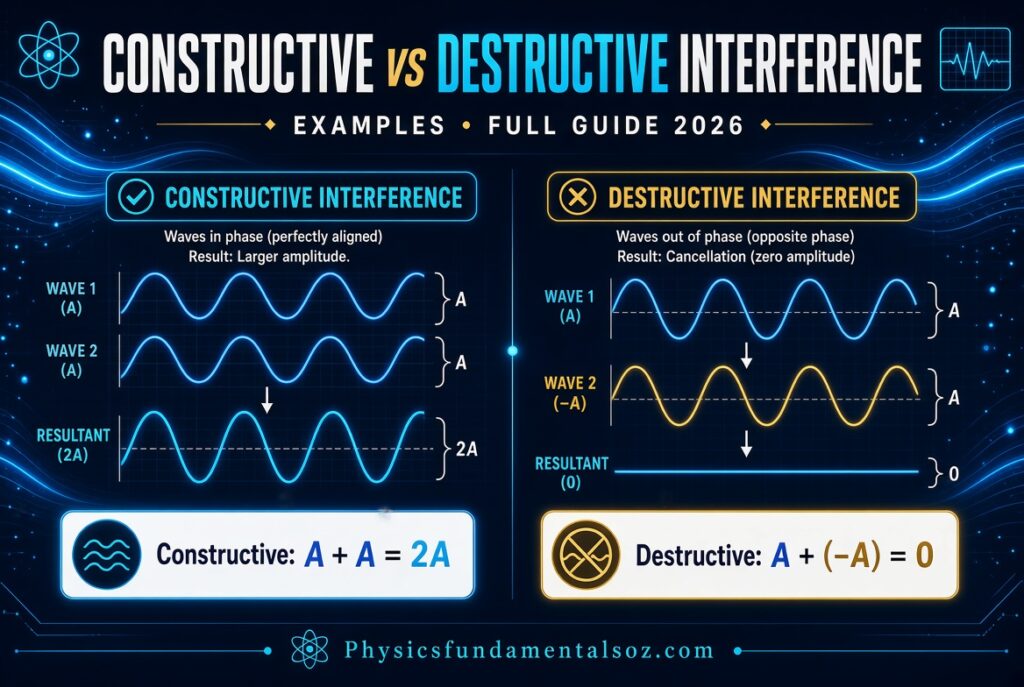
Waves don’t just pass through each other quietly. When two or more waves meet at the same point in space, they combine, and the result can either boost the wave or cancel it out completely.
This combining effect is called wave interference. In this guide, you’ll find clear constructive and destructive interference examples from sound, light, and water, along with the formulas and conditions behind each one.
Table of Contents
What’s the Difference?
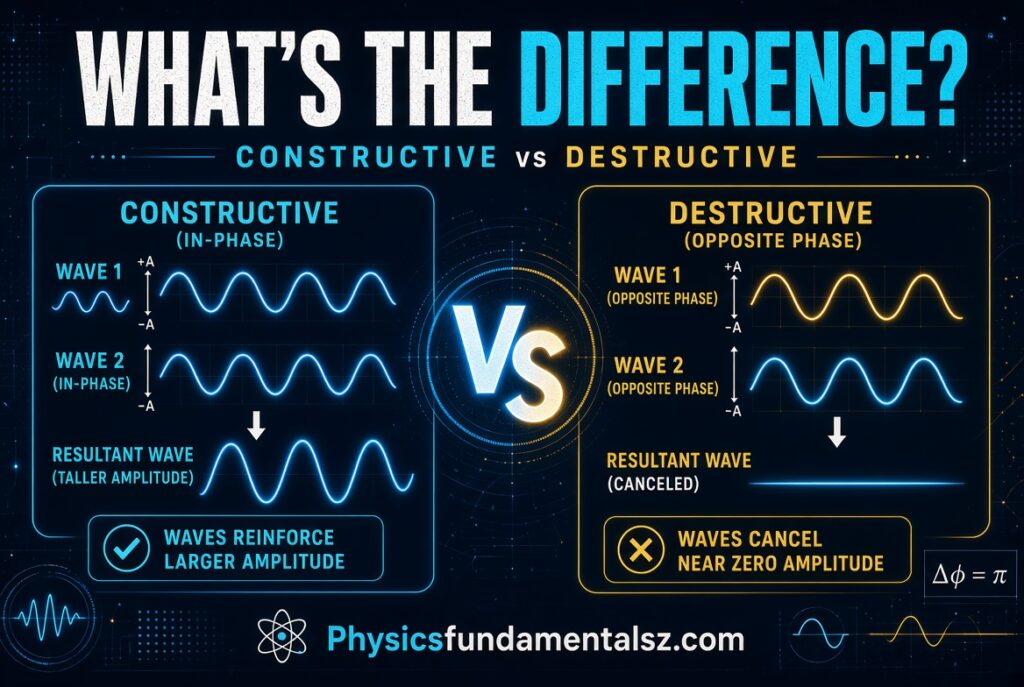
Constructive interference happens when two waves are in phase and combine to form a wave with larger amplitude. Destructive interference happens when two waves are out of phase and combine to cancel each other out, partly or completely.
- Constructive interference → crest meets crest → louder sound, brighter light, taller wave
- Destructive interference → crest meets trough → quieter sound, dimmer light, flatter wave
What Is Wave Interference?
Interference is what happens when two or more waves overlap in the same medium at the same time. The waves combine according to the principle of superposition.
Superposition means the total displacement at any point is simply the sum of the displacements each individual wave would produce alone. This applies to sound waves, light waves, water waves, and even electromagnetic signals.
The outcome of that combination depends entirely on the phase relationship between the waves involved.
Constructive Interference: Definition and Examples
Constructive interference occurs when two waves meet while in phase, meaning their crests align with crests and their troughs align with troughs.
The resulting wave has a larger amplitude than either individual wave. The waves reinforce each other instead of canceling out.
Condition for Constructive Interference
Two waves interfere constructively when the path difference between them equals a whole number of wavelengths.
Path difference = nλ, where n = 0, 1, 2, 3…
Example 1: Two Speakers Playing the Same Sound
When two speakers emit identical sound waves in phase, the sound is noticeably louder in spots where the waves align. This is why stereo speaker placement matters in concert hall and studio design.
Example 2: Ripples From Two Stones in a Pond
When two stones are dropped into calm water at the same time, their ripples overlap. Where the crests meet, the water rises higher than either ripple alone would produce.
Example 3: Young’s Double-Slit Experiment (Bright Fringes)
In Thomas Young’s classic experiment, light passing through two narrow slits produces a pattern of bright and dark bands on a screen. The bright fringes are a direct result of constructive interference between the two light waves.
Example 4: Noise Amplification in Poorly Designed Auditoriums
In some auditoriums, sound waves reflecting off walls arrive in phase with the direct sound at certain seats. This creates unwanted “hot spots” where sound is amplified beyond a comfortable level.
Destructive Interference: Definition and Examples
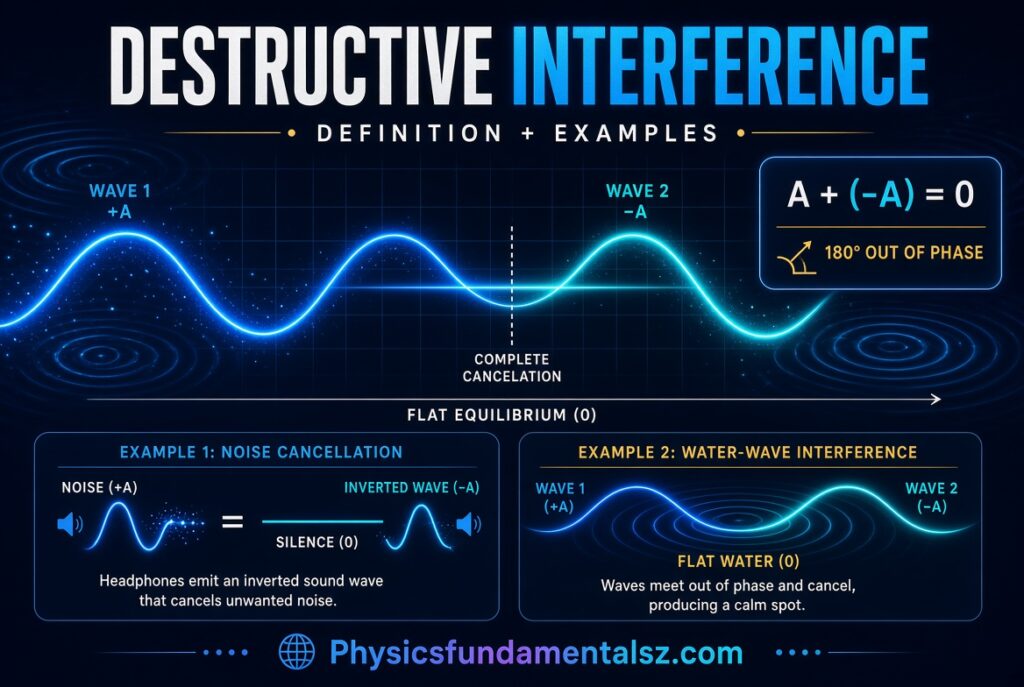
Destructive interference occurs when two waves meet while out of phase, meaning the crest of one wave aligns with the trough of another.
The resulting amplitude is smaller than either individual wave, and in the case of equal amplitudes, the waves can cancel out entirely.
Condition for Destructive Interference
Two waves interfere destructively when the path difference equals a half-integer number of wavelengths.
Path difference = (n + 1/2)λ, where n = 0, 1, 2, 3…
Example 1: Noise-Cancelling Headphones
Noise-cancelling headphones use a microphone to pick up ambient sound, then generate a matching sound wave that is perfectly out of phase. The two waves cancel, and the outside noise is reduced dramatically.
Example 2: Dark Fringes in Double-Slit Interference
In the same double-slit setup that creates bright fringes, the dark bands between them form because light waves arrive completely out of phase and cancel each other out.
Example 3: Dead Zones in Concert Venues
Sound engineers sometimes encounter “dead spots,” seats where reflected and direct sound waves cancel each other, making the audio noticeably quieter or muffled compared to nearby seats.
Example 4: Anti-Reflective Coatings on Lenses
Camera lenses and eyeglasses often use thin coatings designed so that light reflecting off the coating’s surface destructively interferes with light reflecting off the lens underneath. This reduces glare and reflections.
Constructive vs Destructive Interference: Comparison Table
| Feature | Constructive Interference | Destructive Interference |
|---|---|---|
| Phase relationship | In phase | Out of phase |
| Path difference | nλ (whole wavelengths) | (n + 1/2)λ (half wavelengths) |
| Resulting amplitude | Increases | Decreases or cancels |
| Sound example | Louder sound | Quieter or silent sound |
| Light example | Bright fringe | Dark fringe |
| Water wave example | Taller crest | Flattened surface |
Where You See Interference in Real Life
Sound Engineering
Concert halls and recording studios are designed with interference in mind, to avoid dead zones and unwanted amplification, and to keep sound quality consistent across every seat.
Optics and Coatings
Anti-reflective coatings, thin-film colors on soap bubbles, and the colors seen on oil slicks are all everyday results of light waves interfering constructively and destructively at different wavelengths.
Wireless and Radio Signals
Radio and WiFi signals can experience interference when reflected signals combine with direct signals. This is part of why signal strength varies so much by location inside a building.
Medical and Scientific Instruments
Interferometers, devices built specifically to measure tiny distances using interference patterns, are used in everything from gravitational wave detection to precision manufacturing.
Common Mistakes to Avoid
- Confusing “out of phase” with “different frequency.” Interference patterns discussed here assume the waves have the same frequency.
- Assuming destructive interference always means total silence or total darkness. Partial cancellation is far more common than complete cancellation.
- Forgetting that interference requires the waves to overlap in the same medium at the same time and location.
Expert Tip

When analyzing an interference problem, always start by identifying the path difference between the two waves. Once you know whether that difference is a whole or half wavelength, you already know whether the result will be constructive or destructive.
Frequently Asked Questions (FAQs)
What is the main difference between constructive and destructive interference?
Constructive interference happens when waves are in phase and combine to increase amplitude. Destructive interference happens when waves are out of phase and combine to decrease or cancel amplitude.
What is an everyday example of destructive interference?
Noise-cancelling headphones are one of the most common everyday examples, using an out-of-phase sound wave to cancel unwanted background noise.
What is an everyday example of constructive interference?
Two speakers playing the same audio in phase produce a louder combined sound in the areas where their waves overlap and reinforce each other.
Can constructive and destructive interference happen with light?
Yes. Light waves interfere constructively to create bright fringes and destructively to create dark fringes, most famously demonstrated in Young’s double-slit experiment.
Does interference happen with water waves too?
Yes. When ripples from two sources overlap, they interfere constructively where crests align and destructively where a crest meets a trough.
What formula determines constructive interference?
The path difference between two waves must equal a whole number of wavelengths, expressed as path difference = nλ.
What formula determines destructive interference?
The path difference must equal a half-integer number of wavelengths, expressed as path difference = (n + 1/2)λ.
Why do soap bubbles show rainbow colors?
The colors come from light waves reflecting off the inner and outer surfaces of the soap film, interfering constructively for some wavelengths and destructively for others.
Is destructive interference the same as silence?
Not always. Destructive interference reduces amplitude, and only results in total silence when the two waves have exactly equal amplitude and are perfectly out of phase.
How do anti-reflective coatings use destructive interference?
The coating is designed so that light reflecting off its surface is out of phase with light reflecting off the lens beneath it, so the two reflections cancel and reduce glare.
Can two different frequencies produce interference patterns?
Standard interference patterns require the same frequency. Waves of different frequencies produce a different effect called beats, not a stable interference pattern.
Why are some concert hall seats quieter than others?
This is often due to destructive interference between direct sound and sound reflected off walls or ceilings, creating localized dead zones.
What is a path difference in wave interference?
Path difference is the difference in distance traveled by two waves from their sources to a given point, and it determines whether interference is constructive or destructive.
Does interference only happen with two waves?
No, more than two waves can interfere at once, and the result still follows the same superposition principle, just with more waves added together.
What is Young’s double-slit experiment used to demonstrate?
It’s used to demonstrate the wave nature of light by showing an alternating pattern of bright and dark fringes caused by constructive and destructive interference.
Conclusion
Constructive and destructive interference explain a huge range of everyday phenomena, from the colors on a soap bubble to the silence inside a pair of noise-cancelling headphones.
The core idea is simple: waves that align reinforce each other, and waves that oppose each other cancel out. Once you can spot the phase relationship between two waves, you can predict the outcome every time.