Pressure in Fluids: P = ρgh, Pascal’s Law & Hydraulics Explained

Pressure in fluids is one of the most practical ideas in all of physics. It explains why a dam is built thicker at the bottom, why your ears pop when you dive underwater, why a hydraulic jack can lift a car with almost no effort, and why a weather balloon expands as it rises.
Whether you are studying for an exam or simply trying to understand the physics behind everyday devices, understanding pressure in fluids gives you a working model of how liquids and gases behave under force.
If you want a refresher on the force and motion concepts that pressure builds on, our guide to Newton’s Laws of Motion is a good place to start.
Table of Contents
What Is Pressure in Fluids?

Pressure in fluids is defined as the force exerted by a fluid per unit area on any surface it touches, whether that surface is the wall of a container, the floor of a swimming pool, or an object submerged inside the fluid. Fluids include both liquids and gases, and both exert pressure because their particles are in constant, random motion, colliding with any surface they meet.
The formula for pressure is straightforward:
P = F / A
Here, P is pressure, F is the force applied perpendicular to a surface, and A is the area over which that force acts. Pressure is measured in pascals (Pa) in the SI system, where one pascal equals one newton per square meter. Other common units include atmospheres (atm), bar, torr, and millimeters of mercury (mmHg), with the standard conversion being:
1 atm = 1.01325 x 10^5 Pa = 1.01325 bar = 760 torr = 760 mm of Hg
An important property of pressure in fluids is that it is a scalar quantity, meaning it has magnitude but no specific direction. However, the force resulting from that pressure always acts perpendicular to the surface it is applied to. This distinction is one of the first things students confuse when they move from studying forces, covered in our Vectors and Scalars guide, into fluid mechanics.
Types of Pressure in Fluids
Fluid pressure is generally classified into a few key types, and understanding each one is essential for solving problems correctly.
Atmospheric Pressure
Atmospheric pressure is the force exerted by the column of air above a given point on the Earth’s surface, per unit area. At sea level, atmospheric pressure equals roughly 1.013 x 10^5 Pa. This pressure decreases with altitude because there is less air above you as you climb higher, which is why weather balloons and aircraft cabins need pressurization systems.
Gauge Pressure
Gauge pressure is the pressure measured relative to atmospheric pressure. Most pressure gauges, including tire gauges, read gauge pressure rather than absolute pressure, since they are calibrated to read zero when exposed to the atmosphere.
Absolute Pressure
Absolute pressure is the total pressure at a point, including atmospheric pressure. It is calculated as:
Absolute Pressure = Gauge Pressure + Atmospheric Pressure
This distinction matters in engineering and scientific calculations where the true total force on a surface needs to be known, not just the pressure above ambient conditions.
Pressure in Fluids at Rest: Hydrostatic Pressure

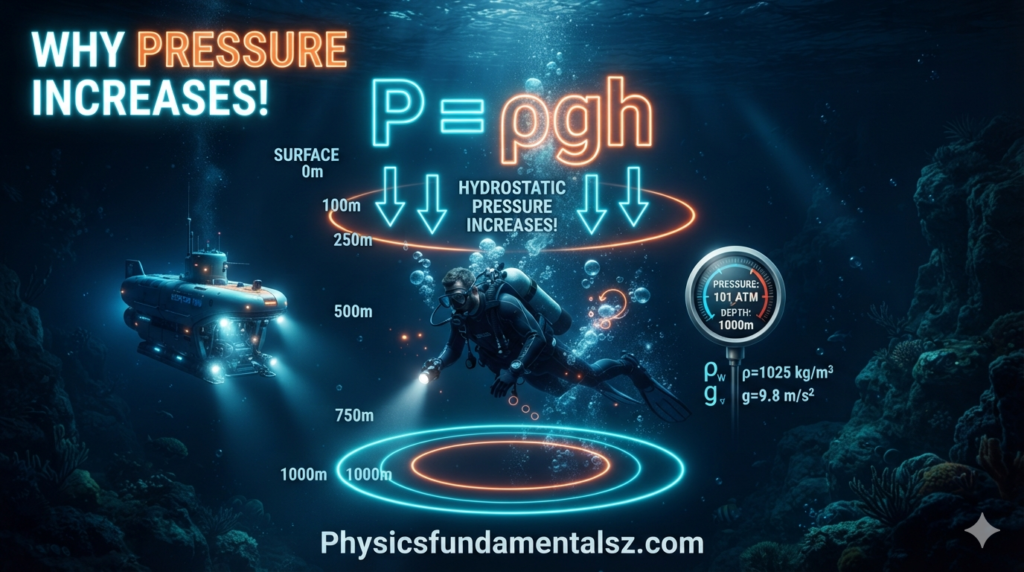
When a fluid is not moving, the pressure it exerts is called hydrostatic pressure, and it depends only on the depth of the fluid, the density of the fluid, and gravitational acceleration. The deeper you go into a fluid, the more pressure you experience, because the fluid at that depth has to support the weight of all the fluid above it.
The formula for pressure at depth in a fluid is:
P = h x rho x g
Where P is the pressure, h is the depth or height of the fluid column, rho is the density of the fluid, and g is the acceleration due to gravity. This relationship explains several everyday observations:
- A swimmer feels increasing pressure on their eardrums the deeper they dive.
- Dams are built thicker at the base because the water pressure is highest there.
- Submarines must be engineered to withstand enormous hydrostatic pressure at ocean depths.
This concept builds directly on ideas from Projectile Motion and gravitational acceleration, since gravity plays the same central role in both.
Pressure Due to a Liquid on a Vertical Wall
Because fluid pressure increases with depth, the pressure exerted by a liquid on a vertical wall is not uniform. It is lowest near the surface and highest near the bottom. Engineers calculate the average pressure on such a wall as the mean of the pressure values across the entire depth, which is critical when designing containers, tanks, and dam walls that must withstand this variable force.
The Hydrostatic Paradox
The hydrostatic paradox is one of the more surprising results in the study of pressure in fluids. It states that the pressure at a given depth in a fluid is the same regardless of the shape or size of the container holding the fluid. In other words, a wide tank and a narrow tube filled with water to the same height will have identical pressure at the bottom, even though they hold vastly different volumes of liquid.
This happens because pressure at any given depth depends only on the height of fluid above that point, its density, and gravity, and not on the total volume or shape of the container. The hydrostatic paradox is often demonstrated using connected vessels of different shapes, all showing the same fluid level when filled from a common source, which is a direct visual proof of Pascal’s principle in action.
Pascal’s Law and the Transmission of Pressure
Pascal’s law states that pressure applied to an enclosed fluid is transmitted equally and undiminished in all directions throughout the fluid. This principle is the foundation of hydraulic systems, including car brakes, hydraulic lifts, and hydraulic presses.
Because pressure in fluids is transmitted equally, a small force applied over a small area can be used to generate a much larger force over a larger area, following the relationship:
F1 / A1 = F2 / A2
This is why a small push on a hydraulic brake pedal can generate enough force to stop a multi-ton vehicle, and why hydraulic jacks can lift heavy machinery using relatively little manual effort. Pascal’s law connects closely with the concept of conserved forces acting through a system, similar in spirit to what you’ll find in our guide on Conservation of Momentum, where quantities are transmitted through a system according to consistent physical laws.
Measuring Pressure in Fluids

Several classic instruments are used to measure pressure in fluids, and each one applies the principles discussed above.
The Barometer
A mercury barometer measures atmospheric pressure using the height of a mercury column. It works on the principle that atmospheric pressure can support a column of liquid, with the height of that column directly indicating the pressure of the atmosphere pushing down on the mercury reservoir. At standard atmospheric pressure, the mercury column typically rises to about 76 cm, which is where the standard unit “760 mmHg” for atmospheric pressure comes from.
The U-Tube Manometer
A U-tube manometer is a simple device used to measure the pressure of a gas or liquid by comparing the height of fluid columns on either side of a U-shaped tube. The difference in height between the two columns is directly proportional to the pressure difference being measured, making it a reliable tool for laboratory and industrial pressure measurement.
Modern Pressure Transducers
In industrial and engineering contexts, pressure transducers convert fluid pressure into an electrical signal, often compensating for temperature and barometric variation to give an accurate final reading. These are widely used in hydraulic systems, fuel lines, and fluid-dispensing equipment where precise, real-time pressure monitoring is essential.
Pressure in Fluids and Buoyancy
Pressure in fluids is also the reason objects experience buoyant force. Since pressure increases with depth, the bottom surface of a submerged object experiences greater pressure than its top surface. This difference in pressure creates a net upward force known as upthrust or buoyancy.
This is the physical basis of Archimedes’ principle, which explains why ships float, why hot air balloons rise, and why a submarine can control its depth by adjusting its own density relative to the surrounding water. Buoyancy is a direct consequence of the same depth-dependent pressure relationship covered earlier in this guide, tying together hydrostatic pressure and the forces studied in classical mechanics.
Pressure in Moving Fluids
So far, we have focused on fluids at rest, but pressure in fluids also changes when the fluid is in motion. According to Bernoulli’s principle, as the velocity of a fluid increases, its pressure decreases, provided other factors like height remain constant. This principle explains how airplane wings generate lift, how a perfume atomizer works, and why a shower curtain gets pulled inward when water is running.
For containers in motion, such as a tank of liquid on an accelerating vehicle, pressure distribution shifts due to the combined effects of gravity and acceleration, which is a more advanced topic that builds on the force and motion concepts covered in our Physics Fundamentals overview.
Why Understanding Pressure in Fluids Matters
Pressure in fluids is not just an abstract exam topic. It has direct real-world applications across engineering, medicine, meteorology, and everyday technology:
- Hydraulics: Car brakes, lifts, and industrial presses all depend on Pascal’s law and the transmission of pressure through enclosed fluids.
- Aviation and weather: Atmospheric pressure changes with altitude affect aircraft design, weather prediction, and even human physiology at high elevations.
- Medicine: Blood pressure measurement uses the same hydrostatic principles as a manometer, tracking pressure changes in a fluid-filled system.
- Marine engineering: Submarine hulls, diving equipment, and underwater structures must all be designed to withstand hydrostatic pressure at depth.
- Everyday devices: Water towers, dams, plumbing systems, and even drinking straws rely on pressure differences in fluids to function.
Frequently Asked Questions (FAQs)
What is the formula for pressure in fluids?
The formula for hydrostatic pressure in a fluid at rest is P = h x rho x g, where h is depth, rho is fluid density, and g is gravitational acceleration. For general pressure, the formula is P = F / A.
Why does pressure in fluids increase with depth?
Pressure increases with depth because the fluid at a given depth must support the weight of all the fluid above it. The deeper you go, the more fluid weight is pushing down, increasing the total pressure.
What is the difference between gauge pressure and absolute pressure?
Gauge pressure is measured relative to atmospheric pressure, while absolute pressure includes atmospheric pressure as part of the total. Absolute pressure equals gauge pressure plus atmospheric pressure.
What is the hydrostatic paradox?
The hydrostatic paradox states that fluid pressure at a given depth depends only on the height of the fluid column above it, not on the shape or volume of the container, meaning a narrow tube and a wide tank filled to the same height exert identical pressure at the bottom.
How does Pascal’s law apply to hydraulic systems?
Pascal’s law states that pressure applied to an enclosed fluid is transmitted equally in all directions. Hydraulic systems use this principle to convert a small input force over a small area into a much larger output force over a larger area.
Is pressure in fluids the same in liquids and gases?
Both liquids and gases exert pressure due to particle motion and follow the same basic pressure principles, but gases are compressible while liquids are largely incompressible, which changes how pressure behaves under changes in volume and temperature.
Final Thoughts
Pressure in fluids ties together some of the most elegant ideas in physics, from Pascal’s law and the hydrostatic paradox to buoyancy and Bernoulli’s principle.
Once you understand that pressure depends on depth, density, and gravity, and that it transmits equally through an enclosed fluid, a huge range of natural phenomena and engineered systems start to make sense.
To keep building your foundation in mechanics, explore our guides on What Is Energy and Stress, Strain and Young’s Modulus, or try our interactive physics calculators to work through pressure and force problems step by step.