Ideal Gas Law Calculator With Steps: PV = nRT Formula & Examples 2026
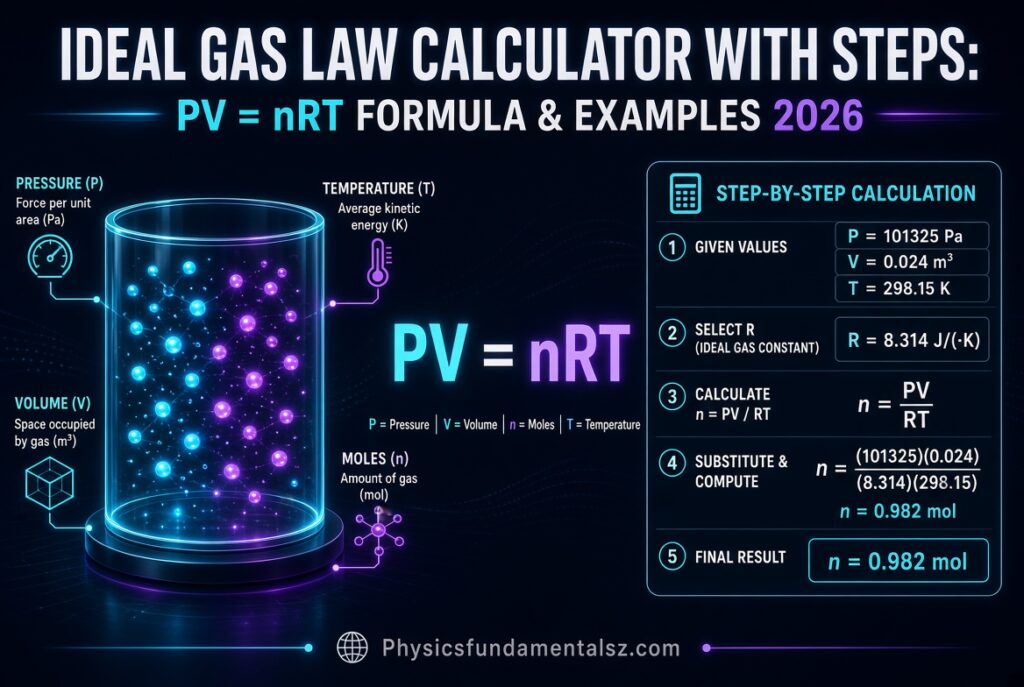
An ideal gas law calculator with steps does more than spit out a number. It shows exactly how pressure, volume, moles, and temperature connect through one equation, PV = nRT, so you can verify every stage of the math yourself.
This guide walks through the formula, the gas constant, unit conversions, and fully worked examples so you can solve any pressure, volume, temperature, or mole problem with confidence.
Table of Contents
What Does the Ideal Gas Law Calculate?
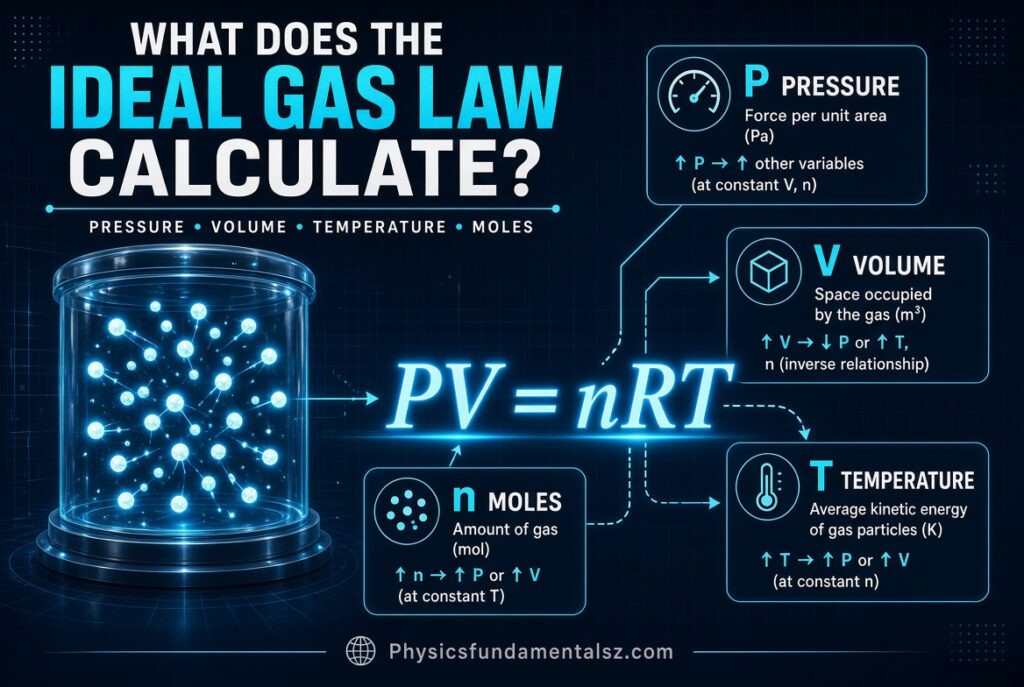
The ideal gas law calculates one missing property of a gas, pressure, volume, moles, or temperature, when you already know the other three. It uses the equation PV = nRT, where R is the universal gas constant.
Because the equation links four variables at once, the calculator lets you solve for whichever one you are missing, not just pressure alone.
What Is the Ideal Gas Law?
The ideal gas law is a single equation that models how gases behave under normal laboratory conditions. It combines Boyle’s law, Charles’s law, and Gay-Lussac’s law into one unified relationship.
It works best for gases at low density and moderate temperature, where molecules rarely interact with each other. At very high pressure or very low temperature, real gases start to deviate from this ideal behavior.
The Ideal Gas Law Formula Explained
The formula at the center of every calculation is:
PV = nRT
- P = pressure of the gas
- V = volume the gas occupies
- n = amount of gas in moles
- R = universal gas constant
- T = temperature in Kelvin
Temperature must always be in Kelvin. Using Celsius or Fahrenheit directly in this formula produces incorrect results every time.
Rearranging the Formula for Each Variable
An ideal gas law calculator with steps typically rearranges the formula four different ways, depending on what you need to solve for.
- Solve for pressure: P = nRT ÷ V
- Solve for volume: V = nRT ÷ P
- Solve for moles: n = PV ÷ RT
- Solve for temperature: T = PV ÷ nR
The Gas Constant R and Its Units
The value of R changes depending on which units you use for pressure and volume. Picking the wrong version of R is one of the most common calculation errors.
| Gas Constant Value | Pressure Unit | Volume Unit |
|---|---|---|
| 8.314 J/(mol·K) | Pascals (Pa) | Cubic meters (m³) |
| 0.0821 L·atm/(mol·K) | Atmospheres (atm) | Liters (L) |
| 62.36 L·mmHg/(mol·K) | mmHg (torr) | Liters (L) |
| 8.314 kPa·L/(mol·K) | Kilopascals (kPa) | Liters (L) |
Choosing the R value that matches your pressure and volume units removes the need for extra unit conversion at the end.
How to Use an Ideal Gas Law Calculator With Steps
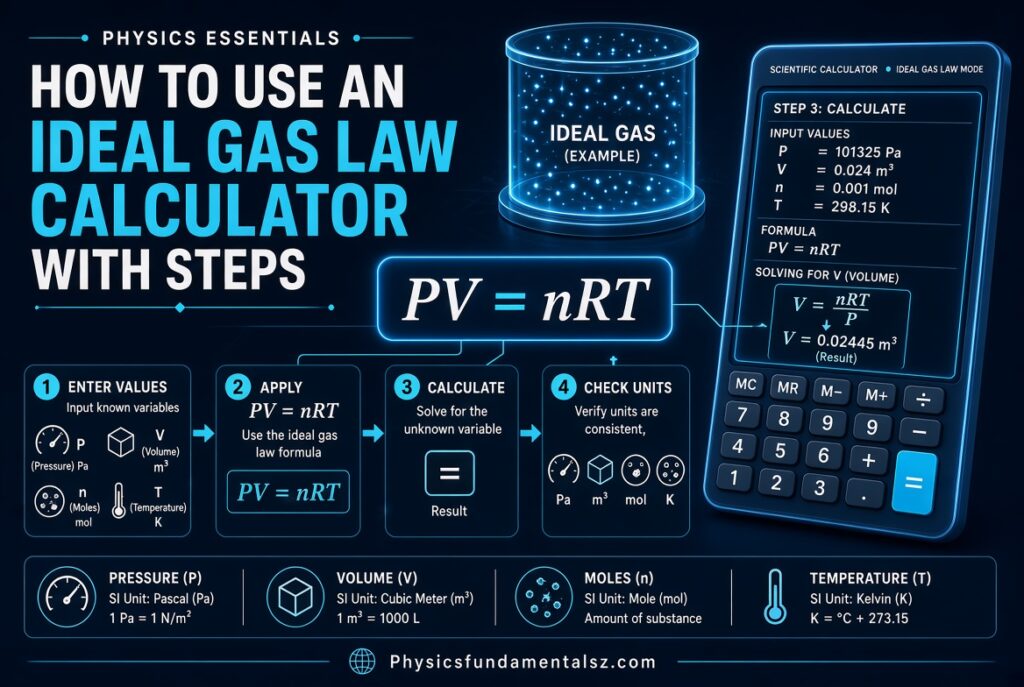
Following the same sequence every time prevents the most common mistakes.
Step 1: List the Values You Already Know
Write down whichever three of P, V, n, and T you have been given in the problem. Identify the one variable you still need to solve for.
Step 2: Convert Temperature to Kelvin
Add 273.15 to any Celsius value to get Kelvin. This step is mandatory, since the ideal gas law only works with absolute temperature.
Step 3: Match Your Units to the Correct R Value
Check your pressure and volume units, then select the version of R from the table above that matches them exactly.
Step 4: Rearrange and Solve
Plug your known values into the rearranged version of PV = nRT that isolates your missing variable, then calculate the result.
Step 5: Check the Final Units
Confirm your answer carries the correct unit, whether that is atm, Pa, liters, moles, or Kelvin, based on which variable you solved for.
Worked Examples of Ideal Gas Law Calculations
Seeing full step-by-step solutions makes the formula far easier to trust on your own.
Example 1: Solving for Pressure
A gas sample has 2 moles, a volume of 10 liters, and a temperature of 300 K. Using R = 0.0821 L·atm/(mol·K):
P = nRT ÷ V = (2 × 0.0821 × 300) ÷ 10 = 4.93 atm
Example 2: Solving for Volume
A gas has a pressure of 1.5 atm, 0.5 moles, and a temperature of 350 K.
V = nRT ÷ P = (0.5 × 0.0821 × 350) ÷ 1.5 = 9.58 L
Example 3: Solving for Moles
A container holds gas at 2 atm, 5 liters, and 400 K.
n = PV ÷ RT = (2 × 5) ÷ (0.0821 × 400) = 0.30 mol
Example 4: Solving for Temperature
A gas exerts 3 atm of pressure across 8 liters with 1.2 moles present.
T = PV ÷ nR = (3 × 8) ÷ (1.2 × 0.0821) = 243.6 K
Ideal Gas Law vs the Individual Gas Laws
The ideal gas law is really a combination of three simpler, historically discovered laws.
| Law | Relationship | What Is Held Constant |
|---|---|---|
| Boyle’s Law | P₁V₁ = P₂V₂ | Temperature and moles |
| Charles’s Law | V₁/T₁ = V₂/T₂ | Pressure and moles |
| Gay-Lussac’s Law | P₁/T₁ = P₂/T₂ | Volume and moles |
| Ideal Gas Law | PV = nRT | Nothing; all four variables can change |
Each individual law becomes a special case of PV = nRT once you fix two of the four variables.
Common Mistakes When Using the Ideal Gas Law
These errors account for the majority of wrong answers on homework and lab reports.
- Forgetting to convert temperature into Kelvin before calculating.
- Mixing an R value meant for atm and liters with pressure entered in Pascals.
- Confusing moles of gas with grams of gas without converting through molar mass.
- Rounding intermediate steps too early in multi-step problems.
- Ignoring that the ideal gas law breaks down at very high pressure or very low temperature.
Real-World Applications of the Ideal Gas Law
The equation extends far beyond the chemistry classroom into everyday engineering and science.
- Weather balloons: Meteorologists predict how volume expands as a balloon rises into lower-pressure air.
- Engine design: Automotive engineers model how compressed air-fuel mixtures behave inside cylinders.
- Scuba diving: Divers calculate how tank pressure changes with depth and temperature.
- HVAC systems: Engineers size ductwork and compressors using gas volume and pressure relationships.
Best Practices for Using an Ideal Gas Law Calculator

- Always convert Celsius or Fahrenheit to Kelvin before entering any temperature value.
- Keep pressure and volume units consistent with the R value you select.
- Use the calculator to verify hand calculations rather than skip understanding the formula.
- Sanity-check your answer against a rough estimate using simple rounded numbers.
Also Read:
- Boyle’s, Charles’ & Gay-Lussac’s Gas Laws: Formulas & Examples
- Thermal Energy & Internal Energy: Heat, Temperature & Q = mcΔT
- Physics Fundamentals: The Complete Guide to Core Concepts, Laws, and Equations
- Pressure in Fluids: P = ρgh, Pascal’s Law & Hydraulics Explained
- Kinetic Energy
- Mechanical Energy: KE + PE, Conservation & Energy Transformations
- Potential Energy: Gravitational, Elastic & Electric Forms Explained
- Work Done in Physics
- Power in Physics
- Net Force: Definition, Formula & Newton’s Second Law Applied
- Escape Velocity: Formula, Derivation & Worked Examples
- Conservation of Momentum
- Momentum and Impulse
- Momentum and Impulse Collisions: Conservation Laws & Examples
- Circular Motion and Centripetal Force
- Simple Harmonic Motion
- Hooke’s Law and Springs
- Vectors and Scalars: Definitions, Examples & Vector Addition
- Acceleration in Physics
- Free Fall and Terminal Velocity
- Terminal Velocity: Why Objects Stop Accelerating & Calculations
- Velocity vs Speed
- Projectile Motion: Complete Guide
- Speed of Light: The Ultimate Guide to c, the Cosmic Speed Limit
Frequently Asked Questions (FAQs)
What is the ideal gas law formula?
The ideal gas law formula is PV = nRT, where P is pressure, V is volume, n is moles, R is the gas constant, and T is temperature in Kelvin.
What is R in the ideal gas law?
R is the universal gas constant. Its value changes depending on the units used, commonly 0.0821 L·atm/(mol·K) or 8.314 J/(mol·K).
Why must temperature be in Kelvin for the ideal gas law?
The equation is derived from absolute temperature relationships, so Celsius or Fahrenheit values would produce negative or nonsensical results.
How do you convert Celsius to Kelvin?
Add 273.15 to the Celsius temperature. For example, 25°C equals 298.15 K.
Can the ideal gas law calculator solve for moles?
Yes. Rearranging the formula to n = PV ÷ RT lets the calculator find moles when pressure, volume, and temperature are known.
What happens if I use the wrong gas constant?
Using an R value that doesn’t match your pressure and volume units produces an answer with an incorrect final unit or magnitude.
Is the ideal gas law accurate for all gases?
It is a close approximation for most gases at normal temperature and pressure but becomes less accurate at very high pressure or very low temperature.
What is the difference between the ideal gas law and real gas laws?
Real gas equations, such as the van der Waals equation, add correction terms for molecular size and intermolecular forces that the ideal gas law ignores.
How is the ideal gas law related to Boyle’s law?
Boyle’s law is the ideal gas law with temperature and moles held constant, showing that pressure and volume are inversely related.
How is the ideal gas law related to Charles’s law?
Charles’s law is the ideal gas law with pressure and moles held constant, showing that volume and temperature increase together.
What units does volume need to be in?
Volume is commonly used in liters or cubic meters, depending on which version of the gas constant R you select.
Can this calculator handle atmospheric pressure problems?
Yes, using R = 0.0821 L·atm/(mol·K) works directly with pressure values given in atmospheres.
What is STP in the context of the ideal gas law?
STP stands for standard temperature and pressure, defined as 273.15 K and 1 atm, a common reference point for gas calculations.
How many moles are in one liter of gas at STP?
One mole of an ideal gas occupies about 22.4 liters at standard temperature and pressure.
Why do weather balloons expand as they rise?
As altitude increases, atmospheric pressure drops, so the ideal gas law predicts the balloon’s volume must increase to keep the equation balanced.
Does the ideal gas law apply to gas mixtures?
Yes, when using the total moles and total pressure of the mixture, though each gas also follows its own partial pressure under Dalton’s law.
What is the difference between moles and mass in this formula?
The formula uses moles directly, so mass must first be divided by the substance’s molar mass to convert it into moles.
How accurate is an online ideal gas law calculator with steps?
It is fully accurate as long as correct units and the matching gas constant are entered, since it applies the same formula as a manual calculation.
Can I use this calculator for scuba diving tank calculations?
Yes, divers commonly use the ideal gas law to estimate how tank pressure and available air change with depth and temperature.
What is a common student mistake with this formula?
The most frequent mistake is forgetting to convert temperature to Kelvin before plugging values into the equation.
Conclusion
An ideal gas law calculator with steps turns PV = nRT from an abstract formula into a clear, checkable process. Once you convert units correctly and match the right gas constant, solving for pressure, volume, moles, or temperature becomes straightforward.
Keep the rearranged formulas and the unit table close by, and you will be able to handle chemistry homework, physics labs, and real-world gas behavior problems with confidence.