De Broglie Wavelength: λ = h/mv Formula, Derivation & Examples
Every electron, baseball, and person you have ever seen has a wavelength. That single idea is the de Broglie wavelength, and it quietly overturned how physicists picture matter itself.
Table of Contents
What Is the De Broglie Wavelength?
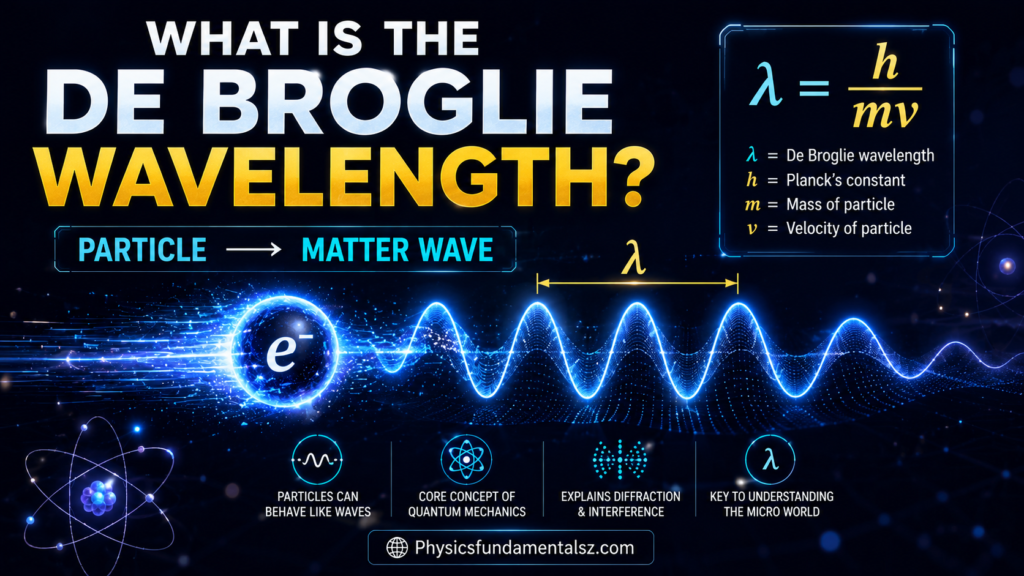
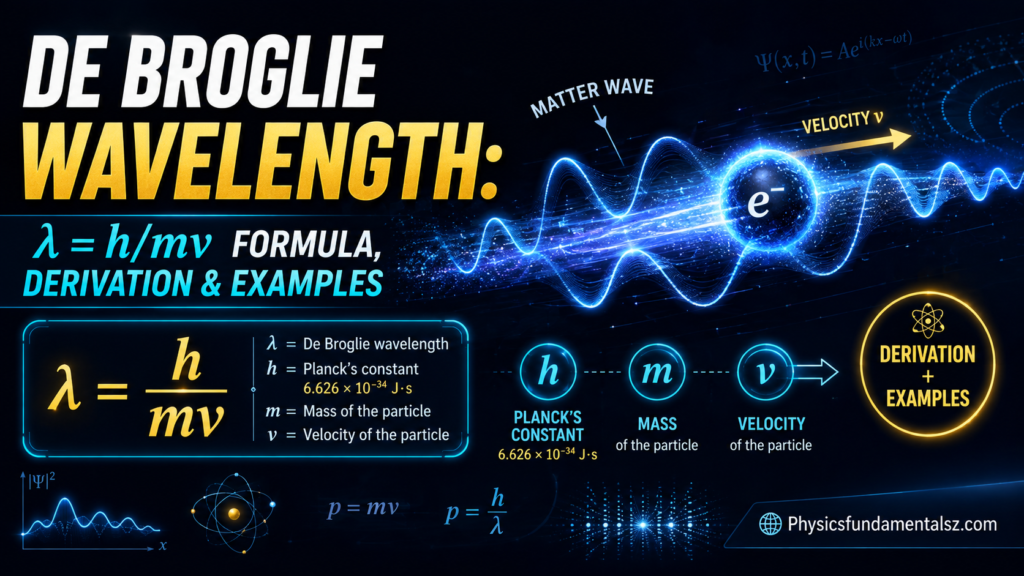
The de Broglie wavelength is the wavelength associated with any moving object, given by λ = h/p, where h is Planck’s constant and p is the object’s momentum.
It applies to every particle with mass, not just light. The formula shows that matter behaves like a wave, a concept known as wave-particle duality.
Who Was Louis de Broglie?
Louis de Broglie was a French physicist who proposed, in his 1924 doctoral thesis, that particles of matter carry wave properties. This was a bold claim, since physicists at the time treated electrons and atoms strictly as particles.
He reasoned that if light (normally a wave) could act like a particle, as Einstein’s photoelectric effect had shown, then particles like electrons might act like waves too. De Broglie won the 1929 Nobel Prize in Physics for this hypothesis.
The De Broglie Wavelength Formula
The core formula is simple:
λ = h / p
Here, λ (lambda) is the wavelength, h is Planck’s constant (6.626 × 10⁻³⁴ J·s), and p is the momentum of the particle.
Since momentum for a non-relativistic particle equals mass times velocity (p = mv), the formula is often written as:
λ = h / (mv)
Breaking Down Each Variable
- λ (wavelength): measured in meters, tells you the wave-like spacing of the particle.
- h (Planck’s constant): a fixed number, 6.626 × 10⁻³⁴ joule-seconds.
- m (mass): the particle’s rest mass, in kilograms.
- v (velocity): the particle’s speed, in meters per second.
- p (momentum): the product of mass and velocity, in kg·m/s.
How the Formula Was Derived
De Broglie combined two established ideas: Einstein’s energy-mass relation and Planck’s quantum energy equation.
Einstein showed that a photon’s energy is E = pc, where c is the speed of light. Planck showed that a photon’s energy is also E = hf, where f is frequency.
Setting these equal gives pc = hf. Since frequency times wavelength equals the speed of light (f = c/λ), substituting and simplifying leads directly to λ = h/p.
De Broglie’s insight was to apply this same relationship to particles with mass, not just massless photons. That extension is what makes the formula universal.
Wave-Particle Duality Explained Simply
Wave-particle duality means every particle can show either wave-like or particle-like behavior, depending on how you observe it. It is not an either-or property.
An electron fired through a screen creates an interference pattern, exactly like a wave. But detected on a screen, it lands as a single point, exactly like a particle.
The de Broglie wavelength is what determines how “wavy” a particle acts. A shorter wavelength makes wave effects harder to observe.
Why We Don’t Notice Wavelengths in Everyday Life
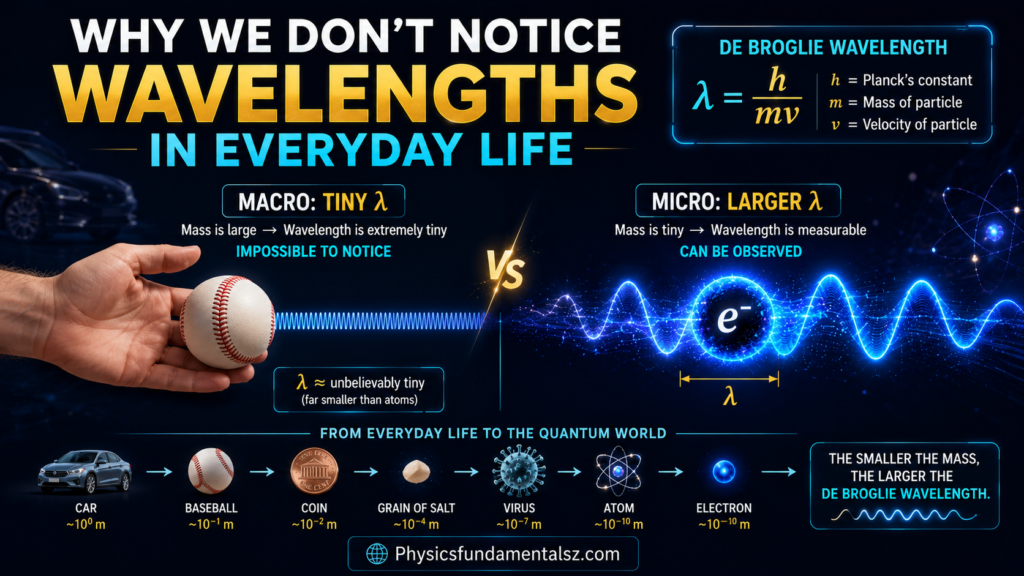
A thrown baseball technically has a de Broglie wavelength, but it is roughly 10⁻³⁴ meters. That is far smaller than any atom, so no instrument can detect it.
Wave behavior only becomes noticeable when the wavelength is close to the size of the objects or gaps a particle interacts with. This is why electrons show clear wave effects, but baseballs never do.
Step-by-Step: How to Calculate De Broglie Wavelength
- Identify the mass (m) of the particle in kilograms.
- Identify the velocity (v) of the particle in meters per second.
- Multiply mass by velocity to get momentum, p = mv.
- Divide Planck’s constant by momentum: λ = h / p.
- Check your units so the final answer comes out in meters.
Worked Example 1: De Broglie Wavelength of an Electron
An electron travels at 2.0 × 10⁶ m/s. Its mass is 9.11 × 10⁻³¹ kg.
Momentum: p = mv = (9.11 × 10⁻³¹)(2.0 × 10⁶) = 1.82 × 10⁻²⁴ kg·m/s.
Wavelength: λ = h/p = (6.626 × 10⁻³⁴) / (1.82 × 10⁻²⁴) ≈ 3.64 × 10⁻¹⁰ m, about the size of an atom.
Worked Example 2: De Broglie Wavelength of a Moving Car
A 1,200 kg car moves at 25 m/s (about 56 mph).
Momentum: p = mv = 1,200 × 25 = 30,000 kg·m/s.
Wavelength: λ = h/p = (6.626 × 10⁻³⁴) / 30,000 ≈ 2.2 × 10⁻³⁸ m, far too tiny to ever measure or matter.
De Broglie Wavelength for Relativistic Particles
At speeds approaching the speed of light, the simple p = mv formula breaks down. Momentum must instead use the relativistic form, p = γmv, where γ is the Lorentz factor.
For particles like fast electrons in accelerators, physicists use λ = h / √(2mE + E²/c²), where E is kinetic energy. This accounts for mass-energy effects at high speed.
De Broglie Wavelength of a Photon
Photons have no rest mass, so the formula uses momentum derived from energy instead: p = E/c. This still gives λ = h/p, which matches the standard light-wavelength formula.
This consistency is part of why de Broglie’s hypothesis was taken seriously. It connected smoothly with existing photon physics rather than contradicting it.
Experimental Proof: The Davisson-Germer Experiment
In 1927, Clinton Davisson and Lester Germer fired electrons at a nickel crystal and observed a diffraction pattern. Diffraction is a signature wave behavior, not something particles were expected to show.
The angles of the diffracted electrons matched exactly what de Broglie’s formula predicted. This experiment gave the first direct experimental confirmation of matter waves.
Comparison Table: De Broglie Wavelength Across Different Objects
| Object | Mass | Typical Speed | Approx. De Broglie Wavelength |
|---|---|---|---|
| Electron in atom | 9.11 × 10⁻³¹ kg | 2 × 10⁶ m/s | ~3.6 × 10⁻¹⁰ m |
| Proton (accelerator) | 1.67 × 10⁻²⁷ kg | 1 × 10⁷ m/s | ~4 × 10⁻¹⁴ m |
| Helium atom (room temp) | 6.6 × 10⁻²⁷ kg | 1,300 m/s | ~7.7 × 10⁻¹¹ m |
| Baseball | 0.145 kg | 40 m/s | ~1.1 × 10⁻³⁴ m |
| Car | 1,200 kg | 25 m/s | ~2.2 × 10⁻³⁸ m |
Where De Broglie Wavelength Matters in Real Technology
The idea is not just theoretical. It underpins several tools used in science and industry today.
- Electron microscopes: use the tiny wavelength of fast electrons to image structures far smaller than visible light allows.
- Neutron diffraction: uses neutron wavelengths to study crystal and magnetic structures.
- Quantum computing: relies on matter-wave behavior of particles like electrons and ions.
- Semiconductor design: engineers must account for electron wave behavior at nanometer scales.
- Atom interferometry: uses the wave nature of atoms for extremely precise measurements, including gravity sensors.
How De Broglie Wavelength Connects to the Bohr Model
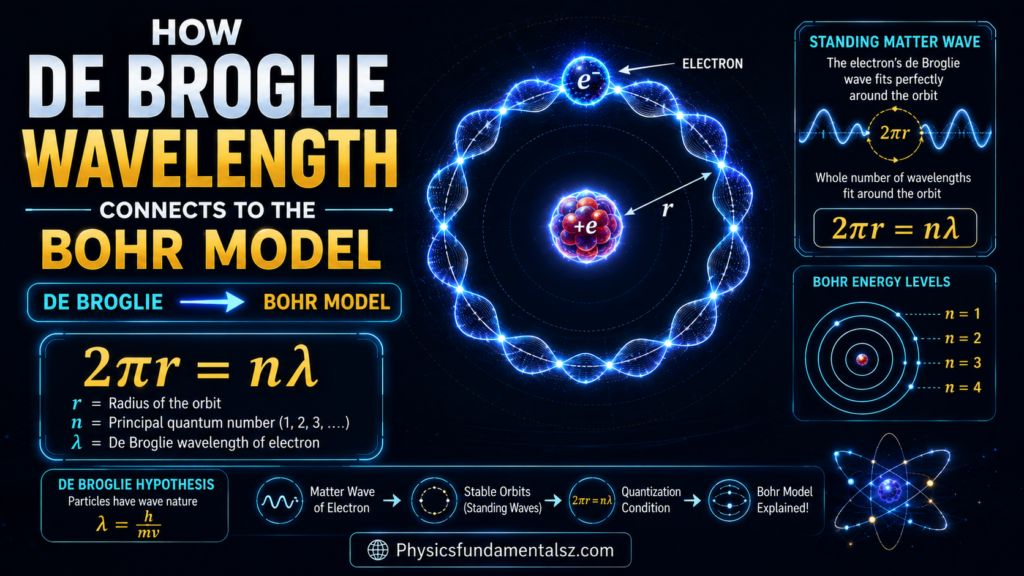
Niels Bohr’s model of the atom required electron orbits to have specific, quantized sizes, but never explained why. De Broglie’s idea supplied the missing reason.
An electron orbit is stable only when it fits a whole number of de Broglie wavelengths around its circumference. This condition, 2πr = nλ, naturally produces Bohr’s quantized orbits.
Common Mistakes When Calculating De Broglie Wavelength
- Using weight instead of mass: always use mass in kilograms, not force in newtons.
- Forgetting relativistic corrections: at very high speeds, plain p = mv gives wrong answers.
- Mixing up units: mismatched units for h, m, and v are the most common source of errors.
- Confusing photon and particle formulas: photons need E = pc, not p = mv.
- Ignoring significant figures: since results involve tiny exponents, rounding errors compound quickly.
Expert Tips for Students
- Always convert mass to kilograms and speed to meters per second before plugging into the formula.
- Keep Planck’s constant to at least four significant figures for accurate results.
- Sanity-check your answer: subatomic particles should give wavelengths near atomic size, not larger.
- Practice with both classical and relativistic problems, since exams often test the difference.
Key Takeaways
- The de Broglie wavelength formula is λ = h/p, or λ = h/(mv) for non-relativistic particles.
- It proves that all matter has wave-like properties, not just light.
- The wavelength is only observable at very small, usually subatomic, scales.
- The Davisson-Germer experiment confirmed the theory experimentally in 1927.
- The concept underlies electron microscopy, quantum computing, and modern atomic theory.
Also Read:
- Newton’s Laws of Motion
- Transverse Waves Explained
- What Is Energy?
- Projectile Motion: Complete Guide
- Wave Speed, Frequency & Wavelength
- Conservation of Momentum
- Half-Life Calculations: Formula & Worked Examples
- Mass-Energy Equivalence: E = mc² Derivation & Nuclear Applications
- Nuclear Decay Equations: Alpha, Beta & Gamma Decay Explained
- Photoelectric Effect Calculations: hf = work-function + KE_max
- Quantum Numbers: n, l, m_l, m_s and Electron Configuration
- Electric Charge and Coulomb’s Law
- Coulomb’s Law Calculations: F = kQ1Q2/r²
- Young’s Double-Slit Experiment: Fringe Formula & Applications
- Diffraction: Single Slit, Diffraction Gratings & dsinθ = nλ
- Electromagnetic Waves: Speed, Spectrum & Wave Properties
- Interference of Waves: Constructive, Destructive & Superposition
- Standing Waves & Resonance: Nodes, Antinodes & Harmonics
- Wave Superposition: Adding Waves, Phase & Interference Patterns
- Polarisation of Light: Malus’s Law & Applications
- Snell’s Law: Derivation & Total Internal Reflection
- Magnetic Flux and Faraday’s Law: Formula & Applications
- Newton’s Law of Universal Gravitation: Full Guide
- Electric Current: I = Q/t, Drift Velocity & Ohm’s Law
Frequently Asked Questions (FAQs)
What is the de Broglie wavelength in simple words?
It is the wavelength that any moving particle has, calculated as Planck’s constant divided by momentum. It shows that matter, not just light, behaves like a wave.
What is the formula for de Broglie wavelength?
The formula is λ = h/p, or λ = h/(mv) for particles moving well below the speed of light.
Who discovered the de Broglie wavelength?
Louis de Broglie proposed it in his 1924 doctoral thesis. He received the 1929 Nobel Prize in Physics for the idea.
Does every object have a de Broglie wavelength?
Yes, every object with mass and velocity has one. Large objects have wavelengths so small they are impossible to detect.
Why can’t we see the wave nature of everyday objects?
Because their de Broglie wavelength is far smaller than any measurable scale. Wave behavior only becomes noticeable near atomic or subatomic sizes.
What experiment proved the de Broglie hypothesis?
The Davisson-Germer experiment in 1927 confirmed it by observing electron diffraction from a nickel crystal.
How is momentum related to de Broglie wavelength?
Wavelength and momentum are inversely related. Higher momentum means a shorter, more compressed wavelength.
Does temperature affect de Broglie wavelength?
Yes, indirectly. Higher temperature usually increases particle speed, which raises momentum and shortens the wavelength.
What is the de Broglie wavelength of a photon?
Photons use momentum from p = E/c since they have no rest mass, giving the same familiar light-wavelength formula.
Can the de Broglie wavelength be longer than the particle itself?
Yes, for slow-moving, low-momentum particles the wavelength can be far larger than the particle’s physical size.
How does mass affect de Broglie wavelength?
Larger mass produces a shorter wavelength at the same speed, since wavelength is inversely proportional to momentum.
What units is de Broglie wavelength measured in?
It is measured in meters, though for atomic-scale particles it is often expressed in picometers or angstroms.
Is de Broglie wavelength the same as light wavelength?
Not exactly. It is a broader concept that includes light as a special case but applies to all matter as well.
What is the de Broglie wavelength equation derivation based on?
It combines Einstein’s mass-energy relation with Planck’s quantum energy equation to link momentum and wavelength.
Why is de Broglie wavelength important in quantum mechanics?
It provided early evidence that particles have wave properties, a foundation of modern quantum theory.
What is the de Broglie wavelength of an electron in a hydrogen atom?
It is roughly equal to the circumference of the electron’s orbit, which is why orbits are quantized in whole wavelength multiples.
How do you calculate de Broglie wavelength from kinetic energy?
First find momentum using p = √(2mE), then divide Planck’s constant by that momentum to get λ.
Does de Broglie wavelength apply to relativistic particles?
Yes, but the momentum term must use the relativistic formula rather than simple p = mv at high speeds.
What is the significance of the de Broglie hypothesis?
It unified the wave and particle descriptions of matter, laying groundwork for the Schrödinger equation and modern quantum mechanics.
How small is the de Broglie wavelength of a baseball?
Roughly 10⁻³⁴ meters, which is astronomically smaller than an atom and completely undetectable.
What role does Planck’s constant play in the formula?
Planck’s constant sets the scale at which wave effects become significant, since it is an extremely small number.
Can de Broglie wavelength be used for molecules?
Yes, experiments have measured de Broglie wavelengths for molecules and even large macromolecules.
What is the difference between de Broglie wavelength and Compton wavelength?
De Broglie wavelength depends on momentum and applies to moving particles, while Compton wavelength is a fixed property tied to a particle’s rest mass.
How does velocity affect de Broglie wavelength?
Increasing velocity increases momentum, which shortens the de Broglie wavelength proportionally.
Why does de Broglie wavelength matter for electron microscopes?
Fast electrons have wavelengths thousands of times shorter than visible light, allowing much sharper magnified images.
Conclusion
The de Broglie wavelength turned matter into something that could wave, diffract, and interfere, not just collide and bounce. That single equation, λ = h/p, reshaped modern physics and still guides technologies like electron microscopy and quantum computing today.
Once you can calculate momentum and apply Planck’s constant correctly, this formula becomes one of the most useful tools in your quantum mechanics toolkit.