How to Solve Calorimetry Problems Step by Step: Formulas, Worked Examples and Practice 2026
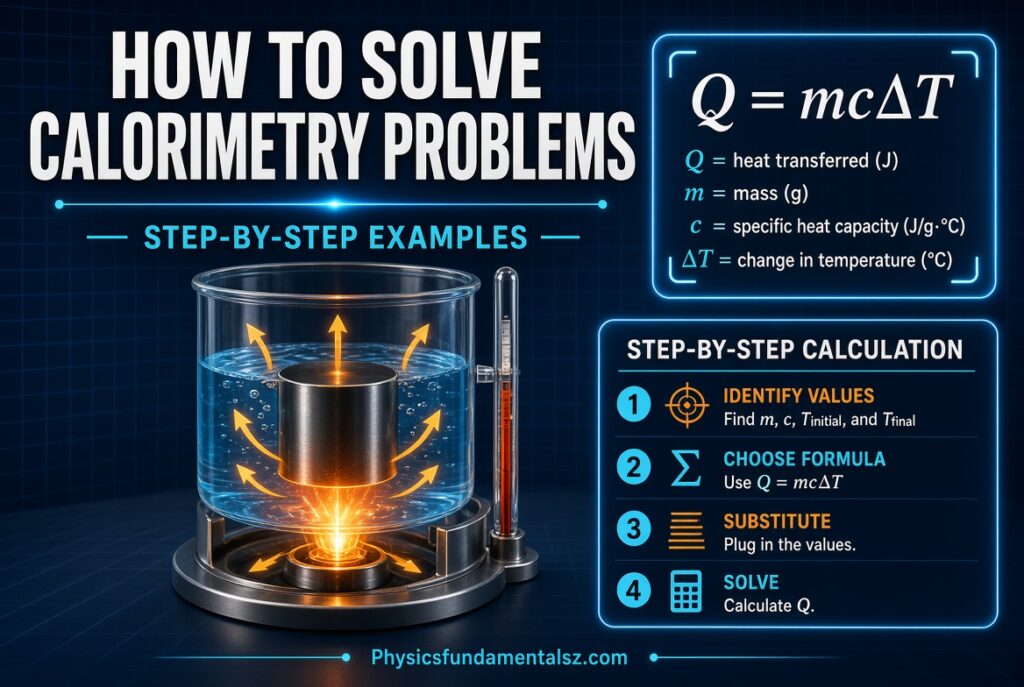
To solve calorimetry problems, set the heat lost by the hot objects equal to the heat gained by the cold objects, then use Q = mcΔT for each one and solve for the unknown. When ice, water, or steam changes phase, add Q = mL for the melting or boiling step. That one energy balance handles almost every problem you will see.
Learning how to solve calorimetry problems step by step is mostly about habit. You follow the same routine each time: define the objects, list the knowns, check for phase changes, write the balance, and solve. Skip a step and the numbers go wrong fast.
Calorimetry problems look different on the surface. One mixes hot metal with cool water. Another drops ice into tea. A third measures the heat from a reaction in a foam cup. Underneath, they all rest on the same idea: energy is conserved, so heat leaving one object must arrive somewhere else.
Table of Contents
The Calorimetry Problem-Solving Method
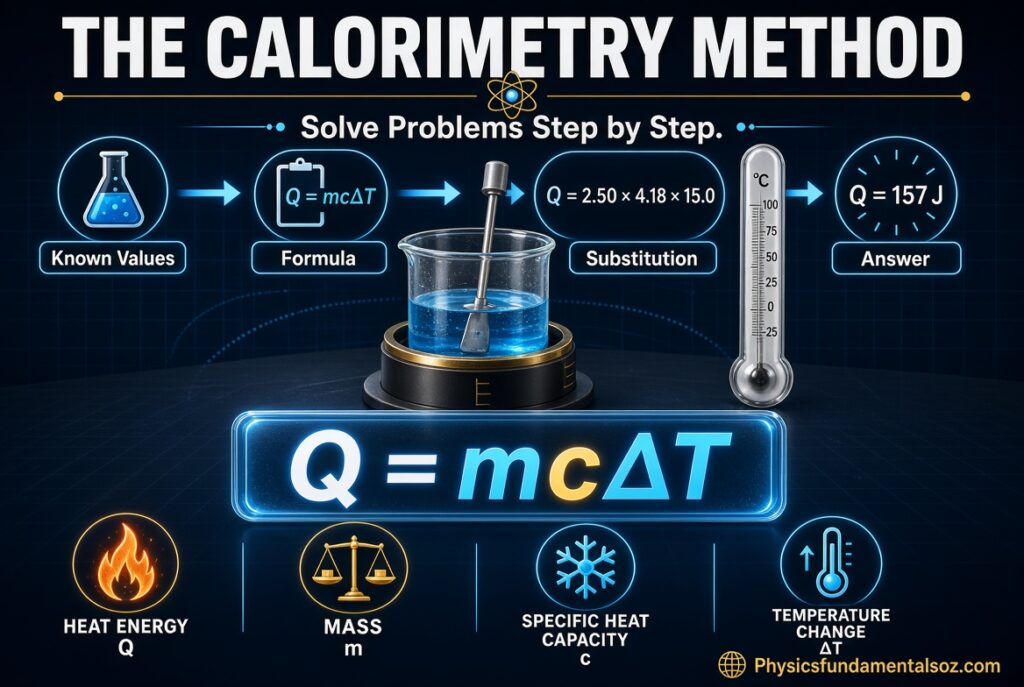
Calorimetry is the measurement of heat transfer. In a calorimetry problem, objects at different temperatures exchange heat inside an insulated container until they reach the same final temperature, called thermal equilibrium.
Core equation: Q_lost + Q_gained = 0, or equivalently, heat lost = heat gained.
Heat for a temperature change: Q = mcΔT
Heat for a phase change: Q = mL
The Six Steps at a Glance
- Identify every object and its starting temperature.
- List the masses, specific heats, and any latent heats.
- Check whether any phase change (melting, freezing, boiling, condensing) can happen.
- Write the energy balance: heat lost = heat gained.
- Substitute Q = mcΔT (and Q = mL where needed) and solve for the unknown.
- Check units, signs, and whether the answer is physically reasonable.
What Is Calorimetry?
Calorimetry is the science of measuring heat. The word comes from “calor,” the Latin word for heat. A device that measures heat is called a calorimeter.
Scientists use calorimetry to find specific heat capacities, heats of reaction, the energy in food, and the heat released when substances dissolve or burn.
Heat vs Temperature
Heat is energy that flows from a hotter object to a colder one. Temperature measures the average kinetic energy of the particles in an object. These are different things.
A bathtub of warm water holds more heat than a cup of boiling water, even though the cup has a higher temperature. Heat depends on mass, material, and temperature. Temperature does not depend on how much material you have.
Why Calorimetry Works: Conservation of Energy
The first law of thermodynamics says energy cannot be created or destroyed. In a perfectly insulated container, no heat escapes. So any heat one object loses must be absorbed by another.
That is why heat lost equals heat gained. Everything in calorimetry builds on this single idea.
Thermal Equilibrium
When you mix hot and cold objects, they exchange heat until they reach one shared temperature. This is thermal equilibrium. The shared temperature is the final temperature, T_f.
Most calorimetry problems ask you to find T_f, or to use T_f to find something else, such as a specific heat or a mass.
The Key Formulas You Need
Only a few equations show up again and again. Learn them well and you can solve nearly every problem.
Heat Absorbed or Released: Q = mcΔT
Q is the heat transferred, m is the mass, c is the specific heat capacity, and ΔT is the temperature change. ΔT = T_final − T_initial.
If an object warms up, ΔT is positive and Q is positive, meaning it absorbed heat. If it cools down, ΔT is negative and Q is negative, meaning it released heat.
Heat Capacity: C = mc
Heat capacity is the heat needed to raise the temperature of an entire object by one degree. It equals mass times specific heat. Its unit is J/°C. You will see C used for calorimeters, where the mass and material are bundled into one number.
With heat capacity, the heat equation becomes Q = CΔT.
Latent Heat: Q = mL
When a substance changes phase, it absorbs or releases heat without changing temperature. The formula is Q = mL, where L is the latent heat. Use L_f (fusion) for melting and freezing. Use L_v (vaporization) for boiling and condensing.
The Energy Balance
For two objects in an isolated system: Q_1 + Q_2 = 0. In words, the heat gained by one equals the heat lost by the other. You can write it as Q_gained = −Q_lost, or work with magnitudes and write heat lost = heat gained.
For a system with a calorimeter, add the calorimeter’s heat: Q_hot + Q_water + Q_calorimeter = 0.
Final Temperature for Simple Mixing
When two objects mix with no phase change, you can solve for the final temperature directly:
T_f = (m₁c₁T₁ + m₂c₂T₂) ÷ (m₁c₁ + m₂c₂)
This works like a weighted average. Each object’s weight is its heat capacity, mc.
Specific Heat Capacity Values You Will Need
Specific heat capacity is the heat needed to raise one gram of a substance by one degree Celsius. Problems usually give you these values. If not, use the table below.
| Substance | Specific heat (J/g·°C) | Specific heat (J/kg·K) |
|---|---|---|
| Water (liquid) | 4.18 | 4,180 |
| Ice | 2.09 | 2,090 |
| Steam (water vapor) | 2.01 | 2,010 |
| Aluminum | 0.90 | 900 |
| Copper | 0.385 | 385 |
| Iron / steel | 0.45 | 450 |
| Brass | 0.38 | 380 |
| Silver | 0.235 | 235 |
| Lead | 0.13 | 130 |
| Glass | 0.84 | 840 |
| Ethanol | 2.44 | 2,440 |
Why Water’s Value Matters
Water has a very high specific heat. It takes 4.18 joules to warm one gram of water by 1°C. Most metals need only 0.1 to 0.9 joules for the same warming.
This is why water is the standard liquid in calorimeters. It absorbs a lot of heat with only a small temperature change, which makes the change easy to measure.
Metals Change Temperature Faster
A metal with a low specific heat warms and cools quickly. Lead, at 0.13 J/g·°C, changes temperature about 32 times as fast as water for the same heat input per gram.
Latent Heat Values for Water
Phase changes need their own constants. These are the standard values for water.
| Process | Symbol | Value (J/g) | Value (kJ/kg) |
|---|---|---|---|
| Melting ice at 0°C | L_f | 334 | 334 |
| Freezing water at 0°C | L_f | 334 | 334 |
| Boiling water at 100°C | L_v | 2,260 | 2,260 |
| Condensing steam at 100°C | L_v | 2,260 | 2,260 |
Some textbooks use 333 or 335 J/g for fusion and 2,256 or 2,257 J/g for vaporization. The differences are tiny. Always use the value your course or problem gives you.
Why Latent Heat Is So Large
Breaking the bonds that hold molecules together takes much more energy than speeding them up slightly. Boiling a gram of water takes about 540 times as much heat as warming it by 1°C. That is 2,260 J compared with 4.18 J.
That is why condensing steam is so effective at heating things, and why a steam burn is worse than a hot water burn.
Units in Calorimetry: Joules, Calories, and Calories (Capital C)
Units cause a surprising number of errors. Know these conversions.
| Unit | Symbol | Equivalent |
|---|---|---|
| Joule | J | Base SI unit of energy |
| Kilojoule | kJ | 1,000 J |
| Calorie (thermochemical) | cal | 4.184 J |
| Kilocalorie | kcal | 1,000 cal = 4,184 J |
| Food Calorie (capital C) | Cal | 1 kcal = 4,184 J |
The Original Definition of a Calorie
One calorie is the heat needed to raise one gram of water by one degree Celsius. That is why the specific heat of water is 1.00 cal/g·°C, which equals 4.184 J/g·°C.
Food Calories
The Calorie on a food label is really a kilocalorie. A 200 Calorie snack contains 200,000 calories, or about 837,000 joules.
Temperature Units
Celsius and kelvin degrees are the same size. A ΔT of 25°C equals a ΔT of 25 K. Do not add 273 to temperature differences. If your specific heat is per °C, you can use ΔT in °C directly.
Sign Conventions: Who Gains and Who Loses?
Signs trip up many students. A clear rule helps.
Heat Absorbed Is Positive
If an object absorbs heat, Q is positive. It warms up or melts. Its ΔT is positive.
Heat Released Is Negative
If an object releases heat, Q is negative. It cools down or freezes. Its ΔT is negative.
Two Reliable Methods
Method one: keep the signs. Compute Q = mc(T_f − T_i) for every object, then set the sum of all Q values to zero.
Method two: use magnitudes. Compute the heat lost with ΔT = T_hot − T_f and the heat gained with ΔT = T_f − T_cold. Then set them equal. Both give the same answer. Pick one and stay with it.
A Quick Sanity Check
The final temperature must lie between the starting temperatures, unless a reaction releases or absorbs heat. If your T_f is hotter than the hottest starting object, something went wrong.
Types of Calorimeters
Different experiments use different devices. The problem type often tells you which one is in play.
Simple (Coffee Cup) Calorimeter
A polystyrene cup with a lid and a thermometer is the classic classroom calorimeter. It works at constant pressure, because the cup is open to the air or loosely lidded. The heat measured equals the enthalpy change, ΔH.
It is used for mixing problems, specific heat experiments, dissolving salts, and acid-base neutralization.
Bomb Calorimeter
A bomb calorimeter is a sealed steel container that sits in a bath of water. A sample burns inside in pure oxygen. Because the volume stays constant, the heat measured equals the change in internal energy, ΔU.
It is used for the energy content of foods and fuels.
Calorimeter Constant
Real calorimeters absorb some heat. The calorimeter constant, C_cal, is the heat capacity of the device itself in J/°C. When it is given or measured, you must include it in the energy balance.
Ideal vs Real Calorimeters
Textbook problems often say to ignore the calorimeter or assume perfect insulation. Real experiments lose some heat to the room, so measured values come out slightly off.
| Feature | Coffee cup calorimeter | Bomb calorimeter |
|---|---|---|
| Pressure or volume | Constant pressure | Constant volume |
| Heat measured | ΔH (enthalpy) | ΔU (internal energy) |
| Typical use | Mixing, dissolving, neutralization | Combustion of foods and fuels |
| Typical temperature change | A few degrees | One to a few degrees |
| Calorimeter constant | Often small or ignored | Always included |
How to Solve Calorimetry Problems Step by Step
Use this routine on every problem. It keeps you organized and catches errors early.
Step 1: Identify the Objects and Draw a Quick Sketch
List every object in the system. That might be a metal block, water, ice, and a calorimeter cup. Write each object’s starting temperature next to it.
A small sketch or table takes ten seconds and prevents mix-ups.
Step 2: List the Knowns and the Unknown
Write down masses, specific heats, starting temperatures, and any latent heats. Mark clearly what you are solving for. Is it the final temperature, a mass, or a specific heat?
Step 3: Convert Units
Make sure masses are all in grams or all in kilograms. Make sure the specific heat uses the same mass unit. Use J/g·°C with grams. Use J/kg·K with kilograms.
Step 4: Check for Phase Changes
Ask whether ice could melt, water could freeze, or steam could condense. If any object starts at a phase boundary, such as ice at 0°C or steam at 100°C, a phase change is likely.
Here is a simple test. Calculate the heat needed to bring the cold material to the phase-change temperature. Compare that with the heat the hot material can give up while cooling to that same temperature. This tells you whether the phase change finishes.
Step 5: Write the Energy Balance
Write heat lost = heat gained, or Q_total = 0. Include every object that exchanges heat. Do not forget the calorimeter if it has a given heat capacity.
Step 6: Substitute and Solve
Replace each Q with mcΔT or mL. Expand, collect the unknown on one side, and solve. Keep units on every line.
Step 7: Check the Answer
Is the final temperature between the starting temperatures? Are the units right? Is the size of the answer reasonable? A specific heat of 40 J/g·°C should make you stop and recheck.
Worked Example 1: Finding the Final Temperature When Mixing Hot and Cold Water
Mix 200 g of water at 80°C with 300 g of water at 20°C in an insulated container. Find the final temperature.
Step 1 and 2: Identify and List
Hot water: m₁ = 200 g, T₁ = 80°C. Cold water: m₂ = 300 g, T₂ = 20°C. Both have c = 4.18 J/g·°C. Unknown: T_f.
Step 3: Check for Phase Changes
Both stay liquid. No phase change applies.
Step 4: Write the Energy Balance
Heat lost by hot water = heat gained by cold water.
m₁c(T₁ − T_f) = m₂c(T_f − T₂)
Step 5: Solve
Because both are water, c cancels.
200 × (80 − T_f) = 300 × (T_f − 20)
16,000 − 200T_f = 300T_f − 6,000
22,000 = 500T_f
T_f = 44°C
Step 6: Check
44°C lies between 20°C and 80°C. It sits closer to 20°C because there is more cold water. The answer makes sense.
Worked Example 2: Finding the Specific Heat of a Metal
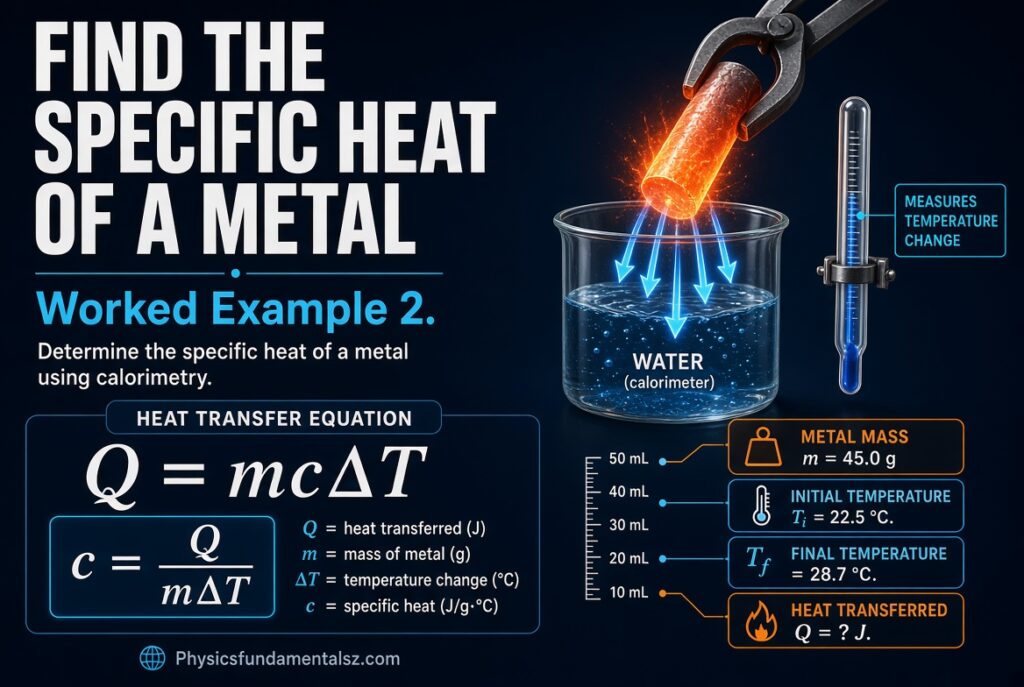
A 50.0 g metal sample is heated to 100.0°C, then dropped into 100.0 g of water at 20.0°C in a calorimeter. The final temperature is 24.0°C. Find the specific heat of the metal. Ignore the calorimeter.
Step 1 and 2: Identify and List
Metal: m = 50.0 g, T_i = 100.0°C, c unknown. Water: m = 100.0 g, T_i = 20.0°C, c = 4.18 J/g·°C. T_f = 24.0°C.
Step 3: Heat Gained by the Water
Q_water = 100.0 × 4.18 × (24.0 − 20.0) = 1,672 J.
Step 4: Heat Lost by the Metal
Q_metal = 50.0 × c × (100.0 − 24.0) = 50.0 × c × 76.0 = 3,800c.
Step 5: Set Them Equal and Solve
3,800c = 1,672
c = 0.440 J/g·°C
Step 6: Identify and Check
A value near 0.44 J/g·°C is close to iron or steel (about 0.45). The answer fits a common metal, which is a good sign.
Worked Example 3: Using the Calorimeter Constant
A calorimeter contains 150 g of water at 20.0°C. Its heat capacity is 60 J/°C. A 75.0 g metal sample at 100.0°C is dropped in, and the final temperature is 25.0°C. Find the specific heat of the metal.
Heat Gained by Water
Q_water = 150 × 4.18 × 5.0 = 3,135 J.
Heat Gained by the Calorimeter
Q_cal = 60 × 5.0 = 300 J.
Heat Lost by the Metal
Q_metal = 75.0 × c × (100.0 − 25.0) = 5,625c.
Solve
5,625c = 3,135 + 300 = 3,435
c = 0.611 J/g·°C
What the Calorimeter Does
The calorimeter soaked up 300 J, which is almost 9 percent of the total. Ignoring it would give c = 0.557 J/g·°C, about 9 percent too low. That is why a calorimeter constant matters.
Worked Example 4: Finding the Calorimeter Constant
A calorimeter holds 100.0 g of water at 22.0°C. You add 100.0 g of water at 52.0°C. The final temperature is 36.0°C. Find the calorimeter’s heat capacity.
Heat Lost by the Hot Water
Q_hot = 100.0 × 4.18 × (52.0 − 36.0) = 6,688 J.
Heat Gained by the Cold Water
Q_cold = 100.0 × 4.18 × (36.0 − 22.0) = 5,852 J.
Heat Gained by the Calorimeter
The difference went into the calorimeter: 6,688 − 5,852 = 836 J.
The calorimeter warmed from 22.0°C to 36.0°C, so ΔT = 14.0°C.
C_cal = 836 ÷ 14.0 = 59.7 J/°C.
How This Is Used
This number goes into later problems as the calorimeter constant. Calibrating a calorimeter with a mix of hot and cold water is a standard first step in many labs.
Worked Example 5: Ice Melting in Warm Water
Place 20.0 g of ice at 0°C into 200 g of water at 40.0°C. Find the final temperature. Use L_f = 334 J/g.
Step 1: Check if All the Ice Melts
Heat needed to melt the ice: 20.0 × 334 = 6,680 J.
Heat the warm water can release by cooling to 0°C: 200 × 4.18 × 40.0 = 33,440 J.
Because 33,440 J is much larger than 6,680 J, all the ice melts. The final temperature is above 0°C.
Step 2: Write the Energy Balance
Heat to melt ice + heat to warm melted ice from 0°C to T_f = heat lost by the warm water.
6,680 + 20.0 × 4.18 × T_f = 200 × 4.18 × (40.0 − T_f)
Step 3: Solve
6,680 + 83.6T_f = 33,440 − 836T_f
919.6T_f = 26,760
T_f = 29.1°C
Check
The answer falls between 0°C and 40°C. It makes sense that the ice cooled the water by about 11°C.
Worked Example 6: Ice Starting Below Freezing
Place 50.0 g of ice at −10.0°C into 300 g of water at 50.0°C. Find the final temperature. Use c_ice = 2.09 J/g·°C and L_f = 334 J/g.
Step 1: Heat Needed to Bring the Ice to Liquid at 0°C
Warm the ice from −10°C to 0°C: 50.0 × 2.09 × 10.0 = 1,045 J.
Melt the ice: 50.0 × 334 = 16,700 J.
Total: 17,745 J.
Step 2: Heat Available From the Water
Cooling the water to 0°C gives up 300 × 4.18 × 50.0 = 62,700 J. That is more than 17,745 J, so all the ice melts and T_f is above 0°C.
Step 3: Balance
17,745 + 50.0 × 4.18 × T_f = 300 × 4.18 × (50.0 − T_f)
17,745 + 209T_f = 62,700 − 1,254T_f
1,463T_f = 44,955
T_f = 30.7°C
Worked Example 7: Steam Condensing in Cool Water
Pass 10.0 g of steam at 100°C into 200 g of water at 20.0°C. Find the final temperature. Use L_v = 2,260 J/g.
Step 1: Heat Released by the Steam
Condensing: 10.0 × 2,260 = 22,600 J.
Cooling the condensed water from 100°C to T_f: 10.0 × 4.18 × (100 − T_f) = 41.8(100 − T_f).
Step 2: Heat Gained by the Cool Water
200 × 4.18 × (T_f − 20.0) = 836(T_f − 20.0).
Step 3: Solve
22,600 + 4,180 − 41.8T_f = 836T_f − 16,720
26,780 + 16,720 = 877.8T_f
T_f = 49.6°C
Why Steam Is So Powerful
Only 10 g of steam raised 200 g of water by almost 30°C. The latent heat released during condensation did most of the work. About 90 percent of the heat came from condensation.
Worked Example 8: How Much Ice Does a Hot Metal Melt?
A 100 g copper block at 100°C is dropped onto a large block of ice at 0°C. How much ice melts? Use c_Cu = 0.385 J/g·°C and L_f = 334 J/g. Assume the copper ends at 0°C.
Heat Released by the Copper
Q = 100 × 0.385 × 100 = 3,850 J.
Mass of Ice Melted
m = Q ÷ L_f = 3,850 ÷ 334 = 11.5 g.
Key Idea
When ice and water sit together at 0°C, any added heat goes into melting, not warming. The temperature stays fixed at 0°C until all the ice is gone. That makes this problem simple.
Worked Example 9: Total Heat to Turn Ice Into Steam
How much heat is needed to turn 10.0 g of ice at −20.0°C into steam at 120.0°C? Use c_ice = 2.09 J/g·°C, c_water = 4.18 J/g·°C, c_steam = 2.01 J/g·°C, L_f = 334 J/g, and L_v = 2,260 J/g.
This problem has five stages. Treat each one separately and add the results.
Stage 1: Warm the Ice From −20°C to 0°C
Q₁ = 10.0 × 2.09 × 20.0 = 418 J.
Stage 2: Melt the Ice at 0°C
Q₂ = 10.0 × 334 = 3,340 J.
Stage 3: Warm the Water From 0°C to 100°C
Q₃ = 10.0 × 4.18 × 100 = 4,180 J.
Stage 4: Boil the Water at 100°C
Q₄ = 10.0 × 2,260 = 22,600 J.
Stage 5: Warm the Steam From 100°C to 120°C
Q₅ = 10.0 × 2.01 × 20.0 = 402 J.
Total
Q_total = 418 + 3,340 + 4,180 + 22,600 + 402 = 30,940 J.
What the Heating Curve Shows
On a graph of temperature against heat, the stages with temperature changes slope upward. The melting and boiling stages are flat. The boiling plateau is by far the longest, because vaporization takes the most energy.
| Stage | Process | Heat (J) | Share of total |
|---|---|---|---|
| 1 | Warm ice | 418 | 1.4% |
| 2 | Melt ice | 3,340 | 10.8% |
| 3 | Warm water | 4,180 | 13.5% |
| 4 | Boil water | 22,600 | 73.0% |
| 5 | Warm steam | 402 | 1.3% |
Worked Example 10: Finding an Unknown Mass
How much water at 90°C must be added to 100 g of water at 10°C to reach a final temperature of 40°C? Ignore the container.
Set Up the Balance
Heat lost by hot water = heat gained by cold water.
m × 4.18 × (90 − 40) = 100 × 4.18 × (40 − 10)
Solve
The 4.18 cancels on both sides.
50m = 3,000
m = 60 g
Check
You need 60 g of hot water. That is less than the 100 g of cold water, which makes sense because the hot water is 50°C above the final temperature while the cold water is only 30°C below it.
Worked Example 11: Three Objects at Different Temperatures
A 100 g aluminum block at 100°C, a 200 g copper block at 20°C, and 300 g of water at 30°C are placed together in an insulated container. Find the final temperature.
Step 1: Compute Each Heat Capacity (mc)
Aluminum: 100 × 0.90 = 90 J/°C.
Copper: 200 × 0.385 = 77 J/°C.
Water: 300 × 4.18 = 1,254 J/°C.
Step 2: Use the Weighted Average
T_f = (90 × 100 + 77 × 20 + 1,254 × 30) ÷ (90 + 77 + 1,254)
T_f = (9,000 + 1,540 + 37,620) ÷ 1,421
T_f = 48,160 ÷ 1,421 = 33.9°C
Why This Works
The final temperature is a weighted average of the starting temperatures. The weights are the heat capacities. Water has the largest weight, so T_f stays close to the water’s starting temperature of 30°C.
Worked Example 12: Finding the Initial Temperature of a Metal
A 40.0 g metal with c = 0.50 J/g·°C is dropped into 200 g of water at 20.0°C. The final temperature is 22.0°C. What was the metal’s initial temperature?
Heat Gained by the Water
Q = 200 × 4.18 × 2.0 = 1,672 J.
Heat Lost by the Metal
40.0 × 0.50 × (T_i − 22.0) = 1,672
20.0 × (T_i − 22.0) = 1,672
T_i − 22.0 = 83.6
T_i = 105.6°C
Worked Example 13: Electrical Heating Problems
A 500 W immersion heater warms 2.0 kg of water in an insulated container for 3.0 minutes. Assume all the electrical energy goes into the water. Find the temperature rise.
Step 1: Energy Delivered
Energy = power × time = 500 W × 180 s = 90,000 J.
Step 2: Find ΔT
ΔT = Q ÷ (mc) = 90,000 ÷ (2,000 × 4.18) = 90,000 ÷ 8,360 = 10.8°C.
A Second Version: Finding c
A 150 W heater warms 1.00 kg of oil for 4.0 minutes. The oil’s temperature rises by 18.0°C. Find the specific heat of the oil.
Energy = 150 × 240 = 36,000 J.
c = Q ÷ (m × ΔT) = 36,000 ÷ (1,000 × 18.0) = 2.0 J/g·°C.
That value is typical of many cooking oils.
Worked Example 14: Calorimetry With Food Energy
A 0.80 g snack is burned under a can containing 200 g of water. The water warms from 20.0°C to 42.0°C. Estimate the energy content in Calories per gram.
Step 1: Heat Absorbed by the Water
Q = 200 × 4.18 × 22.0 = 18,392 J.
Step 2: Convert to Calories
18,392 J ÷ 4,184 = 4.40 Cal (kcal).
Step 3: Per Gram
4.40 ÷ 0.80 = 5.5 Cal per gram.
Why Real Results Come Out Low
In this homemade setup, some heat escapes into the air and some heats the can. The true energy content is therefore a bit higher than the measured value. Percent error is usually large for open-flame food experiments.
Worked Example 15: Heat of Neutralization in a Coffee Cup Calorimeter
Mix 50.0 mL of 1.00 M HCl with 50.0 mL of 1.00 M NaOH in a foam cup. Both start at 21.0°C. The final temperature is 27.5°C. Find the enthalpy of neutralization per mole of water formed. Assume the solution has the density and specific heat of water, and ignore the cup.
Step 1: Mass of Solution
100.0 mL of solution with density 1.00 g/mL has a mass of 100.0 g.
Step 2: Heat Absorbed by the Solution
q = 100.0 × 4.18 × (27.5 − 21.0) = 2,717 J.
Step 3: Heat Released by the Reaction
The reaction released this heat. q_rxn = −2,717 J.
Step 4: Moles of Reaction
Moles of HCl = 0.0500 L × 1.00 mol/L = 0.0500 mol. The reaction forms 0.0500 mol of water.
Step 5: Enthalpy Per Mole
ΔH = −2,717 J ÷ 0.0500 mol = −54,340 J/mol ≈ −54.3 kJ/mol.
Check
The accepted value is about −57 kJ/mol. The small difference comes from heat lost to the cup and the air. The negative sign means the reaction is exothermic.
Worked Example 16: Heat of Solution for a Dissolving Salt
Dissolve 5.00 g of ammonium nitrate (molar mass 80.04 g/mol) in 50.0 g of water. The temperature falls from 22.0°C to 17.0°C. Find the enthalpy of solution in kJ/mol. Assume c = 4.18 J/g·°C for the solution and ignore the cup.
Step 1: Heat Change of the Solution
Total mass = 5.00 + 50.0 = 55.0 g.
q_solution = 55.0 × 4.18 × (17.0 − 22.0) = −1,150 J. The solution lost heat.
Step 2: Heat Absorbed by the Dissolving Salt
The dissolving process absorbed this heat. q_rxn = +1,150 J.
Step 3: Moles
5.00 g ÷ 80.04 g/mol = 0.0625 mol.
Step 4: Enthalpy Per Mole
ΔH = +1,150 J ÷ 0.0625 mol = +18,400 J/mol = +18.4 kJ/mol.
The positive sign shows that the process is endothermic. That is why instant cold packs use this salt.
Worked Example 17: Bomb Calorimetry
A bomb calorimeter has a heat capacity of 10.0 kJ/°C. Burning 1.50 g of glucose (molar mass 180.16 g/mol) raises its temperature by 2.30°C. Find the heat released per gram and per mole.
Step 1: Heat Absorbed by the Calorimeter
q = C_cal × ΔT = 10.0 × 2.30 = 23.0 kJ.
The combustion released 23.0 kJ.
Step 2: Per Gram
23.0 kJ ÷ 1.50 g = 15.3 kJ/g, which is about 3.7 Cal per gram.
Step 3: Per Mole
Moles = 1.50 ÷ 180.16 = 0.00833 mol.
ΔU = −23.0 kJ ÷ 0.00833 mol ≈ −2,760 kJ/mol.
The negative sign shows heat released. This is close to the accepted value for glucose, near −2,800 kJ/mol.
Why Bomb Calorimetry Gives ΔU
The container is sealed, so the volume cannot change and no pressure-volume work is done. The measured heat equals the change in internal energy. For precise ΔH values, small corrections are made for the change in gas moles.
Handling Reaction Calorimetry Correctly
Reaction problems add a twist. The heat gained by the solution comes from the reaction, so the signs flip.
The Key Relationship
q_reaction = −(q_solution + q_calorimeter)
If the solution warms up, the reaction released heat and q_reaction is negative. If the solution cools, the reaction absorbed heat and q_reaction is positive.
From Heat to Enthalpy Change
ΔH = q_reaction ÷ n, where n is the number of moles of the limiting reactant (or of the substance specified). Convert to kJ/mol at the end.
Which Reactant Is Limiting?
Compute moles of each reactant. The smaller amount, after adjusting for the balanced equation, sets the amount that reacts. Use that number to find ΔH per mole.
Typical Assumptions
- The solution has the density of water, 1.00 g/mL.
- The solution has the specific heat of water, 4.18 J/g·°C.
- The cup absorbs no heat, unless a calorimeter constant is given.
- No heat is lost to the surroundings.
Choosing the Right Approach: Problem Types at a Glance
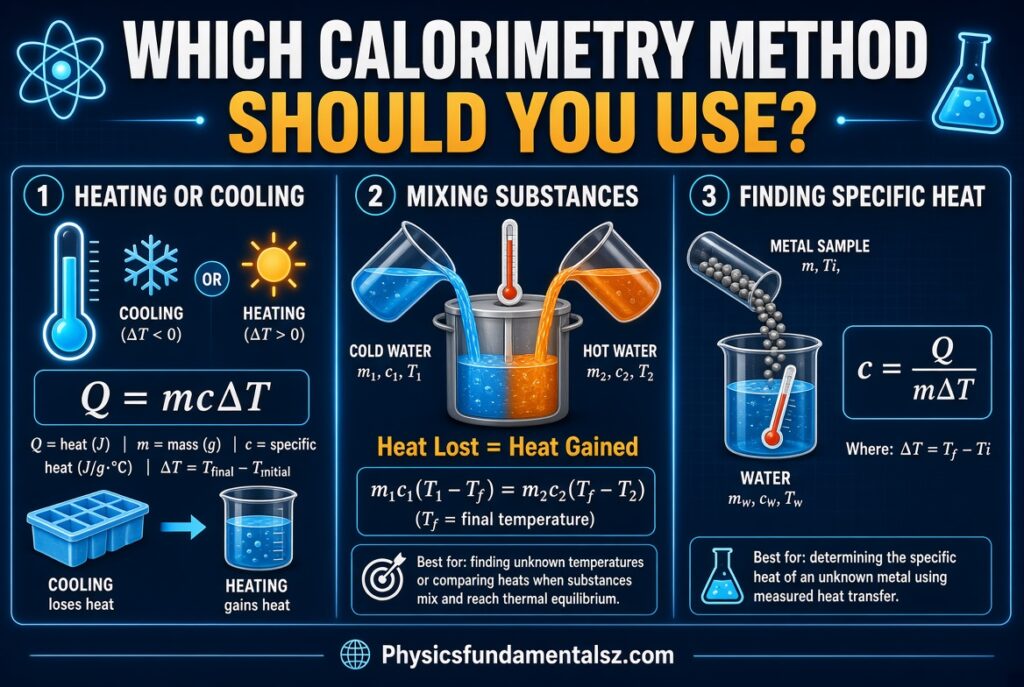
Most problems fall into a few families. Spot the family and you know the method.
| Problem type | What you are given | What you find | Method |
|---|---|---|---|
| Simple mixing | Masses and temperatures of two liquids | Final temperature | Heat lost = heat gained |
| Specific heat of a metal | Hot metal dropped into water | c of the metal | Q_metal = −Q_water |
| Calorimeter calibration | Hot and cold water mix | C_cal | Extra heat goes to the calorimeter |
| Phase change | Ice or steam mixed with water | Final temperature or mass | Add mL terms |
| Heating curve | One substance across several phases | Total heat | Sum all stages |
| Reaction calorimetry | Temperature change of a solution | ΔH per mole | q = mcΔT, then divide by moles |
| Bomb calorimetry | Temperature change of the bomb bath | Energy per gram or mole | q = C_cal × ΔT |
| Electrical heating | Power and time | ΔT or c | Energy = Pt, then Q = mcΔT |
Phase Change Problems: Deciding What Really Happens
Phase change problems are the hardest part of calorimetry. The final temperature depends on how much heat is available. You must decide the end state before you write the balance.
The Three Possible Outcomes for an Ice and Water Mix
- All the ice melts, and the final temperature is above 0°C.
- Only some of the ice melts, and the final temperature is exactly 0°C.
- Some of the water freezes, and the final temperature is exactly 0°C.
If the mixture ends at 0°C, you must find the amount of ice or water at the end instead of a temperature.
The Test That Tells You Which Outcome Occurs
Compute two quantities. First, the heat needed to bring all the ice to liquid water at 0°C. Second, the heat the warm water can give up while cooling to 0°C.
If the warm water’s heat is larger, all the ice melts and T_f is above 0°C. If it is smaller, the mixture ends at 0°C with some ice left.
Worked Example 18: Not All the Ice Melts
Place 100 g of ice at 0°C into 50.0 g of water at 20.0°C. Find the final temperature and how much ice melts.
Step 1: Heat Available From the Water
Cooling the water to 0°C releases 50.0 × 4.18 × 20.0 = 4,180 J.
Step 2: Heat Needed to Melt All the Ice
100 × 334 = 33,400 J.
The water cannot supply that much. Only part of the ice melts, and the final temperature is 0°C.
Step 3: Mass of Ice Melted
m = 4,180 ÷ 334 = 12.5 g.
Final State
The mixture ends at 0°C with 87.5 g of ice and 62.5 g of water.
Worked Example 19: Some of the Water Freezes
Place 20.0 g of ice at −30.0°C into 10.0 g of water at 10.0°C. Find the final state.
Step 1: Heat Needed to Warm the Ice to 0°C
20.0 × 2.09 × 30.0 = 1,254 J.
Step 2: Heat Released by the Water Cooling to 0°C
10.0 × 4.18 × 10.0 = 418 J.
Step 3: Heat Still Needed
1,254 − 418 = 836 J.
Step 4: Does the Water Freeze Completely?
Freezing all the water would release 10.0 × 334 = 3,340 J. Only 836 J is needed, so just part of the water freezes.
Mass frozen = 836 ÷ 334 = 2.50 g.
Final State
The mixture ends at 0°C with 22.5 g of ice and 7.5 g of water.
Common Mistakes in Calorimetry Problems and How to Avoid Them
Most lost marks come from a short list of errors. Check your work against it.
Mixing Up ΔT
ΔT must be final minus initial for each object. A common slip is to use the same ΔT for both objects. Each object has its own temperature change.
Forgetting the Sign
If you use signed Q values, the sum must equal zero. If you use magnitudes, make sure both ΔT values are positive. Do not mix the two methods in one problem.
Ignoring a Phase Change
If ice or steam is involved, a Q = mL term is almost certainly needed. Leaving it out produces a final temperature that is badly wrong.
Using the Wrong Specific Heat
Ice, water, and steam have different specific heats. Use the value for the phase the substance is in during that stage.
Unit Mismatches
Do not combine grams with J/kg·K. Do not use calories with a specific heat in joules. Convert before you calculate.
Forgetting the Calorimeter
If a calorimeter constant is given, include it. Leaving it out makes the calculated specific heat too low.
Using the Final Temperature as ΔT
The temperature change is not the final temperature. It is the difference between final and initial values.
Reporting Too Many Digits
Specific heat values and measurements have limited precision. Report answers with a sensible number of significant figures. Three is usually enough.
Not Checking the Answer
Always ask whether the final temperature lies between the starting temperatures. If it does not, you made an error somewhere.
Sources of Error in Real Calorimetry Experiments
Real experiments rarely match the ideal. Knowing why helps you explain results in a lab report.
Heat Loss to the Surroundings
Even a good foam cup loses some heat to the air. This makes the measured temperature rise smaller than it should be for an exothermic reaction.
Heat Absorbed by the Container
The cup, stirrer, and thermometer all absorb a little heat. If you ignore them, the calculated heat of reaction is too small.
Incomplete Mixing
If the liquids are not stirred well, the thermometer may read a temperature that does not represent the whole sample. Stir gently and steadily.
Thermometer Delay and Precision
A thermometer takes time to respond. Reading it too early gives a temperature that is not yet the true final value. Digital probes usually do better than glass thermometers.
Heat Transfer During Transfer of Hot Metal
When you move a hot metal block from a heater to the calorimeter, it cools a little in the air. That makes the initial temperature lower than you recorded.
Water Splashing or Evaporation
Splashing removes water, and evaporation removes heat. Both make results inaccurate. Use a lid when possible.
Improving Accuracy
- Use a lid on the cup.
- Stir continuously but gently.
- Record temperature at regular intervals and extrapolate to the moment of mixing.
- Measure the calorimeter constant first.
- Use larger masses to reduce the effect of small heat losses.
How to Measure Specific Heat in a Lab
A standard school experiment finds the specific heat of a metal. The method shows calorimetry in action.
Equipment
- Metal sample with known mass.
- Foam cup calorimeter with a lid.
- Thermometer or temperature probe.
- Beaker of boiling water.
- Balance for measuring masses.
Procedure
- Measure the mass of the metal sample.
- Heat the metal in boiling water until it reaches about 100°C.
- Measure the mass of water and place it in the calorimeter.
- Record the water’s starting temperature.
- Quickly move the hot metal into the calorimeter and cover it.
- Stir and record the highest temperature reached.
- Calculate the specific heat using heat lost = heat gained.
Calculating Percent Error
Percent error = |experimental − accepted| ÷ accepted × 100. For example, if you measure 0.44 J/g·°C for iron and the accepted value is 0.45, the error is about 2 percent.
Calorimetry in the Real World
Calorimetry is far more than a classroom exercise. It supports many industries and research fields.
Food Science
Nutrition labels list Calories measured or calculated using calorimetry. Bomb calorimeters burn food samples and measure the heat released.
Fuels and Energy
Engineers measure the heating value of coal, gasoline, and biofuels with bomb calorimeters. The numbers decide how fuels are priced and compared.
Chemistry and Materials
Chemists use calorimetry to find heats of reaction, dissolving, and mixing. Differential scanning calorimetry measures heat flow as a material is heated and reveals melting, crystallization, and other transitions.
Medicine and Biology
Isothermal titration calorimetry measures the heat from molecules binding to each other. Drug researchers use it to study how well a candidate molecule fits its target.
Everyday Cooling and Heating
Cooling a hot drink with ice, adding cold milk to coffee, and filling a bath all follow the same energy balance you have been using.
Practice Problems With Answers
Work through each problem before checking the solution. Use the constants from the tables above.
Problem 1
How much heat is needed to warm 250 g of water from 20°C to 60°C?
Answer: Q = 250 × 4.18 × 40 = 41,800 J, or 41.8 kJ.
Problem 2
A 0.50 kg aluminum block cools from 150°C to 25°C. How much heat does it release? Use c = 0.90 J/g·°C.
Answer: Q = 500 × 0.90 × (25 − 150) = −56,250 J. The block releases about 56.3 kJ.
Problem 3
A 150 g copper block at 100°C is dropped into 200 g of water at 20°C. Find the final temperature. Ignore the container.
Answer: T_f = (150 × 0.385 × 100 + 200 × 4.18 × 20) ÷ (150 × 0.385 + 200 × 4.18) = (5,775 + 16,720) ÷ (57.75 + 836) = 22,495 ÷ 893.75 ≈ 25.2°C.
Problem 4
How much heat is needed to melt 30 g of ice at 0°C and warm the water to 25°C?
Answer: Melting: 30 × 334 = 10,020 J. Warming: 30 × 4.18 × 25 = 3,135 J. Total: 13,155 J.
Problem 5
An 80 g metal at 95°C is dropped into 120 g of water at 22°C. The final temperature is 27°C. Find the specific heat of the metal.
Answer: Q_water = 120 × 4.18 × 5 = 2,508 J. Metal: 80 × c × 68 = 5,440c. c = 2,508 ÷ 5,440 ≈ 0.461 J/g·°C.
Problem 6
How many grams of steam at 100°C are needed to heat 400 g of water from 20°C to 60°C? Ignore the container.
Answer: Water needs 400 × 4.18 × 40 = 66,880 J. Each gram of steam releases 2,260 + 4.18 × 40 = 2,427 J. Mass = 66,880 ÷ 2,427 ≈ 27.6 g.
Problem 7
A bomb calorimeter has C_cal = 8.20 kJ/°C. A 1.20 g sample raises its temperature by 3.10°C. Find the energy released per gram.
Answer: q = 8.20 × 3.10 = 25.4 kJ. Per gram: 25.4 ÷ 1.20 = 21.2 kJ/g.
Problem 8
Mix 25.0 mL of 2.00 M HCl with 25.0 mL of 2.00 M NaOH. The temperature rises by 13.7°C. Find ΔH of neutralization per mole. Assume 50.0 g of solution with c = 4.18 J/g·°C.
Answer: q = 50.0 × 4.18 × 13.7 = 2,863 J. Moles = 0.0500. ΔH = −2,863 ÷ 0.0500 ≈ −57,300 J/mol, or −57.3 kJ/mol.
Problem 9
How much heat is needed to turn 5.0 g of ice at −20°C into steam at 100°C?
Answer: Warm ice: 5.0 × 2.09 × 20 = 209 J. Melt: 5.0 × 334 = 1,670 J. Warm water: 5.0 × 4.18 × 100 = 2,090 J. Boil: 5.0 × 2,260 = 11,300 J. Total: 15,269 J.
Problem 10
Mix 60 g of water at 90°C with 140 g of water at 10°C. Find the final temperature.
Answer: T_f = (60 × 90 + 140 × 10) ÷ 200 = (5,400 + 1,400) ÷ 200 = 34°C.
Deriving the Mixing Formula for Final Temperature
The weighted-average formula is not magic. It comes straight from the energy balance. Seeing the derivation helps you trust it.
Start With the Balance
Two objects, with no phase change. Object 1 is hotter. Heat lost by 1 equals heat gained by 2.
m₁c₁(T₁ − T_f) = m₂c₂(T_f − T₂)
Expand and Collect Terms
m₁c₁T₁ − m₁c₁T_f = m₂c₂T_f − m₂c₂T₂
m₁c₁T₁ + m₂c₂T₂ = (m₁c₁ + m₂c₂)T_f
Solve for T_f
T_f = (m₁c₁T₁ + m₂c₂T₂) ÷ (m₁c₁ + m₂c₂)
This is a weighted average with heat capacities as weights. It extends to any number of objects. Just add more terms on top and bottom.
When You Can Use It
Use it only when no phase change occurs and no reaction releases heat. If ice melts or steam condenses, the formula fails because latent heat changes the balance.
Solving in SI Units: Kilograms and Kelvin
Some courses insist on SI units. The method is the same. Only the numbers change.
Example in SI Units
A 0.250 kg piece of copper at 373 K is placed in 0.500 kg of water at 293 K. Find the final temperature. Use c_Cu = 385 J/kg·K and c_water = 4,180 J/kg·K.
T_f = (0.250 × 385 × 373 + 0.500 × 4,180 × 293) ÷ (0.250 × 385 + 0.500 × 4,180)
Numerator: 35,901 + 612,370 = 648,271.
Denominator: 96.25 + 2,090 = 2,186.25.
T_f = 648,271 ÷ 2,186.25 ≈ 296.5 K, which is about 23.4°C.
A Convenience
Because only temperature differences matter in the balance, you can use Celsius values directly in the weighted average and still get a Celsius answer. The result above would be the same if you used 100°C and 20°C.
A Table Method for Organizing Multi-Object Problems
Complex problems get messy fast. A table keeps everything visible.
How to Set It Up
Make a row for each stage or object. Use columns for mass, specific heat or latent heat, temperature change, and Q. Then add up the Q values.
| Object or stage | m (g) | c or L | ΔT or phase | Q (J) |
|---|---|---|---|---|
| Ice warming to 0°C | 50.0 | 2.09 J/g·°C | +10.0°C | +1,045 |
| Ice melting | 50.0 | 334 J/g | Phase change | +16,700 |
| Melted ice warming to T_f | 50.0 | 4.18 J/g·°C | T_f − 0 | 209T_f |
| Warm water cooling | 300 | 4.18 J/g·°C | T_f − 50.0 | 1,254(T_f − 50.0) |
Why It Helps
The sum of the Q column equals zero. A table shows every term at a glance, makes missing pieces obvious, and lets you check signs quickly. It is especially useful in exams where partial credit depends on clear working.
Specific Heat vs Heat Capacity vs Molar Heat Capacity
Three related terms cause confusion. Here is how they differ.
| Term | Symbol | Definition | Unit |
|---|---|---|---|
| Specific heat capacity | c | Heat per unit mass per degree | J/g·°C or J/kg·K |
| Heat capacity | C | Heat per degree for a whole object | J/°C or J/K |
| Molar heat capacity | C_m | Heat per mole per degree | J/mol·K |
Converting Between Them
C = mc. For water, the molar heat capacity is about 4.18 J/g·°C × 18.02 g/mol ≈ 75.3 J/mol·K.
Which One Should You Use?
Use specific heat when you know the mass. Use heat capacity when the object is a device like a calorimeter. Use molar heat capacity when you are working with moles, as in many chemistry problems.
Why Specific Heat Differs Between Materials
Specific heat depends on how a material stores thermal energy. Some energy goes into making particles move faster, and some goes into other ways of storing energy, such as molecular vibration and rotation.
Water’s High Value
Water molecules form hydrogen bonds. Heat added to water goes partly into stretching and rearranging those bonds, so the temperature rises slowly. That is why water resists temperature change, and why coastal climates are milder than inland ones.
Metals’ Low Values
Metals store thermal energy mainly in atomic vibrations and in free electrons. Per gram, they need little heat to warm up. A metal spoon in hot soup heats up fast for this reason.
Rearranging the Formulas for Any Unknown
Calorimetry problems ask for different unknowns. These rearrangements cover them all.
| To find | Rearranged formula |
|---|---|
| Heat Q | Q = mcΔT |
| Mass m | m = Q ÷ (cΔT) |
| Specific heat c | c = Q ÷ (mΔT) |
| Temperature change ΔT | ΔT = Q ÷ (mc) |
| Final temperature T_f | T_f = T_i + Q ÷ (mc) |
| Mass melted or boiled | m = Q ÷ L |
| Heat of a phase change | Q = mL |
| Calorimeter constant | C_cal = Q_absorbed ÷ ΔT |
| Enthalpy per mole | ΔH = q_reaction ÷ n |
Reading the Question for Clues
Words in the question point to the unknown. “How hot” or “final temperature” means T_f. “What metal” means specific heat. “How much ice melts” means a mass from Q = mL. “How much energy per mole” means ΔH.
Study Tips for Mastering Calorimetry
Calorimetry rewards practice. A few habits make the difference between guessing and solving with confidence.
Memorize the Core Equations
Know Q = mcΔT and Q = mL without looking. Know the specific heat of water and the two latent heats for water. Everything else can be looked up or given.
Always Write the Energy Balance First
Before you plug in any numbers, write heat lost = heat gained in words or symbols. This sets the structure and shows you what is missing.
Estimate Before You Calculate
A quick estimate gives you a target. If a small hot object meets a large cold one, the final temperature should sit close to the cold object’s temperature. If your answer disagrees, recheck.
Practice Each Problem Family
Work at least two problems from each type: simple mixing, specific heat of a metal, calorimeter constant, ice and steam, reaction calorimetry, and bomb calorimetry. Seeing each one a few times builds pattern recognition.
Keep Units Visible
Write units on every line. When units cancel to give the unit you expect, you have probably set up the equation correctly.
Review Your Mistakes
Keep a short list of the errors you make most often. Many students find the same two or three slips recur, such as sign errors or missed phase changes.
Key Takeaways: How to Solve Calorimetry Problems Step by Step
- Heat lost by hot objects equals heat gained by cold objects in an isolated system.
- Use Q = mcΔT for temperature changes and Q = mL for phase changes.
- Define ΔT as final minus initial for each object.
- Check for phase changes before writing the balance.
- Include the calorimeter constant when it is given.
- For reactions, q_reaction = −(q_solution + q_calorimeter), then divide by moles.
- Coffee cup calorimeters measure ΔH, and bomb calorimeters measure ΔU.
- Always check that the final temperature lies between the starting temperatures.
- Keep units consistent: grams with J/g·°C, kilograms with J/kg·K.
- Real experiments lose some heat, so measured values are slightly off.
Also Read:
- Specific Heat Capacity
- Thermal Energy & Internal Energy: Heat, Temperature & Q = mcΔT
- Heat Transfer: Conduction, Convection and Radiation
- The First Law of Thermodynamics
- The Second Law of Thermodynamics
- Entropy Explained for Beginners Easy Guide 2026
- Entropy Explained
- Thermal Expansion: Formula ΔL = αL₀ΔT, Types & Worked Examples
- Why Does Metal Feel Colder Than Wood at Room Temperature? The Physics of Heat Flow Explained 2026
- The Kinetic Theory of Gases
- How Do Heat Engines Work Step by Step? Key Concepts Explained 2026
- Boyle’s, Charles’ & Gay-Lussac’s Gas Laws: Formulas & Examples
- Ideal Gas Law: PV = nRT
- Ideal Gas Law Calculator With Steps: PV = nRT Formula & Examples 2026
- Ideal Gas Law Practice Problems With Answers (2026 Study Guide)
- Stress, Strain & Young’s Modulus: E = sigma/epsilon Formula & Examples
- Half Life Calculator With Steps: Formula, Examples & Full Guide 2026
- Physics Fundamentals: The Complete Guide to Core Concepts, Laws, and Equations
- Mass Energy Equivalence Real Life Examples (2026 Guide)
- How to Calculate Acceleration From a Velocity Time Graph 2026
- Difference Between Speed and Velocity With Examples (2026 Guide)
- What Is the Formula for Conservation of Momentum? 2026
Frequently Asked Questions (FAQs)
How do you solve calorimetry problems step by step?
Identify all objects and their starting temperatures, list the knowns, check for phase changes, and write heat lost = heat gained. Replace each heat term with mcΔT or mL, solve for the unknown, and check that your answer is reasonable.
What is the basic formula for calorimetry?
The basic formula is Q = mcΔT. It gives the heat absorbed or released when a mass m with specific heat c changes temperature by ΔT. The energy balance Q_lost + Q_gained = 0 links the objects together.
What does heat lost equals heat gained mean?
It means energy is conserved in an insulated system. The heat released by hotter objects is absorbed by colder ones. If you add up all the heat changes, the total is zero.
How do you find the final temperature in a calorimetry problem?
Write the energy balance, substitute Q = mcΔT for each object, and solve for T_f. For two liquids with no phase change, T_f = (m₁c₁T₁ + m₂c₂T₂) ÷ (m₁c₁ + m₂c₂).
How do you find the specific heat of a metal using calorimetry?
Heat the metal, drop it into water of known mass and temperature, and record the final temperature. Set the metal’s heat lost equal to the water’s heat gained, then solve for c. A 50 g metal that warms 100 g of water by 4°C from 100°C, for example, has c ≈ 0.44 J/g·°C.
What is the specific heat of water?
It is 4.18 J/g·°C, or 4,180 J/kg·K. In older units, it is 1.00 cal/g·°C. This high value is why water is used in most calorimeters.
What is a calorimeter constant?
It is the heat capacity of the calorimeter itself, in J/°C. It tells you how much heat the cup, stirrer, and thermometer absorb for each degree of temperature rise. You measure it by mixing hot and cold water and finding the missing heat.
How do you calculate the calorimeter constant?
Mix known masses of hot and cold water in the calorimeter. Find the heat lost by the hot water and the heat gained by the cold water. The difference went into the calorimeter. Divide that heat by the calorimeter’s temperature change.
How do you handle phase changes in calorimetry?
Add a Q = mL term for each melting, freezing, boiling, or condensing step. Use L_f = 334 J/g for water melting and L_v = 2,260 J/g for water boiling. First check whether the phase change can complete.
How do you know if all the ice melts?
Compare the heat needed to melt all the ice with the heat the warm water can give up while cooling to 0°C. If the water can supply more, all the ice melts. If not, the mixture ends at 0°C with ice left over.
What is the latent heat of fusion of water?
It is about 334 J/g, or 334 kJ/kg. Some textbooks use 333 or 335 J/g. It is the heat needed to melt one gram of ice at 0°C without changing its temperature.
What is the latent heat of vaporization of water?
It is about 2,260 J/g, or 2,260 kJ/kg, at 100°C. Some sources round it to 2,257 J/g. It is the heat needed to turn one gram of boiling water into steam.
How do you calculate the heat needed to turn ice into steam?
Add five stages: warming the ice, melting it, warming the water, boiling it, and warming the steam. Use mcΔT for the temperature stages and mL for the phase changes. For 10 g of ice at −20°C going to steam at 120°C, the total is about 30,940 J.
What is the difference between heat capacity and specific heat?
Specific heat is heat per unit mass per degree. Heat capacity is heat per degree for a whole object. They are related by C = mc.
What is a coffee cup calorimeter?
It is a foam cup with a lid and thermometer used to measure heat changes at constant pressure. It is common for mixing, dissolving, and neutralization experiments. The heat measured equals the enthalpy change.
What is a bomb calorimeter?
It is a sealed steel vessel in a water bath, used to burn a sample in oxygen. Because the volume is constant, the heat measured equals the change in internal energy. It is used to find the energy in foods and fuels.
What is the difference between a coffee cup and a bomb calorimeter?
A coffee cup calorimeter works at constant pressure and measures ΔH. A bomb calorimeter works at constant volume and measures ΔU. Bomb calorimeters also include a calorimeter constant in every calculation.
How do you calculate enthalpy change from calorimetry data?
Find the heat absorbed by the solution with q = mcΔT. Reverse the sign to get the heat of the reaction. Then divide by the moles of reactant: ΔH = q_reaction ÷ n.
Why is the heat of reaction negative when the temperature rises?
A rising temperature means the solution absorbed heat from the reaction. The reaction released that heat, so its enthalpy change is negative. Such reactions are called exothermic.
How do you convert calories to joules?
Multiply calories by 4.184. For example, 100 cal equals 418.4 J. A food Calorie (capital C) is a kilocalorie, so 1 Cal equals 4,184 J.
Why must the final temperature lie between the starting temperatures?
Heat flows from hot to cold until the temperatures match. The shared final value cannot be hotter than the hottest object or colder than the coldest one. The only exception is when a reaction adds or removes heat.
Do I need to convert Celsius to Kelvin in calorimetry?
No. A change of 1°C equals a change of 1 K, so ΔT is the same in both units. Only convert if a formula needs an absolute temperature, which is rare in basic calorimetry.
Can I use grams and kilograms together?
Only if you convert them first. Use grams with specific heat in J/g·°C, or kilograms with specific heat in J/kg·K. Mixing them gives answers off by a factor of 1,000.
What assumptions do calorimetry problems usually make?
They usually assume the calorimeter is perfectly insulated, the solution has the properties of water, and the container absorbs no heat unless a constant is given. Real experiments lose a little heat, so measured values differ slightly.
Why are real calorimetry results often lower than accepted values?
Heat escapes to the air, the cup absorbs some heat, and mixing may be incomplete. For an exothermic reaction, these losses make the temperature rise smaller than it should be.
How do you find the mass of ice that melts?
Find the heat available, then divide by the latent heat of fusion. If a 100 g copper block at 100°C cools to 0°C, it releases 3,850 J. That melts 3,850 ÷ 334 ≈ 11.5 g of ice.
How do you solve a problem with steam and water?
Include the latent heat released when steam condenses, then the heat released as the condensed water cools. Set that equal to the heat gained by the cold water. Condensation usually supplies most of the heat.
What is thermal equilibrium?
It is the state where all objects in contact reach the same temperature and no net heat flows between them. Calorimetry problems solve for this shared temperature or use it to find another quantity.
How do you check a calorimetry answer?
Confirm that the final temperature lies between the starting values, that units are consistent, and that the heat lost matches the heat gained. Plug your answer back into both sides of the balance to see if they agree.
What are common mistakes in calorimetry problems?
Common mistakes include using the wrong ΔT, skipping a phase change, mixing up signs, using the wrong specific heat, ignoring the calorimeter constant, and mixing units. A checklist and a table of stages help avoid them.
Conclusion
To solve calorimetry problems step by step, start with one idea: heat lost equals heat gained. Identify every object, list the knowns, check for phase changes, write the energy balance, and solve with Q = mcΔT and Q = mL.
The same routine handles every type. It works for hot metal in water, ice in a drink, steam heating a bath, a salt dissolving in a foam cup, and a sample burning in a bomb calorimeter. Only the details change.
Most mistakes come from small slips. Use ΔT as final minus initial. Keep units consistent. Include the calorimeter constant when it is given. Test for phase changes before you commit to a balance. Then check that the final temperature makes sense.
With practice, the process becomes automatic. Work through the examples and practice problems above until the steps feel natural. Once they do, calorimetry stops being a list of formulas and becomes a simple, reliable way to track energy.