How to Calculate Thermal Expansion of a Metal Rod: Formula, Steps and Worked Examples 2026
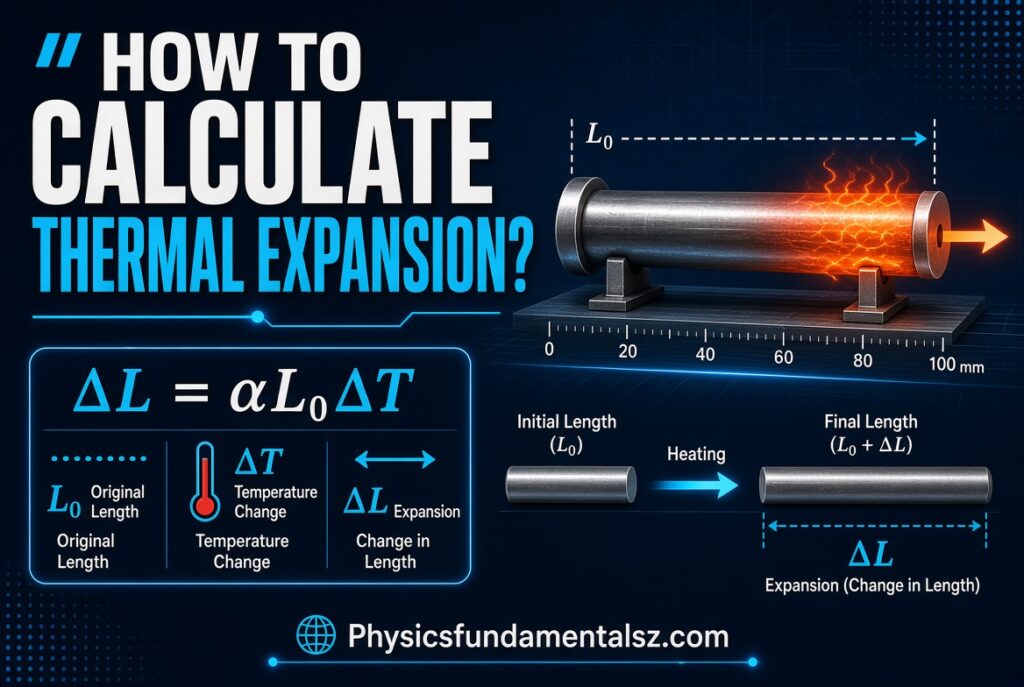
To calculate the thermal expansion of a metal rod, multiply three numbers: the coefficient of linear expansion, the original length, and the change in temperature. The result is how much longer (or shorter) the rod becomes. In symbols, that is ΔL = α × L₀ × ΔT.
Learning how to calculate thermal expansion of a metal rod takes only a few minutes. The formula is short. The tricky parts are choosing the right coefficient, keeping units consistent, and knowing when the simple formula stops being accurate.
A steel rod two meters long, heated by 100°C, grows by only about 2.4 millimeters. That is tiny, yet it is enough to buckle railway tracks, crack pipes, and jam machine parts when nobody leaves room for it.
Table of Contents
The Thermal Expansion Formula for a Metal Rod
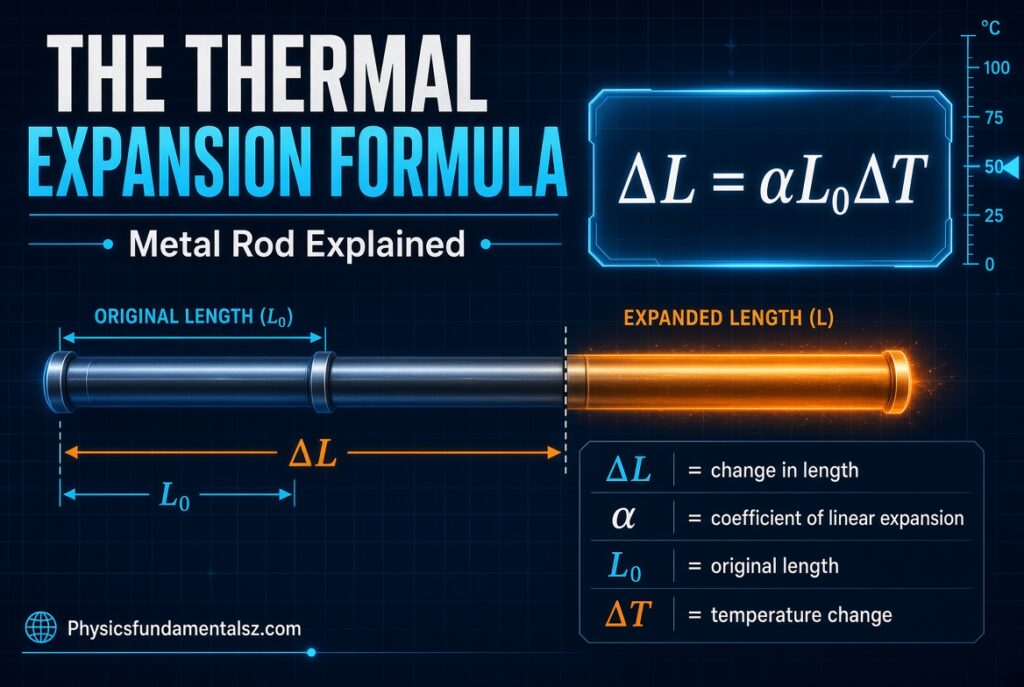
Linear thermal expansion is the change in length of a solid, such as a metal rod, caused by a change in temperature. For small temperature changes, the length change is proportional to the original length and to the temperature change.
Formula: ΔL = α × L₀ × ΔT
- ΔL is the change in length.
- α (alpha) is the coefficient of linear thermal expansion of the metal.
- L₀ is the original length of the rod.
- ΔT is the temperature change, final temperature minus initial temperature.
- Final length: L = L₀ + ΔL = L₀(1 + αΔT)
The Five-Step Method in One Glance
- Write down the original length L₀.
- Find the coefficient α for your metal.
- Work out ΔT = T_final − T_initial.
- Multiply α × L₀ × ΔT to get ΔL.
- Add ΔL to L₀ if you want the final length.
What Is Thermal Expansion?
Thermal expansion is the tendency of matter to change its size when its temperature changes. Most solids, liquids, and gases get bigger when heated. Most shrink when cooled.
For a long, thin object like a rod, the biggest change shows up along its length. That is why physicists talk about linear expansion for rods, wires, pipes, and rails.
Linear, Area, and Volume Expansion
A solid can expand in one, two, or three dimensions. Each has its own version of the formula.
| Type | What changes | Formula |
|---|---|---|
| Linear expansion | Length of a rod, wire, or beam | ΔL = αL₀ΔT |
| Area expansion | Surface area of a plate or sheet | ΔA = 2αA₀ΔT |
| Volume expansion | Volume of a block or container | ΔV = 3αV₀ΔT |
The factors of 2 and 3 appear because each dimension expands by the same fraction. They work for isotropic materials, which expand equally in all directions.
Why a Rod Is the Standard Example
A rod is the simplest geometry. One dimension dominates, so a single number, its length, tells the whole story. Textbooks, lab manuals, and engineering handbooks all start with the rod for this reason.
Expansion on Heating, Contraction on Cooling
If ΔT is positive, ΔL is positive and the rod grows. If ΔT is negative, ΔL is negative and the rod shrinks. The same formula handles both cases, as long as you keep the sign.
Why Do Metal Rods Expand When Heated?
Thermal expansion starts at the atomic scale. The atoms in a metal sit in a lattice and vibrate around fixed positions. Heat makes them vibrate harder.
You might expect harder vibration alone to keep the average position the same. It does not, and the reason is the shape of the forces between atoms.
The Asymmetric Potential Well
The energy curve between two atoms is not symmetric. It rises steeply when atoms are pushed too close together. It rises more gently when they are pulled apart.
As vibrations grow, atoms spend more time on the gentle side. Their average separation increases. Across billions of atoms, the whole rod gets longer.
Why Different Metals Expand by Different Amounts
Metals with weak atomic bonding generally expand more. Metals with strong bonding and a high melting point generally expand less. Aluminum expands about twice as much as steel for the same temperature change.
Special alloys such as Invar are engineered to expand very little. Invar contains about 36 percent nickel in iron and is used for precision instruments and measuring tapes.
Thermal Expansion Is Small but Powerful
The fractional change is tiny, usually around ten to thirty parts per million per degree. The forces involved can still be enormous if the metal cannot move freely. That is why expansion joints exist.
The Coefficient of Linear Thermal Expansion (α)
The coefficient of linear thermal expansion tells you how much each unit of length grows per degree of temperature rise. It is a property of the material. A bigger α means more expansion.
Written as an equation, α = ΔL ÷ (L₀ × ΔT).
Units of α
The usual units are per degree Celsius (1/°C or °C⁻¹) or per kelvin (1/K or K⁻¹). Because a one-degree change in Celsius equals a one-kelvin change, the two numbers are identical.
You often see values like 12 × 10⁻⁶ /°C. That means a 1 meter rod grows by 12 millionths of a meter, which is 0.012 millimeters, for each 1°C rise.
Values in per Degree Fahrenheit
If your temperature is in Fahrenheit, you need α per °F. Divide the per-°C value by 1.8. For steel, 12 × 10⁻⁶ /°C becomes about 6.7 × 10⁻⁶ /°F.
Some online examples use about 7.2 × 10⁻⁶ /°F for steel. That fits some steels, but check which alloy your problem uses.
Mean vs Instantaneous Coefficient
Real materials do not have a perfectly constant α. It rises slowly with temperature. Handbooks often list a mean coefficient over a stated range, such as 20 to 100°C.
For ordinary classroom and workshop calculations, using a single value is fine. For high-precision work or large temperature swings, use the mean coefficient for the actual range.
Coefficient of Linear Expansion Table for Common Metals
Use the table below for typical values near room temperature. Exact numbers vary slightly with alloy, treatment, and source. Always use the value your textbook, datasheet, or problem gives you.
| Metal | α (× 10⁻⁶ /°C) | Notes |
|---|---|---|
| Aluminum | 23 | Expands a lot. Common in structures and heat sinks. |
| Brass | 19 | Copper and zinc alloy. |
| Copper | 17 | Used in wiring and pipes. |
| Stainless steel (austenitic, 304) | 17 | Expands more than carbon steel. |
| Silver | 19 | Rarely used for structures. |
| Gold | 14 | |
| Iron | 12 | Close to mild steel. |
| Steel (carbon, mild) | 12 | Most common structural metal. |
| Concrete (for comparison) | 12 | Similar to steel, which helps reinforced concrete. |
| Titanium | 8.6 | Lower expansion. |
| Glass (soda-lime, for comparison) | 9 | |
| Invar (36% nickel) | About 1.2 | Very low expansion alloy. |
| Zinc | 30 | High expansion. |
| Lead | 29 | High expansion. |
How to Read the Table
Take aluminum at 23 × 10⁻⁶ /°C. A 1 meter aluminum rod heated by 1°C grows by 23 micrometers. Heated by 100°C, it grows by 2.3 millimeters.
Compare that with steel at 12 × 10⁻⁶ /°C. The same rod in steel grows only about 1.2 millimeters. Aluminum moves almost twice as much.
Which Source Should You Trust?
Different references show slightly different values for the same metal. Steel can range from about 10 to 13 × 10⁻⁶ /°C depending on its alloy. Aluminum alloys vary from about 21 to 24.
For homework, use the value in your course material. For design work, use the manufacturer or standards data for your exact alloy.
How to Calculate Thermal Expansion of a Metal Rod Step by Step
Follow the same routine every time. It prevents most mistakes. Here is each step in detail.
Step 1: Identify the Original Length (L₀)
L₀ is the length of the rod at the starting temperature. Measure it or take it from the problem. Keep track of the unit, because ΔL comes out in the same unit.
If L₀ is in meters, ΔL will be in meters. If L₀ is in inches, ΔL will be in inches.
Step 2: Choose the Correct Coefficient (α)
Pick α for the metal in question. Make sure the temperature unit in α matches your ΔT. A coefficient per °C goes with a ΔT in °C or K. A coefficient per °F goes with a ΔT in °F.
Step 3: Calculate the Temperature Change (ΔT)
ΔT = T_final − T_initial. Do not use the final temperature alone. Heating from 20°C to 120°C gives ΔT = 100°C, not 120°C.
If the rod cools, ΔT is negative. That will make ΔL negative, which is correct.
Step 4: Multiply to Find ΔL
ΔL = α × L₀ × ΔT. Use scientific notation to avoid slips with the small numbers. A calculator makes this easy.
Step 5: Find the Final Length
L_final = L₀ + ΔL. For heating, the rod is longer. For cooling, it is shorter.
Step 6: Check That the Answer Makes Sense
Metal rods usually expand by a tiny fraction of their length. If your answer says a 2 meter rod grew by 2 meters, something went wrong. Typical fractional changes are well under one percent.
Worked Example 1: Steel Rod Heated by 100°C
A steel rod is 2.0 m long at 20°C. It is heated to 120°C. Find the change in length and the final length. Use α = 12 × 10⁻⁶ /°C.
Solution
Given: L₀ = 2.0 m, α = 12 × 10⁻⁶ /°C, ΔT = 120 − 20 = 100°C.
ΔL = α × L₀ × ΔT
ΔL = (12 × 10⁻⁶) × 2.0 × 100
ΔL = 2.4 × 10⁻³ m = 2.4 mm
Final length = 2.0 m + 0.0024 m = 2.0024 m.
What This Tells You
A 100°C rise stretches the rod by only 2.4 mm. The fractional change is 0.12 percent. That small movement is still large enough to matter in precision engineering.
Worked Example 2: Aluminum Rod Heated by 60°C
An aluminum rod is 1.5 m long at 25°C. It is heated to 85°C. Find ΔL. Use α = 23 × 10⁻⁶ /°C.
Solution
ΔT = 85 − 25 = 60°C.
ΔL = (23 × 10⁻⁶) × 1.5 × 60
ΔL = 2.07 × 10⁻³ m ≈ 2.07 mm
Final length = 1.5 m + 0.00207 m = 1.50207 m.
Quick Comparison
The aluminum rod is shorter than the steel rod in Example 1 and heated less, yet it expands by nearly the same amount. That is because aluminum’s coefficient is almost twice as large.
Worked Example 3: Copper Rod Cooled Below Room Temperature
A copper rod is 0.50 m long at 30°C. It is cooled to −10°C. Find the change in length. Use α = 17 × 10⁻⁶ /°C.
Solution
ΔT = −10 − 30 = −40°C.
ΔL = (17 × 10⁻⁶) × 0.50 × (−40)
ΔL = −3.4 × 10⁻⁴ m = −0.34 mm
Final length = 0.50 m − 0.00034 m = 0.49966 m.
What the Negative Sign Means
The negative sign shows contraction. The rod gets shorter when it cools. Always keep the sign through the calculation so you do not have to guess the direction.
Worked Example 4: Finding the Final Length of a Brass Rod
A brass rod is 0.800 m long at 15°C. It is heated to 215°C. Find the final length. Use α = 19 × 10⁻⁶ /°C.
Solution
ΔT = 215 − 15 = 200°C.
ΔL = (19 × 10⁻⁶) × 0.800 × 200 = 3.04 × 10⁻³ m = 3.04 mm
L_final = 0.800 + 0.00304 = 0.80304 m.
Alternatively, use L = L₀(1 + αΔT) = 0.800 × (1 + 0.0038) = 0.80304 m. Both methods agree.
Worked Example 5: Finding the Coefficient α From Measurements
A metal rod is exactly 1.000 m long at 20°C. At 70°C it measures 1.00060 m. Find α.
Solution
ΔL = 1.00060 − 1.000 = 0.00060 m.
ΔT = 70 − 20 = 50°C.
α = ΔL ÷ (L₀ × ΔT)
α = 0.00060 ÷ (1.000 × 50) = 1.2 × 10⁻⁵ /°C
That equals 12 × 10⁻⁶ /°C, which is typical for steel or iron. This is how laboratories identify unknown metals and measure coefficients.
Worked Example 6: Finding the Required Temperature Change
A 3.0 m aluminum rod must grow by 5.0 mm. How much must its temperature rise? Use α = 23 × 10⁻⁶ /°C.
Solution
Rearrange the formula: ΔT = ΔL ÷ (α × L₀).
ΔT = 0.0050 ÷ (23 × 10⁻⁶ × 3.0)
ΔT = 0.0050 ÷ (6.9 × 10⁻⁵) ≈ 72.5°C
The rod needs a rise of about 72°C.
Worked Example 7: Finding the Original Length
An iron rod expands by 1.8 mm when heated by 50°C. Find its original length. Use α = 12 × 10⁻⁶ /°C.
Solution
L₀ = ΔL ÷ (α × ΔT)
L₀ = 0.0018 ÷ (12 × 10⁻⁶ × 50)
L₀ = 0.0018 ÷ (6.0 × 10⁻⁴) = 3.0 m
The original rod was 3.0 meters long.
Worked Example 8: A Long Steel Bridge Beam
A steel beam is 30 m long. The temperature swings from −10°C in winter to 40°C in summer. How much does its length change? Use α = 12 × 10⁻⁶ /°C.
Solution
ΔT = 40 − (−10) = 50°C.
ΔL = (12 × 10⁻⁶) × 30 × 50 = 0.018 m = 18 mm
Why This Matters
An 18 mm swing across one span is why bridges have expansion joints. Without a gap, the steel would push against its supports with huge force. Engineers design for the full seasonal range.
Worked Example 9: Using Fahrenheit
A steel rod is 100 inches long. It warms from 60°F to 160°F. Find ΔL. Use α = 6.7 × 10⁻⁶ /°F.
Solution
ΔT = 160 − 60 = 100°F.
ΔL = (6.7 × 10⁻⁶) × 100 × 100 = 0.067 inches
The rod grows by about 0.067 inches, roughly one-sixteenth of an inch.
The Safe Way to Handle Fahrenheit
Option one: use a coefficient per °F with a ΔT in °F, as above. Option two: convert ΔT to °C by dividing by 1.8 and use the per °C coefficient. Both give the same answer.
Never mix a per °C coefficient with a ΔT in °F. That is one of the most common errors.
Quick Reference: Rearranging the Formula
Different problems ask for different unknowns. This table lists each form.
| To find | Formula | Example use |
|---|---|---|
| Change in length ΔL | ΔL = αL₀ΔT | How much does the rod grow? |
| Final length L | L = L₀(1 + αΔT) | What is the new length? |
| Coefficient α | α = ΔL ÷ (L₀ΔT) | Identify a metal in the lab |
| Original length L₀ | L₀ = ΔL ÷ (αΔT) | Work back from measured growth |
| Temperature change ΔT | ΔT = ΔL ÷ (αL₀) | Find heating needed for a fit |
| Final temperature | T_f = T_i + ΔL ÷ (αL₀) | Find the end temperature |
Thermal Expansion Calculator Steps You Can Use in a Spreadsheet
A spreadsheet makes repeated calculations easy. You only need four cells and one formula.
Set Up the Cells
- Cell A1: original length L₀
- Cell A2: coefficient α
- Cell A3: initial temperature
- Cell A4: final temperature
Enter the Formulas
- ΔT: = A4 − A3
- ΔL: = A2 * A1 * (A4 − A3)
- Final length: = A1 + A2 * A1 * (A4 − A3)
Change the inputs to see how the answer shifts. This is handy for comparing metals or planning gaps for a range of temperatures.
Area and Volume Expansion of Metal Parts
Rods are linear, but many parts are plates or blocks. The same coefficient gives you area and volume changes.
Area Expansion
For a flat plate, ΔA = 2αA₀ΔT. The coefficient of area expansion is about 2α. A steel plate of 1.0 m² heated by 100°C grows by 2 × 12 × 10⁻⁶ × 1.0 × 100 = 0.0024 m², which is 24 cm².
Volume Expansion
For a block, ΔV = 3αV₀ΔT. The coefficient of volume expansion β is about 3α. An aluminum block of 1,000 cm³ heated by 50°C grows by 3 × 23 × 10⁻⁶ × 1,000 × 50 = 3.45 cm³.
What Happens to a Hole in a Plate?
A hole expands as if it were made of the same metal. If you heat a washer, the inner hole gets bigger, not smaller. This is why you can loosen a tight metal ring by heating it, or free a stuck lid by running it under hot water.
Why the Factor of 2 and 3 Works
Imagine each side of a square growing by a fraction αΔT. Area is side times side, so it grows by about 2αΔT. For volume, three sides each grow, so about 3αΔT. Because αΔT is tiny, higher-order terms are negligible.
Thermal Stress: What If the Rod Cannot Expand?
If a rod is clamped between two fixed walls, it cannot lengthen. Heating it creates compressive stress instead. This is thermal stress.
The stress equals the force needed to push the rod back to its original length.
The Thermal Stress Formula
σ = E × α × ΔT
Here σ is the thermal stress, E is Young’s modulus (stiffness) of the metal, α is the coefficient of linear expansion, and ΔT is the temperature change. The force is F = σ × A, where A is the cross-sectional area.
Worked Example: Constrained Steel Rod
A steel rod is clamped rigidly at both ends and heated by 50°C. Find the stress and the force if its cross-section is 1.0 cm². Use E = 200 GPa and α = 12 × 10⁻⁶ /°C.
σ = (200 × 10⁹) × (12 × 10⁻⁶) × 50 = 1.2 × 10⁸ Pa = 120 MPa
Area = 1.0 cm² = 1.0 × 10⁻⁴ m².
F = 1.2 × 10⁸ × 1.0 × 10⁻⁴ = 1.2 × 10⁴ N = 12 kN
A tiny rod produces about 12,000 newtons of force. That is roughly the weight of a one-ton object. This is why blocking expansion is dangerous.
Comparing Constrained Stress for Two Metals
| Metal | E (GPa) | α (× 10⁻⁶ /°C) | Stress for ΔT = 50°C (MPa) |
|---|---|---|---|
| Steel | 200 | 12 | 120 |
| Aluminum | 69 | 23 | 79 |
| Copper | 117 | 17 | 99 |
Steel is stiffer, so it develops the highest stress even though aluminum expands more freely. Design depends on both properties.
The Same Idea in Bimetallic Strips
Two metals bonded together expand by different amounts. The strip bends toward the metal that expands less. Thermostats and circuit breakers use this effect.
Common Mistakes When Calculating Thermal Expansion
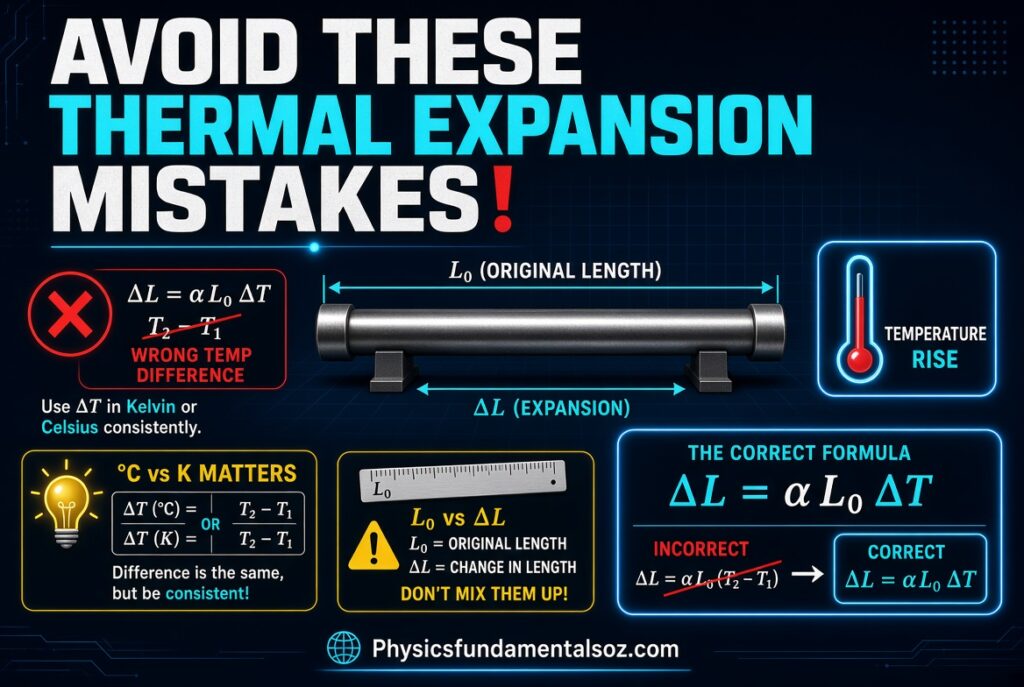
Most wrong answers come from a handful of slips. Check your work against this list.
Using the Final Temperature Instead of ΔT
The formula needs the temperature change, not the final temperature. A rod heated from 20°C to 80°C has ΔT = 60°C. Using 80 will overstate the answer by a third.
Mixing Celsius and Fahrenheit
A coefficient given per °C must be used with a ΔT in °C. A coefficient per °F needs ΔT in °F. Converting only one of them gives an answer that is off by a factor of 1.8.
Using Kelvin Wrongly
Kelvin and Celsius have the same size degree. A ΔT of 50 K equals a ΔT of 50°C. Do not add 273 to a temperature difference. Only add 273 when you convert an actual temperature.
Some online examples add 273 to ΔT and get absurd coefficients. That is an error.
Forgetting the Exponent
A coefficient of 12 × 10⁻⁶ is 0.000012. Dropping the exponent by one place changes your answer tenfold. Use scientific notation and double-check the calculator entry.
Losing the Sign
When a rod cools, ΔT is negative. Many students drop the sign and report a growth instead of a shrink. Keep the sign through every step.
Mixing Length Units
If L₀ is in centimeters, ΔL comes out in centimeters. Do not combine a length in millimeters with a coefficient meant for meters without converting.
Using a Wrong Coefficient
Steel is not one number. Carbon steel, stainless steel, and tool steel differ. Aluminum alloys differ too. Always match the coefficient to your alloy when accuracy matters.
Forgetting That Constrained Rods Behave Differently
If the rod is held in place, it will not change length by the free-expansion formula. It builds stress instead. Use σ = EαΔT in that case.
How Accurate Is the Simple Formula?
The simple formula ΔL = αL₀ΔT assumes α stays constant. That is a good approximation for small temperature ranges. It gets worse over large ranges.
Why α Changes With Temperature
At higher temperatures, atomic vibrations are larger and the lattice becomes more anharmonic. The coefficient creeps upward. Near phase transitions, it can change sharply.
For example, iron and steel show noticeable shifts near the temperatures where their crystal structure changes.
The Integral Form for Large Temperature Ranges
For high accuracy, write the fractional change as an integral: ΔL ÷ L₀ = ∫ α(T) dT, from T_initial to T_final. In practice, use the tabulated mean coefficient for the range, or a polynomial fit from a data sheet.
Choosing the Mean Coefficient
If a data sheet lists α for 20 to 100°C and 20 to 300°C separately, use the one that matches your range. The second value is usually a bit higher.
Significant Figures
The inputs are rarely more precise than two or three significant figures. Report ΔL with the same level of precision. A result like 2.4 mm is more honest than 2.4000 mm.
Does a Hollow Tube Expand the Same as a Solid Rod?
Yes, the length change is the same for a tube and a solid rod of the same metal, length, and temperature change. Expansion is a fractional change in each dimension. The hollow center does not alter that fraction.
The tube’s diameter and wall thickness also expand by the same fraction. The inner hole grows too.
Does the Diameter Change?
Yes. A rod’s diameter increases by ΔD = αD₀ΔT. For a 20 mm steel rod heated by 100°C, ΔD = 12 × 10⁻⁶ × 20 × 100 = 0.024 mm. That is small but important for tight fits.
Does Mass Change?
No. Mass stays constant. Volume increases, so density decreases slightly when a metal is heated.
Real-World Uses of Thermal Expansion Calculations
Engineers calculate rod expansion every day. The formula protects structures and makes devices work.
Railway Tracks
Steel rails expand in summer sun. Without gaps or special welded designs, they buckle. A 30 m steel rail warming by 50°C grows about 18 mm.
Modern continuous welded rail is pre-stressed and anchored to handle the load. Older tracks use small gaps between sections.
Bridges and Expansion Joints
Large bridges use expansion joints, rollers, and sliding bearings. These let the deck move freely as temperature changes. Joint sizing starts with the same ΔL = αL₀ΔT calculation, with a safety margin.
Pipelines and Steam Pipes
Long pipes carrying hot fluids expand a lot. Designers add loops, bends, or bellows to absorb movement. Without them, pipes can twist, leak, or damage supports.
Power Lines
Overhead power lines are longer and sag more on hot days. They are strung with allowance for summer sag and winter tension. In cold weather they tighten and shorten.
Shrink Fitting
Machinists heat a metal ring so its hole expands, slip it over a shaft, then let it cool. As it contracts, it grips tightly. The calculation tells them how much to heat the part.
Engines and Pistons
Engine parts are made with clearances that account for expansion. Aluminum pistons expand more than steel cylinders, so designers allow for that difference when setting tolerances.
Bimetallic Thermostats
A strip of two bonded metals bends when heated because one side expands more. This simple mechanism has been used in thermostats, oven controls, and circuit breakers.
Precision Instruments
Telescopes, lasers, and measuring tools use low-expansion materials such as Invar or glass-ceramics. These keep dimensions stable when the room warms or cools.
Concrete and Steel Together
Steel and concrete expand by nearly the same amount, about 12 × 10⁻⁶ /°C. That match is one reason reinforced concrete works so well. The two do not tear apart under normal temperature changes.
Worked Design Example: Sizing an Expansion Gap
Suppose you are installing a 12 m aluminum handrail. Winter low is −15°C and summer high is 45°C. How much should the rail be allowed to move?
Step 1: Find the Temperature Range
ΔT = 45 − (−15) = 60°C.
Step 2: Calculate Total Movement
ΔL = (23 × 10⁻⁶) × 12 × 60 = 0.01656 m ≈ 16.6 mm
Step 3: Add a Safety Margin
Designers typically add some extra clearance so the part never binds. A margin of 10 to 25 percent is common, depending on the code or standard in use. A 20 percent margin gives about 20 mm of total movement.
Step 4: Split the Gap if Needed
If the rail is fixed at one end, all movement happens at the free end. If it is fixed in the middle, each end moves half as much. Plan the joint layout accordingly.
Worked Example: Heating a Ring for a Shrink Fit
A steel ring has an inner diameter of 50.00 mm at 20°C. The shaft it must fit over is 50.05 mm in diameter. To what temperature must the ring be heated to slip on easily with 0.05 mm of extra clearance? Use α = 12 × 10⁻⁶ /°C.
Solution
Required diameter increase = 50.05 − 50.00 + 0.05 = 0.10 mm.
ΔT = ΔD ÷ (α × D₀) = 0.10 ÷ (12 × 10⁻⁶ × 50.00) = 0.10 ÷ 6.0 × 10⁻⁴ ≈ 167°C.
T_final = 20 + 167 = about 187°C.
This kind of calculation guides real workshop practice. The heat must stay below the temperature that would change the metal’s properties.
How to Measure Thermal Expansion of a Metal Rod in a Lab
Physics classes often measure the coefficient of linear expansion directly. The method is simple and shows the formula at work.
Typical Lab Setup
- A metal rod, usually brass, copper, aluminum, or iron.
- A steam generator or heated water bath.
- A dial gauge or dial indicator to measure length change.
- A thermometer to record temperature.
- A ruler or caliper to measure the original length.
Procedure
- Measure the rod’s length at room temperature and record the temperature.
- Mount the rod so one end is fixed and the other touches the dial gauge.
- Pass steam through the rod or surround it with hot water.
- Wait until the rod reaches steady temperature, near 100°C for steam.
- Read the dial gauge to find ΔL.
- Calculate α = ΔL ÷ (L₀ΔT).
Why the Result Is Often Off
Expect some error. Heat loss to the stand, slow warming, and the thermometer’s position all matter. The rod may not be at uniform temperature.
Use a fresh, cool rod for each trial. Reusing a warm rod gives a smaller ΔT than you think.
Percent Error
Compare your measured α with the accepted value. Percent error = |measured − accepted| ÷ accepted × 100. A good lab result lands within a few percent. Many student results fall within 10 percent.
Advanced Methods
Dilatometers measure tiny length changes with great precision. Some use an optical lever or a laser interferometer. Researchers use them to map how α varies across a wide temperature range.
Practice Problems With Answers
Try these on your own, then check the solutions.
Problem 1
A 4.0 m copper pipe warms from 10°C to 70°C. Find ΔL. Use α = 17 × 10⁻⁶ /°C.
Answer: ΔT = 60. ΔL = 17 × 10⁻⁶ × 4.0 × 60 = 4.08 × 10⁻³ m ≈ 4.1 mm.
Problem 2
A 100 cm steel rod is cooled from 25°C to −35°C. Find the final length. Use α = 12 × 10⁻⁶ /°C.
Answer: ΔT = −60. ΔL = 12 × 10⁻⁶ × 100 × (−60) = −0.072 cm. Final length = 99.928 cm.
Problem 3
An unknown metal rod is 2.00 m long and grows by 1.1 mm when heated by 25°C. Find α and guess the metal.
Answer: α = 0.0011 ÷ (2.00 × 25) = 2.2 × 10⁻⁵ /°C. That is close to aluminum.
Problem 4
A 50 m aluminum cable goes from 0°C to 40°C. How much longer does it get? Use α = 23 × 10⁻⁶ /°C.
Answer: ΔL = 23 × 10⁻⁶ × 50 × 40 = 0.046 m = 46 mm.
Problem 5
A 1 m iron rod is raised from 20°C to 150°C. Find ΔL. Use α = 12 × 10⁻⁶ /°C.
Answer: ΔT = 130. ΔL = 12 × 10⁻⁶ × 1 × 130 = 1.56 × 10⁻³ m = 1.56 mm.
Problem 6
A steel rod of cross-section 2.0 cm² is clamped at both ends and heated by 30°C. Find the compressive force. Use E = 200 GPa and α = 12 × 10⁻⁶ /°C.
Answer: σ = 200 × 10⁹ × 12 × 10⁻⁶ × 30 = 7.2 × 10⁷ Pa. A = 2.0 × 10⁻⁴ m². F = 7.2 × 10⁷ × 2.0 × 10⁻⁴ = 1.44 × 10⁴ N = 14.4 kN.
Problem 7
Which expands more: a 1 m brass rod or a 3 m iron rod, each heated by the same amount? Use brass 19 × 10⁻⁶ and iron 12 × 10⁻⁶.
Answer: Per degree, brass grows 19 × 10⁻⁶ m and iron grows 36 × 10⁻⁶ m. The 3 m iron rod expands more because it is so much longer.
Problem 8
Heating a 2.5 m steel rod by 80°C should leave a clearance of 1 mm to the wall. How large should the initial gap be if the wall does not move? Use α = 12 × 10⁻⁶ /°C.
Answer: ΔL = 12 × 10⁻⁶ × 2.5 × 80 = 2.4 × 10⁻³ m = 2.4 mm. Required gap = 2.4 + 1 = 3.4 mm.
Deriving the Thermal Expansion Formula
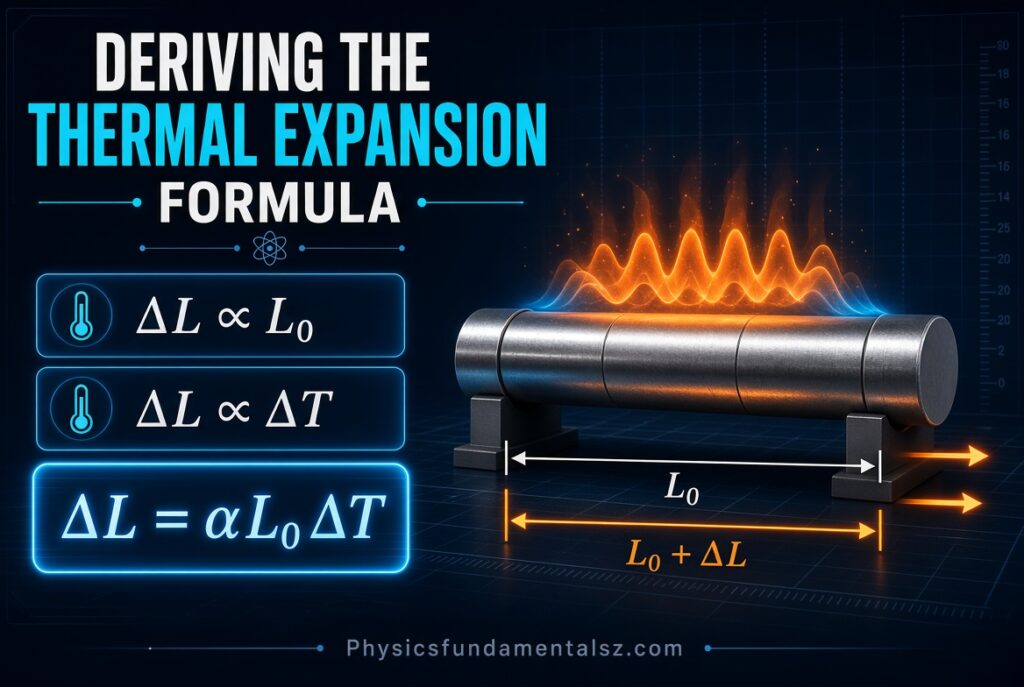
The formula is an experimental result, but you can see where it comes from with a simple idea. Over small ranges, length grows in a straight line as temperature rises.
The Linear Model
Suppose the length L depends on temperature T in a straight line. Then each degree adds the same extra length. Call the added length per degree per meter α. For a rod of length L₀, one degree adds αL₀.
From Slope to Formula
For ΔT degrees, the total addition is ΔL = αL₀ΔT. That is the formula. The coefficient α is simply the slope of the fractional length change against temperature.
The Differential Version
Write the change in an infinitesimal step as dL = αL dT. Integrating gives L = L₀ e^(αΔT). For tiny αΔT, this equals L₀(1 + αΔT), which is the familiar form.
The exponential version helps when ΔT is large. For ordinary rods and ordinary temperatures, the difference is far too small to matter.
Expansion vs Heat: How Much Energy Does It Take?
Thermal expansion tells you how much a rod grows. It does not tell you how much heat you need. For that, use the heat equation Q = mcΔT, where m is mass and c is specific heat capacity.
Worked Example Linking Both
A steel rod is 2.0 m long with a cross-section of 4.0 cm². Its density is 7,850 kg/m³ and its specific heat is about 490 J/kg·K. How much heat raises it by 100°C, and how much does it expand?
Volume = 2.0 × 4.0 × 10⁻⁴ = 8.0 × 10⁻⁴ m³.
Mass = 7,850 × 8.0 × 10⁻⁴ = 6.28 kg.
Q = 6.28 × 490 × 100 ≈ 3.1 × 10⁵ J, about 308 kJ.
ΔL = 12 × 10⁻⁶ × 2.0 × 100 = 2.4 mm.
What You Learn From This
It takes more than 300,000 joules to stretch a two-meter steel rod by only 2.4 mm. Most of the heat goes into making atoms vibrate harder, not into the visible growth. Expansion is a small side effect of a large energy input.
Thermal Expansion of Very Large Structures
Even small coefficients add up over long lengths. Large structures show clear seasonal movement.
The Eiffel Tower Example
The Eiffel Tower is about 330 m tall and built from iron. Its coefficient is near 12 × 10⁻⁶ /°C. If the temperature of the iron changes by 40°C between a cold day and a hot day:
ΔL = 12 × 10⁻⁶ × 330 × 40 ≈ 0.16 m
The tower grows about 16 cm taller in summer. Tour guides often quote a figure of around 15 cm, which matches the physics.
Why the Calculation Is Only an Estimate
Different parts of the structure sit in sun or shade. They do not all reach the same temperature. Real movement depends on the temperature of each member, not one air temperature.
Sidewalks and Concrete Slabs
Concrete slabs expand in summer. Engineers cut joints in sidewalks and roads so cracks form in neat lines instead of random places. The joints also give the slabs room to move.
Low-Expansion Alloys and Special Materials
Some applications cannot tolerate even small dimensional changes. Special materials solve this problem.
Invar
Invar is an iron and nickel alloy with about 36 percent nickel. Its coefficient is around 1.2 × 10⁻⁶ /°C near room temperature, roughly ten times lower than steel. It was invented in the 1890s and won its inventor, Charles Édouard Guillaume, a Nobel Prize in Physics in 1920.
Invar is used in precision instruments, clock pendulums, and surveying equipment.
Glass-Ceramics
Materials such as Zerodur have near-zero expansion at room temperature. Telescope mirrors use them so that temperature shifts do not distort the image.
Negative Thermal Expansion
A few materials shrink when heated over certain ranges. Zirconium tungstate is one example. Scientists use such materials to cancel the expansion of others in composites.
Matching Materials in Assemblies
When two different materials are bonded, mismatched expansion causes stress. Electronics designers choose materials with similar coefficients so chips and boards do not crack when they warm up.
Comparison of Material Choices
| Goal | Good material choice | Reason |
|---|---|---|
| Structures with steel | Concrete, steel | Similar α, about 12 × 10⁻⁶ /°C |
| Heat sinks | Aluminum, copper | High conductivity, but larger expansion |
| Precision gauges | Invar | Very low α |
| Telescope mirrors | Glass-ceramic | Near-zero α |
| Thermostat strips | Brass and steel pair | Different α gives bending |
Bimetallic Strip Calculation
A bimetallic strip is two thin strips of different metals bonded together. When heated, one side expands more, so the strip curves.
How the Bending Works
Suppose brass (α = 19 × 10⁻⁶) is bonded to steel (α = 12 × 10⁻⁶). Heated by 100°C, a 10 cm strip would want to lengthen by 0.19 mm in brass and 0.12 mm in steel.
The difference is 0.07 mm. Because they are bonded, the strip bends toward the steel side. The brass ends up on the outside of the curve.
Using the Strip as a Switch
When the strip bends far enough, it opens or closes an electrical contact. That is how many simple thermostats and old-style turn signals work.
Thermal Expansion of Measuring Tools
Metal rulers, tapes, and calipers expand too. Standards for dimensional measurement call for 20°C as the reference temperature. Measurements taken at other temperatures may need correction.
Correcting a Steel Tape Reading
A steel tape reads 30.000 m at 20°C. On a hot day at 40°C, the tape itself has stretched, so it reads too small for a given real distance. The tape’s length at 40°C is 30 × (1 + 12 × 10⁻⁶ × 20) = 30.0072 m.
A surveyor must add about 7 mm to a 30 m reading to correct for this.
Why Machinists Let Parts Cool
A freshly machined metal part is warm from cutting. If measured while warm, it will shrink as it cools and may end up undersized. Precision shops wait or measure in a controlled room.
Pendulum Clocks and Temperature
A pendulum’s period depends on its length. A rod that lengthens in summer swings more slowly, so the clock runs slow. Clockmakers developed compensated pendulums that use two metals to keep length steady.
The Gridiron Pendulum
A gridiron pendulum uses rods of steel and brass arranged so that their expansions cancel. The effective length stays almost constant. This is an elegant mechanical use of the coefficient values you have been using.
Thermal Expansion in Liquids and Gases
Rods are solids, but liquids and gases also expand. The idea is similar, but the coefficient of volume expansion matters more, because liquids take the shape of their container.
Liquids
Mercury and alcohol expand predictably, which is why they work in thermometers. Water behaves strangely near 4°C, where it is densest. Between 0°C and 4°C, water contracts when heated.
Gases
An ideal gas expands in proportion to its absolute temperature at constant pressure. This is Charles’s law. Its volume expansion is much larger than solids or liquids.
Why Solids Are Easier to Calculate
Solids keep their shape. A single coefficient and a single length are usually enough. That makes the rod problem a clean introduction to thermal expansion.
Frequently Confused Ideas
Several terms get mixed up. Clearing them up prevents errors.
Thermal Expansion vs Heat Capacity
Heat capacity says how much energy changes the temperature. Thermal expansion says how much size changes for a given temperature change. They are different properties.
Coefficient of Linear vs Volumetric Expansion
Linear expansion refers to length. Volumetric expansion refers to volume. For solids, β ≈ 3α.
Expansion vs Melting
Expansion happens at all temperatures below melting. It is a small, reversible change. Melting is a phase change and needs much more energy.
Temperature vs Heat
Temperature measures average atomic motion. Heat is energy in transfer. The expansion formula uses temperature change, not the amount of heat directly.
Thermal Strain: Thinking in Fractions Instead of Lengths
Engineers often talk about thermal strain instead of length change. Strain is the fractional change in length. It lets you compare rods of any size on equal terms.
The Strain Formula
Thermal strain ε = ΔL ÷ L₀ = α × ΔT. Notice that L₀ cancels. Strain depends only on the material and the temperature change.
Example in Parts per Million
A steel rod heated by 100°C has a strain of 12 × 10⁻⁶ × 100 = 1.2 × 10⁻³. That equals 1,200 parts per million, or 0.12 percent. Aluminum under the same heating has a strain of 2,300 parts per million.
Why Strain Is Useful
Once you know the strain, you can multiply by any length. A 1 m rod grows by 1.2 mm. A 100 m rod grows by 120 mm. The strain stays the same.
Unit Conversion Cheat Sheet for Thermal Expansion
Mixed units cause many mistakes. Use this table to convert quickly and safely.
| Quantity | Conversion |
|---|---|
| 1 m | 1,000 mm = 100 cm |
| 1 mm | 0.001 m |
| 1 inch | 25.4 mm |
| ΔT in °F to °C | Divide by 1.8 |
| ΔT in °C to K | Same number |
| α in per °F to per °C | Multiply by 1.8 |
| α in per °C to per °F | Divide by 1.8 |
| 10⁻⁶ | One part per million (ppm) |
Example Conversion
Steel has α = 12 × 10⁻⁶ /°C. In per °F, that is 12 × 10⁻⁶ ÷ 1.8 = 6.7 × 10⁻⁶ /°F. Heating a 100 inch rod by 100°F gives 6.7 × 10⁻⁶ × 100 × 100 = 0.067 inches.
Temperatures vs Temperature Changes
Never convert a temperature difference the same way you convert a temperature. To convert 100°F to °C as a temperature, subtract 32 and divide by 1.8. To convert a 100°F change to °C, just divide by 1.8, which gives 55.6°C.
A Quick Checklist for Solving Any Rod Expansion Problem
Use this checklist whenever you face a new problem. It works for homework, exams, and workshop jobs.
Before You Calculate
- Is the rod free to expand, or is it clamped?
- Is the temperature change small enough for a constant α?
- Which metal or alloy is it?
- Which temperature unit does the coefficient use?
While You Calculate
- Convert all lengths to one unit.
- Write ΔT with the correct sign.
- Use scientific notation for α.
- Keep units visible on every line.
After You Calculate
- Check that the answer is a tiny fraction of the original length.
- Check that the sign matches heating or cooling.
- Round to the precision of your inputs.
- Add a safety margin if you are sizing a real gap.
Why Metals Expand More Than Many Other Solids
Metals sit in the middle of the range of solids. They expand more than glasses and ceramics, but less than most plastics.
Comparison With Other Materials
| Material | Typical α (× 10⁻⁶ /°C) |
|---|---|
| Aluminum | 23 |
| Steel | 12 |
| Glass (soda-lime) | 9 |
| Concrete | 12 |
| Wood (along the grain) | 3 to 5 |
| Common plastics (polyethylene) | 100 to 200 |
| Invar | About 1.2 |
Plastics expand so much that they need generous gaps in pipes and panels. Wood along the grain barely moves with temperature, though it swells and shrinks with moisture.
Why This Matters for Design
When you join different materials, such as a plastic cover on an aluminum frame, the mismatch produces warping or cracking. A coefficient table helps you predict the problem before you build anything.
Classic Textbook Problems on Rod Expansion
Physics courses use a few standard problem types. Knowing them saves time on exams.
Problem Type 1: Two Rods With a Constant Length Difference
Two rods, one steel and one brass, must keep the same length difference at every temperature. Find the ratio of their lengths. Use α_steel = 12 × 10⁻⁶ and α_brass = 19 × 10⁻⁶.
For the difference to stay constant, both rods must expand by the same amount. So α_s × L_s = α_b × L_b.
L_s ÷ L_b = α_b ÷ α_s = 19 ÷ 12 ≈ 1.58
If the brass rod is 1.00 m long, the steel rod must be about 1.58 m long. The constant difference is 0.58 m.
Problem Type 2: Composite Rod Made of Two Metals
A rod is made of 1.0 m of steel joined end to end with 1.0 m of aluminum. It is heated by 50°C. Find the total change in length.
Steel: ΔL = 12 × 10⁻⁶ × 1.0 × 50 = 0.60 mm.
Aluminum: ΔL = 23 × 10⁻⁶ × 1.0 × 50 = 1.15 mm.
Total: 0.60 + 1.15 = 1.75 mm. Add the expansions of each segment because they sit in series.
Problem Type 3: Rod Heated Unevenly
A 2.0 m steel rod starts at 20°C. One end stays at 20°C and the other end is heated to 120°C. The temperature varies in a straight line along the rod. Find the total expansion.
The average temperature is 70°C, so the average rise is 50°C.
ΔL = 12 × 10⁻⁶ × 2.0 × 50 = 1.2 mm.
For a straight-line temperature gradient, use the average temperature change over the length.
Problem Type 4: Rod Between Two Walls With a Small Gap
A 1.000 m steel rod sits between two rigid walls with a 0.5 mm gap total. It is heated by 100°C. Find the stress that develops. Use E = 200 GPa.
Free growth: 12 × 10⁻⁶ × 1.000 × 100 = 1.2 mm.
The gap absorbs 0.5 mm. The remaining 0.7 mm is blocked by the walls.
Strain blocked = 0.7 × 10⁻³ ÷ 1.000 = 7.0 × 10⁻⁴.
Stress = E × strain = 200 × 10⁹ × 7.0 × 10⁻⁴ = 1.4 × 10⁸ Pa = 140 MPa.
This assumes the walls are perfectly rigid. Real supports flex a little, so the real stress is somewhat lower.
Problem Type 5: Two Rods Touching a Gap
A 0.50 m aluminum rod and a 0.50 m steel rod are placed end to end between walls. How much do they expand together when heated by 80°C? Use α_Al = 23 × 10⁻⁶ and α_steel = 12 × 10⁻⁶.
Aluminum: 23 × 10⁻⁶ × 0.50 × 80 = 0.92 mm.
Steel: 12 × 10⁻⁶ × 0.50 × 80 = 0.48 mm.
Total: 1.40 mm. A gap smaller than 1.40 mm would close and create stress.
What Affects How Much a Metal Rod Expands?
Four factors decide the size of the change. Two come from the rod itself, one from the metal, and one from the environment.
Original Length
Longer rods expand more. Doubling L₀ doubles ΔL. A 20 m rail expands twice as much as a 10 m rail.
Temperature Change
A bigger temperature swing causes more expansion. Doubling ΔT doubles ΔL, as long as α stays constant.
Material
The coefficient α is the property of the metal. Aluminum, zinc, and lead expand a lot. Steel and iron expand moderately. Invar and tungsten expand very little.
Constraints
A rod that is free to expand will change length. A rod held in place will build stress instead. In real structures, partial constraint is common, so both effects appear together.
Everyday Examples of Metal Expansion
You can see the effects of expansion in daily life. These examples help the formula feel real.
Loosening a Jar Lid
A tight metal lid can be freed by running it under hot water. The metal lid expands more than the glass jar and loosens its grip. The coefficient of metal is higher than that of glass.
Door Hinges and Gates
Metal gates may stick in summer heat if they have too little clearance. Installers leave small gaps to avoid this. The gap is usually a few millimeters.
Overhead Cables on Hot Days
Utility lines look looser in summer. The metal wire has grown longer, so it hangs lower. In winter the line contracts and pulls tighter.
Cookware
Metal pans may warp if heated unevenly. One area expands faster than another, which bends the pan. Thick-bottomed pans reduce this effect by spreading heat.
Kettles and Pipes That Tick
Pipes sometimes tick or creak as they warm up and cool down. The metal expands and slips against its supports. The sound is the sign of tiny movements that follow the same formula.
Design Tips for Handling Rod Expansion in Real Projects
Calculating ΔL is the first step. The next step is using it to make good design choices.
Let One End Float
Fix a long rod at one end and let the other end slide. This lets it lengthen freely without stress. Use slotted holes, sliding bearings, or rollers for the free end.
Use Expansion Loops and Bellows
In piping, bends and loops absorb movement. Metal bellows can compress and extend with temperature. Both options keep stress low in rigid systems.
Match Materials When Possible
If two parts are joined, pick metals with similar coefficients. A steel bolt in an aluminum housing is a common mismatch. The aluminum grows faster, which can loosen the bolt when hot.
Allow for Both Extremes
Design for the coldest and hottest temperatures the part will see. Include sun exposure, which can make metal surfaces much hotter than the air. A dark metal roof can run tens of degrees above air temperature.
Account for Installation Temperature
Measure the temperature when the part is installed. A rail laid on a cold day will expand more in summer than one laid on a hot day. The installation temperature is the starting point for ΔT.
Build In a Safety Margin
Real conditions are uncertain. Add a margin to the calculated gap. Check the building code, industry standard, or manufacturer guidance for the recommended margin.
Verify With Measurement
For critical parts, measure actual movement after installation. Dial gauges, strain gauges, or simple marks can confirm that the design works as predicted.
Using the Formula Responsibly
The formula gives estimates. It does not replace engineering judgment for safety-critical structures. Bridges, pressure piping, and aircraft parts need professional design that follows applicable codes.
For homework, labs, and small workshop jobs, the simple formula is a reliable tool. For anything where failure could hurt someone, consult a qualified engineer.
Key Takeaways: How to Calculate Thermal Expansion of a Metal Rod
- Use ΔL = α × L₀ × ΔT for the change in length.
- Final length is L = L₀(1 + αΔT).
- ΔT is final temperature minus initial temperature.
- Match the temperature unit in α with your ΔT.
- Aluminum expands about twice as much as steel for the same heating.
- A rod that cannot expand develops thermal stress σ = EαΔT.
- Area expansion uses 2α, and volume expansion uses 3α.
- Real α changes slightly with temperature, so use mean values for large ranges.
- Engineers use these calculations for expansion joints, rails, pipes, and precision parts.
- Always check the sign. Cooling gives a negative ΔL.
Also Read:
- Thermal Expansion: Formula ΔL = αL₀ΔT, Types & Worked Examples
- Stress, Strain & Young’s Modulus: E = sigma/epsilon Formula & Examples
- Specific Heat Capacity
- Thermal Energy & Internal Energy: Heat, Temperature & Q = mcΔT
- Heat Transfer: Conduction, Convection and Radiation
- Why Does Metal Feel Colder Than Wood at Room Temperature? The Physics of Heat Flow Explained 2026
- The Kinetic Theory of Gases
- The First Law of Thermodynamics
- The Second Law of Thermodynamics
- Entropy Explained for Beginners Easy Guide 2026
- Entropy Explained
- Boyle’s, Charles’ & Gay-Lussac’s Gas Laws: Formulas & Examples
- Ideal Gas Law: PV = nRT
- Ideal Gas Law Calculator With Steps: PV = nRT Formula & Examples 2026
- Ideal Gas Law Practice Problems With Answers (2026 Study Guide)
- How Do Heat Engines Work Step by Step? Key Concepts Explained 2026
- Physics Fundamentals: The Complete Guide to Core Concepts, Laws, and Equations
- Difference Between Speed and Velocity With Examples (2026 Guide)
- How to Calculate Acceleration From a Velocity Time Graph 2026
- Projectile Motion Formula for Angled Launch Explained (2026 Guide)
- What Is the Formula for Conservation of Momentum? 2026
- How to Derive Wave Speed Formula? Full Derivation Guide 2026
Frequently Asked Questions (FAQs)
How do you calculate the thermal expansion of a metal rod?
Multiply the coefficient of linear expansion by the original length and by the temperature change: ΔL = α × L₀ × ΔT. Add ΔL to the original length to get the final length. Keep the temperature unit in α consistent with your ΔT.
What is the formula for linear thermal expansion?
The formula is ΔL = αL₀ΔT. It can also be written as L = L₀(1 + αΔT). Here α is the coefficient of linear expansion, L₀ is the original length, and ΔT is the temperature change.
What is the coefficient of linear expansion?
It is a material property that gives the fractional change in length per degree of temperature change. It is written α and has units of 1/°C or 1/K. For steel it is about 12 × 10⁻⁶ /°C.
What is the coefficient of thermal expansion for steel?
Carbon steel is typically about 12 × 10⁻⁶ /°C, or about 6.7 × 10⁻⁶ /°F. Stainless steels such as 304 are higher, near 17 × 10⁻⁶ /°C. Always check the alloy.
What is the coefficient of thermal expansion for aluminum?
Aluminum is about 23 × 10⁻⁶ /°C, or about 12.8 × 10⁻⁶ /°F. Different alloys vary slightly, usually between about 21 and 24 × 10⁻⁶ /°C.
What is the coefficient of thermal expansion for copper?
Copper is about 17 × 10⁻⁶ /°C. Brass, which is a copper and zinc alloy, is slightly higher at about 19 × 10⁻⁶ /°C.
How much does a steel rod expand per degree?
A 1 m steel rod grows about 12 micrometers, or 0.012 mm, for each 1°C rise. A 10 m rod grows about 0.12 mm per degree. Multiply by the temperature change to get the total.
How do you find the final length of a heated rod?
Calculate ΔL = αL₀ΔT, then add it to the original length. You can also use L = L₀(1 + αΔT). For example, a 2.0 m steel rod heated by 100°C ends up 2.0024 m long.
Does a rod expand when cooled?
No, it shrinks. In that case ΔT is negative, so ΔL is negative. The same formula works for heating and cooling, as long as you keep the sign.
Do I use the final temperature or the temperature change?
Use the temperature change, ΔT = T_final − T_initial. Using the final temperature alone gives a wrong answer unless the starting temperature was zero.
Can I use Fahrenheit in the thermal expansion formula?
Yes, if α is given per °F. Otherwise convert ΔT to °C by dividing by 1.8 and use the per °C value. Never mix a per °C coefficient with a ΔT in °F.
Do I need to convert temperature to Kelvin?
No. A change of 1 K equals a change of 1°C. Use the temperature difference directly. Only add 273.15 when you convert an actual temperature, not a difference.
How do you find the coefficient of thermal expansion from data?
Rearrange the formula: α = ΔL ÷ (L₀ × ΔT). Measure the rod’s original length, the change in length, and the temperature change. Then divide.
How do you find the temperature change needed for a given expansion?
Use ΔT = ΔL ÷ (α × L₀). For example, a 3.0 m aluminum rod needs about a 72°C rise to grow by 5.0 mm.
Does a thicker rod expand more than a thin rod?
Length change depends on length, not thickness. A thick rod and a thin rod of the same metal and length expand by the same amount for the same temperature change. The thick rod’s diameter also expands more in absolute terms.
Does a hollow tube expand the same as a solid rod?
Yes, for length. Expansion depends on the original length, the coefficient, and the temperature change. A hollow center does not change that.
Why does a metal rod expand when heated?
Heating makes atoms vibrate with larger amplitude. Because the forces between atoms are asymmetric, their average separation grows. Over the whole rod, that adds up to a visible increase in length.
Which metal expands the most?
Among common metals, zinc and lead expand the most, near 29 to 30 × 10⁻⁶ /°C. Aluminum is also high. Invar and tungsten are examples of metals that expand very little.
What happens if a metal rod cannot expand?
It develops thermal stress. The stress equals Young’s modulus times the coefficient times the temperature change, σ = EαΔT. A clamped steel rod heated by 50°C can reach about 120 MPa.
How do you calculate thermal stress in a rod?
Use σ = E × α × ΔT. Multiply by the cross-sectional area to get force. For a steel rod with 1.0 cm² area heated by 50°C, the force is about 12 kN.
How much does a railway track expand in summer?
A 30 m steel rail warmed by 50°C expands about 18 mm. Modern welded rails are pre-stressed and anchored so they do not buckle. Older tracks use gaps between sections.
Why do bridges have expansion joints?
Bridge decks expand and contract with temperature. Joints give the steel and concrete room to move. Without them, the structure would build up huge forces and could crack or buckle.
What is the formula for area expansion?
ΔA = 2αA₀ΔT for isotropic solids. A plate’s area grows by about twice the linear fraction. The coefficient of area expansion is roughly 2α.
What is the formula for volume expansion?
ΔV = 3αV₀ΔT, or ΔV = βV₀ΔT where β ≈ 3α. The volume of a solid grows by about three times the linear fraction.
Does a hole in a metal plate get bigger or smaller when heated?
It gets bigger. The hole expands as if it were filled with the same metal. This is why heating a tight ring lets it slip over a shaft.
How accurate is the thermal expansion formula?
It is accurate for modest temperature ranges where α is nearly constant. For large ranges, use a mean coefficient for that range or integrate α over temperature. Alloy differences also affect accuracy.
How do you measure the thermal expansion of a rod in a lab?
Fix one end of the rod, heat it with steam or hot water, and read the length change on a dial gauge. Record the temperatures and original length. Then calculate α = ΔL ÷ (L₀ΔT).
What is Invar and why is it special?
Invar is an iron and nickel alloy with about 36 percent nickel. Its coefficient is near 1.2 × 10⁻⁶ /°C, far lower than steel. It is used where dimensions must stay stable.
How much expansion gap should I leave for a metal rod?
Calculate ΔL for the full temperature range, then add a safety margin. Margins of 10 to 25 percent are common, but follow the standard or code that applies to your project.
Is thermal expansion the same as heat capacity?
No. Thermal expansion describes how size changes with temperature. Heat capacity describes how much energy it takes to change temperature. They are separate properties.
Conclusion
To calculate the thermal expansion of a metal rod, use ΔL = α × L₀ × ΔT. Find the coefficient for your metal, take the temperature change as final minus initial, and multiply. Add the result to the original length for the final length.
The key habits are simple. Match your temperature units to the coefficient. Keep the sign for cooling. Use scientific notation. Check that the answer is a tiny fraction of the original length.
The same idea scales to area, volume, and thermal stress. Area expansion uses 2α, volume expansion uses 3α, and a rod that cannot move develops stress equal to EαΔT. That stress is why rails, bridges, and pipes need room to expand.
Once you can calculate a rod’s expansion confidently, you can size gaps, plan shrink fits, compare materials, and predict how a structure will behave through the seasons. A few millimeters of growth may look small on paper, but in the real world it is what separates a design that lasts from one that fails.