Why Does Sweat Cool You Down Physics Explanation: The Science of Evaporative Cooling 2026
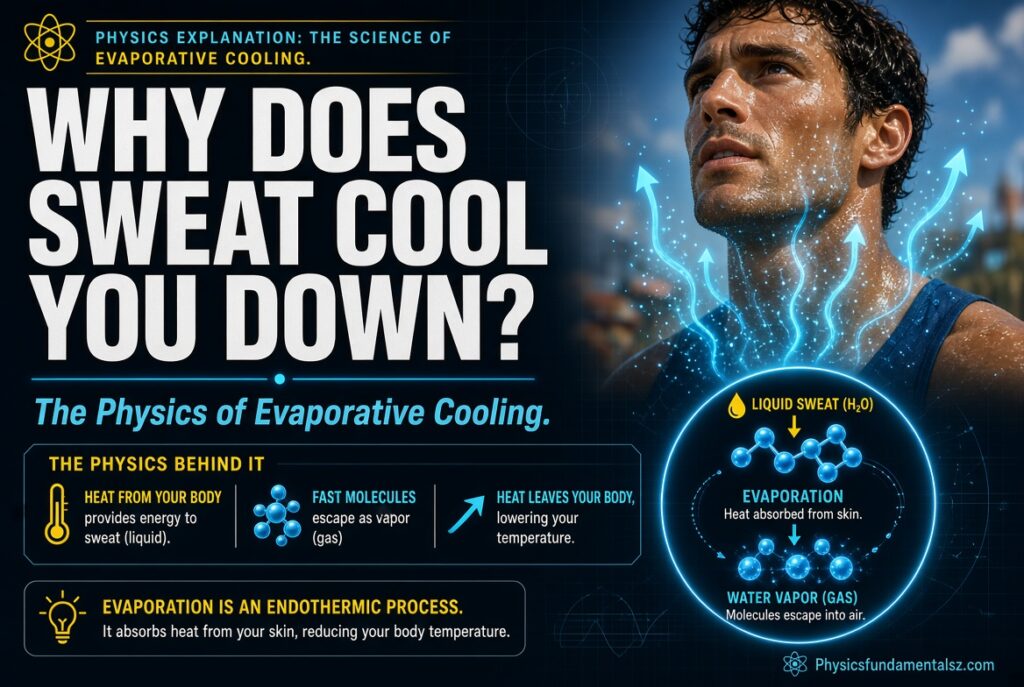
Sweat cools you down because liquid water needs a huge amount of energy to turn into vapor. That energy comes from your skin. When sweat evaporates, it pulls heat out of your body and carries it into the air.
The full Why Does Sweat Cool You Down Physics Explanation rests on four ideas: evaporation, latent heat, molecular motion, and energy conservation. Each one is simple on its own. Together they explain why a sweaty runner feels cooler in a breeze and why a humid day feels so heavy.
Here is the part most people miss. Sweat is not cold, and it does not cool you by simply sitting on your skin. The cooling happens at the moment of evaporation, when the fastest water molecules break free and take their energy with them.
Once you see that mechanism, everything else falls into place. Humidity, wind, fans, wet clothes, dogs panting, and even clay water pots all follow the same physical rule.
Table of Contents
Why Sweat Cools You Down
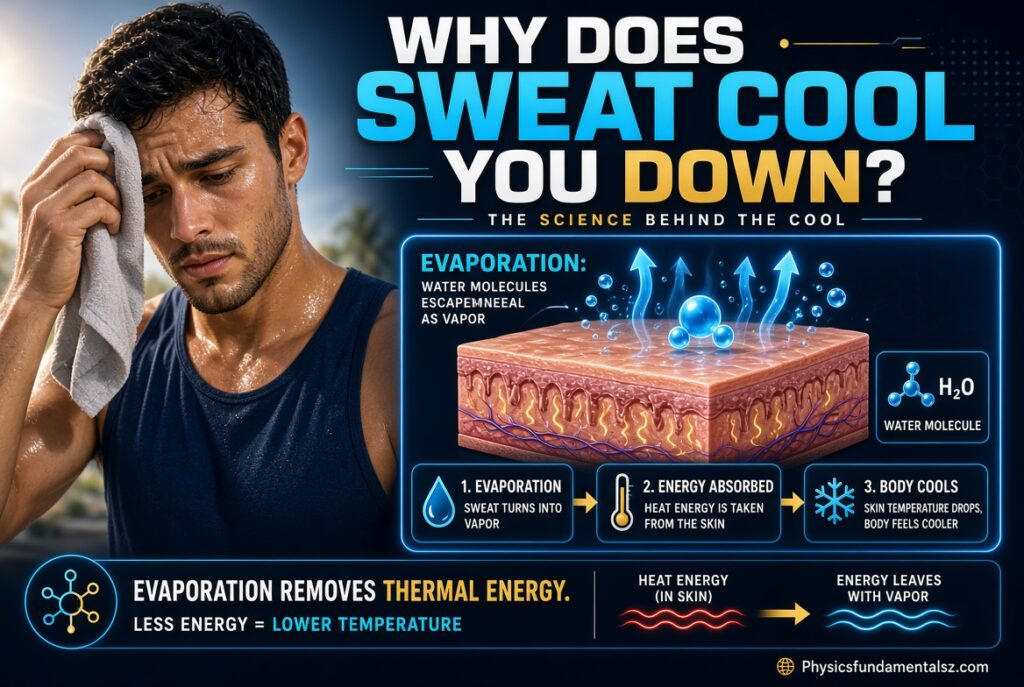
Evaporative cooling is the removal of heat from a surface when a liquid on it changes into vapor. Sweat cools the body because each gram of water that evaporates absorbs about 2,420 joules of heat from the skin.
- Sweat glands release a watery fluid onto the skin.
- Evaporation turns that liquid into vapor.
- Evaporation needs energy, called the latent heat of vaporization.
- That energy is taken from your skin and the blood beneath it.
- Cooler skin lets blood return to the core at a lower temperature.
- Your core temperature stays near 37°C (98.6°F).
What Is Sweat and Why Does the Body Make It
Sweat is a fluid made by glands in the skin. Its main job is to carry water to the surface so the water can evaporate. That makes sweat the body’s built-in liquid cooling system.
Your body makes heat all the time. Muscles, organs, and even digestion release thermal energy. If that heat had nowhere to go, your core temperature would climb within minutes of hard exercise.
Eccrine Sweat Glands
Humans have roughly two to four million eccrine sweat glands spread across the skin. They are most dense on the palms, soles, and forehead. They are the main glands used for temperature control.
Eccrine glands release a thin, watery fluid. It rises through a tiny duct and exits at a pore on the skin surface.
Apocrine Sweat Glands
Apocrine glands sit mostly in the armpits and groin. They release a thicker fluid that contains proteins and lipids. Skin bacteria break this fluid down, which is the source of body odor.
These glands play a small role in cooling. They respond more to stress and hormones than to heat. For the physics of cooling, eccrine sweat is what matters.
What Sweat Is Made Of
Eccrine sweat is about 99 percent water. The rest is a mix of sodium, chloride, potassium, and small amounts of urea, lactate, and other compounds. Sodium usually sits somewhere between 20 and 60 millimoles per liter.
That makes sweat more dilute than blood plasma. The body wants the water, and it keeps most of the salt. The water is the part that does the cooling.
Sweat Itself Does Not Smell or Feel Cold
Fresh eccrine sweat is nearly odorless. It leaves the pore at roughly skin temperature, about 33 to 35°C. It is not a cold liquid.
Wet skin feels cold only when evaporation is running. The chill comes from heat leaving, not from the sweat arriving.
How the Body Controls Temperature (Thermoregulation)
Thermoregulation is the process that keeps your core temperature steady. Your body targets about 37°C (98.6°F). Small drifts of one or two degrees already cause real problems.
Think of it as a thermostat with sensors, a control center, and several outputs. Sweating is the strongest output when you are hot.
The Hypothalamus as the Body’s Thermostat
The hypothalamus, a small region at the base of the brain, acts as the control center. Its preoptic area compares your current temperature with a set point. If you run warm, it sends out cooling commands.
Temperature sensors sit in your skin, spinal cord, and deep tissues. They feed the hypothalamus a constant stream of data. This is feedback control, the same idea used in a home thermostat.
How the Brain Triggers Sweating
When core temperature rises, nerves release a chemical messenger called acetylcholine onto the eccrine glands. The glands respond by pushing sweat onto the skin. Sweat output can increase from almost nothing to over a liter per hour.
At the same time, the skin’s blood vessels widen. This is called vasodilation. It brings warm blood close to the surface where sweat can cool it.
Core Temperature vs Skin Temperature
Your core sits near 37°C. Your skin is cooler, usually 33 to 34°C in comfortable conditions. That gap lets heat flow outward from the core to the skin.
Evaporating sweat lowers skin temperature further. A bigger gap means more heat flows out of the core. Cooling the skin is how the body cools the core.
Where Body Heat Comes From
Every chemical reaction in your cells releases some heat. At rest, a typical adult produces about 80 to 100 watts of heat. That is similar to an old incandescent light bulb.
Hard exercise changes the picture. Muscles are only about 20 to 25 percent efficient, so most of the energy they burn becomes heat. A running adult can generate several hundred watts of extra thermal power.
The Heat Balance Idea
Your body temperature stays steady when heat gained equals heat lost. Physicists and physiologists write this as a simple balance:
Heat produced + heat gained from surroundings = heat lost
Sweat evaporation sits on the “heat lost” side. When the other routes of heat loss fail, evaporation becomes the only one left.
What Is Evaporative Cooling
Evaporative cooling is a drop in temperature caused by liquid turning into vapor. The liquid takes energy from whatever it touches. That object then cools down.
It is a physical process, not a chemical one. Nothing new is created. Water simply changes its state from liquid to gas.
Evaporation vs Boiling
Evaporation happens at the surface of a liquid at any temperature. Boiling happens throughout the liquid at one specific temperature. Sweat evaporates at skin temperature, far below the 100°C boiling point.
Evaporation is slower than boiling, but it keeps working quietly. A puddle dries on a warm day without ever boiling. Your sweat does the same thing.
Why Evaporation Is an Endothermic Process
An endothermic process absorbs heat from its surroundings. Evaporation is a clear example. The water gains energy while the skin loses it.
The reverse process is condensation. Condensing vapor releases heat. That is why steam burns are so severe and why a cold glass of water “sweats” on a humid day.
A Simple Way to Feel It
Wet your fingertip and hold it up in the air. One side feels cool. The cool side is the side facing the moving air, where evaporation is fastest.
You just built a tiny evaporative cooler. The same physics runs across your whole body when you sweat.
Heat of Vaporization of Water Explained
The heat of vaporization of water is the energy needed to turn liquid water into vapor without changing its temperature. It is the single most important number behind sweat cooling. Water’s value is unusually large.
At skin temperature, evaporating one gram of water absorbs about 2,420 joules. That is roughly 0.58 kilocalories, the unit used on food labels. Few common liquids come close on a per-gram basis.
What Latent Heat Means
Latent heat is energy that goes into changing a substance’s state instead of changing its temperature. You can add heat to boiling water and the thermometer stays at 100°C. The extra energy is busy turning liquid into steam.
Sweat works the same way at a much lower temperature. The skin supplies the energy. The sweat changes state. The skin temperature falls.
Latent Heat of Vaporization of Water at Skin Temperature
The value changes slightly with temperature. Here are typical figures for water.
| Temperature | Latent heat of vaporization (approx.) |
|---|---|
| 25°C (77°F) | 2,442 J/g |
| 35°C (95°F) | 2,418 J/g |
| 100°C (212°F) | 2,260 J/g |
At the temperature of human skin, a figure near 2,420 J/g is a good working number. This article uses it in every calculation below.
Why Water Has Such a High Heat of Vaporization
Water molecules stick to each other through hydrogen bonds. Each molecule forms roughly three to four of them with its neighbors. Breaking free of that network takes a lot of energy.
Compare that with a liquid like ether, whose molecules hold on to each other weakly. Ether evaporates fast and absorbs much less energy per gram. Water’s strong bonding is why it is such an effective coolant.
The Sensible Heat Myth
A common question is whether sweat cools you by carrying away its own warmth. The answer is mostly no. Warming a gram of water by 4°C takes only about 17 joules.
Evaporating that gram takes about 2,420 joules. The latent heat is more than 140 times larger. Evaporation, not warm liquid leaving, does nearly all the work.
A Surprising Comparison
Here is a useful way to feel the size of latent heat. The energy needed to evaporate one gram of water could heat that same gram by roughly 580°C, if it could stay liquid. That is why a tiny amount of sweat has a big cooling effect.
The Molecular Physics of Evaporation
To see why evaporation cools, you have to zoom in to the molecules. A drop of sweat contains an enormous number of water molecules in constant motion. They bump, jiggle, and swap energy every instant.
Temperature measures the average kinetic energy of those molecules. Some move faster than average, and some move slower. That spread is the key.
Molecules Move at Different Speeds
At any temperature, molecules in a liquid have a range of speeds. Physicists describe this spread with the Maxwell-Boltzmann distribution. Most molecules sit near the average, but a few have much more energy.
Only the high-energy molecules near the surface can escape. They need enough energy to overcome the hydrogen bonds holding them in the liquid. Slower molecules stay behind.
Why the Leftover Liquid Gets Cooler
When the fastest molecules leave, the average energy of those remaining drops. A lower average kinetic energy means a lower temperature. The liquid cools.
Cooler sweat then absorbs heat from the warmer skin beneath it. The skin loses energy to the sweat layer. That is the heat flow that cools you.
The Energy Cost per Molecule
Per molecule, the energy needed to escape is about 0.46 electron-volts at skin temperature. The average thermal energy of a molecule at body temperature is only about 0.04 electron-volts. Escape takes roughly ten times the average.
That gap explains why evaporation is selective. Only a rare, energetic molecule makes it out. And each one that leaves takes a big chunk of energy with it.
Evaporative Cooling in Cutting-Edge Physics
The same idea cools atoms in laboratories. Physicists remove the most energetic atoms from a trapped cloud, and the rest drop in temperature. This method helped create the first Bose-Einstein condensates in 1995.
So sweat on your forehead and ultracold atoms in a vacuum chamber share one principle. Remove the hottest particles and the group gets colder.
Where the Energy Comes From
Evaporating sweat has no private energy source. The energy comes from the surface it sits on. That surface is your skin, and below it, warm blood flowing through capillaries.
Blood then carries the cooled temperature back toward the core. The cycle repeats thousands of times a minute during exercise.
Sweat Evaporation and the First Law of Thermodynamics
The first law of thermodynamics says energy cannot be created or destroyed. It can only move or change form. Sweat cooling follows this law exactly.
When sweat evaporates, thermal energy leaves your body and becomes the internal energy of water vapor in the air. The total energy stays the same. It just changes location.
An Energy Bookkeeping View
Think of your body as an account that holds thermal energy. Metabolism deposits energy. Evaporation withdraws it. When deposits and withdrawals match, your temperature holds steady.
If deposits exceed withdrawals, the balance grows and you heat up. That is exactly what happens in a humid heat wave.
Why Cooling Needs a Place to Send the Vapor
The vapor must go somewhere. If the air next to your skin fills up with vapor, evaporation slows. Moving air sweeps the vapor away and lets more sweat evaporate.
This links the first law to practical airflow. Energy must have a path out, and the path runs through the air.
The Second Law of Thermodynamics and Heat Flow
The second law says heat flows spontaneously from hot to cold. Your core is hot, your skin is cooler, and the air is cooler still. Heat follows that downhill path.
Evaporation helps by keeping the skin cooler than it would otherwise be. That steepens the temperature slope and speeds up heat flow out of the body.
Entropy and Evaporation
Entropy measures how spread out energy and matter are. Liquid water turning into vapor increases entropy, because vapor molecules spread out and move freely. Nature favors that increase.
Evaporation is spontaneous when the air is not already saturated with vapor. The universe gains entropy, and your skin pays the energy cost.
Why You Cannot Cool Below the Air Temperature Without Work
Sweat can cool your skin below the air temperature when the air is dry. It can never cool it below the wet-bulb temperature, which is a floor set by humidity. Going lower would require a machine like an air conditioner that does work.
This limit matters a lot in humid heat. It shows up again in the wet-bulb section below.
Heat Transfer: Conduction, Convection, Radiation, and Evaporation
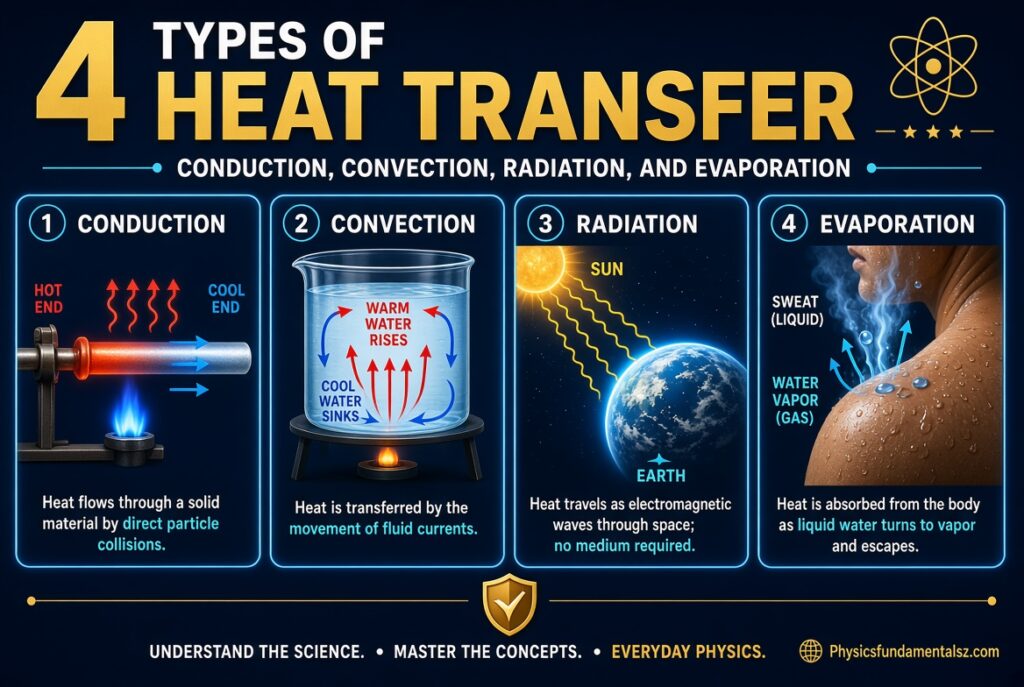
Your body loses heat in four ways. Sweat evaporation is only one of them. Understanding the other three shows why evaporation becomes so important in the heat.
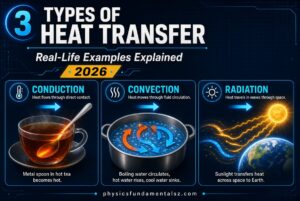
Conduction
Conduction moves heat through direct contact. Sitting on a cold bench or holding an ice pack pulls heat out of your body by conduction. Air is a poor conductor, so conduction in open air is small.
Water is a much better conductor. Wet clothes can pull heat from your body more than twenty times faster than dry air at the same temperature.
Convection
Convection moves heat through a flowing fluid, such as air or water. A thin layer of air next to your skin warms up and drifts away. Fresh, cooler air takes its place.
Wind and fans speed this up. They also help sweat evaporation by removing humid air near the skin.
Radiation
Radiation moves heat as infrared light. Every warm object emits it. Your body radiates heat to cooler walls, sky, and ground, even with no air in between.
In a comfortable room, radiation is the largest single route of heat loss. It stops working when your surroundings are as warm as your skin.
Evaporation
Evaporation removes heat through the phase change of water. It works even when the air is hotter than your skin. That makes it the only reliable cooling route in very hot weather.
| Heat loss route | Share at rest in a comfortable room (approx.) | Works when air is hotter than skin? |
|---|---|---|
| Radiation | About 60% | No, it can reverse and add heat |
| Convection | About 15% | No, it can reverse and add heat |
| Conduction | About 3% | No |
| Evaporation (skin and breath) | About 22% | Yes, if the air is not too humid |
These shares shift with conditions. During hard exercise in the heat, evaporation can account for most of the heat you lose.
Why Evaporation Takes Over in the Heat
When air temperature rises toward skin temperature, radiation and convection fade. When air passes skin temperature, they begin to add heat instead. Only evaporation keeps removing it.
That is why you sweat so much on a hot day. The body shifts its cooling load onto the one route that still works.
Worked Example: How Much Heat Does Sweat Remove?
Numbers make the physics concrete. The calculations below use round values and a 70 kg adult. They show how powerful evaporative cooling really is.
Step 1: Heat Removed by One Gram of Sweat
Use the latent heat of vaporization at skin temperature.
Q = m × L = 1 g × 2,420 J/g = 2,420 J
One gram of evaporated sweat removes about 2,420 joules of heat. That is about 0.58 kilocalories.
Step 2: Heat Removed by One Liter of Sweat
One liter of water has a mass of about 1,000 grams.
Q = 1,000 g × 2,420 J/g = 2,420,000 J, or 2.42 MJ
That equals roughly 580 kilocalories. It is about the energy in a large snack.
Step 3: Cooling Power in Watts
A power value shows how fast heat leaves. Suppose you sweat one liter per hour and all of it evaporates.
Power = 2,420,000 J ÷ 3,600 s ≈ 672 W
That is more than the heat output of a person at rest, many times over. A strong sweater can match the heat produced by hard exercise.
Step 4: Temperature Drop From Evaporating 100 Grams
The average specific heat of the human body is about 3.47 J per gram per degree Celsius. A 70 kg body holds 70,000 g.
Heat capacity = 70,000 g × 3.47 J/g°C ≈ 243,000 J per °C
Evaporating 100 g of sweat removes 242,000 J. That would lower body temperature by about 1°C, if no new heat were being made.
Step 5: Why Exercise Still Heats You Up
During a hard run, you might produce 700 to 800 watts of heat. Sweat evaporation at 672 W comes close but may not fully keep up. Radiation and convection cover the rest.
If the air is humid, evaporation falls short. Heat then builds up faster than the body can shed it. That is how heat exhaustion begins.
Summary Table of the Calculations
| Quantity | Value |
|---|---|
| Heat removed per gram of sweat evaporated | About 2,420 J |
| Heat removed per liter of sweat evaporated | About 2.42 MJ (580 kcal) |
| Cooling power at 1 L/hour, fully evaporated | About 670 W |
| Body heat capacity, 70 kg adult | About 243 kJ per °C |
| Sweat needed to cool a 70 kg body by 1°C | About 100 g |
Why Humidity Makes Sweat Less Effective
Humidity is the amount of water vapor already in the air. Evaporation slows when the air holds a lot of vapor. In very humid air, sweat just sits on your skin and soaks your clothes.
This is why 32°C (90°F) feels far worse in Houston than in Phoenix. The temperature is similar. The ability of sweat to evaporate is not.
Vapor Pressure: The Real Driver of Evaporation
Evaporation speed depends on a pressure difference. Wet skin has a vapor pressure set by its temperature. The air has its own vapor pressure, set by its humidity.
Water moves from high vapor pressure to low vapor pressure. A larger gap means faster evaporation. Heat loss by evaporation is roughly proportional to that gap.
What Relative Humidity Tells You
Relative humidity compares the water vapor in the air with the most the air can hold at that temperature. At 100 percent relative humidity, the air is saturated. Sweat cannot evaporate at all into saturated air that is as cool as the skin.
The table below shows how the gap shrinks as humidity rises. It assumes skin at 35°C and air at 35°C. Values are approximate.
| Relative humidity of 35°C air | Air vapor pressure | Gap from skin (kPa) | Evaporation drive vs dry air |
|---|---|---|---|
| 20% | About 1.1 kPa | About 4.5 | 100% |
| 50% | About 2.8 kPa | About 2.8 | About 63% |
| 80% | About 4.5 kPa | About 1.1 | About 25% |
| 100% | About 5.6 kPa | 0 | 0% |
At 80 percent humidity, you have only about a quarter of the evaporation drive you had at 20 percent. This is why the same temperature feels easy in one place and brutal in another.
The Lewis Relation
Engineers link evaporation to airflow through the Lewis relation. It says the evaporative heat transfer coefficient is roughly 16.5 degrees Celsius per kilopascal times the convective coefficient. In plain terms, any airflow that boosts convection also boosts evaporation.
This is why wind helps so much, and why standard comfort models used by groups like ASHRAE include both factors together.
Wet-Bulb Temperature Explained
Wet-bulb temperature is what a thermometer reads when its bulb is wrapped in wet cloth and exposed to moving air. It reflects both heat and humidity. It tells you how far evaporation can cool a wet surface.
In dry air, the wet-bulb reading sits well below the normal air temperature. In saturated air, the two readings are equal. Your skin behaves like a wet bulb when you sweat.
Why a Wet-Bulb Temperature of 31°C Matters
Scientists once theorized that a wet-bulb temperature of 35°C was the upper limit of human survival. Researchers at Penn State tested this with young, healthy volunteers in a heat chamber. Their 2022 results found the limit was lower.
They reported critical wet-bulb temperatures of about 30 to 31°C in warm, humid conditions. That is roughly 31°C at 100 percent humidity or 38°C at 60 percent humidity. Above those levels, core temperature starts to climb even at rest.
The study involved young, healthy people. Older adults and people with heart disease or diabetes may have lower limits.
Hot and Dry vs Hot and Humid
In hot, dry air, almost all sweat evaporates. The Penn State team found limits there were set by other factors, with critical wet-bulb values closer to 25 to 28°C. The body loses water fast, but evaporation keeps working.
In humid heat, sweat drips off without cooling. You lose water and gain little cooling. This is why humid heat is considered more dangerous at the same temperature.
The Heat Index
The National Weather Service uses a heat index to express how hot it feels. It combines air temperature and relative humidity. A reading of 105°F can feel like far more than the thermometer shows.
The heat index is a practical tool for planning outdoor work and exercise. It translates the physics of sweat evaporation into one number.
Wind, Fans, and Airflow: Why Moving Air Helps
Moving air makes sweat evaporate faster. It does this in two ways. It removes the humid layer next to your skin, and it increases convective heat loss.
A breeze does not change the air temperature. It changes how fast your body can dump heat into that air.
The Boundary Layer
A thin film of still air clings to your skin. This is the boundary layer. As sweat evaporates, the layer fills with vapor and evaporation slows.
Wind thins and sweeps away this layer. Fresh, drier air keeps the vapor pressure gap large. That is why a fan feels so good when you are sweating.
Why Fans Feel Cool Without Lowering Temperature
A fan does not cool the room. It cools you. It speeds up evaporation and convection from your skin. Sometimes it even adds a little heat to the room from its motor.
If you leave the room, turn the fan off. Fans only help the people who are in the airflow.
When Fans Can Make Things Worse
When air is hotter than your skin, a fan can push more heat onto you by convection. In humid heat, extra airflow also adds little evaporation. The net effect may be no cooling at all.
Health agencies, including the CDC, note that electric fans may not prevent heat-related illness in very high temperatures. Air conditioning, cool showers, and shade work better then.
Does Sweat Cool You If It Drips or You Wipe It Off?
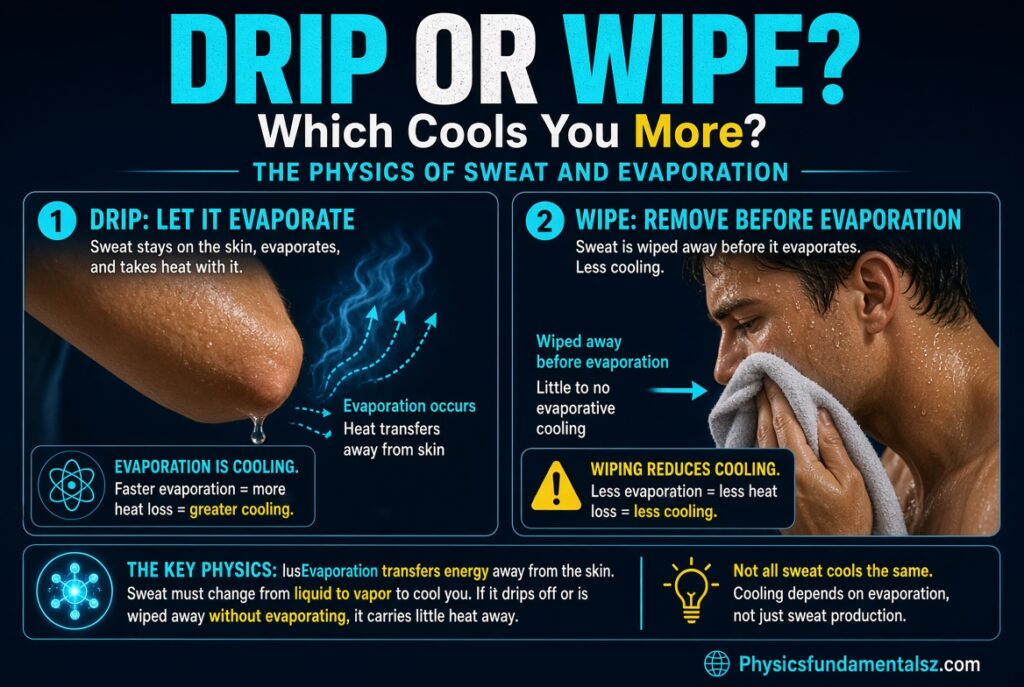
Only sweat that evaporates from your skin cools you. Sweat that drips to the ground carries away almost no useful cooling. The latent heat step never happens on your body.
That leads to a practical question. Should you wipe your face when you are sweaty?
Wiping Off Sweat: What Physics Says
If sweat is not dripping, leave it. A thin wet film evaporates and cools you. Wiping it off removes the liquid that was about to cool you.
If sweat is pouring off, wiping is fine. That excess was never going to evaporate in time. Wiping it may even help clear the skin so new sweat can spread and evaporate.
Why Dripping Sweat Wastes Water
When production outpaces evaporation, sweat pools and runs off. This often happens in humid air or during very intense effort. You lose fluid and salt but gain little cooling.
A fan, shade, or a drier environment can turn that dripping sweat back into effective cooling. Lower humidity near your skin is what matters.
Towels and Wet Cloths
A damp towel on your neck cools you because the water in it evaporates. It also touches the skin, so it cools by conduction. A wet cloth works even better than a dry one because water is both a coolant and a conductor.
Re-wet the cloth when it dries. A dry towel stops cooling and starts to insulate.
Why Does Wet Skin Feel Cold?
Wet skin feels cold because evaporation is pulling heat out of it. Your skin’s temperature sensors detect the drop and signal “cool” to your brain. The feeling is real heat loss, not an illusion.
You can test this. Step out of a swimming pool on a breezy day and you shiver, even in warm weather. The water on your skin is evaporating fast.
Why You Feel Cold After Exercise
When you stop moving, heat production drops quickly. But sweat on your skin keeps evaporating. Heat loss now exceeds heat production, so you feel chilled.
Sweat-soaked clothes make it worse. Wet fabric conducts heat away from your skin many times faster than dry fabric. That is why athletes change into dry clothes right after a workout.
Why a Cold Shower Feels Different From Sweat Cooling
A cold shower cools you by conduction. Cold water touches the skin and heat flows directly into it. Sweat works differently, by absorbing latent heat as it turns to vapor.
Both lower skin temperature. Sweat cooling, however, uses far less water and works without any external supply.
Blood Flow, Skin Temperature, and the Role of Vasodilation
Sweat cools the skin, but the body has to move heat from the core to the skin first. Blood is the delivery system. It picks up heat from working muscles and organs and carries it outward.
Without that transport, sweat would only cool a thin layer on the surface.
Vasodilation and Skin Blood Flow
In heat, the body widens skin blood vessels. Skin blood flow can rise from a fraction of a liter per minute at rest to several liters per minute in the heat. That is a huge share of the heart’s output.
This is why your face turns red when you exercise or stand in the sun. Warm blood is flowing close to the surface to meet the sweat.
The Cost to the Heart
Pumping that much blood to the skin puts a strain on the cardiovascular system. In severe heat, the heart works harder while blood pressure can fall. People with heart conditions are at higher risk.
This is another reason humid heat is dangerous. The body does the work of moving blood but gets little evaporative payoff.
Skin Wetness and Hidromeiosis
When skin stays soaked for a long time, sweat output can fall. This is called hidromeiosis. Swollen skin partly blocks the sweat ducts.
That means constantly drenched skin can become less efficient. It is one more reason dry, breathable clothing and airflow help in the heat.
Sweat Rate: How Much Do We Actually Sweat?
Sweat rate is the volume of sweat your body produces per hour. It varies widely between people and conditions. Fitness, body size, heat, and humidity all play a role.
The cooling power you get depends on how much of that sweat actually evaporates.
Typical Sweat Rates
| Situation | Approximate sweat rate | Approximate cooling if fully evaporated |
|---|---|---|
| Resting in a comfortable room | Under 0.1 L/hour (mostly invisible) | About 30 to 60 W |
| Light activity in warm weather | 0.2 to 0.5 L/hour | About 130 to 340 W |
| Hard exercise in the heat | 1 to 1.5 L/hour | About 670 to 1,000 W |
| Elite athlete in extreme heat | Up to 2 to 3 L/hour | Over 1,300 W |
Even at rest, water slowly diffuses through the skin and from the lungs. This is called insensible water loss. It adds up to several hundred milliliters a day.
Why Some People Sweat More
Genetics, body size, fitness, and heat acclimatization all matter. Fit people usually start sweating earlier and sweat more. Their bodies have learned to cool efficiently.
Heavy sweating is not a sign of weakness. In most cases it is a sign of an effective cooling system.
Thermal vs Emotional Sweating
Thermal sweating covers most of the body and responds to heat. Emotional sweating occurs on the palms, soles, and sometimes the armpits, driven by stress. Emotional sweat does little to cool the core.
This difference explains why nervous hands get damp while the rest of you stays dry.
Is Sweat Evaporation a Physical or Chemical Change?
Sweat evaporation is a physical change. Water molecules leave the liquid and enter the gas phase. No bonds inside the water molecules break, and no new substance forms.
The water in vapor is still H2O. If the vapor cools, it condenses back into liquid water.
Why It Counts as a Phase Change
A phase change is a switch between solid, liquid, and gas. Evaporation is the liquid-to-gas switch. It involves energy exchange, but not chemical reactions.
Only the forces between molecules change. The hydrogen bonds between water molecules break, while the bonds inside each molecule stay intact.
Common Test Question
Students often meet this idea in biology and chemistry classes. “A person gets cooler by perspiring. Is this a chemical or physical change?” The answer is physical. The cooling comes from the heat absorbed during evaporation.
Does Salt in Sweat Affect Cooling?
Sweat contains salt, and dissolved salt slightly lowers the vapor pressure of water. This follows Raoult’s law. In theory, salty sweat evaporates a bit more slowly than pure water.
The effect is very small. Sweat is roughly 99 percent water, and the dissolved solutes lower vapor pressure by only a fraction of a percent. For practical cooling, you can ignore it.
Why Salt Still Matters
Salt matters for other reasons. Sodium helps your body hold water and keeps nerves and muscles working. Losing too much can lead to cramps and, in rare cases, dangerous low blood sodium.
Salt crystals on a hat or shirt are a visible sign of heavy sweating. They are the leftover solutes after the water evaporated.
Why Sweat Leaves Salty Residue
Water evaporates. Salts do not. As sweat dries, the dissolved sodium chloride stays on the skin and fabric as a white film.
That residue is a neat reminder of the physics. Only the water leaves as vapor, and only the water carries the cooling effect.
Why Dogs Pant and How Other Animals Cool Down
Humans are unusual. We have millions of sweat glands and very little fur. Most mammals rely on other cooling tricks.
All of these methods use the same physics. They find a way to evaporate water from a moist surface.
Panting
Dogs have few sweat glands, mostly on their paw pads. They pant to move air over the wet surfaces of the tongue and mouth. Evaporation there cools blood vessels close to the surface.
Panting is less efficient than whole-body sweating. It also uses muscle effort, which makes some heat of its own.
Other Animal Strategies
| Animal | Cooling method | Physics principle |
|---|---|---|
| Humans | Whole-body sweating | Evaporation of sweat from skin |
| Horses | Heavy sweating | Evaporation from a wet coat |
| Dogs | Panting | Evaporation from tongue and airways |
| Birds | Panting and gular fluttering | Evaporation from throat and mouth |
| Elephants | Spraying water, large ears | Evaporation and radiation from thin skin |
| Pigs | Wallowing in mud | Evaporation from wet mud |
| Kangaroos | Licking forearms | Evaporation of saliva |
| Reptiles | Basking and shade seeking | Behavioral temperature control |
Reptiles are ectotherms. They rely on external heat sources and shade instead of internal heat production, so they do not need to sweat.
Why Humans Are Good at Sweating
Our upright posture, hairless skin, and dense sweat glands let us shed heat very well. Some scientists argue this helped early humans run long distances in hot weather. Prey animals that depended on panting had to stop and rest.
This idea is called the endurance running hypothesis. It remains debated, but the physics behind human sweating is solid.
Everyday Examples of Evaporative Cooling
Once you know the rule, you find it everywhere. Any wet surface that dries is losing heat to evaporation. Many technologies copy this effect on purpose.
Swamp Coolers
Evaporative coolers, often called swamp coolers, blow air across a wet pad. Water evaporates, absorbing heat from the air. The air that leaves is cooler and more humid.
They work best in dry climates like the American Southwest. In humid regions they do poorly, for the same reason sweating does poorly there.
Clay Water Pots
Traditional clay pots, such as the matka used in South Asia and the zeer pot in North Africa, keep water cool without electricity. Water seeps through tiny pores in the clay and evaporates from the outer surface. That evaporation carries heat away from the water inside.
This simple device shows evaporative cooling at work in a very practical form. It works best in hot, dry air.
Cooling Towers
Power plants and large buildings use cooling towers. Water is sprayed into moving air, and a small fraction evaporates. The evaporation cools the rest of the water, which then returns to remove heat from the system.
A cooling tower is basically a giant, controlled sweat gland for industry.
Wet Cloth and Misting Fans
Wrapping a wet cloth around your neck, or standing in the fine spray of a misting fan, helps cool you. The mist evaporates from your skin or from the air around you. Both processes remove heat.
Misting works best in dry air. In humid air, the water cannot evaporate fast enough, and you just get wet.
Steam Burns vs Hot Water Burns
Condensing steam gives up the same latent heat that evaporation absorbs. That is why 100°C steam burns more than 100°C water. Each gram of steam releases about 2,260 joules as it condenses on your skin.
It is the same physics as sweating, run in reverse.
Why Rubbing Alcohol Feels Colder Than Water
Rubbing alcohol feels much colder than water on your skin. That surprises people, because water has a larger latent heat per gram. The difference comes from evaporation speed.
Alcohols are volatile. Their molecules are held together by weaker forces, so they escape much faster.
Latent Heat vs Evaporation Rate
Cooling power depends on two things. It depends on the energy absorbed per gram and on how many grams evaporate per second. Alcohol has a lower latent heat per gram but evaporates far more quickly.
The faster rate wins. You feel a sharp chill almost at once.
Water vs Alcohol Comparison
| Property | Water | Ethanol |
|---|---|---|
| Latent heat of vaporization (approx., per gram) | About 2,420 J | About 900 J |
| Vapor pressure at 20°C (approx.) | About 2.3 kPa | About 5.9 kPa |
| Feels colder on skin | Moderately | Much more quickly |
| Cooling that lasts | Longer per gram | Short and sharp |
Hand sanitizer feels cool for the same reason. The alcohol evaporates within seconds, leaving a brief cold sensation.
Why This Does Not Replace Sweat
Alcohol would cool you quickly, but it is not a safe or practical coolant. It dries and irritates skin, and it is flammable. Water is the best choice: safe, abundant, and rich in latent heat.
The Cost of Sweating: Dehydration
Sweating cools you, but it spends water. Every liter evaporated is a liter your body must replace. If you do not, blood volume falls and cooling becomes harder.
This creates a trade-off between cooling and fluid balance.
Why Dehydration Hurts Cooling
When you are dehydrated, blood volume drops. The body then has to choose between sending blood to the skin for cooling and sending it to muscles and organs. Sweat rate can fall while core temperature rises.
Even mild dehydration can reduce exercise performance in the heat. Drinking early and often helps keep the cooling system running.
How Much Fluid Do You Lose?
A person sweating 1 liter per hour for three hours loses about 3 liters. For a 70 kg adult, that is over 4 percent of body mass. Losses like this can affect performance and safety.
Weighing yourself before and after exercise is a simple way to estimate sweat loss. Each kilogram lost is roughly one liter of fluid.
Electrolytes and Rehydration
Water helps, but long sweating sessions also drain sodium. Sports drinks, salty snacks, or food with fluids can help in long events. For short, light activity, plain water is usually enough.
Anyone with medical conditions or on certain medicines should ask a healthcare provider about hydration plans.
Heat Exhaustion and Heat Stroke: When Cooling Fails
Sometimes sweat cannot keep up. Core temperature rises past safe levels. That is a medical emergency, not just discomfort.
This section is general information, not medical advice.
Heat Exhaustion Signs
According to the CDC, signs of heat exhaustion include heavy sweating, cold and clammy skin, a fast and weak pulse, nausea, muscle cramps, tiredness, dizziness, headache, and fainting. Move to a cool place, loosen clothing, sip water, and cool the skin with wet cloths.
If symptoms get worse or last more than an hour, get medical help.
Heat Stroke Signs
Heat stroke is more severe. The CDC lists a body temperature of 103°F (39.4°C) or higher, hot red skin that can be dry or damp, a fast strong pulse, confusion, and loss of consciousness.
Call 911 right away. While waiting, move the person to a cooler place and use cool cloths or a cool bath to bring the temperature down.
Why Sweating May Stop
In severe heat stroke, the body’s cooling system can fail. Skin may feel dry and hot. A person who has stopped sweating in the heat is in serious danger.
Heat Acclimatization: How the Body Improves Its Cooling
Your body can adapt to heat. After one to two weeks of regular heat exposure, cooling becomes more efficient. This process is called acclimatization.
It is a good example of physiology tuning itself to physical limits.
What Changes
- Sweating starts earlier, at a lower core temperature.
- Sweat rate increases.
- Sweat becomes more dilute, so less sodium is lost.
- Blood plasma volume expands.
- Heart rate during exercise drops.
These changes help the body move more heat to the surface and spend less salt doing it.
How to Acclimatize Safely
Start with short, easy sessions in the heat. Add time and effort gradually over several days. Drink fluids and rest in the shade.
Athletes, outdoor workers, and travelers all benefit. Workplace safety groups such as OSHA publish guidance on safe acclimatization for workers.
How to Help Sweat Cool You Down Better
Now that you know the physics, you can use it. Anything that raises evaporation helps. Anything that blocks evaporation hurts.
Practical Tips
- Wear light, breathable fabrics that let vapor escape.
- Choose moisture-wicking clothing that spreads sweat for faster evaporation.
- Use a fan, but stay hydrated.
- Seek shade to cut radiant heat.
- Take breaks in cooler or less humid spaces.
- Dab dripping sweat, but leave a thin damp film on your skin.
- Drink water before, during, and after heat exposure.
- Use a cool, damp cloth on your neck, wrists, and face.
Clothing and Evaporation
Cotton holds sweat and dries slowly. Synthetic wicking fabrics move sweat to the outer surface where it evaporates faster. Loose clothing allows more airflow than tight clothing.
In very hot, dry deserts, light loose robes protect from the sun and keep a layer of air that helps evaporation.
Mistakes to Avoid
Avoid heavy, non-breathable clothing in the heat. Avoid wiping skin dry when it is not dripping. Avoid depending on fans alone in extreme heat.
Do not wait until you feel thirsty to drink during intense effort. Thirst lags behind fluid loss.
Common Misconceptions About Sweat Cooling
Several popular ideas about sweat are only partly right. Clearing them up makes the physics easier to follow.
“Sweat Cools Because It Is Cold”
False. Sweat leaves your body warm. It cools you when it evaporates.
“Sweat Carries Heat Out Like a Hot Liquid”
Mostly false. Warm liquid carries a tiny amount of heat. Latent heat is more than 140 times larger.
“Wiping Always Cools You Faster”
Not always. Wiping a thin sweat film removes the water that would have evaporated. Wiping dripping sweat is fine.
“A Fan Always Lowers Your Temperature”
No. A fan lowers your skin temperature only when it helps evaporation or convection. In extreme heat, it may add heat.
“Humid Days Are Hot Because Air Is Hotter”
Not necessarily. Humid days feel hotter because sweat cannot evaporate well. The thermometer may read the same as on a dry day.
“Sweating Burns Fat”
No. Sweat is mostly water. You lose water weight, which returns when you rehydrate.
Simple Experiments to See Evaporative Cooling
You can test these ideas at home with everyday items. Each one shows a different part of the physics.
Wet Finger Test
Dip a finger in water and hold it in still air. Then wave it back and forth. The wave makes the cool feeling stronger because airflow speeds evaporation.
Wet vs Dry Thermometer
Wrap a damp cloth around the bulb of one thermometer. Leave a second thermometer dry. Fan both. The wet one drops several degrees below the dry one.
This difference is the idea behind wet-bulb temperature. In humid air, the gap is small. In dry air, the gap is large.
Water vs Alcohol Test
Put a drop of water on one arm and a drop of rubbing alcohol on the other. The alcohol feels colder, but it disappears fast. This shows how both latent heat and speed of evaporation matter.
Use a very small amount, and keep it away from eyes and open skin.
Clay Pot Test
Place two cups of water outdoors in a dry, breezy place. Wrap one cup in a wet cloth. After an hour, check the temperature of both. The wrapped cup is usually cooler.
The Evaporative Heat Loss Formula
Physiologists describe sweat cooling with a simple relationship. It shows which factors you can change and which you cannot.
E = h_e × A × w × (p_skin − p_air)
Here E is the evaporative heat loss. The symbol h_e is the evaporative heat transfer coefficient, which rises with airflow. A is the body surface area, w is the fraction of skin that is wet, and p_skin and p_air are the vapor pressures at the skin and in the air.
What Each Term Means
- Airflow (h_e): More wind raises this value and speeds up evaporation.
- Surface area (A): A typical adult has about 1.7 to 1.9 square meters of skin.
- Skin wetness (w): Spread-out sweat covers more skin and raises this value.
- Vapor pressure gap: Dry air and warm skin make this gap larger.
What the Formula Tells You
Only the vapor pressure gap depends on the weather. Humidity shrinks it. Everything else you can partly control with fans, clothing, and body position.
This is why a person in a humid room gains more from a fan than from standing still, but still struggles once the gap closes.
Sweat Cooling in Sports and Outdoor Work
Coaches, military trainers, and workplace safety teams use the physics of sweat to set rules. They know humid heat is more dangerous than dry heat at the same air temperature.
Wet-Bulb Globe Temperature
Wet-bulb globe temperature, or WBGT, combines humidity, air temperature, sunlight, and wind into one index. It is widely used to decide when to slow, stop, or reschedule outdoor activity. It is more reliable than air temperature alone.
A high WBGT tells you that sweat evaporation is limited and that heat stress is rising.
Why Athletes Cool Between Efforts
Between sprints or plays, athletes use shade, fans, ice towels, and fluids. Each of these lowers heat load or helps sweat evaporate. Together they keep core temperature from climbing too high.
Cold water immersion is also used in emergencies for exertional heat stroke. It removes heat by conduction much faster than sweat alone.
Why Cooling Vests and Hats Help
Cooling vests use ice packs, wet fabric, or evaporative layers to pull heat from the torso. Wide-brim hats block sunlight so less radiant heat reaches the skin. They support sweat cooling instead of replacing it.
Why Sweat Cools Better in a Desert
In a desert, the air can be extremely dry. A large vapor pressure gap lets sweat evaporate almost instantly. Skin can feel dry even though you are sweating heavily.
That hides the danger. You may lose liters of water without noticing. This is why desert hikers are told to drink on a schedule, not by thirst.
Night Cooling in Dry Air
Dry air also lets heat radiate to the clear night sky. Desert nights cool off fast. The same dryness that helps sweat during the day makes the temperature swing large after sunset.
Humid Heat vs Desert Heat
| Feature | Hot and dry (desert) | Hot and humid (tropical) |
|---|---|---|
| Sweat evaporation | Fast | Slow |
| Skin feels | Dry | Wet and sticky |
| Main risk | Rapid dehydration | Heat buildup and dehydration |
| Fan or breeze | Helpful | Helps less |
| Evaporative cooler | Effective | Poor |
Step-by-Step: From Rising Heat to a Cooler Body
Here is the full chain of events in order. It ties the biology and the physics together.
- Your muscles or the environment add heat, and core temperature starts to rise.
- Sensors in the skin and brain detect the change.
- The hypothalamus sends signals to the eccrine sweat glands.
- Skin blood vessels widen, bringing warm blood close to the surface.
- Sweat reaches the skin and spreads into a thin film.
- The fastest water molecules in the film break their hydrogen bonds and escape.
- Each escaping molecule carries energy away as latent heat.
- The skin and sweat film cool down.
- Cooler blood flows back to the core, and core temperature stabilizes.
If any step is blocked, such as saturated air at step 6, the chain weakens. That is why humidity has such a strong effect.
Sweat Cooling vs Other Ways to Cool Down
Sweat is not the only way to lower body temperature. Other methods use different physics. Comparing them shows where sweat is strongest.
| Method | Main physics | Strength | Weakness |
|---|---|---|---|
| Sweating | Evaporation (latent heat) | Works without equipment, even in hot air | Fails in saturated air and costs water |
| Air conditioning | Heat pump removes heat from air | Works in any humidity | Needs electricity and equipment |
| Cold shower or bath | Conduction | Fast and strong | Needs a cold water supply |
| Fan | Convection and evaporation boost | Cheap and simple | Can add heat in very hot air |
| Shade | Blocks radiation | Lowers heat load | Does not remove stored heat |
| Ice pack on neck | Conduction | Cools blood near the surface | Short lasting |
Why Air Conditioning Beats Sweat in Humid Heat
An air conditioner cools and dries the air. Cooler, drier air restores the vapor pressure gap and lowers the temperature gradient. Both help the body lose heat.
Sweat alone cannot lower the air temperature, so it hits a hard limit in humid air. A machine that does work can go beyond that limit.
How Age, Fitness, and Health Change Sweat Cooling
Not everyone cools at the same rate. Several factors shift how well sweat does its job.
Older Adults
Older adults often start sweating later and produce less sweat. Skin blood flow also responds more slowly. This lowers their heat tolerance, which is why the Penn State team continued testing older groups after the first study.
Children
Children have more skin area per kilogram of body mass and lower sweat output per gland. They can heat up faster in hot environments. They need shade, fluids, and breaks.
Fitness and Body Size
Fit people typically sweat earlier and more. Larger bodies make more heat but have less surface area per kilogram to shed it. Both effects shape how the cooling load plays out.
Medications and Medical Conditions
Some medicines and conditions reduce sweating or affect fluid balance. Examples include certain anticholinergic drugs, diuretics, and heart conditions. Anyone with these concerns should talk to a doctor about heat safety.
Key Takeaways: Why Does Sweat Cool You Down
- Sweat cools you because evaporation absorbs heat from your skin.
- Each gram of evaporated sweat removes about 2,420 joules.
- The cooling comes from latent heat, not from sweat being cold.
- Only the most energetic molecules escape, leaving cooler liquid behind.
- Hydrogen bonds give water an unusually high heat of vaporization.
- Humidity, wind, and skin temperature set how fast sweat evaporates.
- Sweat that drips off skin gives little cooling.
- Wet-bulb temperature shows how well evaporation can work.
- A wet-bulb temperature near 31°C is a danger point even for healthy young adults in humid heat.
- Dehydration and heat illness are the price when cooling fails.
Also Read:
- Why Does Metal Feel Colder Than Wood at Room Temperature? The Physics of Heat Flow Explained 2026
- Heat Transfer: Conduction, Convection and Radiation
- Specific Heat Capacity
- Thermal Energy & Internal Energy: Heat, Temperature & Q = mcΔT
- Entropy Explained for Beginners Easy Guide 2026
- Entropy Explained
- The Second Law of Thermodynamics
- The First Law of Thermodynamics
- The Kinetic Theory of Gases
- Thermal Expansion: Formula ΔL = αL₀ΔT, Types & Worked Examples
- How Do Heat Engines Work Step by Step? Key Concepts Explained 2026
- Boyle’s, Charles’ & Gay-Lussac’s Gas Laws: Formulas & Examples
- Ideal Gas Law: PV = nRT
- Ideal Gas Law Calculator With Steps: PV = nRT Formula & Examples 2026
- Ideal Gas Law Practice Problems With Answers (2026 Study Guide)
- Stress, Strain & Young’s Modulus: E = sigma/epsilon Formula & Examples
- Physics Fundamentals: The Complete Guide to Core Concepts, Laws, and Equations
- Mass Energy Equivalence Real Life Examples (2026 Guide)
- Conservation of Momentum Real Life Examples (2026 Guide)
- What Is Centripetal Force With Examples? (Formula + Guide) 2026
- Difference Between Speed and Velocity With Examples (2026 Guide)
- Projectile Motion Formula for Angled Launch Explained (2026 Guide)
Frequently Asked Questions (FAQs)
Why does sweat cool you down in physics?
Sweat cools you because evaporation absorbs heat. Each gram of water that turns to vapor takes about 2,420 joules from your skin. That energy loss lowers skin temperature and helps keep your core near 37°C.
What is the main physics principle behind sweating?
The main principle is the latent heat of vaporization. Changing water from liquid to gas needs energy. Sweat gets that energy from your skin, which cools you.
Does sweat cool you down or does evaporation?
Evaporation does the cooling. Sweat is only the liquid that makes evaporation possible. Sweat that drips off or is wiped away gives little cooling.
Why does evaporation cause cooling?
The fastest, most energetic molecules escape the liquid first. The remaining molecules have lower average kinetic energy, so the liquid is cooler. That cooler liquid then draws heat from the skin.
What is the latent heat of vaporization of water?
It is the energy needed to turn liquid water into vapor without changing its temperature. At skin temperature it is about 2,420 J per gram. At 100°C it is about 2,260 J per gram.
How much heat does one liter of sweat remove?
One liter of evaporated sweat removes about 2.42 million joules, or roughly 580 kilocalories. If that happens over one hour, the cooling power is about 670 watts.
Is sweat cooling a physical or chemical change?
It is a physical change. Water changes from liquid to gas, but it is still H2O. No new substance forms.
Why does sweat not cool me in humid weather?
Humid air already holds a lot of water vapor. The vapor pressure gap between skin and air shrinks, so sweat evaporates slowly. Sweat then drips off or soaks clothing without removing much heat.
What is wet-bulb temperature and why does it matter?
Wet-bulb temperature is what a thermometer reads when its bulb is wrapped in wet cloth in moving air. It combines heat and humidity and shows how well evaporation can cool you. Penn State researchers found danger for young, healthy adults starting near 31°C wet-bulb in humid conditions.
Why does a fan make me feel cooler?
A fan moves humid air away from your skin and boosts convection. That speeds up sweat evaporation. It does not lower the room temperature.
Can a fan make you hotter?
Yes, in very hot air. If the air is hotter than your skin, a fan can add heat by convection. In very humid air, it also adds little extra evaporation.
Why do I feel cold after I stop exercising?
Heat production drops fast, but sweat keeps evaporating. Heat loss then exceeds heat gain. Wet clothes make this worse by conducting heat away from your skin.
Should I wipe off my sweat?
If sweat is not dripping, leave it so it can evaporate. If sweat is dripping, wiping is fine, because that sweat would not evaporate on your body anyway.
Why does wet skin feel cold?
Evaporation is pulling heat out of the skin. Temperature sensors detect the drop and send a “cool” signal to the brain. The feeling reflects real heat loss.
Does salt in sweat reduce cooling?
Only by a tiny amount. Dissolved salt lowers the vapor pressure of water slightly, but sweat is about 99 percent water. The effect is too small to matter in practice.
Why does rubbing alcohol feel colder than water?
Alcohol evaporates much faster than water. It absorbs less heat per gram, but the higher evaporation rate produces a stronger, quicker chill.
Why does water have such a high heat of vaporization?
Water molecules form strong hydrogen bonds with each other. Breaking those bonds so a molecule can escape takes a lot of energy. That makes water an excellent coolant.
How does sweat follow the first law of thermodynamics?
Energy is conserved. Heat leaves your skin and becomes internal energy in water vapor. Total energy stays the same while your body cools.
How does the second law of thermodynamics apply to sweating?
Heat flows from hot to cold, and evaporation increases entropy as water molecules spread into the gas phase. Sweat keeps your skin cooler than your core, so heat keeps flowing outward.
What are the four ways the body loses heat?
The four ways are conduction, convection, radiation, and evaporation. In hot weather, when the air is warmer than your skin, evaporation is the only route that keeps removing heat.
Why do dogs pant instead of sweating?
Dogs have few sweat glands. Panting moves air over the wet tongue and airways, so water evaporates there and cools blood close to the surface.
How much do people sweat during exercise?
Many people sweat 0.5 to 1.5 liters per hour in hot conditions. Elite athletes in extreme heat may reach 2 to 3 liters per hour. Rates vary by fitness, size, and climate.
What is heat acclimatization?
It is the body’s adaptation to heat over one to two weeks. Sweating starts earlier, sweat rate rises, sweat becomes less salty, and blood volume expands.
What are the signs that sweating is not enough?
Heavy sweating with cold, clammy skin, dizziness, nausea, and a weak, fast pulse suggest heat exhaustion. Confusion, a body temperature of 103°F or higher, and hot skin suggest heat stroke. Heat stroke needs emergency care.
Does sweating burn fat?
No. Sweat is mostly water. Weight lost through sweat comes back when you rehydrate.
Why does humid heat feel worse than dry heat?
In humid heat, sweat cannot evaporate well, so cooling is weak. In dry heat, sweat evaporates quickly and keeps you cooler, though you lose water faster.
How does a swamp cooler use the same physics?
A swamp cooler blows air across a wet pad. Water evaporates and absorbs heat from the air. It works well in dry climates and poorly in humid ones.
Can sweat cool you below the air temperature?
Yes, in dry air. Your skin can be cooler than the air because evaporation removes heat. The limit is the wet-bulb temperature, which depends on humidity.
Is it bad to stop sweating in the heat?
It can be. If you are hot and your sweating stops, your body may be losing its ability to cool itself. That can signal heat stroke, and you should get medical help immediately.
What is the best way to help sweat cool me?
Wear light, breathable clothing, stay in shade, use airflow, and keep drinking fluids. In very hot or humid conditions, move indoors or into air conditioning.
Conclusion
The why does sweat cool you down physics explanation comes down to one idea: evaporation takes energy. Each gram of sweat that turns to vapor removes about 2,420 joules from your skin. That energy loss is what cools you.
Water’s strong hydrogen bonds give it a very high latent heat of vaporization. The fastest molecules escape first, the remaining liquid cools, and heat flows from skin into sweat. The first and second laws of thermodynamics keep the process consistent and one-directional.
Humidity, airflow, skin temperature, and clothing decide how well it works. In dry air, sweat is a powerful coolant. In humid air, it struggles, and a wet-bulb temperature near 31°C can overwhelm even healthy young adults.
Understanding this physics makes everyday choices easier. Let sweat evaporate, use airflow, drink enough fluid, and respect heat warnings. Your body’s cooling system is excellent, but it still follows the laws of physics.