Heisenberg Uncertainty Principle: ΔxΔp ≥ ℏ/2 — Explained Simply
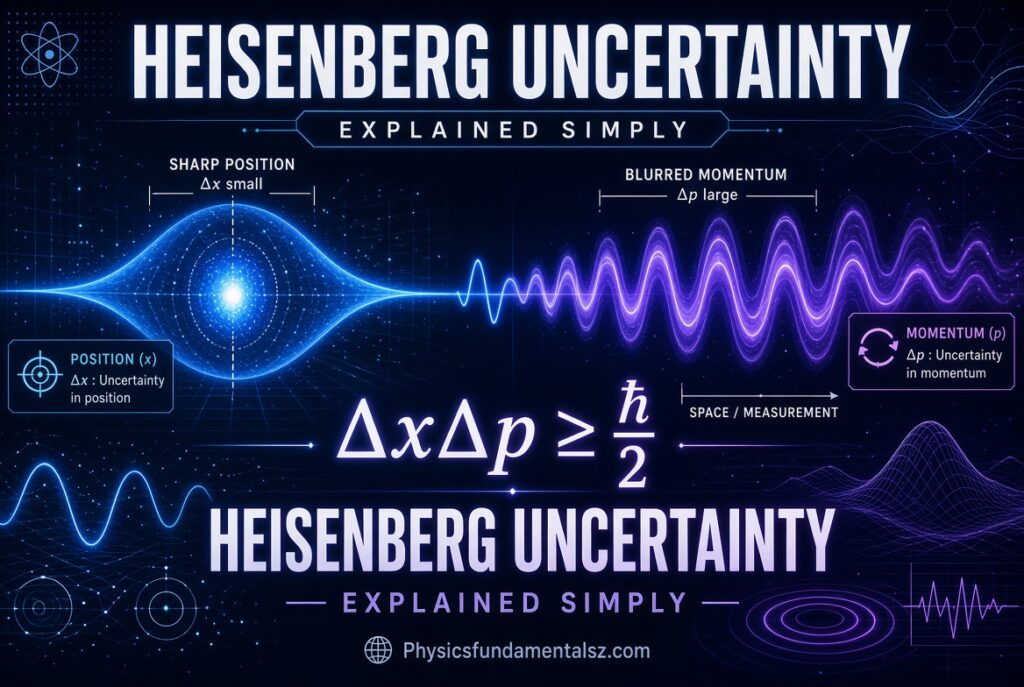
Try to picture an electron as a tiny ball with a fixed spot and a fixed speed. That picture is wrong, and the Heisenberg uncertainty principle is the reason why.
This single idea, introduced in 1927, quietly rewrote what “knowing” something even means in physics. It is not about bad instruments or clumsy hands.
Table of Contents
What Is the Heisenberg Uncertainty Principle?
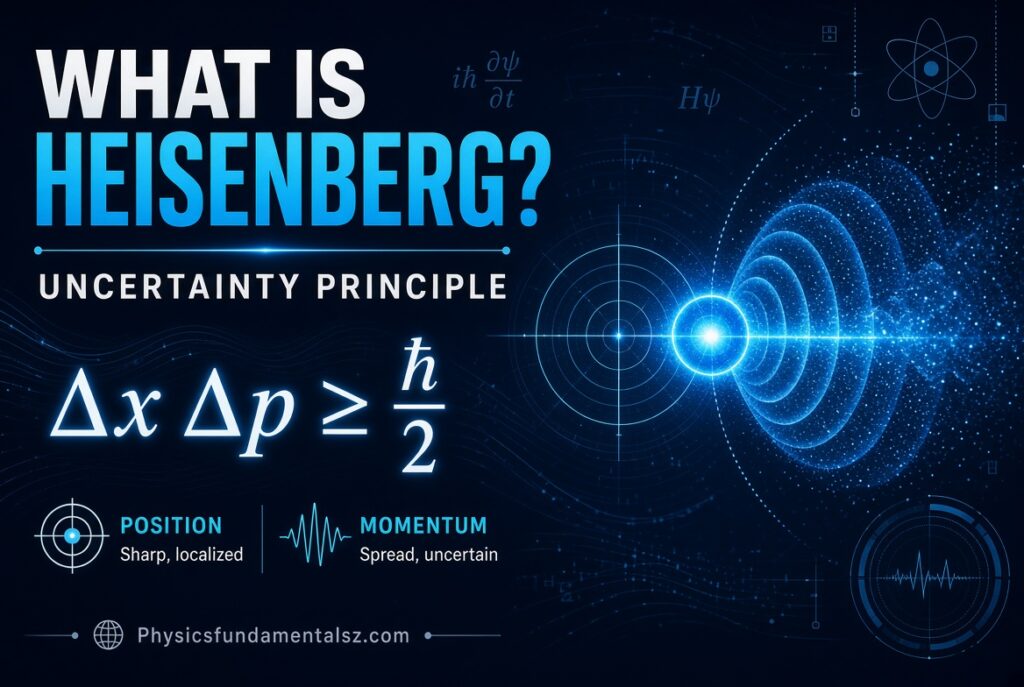
The Heisenberg uncertainty principle states that you cannot know a particle’s exact position and exact momentum at the same time. The more precisely you know one, the less precisely you can know the other.
This is not a limitation of your ruler or your stopwatch. It is a built-in feature of how quantum particles behave.
Werner Heisenberg formulated this idea in 1927 while working through the mathematics of matrix mechanics. It became one of the founding pillars of quantum theory.
The Heisenberg Uncertainty Principle Formula
The most common version of the formula is written as:
Δx · Δp ≥ ℏ/2
Here, Δx is the uncertainty in position, Δp is the uncertainty in momentum, and ℏ is the reduced Planck constant.
Position-Momentum Uncertainty
This is the classic form most textbooks teach first. It says the product of position uncertainty and momentum uncertainty can never drop below ℏ/2.
Shrink Δx by measuring position very precisely, and Δp is forced to grow. There is no way around this trade-off.
Energy-Time Uncertainty
A second version relates energy and time: ΔE · Δt ≥ ℏ/2.
This form explains why particles that exist for only a fleeting moment can have a very uncertain, “fuzzy” energy value.
Who Discovered the Heisenberg Uncertainty Principle?
Werner Heisenberg, a German physicist, introduced this principle in 1927 while at the University of Göttingen. He was 25 years old at the time.
His work built on the strange new mathematics of quantum mechanics, where position and momentum are represented by operators rather than simple numbers.
Earl Kennard later gave the principle its precise mathematical form using standard deviations, which is the version most physicists use today.
Heisenberg received the Nobel Prize in Physics in 1932 for his contributions to the creation of quantum mechanics.
Why Does the Uncertainty Principle Exist?
Wave-Particle Duality
Every quantum particle behaves partly like a wave. A wave that is spread out has a very well-defined wavelength, which relates directly to momentum.
But a spread-out wave has no single, sharp position. Squeeze that wave into a tight spot, and you mix many wavelengths together, making momentum uncertain instead.
The Observer Effect vs True Uncertainty
People often confuse the uncertainty principle with the observer effect, the idea that measuring something disturbs it. These are related but not identical.
The observer effect says measurement causes disturbance. The uncertainty principle says the particle itself never has both properties sharply defined, even before you measure anything.
Heisenberg Uncertainty Principle Explained With Simple Examples
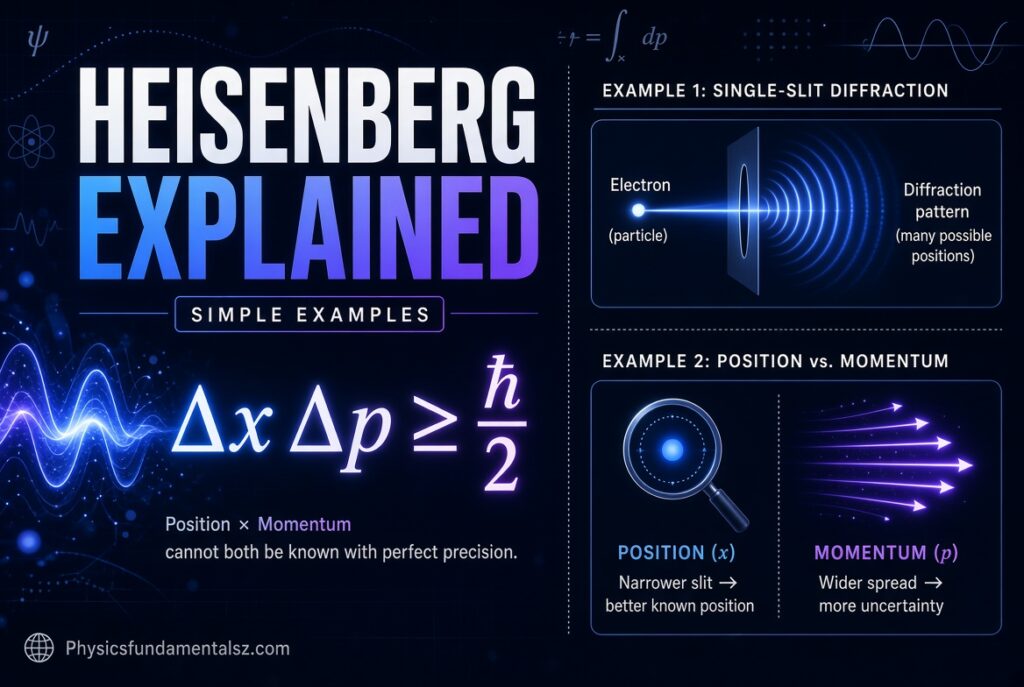
Example 1: Electron in an Atom
An electron confined to a small atomic orbital has a very limited Δx. That forces its momentum uncertainty, Δp, to be large.
This is exactly why electrons do not spiral into the nucleus. Confining them tighter would require enormous momentum, which costs enormous energy.
Example 2: A Car vs a Quantum Particle
A car’s mass is so large that ℏ/2 is a meaningless rounding error compared to normal measurement precision. You can know its position and speed together with no practical issue.
An electron’s mass is roughly 10³¹ times smaller. At that scale, the uncertainty becomes the dominant, unavoidable feature of its behavior.
Mathematical Derivation (Simplified)
The formal derivation uses the commutator of the position and momentum operators, written as [x, p] = iℏ.
Because these operators do not commute, meaning xp does not equal px, quantum theory proves a lower bound must exist on the product of their uncertainties.
Working through the Cauchy-Schwarz inequality with this commutator produces the familiar Δx · Δp ≥ ℏ/2 result.
Applications of the Heisenberg Uncertainty Principle
Quantum Mechanics and Atomic Structure
The principle explains why atoms are stable and why electrons occupy defined energy levels rather than collapsing into the nucleus.
Electron Microscopy
Electron microscopes must balance wavelength against momentum spread when choosing beam energy, directly shaped by this same trade-off.
Quantum Computing
Qubit design and error correction both account for fundamental uncertainty limits when engineers try to control quantum states precisely.
Nuclear Physics
Energy-time uncertainty explains why unstable particles with very short lifetimes have a naturally broad, uncertain energy spread.
Modern Technology
Lasers, semiconductors, and MRI machines all rely on quantum behavior that only makes sense once uncertainty is built into the model.
Heisenberg Uncertainty Principle vs Observer Effect
| Aspect | Uncertainty Principle | Observer Effect |
|---|---|---|
| Core idea | Fundamental limit on simultaneous precision | Measurement disturbs the system |
| Applies without measuring? | Yes | No, requires an act of measurement |
| Origin | Wave nature of matter | Physical interaction during measurement |
| Can technology fix it? | No, it is fundamental | Sometimes, with gentler measurement |
Common Misconceptions
- “It’s just bad equipment.” No instrument, however advanced, can beat this limit. It is a property of nature, not engineering.
- “It only matters for tiny particles.” It technically applies to everything, but the effect is undetectable at everyday, large scales.
- “Heisenberg said we can never know anything.” The principle only restricts simultaneous precision of specific paired quantities, not all knowledge.
Heisenberg Uncertainty Principle in Everyday Life
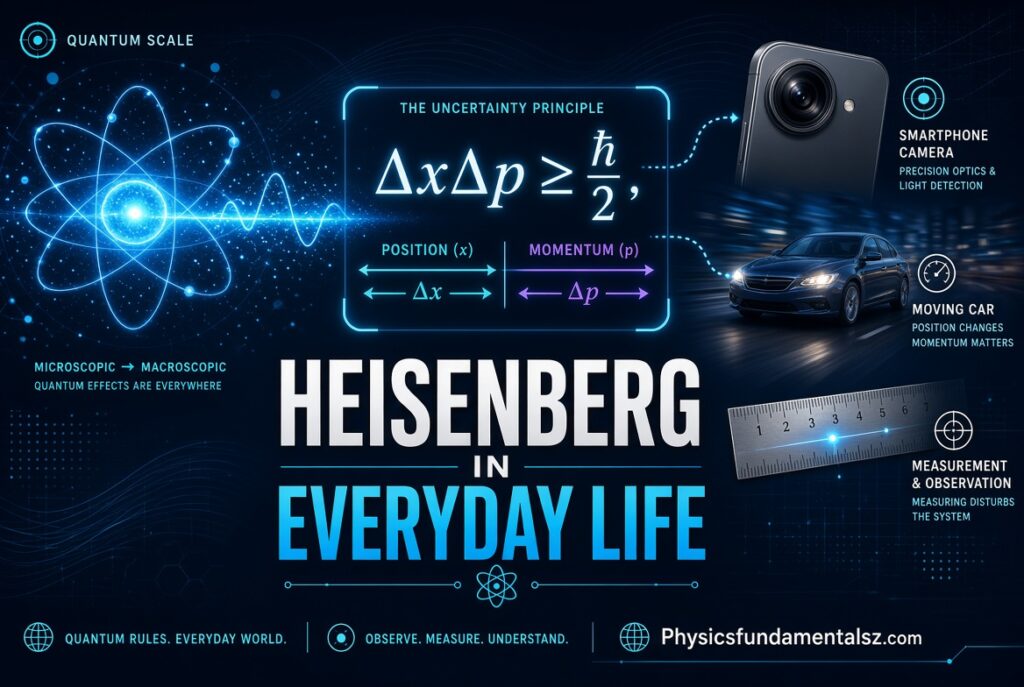
You will never notice this principle while driving a car or throwing a ball. The uncertainty involved is far too small to matter at human scale.
Its real impact shows up in the technology built on quantum rules, from semiconductor chips to the medical scanners used in hospitals every day.
Key Takeaways
- Position and momentum cannot both be known with perfect precision at once.
- The formula is Δx · Δp ≥ ℏ/2, with a similar version for energy and time.
- Werner Heisenberg introduced the idea in 1927 within quantum mechanics.
- It is a fundamental property of nature, not a flaw in measuring tools.
- It explains atomic stability, electron behavior, and much of modern quantum technology.
Also Read:
- Bohr Model of the Atom: Energy Levels, Emission & Absorption Spectra
- De Broglie Wavelength: λ = h/mv Formula, Derivation & Examples
- Quantum Numbers: n, l, m_l, m_s and Electron Configuration
- Photoelectric Effect Calculations: hf = work-function + KE_max
- Half-Life Calculations: Formula & Worked Examples Explained
- Mass-Energy Equivalence: E = mc² Derivation & Nuclear Applications
- Nuclear Decay Equations: Alpha, Beta & Gamma Decay Explained
- Special Relativity Explained
- Work-Energy Theorem: Complete Guide with Formula, Derivation, and Examples
- Simple Pendulum: Definition, Formula, Time Period, and Derivation
- Newton’s Laws of Motion
- Transverse Waves Explained
- What Is Energy?
- Projectile Motion: Complete Guide
- Wave Speed, Frequency & Wavelength
- Conservation of Momentum
- Coulomb’s Law Calculations: F = kQ1Q2/r² Formula & Examples
- Capacitors and Capacitance: C = Q/V Formula, Energy Storage & Examples
- Electric Potential Energy: E = kQq/r, Work Done & Worked Examples
- Electric Current: I = Q/t, Drift Velocity & Ohm’s Law Connection
- Magnetic Field of a Current-Carrying Wire: B = μ0I/2πr
- Electric Circuits & Kirchhoff’s Laws: KCL, KVL & Worked Examples
- Kirchhoff’s Laws Advanced: Solving Multi-Loop Circuits Step by Step
- Lenz’s Law: The Direction of Induced Current Explained
- Magnetic Flux and Faraday’s Law: Formula, Examples & Applications
Frequently Asked Questions (FAQs)
What is the Heisenberg uncertainty principle in simple terms?
It states you cannot know a particle’s exact position and exact momentum at the same time. Measuring one precisely makes the other inherently uncertain.
Who discovered the Heisenberg uncertainty principle?
Werner Heisenberg, a German physicist, introduced it in 1927 while developing matrix mechanics at the University of Göttingen.
What is the formula for the Heisenberg uncertainty principle?
The standard formula is Δx · Δp ≥ ℏ/2, where Δx is position uncertainty, Δp is momentum uncertainty, and ℏ is the reduced Planck constant.
Is the Heisenberg uncertainty principle the same as the observer effect?
No. The observer effect is disturbance caused by measurement, while the uncertainty principle is a fundamental limit that exists even without measuring anything.
Does the uncertainty principle apply to everyday objects like cars?
Technically yes, but the effect is astronomically small at large scales, so it never shows up in everyday measurements.
Why can’t we measure position and momentum precisely at the same time?
Because quantum particles behave like waves, and a wave’s shape cannot be both perfectly localized and have a single, sharp momentum simultaneously.
What is the energy-time uncertainty principle?
It states ΔE · Δt ≥ ℏ/2, meaning particles with very short lifetimes naturally have a broad, uncertain energy value.
Does the Heisenberg uncertainty principle prove the universe is random?
It shows precise, simultaneous knowledge of certain pairs is impossible, but this reflects fundamental quantum behavior rather than pure randomness.
How does the uncertainty principle explain atomic stability?
Confining an electron tightly around the nucleus would force its momentum uncertainty extremely high, requiring more energy than the atom actually has, so it stays spread out instead.
What is Planck’s constant’s role in the uncertainty principle?
The reduced Planck constant, ℏ, sets the scale of the uncertainty limit. It is why quantum effects are unnoticeable for large, everyday objects.
Can technology ever eliminate the uncertainty principle?
No. It is a fundamental property of quantum systems, not a technological shortfall that better instruments could someday fix.
What did Einstein think about the uncertainty principle?
Einstein was famously uncomfortable with it and debated Niels Bohr extensively, though the principle has since been confirmed by decades of experiments.
How is the uncertainty principle used in electron microscopes?
Engineers balance electron wavelength against momentum spread when setting beam energy, a direct application of this same quantum trade-off.
What is the difference between Heisenberg uncertainty and quantum indeterminacy?
Uncertainty describes limits on simultaneous measurement precision, while indeterminacy more broadly describes the probabilistic nature of quantum outcomes.
Is the Heisenberg uncertainty principle proven experimentally?
Yes, it has been confirmed repeatedly, including precision experiments with electrons, photons, and even large molecules like fullerenes.
What are conjugate variables in the uncertainty principle?
Conjugate variables, like position-momentum or energy-time, are paired quantities that cannot both be measured with unlimited precision at once.
How does the uncertainty principle relate to quantum computing?
Qubit control and error correction must account for fundamental limits on precisely knowing certain paired quantum properties simultaneously.
Why is it called “uncertainty” rather than “error”?
Because the limitation is not a measurement mistake or error. It reflects a real, built-in property of how quantum particles exist.
What happens if you try to measure position very precisely?
The particle’s momentum becomes correspondingly uncertain, an unavoidable trade-off described directly by the Δx · Δp ≥ ℏ/2 formula.
Does the uncertainty principle apply to light and photons too?
Yes, photons also obey these same quantum limits, since the principle applies broadly to any particle exhibiting wave-like quantum behavior.
Conclusion
The Heisenberg uncertainty principle is not a gap in our tools. It is a fundamental rule about how nature itself behaves at the quantum scale.
Once you see position and momentum as genuinely linked, atomic stability, electron behavior, and quantum technology all start making far more sense.
Keep exploring the “Also Read” articles above to build a complete, connected picture of modern physics from the ground up.