How to Study for AP Physics 1 Exam Effectively: Study Plan, Unit-by-Unit Strategy, and Exam Tips for May 2027

Here is a frustrating pattern that shows up every year. A student memorizes every formula, finishes every homework set, and still walks out of the AP Physics 1 exam feeling blindsided.
The reason is simple. This exam does not reward the student who knows the most equations. It rewards the student who can explain why a block slows down, why a pendulum behaves the way it does, and how to design an experiment from scratch.
That changes how you should prepare. If you want to learn how to study for AP Physics 1 exam effectively, you need a plan built around understanding, practice, and feedback, not around rereading notes the night before.
Table of Contents
How to Study for AP Physics 1 Exam Effectively

Start early and study in short, regular sessions. Learn concepts first, then practice problems without looking at the solution, and review your mistakes in an error log.
Focus extra time on the heaviest units, Force and Translational Dynamics and Work, Energy, and Power. Practice explaining answers in words, and take timed practice sections as the exam gets closer.
The Seven Habits at a Glance
| Habit | What to do | Why it works |
|---|---|---|
| Space your study | Review each unit several times over weeks | Memory lasts longer with spacing |
| Test yourself | Solve problems before checking answers | Retrieval strengthens learning |
| Explain in words | Justify answers without relying on equations | The exam rewards reasoning |
| Draw first | Sketch diagrams, graphs, and free-body diagrams | Representations organize your thinking |
| Keep an error log | Record every mistake and its cause | Patterns reveal your weak spots |
| Practice under time | Use realistic timing for practice sections | Speed and focus improve with practice |
| Do real labs | Think through experiments, variables, and data | One full free-response question tests it |
What Is on the AP Physics 1 Exam?
Before building a plan, learn exactly what you are preparing for. AP Physics 1 is an algebra-based, introductory college-level physics course, equivalent to a first-semester college course.
The College Board has updated the exam for May 2027. This guide uses the current College Board course overview, so check AP Central for any later changes.
Exam Structure
The exam lasts 3 hours and has two sections. Each section counts for half of your score.
| Section | Questions | Time | Weight |
|---|---|---|---|
| Section I: Multiple Choice | 42 | 85 minutes | 50% |
| Section II: Free Response | 4 | 95 minutes | 50% |
A four-function, scientific, or graphing calculator is allowed on both sections. The exam also provides reference information with the equations you need.
The Four Free-Response Questions
The free-response questions appear in a fixed order. Each one tests a different skill.
| Question | Type | Points |
|---|---|---|
| Question 1 | Mathematical Routines | 10 |
| Question 2 | Translation Between Representations | 12 |
| Question 3 | Experimental Design and Analysis | 10 |
| Question 4 | Qualitative/Quantitative Translation | 8 |
Together that is 40 free-response points. Knowing the format in advance means you can practice each type on purpose.
The Eight Units and Their Weights
The multiple-choice section is weighted by unit. Use this table to decide where your study hours go.
| Unit | Topic | Multiple-Choice Weight |
|---|---|---|
| 1 | Kinematics | 10–15% |
| 2 | Force and Translational Dynamics | 18–23% |
| 3 | Work, Energy, and Power | 18–23% |
| 4 | Linear Momentum | 10–15% |
| 5 | Torque and Rotational Dynamics | 10–15% |
| 6 | Energy and Momentum of Rotating Systems | 5–8% |
| 7 | Oscillations | 5–8% |
| 8 | Fluids | 10–15% |
Units 2 and 3 together account for roughly 36 to 46 percent of the multiple-choice section. They deserve the most attention.
The Three Science Practices
The College Board organizes skills into three science practices. They show up on every exam.
- Creating Representations: drawing diagrams, graphs, tables, and sketches.
- Mathematical Routines: deriving, calculating, estimating, and predicting.
- Scientific Questioning and Argumentation: designing experiments, analyzing data, and supporting claims.
What About Electricity and Waves?
Based on the official unit list, the course covers mechanics and fluids. It does not list electric circuits or electric charge units.
That is good news if you were worried about a huge range of topics. It also means you can go deep on a smaller set of ideas.
How the Exam Is Scored
Your multiple-choice and free-response results combine into a composite score. The College Board converts it to a scale from 1 to 5.
Many colleges grant credit or placement for a 3 or higher, though policies vary. Use the College Board’s credit policy search to check the schools you care about.
There is no penalty for wrong answers, so never leave a multiple-choice question blank.
Why AP Physics 1 Feels So Hard
Most students do not struggle because of the math. They struggle because the exam asks them to think.
Understanding the real challenge helps you prepare for it.
It Is a Reasoning Exam
Many questions give you no numbers at all. You compare situations, predict what changes, and justify your answer in a sentence or two.
A student who only plugs numbers into formulas will lose points on these.
Concepts Hide Inside Problems
A single problem may involve forces, energy, and momentum at once. You must choose the right principle before you calculate anything.
Choosing the right tool is half the skill. Memorizing the tools is the easy half.
The Course Moves Fast
Each unit builds on the last. If you fall behind on forces, energy will feel confusing. If energy is shaky, momentum and rotation will be worse.
That is why steady, early study beats last-minute cramming.
Intuition Often Fights the Physics
Everyday experience tells us that things stop when we stop pushing them. Physics says otherwise. Fixing these misconceptions takes deliberate practice.
For a clear explanation of the foundations, start with our guide to Newton’s laws of motion.
Build Your AP Physics 1 Study Plan
A plan turns good intentions into results. The goal is to cover everything at least three times: once to learn it, once to practice it, and once to review it.
Today is late October, which leaves about six to seven months before the May exam. That is enough time to prepare well if you start now.
Step 1: Stay Current With Your Class
Your first job is to understand each unit while your teacher covers it. Do the homework honestly, and ask questions the same week you get confused.
Falling behind is the most common reason students panic in spring.
Step 2: Add Short Weekly Review Sessions
Spend 30 to 45 minutes each week reviewing earlier units. This is spaced practice, and it is the cheapest way to improve long-term memory.
Mix old and new topics so you keep switching between ideas.
Step 3: Take Real Practice Sections
Starting in winter, practice full multiple-choice sets and individual free-response questions under timed conditions. Practice that matches exam conditions is the best predictor of exam performance.
Step 4: Review Mistakes Relentlessly
After every practice session, sort your errors by cause. Then fix the cause, not just the answer.
A Month-by-Month Timeline
| Period | Main Goal | What to Do |
|---|---|---|
| Late Oct to Dec | Build the foundation | Master Kinematics, Forces, and Energy as your class covers them |
| January | Close gaps | Redo old homework, start an error log, practice FRQs by type |
| February | Deepen understanding | Work on momentum, torque, and mixed-topic problems |
| March | Complete content review | Finish Units 6, 7, and 8, and take a first full practice exam |
| April | Simulate the exam | Take timed practice sections each week and fix weak spots |
| Early May | Final polish | Review the error log, formula reference, and lab skills |
| Exam week | Stay sharp | Light review, good sleep, and a calm routine |
A Sample Weekly Schedule
| Day | Activity | Time |
|---|---|---|
| Monday | New topic practice from class | 45 minutes |
| Tuesday | Review an older unit from memory | 30 minutes |
| Wednesday | Free-response question, timed | 30 minutes |
| Thursday | Error log and concept review | 30 minutes |
| Friday | Light mixed practice | 30 minutes |
| Saturday | Multiple-choice set or longer review | 60 minutes |
| Sunday | Rest or very light review | 0–15 minutes |
Adjust the schedule to fit your life. Consistency matters more than perfect timing.
The Last Four Weeks
In the final month, shift from learning to performing. Take full timed sections, review them carefully, and target your three weakest topics.
Avoid starting entirely new resources. Polish what you already know.
Study Techniques That Actually Work
Not all study methods are equal. Many popular habits feel productive but do little.
Research reviewing common learning techniques, including the well-known review by Dunlosky and colleagues, found that practice testing and spreading study over time are among the most effective. Rereading and highlighting rated much lower.
Retrieval Practice
Close the book and try to recall the idea or solve the problem from scratch. Struggling for a moment is a sign that learning is happening.
Use blank-page recall: write everything you remember about a topic, then check what you missed.
Spaced Repetition
Review each topic several times with gaps in between. A topic you studied in October should reappear in November, January, and March.
Short, repeated sessions beat one long session.
Interleaving
Mix problem types in one session instead of doing twenty of the same kind. This trains you to choose the right method, which is exactly what the exam demands.
Mix a forces question, an energy question, and a momentum question in the same set.
Worked Examples and Self-Explanation
Study a worked solution line by line and explain why each step happens. Then try a similar problem on your own.
The explanation habit is what turns a worked example into real understanding.
The Teach-It-Back Method
Explain a concept out loud as if teaching a friend. If you stumble, you have found a gap.
Record yourself if it helps. Listening back is surprisingly revealing.
Dual Coding: Words Plus Diagrams
Pair every explanation with a picture. Draw free-body diagrams, energy bar charts, and motion graphs.
Physics is visual. A good diagram often solves half the problem.
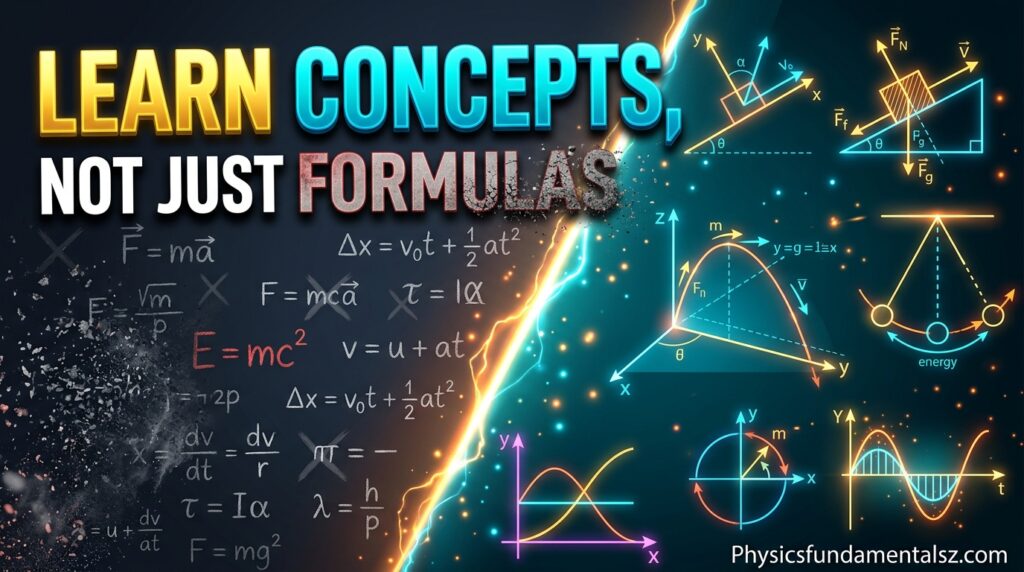
Learn Concepts, Not Just Formulas

Because the exam provides reference information, memorizing a list of equations is the least valuable use of your time. Knowing when and why to use each equation is what counts.
Start With the Physical Story
Before writing any equation, describe what is happening in plain words. What objects are involved? What is changing? What stays the same?
This habit prevents most careless errors.
Choose the Principle First
Ask which big idea applies. Is it Newton’s second law, conservation of energy, conservation of momentum, or rotational equilibrium?
The choice often depends on what the question gives you and asks for.
Use Proportional Reasoning
Many questions ask what happens if you double a mass or halve a distance. Practice answering without a calculator by looking at how the variables connect.
For example, if kinetic energy depends on speed squared, doubling speed multiplies the energy by four.
Test Limiting Cases
Imagine extreme values. What if the mass is huge, or friction is zero? If your answer behaves sensibly, you are likely on the right track.
This is also a great way to justify an answer in words.
Always Check Units
Units catch many mistakes before you finish. If your answer for speed has units of meters, something went wrong.
Build the habit of writing units on every line.
Unit-by-Unit Study Guide
Each unit has its own traps and key skills. Use this section as a checklist as you review.
Unit 1: Kinematics (10–15%)
Kinematics describes motion without asking what causes it. You will work with position, velocity, acceleration, and graphs.
Key skills include reading slopes and areas on motion graphs, using constant-acceleration equations, and breaking projectile motion into horizontal and vertical parts.
Common traps include mixing up speed and velocity, forgetting that acceleration at the top of a throw is still downward, and using constant-acceleration equations when acceleration is not constant.
For deeper practice, read our guide to projectile motion.
Unit 2: Force and Translational Dynamics (18–23%)
This is one of the two heaviest units. It centers on Newton’s laws, free-body diagrams, friction, and forces in systems.
Key skills include drawing clean free-body diagrams, resolving forces into components, and writing Newton’s second law for each direction.
Common traps include drawing forces that do not exist, confusing mass with weight, and assuming the normal force always equals mg.
Unit 3: Work, Energy, and Power (18–23%)
The second heavy unit covers work, kinetic energy, potential energy, conservation of energy, and power.
Key skills include tracking energy in a system, using energy bar charts, and deciding when mechanical energy is conserved.
Common traps include forgetting that friction removes mechanical energy, treating work as always positive, and mixing up energy and power.
Strengthen the basics with our guides to what is energy and the work-energy theorem.
Unit 4: Linear Momentum (10–15%)
Momentum covers impulse, conservation of momentum, and collisions.
Key skills include defining the system carefully, comparing before and after, and telling elastic from inelastic collisions.
Common traps include assuming kinetic energy is conserved in every collision and ignoring direction, since momentum is a vector.
Practice with our guide to conservation of momentum.
Unit 5: Torque and Rotational Dynamics (10–15%)
This unit extends forces to rotation. It covers torque, rotational inertia, and rotational equilibrium.
Key skills include finding the lever arm, choosing a pivot wisely, and applying the rotational version of Newton’s second law.
Common traps include using the wrong distance for the lever arm and forgetting that mass distribution affects rotational inertia.
Unit 6: Energy and Momentum of Rotating Systems (5–8%)
This smaller unit covers rotational kinetic energy and angular momentum. It also includes rolling motion.
Key skills include applying conservation of angular momentum and comparing translational and rotational energy.
A classic example is a spinning skater pulling in their arms. Rotational inertia drops, so angular speed rises.
Unit 7: Oscillations (5–8%)
Oscillations cover simple harmonic motion for springs and pendulums, plus energy in oscillating systems.
Key skills include relating period to mass and spring constant, or to length and gravity, and reading position-time graphs.
A common trap is thinking the period of a pendulum depends on its mass. It does not.
Explore the details in our guide to the simple pendulum.
Unit 8: Fluids (10–15%)
Fluids cover pressure, buoyancy, and flow. You will use density, Archimedes’ principle, continuity, and Bernoulli’s equation.
Key skills include relating pressure to depth, deciding whether an object floats, and connecting pipe size to fluid speed.
Because fluids carry a similar weight to momentum and rotation, do not skip them. They are often the unit students leave for last and then study too lightly.
How to Use the Unit Guide
After each unit, write one page that answers four questions. What are the three biggest ideas? What are the most common mistakes? Which problems do I still miss? What would I say in a two-minute explanation?
That page becomes a powerful review sheet in April.
How to Master the Free-Response Section
The free-response section is where understanding shows. Each of the four questions needs a different mindset.
Plan your time carefully. With 95 minutes for 40 points, you have roughly 2.4 minutes per point.
Question 1: Mathematical Routines (10 points)
This question asks you to derive, calculate, estimate, or predict. Show a clear chain of reasoning.
Start from a fundamental principle or an equation from the reference information. Then carry the algebra forward symbolically before plugging in numbers.
Write units, circle your final answer, and label each part.
Question 2: Translation Between Representations (12 points)
This is the most valuable question, so give it your full focus. You move between words, diagrams, graphs, and equations.
Practice turning a description into a free-body diagram, a graph into a story, or an equation into a sketch.
Label axes, draw to scale, and make the shape of your graph match the physics.
Question 3: Experimental Design and Analysis (10 points)
You may be asked to design a procedure, identify variables, analyze data, or explain how to reduce error.
A strong answer names the independent variable, the dependent variable, what is held constant, and the measuring tools. It explains what data to collect and how to analyze it.
Learn to turn a relationship into a straight-line graph. Knowing what the slope and intercept mean is a common requirement.
Question 4: Qualitative/Quantitative Translation (8 points)
This question asks you to connect conceptual reasoning with a calculation. The College Board’s sample for this question type asks you to estimate a result, derive an equation, and then check whether the equation agrees with your estimate.
Practice writing a short justification that goes beyond quoting an equation. Describe what happens physically and why.
A Simple Framework for Justifying Answers
Use claim, evidence, and reasoning. State your claim, point to the evidence in the problem, and connect it to a physical principle.
For example: “The speed after the collision is smaller (claim). The total mass increases while total momentum stays the same (evidence). Since momentum equals mass times velocity, a larger mass means a smaller speed (reasoning).”
Free-Response Writing Tips
- Answer the question that is asked, not a nearby one.
- Write in complete, clear sentences for any “justify” or “explain” prompt.
- Do not erase work. Cross it out neatly if it is wrong.
- If you are stuck, write the relevant principle anyway. Partial credit exists.
- Leave nothing blank.
How to Master the Multiple-Choice Section
The multiple-choice section gives you 42 questions in 85 minutes. That is about 2 minutes per question.
Many are conceptual and quick. Others need a short calculation. Your goal is to bank the easy points first.
Pace Yourself
Skim a question, decide whether it is quick, medium, or long, and move on if it is a long one. Mark it and come back.
Do not let one hard problem eat five minutes.
Read the Whole Question
Many wrong answers come from misreading. Underline what is asked, circle key words like “constant,” “increases,” or “at rest,” and note any given values.
Eliminate and Estimate
Rule out answers that violate basic physics, such as the wrong units or a result that grows when it should shrink. Even a quick estimate can eliminate two options.
Draw Even Quick Diagrams
A tiny sketch next to the question can prevent big mistakes. For force questions, draw the free-body diagram.
Guess Strategically
There is no penalty for wrong answers. If you must guess, remove what you can and pick the best remaining choice.
Lab Skills and Experimental Reasoning
Labs are not an extra. The course requires hands-on lab work, and a full free-response question tests experimental thinking.
Treat every lab in your class as exam preparation.
Know the Vocabulary
Be comfortable with independent variable, dependent variable, control variable, systematic error, random error, uncertainty, and best-fit line.
Practice Writing Procedures
Take any physics idea and write a procedure to test it. List the equipment, steps, measurements, and how you will reduce error.
A good procedure is something another student could follow without asking you questions.
Linearize Relationships
If period depends on the square root of length, plot period squared against length to get a straight line. Then explain what the slope represents.
This one skill appears often in experimental questions.
Think About Error
Ask how each measurement could be wrong and how you would improve it. Repeating trials, using better tools, and reducing friction are typical answers.
Math Skills You Need for AP Physics 1
The course is algebra-based, so you do not need calculus. You do need confident algebra and basic trigonometry.
Core Math Toolkit
- Solving equations for any variable.
- Working with ratios and proportions.
- Using sine, cosine, and tangent for components.
- Reading slopes and areas on graphs.
- Handling scientific notation and unit conversions.
Do the Algebra Symbolically
Solve for the variable before plugging in numbers. It reduces rounding errors and shows the relationships clearly.
It also makes it easier to see how changing one quantity affects another.
Check Whether the Answer Is Reasonable
A car traveling at 3,000 meters per second is a red flag. Build a sense for typical sizes of everyday quantities.
Best Resources and How to Use Them
The right resources make studying efficient. The wrong ones waste time.
Choose a small set and use them well.
Official College Board Materials
AP Central publishes the Course and Exam Description, the Course at a Glance, and past free-response questions. Use them to see the exact skills tested.
Note that some older free-response questions came from earlier exam formats. They are still good practice for content, but the question types may differ from the current exam.
Your Teacher and AP Classroom
If your class uses AP Classroom, take advantage of its practice questions and progress checks. Ask your teacher to review your free-response answers against the scoring guidelines.
Your Textbook and Class Notes
Use them as references, not as something to reread cover to cover. Go to them when a practice problem exposes a gap.
Physics Fundamentals Articles, Calculators, and Games
Our site offers explainers, calculators, and browser games that link to the concepts behind them. Try the physics calculators to check your answers and see each formula, and the physics games to build intuition by changing variables.
If you want a guided path through the subject, follow the physics roadmap.
Study Groups
A small group of two to four people works well. Take turns explaining a problem, and let the others ask questions.
Explaining is one of the best ways to find out what you really know.
How to Use Practice Exams Well
Practice exams are powerful only if you review them properly. Taking a test and moving on wastes most of the benefit.
Take Them Under Real Conditions
Use a timer, a quiet space, and only the materials allowed on the exam. Take the multiple-choice and free-response sections separately, with the official timing.
Review Every Question
Go through every question, including the ones you got right. Ask whether you were sure or lucky.
For every mistake, write down why it happened and what you will do differently.
Sort Your Errors
| Error type | Example | Fix |
|---|---|---|
| Concept gap | Did not know why momentum is conserved | Re-study the idea and explain it aloud |
| Skipped step | Forgot a free-body diagram | Make diagrams a habit |
| Math slip | Wrong sign or algebra mistake | Slow down and check units |
| Misread question | Answered a different question | Underline what is asked |
| Time pressure | Rushed the last questions | Practice pacing |
Keep an Error Log
Write each mistake in a notebook with the topic, the cause, and the correct reasoning. Review the log every week.
In a few weeks, you will see patterns. Those patterns tell you exactly where to study.
Worked Mini-Examples for Exam Thinking
These short examples show the style of reasoning the exam rewards.
Example 1: A Proportional Reasoning Question
A spring-mass system oscillates with a certain period. If the mass is quadrupled and the spring stays the same, what happens to the period?
The period depends on the square root of mass divided by the spring constant. Quadrupling the mass multiplies the period by the square root of four, which is two. The period doubles.
Example 2: A Qualitative Justification
A moving cart sticks to a much lighter cart at rest. Estimate how the final speed compares with the initial speed, and justify your answer without using an equation.
Because the second cart is so light, the combined mass is barely larger than the original mass. Momentum is conserved, so the speed must be only slightly lower than before. A tiny increase in mass can only cause a tiny drop in speed.
Example 3: Choosing the Right Principle
A block slides down a smooth curved ramp. You want its speed at the bottom. Which principle is easier to use, forces or energy?
Energy is easier. The ramp is curved, so the force changes with position. Conservation of energy skips the details of the path and connects height directly to final speed.
Example 4: Designing a Measurement
You want to find how the stopping distance of a sliding block depends on its initial speed. What would you measure and plot?
Launch the block at several measured speeds, measure the stopping distance each time, and repeat each trial. Plot stopping distance against speed squared. A straight line supports the relationship, and the slope relates to the friction.
Common Study Mistakes to Avoid
Even motivated students lose points to avoidable habits. Check yourself against this list.
Only Rereading Notes
Rereading feels easy and gives a false sense of mastery. Replace it with practice problems and recall.
Looking at the Solution Too Soon
If you glance at the answer after thirty seconds, you never build problem-solving strength. Struggle for a few minutes first.
Skipping Diagrams
Students who skip diagrams make more errors. A diagram takes ten seconds and saves minutes.
Studying Only Favorite Topics
It is natural to practice what you enjoy. Make yourself work on the weaker units first.
Ignoring the Free-Response Style
Many students practice multiple-choice only and are surprised by the writing. Practice free-response every week.
Cramming the Night Before
All-night study sessions reduce memory and focus. Prepare steadily and rest before the exam.
Neglecting Lab Skills
Experimental design is a full question. Review it throughout the year, not only in May.
Staying Focused, Rested, and Confident
Physics is hard, and it is normal to feel stuck sometimes. How you handle that matters.
Treat confusion as a signal that learning is about to happen.
Build Healthy Habits
Sleep, regular meals, and breaks improve memory and concentration. Study in 25 to 45 minute blocks with short rests.
Put your phone out of reach while you work.
Handle Test Anxiety
Take practice tests so the real one feels familiar. If anxiety rises, breathe slowly and refocus on one question at a time.
Remember that you do not need a perfect score. You need enough points to reach your goal.
Celebrate Progress
Track your practice scores and error log over time. Seeing improvement builds motivation.
Final Week and Exam Day Checklist
Your last week should be calm and focused. The big learning is done.
The Week Before
- Review your error log and unit summary pages.
- Do a few light, mixed practice problems each day.
- Practice one full free-response question per type.
- Prepare your calculator and check that it is allowed.
- Go to bed early.
The Night Before
Do a short review, pack your supplies, and relax. Do not start new material.
On Exam Day
- Bring approved calculators, pencils, pens, and your required materials.
- Eat a good breakfast and arrive early.
- Read each question carefully and pace yourself.
- Use the reference information and write clear work.
- Answer every multiple-choice question.
Authoritative Sources for Further Reading
For official details, consult AP Central and AP Students from the College Board. They publish the Course and Exam Description, exam dates, scoring information, and credit policy tools.
For learning science, the review by John Dunlosky and colleagues, “Improving Students’ Learning With Effective Learning Techniques,” is a respected summary of which study methods work best.
Also Read:
- Newton’s Laws of Motion
- Projectile Motion
- Conservation of Momentum
- Work-Energy Theorem: Complete Guide with Formula, Derivation, and Examples
- What Is Energy?
- Simple Pendulum: Definition, Formula, Time Period, and Derivation
- Special Relativity Explained
- Mass-Energy Equivalence: E = mc² Derivation & Nuclear Applications
- Wave Speed, Frequency & Wavelength
- Transverse Waves Explained
- How to Calculate Thermal Expansion of a Metal Rod: Formula, Steps and Worked Examples 2026
- How to Solve Calorimetry Problems Step by Step: Formulas, Worked Examples and Practice 2026
- Real Life Examples of Conduction Convection Radiation: Everyday Heat Transfer Explained 2026
- Why Does Metal Feel Colder Than Wood at Room Temperature? The Physics of Heat Flow Explained 2026
- Why Does Sweat Cool You Down Physics Explanation: The Science of Evaporative Cooling 2026
- How to Solve Doppler Effect Problems Step by Step: Formulas, Sign Rules, and Worked Examples 2026
- How to Calculate Decibel Levels from Sound Intensity: Formula, Steps, and Worked Examples 2026
- Real Life Examples of Total Internal Reflection: Everyday Life, Nature, Technology, and Medicine 2026
- Why Does a Straw Look Bent in Water Refraction? The Science Behind the Bent Straw Illusion 2026
- How to Find Equivalent Capacitance in Series and Parallel: Formulas, Steps, and Solved Examples 2026
- Half-Life Calculations: Formula & Worked Examples Explained
- Nuclear Decay Equations: Alpha, Beta & Gamma Decay Explained
Frequently Asked Questions (FAQs)
How should I start studying for AP Physics 1?
Start by learning the exam format and unit weights. Then keep up with your class, do practice problems regularly, and begin an error log early.
How many hours should I study for AP Physics 1?
There is no single number. A steady habit of about 3 to 4 hours per week, increasing in spring, works well for many students. Quality and consistency matter more than total hours.
When should I start preparing for the AP Physics 1 exam?
Right away. Because the course builds on itself, learning each unit as it is taught is the best preparation. Add dedicated review in January and intensify in March and April.
How is the AP Physics 1 exam structured?
It lasts 3 hours. Section I has 42 multiple-choice questions in 85 minutes, and Section II has 4 free-response questions in 95 minutes. Each section is worth 50 percent.
What are the four free-response question types?
Mathematical Routines, Translation Between Representations, Experimental Design and Analysis, and Qualitative/Quantitative Translation.
Which units are most important?
Force and Translational Dynamics and Work, Energy, and Power each carry 18 to 23 percent of the multiple-choice section. Together they are the largest share.
What topics are on AP Physics 1?
Kinematics, force and translational dynamics, work, energy and power, linear momentum, torque and rotational dynamics, energy and momentum of rotating systems, oscillations, and fluids.
Is a calculator allowed on the AP Physics 1 exam?
Yes. A four-function, scientific, or graphing calculator is allowed on both sections.
Do I need to memorize all the formulas?
No. The exam provides reference information. Focus on knowing when and why to use each equation.
Is there a penalty for guessing?
No. Answer every multiple-choice question.
Is AP Physics 1 harder than other AP exams?
It is often considered challenging because it emphasizes reasoning, not memorization. With steady practice and good conceptual understanding, it is very manageable.
What score do I need for college credit?
Many colleges award credit or placement for a 3 or higher, though policies vary widely. Check the College Board’s credit policy search for your schools.
How do I study for the free-response section?
Practice each question type, write clear explanations, and compare your answers with official scoring guidelines. Time yourself, and review every mistake.
How do I get better at conceptual questions?
Explain ideas in words, use proportional reasoning, and draw diagrams. Practice justifying answers without relying on equations.
How do I prepare for experimental design questions?
Learn the vocabulary, practice writing procedures, and master linearizing graphs. Think about sources of error and how to reduce them.
What is the best way to review mistakes?
Keep an error log. Record the topic, the cause of each mistake, and the correct reasoning, then review it weekly.
Should I take full practice exams?
Yes, starting in winter and more often in spring. Use realistic timing and review each question afterward.
How can I improve my physics problem-solving speed?
Practice regularly, build a routine of drawing diagrams and choosing principles, and time yourself on short sets. Speed follows from familiarity.
Do I need calculus for AP Physics 1?
No. The course is algebra-based. You need solid algebra and basic trigonometry.
Are labs important for the exam?
Yes. The course requires hands-on labs, and one free-response question focuses on experimental design and analysis.
What should I do the night before the exam?
Do a light review, pack your supplies, and go to bed early. Avoid cramming or learning new material.
How can I reduce test anxiety?
Practice under exam conditions, sleep well, and focus on one question at a time. Familiarity is the best antidote to stress.
Are past AP Physics 1 free-response questions still useful?
Yes, especially for content and reasoning. Keep in mind that the exam format has changed over the years, so check the current question types.
Conclusion
Learning how to study for AP Physics 1 exam effectively comes down to a handful of reliable habits. Understand the format, study a little every week, practice without peeking at the answer, and learn from every mistake.
Put the most effort into the heaviest units, explain your reasoning in words, and treat the lab and free-response skills as seriously as the multiple-choice questions.
You do not need to be a genius or memorize every formula. You need a steady plan, honest practice, and the patience to turn confusion into understanding.
Start this week. Pick one unit, write a one-page summary from memory, and solve five problems without looking at the solutions. That small beginning is how a strong score gets built.