What Is Electric Flux Simple Explanation: Formula, Unit & Examples 2026
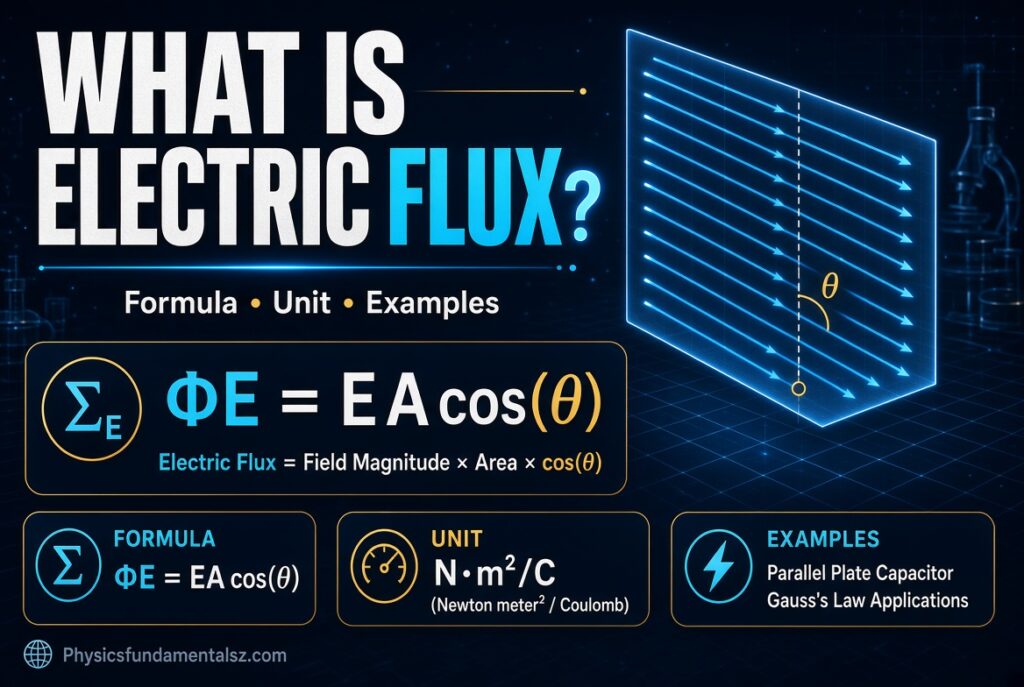
What Is Electric Flux Simple Explanation begins with understanding how an electric field passes through a given surface.
Electric flux is a physical quantity that represents the amount of electric field passing through a surface, depending on the field strength, surface area, and angle between the electric field and the surface’s normal direction.
It is commonly represented by ΦE and measured in newton-meters squared per coulomb (N·m²/C). For a uniform electric field and flat surface, electric flux is described by the relationship between electric field strength, area, and orientation.
Table of Contents
What Is Electric Flux? Simple Explanation
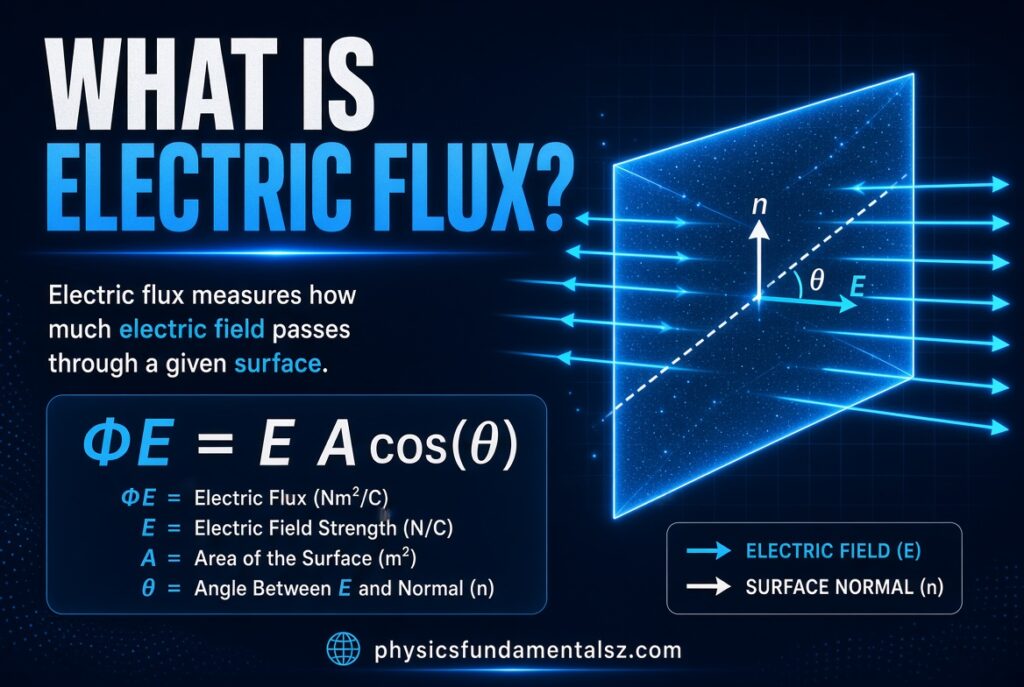
Definition: Electric flux is a measure of how much electric field passes through a surface. It depends on the field strength, the size of the surface and the angle between them.
Formula: Φ = E × A × cosθ
Unit: newton meter squared per coulomb (N·m²/C)
Think of it as counting how many electric field lines poke through a surface.
Electric Flux in Plain English
An electric field surrounds every charged object. Field lines are a drawing tool that shows its direction and strength. Where lines crowd together, the field is strong.
Electric flux counts how many of those lines cross a chosen surface. More lines crossing means more flux.
The Wind and Window Analogy
Picture wind blowing at a rectangular window. The wind is the electric field and the window is the surface.
- Window facing the wind: maximum air passes through.
- Window tilted: less air passes through.
- Window edge-on to the wind: no air passes through.
Why It Is Called “Flux”
The word comes from the Latin for “flow.” In reality, nothing physically flows in an electric field. Flux is just a useful way to measure how much field passes through a surface.
Electric Flux Formula Explained
The full formula for a flat surface in a uniform field is Φ = EA cosθ.
Each symbol has a simple meaning.
| Symbol | Meaning | Unit |
|---|---|---|
| Φ (phi) | Electric flux | N·m²/C |
| E | Electric field strength | N/C (or V/m) |
| A | Area of the surface | m² |
| θ | Angle between the field and the surface’s normal (the line perpendicular to the surface) | degrees or radians |
Why cosθ Appears
Only the part of the field that goes straight through the surface counts. The cosθ factor picks out that perpendicular part.
Another way to see it: A cosθ is the surface’s projected area as seen from the field’s point of view.
The Angle Rule
| Angle θ | cosθ | Flux | What it looks like |
|---|---|---|---|
| 0° | 1 | Maximum (EA) | Surface faces the field head-on |
| 60° | 0.5 | Half of maximum | Surface tilted |
| 90° | 0 | Zero | Field runs parallel to the surface |
| 180° | −1 | Negative (−EA) | Normal points against the field |
Always measure θ from the normal, not from the surface itself. This is one of the most common mistakes.
What Is the Unit of Electric Flux?
The SI unit of electric flux is the newton meter squared per coulomb (N·m²/C). It is also equal to the volt meter (V·m).
The two are the same thing because a volt equals a newton meter per coulomb.
The dimensional formula is M L³ T⁻³ A⁻¹.
Electric Flux Through Closed and Open Surfaces
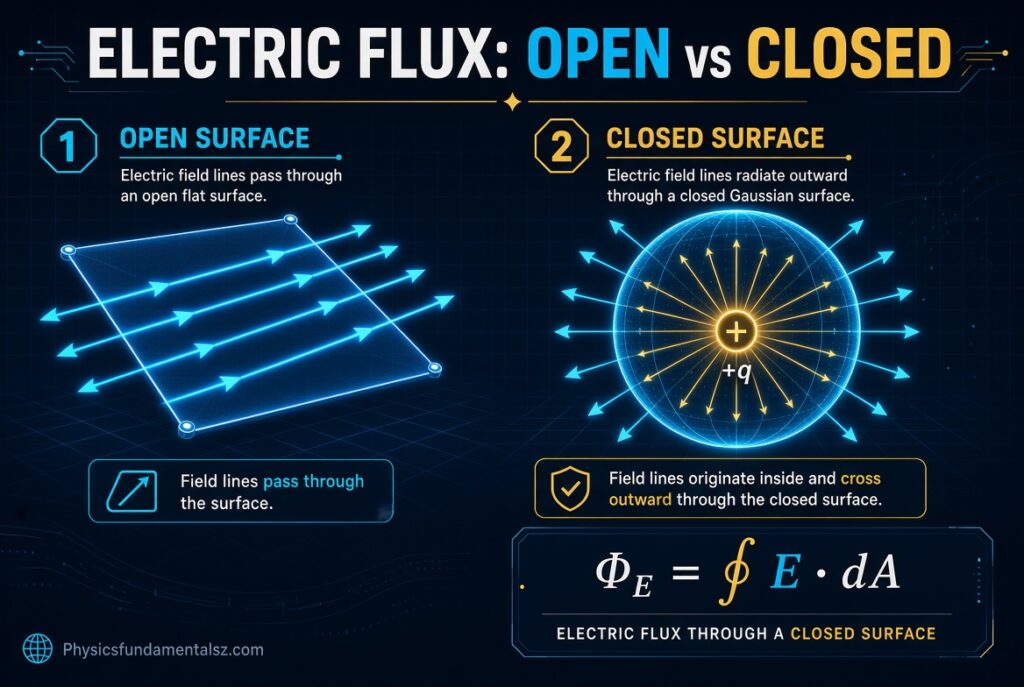
A closed surface fully encloses a volume, like a balloon or a sphere. An open surface has an edge, like a sheet of paper or a disc.
Sign Convention for Closed Surfaces
For a closed surface, the normal points outward by convention.
- Field lines leaving the surface give positive flux.
- Field lines entering the surface give negative flux.
Non-Uniform Fields
If the field changes across the surface, add up the contributions from tiny patches. In calculus form: Φ = ∫ E · dA. For a closed surface, this becomes Φ = ∮ E · dA.
Gauss’s Law: Electric Flux and Enclosed Charge
Gauss’s law is the big payoff of electric flux. It says the net flux through any closed surface depends only on the charge inside it.
Φ = Q_enclosed ÷ ε₀
Here ε₀ ≈ 8.85 × 10⁻¹² C²/(N·m²) is the permittivity of free space.
What a Gaussian Surface Is
A Gaussian surface is an imaginary closed surface you draw to make a calculation easier. You choose its shape to match the symmetry of the problem, such as a sphere, cylinder or flat box.
What Gauss’s Law Tells You
- More enclosed charge means more net flux.
- No enclosed charge means zero net flux.
- The size and shape of the surface do not change the net flux.
- Charges outside the surface do not add to the net flux.
Why the Radius Cancels for a Point Charge
Put a point charge q at the center of a sphere of radius r. The field on the sphere is E = kq/r², and the area is A = 4πr².
Multiply them: EA = kq × 4π. Since k = 1/(4πε₀), this equals q/ε₀. The radius cancels, so a bigger sphere gives the same flux.
How to Calculate Electric Flux Step by Step
Follow these five steps for a flat surface in a uniform field.
- Find the field strength E. Use the value given in N/C.
- Find the area A. Convert to square meters.
- Find the angle θ. Measure it between the field and the surface’s normal.
- Multiply. Use Φ = E × A × cosθ.
- Check the sign and units. The answer is in N·m²/C.
Worked Examples
Example 1: Surface Facing the Field
A uniform field of 100 N/C passes straight through a 0.50 m² surface.
θ = 0°, so Φ = 100 × 0.50 × 1 = 50 N·m²/C.
Example 2: Tilted Surface
Tilt the same surface so its normal makes a 60° angle with the field.
Φ = 100 × 0.50 × cos 60° = 100 × 0.50 × 0.5 = 25 N·m²/C.
Tilting halved the flux.
Example 3: Surface Parallel to the Field
Turn the surface until the field runs along it. Now θ = 90°.
Φ = 100 × 0.50 × cos 90° = 0. No field lines cross the surface.
Example 4: Charge Inside a Closed Surface
A closed surface encloses a charge of 2.0 μC (2.0 × 10⁻⁶ C).
Φ = Q ÷ ε₀ = (2.0 × 10⁻⁶) ÷ (8.85 × 10⁻¹²) ≈ 2.26 × 10⁵ N·m²/C.
Example 5: Cube in a Uniform Field
A cube with 0.10 m sides sits in a uniform 200 N/C field along the x-axis. Each face has an area of 0.010 m².
- Face where the field leaves: Φ = +200 × 0.010 = +2.0 N·m²/C
- Face where the field enters: Φ = −2.0 N·m²/C
- The four side faces: Φ = 0, since the field runs parallel to them
The net flux is zero. Every line that enters also leaves, and no charge is inside.
Example 6: Charge at the Center of a Cube
A 3.0 μC charge sits at the center of a cube. The total flux is Q ÷ ε₀ = (3.0 × 10⁻⁶) ÷ (8.85 × 10⁻¹²) ≈ 3.39 × 10⁵ N·m²/C.
By symmetry, the six faces share it equally. Each face gets about 5.65 × 10⁴ N·m²/C.
Electric Flux vs Electric Field vs Flux Density
These terms are easy to mix up.
| Quantity | Symbol | What it means | Unit | Type |
|---|---|---|---|---|
| Electric field | E | Force per unit charge at a point | N/C | Vector |
| Electric flux | Φ | Field passing through a surface | N·m²/C | Scalar |
| Electric flux density | D | Flux per unit area (D = εE) | C/m² | Vector |
Electric Flux vs Magnetic Flux
Magnetic flux follows a similar formula, but the physics differs in an important way.
| Feature | Electric flux | Magnetic flux |
|---|---|---|
| Formula | Φ_E = EA cosθ | Φ_B = BA cosθ |
| Field involved | Electric field E | Magnetic field B |
| SI unit | N·m²/C (or V·m) | Weber (Wb), equal to T·m² |
| Net flux through a closed surface | Equals Q ÷ ε₀ | Always zero |
| Reason | Isolated electric charges exist | No isolated magnetic poles have been found |
Real-World Uses of Electric Flux
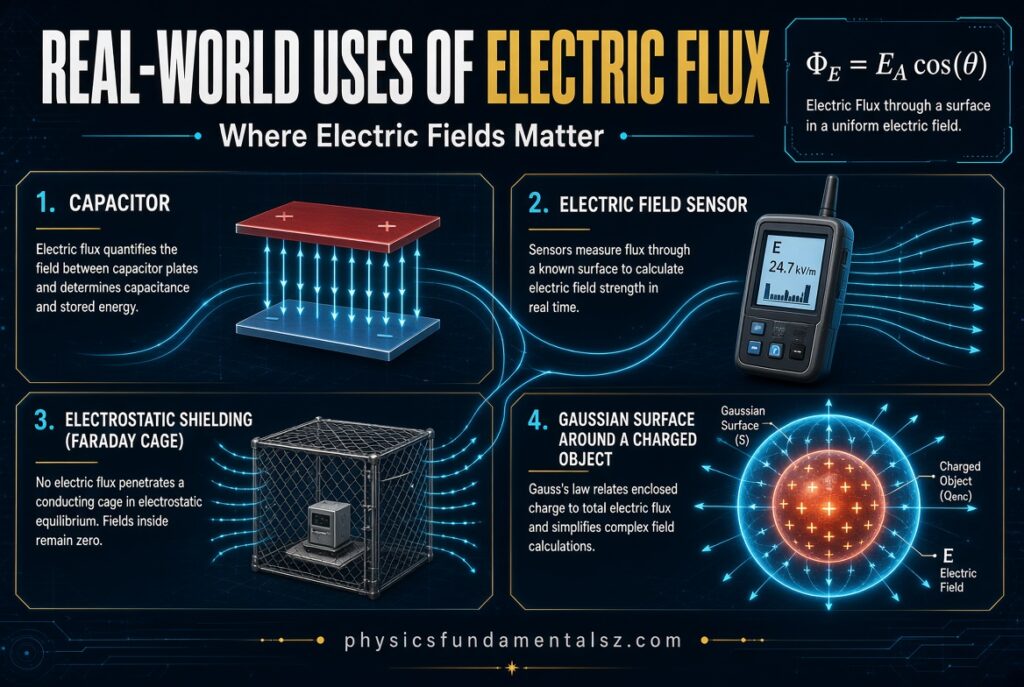
- Finding fields of symmetric charges: Gauss’s law makes spheres, long lines and flat sheets of charge easy to solve.
- Capacitors: The field between charged plates comes from a Gauss’s law calculation.
- Electrostatic shielding: Inside a conductor in equilibrium the field is zero, so a hollow conductor shields its interior.
- Maxwell’s equations: Gauss’s law for electric fields is one of the four core equations of electromagnetism.
- Charge measurement ideas: Net flux tells you the net charge inside a region.
Common Mistakes to Avoid
| Mistake | Why it is wrong | Fix |
|---|---|---|
| Treating flux as a vector | Flux is a scalar with a sign | Use a number and a sign only |
| Measuring θ from the surface | The formula needs the angle to the normal | Draw the normal first |
| Thinking surface shape changes net flux | Only enclosed charge matters | Use Φ = Q ÷ ε₀ |
| Counting outside charges | They add as much flux in as out | Include only enclosed charge |
| Forgetting the sign | Inward flux is negative | Use outward normals for closed surfaces |
| Assuming zero flux means zero field | Lines can enter and leave the surface | Check the field directly |
| Using cm² without converting | Gives an answer off by 10,000 | Convert to m² |
Expert Tips for Understanding Electric Flux
- Draw the field lines and the surface normal before doing any math.
- Ask yourself, “How many lines cross this surface?” That gives you a quick sanity check.
- For a closed surface, list each face and give it a sign. Then add.
- Remember that symmetry is what makes Gauss’s law useful. Pick a Gaussian surface that matches it.
- Keep your units in SI. Field in N/C, area in m² and charge in C.
Practice Problems
Try these before checking the answers.
- A 300 N/C field passes straight through a 0.20 m² surface. Find the flux.
- The same surface is tilted so the normal makes a 30° angle with the field. Find the flux.
- A closed surface encloses 5.0 × 10⁻⁹ C. What is the net flux?
- A closed surface encloses +4.0 nC and −4.0 nC. What is the net flux?
- A surface lies parallel to a uniform field. What is the flux through it?
Answers
- 300 × 0.20 = 60 N·m²/C
- 60 × cos 30° ≈ 52 N·m²/C
- (5.0 × 10⁻⁹) ÷ (8.85 × 10⁻¹²) ≈ 565 N·m²/C
- Zero, because the net enclosed charge is zero.
- Zero, because θ = 90°.
Also Read:
- Electromagnetism Articles and Guides
- Right Hand Rule for Magnetic Field Explained
- How to Calculate Resistance in a Series Circuit
- Ohm’s Law Calculator: Solve for Current
- Physics Fundamentals: The Complete Guide to Core Concepts, Laws, and Equations
- Play Physics Games (Build Circuits and More)
- Kinetic Energy
- Angular Momentum
- Difference Between Speed and Velocity With Examples
- Momentum Calculator Physics: Formula, Steps & Worked Examples
- Tension Force
- The Doppler Effect
- Electromagnetic Spectrum
- Torque in Physics
- Circular Motion and Centripetal Force
- Newton’s Laws of Motion
- Work Done in Physics
- Power in Physics
- Conservation of Momentum
- Momentum and Impulse
- Wave Speed, Frequency & Wavelength
- Speed of Light: The Ultimate Guide to c, the Cosmic Speed Limit
Frequently Asked Questions (FAQs)
What is electric flux in simple words?
It is a measure of how much electric field passes through a surface. Picture counting the field lines that cross the surface.
What is the formula for electric flux?
Φ = EA cosθ for a flat surface in a uniform field. For a changing field, use Φ = ∫ E · dA.
What is the unit of electric flux?
The SI unit is the newton meter squared per coulomb (N·m²/C). It is equivalent to the volt meter (V·m).
Is electric flux a scalar or a vector?
It is a scalar. It has a size and a sign but no direction of its own.
When is electric flux maximum?
When the field is perpendicular to the surface, so the angle to the normal is 0°. Then Φ = EA.
When is electric flux zero?
When the field runs parallel to the surface (θ = 90°). It is also zero for a closed surface with no net enclosed charge.
Can electric flux be negative?
Yes. If the field enters a closed surface or the normal points against the field, the flux is negative.
What is the difference between electric field and electric flux?
The electric field is a vector at each point that gives force per unit charge. Electric flux is a scalar that measures how much field passes through a surface.
What is electric flux density?
It is the flux per unit area, written D and given by D = εE. Its unit is coulombs per square meter (C/m²).
What is a Gaussian surface?
It is an imaginary closed surface chosen to match the symmetry of a charge distribution. It makes Gauss’s law calculations simple.
What does Gauss’s law say about electric flux?
The net flux through a closed surface equals the enclosed charge divided by ε₀: Φ = Q ÷ ε₀.
Does electric flux depend on the shape of the surface?
Not for the net flux through a closed surface. It depends only on the enclosed charge.
Does a charge outside a closed surface create net flux?
No. Every field line from that charge that enters the surface also leaves it, so the net flux is zero.
What is the electric flux through a closed surface with no charge inside?
It is zero. Inward and outward flux cancel exactly.
What is the difference between electric flux and magnetic flux?
Electric flux uses the electric field and equals Q ÷ ε₀ for closed surfaces. Magnetic flux uses the magnetic field and is always zero through a closed surface.
What is the dimensional formula of electric flux?
M L³ T⁻³ A⁻¹. This comes from converting N·m²/C into base SI units.
How do you find the flux through a sphere around a point charge?
Use Φ = Q ÷ ε₀. The radius does not matter, because the field weakens with distance exactly as the sphere’s area grows.
Why is it called flux if nothing flows?
The name comes from the Latin word for “flow.” It was borrowed from fluid ideas, but electric flux is just a measure of how much field passes through a surface.
Why does the cosθ factor appear in the formula?
Only the component of the field perpendicular to the surface passes through it. Cosine extracts that component.
What is electric flux used for?
It is the basis of Gauss’s law. Physicists use it to find electric fields, understand capacitors and explain shielding.
Conclusion
Electric flux tells you how much electric field passes through a surface. Remember the formula Φ = EA cosθ, and always measure the angle from the surface’s normal.
For closed surfaces, Gauss’s law turns flux into a shortcut for finding enclosed charge. Practice the examples above, and the simple explanation of what electric flux is will feel natural.
Keep exploring with the Electromagnetism articles and see how fields connect to circuits with the Ohm’s Law Calculator.