Difference Between Transverse and Longitudinal Waves: Complete Guide
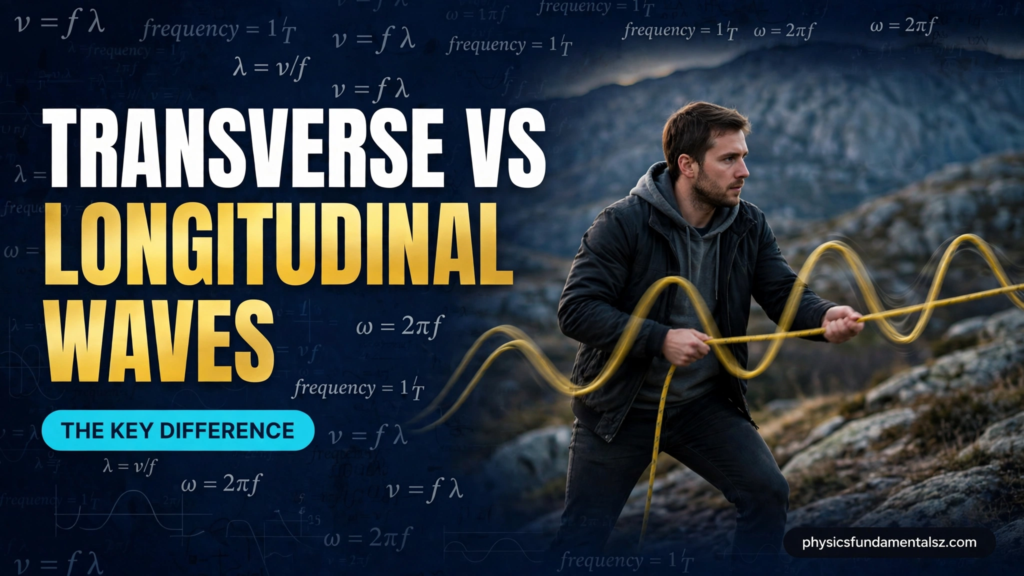
Shake a rope and a wave races along it. Speak, and a wave races through the air. Both are waves, but they move in fundamentally different ways. In one, the medium vibrates at right angles to the direction the wave travels. In the other, the medium vibrates back and forth along the very same line the wave travels. That single difference — the direction of vibration relative to the direction of travel — divides the wave world into transverse waves and longitudinal waves.
This guide explains the difference between transverse and longitudinal waves clearly and completely: definitions, diagrams in words, the features that belong to each type, a full comparison table, worked problems, and the examples examiners love to ask about.
Quick Answer: The Core Difference
Definition box: In a transverse wave, the particles of the medium vibrate perpendicular (at right angles) to the direction the wave travels. In a longitudinal wave, the particles of the medium vibrate parallel (along the same line) to the direction the wave travels.
That is the whole distinction in one sentence. Everything else — crests and troughs versus compressions and rarefactions, polarisation, the media each type can travel through — follows from it. If you remember nothing else, remember the vibration direction.
What Is a Transverse Wave?
A transverse wave is a wave in which the disturbance moves at right angles to the direction of energy transfer. Picture a rope tied to a wall. Flick one end up and down and a hump travels along the rope towards the wall. Each piece of rope moves up and down, but the wave itself moves sideways along the rope. The rope particles never travel to the wall — they just oscillate in place while the energy moves on.
The highest points of a transverse wave are called crests, and the lowest points are called troughs. The distance between two adjacent crests (or two adjacent troughs) is one wavelength. The maximum displacement of a particle from its rest position is the amplitude.
Examples of transverse waves include:
- Waves on a stretched string or rope
- Ripples on the surface of water
- Light waves and all other electromagnetic waves
- S-waves (secondary seismic waves) that travel through Earth’s interior
- Waves on a slinky shaken side to side
Note something important: light is a transverse wave, but it does not need a medium at all. It is an oscillating electric and magnetic field, and it travels happily through the vacuum of space. This is a key difference from mechanical transverse waves like rope waves, which do need a medium.
What Is a Longitudinal Wave?
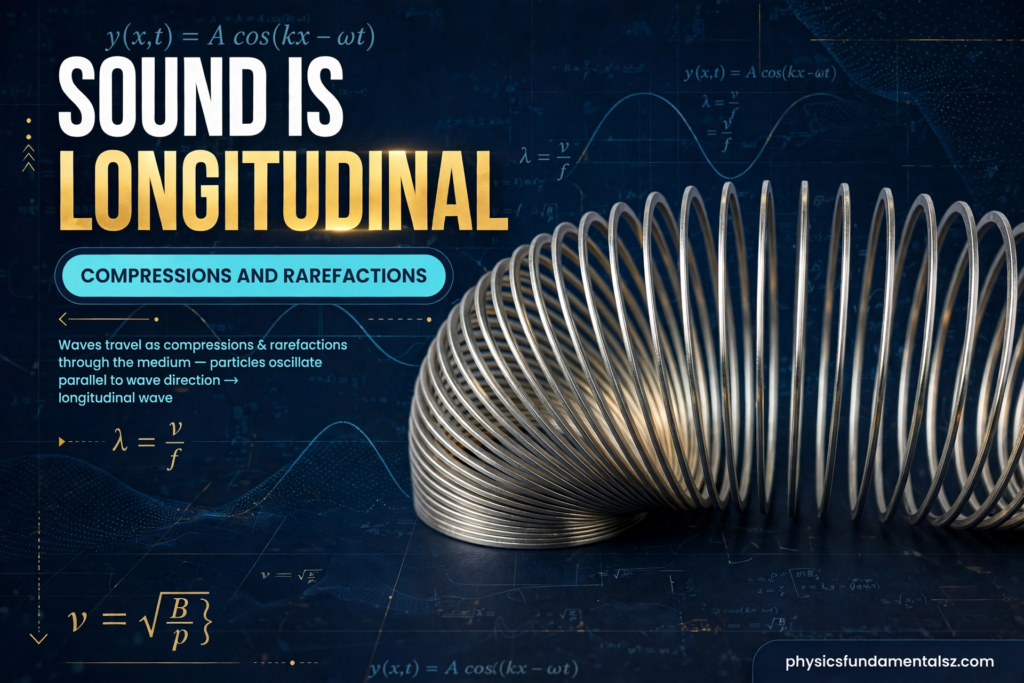
A longitudinal wave is a wave in which the disturbance moves parallel to the direction of energy transfer. Push and pull one end of a slinky along its length and a pulse of bunched-up coils travels down it. Each coil moves back and forth along the slinky, but the pulse itself travels the length of the slinky. Sound is the most important longitudinal wave in everyday life.
Instead of crests and troughs, a longitudinal wave has compressions and rarefactions. A compression is a region where the particles are squeezed close together, giving high pressure and high density. A rarefaction is a region where the particles are spread apart, giving low pressure and low density. The distance between the centres of two adjacent compressions (or two adjacent rarefactions) is one wavelength.
Examples of longitudinal waves include:
- Sound waves travelling through air, water, or solids
- P-waves (primary seismic waves) from earthquakes
- A pulse travelling along a spring pushed and pulled lengthwise
- Ultrasound waves used in medical imaging
- Pressure waves in a gas pipe or inside a musical wind instrument
When you speak, your vocal cords push air molecules back and forth, creating a travelling pattern of compressions and rarefactions. Your eardrum responds to those pressure changes, and your brain interprets them as sound. For a large set of worked examples of both kinds, see our post on transverse vs longitudinal waves examples.
Transverse vs Longitudinal Waves: Comparison Table
| Feature | Transverse wave | Longitudinal wave |
|---|---|---|
| Vibration direction | Perpendicular to wave travel | Parallel to wave travel |
| Wave features | Crests and troughs | Compressions and rarefactions |
| Particle motion | Up and down (or side to side) | Back and forth along the wave |
| Needs a medium? | Mechanical ones do; light does not | Yes, always — no medium, no sound |
| Travels through solids | Yes | Yes |
| Travels through liquids | Surface waves only | Yes |
| Travels through gases | No (mechanical) | Yes |
| Travels through a vacuum | Only electromagnetic waves | No |
| Can be polarised? | Yes | No |
| Example | Light, rope wave, water ripple | Sound, P-wave, slinky push |
| Pressure variation | No | Yes — alternating high and low pressure |
| Wavelength measured | Crest to crest (or trough to trough) | Compression to compression |
Why the Medium Matters: Solids, Liquids, Gases, and Vacuum
One of the most tested consequences of the transverse-longitudinal split is which media each type can travel through. A transverse mechanical wave needs a medium that can support shear — a sideways restoring force. Solids can do this because their particles are bonded in a structure that resists sideways displacement. Liquids and gases cannot, because their particles flow past one another. That is why you cannot send a rope-style wave through air.
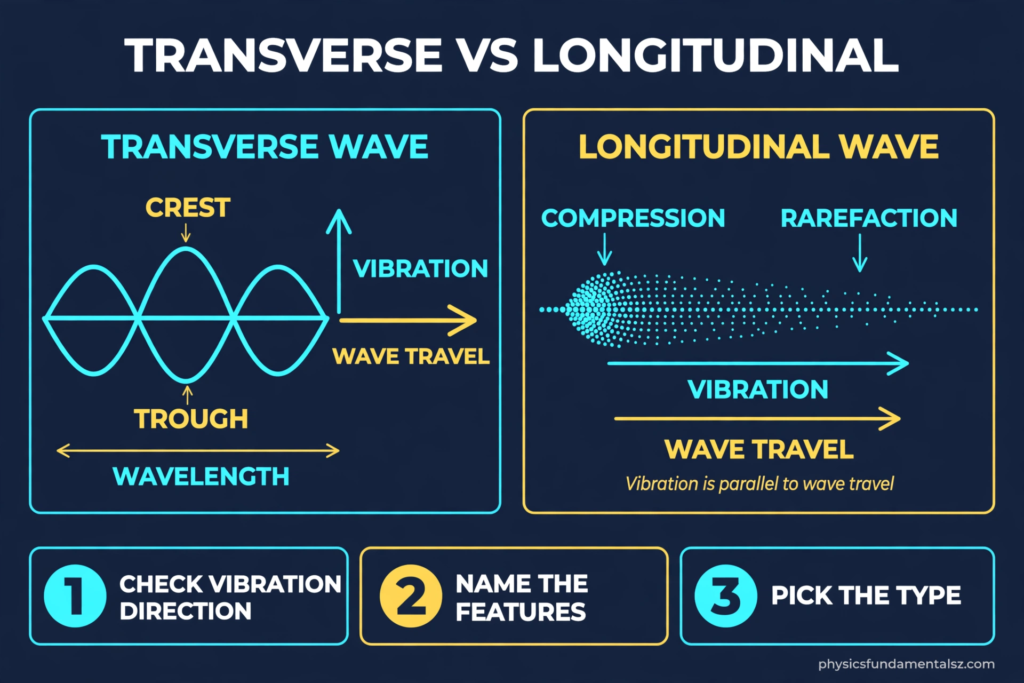
Longitudinal waves need only compressibility, which every material has. Push particles together and they push back. So sound travels through solids, liquids, and gases — fastest in solids, where particles are tightly packed and pass the disturbance on quickly, and slowest in gases.
This is why earthquakes produce two kinds of body waves with different behaviour. P-waves are longitudinal and travel through solid, liquid, and gas, so they pass through Earth’s liquid outer core. S-waves are transverse and cannot travel through liquids, so they are blocked by the outer core — creating a shadow zone on the far side of the planet that told seismologists the core must be liquid. A beautiful piece of detective work, all from the transverse-longitudinal distinction.
Polarisation: The Test That Only Transverse Waves Pass
Polarisation is the property that most cleanly separates the two wave types. A transverse wave can be polarised, meaning its vibrations can be restricted to a single plane. A longitudinal wave cannot be polarised, because its vibrations are already along the direction of travel — there is no plane to restrict them to.
This is not an abstract curiosity. Polarised sunglasses work because reflected light becomes partially polarised, and the sunglass filter blocks that orientation. 3D cinema glasses use polarisation to send a different image to each eye. The fact that light can be polarised is proof that light is a transverse wave — one of the great discoveries of 19th-century physics.
Wave Properties Shared by Both Types
Although transverse and longitudinal waves differ in vibration direction, they share the same descriptive quantities, and the same wave equation governs both:
v = fλ
where v is the wave speed, f is the frequency, and λ (lambda) is the wavelength. This equation appears in nearly every wave problem, so it must be automatic.
- Amplitude: the maximum displacement of a particle from its rest position. For a transverse wave, it is the height of a crest; for a longitudinal wave, it is how far particles are displaced from equilibrium, which determines the pressure variation.
- Wavelength (λ): the distance between two identical points on consecutive waves — crest to crest, or compression to compression.
- Frequency (f): the number of waves passing a point per second, measured in hertz (Hz).
- Period (T): the time for one complete wave to pass, equal to 1 / f.
- Speed (v): how fast the wave pattern travels through the medium. It depends on the medium, not on the frequency or amplitude.
For a step-by-step treatment of this equation, see our guide on how to derive the wave speed formula and our calculator-style walkthrough of how to calculate wavelength from frequency.
Transverse Waves in Depth
Water waves: a special case
Surface water waves are a fascinating hybrid. A floating duck on a ripple does not just bob up and down — it moves in a small circle, combining transverse and longitudinal motion. At the surface, water particles trace circular orbits, and the circles shrink with depth until the motion dies out. Strictly, a pure surface wave is neither purely transverse nor purely longitudinal. Examiners usually classify simple ripples as transverse, but the circular-motion detail is a strong bonus point in a longer answer.
Electromagnetic waves: transverse without a medium
All electromagnetic waves — radio, microwaves, infrared, visible light, ultraviolet, X-rays, gamma rays — are transverse. Their electric and magnetic fields oscillate at right angles to each other and to the direction of travel. Because they are fields, not particle vibrations, they need no medium, which is why sunlight crosses the vacuum of space to reach Earth. Our guide to electromagnetic waves covers the full spectrum.
Seismic S-waves
Secondary seismic waves are transverse waves that travel through Earth’s solid interior at about half the speed of P-waves. They arrive second at a seismometer station — hence “secondary.” Their inability to pass through liquid is one of the strongest pieces of evidence that Earth’s outer core is molten.
Longitudinal Waves in Depth
Sound: the longitudinal wave you live in
Sound is a longitudinal pressure wave. A vibrating source — a vocal cord, a guitar string, a loudspeaker cone — pushes air molecules together and pulls them apart in a rhythmic pattern. Compressions and rarefactions travel outward at about 343 m/s in air at room temperature. Your ear detects the pressure changes, not the air molecules themselves, which barely move from their average positions.
Sound travels faster in water (about 1,480 m/s) and faster still in steel (about 5,100 m/s), because the particles in denser, stiffer materials transmit the disturbance more efficiently. This is why you can hear a distant train sooner through the rails than through the air.
P-waves: the fastest earthquake waves
Primary seismic waves are longitudinal waves that travel through Earth’s interior at up to 8 km/s in the crust. They arrive first at seismometers — hence “primary” — and they can pass through the liquid outer core, unlike S-waves. The time gap between P-wave and S-wave arrivals lets seismologists locate an earthquake’s epicentre.
Ultrasound and infrasound
Ultrasound is simply sound above the range of human hearing (above about 20,000 Hz). Medical ultrasound imaging sends longitudinal pulses into the body and builds images from their echoes. Bats and dolphins navigate by echolocation using ultrasound. Infrasound, below about 20 Hz, is produced by earthquakes, volcanoes, and large animals like elephants, which use it to communicate over long distances.
Worked Examples
Example 1: Wave speed from frequency and wavelength
A transverse wave on a rope has a frequency of 5 Hz and a wavelength of 0.8 m. Calculate its speed.
Solution: v = fλ = 5 × 0.8 = 4.0 m/s. The wave pattern travels along the rope at 4 metres per second, even though no individual piece of rope moves anywhere near that fast sideways.
Example 2: Sound wavelength
A tuning fork produces a sound of frequency 440 Hz in air, where the speed of sound is 343 m/s. What is the wavelength of the sound wave?
Solution: λ = v / f = 343 / 440 = 0.78 m. The compressions of this concert-A note are spaced about 78 cm apart.
Example 3: Period and frequency
A longitudinal wave has a period of 0.02 s. What is its frequency?
Solution: f = 1 / T = 1 / 0.02 = 50 Hz. This is the frequency of mains hum in many countries — a longitudinal sound wave you may be hearing from a nearby appliance right now.
Example 4: Identifying the wave type
A wave travels through a gas and its particles vibrate parallel to the direction of travel. Is it transverse or longitudinal, and can it be polarised?
Solution: The vibration is parallel to the direction of travel, so the wave is longitudinal. Longitudinal waves cannot be polarised, so the answer is no.
Example 5: Seismic wave reasoning
An earthquake occurs on the opposite side of Earth from a seismometer station. The station records P-waves but no S-waves. Explain why.
Solution: S-waves are transverse and cannot travel through liquids. The liquid outer core blocks them, creating a shadow zone. P-waves are longitudinal and can travel through liquid, so they reach the station. The missing S-waves are evidence that the outer core is liquid.
Real-World Applications
- Medical ultrasound: longitudinal pulses image organs and unborn babies safely, without radiation.
- Sonar: ships and submarines use longitudinal sound pulses in water to map the seabed and detect objects.
- Earthquake detection: the P-wave/S-wave difference locates epicentres and reveals Earth’s internal structure.
- Musical instruments: strings and membranes produce transverse vibrations, while wind instruments shape longitudinal air columns. A guitar string is transverse; the sound it sends through the air is longitudinal.
- Polarised sunglasses and 3D cinema: both exploit the polarisability of transverse light waves.
- Non-destructive testing: engineers send ultrasonic longitudinal waves through metal parts to find hidden cracks without damaging them.
- Noise-cancelling headphones: they generate longitudinal sound waves that destructively interfere with ambient noise.
Common Mistakes to Avoid
- Saying particles travel with the wave: they do not. Particles oscillate in place; only energy and the pattern move forward.
- Calling sound a transverse wave: sound in air is always longitudinal. This is one of the most common exam errors.
- Saying light needs a medium: light is transverse but electromagnetic, so it travels through a vacuum.
- Claiming longitudinal waves can be polarised: they cannot, by definition.
- Mixing up compressions with crests: crests belong to transverse waves; compressions belong to longitudinal waves.
- Thinking wave speed depends on frequency: in a given medium, wave speed is fixed; changing the frequency changes the wavelength, not the speed.
- Forgetting water surface waves are a hybrid: the circular particle motion is a strong extra detail.
Expert Tips for Exams
- Always state the vibration direction first in a “difference” answer — it is the defining feature and earns the opening mark.
- For “which media” questions, reason from shear: transverse mechanical waves need a solid; longitudinal waves need only compressibility.
- Use the S-wave shadow zone as your go-to real-world evidence for the transverse-longitudinal distinction.
- Draw particle diagrams: arrows at right angles for transverse, arrows along the wave for longitudinal. A labelled diagram often earns marks even if the words falter.
- When a question mentions polarisation, the answer almost always turns on whether the wave is transverse.
Quick Summary
- Transverse waves vibrate perpendicular to travel; longitudinal waves vibrate parallel to travel.
- Transverse waves have crests and troughs; longitudinal waves have compressions and rarefactions.
- Only transverse waves can be polarised.
- Sound and P-waves are longitudinal; light, rope waves, and S-waves are transverse.
- The wave equation v = fλ applies to both types.
Energy Transfer: How Waves Carry Energy Without Carrying Matter
A wave’s most important job is transporting energy. Ocean waves carry the energy of distant storms to a beach. Sound waves carry the energy of a voice to a listener’s ear. Light carries the Sun’s energy across 150 million kilometres of empty space.
The energy of a wave depends on its amplitude: double the amplitude and the energy carried increases fourfold, because energy is proportional to amplitude squared. That is why a loud sound, with large pressure variations, carries far more energy than a quiet one, and why a high-amplitude earthquake wave does far more damage than a gentle tremor of the same frequency.
Crucially, the medium itself does not travel with the energy. A cork bobbing on a water wave stays roughly in place while the wave passes. The energy moves on; the matter just oscillates. This is the defining idea of wave motion, and it applies equally to transverse and longitudinal waves.
Travelling Waves vs Standing Waves
A travelling wave moves through a medium, carrying energy from one place to another. A standing wave, by contrast, appears to stay in place: it forms when two identical travelling waves move in opposite directions and interfere. Guitar strings vibrate in standing waves, with fixed nodes (points of no motion) and antinodes (points of maximum motion).
Both transverse and longitudinal standing waves exist. A guitar string shows transverse standing waves; the air column inside a flute shows longitudinal standing waves, with nodes and antinodes of pressure rather than displacement. Standing waves are the basis of all musical instruments: the allowed standing-wave patterns of a string or air column determine the notes the instrument can play. For the full story, see our guide to standing waves and resonance.
Sound Speed in Different Media
The speed of a longitudinal sound wave depends strongly on the medium. The table below shows why shouting across a valley and tapping on a rail give such different arrival times.
| Medium | Speed of sound (approx.) | Why |
|---|---|---|
| Air at 20°C | 343 m/s | Particles far apart, weak coupling |
| Water | 1,480 m/s | Particles closer, stronger coupling |
| Steel | 5,100 m/s | Rigid bonds transmit disturbances fast |
| Rubber | 60 m/s | Soft, flexible bonds transmit slowly |
Temperature matters too: sound travels faster in warm air than in cold air, because warmer molecules move faster and pass the disturbance on more quickly. This is one reason sound refracts in the atmosphere — layers of air at different temperatures bend sound waves, sometimes carrying sounds surprisingly far at night.
How Seismologists Use Both Wave Types
When an earthquake strikes, seismometers around the world record P-waves arriving first and S-waves arriving later. The time gap between them grows with distance from the epicentre, so three stations can triangulate the epicentre’s position by comparing their gaps.
But the two wave types reveal even more. P-waves pass through the whole planet, including the liquid outer core, while S-waves stop at the core boundary. The resulting S-wave shadow zone — a band of Earth’s surface where no direct S-waves arrive — proved the outer core is liquid. HyperPhysics explains this evidence in its seismic waves overview (Seismic Waves). The speed changes of P-waves as they pass through different layers map the boundaries between crust, mantle, and core. Two wave types, one planet mapped.
Interference and Diffraction in Both Wave Types
Transverse and longitudinal waves both show interference and diffraction, because these are properties of waves in general, not of one type. When two waves meet, they add together: constructive interference where crest meets crest or compression meets compression, destructive interference where crest meets trough or compression meets rarefaction.
Diffraction — the spreading of waves around obstacles and through gaps — also applies to both. Sound diffracts around corners, which is why you can hear someone talking in the next room even when you cannot see them. Light diffracts through narrow slits, producing the patterns studied in Young’s double-slit experiment. Our guide to constructive and destructive interference examples works through both cases.
Reading and Drawing Wave Diagrams
Exam diagrams for waves reward careful labelling. For a transverse wave, draw a smooth sine-like curve and label one crest, one trough, one wavelength (crest to crest), and the amplitude (rest position to crest). Arrows showing particle motion must point up and down, at right angles to the wave’s travel arrow.
For a longitudinal wave, draw a row of dots or a slinky-like coil pattern: dense clusters for compressions, spread-out regions for rarefactions. Label one wavelength as the distance between two compression centres. Particle-motion arrows must point back and forth along the wave’s travel direction. A common error is drawing longitudinal waves as sine curves without explaining what the curve represents — if you draw a sine curve for sound, label its vertical axis as pressure or displacement, or the diagram is ambiguous.
Two more diagram habits earn marks. First, always show the direction of energy transfer with a clear arrow. Second, when comparing two waves, draw them on the same scale so differences in amplitude or wavelength are visible rather than merely asserted.
How Waves Are Produced
Every wave needs a vibrating source. Pluck a guitar string and the string’s transverse vibration disturbs the air, launching a longitudinal sound wave. Drop a stone in a pond and the impact displaces water, launching ripples. Shake a rope and your hand supplies the energy for the transverse wave.
The source’s frequency sets the wave’s frequency, and the source’s vigour sets its amplitude. But the wave’s speed is set by the medium, not the source. Shake a rope faster and you get more waves per second, not faster waves — the wavelength shortens to compensate, keeping v = fλ true. This separation between what the source controls (frequency, amplitude) and what the medium controls (speed) is a distinction examiners probe repeatedly, and it is worth stating explicitly in answers.
Glossary: Wave Vocabulary at a Glance
- Crest: the highest point of a transverse wave.
- Trough: the lowest point of a transverse wave.
- Compression: the high-density, high-pressure region of a longitudinal wave.
- Rarefaction: the low-density, low-pressure region of a longitudinal wave.
- Amplitude: the maximum displacement of a particle from its rest position; it sets the wave’s energy.
- Wavelength: the distance between two identical points on consecutive waves.
- Frequency: the number of waves passing a point per second, in hertz.
- Period: the time for one complete wave to pass a point, equal to 1 / frequency.
- Wavefront: a line joining points of a wave that are in phase, such as neighbouring crests.
- Ray: a line drawn perpendicular to wavefronts showing the direction of energy travel.
- Polarisation: restricting a transverse wave’s vibrations to a single plane; impossible for longitudinal waves.
- Node: a point of zero motion in a standing wave.
- Antinode: a point of maximum motion in a standing wave.
Keep this glossary beside you when revising. Wave questions often hinge on one term, and a precise definition is worth a mark on its own.
Frequently Asked Questions
1. What is the main difference between transverse and longitudinal waves?
The main difference is the direction of particle vibration. In transverse waves, particles vibrate perpendicular to the wave’s direction of travel; in longitudinal waves, they vibrate parallel to it.
2. Is sound a transverse or longitudinal wave?
Sound is a longitudinal wave. Air particles vibrate back and forth along the direction the sound travels, creating compressions and rarefactions.
3. Is light a transverse or longitudinal wave?
Light is a transverse wave. Its electric and magnetic fields oscillate at right angles to the direction of travel, and it can be polarised, which proves its transverse nature.
4. What are examples of transverse waves?
Examples include waves on a rope, ripples on water, light and other electromagnetic waves, and seismic S-waves.
5. What are examples of longitudinal waves?
Examples include sound waves, seismic P-waves, ultrasound, and a pulse pushed along a slinky lengthwise.
6. Can longitudinal waves be polarised?
No. Polarisation requires vibrations in a plane perpendicular to travel, and longitudinal vibrations are along the travel direction, so there is nothing to restrict.
7. Can transverse waves travel through a vacuum?
Only electromagnetic transverse waves, like light, can travel through a vacuum. Mechanical transverse waves, like rope waves, need a medium.
8. Why can’t S-waves travel through Earth’s outer core?
S-waves are transverse and require a medium that supports shear forces. The outer core is liquid, and liquids cannot support shear, so S-waves are blocked.
9. What is a compression in a longitudinal wave?
A compression is a region where particles are squeezed close together, producing high pressure and high density. It is the longitudinal equivalent of a crest.
10. What is a rarefaction?
A rarefaction is a region where particles are spread apart, producing low pressure and low density. It is the longitudinal equivalent of a trough.
11. What is the wavelength of a longitudinal wave?
The wavelength is the distance between the centres of two adjacent compressions, or between two adjacent rarefactions.
12. Do particles move along with a wave?
No. Particles oscillate around their rest positions and return to them. Only the energy and the wave pattern travel forward.
13. Which travels faster, P-waves or S-waves?
P-waves travel faster, roughly twice as fast as S-waves in the same rock. That is why P-waves arrive first at a seismometer station.
14. Are water waves transverse or longitudinal?
Surface water waves are a combination of both: water particles move in circles, with both transverse and longitudinal components. Simple textbook treatments usually call them transverse.
15. What is the wave equation?
The wave equation is v = fλ, where v is wave speed, f is frequency, and λ is wavelength. It applies to both transverse and longitudinal waves.
16. Does wave speed depend on amplitude?
No. In a given medium, wave speed depends on the medium’s properties, not on the amplitude or frequency of the wave.
17. How does sound travel faster in solids than in air?
Particles in solids are tightly packed and strongly bonded, so they pass the compression disturbance to their neighbours much more quickly than the widely spaced particles in a gas.
18. What is the difference between a crest and a compression?
A crest is the highest point of a transverse wave, while a compression is the high-density, high-pressure region of a longitudinal wave. They play analogous roles in their respective wave types.
19. What is an example of a wave that is both transverse and longitudinal?
Surface water waves are the classic example. Water particles at the surface move in circles, combining up-and-down transverse motion with back-and-forth longitudinal motion. The circular motion shrinks with depth and disappears in deep water.
20. Can a wave travel through a solid in both forms?
Yes. Solids support both types: longitudinal P-waves and transverse S-waves travel through rock during earthquakes. Liquids and gases, however, support only longitudinal waves, because they cannot resist shear forces.
21. Why is sound louder near a wall at a concert?
Sound waves reflect off hard surfaces and can interfere constructively, reinforcing each other at certain spots. Room acoustics is largely the management of longitudinal wave reflections and interference.
22. How does a slinky show both wave types?
Shake a slinky side to side and you create a transverse wave; push and pull it along its length and you create a longitudinal wave of compressions and rarefactions. One toy demonstrates the entire distinction.
23. What happens when two waves meet?
When two waves meet, they interfere. If a crest meets a crest, or a compression meets a compression, they add up in constructive interference and the amplitude grows. If a crest meets a trough, or a compression meets a rarefaction, they cancel partly or fully in destructive interference. Noise-cancelling headphones use destructive interference to silence ambient sound.
Conclusion
The difference between transverse and longitudinal waves comes down to one elegant idea: the direction of vibration. Perpendicular gives you crests, troughs, polarisation, and light itself. Parallel gives you compressions, rarefactions, sound, and the P-waves that reveal Earth’s hidden core. Learn that distinction, practise the wave equation, and the whole topic of wave motion falls into place — and stays there in exams and beyond.
To go further, read our guides to simple harmonic motion, sound wave frequency, how to solve Doppler effect problems, and standing waves and resonance.
Further reading: Khan Academy’s introduction to waves, the HyperPhysics wave pages from Georgia State University (Seismic Waves), and the Britannica entries on transverse and longitudinal waves all offer diagrams and practice problems.