What Is Sound Wave Frequency? Pitch, Formula, Examples and How to Calculate It

Quick answer: Sound wave frequency is the number of complete vibrations, or cycles, a sound wave makes each second. It is measured in hertz (Hz), where 1 Hz means one cycle per second. Frequency decides pitch: a higher frequency sounds higher pitched, and a lower frequency sounds lower pitched. The source sets the frequency, and the frequency stays the same even when the wave moves into a different material, although its speed and wavelength change.
Listen to a low drum beat and then to a high whistle. Both sounds travel through the same air at the same speed. Both reach your ear as pressure waves. The difference you hear is frequency.
A drum skin vibrates slowly, pushing the air in slow, wide-spaced pulses. A whistle vibrates fast, sending rapid, closely spaced pulses. Your ear and brain read that rate of vibration as pitch. That is why frequency is the first idea to master in the study of sound.
This guide explains sound wave frequency from the ground up. You will learn the definition, the units, the two key formulas, and the link between frequency, wavelength, and wave speed. You will work through calculations step by step, see how frequency differs from loudness and wavelength, and learn how musicians, doctors, engineers, and animals use frequency every day.
What Is Frequency in a Sound Wave?
Frequency is a count per second. For a sound wave, it counts how many complete cycles pass a fixed point in one second. One cycle is one full compression and one full rarefaction, or one complete up-and-down movement of a vibrating source.
Imagine a tuning fork vibrating 256 times each second. Each vibration sends one wave cycle into the air. The sound wave has a frequency of 256 Hz. A guitar string vibrating 440 times each second produces a 440 Hz tone. The number is not a label. It is a physical count of events per second.
The symbol for frequency is f. The unit is the hertz, named after Heinrich Hertz. One hertz equals one cycle per second, written as 1 Hz = 1 s⁻¹. Frequencies in sound work are often given in kilohertz (kHz), where 1 kHz = 1,000 Hz. A 20 kHz sound therefore makes 20,000 cycles every second.
Frequency is a property of the source. Change how fast the source vibrates, and you change the frequency. Tighten a guitar string and it vibrates faster, so its note rises. Blow harder across a bottle top in a different way and the air column vibrates at a different rate. Once the wave leaves the source, its frequency does not change when it enters water, wood, or steel, even though it travels faster and its wavelength stretches.
That last point surprises many learners, and examiners test it often. Keep it in mind throughout this guide. Speed and wavelength adapt to the medium. Frequency is set at the source and stays put.
Sound Waves Are Longitudinal Waves
Sound is a longitudinal wave. The particles of the medium vibrate back and forth along the same line as the wave travels. Air particles bunch together in compressions, where the pressure is high, and spread apart in rarefactions, where the pressure is low.
This is different from a wave on a rope, where particles move up and down while the wave moves sideways. That type is called a transverse wave. Light is also transverse, but sound in air is always longitudinal. Our guide to transverse and longitudinal waves compares the two types with everyday examples.
In a longitudinal sound wave, one wavelength is the distance from one compression to the next compression. It is also the distance covered by one complete cycle. Frequency counts how many of those cycles pass a point each second. Wavelength measures how long each cycle is in space. The two ideas describe the same wave from different angles: one in time, one in space.
Frequency, Period, and Wavelength
Three quantities describe a repeating wave together. Frequency (f) is cycles per second. Period (T) is the time for one cycle, in seconds. Wavelength (λ, the Greek letter lambda) is the length of one cycle, in metres.
Frequency and period are reciprocals of each other. If a source completes 100 cycles in one second, each cycle takes 1/100 of a second. The formulas are f = 1/T and T = 1/f. A high frequency always means a short period, and a low frequency always means a long period.
Wavelength links to frequency through wave speed. The wave speed equation, v = fλ, says that speed equals frequency multiplied by wavelength. For sound in air at about 20 °C, the speed is about 343 metres per second. That speed is treated as constant for most school problems, so a higher frequency must mean a shorter wavelength.
| Quantity | Symbol | Unit | What it tells you |
|---|---|---|---|
| Frequency | f | Hertz (Hz) | Cycles per second; sets the pitch |
| Period | T | Seconds (s) | Time for one complete cycle |
| Wavelength | λ | Metres (m) | Distance covered by one cycle |
| Wave speed | v | Metres per second (m/s) | How fast the wave travels |
| Amplitude | A | Metres or pascals | Size of the vibration; sets loudness |
Our guide on how to derive the wave speed formula shows where v = fλ comes from, step by step. Our wavelength from frequency guide works through the same rearrangement with more numbers.
The Formulas for Sound Wave Frequency
You need two formulas for almost every sound frequency problem. The first links frequency and period. The second links frequency, wavelength, and wave speed. Learn both, learn when each applies, and always check your units before you calculate.
The period formula is f = 1/T. Use it when you know the time for one vibration, or when a question gives you the time for a number of vibrations. First find the period by dividing total time by the number of cycles, then take the reciprocal.
The wave speed formula is v = fλ. Rearranged for frequency, it becomes f = v/λ. Use it when you know the wave speed and the wavelength. In air, use 343 m/s unless the question gives a different speed or temperature. In water, sound travels much faster, at about 1,480 m/s, so the same frequency has a much longer wavelength there.
OpenStax University Physics treats frequency, period, and wave speed together in its waves chapters, and Khan Academy’s physics course gives guided practice on the same relationships. HyperPhysics provides clear wave diagrams that show compressions, wavelength, and frequency side by side.

Worked Example 1: Frequency From Period
A loudspeaker cone completes one vibration in 0.002 seconds. What is the frequency of the sound it produces?
Write down what you know. The period T = 0.002 s. Use f = 1/T. Substitute the value: f = 1 / 0.002. Work it out: 1 / 0.002 = 500. The frequency is 500 Hz.
Check the answer. A period of 2 milliseconds is short, so a frequency of several hundred hertz makes sense. Human speech uses frequencies in this range. The unit is hertz, and the method is one step. State the formula, substitute, and give the unit in every answer.
Worked Example 2: Wavelength of a Musical Note
A tuning fork produces a note of frequency 440 Hz. The speed of sound in air is 343 m/s. What is the wavelength of the note?
Use v = fλ, rearranged as λ = v/f. Substitute: λ = 343 / 440. Work it out: 343 / 440 = 0.78 m, to two significant figures. The wavelength is about 0.78 metres, roughly the length of a guitar.
Notice the pattern. Middle-range musical notes have wavelengths of tens of centimetres to a few metres. That is why concert halls, classrooms, and recording studios must think about reflections and echoes at those scales. A wave that is a metre long interacts with walls, doors, and furniture in ways a tiny light wave never does.
Worked Example 3: Frequency From Wavelength
A sound wave in air has a wavelength of 1.72 m. The speed of sound is 344 m/s. What is its frequency?
Use f = v/λ. Substitute: f = 344 / 1.72. Work it out: 344 / 1.72 = 200. The frequency is 200 Hz. That is a low musical pitch, near the bottom of a typical singing voice range.
Always pair a frequency answer with a sense check. A wavelength longer than a metre in air must give a frequency below about 340 Hz, because 343 / 1 = 343. A wavelength shorter than a centimetre must give a frequency above about 34,000 Hz, beyond human hearing. Those rough checks catch decimal-point errors fast.
Worked Example 4: Counting Cycles
A buzzer makes 1,200 vibrations in 3 seconds. What is its frequency, and what is its period?
Frequency is cycles divided by time: f = 1,200 / 3 = 400 Hz. Period is the reciprocal: T = 1/f = 1 / 400 = 0.0025 s. The buzzer vibrates 400 times each second, and each vibration takes 2.5 milliseconds.
Questions sometimes give the count and the time in words, without naming frequency or period. Read the question twice. If it asks “how many per second”, it wants frequency. If it asks “how long for one”, it wants period. Naming the wanted quantity first prevents the common error of giving the reciprocal of the answer asked for.
Frequency and Pitch: Why Higher Means Higher
Pitch is the musical name for how high or low a sound seems. Frequency controls pitch. Double the frequency, and the pitch rises by one octave. Halve the frequency, and the pitch falls by one octave.
The standard tuning note A above middle C, called A4, has a frequency of 440 Hz. The A one octave higher, A5, is 880 Hz. The A one octave lower, A3, is 220 Hz. Each octave is a doubling, not an equal step in hertz. The jump from 220 Hz to 440 Hz is 220 Hz, while the jump from 440 Hz to 880 Hz is 440 Hz. Both jumps sound like the same musical distance.
Human hearing does not judge pitch in equal hertz steps. It judges ratios. That is why a 20 Hz rise matters hugely at low frequencies and barely at all at high frequencies. A rise from 100 Hz to 120 Hz is clearly heard. A rise from 10,000 Hz to 10,020 Hz is almost unnoticeable.
Instruments change pitch by changing the vibration rate of a string, air column, or membrane. Shorten a string and it vibrates faster, so the pitch rises. Tighten a drum skin and its vibration rate rises. Shorten an air column in a flute by opening a hole, and the pitch rises. Every instrument is a frequency machine, even when it looks like a box of wood and wire.
The Audible Range: Infrasound, Audible Sound, Ultrasound
Humans typically hear frequencies from about 20 Hz to about 20,000 Hz. That range is called the audible range. Sounds below 20 Hz are infrasound. Sounds above 20,000 Hz are ultrasound. Neither is heard by most people, but both are real physical waves with uses in nature and technology.
The upper limit falls with age and with exposure to loud noise. A teenager may hear close to 20,000 Hz. An older adult may hear only up to 12,000 Hz or less. Hearing tests measure this limit, and hearing protection exists to preserve it. Loud sounds damage the sensitive hair cells in the inner ear, and that damage is often permanent.
Animals hear wider ranges. Dogs hear ultrasound up to about 45,000 Hz, which is why dog whistles work. Bats use ultrasound for echolocation, sending out calls and listening for echoes to find insects in the dark. Elephants and whales use infrasound to communicate over long distances, because low-frequency waves travel far and pass around obstacles.
| Band | Frequency range | Heard by | Common examples |
|---|---|---|---|
| Infrasound | Below 20 Hz | Elephants, whales (humans feel, rarely hear) | Earthquakes, thunder, elephant calls |
| Audible sound | About 20 Hz to 20,000 Hz | Humans and most mammals | Speech, music, everyday noise |
| Ultrasound | Above 20,000 Hz | Bats, dogs, dolphins | Bat echolocation, medical scans, cleaning |
At 20 Hz in air, the wavelength is about 17 metres. At 20,000 Hz, it is about 1.7 centimetres. That huge range explains why low sounds seem to come from everywhere and pass through walls, while high sounds are easily blocked and give sharp direction clues. Long waves bend around obstacles. Short waves are stopped by them.
Frequency Is Not Loudness, and Not Wavelength
Three confusions cause most lost marks on this topic. The first is mixing frequency with loudness. The second is mixing frequency with wavelength. The third is thinking frequency changes when a wave changes medium. Each confusion has a clean fix.
Loudness depends on amplitude, not frequency. Amplitude is the size of the vibration, or the size of the pressure change in the air. A loud 200 Hz note and a quiet 200 Hz note have the same frequency and the same pitch. The loud one has a larger amplitude. A quiet 2,000 Hz note and a loud 200 Hz note differ in both pitch and loudness, and the two effects must be described separately.
Decibels measure loudness on a logarithmic scale. Our guide to decibel levels from sound intensity explains that scale and works through intensity calculations. Do not use decibels to describe frequency, and do not use hertz to describe loudness. The units keep the ideas apart: hertz for frequency, decibels for level.
Wavelength and frequency move in opposite directions when speed is fixed. Raise the frequency, and the wavelength shortens. Lower the frequency, and the wavelength lengthens. The product fλ stays equal to the wave speed. A common error is to say that a higher frequency means a longer wavelength. It means the opposite, in the same medium.
When a sound wave moves from air into water, its speed rises from about 343 m/s to about 1,480 m/s. Its frequency stays the same, because the source still vibrates at the same rate and the same number of cycles must cross the boundary each second. Its wavelength therefore stretches by the same factor as the speed. If you keep frequency fixed and change the medium, wavelength must change with speed.
How Frequency Is Measured
Frequency can be measured with the ear, with a tuner, or with laboratory instruments. Each method suits a different purpose, and each has limits that matter in exams and in real work.
A simple tuner or phone app listens to a note and reports its frequency. It works by analysing the repeating pattern in the sound. Musicians use tuners to set instruments to standard pitch, usually A4 = 440 Hz. The reading is only as good as the microphone and the background noise, so a quiet room gives a cleaner result.
An oscilloscope displays the wave as a graph of pressure or voltage against time. Measure the time for one cycle on the screen, and the period is read directly. Take the reciprocal for frequency. Measure the time for several cycles and divide, and the result is more accurate, because a small reading error is spread over more cycles.
A frequency counter counts cycles electronically over a set time. It is the most precise method for steady tones. Signal generators in school laboratories produce tones of known frequency, and students check them against the counter or the oscilloscope. For changing sounds, such as speech, a spectrum analyser shows how the frequency content changes over time.
The Doppler Effect: Frequency Changes When Source or Listener Moves
The Doppler effect is the change in observed frequency when a sound source and a listener move towards or away from each other. The emitted frequency stays the same. The observed frequency shifts because the motion squeezes or stretches the waves between source and listener.
An ambulance siren gives the classic example. As the ambulance approaches, the waves bunch up in front of it, so more cycles reach your ear each second. The siren sounds higher pitched. As it moves away, the waves spread out behind it, fewer cycles arrive each second, and the siren sounds lower pitched. The siren itself never changes its note.
The same effect applies when the listener moves. Walk towards a steady sound source and you meet more cycles per second. Walk away and you meet fewer. In both cases, relative motion along the line joining source and listener is what matters. Motion sideways, at right angles, produces little or no shift at the moment of closest approach.
Our guide to Doppler effect problems works through the Doppler formula with numbers, including moving sources, moving listeners, and both moving at once. The key exam point is the direction of the shift: approach raises observed frequency, recession lowers it. Never reverse them.
Astronomers use the same idea with light, where a shift towards red means a galaxy is moving away. Radar speed guns use the Doppler shift of radio waves to measure vehicle speed. Weather radar uses it to track rain and wind. The physics is one idea with many instruments built on it.
Resonance and Natural Frequency
Every object has a natural frequency, the rate at which it vibrates most easily when disturbed. Tap a wine glass and it rings at its natural frequency. Pluck a string and it vibrates at its natural frequency, set by its length, tension, and mass.
Resonance happens when a driving force matches the natural frequency. A small push at the right rate builds up a large vibration. Push a swing at its natural rate and it goes higher with little effort. Push at the wrong rate and the pushes cancel out. Resonance is frequency matching, and it explains both musical instruments and engineering failures.
A singer can shatter a glass only by singing at the glass’s natural frequency, loudly and steadily, so energy builds up cycle after cycle. Engineers avoid resonance in bridges and buildings by keeping their natural frequencies away from the frequencies of wind, traffic, and machinery. A bridge that resonates in strong wind can swing dangerously, which is why modern designs are tested against vibration from many sources.
Standing waves are the resonance patterns on strings and in air columns. A guitar string fixed at both ends vibrates in patterns with nodes, points that stay still, and antinodes, points that move most. The simplest pattern has one antinode and vibrates at the fundamental frequency. More complex patterns vibrate at multiples of the fundamental. Our guide to standing waves and resonance explains nodes, antinodes, and harmonics with diagrams.
Harmonics, Overtones, and Musical Frequency
Musical instruments rarely produce a single pure frequency. A plucked string vibrates at its fundamental and at harmonics at the same time. The second harmonic is twice the fundamental frequency. The third harmonic is three times the fundamental. The pattern continues with whole-number multiples.
If a string’s fundamental is 110 Hz, its harmonics are 220 Hz, 330 Hz, 440 Hz, and so on. The ear hears the fundamental as the pitch. The brain uses the harmonic pattern to recognise the instrument and to judge the note even when the fundamental is weak, as in a phone speaker that cannot reproduce low bass.
Wind instruments use air columns instead of strings. An open pipe, open at both ends, supports harmonics at all whole-number multiples of the fundamental. A closed pipe, closed at one end, supports only odd multiples: 1, 3, 5, and so on. That difference gives flutes and clarinets different tone colours, even at the same pitch.
The frequency of a stretched string follows a clear pattern. It rises when tension rises, falls when length rises, and falls when mass per unit length rises. A short, tight, thin string gives a high note. A long, loose, thick string gives a low note. Instrument makers use all three controls, and players use length most often by pressing strings against frets or keys.
| Control | Change | Effect on frequency |
|---|---|---|
| Length | Shorter string | Frequency rises |
| Tension | Tighter string | Frequency rises |
| Mass per length | Thinner string | Frequency rises |
| Air column length | Shorter column | Frequency rises |
This table is a reliable exam summary. Learn the direction of each effect, not just the list. A question that asks what happens when a string is shortened expects “frequency increases, pitch rises”, with the reason that the wave has less distance to cover in each cycle at the same wave speed.
Real-World Uses of Sound Frequency
Frequency is not only an exam topic. It shapes medicine, engineering, music, animal behaviour, and safety systems. The uses below show the same formulas at work in very different settings.
Medicine: Ultrasound Scans
Medical ultrasound uses frequencies well above human hearing, typically in the range of a few megahertz. A probe sends short pulses into the body and listens for echoes. The time delay gives depth, and the strength of the echo gives tissue boundaries.
Ultrasound is safe for repeated use because it uses sound, not ionising radiation. It checks pregnancy, examines the heart, and guides needles and treatments. The high frequency gives short wavelengths, which resolve small details. A 5 MHz wave in tissue, where sound travels at about 1,540 m/s, has a wavelength of about 0.3 mm, fine enough to image small structures.
Doppler ultrasound adds frequency-shift measurement to imaging. Moving blood shifts the echo frequency, and the shift reveals blood speed and direction. Doctors use it to check blood flow, find blockages, and monitor the heart. The same Doppler idea as the ambulance siren, applied inside the body.
Industry and Engineering: Testing and Cleaning
Ultrasonic cleaning uses high-frequency vibrations to shake dirt loose in a liquid bath. Jewellery, surgical tools, and precision parts are cleaned this way. The frequency is high enough that tiny bubbles form and collapse, scrubbing surfaces without harsh brushing.
Non-destructive testing uses ultrasound to find cracks inside metal parts without cutting them open. A pulse travels through the part, reflects from a crack, and returns early. Engineers measure the time and the frequency content to locate the flaw. Aircraft parts, pipelines, and bridges are checked this way, because a hidden crack can grow under repeated stress.
Vibration analysis uses frequency to diagnose machines. A healthy motor vibrates at its rotation frequency and a few harmonics. A worn bearing adds new frequencies. Engineers record the vibration spectrum and spot the extra peaks before the machine fails. It is preventive medicine for engines, turbines, and pumps.
Music, Audio, and Communication
Audio engineers think in frequency bands. Bass covers the low end, midrange covers speech and most instruments, and treble covers the high end. Equalisers boost or cut each band to shape the sound. A mix that is too strong in one band sounds muddy or harsh, and the fix is a frequency adjustment, not simply more volume.
Speakers are built for frequency ranges. Woofers handle low frequencies with large cones that move plenty of air. Tweeters handle high frequencies with small, light domes that can vibrate fast. A crossover network sends each frequency band to the right driver. No single driver covers the full audible range well, which is why good speakers use two or three.
Voice communication also depends on frequency. Human speech carries most of its meaning between about 300 Hz and 3,400 Hz, the range used by traditional telephone systems. Modern systems carry a wider range for clearer, more natural sound. Speech recognition software analyses frequency patterns over time to match sounds to words.
Common Mistakes to Avoid
Mistakes on frequency questions follow a small set of patterns. Learn the patterns, and you can check your own work before handing it in.
Mistake 1: Confusing frequency with amplitude. Frequency sets pitch. Amplitude sets loudness. A loud high note is not “more frequent” than a quiet high note. State which quantity you mean, and give its unit. Hertz for frequency, decibels or amplitude for loudness.
Mistake 2: Saying frequency changes in a new medium. It does not. Speed and wavelength change. Frequency is fixed by the source. If a question asks what happens when sound enters water, answer: speed increases, wavelength increases, frequency stays the same.
Mistake 3: Inverting the wave speed formula. The formula is v = fλ, so f = v/λ and λ = v/f. Dividing the wrong way gives a wildly wrong answer, often by orders of magnitude. Check with a rough estimate: in air, a 1 m wavelength must give a frequency near 340 Hz.
Mistake 4: Mixing period and frequency. Period is time per cycle. Frequency is cycles per time. They are reciprocals. If you calculate 0.005 and the question asks for frequency, check whether 0.005 s is a period or 200 Hz is the frequency. Give the quantity asked for, with the right unit.
Mistake 5: Using the speed of light for sound. Sound in air travels at about 343 m/s, not 300,000,000 m/s. Using the light speed gives a frequency a million times too large. Keep the two speeds in separate mental boxes, and write the speed you used in your working.
Mistake 6: Forgetting unit conversion. Frequencies in kHz must be converted to Hz before using v = fλ with speed in m/s. Wavelengths in centimetres must be converted to metres. A missing conversion by 1,000 is the most common arithmetic slip in wave problems.
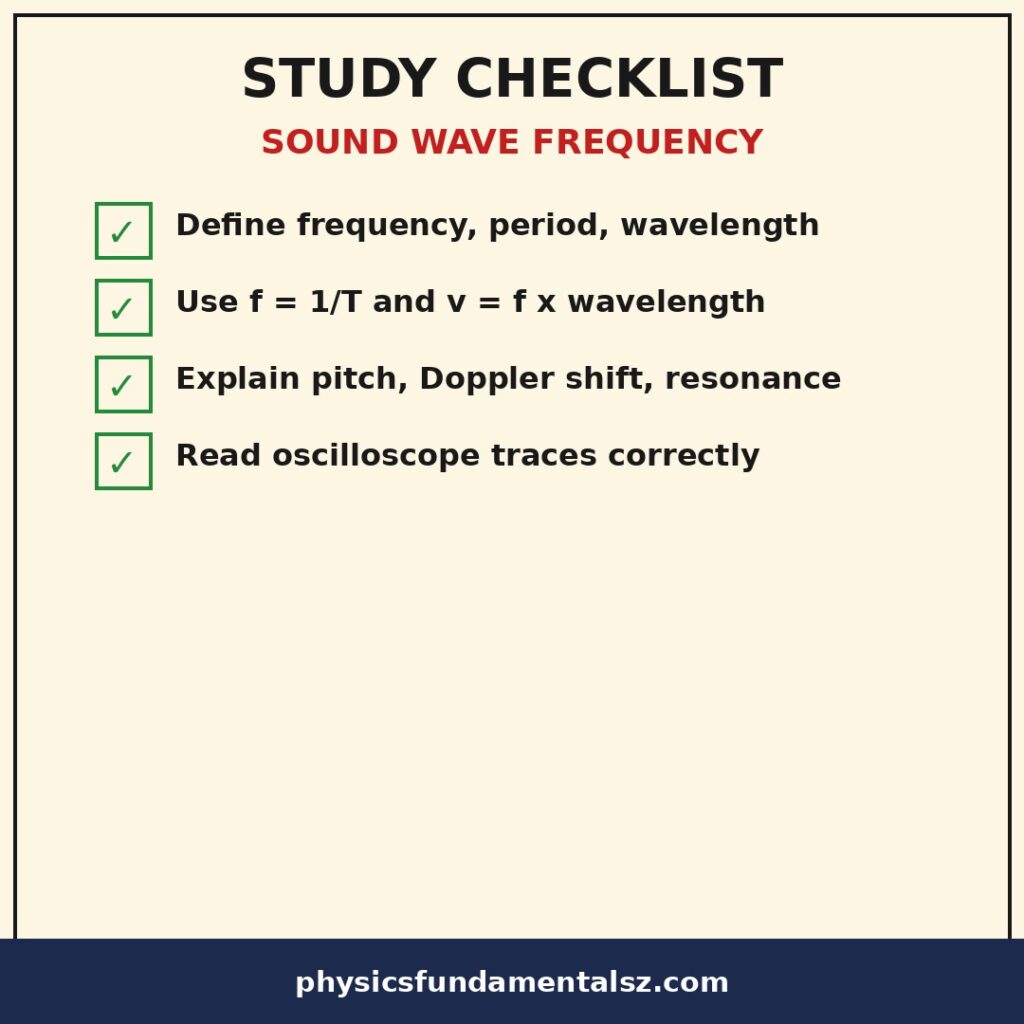
Expert Tips for Exams
Start every wave calculation by writing the formula, the known values with units, and the wanted quantity. That habit earns method marks even if the arithmetic slips. It also forces you to notice when a value is in kHz or centimetres before you substitute it.
Draw the wave when a question describes compressions, nodes, or a pipe. Mark one wavelength on the drawing. Count how many wavelengths fit in the pipe or string. The drawing turns a word problem into a counting problem, which is far easier to get right.
Use the octave rule as a sense check. If doubling a frequency is described, the pitch rises one octave. If a string is halved in length, its frequency doubles. These ratio checks work without a calculator and catch errors in longer calculations.
Learn the audible range, the speed of sound in air, and the A4 = 440 Hz reference. Those three facts anchor many questions. A frequency of 20,000 Hz is at the top of hearing. A speed of 343 m/s is sound in air. A note at 440 Hz is a standard musical pitch. With those anchors, wrong answers stand out.
Practise oscilloscope questions with the timebase. Count divisions, multiply by seconds per division, and take the reciprocal. Do several examples until the steps feel automatic. Oscilloscope questions appear often because they test both understanding and careful reading.
Finally, describe frequency in words, not only in symbols. An answer that says “the frequency is 440 Hz, so the source vibrates 440 times each second and the pitch is A4” shows understanding. An answer that gives only “440” shows a number. Examiners reward the explanation, and the explanation helps you spot your own errors.

Practice Problems With Answers
Problem 1. A source vibrates 900 times in 2 seconds. Find its frequency and period.
Frequency = 900 / 2 = 450 Hz. Period = 1 / 450 = 0.00222 s, about 2.2 milliseconds.
Problem 2. A sound wave has frequency 680 Hz and speed 340 m/s in air. Find its wavelength.
Wavelength = 340 / 680 = 0.50 m. The wave is half a metre long.
Problem 3. A whistle produces ultrasound at 25,000 Hz. The speed of sound in air is 340 m/s. Find the wavelength, and say whether a human can hear it.
Wavelength = 340 / 25,000 = 0.0136 m, about 1.4 cm. A human cannot hear it, because it is above the 20,000 Hz limit.
Problem 4. Sound enters water, where its speed is 1,480 m/s. A 500 Hz tone keeps the same frequency. Find its wavelength in water and in air at 340 m/s, and compare them.
In water: 1,480 / 500 = 2.96 m. In air: 340 / 500 = 0.68 m. The wavelength in water is about 4.4 times longer, because the speed is higher and the frequency is unchanged.
Frequently Asked Questions
What is sound wave frequency in simple terms?
Sound wave frequency is how many vibrations a sound source makes each second. It is measured in hertz. More vibrations per second means a higher frequency and a higher pitch.
What is the formula for sound wave frequency?
The two main formulas are f = 1/T, where T is the period, and f = v/λ, where v is wave speed and λ is wavelength. Use the first when you know the time for one cycle, and the second when you know speed and wavelength.
Does higher frequency mean louder sound?
No. Higher frequency means higher pitch. Loudness depends on amplitude. A high note can be quiet, and a low note can be loud. Keep pitch and loudness as separate ideas.
Does higher frequency mean shorter wavelength?
Yes, when wave speed is fixed. In air, doubling the frequency halves the wavelength, because v = fλ and v stays about the same. The product of frequency and wavelength is always the wave speed.
What frequency can humans hear?
Most humans hear from about 20 Hz to about 20,000 Hz. The upper limit falls with age and loud-noise exposure. Sounds below 20 Hz are infrasound, and sounds above 20,000 Hz are ultrasound.
What is the frequency of a normal human voice?
Speech uses a wide range, but the fundamental frequency of an adult voice is often roughly 85 Hz to 180 Hz for men and 165 Hz to 255 Hz for women, with harmonics extending much higher. Those values vary widely between individuals and with the sounds being made.
Does sound frequency change in water?
No. The frequency stays the same when sound moves from air to water, because it is set by the source. The speed rises and the wavelength stretches, but the number of cycles per second does not change.
What is the difference between frequency and pitch?
Frequency is a measured physical quantity in hertz. Pitch is how high or low a sound seems to a listener. Pitch rises with frequency, but pitch is a perception, while frequency is a measurement.
What is the difference between frequency and wavelength?
Frequency counts cycles per second. Wavelength measures the length of one cycle in metres. They are linked by wave speed: v = fλ. A wave can have high frequency and short wavelength, or low frequency and long wavelength, at the same speed.
What happens when frequency doubles?
The pitch rises by one octave, and the wavelength halves, if the wave speed stays the same. The period also halves, because each cycle takes half as long.
What is infrasound used for?
Infrasound is used by elephants and whales to communicate over long distances. In technology, infrasound sensors monitor volcanoes, earthquakes, and explosions, because low-frequency waves travel far with little loss.
What is ultrasound used for?
Ultrasound is used in medical scans, foetal imaging, blood-flow measurement, industrial cleaning, flaw detection in metal, and animal echolocation. Its short wavelength gives fine detail, and its high frequency keeps it inaudible to humans.
How does the Doppler effect change frequency?
Motion towards a listener squeezes the waves and raises the observed frequency. Motion away stretches the waves and lowers the observed frequency. The emitted frequency does not change. Only the observed frequency shifts.
Why do low sounds travel through walls better?
Low-frequency waves have long wavelengths that bend around obstacles and pass through gaps more easily. High-frequency waves have short wavelengths that are blocked and reflected more readily. That is why bass from a neighbour’s music is heard more clearly than the treble.
How is sound frequency measured in a lab?
It is measured with an oscilloscope, a frequency counter, or spectrum analysis software. The oscilloscope shows the wave against time, the counter counts cycles directly, and spectrum software shows the frequency content of complex sounds.
Why does a guitar string sound higher when tightened?
Tightening raises the wave speed on the string, and with the length fixed, the vibration frequency rises. The pitch therefore rises. Loosening the string has the opposite effect.
Conclusion
Sound wave frequency is the number of vibrations each second, measured in hertz. It sets pitch, stays fixed when a wave changes medium, and links to wavelength and speed through v = fλ and to period through f = 1/T.
Keep the three confusions apart: frequency is not loudness, frequency is not wavelength, and frequency does not change at a boundary. With those ideas clear, the worked examples, the Doppler effect, resonance, and the applications in medicine, music, and engineering all fall into place.
Practise with real numbers. Calculate wavelengths for notes you know, read an oscilloscope trace, and listen for beats when two close notes sound together. Frequency stops being an abstract symbol when you hear it, measure it, and use it to predict what a wave will do next.