How to Calculate Wavelength From Frequency (Formula + Examples) 2026
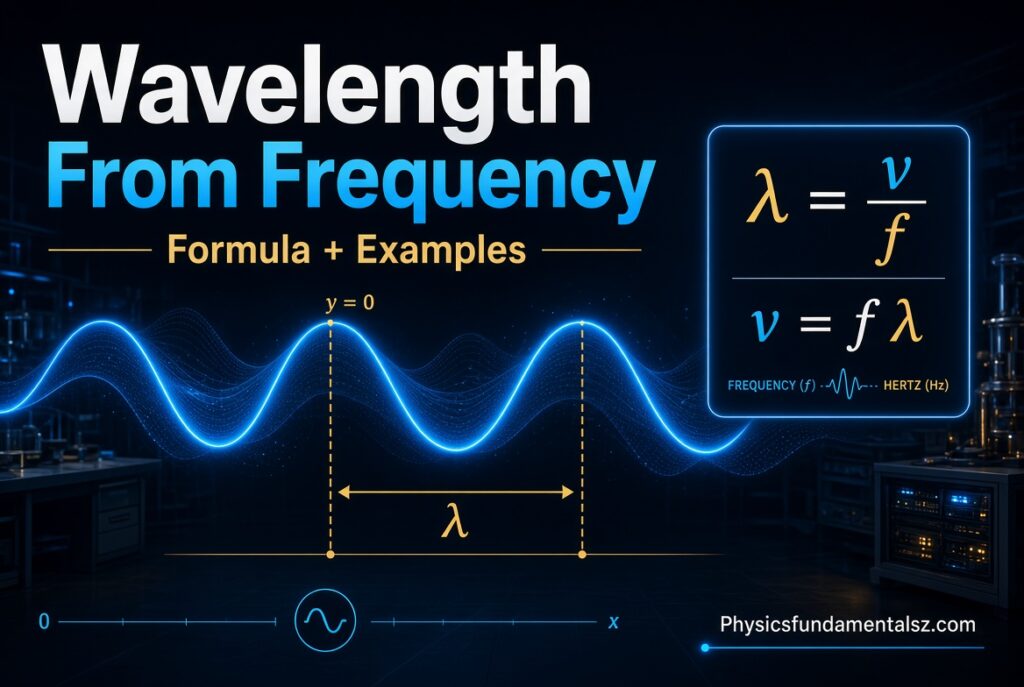
If you know a wave’s frequency and speed, you can find its wavelength in one simple step. This guide breaks down exactly how to calculate wavelength from frequency, with the formula, worked examples, and easy-to-follow steps.
Wavelength and frequency are inversely related. As frequency goes up, wavelength goes down, and vice versa. Understanding this relationship is key to physics, electronics, sound engineering, and even Wi-Fi and radio technology.
Table of Contents
How to Calculate Wavelength From Frequency
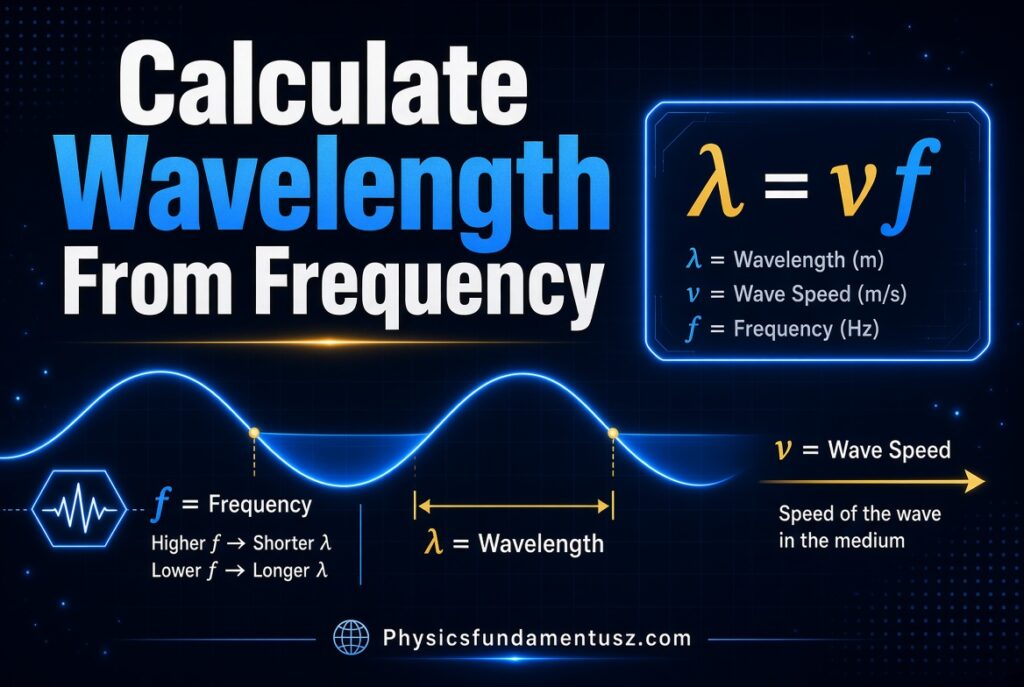
Wavelength = Speed of the wave ÷ Frequency, or λ = v / f. For light and radio waves, use the speed of light (3 × 10⁸ m/s). For sound, use the speed of sound in air (about 343 m/s).
What Is Wavelength?
Wavelength is the physical distance between two identical points on a wave, like from one crest to the next. It’s measured in meters (m), or smaller units like nanometers (nm) for light.
Wavelength tells you how “stretched out” a wave is. Long wavelengths mean the wave repeats less often over a given distance.
What Is Frequency?
Frequency is how many complete wave cycles pass a fixed point every second. It’s measured in Hertz (Hz), where 1 Hz equals one cycle per second.
Higher frequency means more wave cycles are packed into the same amount of time. Frequency and wavelength move in opposite directions when speed stays constant.
The Wavelength Formula Explained
λ = v / f
This is the core wave equation. Here’s what each symbol means:
| Symbol | Meaning | Unit |
|---|---|---|
| λ (lambda) | Wavelength | meters (m) |
| v | Speed of the wave | meters per second (m/s) |
| f | Frequency | Hertz (Hz) |
This formula works for any wave type, sound, light, radio, or water waves, as long as you use the correct speed value for that wave.
Speed of Light and the Electromagnetic Spectrum
For electromagnetic waves like light, radio, and microwaves, the speed value is always the speed of light in a vacuum: c = 3 × 10⁸ m/s.
This applies across the entire electromagnetic spectrum, from radio waves to gamma rays. Only the frequency and wavelength change; the speed stays constant in a vacuum.
For sound waves, you’d instead use the speed of sound, which is roughly 343 m/s in air at room temperature.
Step-by-Step: How to Calculate Wavelength From Frequency
- Identify the frequency (f) of the wave in Hertz.
- Identify the correct speed (v) for that wave type (light, sound, or other medium).
- Divide speed by frequency: λ = v ÷ f.
- Check your units so the answer comes out in meters.
- Convert units if needed, such as meters to nanometers for visible light.
Each step matters. Using the wrong speed value is the single most common mistake people make.
Worked Examples
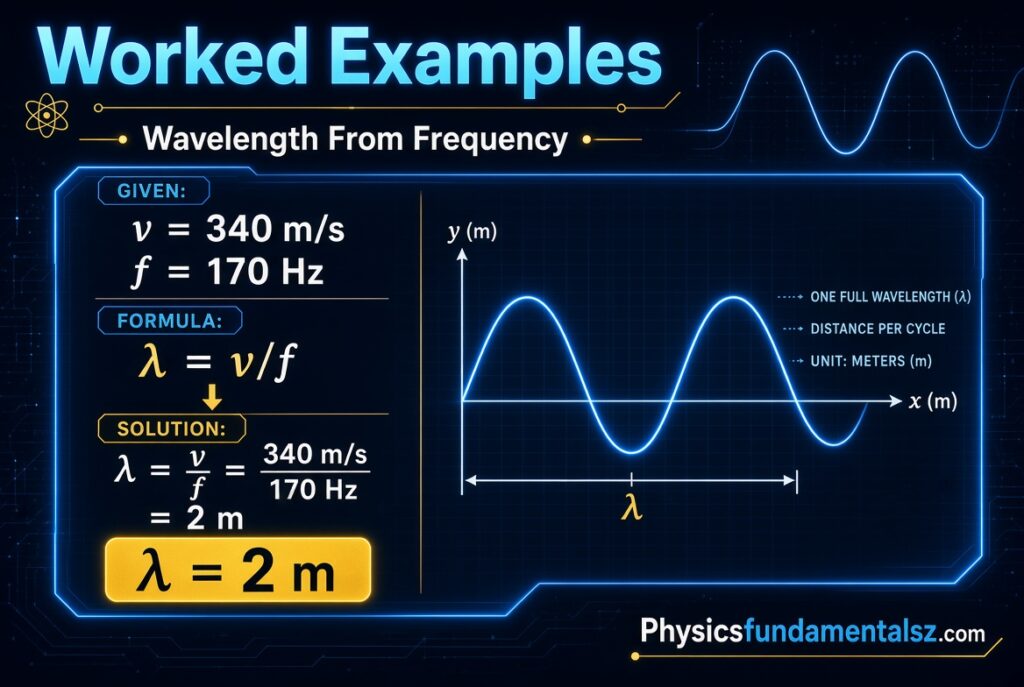
Example 1: Radio Wave
A radio station broadcasts at a frequency of 100 MHz (100,000,000 Hz). Using the speed of light:
λ = (3 × 10⁸ m/s) ÷ (1 × 10⁸ Hz) = 3 meters
This 3-meter wavelength is typical for FM radio broadcasts.
Example 2: Visible Light
Green light has a frequency of about 5.5 × 10¹⁴ Hz. Using the speed of light:
λ = (3 × 10⁸ m/s) ÷ (5.5 × 10¹⁴ Hz) ≈ 5.45 × 10⁻⁷ m, or about 545 nanometers
This matches the known wavelength range for green visible light.
Example 3: Sound Wave
A sound wave has a frequency of 440 Hz (musical note A). Using the speed of sound in air:
λ = (343 m/s) ÷ (440 Hz) ≈ 0.78 meters
Wavelength and Frequency Quick Reference Table
| Wave Type | Typical Frequency | Speed Used | Approx. Wavelength |
|---|---|---|---|
| AM Radio | 1 MHz | 3 × 10⁸ m/s | 300 m |
| FM Radio | 100 MHz | 3 × 10⁸ m/s | 3 m |
| Wi-Fi (2.4 GHz) | 2.4 GHz | 3 × 10⁸ m/s | 0.125 m |
| Visible Light (Red) | 4.3 × 10¹⁴ Hz | 3 × 10⁸ m/s | ~700 nm |
| Visible Light (Violet) | 7.5 × 10¹⁴ Hz | 3 × 10⁸ m/s | ~400 nm |
| Audible Sound (A4 note) | 440 Hz | 343 m/s | 0.78 m |
Wavelength vs. Frequency: Key Differences
| Factor | Wavelength | Frequency |
|---|---|---|
| Definition | Distance between wave crests | Cycles per second |
| Unit | Meters (m) | Hertz (Hz) |
| Symbol | λ | f |
| Relationship to speed | Direct | Direct |
| Relationship to each other | Inverse | Inverse |
Common Mistakes to Avoid
- Using the wrong speed value, such as light speed for a sound wave.
- Forgetting to convert MHz or GHz into Hz before calculating.
- Mixing up wavelength and frequency in the formula.
- Not converting meters into nanometers when working with light.
- Ignoring the medium; sound speed changes in water, air, or solids.
Expert Tips
- Always double-check your unit conversions before finalizing an answer.
- For light and radio waves, memorize c = 3 × 10⁸ m/s to save time.
- Use scientific notation carefully; a misplaced exponent changes the answer dramatically.
- Cross-check your result against known values, like visible light being roughly 400–700 nm.
Real-World Applications
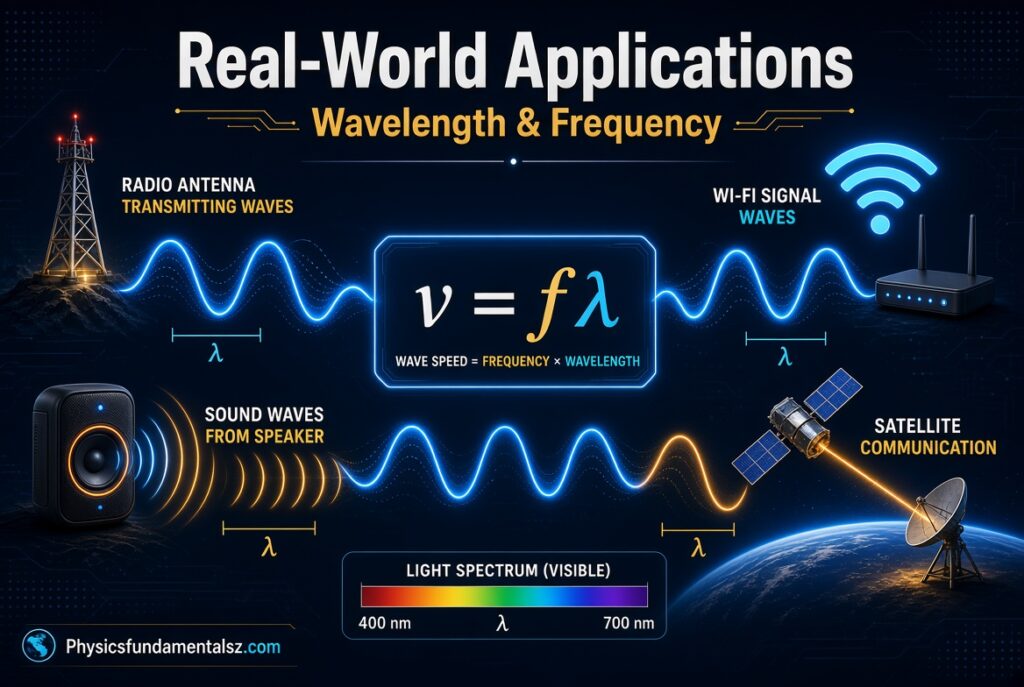
Engineers use this formula to design antennas, Wi-Fi routers, and radio transmitters. Musicians and audio engineers use it to understand pitch and resonance. Physicists and astronomers use it to study light from distant stars through spectroscopy.
Frequently Asked Questions (FAQs)
What is the formula to calculate wavelength from frequency?
The formula is λ = v / f, where λ is wavelength, v is wave speed, and f is frequency.
How do I calculate wavelength if I only have frequency?
You also need the wave’s speed. For light or radio waves, use 3 × 10⁸ m/s; for sound, use approximately 343 m/s in air.
What units should wavelength be in?
Wavelength is typically measured in meters, though nanometers are common for visible light.
Does frequency increase or decrease wavelength?
They’re inversely related. As frequency increases, wavelength decreases, assuming speed stays the same.
How do you convert MHz to Hz before calculating wavelength?
Multiply the MHz value by 1,000,000. For example, 100 MHz equals 100,000,000 Hz.
What is the wavelength of visible light?
Visible light wavelengths range from about 400 nm (violet) to 700 nm (red).
What speed value should I use for sound waves?
Use approximately 343 m/s in air at room temperature; this changes with temperature and medium.
Can I calculate frequency if I know wavelength instead?
Yes, rearrange the formula: f = v / λ.
Why does wavelength change but not the speed of light?
In a vacuum, the speed of light is constant. Only frequency and wavelength change based on the type of electromagnetic wave.
What is a real-world example of this calculation?
Calculating the wavelength of a Wi-Fi signal at 2.4 GHz gives roughly 0.125 meters using the speed of light.
How is wavelength measured in physics?
Wavelength is measured as the distance between two consecutive identical points on a wave, like crest to crest.
What is the wavelength formula for sound specifically?
Same formula, λ = v/f, but v is the speed of sound rather than the speed of light.
Is wavelength always smaller with higher frequency light?
Yes, higher-frequency light such as ultraviolet has a shorter wavelength than lower-frequency light such as red.
What is the symbol for wavelength?
The Greek letter lambda (λ) represents wavelength in physics formulas.
How do you calculate wavelength in nanometers?
First calculate wavelength in meters, then multiply by 1,000,000,000 to convert to nanometers.
What tools can calculate wavelength automatically?
Online wavelength calculators let you input frequency and speed to get instant results.
Does the medium affect wavelength calculations?
Yes, especially for sound, since speed changes across air, water, and solids.
What is the frequency of visible light in Hz?
Visible light frequency ranges from about 4 × 10¹⁴ Hz to 7.9 × 10¹⁴ Hz.
How accurate is the λ = v/f formula?
It’s exact for uniform, non-dispersive media, and it’s the standard formula used across physics and engineering.
What’s the difference between wavelength and amplitude?
Wavelength measures distance between wave cycles; amplitude measures the height or intensity of the wave.
Why do radio waves have longer wavelengths than light waves?
Because radio waves have much lower frequencies than visible light, and wavelength is inversely proportional to frequency.
How do engineers use this formula in real life?
They use it to design antennas, tune radio frequencies, and build wireless communication systems like Wi-Fi and Bluetooth.
What happens to wavelength if frequency doubles?
If speed stays constant, wavelength is cut in half when frequency doubles.
Can this formula be used for water waves too?
Yes, as long as you use the correct speed value for water waves in that specific condition.
Conclusion
Calculating wavelength from frequency comes down to one formula: λ = v / f. Once you identify the correct speed for your wave type and keep your units consistent, the math is straightforward.
Whether you’re working with radio signals, visible light, or sound waves, this same relationship holds true. Practice with a few examples, and it becomes second nature.