What Is Centripetal Force With Examples? (Formula + Guide) 2026
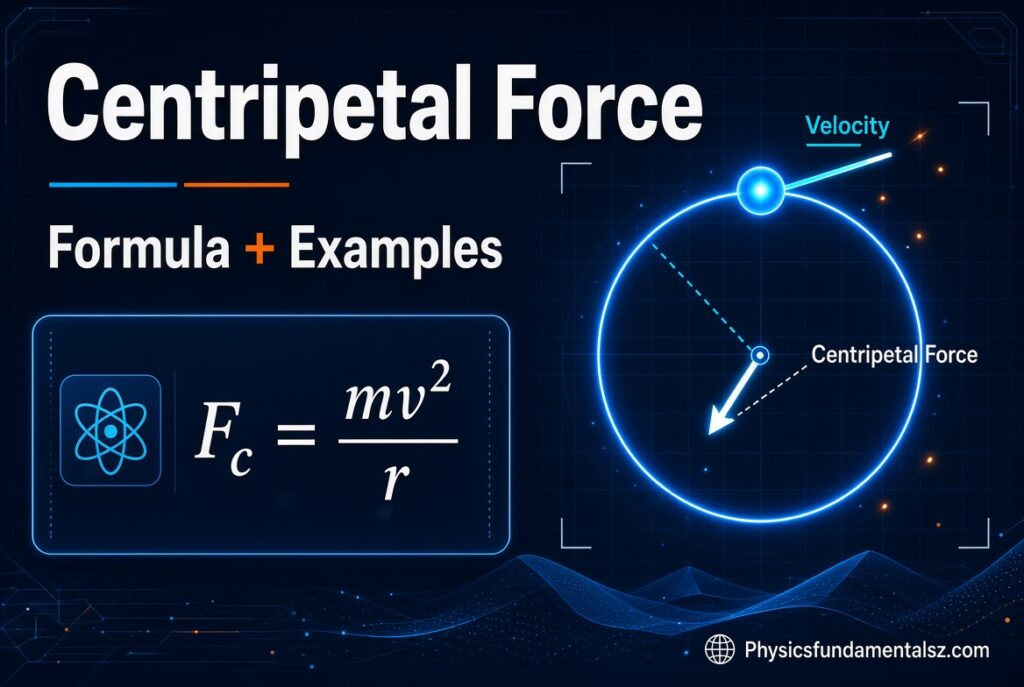
What Is Centripetal Force With Examples? Ever wondered why a car doesn’t fly off the road on a sharp turn? Or why the Moon doesn’t drift away from Earth? The answer to both is the same force.
Table of Contents
What Is Centripetal Force With Examples
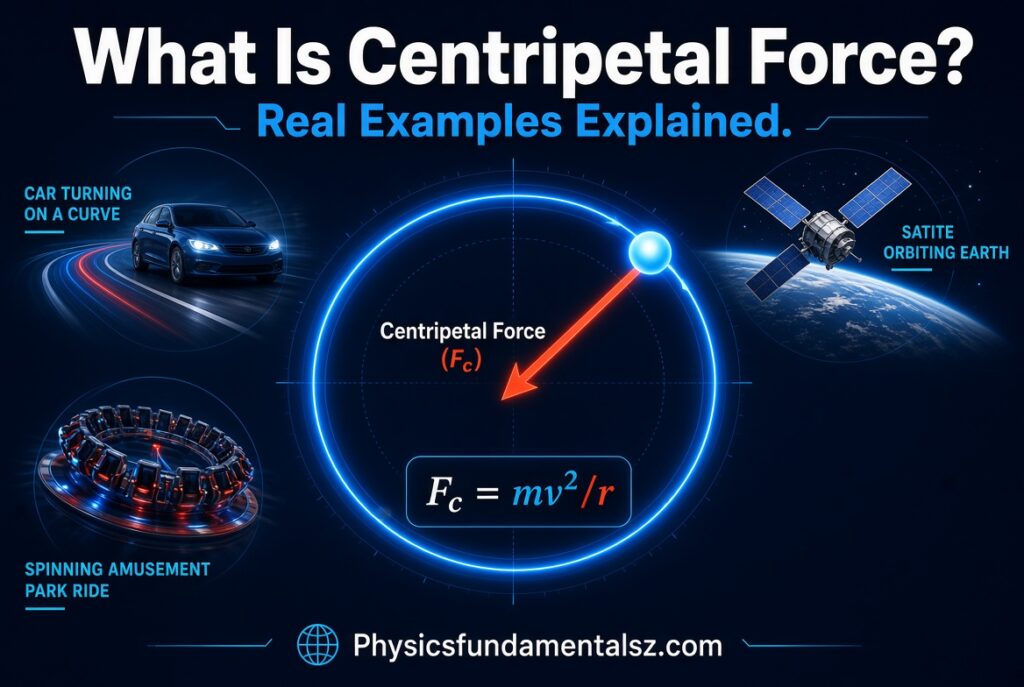
Centripetal force is the net force that acts on an object moving in a circular path, always pointing toward the center of that circle.
It doesn’t push an object forward. It only changes the object’s direction, which keeps it moving along the curve instead of flying off in a straight line.
Common examples include a car turning a corner, a satellite orbiting Earth, and a ball swung on a string.
Definition of Centripetal Force
The word “centripetal” comes from Latin, meaning “center-seeking.” It describes any force that is directed inward, toward the center of a circular path.
Centripetal force is not a brand-new type of force. It is simply the role played by an existing force, such as gravity, tension, friction, or a normal force, when that force points toward the center of a curve.
Without this inward force, Newton’s first law takes over. The object would move off in a straight line instead of curving.
The Centripetal Force Formula
The standard formula for centripetal force is:
F = mv² / r
- F = centripetal force (measured in newtons, N)
- m = mass of the object (kilograms, kg)
- v = speed of the object (meters per second, m/s)
- r = radius of the circular path (meters, m)
This formula comes directly from Newton’s second law, F = ma, combined with the formula for centripetal acceleration, a = v² / r.
What the Formula Tells You
Doubling an object’s speed increases the required centripetal force by four times, since speed is squared in the equation.
A tighter turn (smaller radius) also demands more force. This is why race cars slow down before sharp corners instead of holding top speed.
Heavier objects need proportionally more force to stay on the same circular path at the same speed.
How Centripetal Force Works
Picture a ball tied to a string, swinging in a horizontal circle. The string constantly pulls the ball inward, toward your hand.
That inward pull is the centripetal force. It never pushes the ball forward or backward along its path, only inward.
Because the force is always perpendicular to the ball’s velocity, it changes direction but not speed. This is what keeps the motion circular instead of straight.
Centripetal Force and Newton’s Second Law
Newton’s second law states that a net force causes acceleration in the direction of that force.
In circular motion, the acceleration always points toward the center, called centripetal acceleration. The force causing it must point the same way.
If the inward force suddenly disappears, so does the acceleration. The object then travels in a straight line, tangent to the circle at that exact point.
Real-Life Examples of Centripetal Force
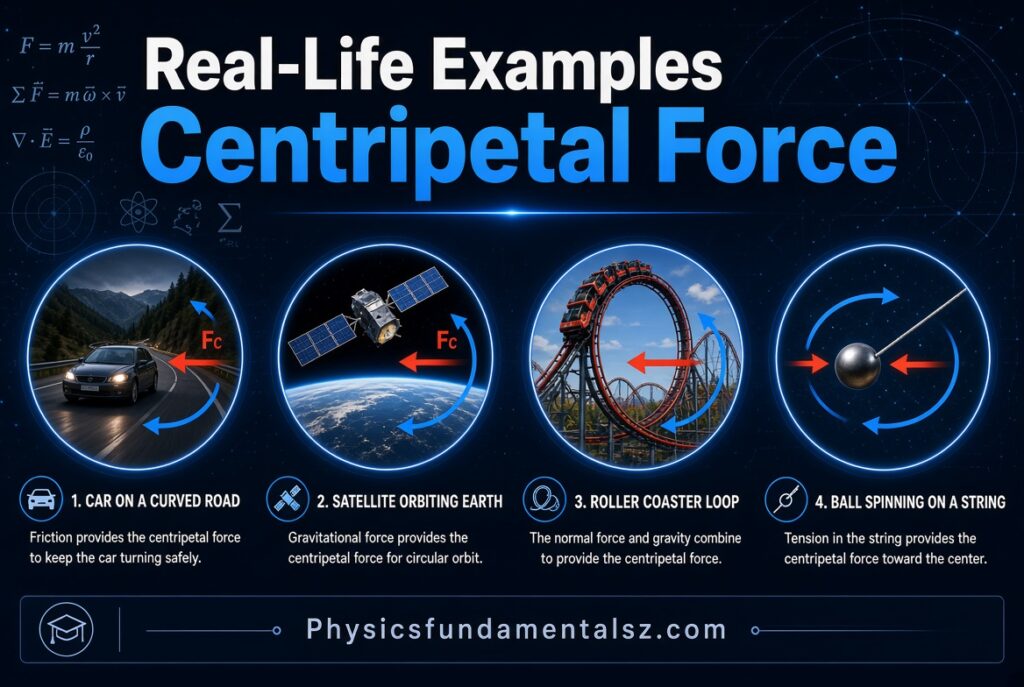
Centripetal force shows up constantly in daily life, sports, engineering, and even astronomy. Here are the clearest examples.
1. A Car Turning a Corner
Friction between the tires and the road supplies the centripetal force that pulls the car toward the center of the turn.
On icy roads, friction drops sharply. That’s why cars skid or slide outward instead of following the curve.
2. Roller Coaster Loops
Inside a loop, the track pushes inward on the cars, acting as the centripetal force that keeps them on the rails.
At the top of the loop, gravity also contributes to this inward pull, which is why riders feel weightless for a moment.
3. Satellites and Planets in Orbit
Gravity is the centripetal force that keeps satellites, moons, and planets moving along curved orbital paths instead of drifting into space.
Earth’s gravity constantly pulls the Moon inward, bending its path into a near-circular orbit around our planet.
4. Spinning a Ball on a String
The tension inside the string provides the centripetal force. It pulls the ball inward with every fraction of a second.
If the string snaps, the tension disappears instantly, and the ball flies off in a straight line.
5. A Washing Machine Spin Cycle
The drum’s walls push inward on wet clothes, forcing them into a circular path as the drum spins.
Water molecules, being smaller and less constrained, escape through the drum’s holes rather than following the same tight curve.
6. Rounding a Roundabout on a Bicycle
Riders lean inward while cycling around a roundabout. This lean redirects part of the normal and friction forces toward the center.
That inward component becomes the centripetal force, keeping the bike on its curved path without tipping over.
7. Electrons Around an Atomic Nucleus
In simplified atomic models, electrostatic attraction between the negative electron and the positive nucleus acts as the centripetal force.
This attraction is what keeps electrons in their orbital paths around the nucleus in classic physics models.
8. Banked Airplane Turns
When a plane banks or tilts during a turn, part of the lift force points sideways, toward the center of the turning arc.
That horizontal component of lift becomes the centripetal force guiding the aircraft through the curve.
Centripetal Force vs. Centrifugal Force
These two terms get confused constantly, but only one of them is a real force.
| Feature | Centripetal Force | Centrifugal Force |
|---|---|---|
| Direction | Toward the center | Away from the center |
| Real or apparent | Real force | Apparent (fictitious) force |
| Frame of reference | Inertial (outside observer) | Rotating (inside the object) |
| Cause | Gravity, tension, friction, or normal force | A result of inertia, not a true force |
| Example | Earth’s gravity pulling a satellite inward | The “push” you feel outward in a turning car |
Centripetal force is what physics actually measures and calculates. Centrifugal force is simply how inertia feels from inside a rotating system.
Solved Example Problems
Example 1: Finding the Centripetal Force
A 2 kg object moves in a circle of radius 0.5 m at a speed of 4 m/s. Find the centripetal force.
Using F = mv² / r: F = (2 × 4²) / 0.5 = (2 × 16) / 0.5 = 64 N.
Example 2: Finding the Required Speed
What speed keeps a 1,000 kg car on a curve of radius 50 m if the road can supply 5,000 N of friction?
Rearranging F = mv² / r gives v² = Fr / m = (5,000 × 50) / 1,000 = 250, so v ≈ 15.8 m/s.
Common Mistakes to Avoid
Many students treat centripetal force as a separate, extra force acting alongside gravity, tension, or friction.
In reality, centripetal force is a role, not a new force. It’s whichever existing force happens to point toward the center at that moment.
Another common error is confusing centripetal force with centrifugal force. Only centripetal force is real and appears in free-body diagrams.
Where Centripetal Force Matters Most

- Astronomy: explaining how planets, moons, and satellites stay in orbit.
- Engineering: designing safe curves on roads, railways, and roller coasters.
- Centrifuges: separating substances of different densities in labs and hospitals.
- Sports: analyzing hammer throw, discus, and cycling technique.
- Everyday devices: washing machines, salad spinners, and merry-go-rounds.
Also Read:
- Physics Fundamentals: The Complete Guide to Core Concepts, Laws, and Equations
- Kinetic Energy
- Potential Energy: Gravitational, Elastic & Electric Forms Explained
- Conservation of Energy: Law, Forms & Worked Examples
- Tension Force
- Centre of Gravity vs Centre of Mass: Definition & Applications
- Momentum Calculator Physics: Formula, Steps & Worked Examples
- Difference Between Speed and Velocity With Examples
- Ohm’s Law Calculator Solve for Current: Formula, Steps & Examples
- Physics Calculators
- Physics Fundamentals — Home
Frequently Asked Questions (FAQs)
What is centripetal force in simple words?
Centripetal force is the inward pull or push that keeps an object moving along a circular path instead of a straight line.
What is the formula for centripetal force?
The formula is F = mv² / r, where m is mass, v is speed, and r is the radius of the circular path.
Is centripetal force a real force?
Yes. It’s always provided by a real, existing force such as gravity, tension, friction, or a normal force.
What are 5 examples of centripetal force?
A car turning a corner, a satellite orbiting Earth, a ball on a string, a roller coaster loop, and a spinning washing machine drum.
What direction does centripetal force point?
It always points toward the center of the circular path, perpendicular to the object’s velocity at every instant.
What is the difference between centripetal and centrifugal force?
Centripetal force is real and points inward. Centrifugal force is an apparent outward sensation felt only inside a rotating frame.
Does centripetal force do any work on the object?
No. Since it’s always perpendicular to velocity, centripetal force does zero work and doesn’t change the object’s speed.
What provides centripetal force in a car turning a corner?
Friction between the tires and the road surface provides the inward centripetal force during a turn.
What provides centripetal force for satellites?
Gravitational attraction between the satellite and the planet it orbits acts as the centripetal force.
What happens if centripetal force suddenly disappears?
The object stops curving and moves off in a straight line, tangent to its previous circular path.
Why do you feel pushed outward in a turning car?
That sensation is inertia, often called centrifugal force. Your body resists the inward turn the car is making.
How does speed affect centripetal force?
Centripetal force increases with the square of speed. Doubling speed quadruples the required force.
How does radius affect centripetal force?
Centripetal force is inversely proportional to radius. A tighter circle needs more force at the same speed.
Can centripetal force change an object’s speed?
No. It only changes direction. A separate tangential force is needed to speed up or slow down the object.
What is centripetal acceleration?
It’s the acceleration directed toward the center of a circular path, calculated as a = v² / r.
Is gravity always a centripetal force?
Gravity acts as centripetal force only when it causes circular or orbital motion, such as with satellites and planets.
What keeps electrons moving around a nucleus?
In simple atomic models, electrostatic attraction between electrons and the nucleus acts as the centripetal force.
Why don’t roller coaster riders fall out during a loop?
The track exerts an inward normal force on the cars, which is strong enough to keep riders pressed against their seats.
What is an example of centripetal force in sports?
In hammer throw, the tension in the wire supplies the centripetal force as the athlete spins the hammer in a circle.
Is centripetal force the same at every point in a circle?
For uniform circular motion, yes. The magnitude stays constant, but its direction continuously changes to always point inward.
What units is centripetal force measured in?
Like all forces, centripetal force is measured in newtons (N) in the SI system.
Can centripetal force exist without circular motion?
No. Centripetal force only exists when an object is actively moving along a curved or circular path.
Why is centripetal force important in engineering?
Engineers use it to design safe road curves, banked railway tracks, roller coasters, and rotating machinery like centrifuges.
Conclusion
So, what is centripetal force with examples that make it click? It’s the inward force, from gravity, tension, friction, or a push, that bends straight-line motion into a circle.
You’ve now seen it in cars, satellites, roller coasters, and even atoms. You also know the formula, F = mv² / r, and how mass, speed, and radius each affect it.
Next time you round a corner or watch a planet orbit, you’ll know exactly what force is quietly doing the work.