Pascal’s Law Explained: Pressure, Hydraulics, and Worked Examples
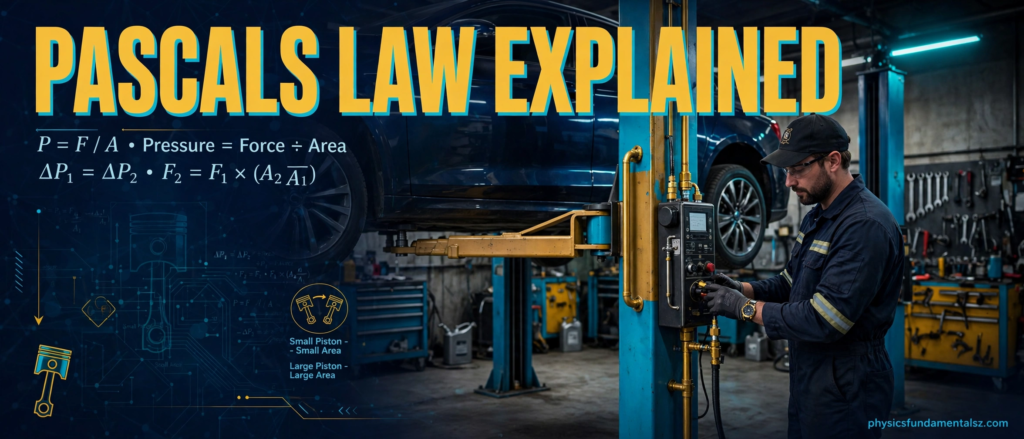
A child pressing a small piston can lift a car. A foot on a brake pedal can stop a two-tonne vehicle. A dentist’s chair rises smoothly under a patient at the touch of a button. None of these feats involves a large force at the point where the work is done. All of them rely on a fluid doing the heavy lifting, and all of them are explained by Pascal’s law.
This guide explains Pascal’s law from first principles. You will learn what pressure really means, why it spreads equally through a confined fluid, how hydraulic machines multiply force, and how to solve the numerical problems examiners set. Along the way you will meet the man behind the law, the units that bear his name, and the limits that keep the law honest.
Who Was Blaise Pascal?
Blaise Pascal was a French mathematician, physicist, and philosopher who lived from 1623 to 1662. He was a prodigy who published a work on conic sections at sixteen and built one of the first mechanical calculators, the Pascaline, as a teenager to help his father with tax calculations. His work on fluids came later, in the 1640s and 1650s, when he took up the experiments of Evangelista Torricelli on air pressure and the vacuum.
Pascal’s most famous fluid experiment was the Puy-de-Dôme experiment of 1648. His brother-in-law carried a barometer up a mountain, and the mercury column fell as they climbed, proving that air pressure decreases with altitude and that air itself has weight. Pascal also performed the dramatic barrel experiment, in which a tall, thin tube of water attached to a sealed barrel burst the barrel, showing that pressure depends on height, not on the total volume of water.
The SI unit of pressure, the pascal, is named after him (Britannica on Pascal’s law). One pascal is one newton per square metre, a small unit, which is why everyday pressures are usually quoted in kilopascals or megapascals. Car tyres run at around 200 kilopascals. Atmospheric pressure at sea level is about 101 kilopascals. Hydraulic systems in heavy machinery can reach tens of megapascals.
Pascal died at thirty-nine, but his name survives in the unit, in the programming language named after him, and in the law that bears his name in every physics textbook. His law is one of those ideas that sounds almost too simple to be powerful, until you see what engineers have built with it.
Pressure First: What P = F/A Really Means
Pascal’s law is a statement about pressure, so pressure itself must be clear first. Pressure is force per unit area, defined by P = F/A, where P is pressure, F is the force acting perpendicular to a surface, and A is the area of that surface. The unit is the pascal: one newton acting on one square metre.
The formula explains everyday experiences that otherwise seem puzzling. A sharp knife cuts easily because its tiny edge area concentrates the force into a huge pressure. A snowshoe stops you sinking because its large area spreads your weight into a small pressure. A stiletto heel damages a wooden floor while a flat shoe does not, because the same weight acts on a far smaller area.
Pressure acts in all directions in a fluid, not just downwards. Push on a fluid and it pushes back on every surface it touches, sideways and upwards as well as downwards. This is different from a solid block, where a push in one direction is mainly felt in that direction. A fluid has no fixed shape, so it transmits a push in every direction at once. That all-directions behaviour is the heart of Pascal’s law.
It is also important to distinguish pressure from force. Pressure is force spread over an area. The same pressure acting on a large area produces a large force, while the same pressure acting on a small area produces a small force. Hydraulic machines exploit exactly this distinction, as you will see below. Many exam errors come from treating pressure and force as the same thing; they are related by area, and area is the whole trick.
Pascal’s Law Stated
Pascal’s law, also called Pascal’s principle, states that pressure applied to a confined fluid is transmitted undiminished to every part of the fluid and to the walls of its container.
Three words in that statement carry weight. “Confined” matters, because an unconfined fluid simply flows away or splashes out, and no useful pressure builds up. “Undiminished” matters, because it means the pressure does not fade with distance: a push at one end of a hydraulic pipe produces the same pressure increase at the other end, however long the pipe is. “Every part” matters, because the pressure acts on every surface, in every direction, not just in the direction of the original push.
In symbols, if an external pressure change ΔP is applied to a confined fluid, then every point in the fluid experiences the same pressure change ΔP, in addition to whatever pressure was already there from gravity or the atmosphere. The law is about changes in pressure, not about total pressure, which is why it works at any depth and under any atmospheric pressure.
Why is the law true? Because a fluid at rest cannot sustain a pressure difference without flowing. If one region had a higher pressure than a neighbouring region, fluid would flow from high to low pressure until the pressures equalised. In a confined, static fluid, therefore, any applied pressure must spread until it is uniform. The fluid enforces equality by flowing, and once it has stopped flowing, the pressure is the same everywhere.
The law assumes the fluid is incompressible, or nearly so, and that the system is at rest or moving slowly. Liquids such as water and oil are almost incompressible, so they are ideal hydraulic fluids. Gases are compressible, so Pascal’s law applies to them only approximately, and only when pressure changes are small or the gas is confined in a way that limits compression. For most school problems, the fluid is a liquid, and the law applies cleanly.
The Classic Demonstration: Two Pistons
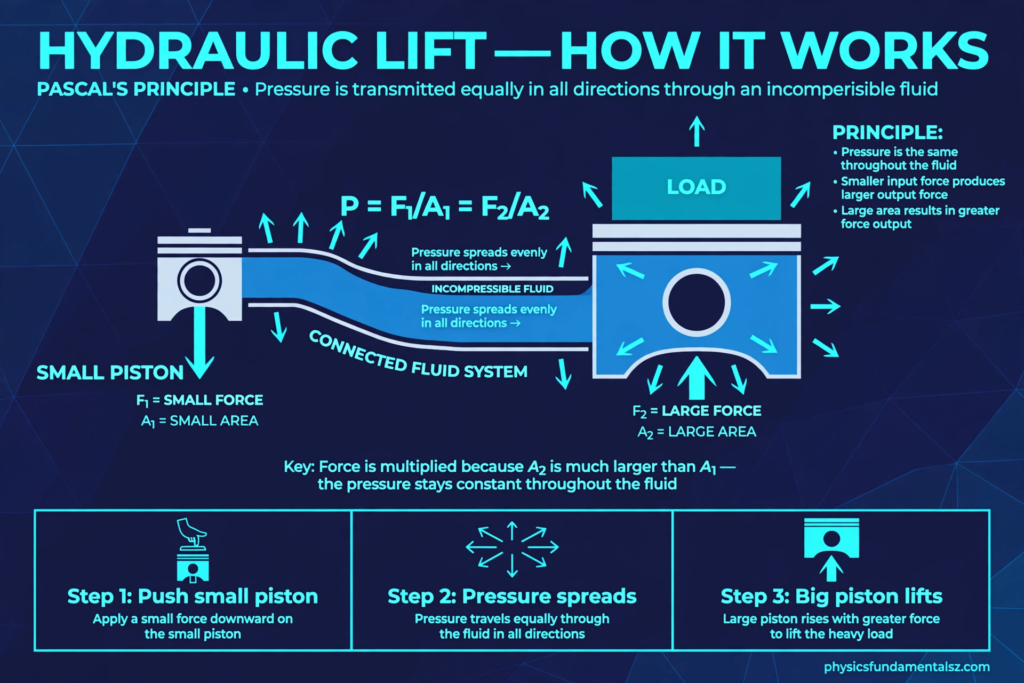
The standard demonstration uses a U-shaped vessel, or two cylinders joined by a pipe, filled with liquid and fitted with pistons of different sizes. Push down on the small piston, and the large piston rises. The force on the large piston can be many times larger than the force you applied, even though the pressure is the same throughout.
Here is the reasoning. The pressure under the small piston is P = F1/A1, where F1 is your applied force and A1 is the small piston’s area. Pascal’s law says this same pressure acts under the large piston. The force on the large piston is therefore F2 = P × A2 = F1 × (A2/A1). If the large piston’s area is ten times the small piston’s area, the output force is ten times the input force. Force has been multiplied by the area ratio.
That sounds like free energy, and it is not. The trade-off is distance. The volume of liquid pushed out of the small cylinder must equal the volume entering the large cylinder, because liquid is incompressible. If the large piston’s area is ten times larger, it moves only one tenth as far as the small piston. Force is multiplied by ten, distance is divided by ten, and the work done, force times distance, stays the same (ignoring friction). Hydraulic machines trade distance for force, exactly like levers and pulleys do.
A numerical example makes this concrete. Suppose the small piston has an area of 0.01 square metres and you apply a force of 100 newtons. The pressure is 100 divided by 0.01, which is 10,000 pascals. If the large piston has an area of 0.50 square metres, the output force is 10,000 times 0.50, which is 5,000 newtons, fifty times the input force. The small piston must move fifty times further than the large piston rises, so pushing it down by 50 centimetres lifts the load by just 1 centimetre. Slow, but enormously strong.
This is the principle behind every hydraulic lift, from a garage car lift to the rams that raise a drawbridge. Small force, small piston, large piston, large force, small movement. The physics is simple; the engineering is in the seals, the pumps, and the strength of the cylinders.
Hydraulic Lifts and Car Jacks
A garage hydraulic lift is the two-piston system scaled up and powered by a pump. The mechanic presses a lever or a button, a pump forces oil into the small cylinder, and the large ram rises, lifting the car. The mechanic’s effort is small; the oil pressure does the work.
A hydraulic car jack works the same way by hand (HyperPhysics on Pascal’s principle). Each stroke of the handle pumps a small volume of oil from a reservoir into the lifting cylinder. The pressure builds, the ram extends a little, and repeated strokes lift the car steadily. A release valve lets the oil flow back when the car needs lowering. The jack’s mechanical advantage comes entirely from the area ratio, plus a little extra from the lever handle.
Safety matters here, and physics explains why. The pressure in a car lift can be several megapascals, and a burst hose releases that energy suddenly. That is why lifts have mechanical locks, why jacks have stands, and why you should never work under a car supported only by a hydraulic jack. Pascal’s law multiplies force; it also multiplies the consequences of a failure.
A useful exam point is that hydraulic lifts work because liquids are nearly incompressible. If the fluid were a gas, pressing the small piston would mainly compress the gas, and the large piston would barely move. That is why hydraulic systems use oil, not air, even though air systems, called pneumatics, have their own uses where softness and compressibility are advantages rather than problems.
Hydraulic Brakes: Pascal’s Law Saving Lives
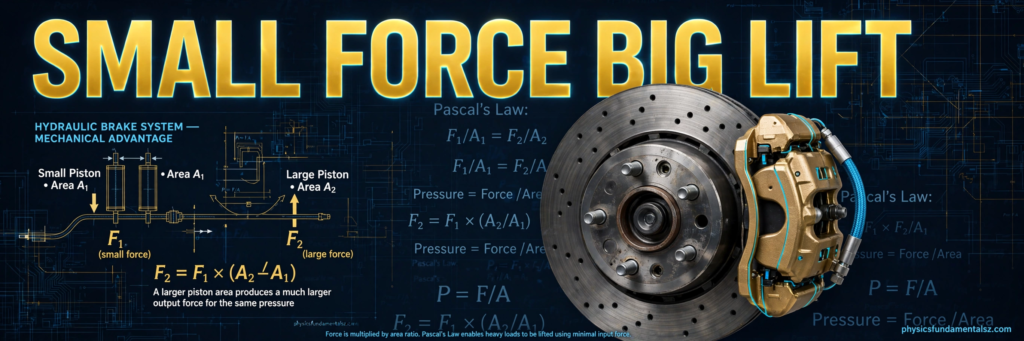
Hydraulic brakes are the most important everyday application of Pascal’s law (Khan Academy on pressure and Pascal’s principle), because they are a safety system in every car on the road. Pressing the brake pedal pushes a piston in the master cylinder, which pressurises brake fluid. That pressure travels through pipes to smaller cylinders at each wheel, called callipers or wheel cylinders, which press brake pads against discs or drums and slow the car.
The design uses Pascal’s law in two ways. First, the pressure is transmitted undiminished to all four wheels, so all four brakes act together, even though the pedal is in one place. Second, the pedal’s leverage and the piston areas are chosen so that a moderate foot force produces a large braking force at the wheels. A driver pressing with 200 newtons can generate thousands of newtons of braking force, distributed evenly.
Brakes also show why the choice of fluid matters. Brake fluid must be nearly incompressible, must not boil at high temperatures, and must not corrode the seals. Air bubbles in the brake lines are dangerous precisely because air is compressible: pressing the pedal compresses the bubbles instead of transmitting pressure, and the pedal feels spongy while the brakes barely act. Bleeding the brakes removes the air and restores the solid, incompressible column of fluid that Pascal’s law needs.
The same principle appears in aircraft brakes, in the hydraulic controls of excavators, and in the steering systems of large ships. Wherever a control input in one place must produce a large, evenly distributed force somewhere else, hydraulics and Pascal’s law are usually involved.
For the pressure ideas that underlie hydraulics, see our guide to density, which explains how mass, volume, and fluid properties connect, and our guide to Archimedes’ principle, which covers the related case of buoyancy in fluids.
More Applications: From Dentist Chairs to Aircraft
Hydraulic systems appear wherever large forces must be controlled smoothly. A dentist’s chair rises, tilts, and lowers on a hydraulic ram, giving precise, jerk-free motion under a patient’s weight. Hospital beds adjust the same way. Forklift trucks lift pallets with hydraulic forks. Excavators dig with hydraulic arms that combine several rams to produce complex, powerful movements.
Aircraft use hydraulics for flight controls, landing gear, and brakes, because hydraulic lines can carry large forces through flexible pipes to places where mechanical linkages would be heavy or impractical. A pilot’s small control input is converted into hydraulic pressure, which moves large control surfaces against powerful aerodynamic forces. Redundant hydraulic circuits, often three independent systems, protect against a single failure.
Even nature uses Pascal-like pressure transmission. The human circulatory system is not a hydraulic machine in the engineering sense, but blood pressure is transmitted through a confined fluid, the blood, and changes in pressure at the heart are felt throughout the arterial system. Plants move water through confined vessels under pressure, and some animals, such as spiders, extend their legs partly by hydraulic pressure rather than by muscles alone.
Water supply systems also rely on pressure transmission. A water tower stores water at height, and the pressure at any tap depends on the height difference, transmitted through the pipes. Opening a tap anywhere does not change the pressure elsewhere very much, because the system is large and the supply is maintained. The same undiminished transmission that Pascal described governs the pipes under every street.
Pressure With Depth: A Related but Different Idea
Pascal’s law is about pressure changes applied to a confined fluid. It is often taught alongside the pressure due to depth, P = ρgh, where ρ is fluid density, g is gravitational acceleration, and h is depth. The two ideas are related but distinct, and confusing them is a common exam error.
Pressure due to depth exists even with no piston pushing at all. It comes from the weight of the fluid above. Dive ten metres underwater and the pressure rises by about 100 kilopascals, roughly one atmosphere, regardless of the shape of the container. Pascal’s law then says that if you add an extra pressure at the surface, that extra pressure is added undiminished at every depth. The total pressure at depth h becomes atmospheric pressure plus ρgh plus any applied pressure.
The barrel experiment illustrates the depth rule dramatically. A tall, narrow tube of water attached to a sealed barrel produced enough pressure at the barrel’s depth, through ρgh, to burst it, even though the total volume of water was small. Height, not volume, decides pressure. That result surprised Pascal’s contemporaries, who expected a small amount of water to produce a small effect.
In hydraulic problems, depth differences are usually ignored, because the pistons are at similar heights or the applied pressure is far larger than the ρgh difference between them. If a problem gives piston heights that differ significantly, however, include the depth term. Always check whether the question mentions height differences before assuming the pressure is identical at both pistons.
Worked Examples
Here is a standard hydraulic lift problem. A hydraulic lift has a small piston of area 0.02 square metres and a large piston of area 0.60 square metres. A force of 150 newtons is applied to the small piston. What force does the large piston exert?
First find the pressure: P = F1/A1 = 150 / 0.02 = 7,500 pascals. Then find the output force: F2 = P × A2 = 7,500 × 0.60 = 4,500 newtons. The force multiplication factor is A2/A1 = 0.60 / 0.02 = 30, and indeed 150 × 30 = 4,500 newtons. Either route gives the same answer; the ratio route is faster, and the pressure route shows the physics more explicitly.
A second example asks about distance. In the same lift, if the small piston moves down by 60 centimetres, how far does the large piston rise? Volume conservation gives A1 × d1 = A2 × d2, so d2 = (A1/A2) × d1 = (0.02/0.60) × 60 cm = 2 cm. The large piston rises just 2 centimetres. Check the work: input work is 150 N × 0.60 m = 90 joules; output work is 4,500 N × 0.02 m = 90 joules. The works match, confirming energy conservation.
A third example uses circular pistons, where areas must be calculated from diameters. A small piston of diameter 5 cm and a large piston of diameter 30 cm are connected hydraulically. What is the force multiplication factor? Area is proportional to diameter squared, so the ratio is (30/5)^2 = 6^2 = 36. A force of 100 N on the small piston gives 3,600 N on the large piston. Students who use the diameter ratio directly, without squaring, get 6 instead of 36 and lose the question. Whenever a problem gives diameters or radii, square them.
A fourth example tests understanding of pressure itself. A force of 500 N is applied to a piston of area 0.05 square metres in a sealed system. What is the pressure increase at a point 2 metres away in the fluid? Pascal’s law answers immediately: the pressure increase is undiminished, so it is 500 / 0.05 = 10,000 pascals everywhere, including at the distant point. Distance is irrelevant. Questions that give an irrelevant distance are testing whether you know that.
Limitations of Pascal’s Law
Pascal’s law is powerful, but it is not universal. Knowing its limits prevents over-applying it in problems and in real engineering.
First, the fluid must be confined. An open bucket of water does not transmit an applied pressure undiminished, because the water surface is free to move and the pressure escapes to the atmosphere. Hydraulic systems are sealed for exactly this reason.
Second, the fluid must be at rest or moving slowly. In fast-flowing fluids, pressure varies with speed, as Bernoulli’s principle describes, and Pascal’s simple equality no longer holds. A fire hose jet and a hydraulic ram are different regimes, and mixing their rules causes errors.
Third, the fluid should be incompressible. Liquids qualify well. Gases qualify only approximately, and only for small pressure changes. A pneumatic system, which uses compressed air, behaves differently from a hydraulic system precisely because air compresses, stores energy like a spring, and responds more softly.
Fourth, real systems lose energy to friction. Seals drag, pipes resist flow, and pumps are not perfectly efficient. The ideal force multiplication from the area ratio is an upper limit; the real output is always a little less. Exam problems ignore friction unless they say otherwise, but engineers never do.
Fifth, Pascal’s law says nothing about the strength of the container. A pressure that is transmitted undiminished will also act on the weakest part of the vessel. Designing for pressure means designing every seal, pipe, and joint to withstand the full pressure, not just the piston that generates it. That is why hydraulic hoses have rated pressures and why exceeding them is dangerous.
Pascal, Archimedes, and Bernoulli: Telling Them Apart
Three fluid principles appear together in most courses, and students often blur them. Here is the separation.
Pascal’s law is about transmitted pressure: an applied pressure spreads equally through a confined fluid. Use it for hydraulic lifts, brakes, and jacks, where a push in one place produces a force somewhere else.
Archimedes’ principle is about buoyancy: a body immersed in a fluid experiences an upward force equal to the weight of the fluid it displaces. Use it for floating, sinking, and apparent weight problems, where an object sits in a fluid and you need the upward force on it.
Bernoulli’s principle is about flowing fluids: where a fluid speeds up, its pressure drops, if height and energy are accounted for. Use it for aeroplane wings, Venturi meters, and flowing pipes, where the fluid is moving and its speed varies.
A quick decision rule: confined and static, think Pascal. Immersed object, think Archimedes. Flowing fluid, think Bernoulli. Many questions give away the principle in their first sentence: “a hydraulic press” signals Pascal, “a block floats” signals Archimedes, and “water flows through a narrowing pipe” signals Bernoulli.
The three principles are not rivals. They describe different aspects of the same physics, and real systems often involve more than one. A submarine involves Archimedes for buoyancy, Pascal for the pressure transmitted through its hydraulic systems, and Bernoulli for the flow of water around its hull. Learning to pick the right principle for the right question is a core physics skill.
For the other two principles in full, see our guides to Archimedes’ principle and Bernoulli’s principle, and for the spring-like forces that sometimes appear alongside hydraulics, see Hooke’s law.
Common Mistakes
The first mistake is confusing pressure and force. Pascal’s law says pressure is transmitted undiminished, not force. Force is multiplied by the area ratio. An answer that says the output force equals the input force has missed the entire point of hydraulics.
The second mistake is using diameter instead of area. Force ratios follow area ratios, and area follows diameter squared. Always convert diameters to areas, or square the diameter ratio, before calculating.
The third mistake is forgetting the distance trade-off. A hydraulic machine that multiplies force by 30 divides distance by 30. Questions that ask how far the large piston moves are testing volume conservation, not just the force ratio.
The fourth mistake is claiming energy is created. It is not. Work in equals work out, ignoring friction. Force goes up, distance goes down, and the product stays constant. Any solution that shows output work exceeding input work has made an arithmetic error.
The fifth mistake is applying Pascal’s law to unconfined or flowing fluids. An open container, a jet of water, or a fast-flowing river is not a Pascal’s law situation. Check confinement and stillness before applying the law.
The sixth mistake is unit errors with area. Areas in square centimetres must be converted to square metres before dividing force in newtons to get pressure in pascals. A factor of 10,000 hides in every square centimetre to square metre conversion, and it is the most common arithmetic slip in this topic.
Frequently Asked Questions
What is Pascal’s law in simple words?
Pascal’s law says that when you squeeze a confined fluid, the extra pressure spreads equally to every part of the fluid and to the walls of the container. Push on a small piston and the same pressure appears under a large piston, where it can produce a much larger force because the area is larger.
What is the formula for Pascal’s law?
The working formula is F1/A1 = F2/A2, which comes from the pressure being equal at both pistons: P = F1/A1 = F2/A2. From it, F2 = F1 × (A2/A1). Pressure itself is P = F/A, measured in pascals.
Why does a hydraulic lift multiply force?
Because pressure is force divided by area, and pressure is the same throughout the fluid. The same pressure acting on a larger area gives a larger force. The area ratio is the multiplication factor. The cost is distance: the large piston moves less far than the small piston, so total work stays the same.
Does Pascal’s law apply to gases?
Only approximately. Gases are compressible, so pressing a piston in a gas system partly compresses the gas instead of transmitting the full pressure change. For small pressure changes or slow movements, Pascal’s law is a reasonable approximation for gases, but liquids are the proper hydraulic fluids.
What is the difference between Pascal’s law and Archimedes’ principle?
Pascal’s law is about pressure transmitted through a confined fluid. Archimedes’ principle is about the upward buoyant force on an object immersed in a fluid, equal to the weight of displaced fluid. Pascal answers hydraulic questions; Archimedes answers floating and sinking questions.
How do hydraulic brakes use Pascal’s law?
Pressing the brake pedal pressurises brake fluid in a master cylinder. Pascal’s law transmits that pressure undiminished through pipes to the brakes at each wheel, where it produces large, even braking forces. Air in the lines breaks the system, because air compresses instead of transmitting pressure.
Conclusion
Pascal’s law is a short statement with a long reach. Pressure applied to a confined fluid is transmitted undiminished everywhere, and because pressure is force over area, the same pressure on a larger area means a larger force. That is the whole secret of hydraulic lifts, jacks, brakes, and presses: small force in, large force out, paid for in distance, not in energy.
Remember the three habits that solve these problems reliably. First, distinguish pressure from force, and let area convert between them. Second, square diameters when finding area ratios. Third, check work conservation with the distance trade-off, and check confinement before applying the law at all. With those habits, Pascal’s law questions become some of the most predictable marks in the exam.
The next time you watch a car rise on a lift, press a brake pedal, or see an excavator swing its arm, you are watching Pascal’s law at work. A seventeenth-century insight about a confined fluid still lifts the modern world, one piston at a time.
Sources for further reading: OpenStax University Physics: Pascal’s principle, HyperPhysics: Pascal’s principle, Khan Academy: Pressure and Pascal’s principle, Britannica: Pascal’s law.