What Is Refraction of Light? Definition, Laws, Examples & Uses
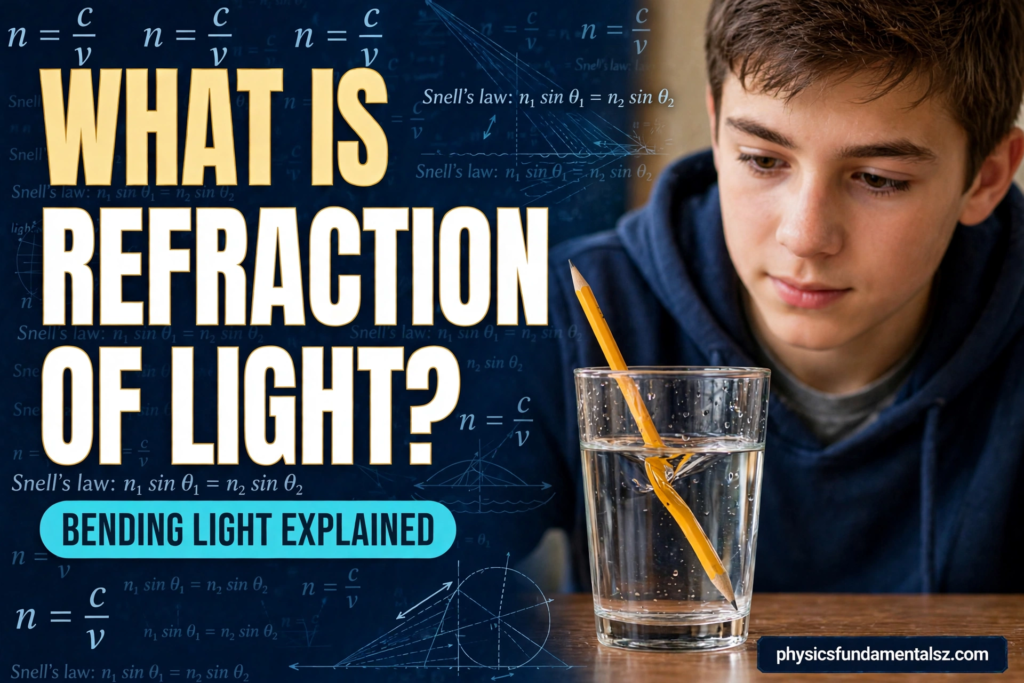
Drop a pencil into a glass of water and it looks broken at the surface. Slide a coin to the bottom of an empty bowl, step back until it disappears, then pour in water — and the coin magically reappears. Neither trick is magic. Both are refraction of light in action, and once you understand it, you start noticing it everywhere: in your glasses, in a camera lens, in a rainbow, and even in the shimmer above a hot road.
This guide explains what refraction of light is in plain language, then goes deep: the laws that govern it, the mathematics of Snell’s law, worked exam-style problems, the difference between refraction and reflection, and the real-world devices that would not work without it.
What Is Refraction of Light? The Simple Definition
Definition box: Refraction of light is the bending of a light ray when it passes from one transparent medium into another medium with a different optical density. The change in speed at the boundary causes the ray to change direction, except when it strikes the boundary head-on.
Light travels fastest in a vacuum, at about 300,000 kilometres per second. In air it moves almost as fast. But in water it slows to roughly 225,000 kilometres per second, and in glass to about 200,000 kilometres per second. When a ray crosses from one medium to another, one side of its wavefront slows down before the other side does, and that uneven slowing tilts the ray. Think of a marching band crossing from pavement onto sand at an angle: the marchers who hit the sand first slow down first, so the whole line pivots. Light does the same thing.
A few points in that definition matter for exams:
- Refraction only happens at a boundary between two media with different optical densities.
- The ray bends towards the normal when it enters a denser medium (air to water), and away from the normal when it enters a rarer medium (water to air).
- If the ray hits the boundary along the normal (at 90 degrees to the surface), it does not bend at all — though it still changes speed.
- The frequency of light never changes during refraction. Only its speed and wavelength change.
Why Does Light Bend? The Wavefront Explanation
Imagine a wavefront as a straight line of soldiers marching shoulder to shoulder. They approach a beach at an angle. The soldiers on one end reach the sand first and slow down, while the soldiers on the other end are still marching fast on the pavement. The line bends. That is exactly what happens to a light wavefront at a boundary.
The amount of bending depends on two things: the angle at which the light arrives, and how much the speed changes. A bigger speed change means a sharper bend. That is why light bends more going from air into diamond than from air into water — diamond slows light far more dramatically.
This wavefront picture also explains why refraction is not a mystery of “light deciding to turn.” It is a direct consequence of wave behaviour, and the same reasoning explains why sound waves and water waves refract too. The physics is universal; light is simply the most visible example.
Key Terms You Must Know
Before going further, lock in the vocabulary. Examiners test these terms relentlessly, and students lose marks by mixing them up.
- Incident ray: the ray travelling towards the boundary.
- Refracted ray: the ray after it has entered the second medium.
- Normal: an imaginary line drawn perpendicular to the boundary at the point of incidence. All angles are measured from the normal, never from the surface.
- Angle of incidence (i): the angle between the incident ray and the normal.
- Angle of refraction (r): the angle between the refracted ray and the normal.
- Optical density: a measure of how much a medium slows light. It is not the same as mass density, though denser materials often slow light more.
- Refractive index (n): the number that quantifies how much a medium slows light, defined as the speed of light in a vacuum divided by the speed of light in the medium.
Refractive Index Explained
The refractive index, written as n, is the single most useful number in refraction. It is defined as:
n = c / v
where c is the speed of light in a vacuum (3.00 × 10⁸ m/s) and v is the speed of light in the medium. Because light is fastest in a vacuum, n is always 1 or greater. A vacuum has n = 1 exactly, air has n ≈ 1.00, water has n ≈ 1.33, crown glass has n ≈ 1.52, and diamond has n ≈ 2.42.
A higher refractive index means light travels more slowly in that material, and bends more sharply at the boundary. This is why a diamond sparkles so intensely: its enormous refractive index bends light dramatically inside the stone, producing the flashes and fire that make diamonds prized.
| Medium | Refractive index (n) | Speed of light (approx.) |
|---|---|---|
| Vacuum | 1.00 | 3.00 × 10⁸ m/s |
| Air | 1.00 | 2.99 × 10⁸ m/s |
| Ice | 1.31 | 2.29 × 10⁸ m/s |
| Water | 1.33 | 2.25 × 10⁸ m/s |
| Crown glass | 1.52 | 1.97 × 10⁸ m/s |
| Flint glass | 1.62 | 1.85 × 10⁸ m/s |
| Diamond | 2.42 | 1.24 × 10⁸ m/s |
Notice something important in that table: the refractive index is not a fixed property of a chemical alone. It depends slightly on the wavelength of light and on temperature. That wavelength dependence is why a prism splits white light into a spectrum — blue light is slowed more than red light in glass, so it bends more. This splitting is called dispersion, and it is refraction’s most colourful consequence.
The Laws of Refraction
Refraction obeys two laws, and both are worth memorising word for word.
First law: The incident ray, the refracted ray, and the normal at the point of incidence all lie in the same plane.
Second law (Snell’s law): The ratio of the sine of the angle of incidence to the sine of the angle of refraction is a constant for a given pair of media. That constant equals the ratio of the refractive indices, written as:
n₁ sin θ₁ = n₂ sin θ₂
where n₁ and θ₁ belong to the first medium and n₂ and θ₂ belong to the second medium. This law, named after the Dutch astronomer Willebrord Snellius, lets you calculate exactly where a refracted ray will go. Georgia State University’s HyperPhysics site works through the law with an interactive calculator (Refraction of Light). For a deeper treatment of the law itself, see our guide to Snell’s law on this site.
Snell’s law also gives a neat shortcut: when light travels from a medium into a vacuum (or air), the relationship simplifies to n = sin i / sin r. This form appears constantly in textbook problems, so practise it until it is automatic.
How Refraction Works Step by Step
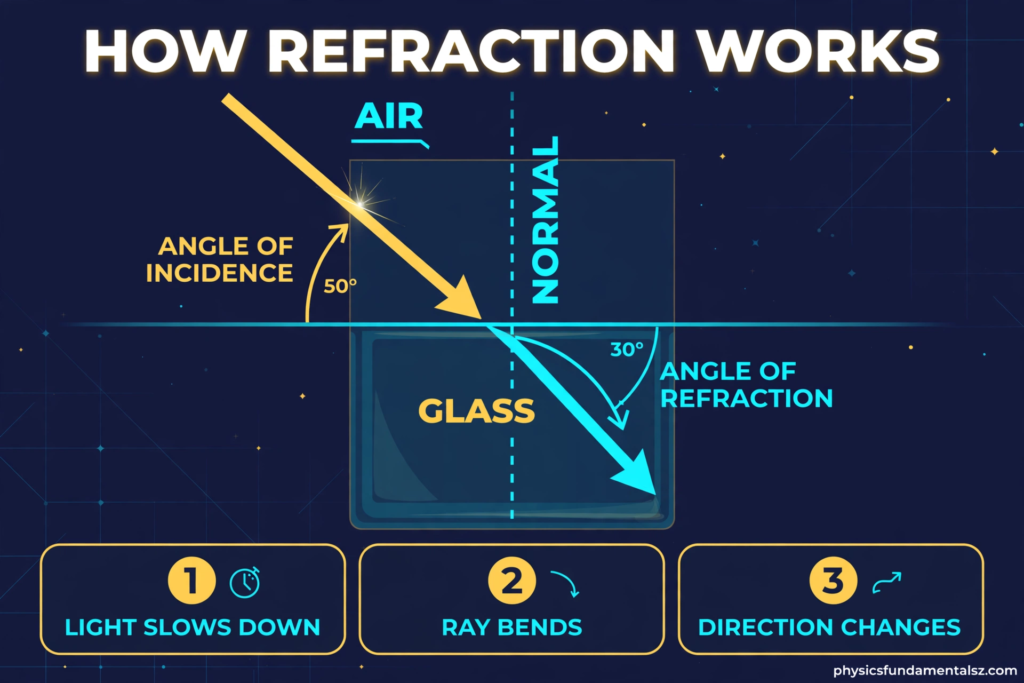
Here is the full sequence when a ray travels from air into water at an angle:
- The ray travels through air at nearly 3.00 × 10⁸ m/s, approaching the water surface at some angle of incidence.
- The leading edge of the wavefront enters the water first and slows to about 2.25 × 10⁸ m/s.
- The trailing edge is still moving at full speed in air, so the wavefront pivots.
- The ray emerges inside the water travelling in a new direction, bent towards the normal.
- The frequency stays the same, but the wavelength shortens in proportion to the speed change.
Reverse the journey — water to air — and everything flips: the ray speeds up, bends away from the normal, and its wavelength lengthens. The reversibility of the light path is a powerful check on your diagrams: if you draw a ray going from air to water, the reverse ray from water to air must retrace the same path.
Refraction vs Reflection: The Key Differences
Students constantly confuse refraction with reflection. They are different phenomena, though both often happen at the same boundary. When light strikes water, some of it reflects off the surface and some of it refracts into the water. That is why you can see both your reflection and the bottom of a pond at the same time.
| Feature | Refraction | Reflection |
|---|---|---|
| What happens | Light passes into a new medium and bends | Light bounces back into the same medium |
| Speed change | Yes — speed changes in the new medium | No — speed stays the same |
| Governing law | Snell’s law (n₁ sin θ₁ = n₂ sin θ₂) | Angle of incidence = angle of reflection |
| Needs two media | Yes, with different optical densities | No — works at a single surface |
| Wavelength change | Yes — wavelength changes with speed | No — wavelength unchanged |
| Everyday example | Bent pencil in water, lenses | Mirror image, still lake surface |
A useful exam trick: if a question asks about light “bouncing back,” it is reflection. If it asks about light “bending as it enters,” it is refraction. If it mentions both, check which one the numbers describe.
Everyday Examples of Refraction
The bent pencil and the broken straw
The classic demonstration is also the most convincing. A pencil in a glass of water looks kinked at the surface because the light from the submerged part bends as it leaves the water, making that part appear shifted. Your brain assumes light travels in straight lines, so it projects the submerged part to the wrong position. Our article on why a straw looks bent in water explores this exact illusion in detail.
A swimming pool looks shallower than it is
Light from the pool floor bends away from the normal as it exits the water into air. Your brain traces the rays back in straight lines and concludes the floor is higher than it really is. Pools, ponds, and rivers all look shallower than they are — a genuinely dangerous illusion for anyone judging depth before diving. Never trust your eyes over a measured depth.
The coin that reappears
Place a coin in an empty bowl and move back until the rim hides it. Now pour water in without moving. The coin becomes visible because light from the coin refracts at the water surface and bends over the rim towards your eye. The same principle makes fish in a pond appear closer to the surface than they really are, which is why spear-fishing requires aiming below the apparent fish.
Rainbows
A rainbow is refraction plus dispersion plus internal reflection, all inside raindrops. Sunlight enters a raindrop, refracts and splits into colours, reflects off the back of the drop, and refracts again on exit. Each colour leaves at a slightly different angle, and millions of drops together paint the arc. Without refraction, there would be no rainbow at all.
Mirages
On a hot day, the air just above a road is hotter and less dense than the air above it. Light from the sky bends gradually as it passes through layers of air of changing density — a process called graded refraction — and your brain interprets the bent light as a puddle of water on the road. The “water” is really a refracted image of the sky.
Stars twinkle, planets do not
Starlight passes through Earth’s turbulent atmosphere, where pockets of air of different densities refract it slightly differently from moment to moment. The star appears to flicker. Planets are close enough to appear as tiny discs rather than points, so the twinkling averages out and they shine steadily. Atmospheric refraction also makes the Sun appear above the horizon for a couple of minutes after it has actually set — the Sun you see at sunset is a refracted image.
Total Internal Reflection
Something special happens when light travels from a denser medium towards a rarer one, like water to air. As the angle of incidence increases, the angle of refraction grows faster, and at a certain point the refracted ray runs exactly along the boundary — an angle of refraction of 90 degrees. That angle of incidence is called the critical angle.
Beyond the critical angle, no light escapes at all. All of it reflects back inside the denser medium. This is total internal reflection, and it is far more efficient than a mirror: a good mirror reflects about 90 percent of light, while total internal reflection reflects essentially 100 percent.
The critical angle C for a medium with refractive index n (relative to air) is given by:
sin C = 1 / n
For water (n = 1.33), the critical angle is about 48.8 degrees. For glass (n = 1.52), it is about 41.1 degrees. For diamond (n = 2.42), it is just 24.4 degrees — which is why so much light stays trapped inside a diamond, bouncing around before escaping as sparkle.
Total internal reflection has enormous practical importance. Optical fibres carry internet data around the world by trapping light inside a thin glass core through repeated total internal reflection. A fibre can guide a signal for kilometres with very little loss. For everyday examples of this effect, see our post on real-life examples of total internal reflection. Endoscopes, which let doctors see inside the human body, use the same principle.
Worked Examples: Snell’s Law Problems
Worked examples are where marks are won or lost. Study the method, not just the answer: identify the two media, write down both refractive indices, apply Snell’s law, and check that your answer is physically sensible.
Example 1: Air to water
A light ray in air strikes water at an angle of incidence of 45 degrees. What is the angle of refraction? Take the refractive index of water as 1.33.
Solution: Using n₁ sin θ₁ = n₂ sin θ₂, with n₁ = 1.00 (air), θ₁ = 45°, n₂ = 1.33 (water):
sin θ₂ = (1.00 × sin 45°) / 1.33 = 0.7071 / 1.33 = 0.5317
θ₂ = sin⁻¹(0.5317) ≈ 32.1°
The ray bends towards the normal, from 45° to about 32°, exactly as expected when entering a denser medium.
Example 2: Finding a refractive index
A ray travels from glass into air. The angle of incidence in glass is 30°, and the angle of refraction in air is 50°. Calculate the refractive index of the glass.
Solution: Using n_glass × sin 30° = n_air × sin 50°:
n_glass = (1.00 × sin 50°) / sin 30° = 0.7660 / 0.5000 = 1.53
This matches crown glass, which has a refractive index of about 1.52.
Example 3: Speed of light in a medium
Light travels at 1.97 × 10⁸ m/s in a certain glass. What is the refractive index of the glass?
Solution: n = c / v = (3.00 × 10⁸) / (1.97 × 10⁸) = 1.52. This is crown glass, the standard material for ordinary lenses and windows.
Example 4: Critical angle of diamond
Calculate the critical angle for diamond (n = 2.42) surrounded by air.
Solution: sin C = 1 / n = 1 / 2.42 = 0.4132, so C = sin⁻¹(0.4132) ≈ 24.4°. Any ray inside the diamond striking the surface at more than 24.4° to the normal is totally internally reflected — the reason diamonds trap light so effectively.
Example 5: Apparent depth
A fish is 1.20 m below the surface of a pond. How deep does it appear to an observer looking straight down? Take n_water = 1.33.
Solution: For near-normal viewing, apparent depth = real depth / n = 1.20 / 1.33 ≈ 0.90 m. The fish appears about 30 cm closer to the surface than it really is. Spear-fishers and herons both have to correct for this — herons do it instinctively.
Refraction in Lenses and the Human Eye
Lenses are refraction made useful. A convex lens is thicker in the middle, so rays passing through it refract towards the axis and converge to a focus. A concave lens is thinner in the middle and spreads rays apart. Camera lenses, microscopes, telescopes, and projectors are all carefully engineered stacks of refracting surfaces, each one bending light by a precise amount.
Your eye works the same way. The cornea does most of the refracting, and the crystalline lens fine-tunes the focus onto the retina. If the eyeball is too long, the image focuses in front of the retina — short-sightedness — and a concave lens corrects it by diverging the rays slightly. If the eyeball is too short, a convex lens converges them. Every pair of glasses is a personalised refraction correction. Our guide to the lens formula and magnification shows how to calculate image positions for these lenses.
Applications of Refraction in Technology
- Optical fibres: total internal reflection carries phone and internet signals across oceans at nearly the speed of light.
- Endoscopes: fibre bundles let surgeons see inside the body without major surgery.
- Cameras and telescopes: multi-element lenses correct for aberrations and focus images sharply.
- Prisms and spectrometers: dispersion splits light into spectra, letting scientists identify the chemical composition of stars.
- Contact lenses and spectacles: correct vision by adjusting where light focuses in the eye.
- Underwater viewing windows and periscopes: prisms redirect light through total internal reflection.
- Refractometers: measure the sugar content of fruit juice or the salinity of seawater by measuring a refractive index.
- Mirages and atmospheric optics: understanding graded refraction explains mirages, green flashes, and the flattened appearance of the setting Sun.
Refraction of Other Waves
Refraction is not limited to light. Sound waves refract when they pass between air layers of different temperatures — which is why sound carries further on a still, cool night. Seismic waves refract as they pass through Earth’s layers of different density, and seismologists use that bending to map the planet’s interior. Water waves refract as they approach a beach, bending to arrive almost parallel to the shore. The same Snell’s-law mathematics describes all of them, with the wave speed in each medium taking the place of the speed of light.
Common Mistakes to Avoid
- Measuring angles from the surface: always measure from the normal. This single error ruins more refraction diagrams than any other.
- Forgetting that frequency stays constant: speed and wavelength change, frequency does not.
- Bending the ray the wrong way: denser medium means towards the normal; rarer medium means away from the normal.
- Using the wrong refractive index ratio: in Snell’s law, each n belongs to the medium its angle is measured in.
- Assuming total internal reflection works both ways: it only happens when light travels from denser to rarer medium, never the reverse.
- Confusing optical density with mass density: they are related but not identical. Some materials are heavy yet optically light.
- Drawing the refracted ray when it should be totally reflected: if the angle of incidence exceeds the critical angle, there is no refracted ray at all.
Expert Tips for Exams
- Draw the normal first, every time, as a dashed line. Then draw the rays.
- If a ray enters along the normal, write “no bending” immediately — it is a free mark.
- For apparent depth questions, remember real depth is always greater than apparent depth.
- When a problem gives the speed of light in a medium, convert it to a refractive index first with n = c / v.
- Check your Snell’s law answer: going denser means the angle shrinks; going rarer means it grows. If your answer violates that, you have mixed up the indices.
- For critical angle questions, confirm the direction: the light must start in the denser medium, or the question has no valid answer.
Quick Summary
- Refraction is the bending of light at a boundary between media of different optical density, caused by a change in speed.
- Snell’s law, n₁ sin θ₁ = n₂ sin θ₂, predicts the new direction exactly.
- Refractive index n = c / v measures how much a medium slows light.
- Beyond the critical angle, light undergoes total internal reflection — the basis of optical fibres.
- Refraction explains lenses, rainbows, mirages, apparent depth, and human vision itself.
Refraction Through a Glass Slab and Lateral Displacement
Pass light through a rectangular glass block and something neat happens: the ray enters, bends towards the normal, travels through the glass, then bends away from the normal by exactly the same amount as it exits. The emerging ray is parallel to the incident ray, but shifted sideways. That sideways shift is called lateral displacement.
Lateral displacement grows when the glass is thicker, when the angle of incidence is larger, or when the refractive index is higher. It is a favourite ray-diagram question because it tests both laws at once: bending at entry, bending at exit, and the parallel result. If your emergent ray is not parallel to your incident ray in a rectangular slab diagram, something has gone wrong.
Refraction in Prisms and Dispersion in Detail
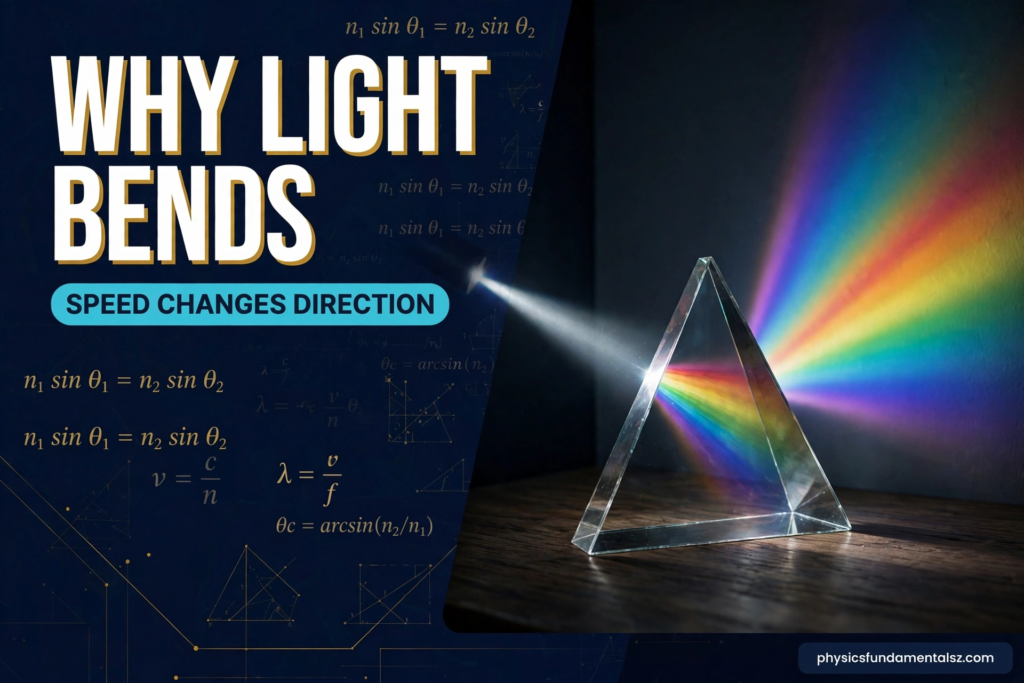
A prism is where refraction becomes spectacular. Light enters one face, refracts, travels through the glass, and refracts again on exit. Because the two faces are not parallel, the second refraction does not undo the first — the ray emerges deviated from its original path.
Crucially, the refractive index of glass depends slightly on wavelength. Violet light has a higher refractive index in glass than red light, so violet bends more at each face. White light entering a prism therefore fans out into a spectrum: red deviated least, violet most. This is dispersion, and it explains rainbows too — each raindrop acts as a tiny prism, dispersing sunlight before sending it to your eye.
The angle of deviation through a prism depends on the prism’s refracting angle and the refractive index. Spectrometers exploit this dependence: by measuring the deviation of each colour precisely, scientists identify the elements present in a distant star’s atmosphere. Every element leaves a unique fingerprint of spectral lines, and refraction is the tool that reads it.
Atmospheric Refraction: Why the Sun Lingers
Earth’s atmosphere is not uniform. Air near the ground is denser than air high up, so light from the Sun bends gradually as it travels down through layers of increasing density. Near sunrise and sunset, when sunlight crosses the atmosphere at a shallow angle, this graded refraction lifts the Sun’s apparent position by about half a degree — roughly the Sun’s own diameter.
The practical result is that you see the Sun for about two minutes before it geometrically rises and two minutes after it geometrically sets. The day is, in effect, four minutes longer because of refraction. The same graded bending flattens the Sun’s disc near the horizon into an oval, because light from the Sun’s lower edge bends more than light from its upper edge.
How to Draw Refraction Ray Diagrams
Good ray diagrams earn easy marks. Follow this method every time:
- Draw the boundary as a straight line and the normal as a dashed line at right angles to it.
- Draw the incident ray with an arrow pointing towards the boundary, and label the angle of incidence from the normal.
- Decide the direction of bending: entering a denser medium means towards the normal; entering a rarer medium means away from the normal.
- Draw the refracted ray with its arrow pointing away from the boundary, and label the angle of refraction.
- If the ray travels along the normal, draw it straight through with no bend, and note that explicitly.
- Check your diagram against Snell’s law if numbers are given: the ratio of the sines must match the refractive indices.
For a glass slab, repeat the process at the second surface and confirm the emergent ray is parallel to the incident ray. For a prism, remember the two faces are angled, so the emergent ray is deviated, not parallel.
Refraction and the Speed of Light in Different Colours
One subtle point that separates strong answers from average ones: the speed of light in a medium depends on its colour. In glass, violet light travels slightly slower than red light. That is why violet refracts more. This wavelength dependence of refractive index is called dispersion of the refractive index, and it is the reason a single lens can never focus all colours perfectly — the defect is called chromatic aberration, and camera manufacturers correct it by combining lenses made from different glasses.
Frequently Asked Questions
1. What is refraction of light in simple words?
Refraction of light is the bending of light when it passes from one transparent material into another, such as from air into water. The light changes speed at the boundary, and that speed change makes it change direction.
2. What causes refraction of light?
Refraction is caused by light changing speed when it moves between media of different optical densities. One side of the wavefront slows down before the other, which tilts the wavefront and bends the ray.
3. What is the difference between refraction and reflection?
In refraction, light enters a new medium and bends; in reflection, light bounces back into the same medium. Refraction changes the light’s speed and wavelength, while reflection changes neither.
4. What is Snell’s law in simple terms?
Snell’s law states that n₁ sin θ₁ = n₂ sin θ₂, where n is the refractive index and θ is the angle measured from the normal in each medium. It lets you calculate the angle of refraction from the angle of incidence.
5. What is the refractive index of water?
The refractive index of water is approximately 1.33, meaning light travels about 1.33 times slower in water than in a vacuum.
6. Why does a pencil look bent in water?
Light from the submerged part of the pencil bends as it leaves the water, so your brain, which assumes light travels straight, places that part in the wrong position. The pencil looks kinked at the water surface.
7. Does light bend when it enters glass at 90 degrees?
No. When light strikes a boundary along the normal, it passes straight through without bending, although it still slows down inside the glass.
8. What is total internal reflection?
Total internal reflection happens when light travelling from a denser to a rarer medium hits the boundary at an angle greater than the critical angle. All the light reflects back inside the denser medium instead of escaping.
9. What is the critical angle of water?
The critical angle of water relative to air is about 48.8 degrees, calculated from sin C = 1 / 1.33.
10. Why does light change speed in water?
Light interacts with the atoms of the medium as it passes through. These interactions delay the wave’s progress, so the effective speed of light in the medium is lower than in a vacuum.
11. Does the frequency of light change during refraction?
No. The frequency of light stays constant during refraction. Only its speed and wavelength change, and they change in proportion so that frequency remains the same.
12. Why does a swimming pool look shallower than it is?
Light from the pool floor bends away from the normal when it exits the water, making the floor appear higher than it really is. The pool always looks shallower than its true depth.
13. How is refraction used in optical fibres?
Optical fibres use total internal reflection to trap light inside a glass core. The light bounces along the fibre with very little loss, carrying data over enormous distances.
14. What is dispersion?
Dispersion is the splitting of white light into its colours because different wavelengths refract by different amounts. Blue light bends more than red light in glass, which is how a prism creates a spectrum.
15. Why do stars twinkle but planets do not?
Starlight is refracted by turbulent pockets of air in Earth’s atmosphere, making stars appear to flicker. Planets appear as small discs, so the twinkling averages out and they shine steadily.
16. Can refraction happen with sound?
Yes. Sound waves refract when they pass between air layers of different temperatures or densities, which is why sound sometimes carries much further at night.
17. What is the refractive index of diamond and why is it important?
Diamond has a refractive index of about 2.42, one of the highest of any natural material. This gives it a small critical angle of about 24.4 degrees, trapping light inside and producing its famous sparkle.
18. How do glasses correct vision?
Glasses use refraction to adjust where light focuses inside the eye. Concave lenses correct short-sightedness by diverging rays, while convex lenses correct long-sightedness by converging them.
Conclusion
Refraction of light is one of those ideas that seems small until you notice how much of the world depends on it. It bends the pencil in your glass, paints the rainbow, guides the internet through fibres under the ocean, and focuses the image on your retina right now. Master the definition, Snell’s law, and the critical angle, and you have the tools to solve almost any refraction problem an exam can set — and to understand a surprising amount of the technology around you.
For more wave and light physics, explore our guides to how to calculate wavelength from frequency, constructive and destructive interference, and electromagnetic waves.
Further reading: Khan Academy’s refraction and Snell’s law lessons, the HyperPhysics refraction pages from Georgia State University (Refraction of Light), and the Britannica entry on the angle of refraction (Angle of refraction) all offer excellent diagrams and interactive simulations to practise with.