Difference Between Scalar and Vector Quantities: Definition, Examples, and Comparison
Introduction
“Walk 5 meters.” “Walk 5 meters north.” The first instruction tells you how far to go; the second tells you how far and in which direction. That single extra piece of information — direction — is the dividing line between two of the most fundamental categories in physics: scalar quantities and vector quantities. Getting this distinction right matters far beyond vocabulary quizzes. It determines how you add quantities, which formulas apply, and whether your answers even make sense.
In this guide, you will learn exactly what makes a quantity scalar or vector, see complete lists of examples, master the rules for adding and subtracting each type, and work through problems that show why the distinction changes results. By the end, you will be able to classify any common physics quantity confidently and explain why quantities like speed and velocity, though related, are not interchangeable.
Quick answer: A scalar quantity has magnitude only (for example, mass, temperature, speed). A vector quantity has both magnitude and direction (for example, displacement, velocity, force). Scalars add by ordinary arithmetic; vectors add by direction-aware rules such as the triangle or parallelogram law.
What Is a Scalar Quantity?
A scalar quantity is a physical quantity that is fully described by a single number (its magnitude) together with a unit. No direction is needed, and none is implied. If someone tells you “the temperature is 25 degrees Celsius” or “the mass is 70 kilograms,” you have all the information there is. There is no “25 degrees Celsius north” — the idea is meaningless.
Scalars follow the ordinary rules of arithmetic. Two masses of 3 kg and 4 kg combine to 7 kg, regardless of how they are arranged in space. Two temperatures do not combine that way in a physical sense — mixing water at 30°C and 60°C does not give 90°C — but that is a property of temperature as a physical process, not of scalar arithmetic. The scalar quantities themselves add and subtract as plain numbers whenever the physics calls for combining them, as with mass, energy, or time intervals.
Common Scalar Quantities
- Mass — measured in kilograms (kg). A body’s mass is the same no matter which way it faces.
- Distance — the total path length travelled, in meters (m). Unlike displacement, it never cancels out.
- Speed — how fast something moves, in m/s, without any direction attached.
- Time — duration in seconds (s). Time intervals are scalars, even though the arrow of time is a deep topic in its own right.
- Temperature — in degrees Celsius, kelvin, or Fahrenheit. A temperature has no direction.
- Energy — kinetic, potential, thermal, and all other forms, in joules (J).
- Work — in joules. Work is the dot product of two vectors, and the result is a scalar.
- Power — the rate of doing work, in watts (W).
- Pressure — force per unit area, in pascals (Pa). Pressure acts in all directions at a point, which is precisely why it is not a vector.
- Density — mass per unit volume, in kg/m³. See our guide to what density is in physics for a full treatment.
- Volume — in cubic meters (m³).
- Electric charge — in coulombs (C). Charge has a sign (positive or negative), but sign is not direction.
- Frequency — oscillations per second, in hertz (Hz).
- Wavelength — in meters, for a wave travelling in any direction.
What Is a Vector Quantity?
A vector quantity is a physical quantity that needs both a magnitude and a direction for a complete description. “A force of 10 newtons” is incomplete: 10 newtons to the east and 10 newtons to the west produce opposite effects. Only “10 newtons east” fully specifies the force.
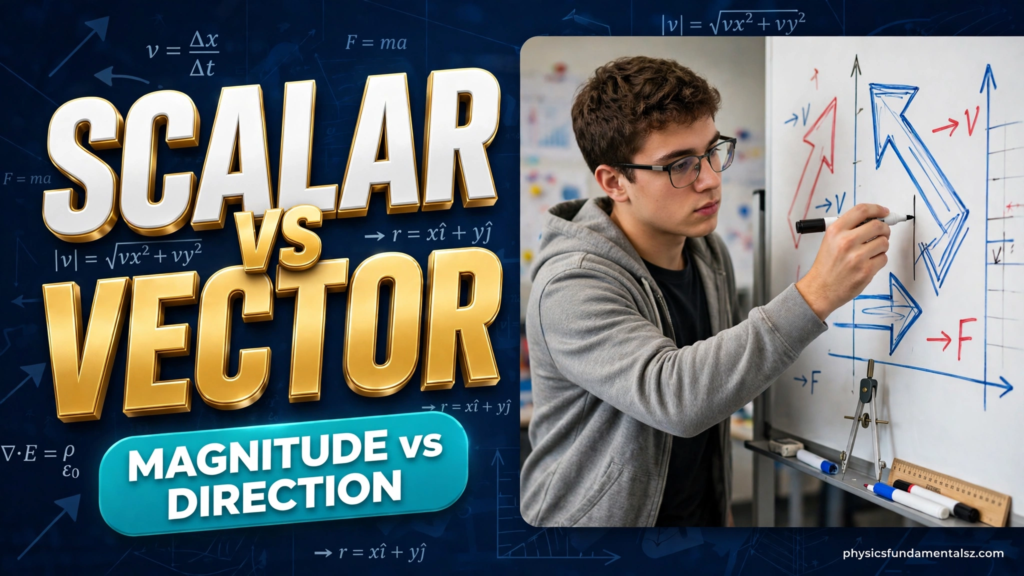
Vectors are represented graphically by arrows: the arrow’s length shows the magnitude, and the arrow’s direction shows the direction of the quantity. Mathematically, a vector in two dimensions can be written in component form, such as (3, 4), meaning 3 units east and 4 units north, or in unit-vector notation, such as 3î + 4ĵ.
Common Vector Quantities
- Displacement — change in position, in meters, from a starting point to an ending point. Unlike distance, displacement can be zero for a round trip. See the difference between distance and displacement for worked comparisons.
- Velocity — rate of change of displacement, in m/s, with direction. Compare with the difference between speed and velocity.
- Acceleration — rate of change of velocity, in m/s², with direction. See the difference between velocity and acceleration.
- Force — a push or pull, in newtons, always in a specific direction.
- Weight — the gravitational force on a mass, always directed toward Earth’s center. The distinction between mass (scalar) and weight (vector) is covered in our article on the difference between mass and weight in physics.
- Momentum — mass times velocity, in kg·m/s, pointing in the velocity’s direction. See what momentum is in physics.
- Electric field — force per unit charge, in N/C, with direction.
- Magnetic field — in teslas (T), with direction. See what a magnetic field is.
- Torque — a rotational force effect, in N·m. Torque’s direction is along the axis of rotation, given by the right-hand rule. See what torque is in physics.
- Angular velocity and angular acceleration — rotational quantities with axial directions.
- Impulse — change in momentum, in N·s, in the direction of the applied force.
- Thrust and drag — forces in specific directions, central to flight and vehicle physics.
Scalar vs Vector: The Key Differences at a Glance
| Feature | Scalar Quantity | Vector Quantity |
|---|---|---|
| Description needs | Magnitude only | Magnitude and direction |
| Example | Mass, temperature, speed, energy | Displacement, velocity, force, acceleration |
| Graphical representation | A single number | An arrow (length = magnitude, direction = direction) |
| Addition rule | Ordinary arithmetic | Triangle/parallelogram law or component addition |
| Can it cancel out? | No (magnitudes add up) | Yes (opposite directions can cancel) |
| Can it be negative? | Some can (e.g. temperature in °C, charge) | Components can be negative; magnitude itself is never negative |
| Division by a vector | Not applicable | Dividing a vector by a scalar gives a vector |
| Product of two vectors | Dot product gives a scalar | Cross product gives a vector |
| Example of change | Heating water changes temperature | Turning a car changes velocity even at constant speed |
Why Direction Changes Everything: Addition
The most practical difference between scalars and vectors is how they combine.
Adding Scalars
Scalar addition is ordinary arithmetic. Walk 3 meters, then 4 more meters, and you have covered 7 meters of distance. Pour 2 liters of water into 3 liters and you have 5 liters. The arrangement in space is irrelevant.
Adding Vectors
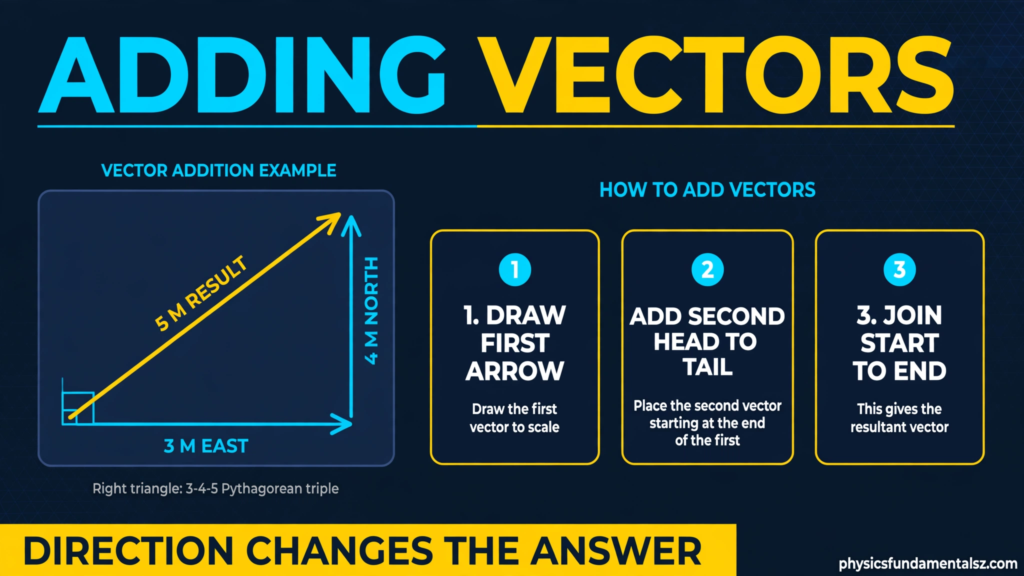
Vector addition must account for direction. Walk 3 meters east, then 4 meters north, and your displacement is not 7 meters — it is 5 meters northeast, by Pythagoras’ theorem (√(3² + 4²) = 5). Walk 3 meters east and then 3 meters west, and your displacement is zero, even though you covered 6 meters of distance.
Two standard methods handle vector addition:
- The triangle (head-to-tail) method: place the tail of the second vector at the head of the first; the resultant runs from the first tail to the second head.
- The component method: break each vector into x and y components, add the components separately, then recombine. This is the method used in nearly all calculations, because it reduces vector addition to scalar addition of components.
Worked Example 1: Displacement vs Distance
A student walks 6 m east, then 8 m north. Find (a) the distance travelled and (b) the displacement.
(a) Distance = 6 + 8 = 14 m. Distance is a scalar and simply accumulates.
(b) Displacement = √(6² + 8²) = √(36 + 64) = √100 = 10 m, in a direction of tan⁻¹(8/6) ≈ 53° north of east. The displacement is a vector, shorter than the distance, because the path was not straight.
Worked Example 2: Velocity Addition
A boat crosses a river at 4 m/s relative to the water, heading straight across, while the river current carries it downstream at 3 m/s. The boat’s velocity relative to the ground is the vector sum: √(4² + 3²) = 5 m/s, at an angle of tan⁻¹(3/4) ≈ 37° downstream from the straight-across direction. A passenger who only knew the speed (5 m/s) without the direction would not know where the boat will land.
Worked Example 3: Forces That Cancel
Two people push a crate with 100 N each, one east and one west. The net force — the vector sum — is zero, and the crate does not accelerate. Two scalars of 100 and 100 would give 200; vectors can cancel, and that cancellation is the whole reason free-body diagrams matter.
Speed vs Velocity: The Classic Pair
Speed and velocity are the most-tested scalar-vector pair in school physics, and they deserve a careful look.
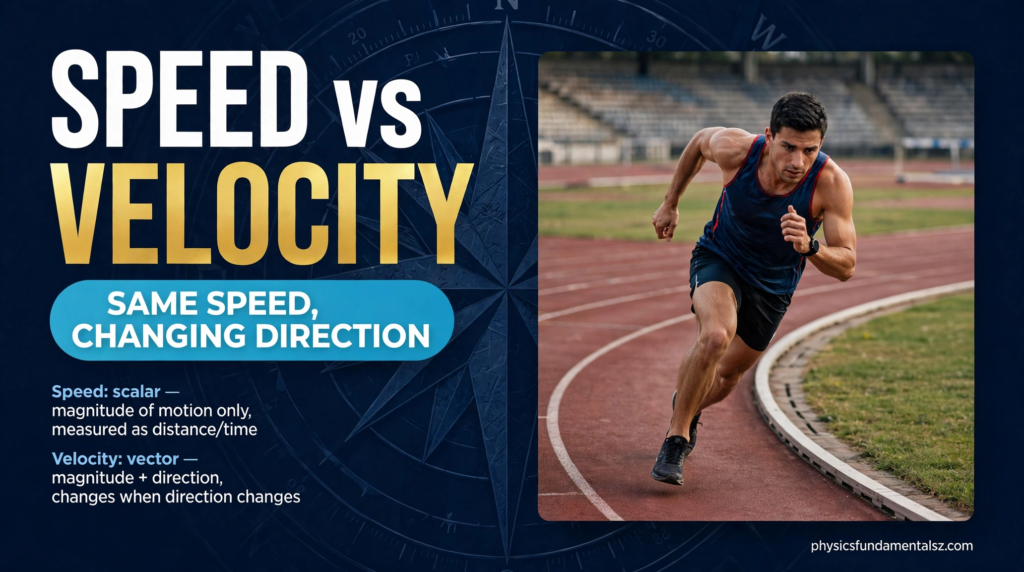
Speed is a scalar: it answers “how fast?” A car’s speedometer reads speed. It is the magnitude of the velocity vector, and it is always non-negative.
Velocity is a vector: it answers “how fast, and in which direction?” A car driving around a roundabout at a constant 30 km/h has constant speed but constantly changing velocity, because its direction changes at every instant. That changing velocity is why a centripetal acceleration exists even at constant speed — a connection explored in our guide to what centripetal force is.
Average speed and average velocity also differ. Average speed is total distance divided by total time. Average velocity is displacement divided by time. For a round trip that returns to the start, average velocity is zero while average speed is not. Exams love this distinction, and it is the single most reliable source of marks in the topic if you remember which one is which.
Distance vs Displacement: Another Classic Pair
Distance is the scalar twin of displacement. A marathon runner covers 42.195 km of distance but may finish only a few hundred meters from the start in displacement terms. A satellite in a circular orbit travels an enormous distance each revolution while its displacement over one full orbit is zero.
The rule of thumb: whenever a problem asks “how far did it travel?” it usually wants distance (scalar). Whenever it asks “how far is it from the start?” or “what is its change in position?” it wants displacement (vector). Reading the question’s wording carefully is half the battle.
Mass vs Weight: Scalar Mass, Vector Weight
Mass is a scalar: it measures how much matter a body contains and how strongly it resists acceleration. It is the same on Earth, on the Moon, and in deep space. Weight is a vector: it is the gravitational force acting on that mass, W = mg, directed toward the gravitating body. An astronaut’s mass does not change on the Moon, but their weight drops to about one-sixth of its Earth value, and its direction is toward the Moon’s center.
This pair also illustrates a general rule: multiplying a vector by a scalar gives a vector (mass × gravitational field strength = weight), while multiplying a scalar by a scalar gives a scalar.
Energy, Work, and Power: Why They Are Scalars
Students sometimes wonder why energy is a scalar when force, which creates it, is a vector. The answer lies in how work is defined: work is the dot product of force and displacement, W = F·d = Fd cos θ. The dot product takes two vectors and returns a single number — the component of force along the displacement, times the displacement. Direction is used in the calculation (through cos θ) and then disappears from the result. Energy inherits this scalar character: kinetic energy ½mv² depends on speed (the magnitude of velocity), not on velocity’s direction, so a car moving east at 20 m/s has exactly the same kinetic energy as one moving west at 20 m/s. Our articles on kinetic energy, potential energy, and the difference between work and power develop these ideas fully.
Scalars and Vectors in Formulas: What Changes
Recognizing whether a quantity is scalar or vector tells you which mathematical tools apply:
- Scalars in formulas: add, subtract, multiply, and divide normally. Kinetic energy, temperature change, and total time are computed with plain arithmetic.
- Vectors in formulas: must be resolved into components or combined with vector rules before arithmetic applies. Net force is the vector sum of forces, not their arithmetic sum. Acceleration is the vector change in velocity divided by time — which is why an object can accelerate while its speed stays constant.
- Dot products: force · displacement = work (scalar); force · velocity = power (scalar).
- Cross products: position × force = torque (vector); charge × velocity × magnetic field gives the magnetic force (vector). Cross products are where direction rules like the right-hand rule enter.
A useful exam habit: whenever a formula contains an arrow or boldface symbol in your textbook, treat that quantity as a vector and check directions before plugging in numbers.
Resolving Vectors into Components
Most vector calculations in two dimensions go through components. A vector of magnitude V at angle θ above the x-axis has:
- x-component: V_x = V cos θ
- y-component: V_y = V sin θ
Conversely, from components you recover magnitude and direction:
- Magnitude: V = √(V_x² + V_y²)
- Direction: θ = tan⁻¹(V_y / V_x), taking care about which quadrant the vector points into.
Components are scalars with signs — the sign records direction along that axis — and they add by ordinary arithmetic. This is the bridge between vector physics and scalar calculation, and it is the technique behind projectile motion, inclined-plane problems, and equilibrium analysis.
Worked Example 4: Resolving a Force
A force of 50 N acts at 30° above the horizontal. Find its components.
F_x = 50 cos 30° = 50 × 0.866 = 43.3 N (horizontal) F_y = 50 sin 30° = 50 × 0.5 = 25 N (vertical)
Only the horizontal component pushes the object forward; only the vertical component lifts it. A problem that asks for the forward push wants 43.3 N, not 50 N.
Scalar and Vector Quantities in Exam Questions
Exam questions on this topic usually test classification, addition, or interpretation, and they reward careful reading more than heavy calculation. A typical question gives a journey in stages — for example, 20 m north, then 15 m east — and asks for both distance and displacement. The distance is the simple sum, 35 m. The displacement needs Pythagoras: √(20² + 15²) = 25 m, at tan⁻¹(15/20) ≈ 37° east of north. Students who answer 35 m for both lose the displacement marks entirely, even though their arithmetic was perfect.
Another common format presents a list of quantities — mass, velocity, temperature, force, energy, acceleration, time, momentum — and asks which are scalars and which are vectors. The fastest way through such a list is the direction test: ask of each quantity, “Would the answer change if the direction changed?” If yes, it is a vector. A velocity of 5 m/s east is genuinely different from 5 m/s west; a temperature of 20°C is the same in every direction.
Graph questions test the same distinction visually. A distance-time graph’s gradient gives speed (scalar), while a displacement-time graph’s gradient gives velocity (vector), and its sign records direction. Similarly, a speed-time graph’s area gives distance, while a velocity-time graph’s area gives displacement, with areas below the axis counting negative. Keeping the scalar and vector members of each pair straight turns these graph questions into easy marks.
A final exam trap involves average values over a round trip. An athlete who runs one lap of a 400 m track in 80 s has an average speed of 5 m/s, but an average velocity of zero, because the displacement over the full lap is zero. Questions that ask for “average velocity” after a return journey are specifically testing whether you noticed the displacement, not the distance.
Common Mistakes to Avoid
Mistake 1: Adding Vectors Like Scalars
Adding 3 m east and 4 m north to get 7 m is wrong for displacement. Always check direction before adding. If directions differ, use components or the triangle law.
Mistake 2: Confusing Speed with Velocity (or Distance with Displacement)
The pairs speed/velocity, distance/displacement, and mass/weight are the most common confusions. The rule is simple: the one with direction is the vector. If a question gives a direction, it is testing the vector; if it asks only “how much,” it may be testing the scalar.
Mistake 3: Treating a Negative Sign as a Negative Magnitude
A velocity of −5 m/s does not mean a “negative speed.” It means 5 m/s in the negative direction along the chosen axis. Magnitudes are never negative; signs on components record direction.
Mistake 4: Calling Temperature or Pressure Vectors
Pressure acts in all directions, which tempts students to call it a vector. It is not: a vector has one direction, and pressure has no single direction. Similarly, a “hot wind blowing north” has a vector velocity, but the temperature itself remains a scalar.
Mistake 5: Forgetting That Vector Quantities Need Direction in Answers
An answer of “10 m/s” to a velocity question is incomplete; “10 m/s east” is complete. Examiners deduct marks for missing directions, and in real engineering, a force without a direction is a useless specification.
Scalars and Vectors Beyond Mechanics
The scalar-vector distinction extends far beyond motion:
- Electricity: electric charge and electric potential are scalars; electric field and current density are vectors. (Electric current itself is often treated as a scalar in circuit analysis because the wire defines the direction, though current density is the true vector.)
- Waves: amplitude and frequency are scalars; wave velocity and the wave vector (which points in the propagation direction) are vectors. See our article on sound wave frequency for wave quantities in context.
- Thermodynamics: temperature, pressure, internal energy, and entropy are scalars. Heat and work are energy transfers, also scalar in accounting, even though they arise from molecular motion.
- Modern physics: in relativity, quantities combine into four-vectors that mix space and time, and in quantum mechanics, the state of a system is a vector in an abstract space. The scalar-vector distinction you learn in school mechanics is the first step toward those deeper structures.
Quick Classification Table
| Quantity | Scalar or Vector? | Unit | Notes |
|---|---|---|---|
| Mass | Scalar | kg | Same everywhere |
| Distance | Scalar | m | Total path length |
| Displacement | Vector | m | Straight line from start to finish |
| Speed | Scalar | m/s | Magnitude of velocity |
| Velocity | Vector | m/s | Speed with direction |
| Acceleration | Vector | m/s² | Change in velocity, including direction change |
| Force | Vector | N | Push or pull in a direction |
| Weight | Vector | N | Gravity’s force, toward Earth’s center |
| Energy | Scalar | J | All forms |
| Work | Scalar | J | Dot product of force and displacement |
| Power | Scalar | W | Rate of energy transfer |
| Momentum | Vector | kg·m/s | Mass × velocity |
| Temperature | Scalar | K or °C | No direction |
| Pressure | Scalar | Pa | Acts in all directions |
| Density | Scalar | kg/m³ | Mass per unit volume |
| Electric charge | Scalar | C | Sign is not direction |
| Electric field | Vector | N/C | Force per unit charge |
| Magnetic field | Vector | T | Direction matters for compasses and motors |
| Torque | Vector | N·m | Axis direction by right-hand rule |
| Frequency | Scalar | Hz | Cycles per second |
| Time | Scalar | s | Duration |
Key Takeaways
- Scalars have magnitude only; vectors have magnitude and direction.
- Scalars add by ordinary arithmetic; vectors add by the triangle law or component addition.
- Speed, distance, mass, temperature, and energy are scalars; velocity, displacement, weight, force, and acceleration are vectors.
- Vectors can cancel; scalars (as magnitudes) cannot.
- A vector’s components are signed scalars, and they are the working tool for most calculations.
- The magnitude of a vector is never negative; a minus sign on a component records direction.
- Work and energy are scalars because they come from dot products, even though force and displacement are vectors.
Conclusion
The difference between scalar and vector quantities is one of the first distinctions physics teaches, and it is also one of the most durable. It governs how quantities combine, which formulas apply, and what counts as a complete answer. Whenever you meet a new quantity, ask the one question that settles its category: “Does it need a direction to be fully described?” If the answer is no, treat it as a scalar and use ordinary arithmetic. If the answer is yes, draw the arrow, resolve the components, and respect the direction. That single habit will prevent a large fraction of the errors students make in mechanics and beyond.
Frequently Asked Questions
What is the difference between scalar and vector quantities?
A scalar quantity has only magnitude, such as mass or temperature. A vector quantity has both magnitude and direction, such as velocity or force. Scalars add by ordinary arithmetic, while vectors require direction-aware addition.
Is speed a scalar or vector?
Speed is a scalar. It measures how fast an object moves, without direction. Its vector counterpart is velocity, which includes direction.
Is force a scalar or vector?
Force is a vector. A force is only fully described when both its magnitude (in newtons) and its direction are given.
Is temperature a scalar or vector?
Temperature is a scalar. It has a value and a unit but no direction, even though heat may flow in a particular direction.
Is distance a scalar or vector?
Distance is a scalar: the total path length travelled. Displacement is the vector version — the straight-line change in position from start to finish.
Is mass a scalar or vector?
Mass is a scalar. It is the same regardless of orientation or location. Weight, the gravitational force on a mass, is the vector counterpart.
Is energy a scalar or vector?
Energy is a scalar. Kinetic energy depends on speed (a scalar), and work is a dot product, which always produces a scalar.
Can vectors be added like scalars?
Only when they point in exactly the same direction. In general, vectors must be added by the triangle law, the parallelogram law, or component addition, because direction affects the result.
Can a vector be zero?
Yes. A zero vector has zero magnitude and no defined direction. It results when equal and opposite vectors cancel, such as two equal forces pulling in opposite directions.
Is acceleration a scalar or vector?
Acceleration is a vector. It describes the rate of change of velocity, and since velocity includes direction, acceleration must too. An object changing direction at constant speed is accelerating.
Is pressure a scalar or vector?
Pressure is a scalar. Although it acts on surfaces in all directions, it has no single direction of its own, which is the test for being a vector.
What is an example of a scalar quantity in daily life?
The temperature outside (25°C), the mass of a bag of rice (5 kg), and the time a journey takes (40 minutes) are all scalars — each is complete without a direction.
What is an example of a vector quantity in daily life?
Wind velocity (“20 km/h from the north”), the force needed to push a car, and the displacement from home to school are all vectors — each needs a direction to be meaningful.
Is electric current a scalar or vector?
In circuit analysis, current is treated as a scalar because the wire defines its direction. The more fundamental quantity, current density, is a vector. Exam boards usually classify current as a scalar.
How do you find the magnitude of a vector?
For a vector with components (x, y), the magnitude is √(x² + y²). In three dimensions, it is √(x² + y² + z²). Magnitude is always non-negative.
What is the difference between a vector and a scalar in terms of direction?
A vector’s direction is part of its identity: reversing the direction gives a different vector. A scalar has no direction to reverse, so the question does not apply.
Is momentum a scalar or vector?
Momentum is a vector: it is mass (scalar) times velocity (vector), and it points in the direction of motion. Conservation of momentum must be applied direction by direction.
Is work a scalar or vector?
Work is a scalar. It is the dot product of force and displacement, and dot products always yield scalars, even though both inputs are vectors.
Can a scalar quantity be negative?
Some scalars can be negative, such as temperature in Celsius or electric charge. But a magnitude — like speed or distance — is never negative. The sign of a scalar like charge indicates type, not direction.
Why is velocity a vector but speed a scalar?
Because velocity is defined as the rate of change of displacement (a vector), while speed is defined as the rate of change of distance (a scalar). The definitions inherit the character of the quantity they are derived from.
References and Further Reading
- Khan Academy, “Vectors and scalars” — khanacademy.org/science/physics/one-dimensional-motion
- HyperPhysics, Georgia State University, “Scalars and Vectors” — hyperphysics.phy-astr.gsu.edu/hbase/vect.html
- OpenStax University Physics, “Scalars and Vectors” — openstax.org/details/books/university-physics-volume-1
- Encyclopaedia Britannica, “Vector” — britannica.com/science/vector-mathematics
- MIT OpenCourseWare, “Vectors” — ocw.mit.edu