Difference Between Conductors and Insulators Explained
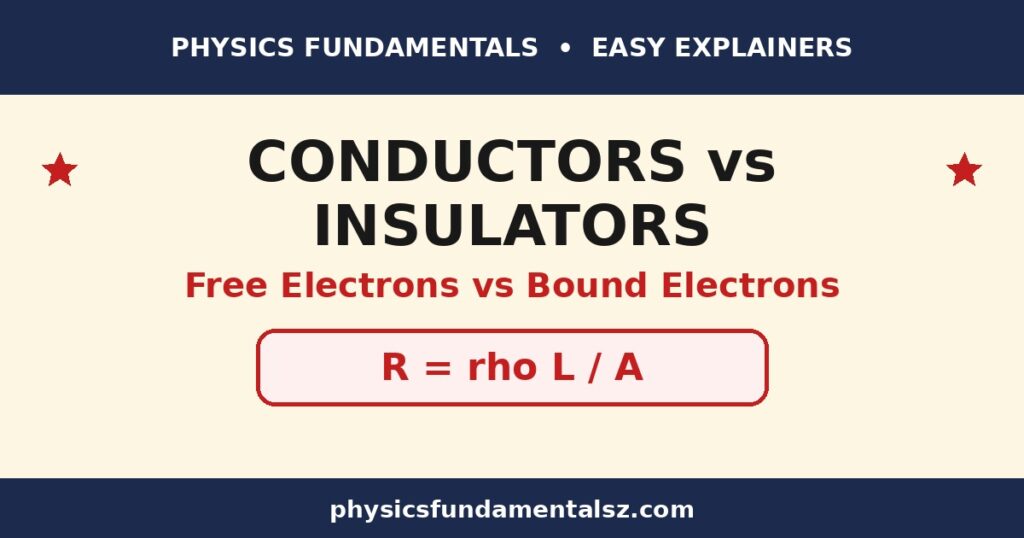
Quick answer: A conductor is a material that lets electric charge flow easily through it, because it has free electrons that can move. An insulator is a material that resists the flow of charge, because its electrons are tightly bound to atoms and cannot move freely. Metals such as copper and aluminium are good conductors. Rubber, plastic, glass, and dry wood are good insulators. The difference is not absolute: every material conducts a little, and insulators can break down under very high voltage.
Every electrical device depends on this pair of opposites working together. Copper wires carry current where it is wanted. Plastic coating stops the same current from reaching your hand. A switch connects a conductor to let current flow, and breaks the connection with an insulating gap to stop it.
Students often learn conductors and insulators as two lists to memorise. That approach works for a quick question, but it fails when a question asks why a material behaves as it does, or what happens when temperature, voltage, or thickness changes. The behaviour follows from atomic structure, and this guide explains that structure first.
You will learn the definitions, the free-electron model, resistivity and conductivity, worked calculations, temperature effects, semiconductors, thermal conduction, and safety. Tables compare the key properties side by side, and worked examples show the numbers behind the words.
What Is an Electrical Conductor?
An electrical conductor allows electric charge to move through it with little resistance. In a metal, the outer electrons of each atom are not tied to one atom. They form a sea of free electrons that can drift through the whole piece of metal when a voltage is applied.
Apply a voltage across a copper wire, and the free electrons drift slowly from the negative end towards the positive end. Individual electrons move in a random, zigzag way, colliding with atoms, but the drift gives a steady net flow. That flow is the electric current. The more free electrons per unit volume, and the more easily they move, the better the conductor.
Copper is the standard conductor for wiring because it combines high conductivity with flexibility, durability, and reasonable cost. Aluminium is lighter and cheaper, so it is used for overhead power lines, where weight matters over long spans. Silver conducts even better than copper, but its cost limits it to special contacts and instruments. Gold does not tarnish, so it is used for thin coatings on connectors, even though it conducts slightly less well than copper.
Conductors are not only metals. Salt water, the graphite in a pencil, and the plasma in a fluorescent tube all conduct, because they contain mobile charged particles. In salt water, ions carry the charge. In graphite, delocalised electrons move between layers of carbon atoms. The common thread is mobile charge, whatever its form.
OpenStax University Physics explains conduction, resistivity, and the free-electron model in its current and resistance chapters. Khan Academy’s physics course covers resistivity and Ohm’s law with guided examples. Our guide to electric current explains charge flow and drift velocity in more detail.
What Is an Electrical Insulator?
An electrical insulator resists the flow of charge. Its electrons are tightly bound to their atoms, so very few are free to move. Apply a voltage, and the electrons shift slightly within their atoms, but they do not drift through the material. Almost no current flows.
Rubber, plastic, glass, ceramic, dry wood, paper, and pure water are common insulators. The plastic around a wire, the ceramic on a power-line pylon, and the rubber handle of a tool all use this property. They keep current in its intended path and keep people separated from live conductors.
Insulators are not perfect. A tiny leakage current always flows, and under a high enough voltage, an insulator breaks down. Air, normally an insulator, breaks down in a lightning strike or a spark. The voltage at which breakdown happens is called the breakdown voltage, and it depends on the material and its thickness. Good design keeps working voltages well below breakdown, with a safety margin.
The word “insulator” also appears in thermal physics, where it means a poor conductor of heat. Most electrical insulators are also poor thermal conductors, but the two properties are not identical. Diamond is an excellent thermal conductor and an electrical insulator. That exception matters, and it is covered later in this guide.
Conductors vs Insulators at a Glance
| Feature | Conductors | Insulators |
|---|---|---|
| Free charge carriers | Many free electrons (metals) or ions | Very few free carriers; electrons bound to atoms |
| Resistivity | Very low, about 10⁻⁸ Ω·m for metals | Very high, about 10¹⁰ Ω·m or more |
| Current under voltage | Large current flows easily | Almost no current flows |
| Energy bands | Conduction band overlaps valence band, or partly filled | Large band gap, electrons cannot jump easily |
| Typical examples | Copper, aluminium, silver, gold, graphite, salt water | Rubber, plastic, glass, ceramic, dry wood, air |
| Main use | Carry current in wires, contacts, and circuits | Contain current, separate conductors, protect people |
| Heating under current | Heats when current is large, by design in heaters | Stays cool in normal use; heats only if breakdown occurs |
| Effect of heating | Resistance rises with temperature (metals) | Resistance usually falls as temperature rises |
This table is the core comparison. Learn the first three rows first: carriers, resistivity, and current. Those rows answer most short questions. The band-gap row explains why the difference exists, and the temperature row is the one students forget most often.
The Free-Electron Model in Plain Language
Picture a metal as a regular lattice of positive ions, with a shared pool of electrons moving between them. The ions vibrate in place. The electrons move freely, colliding with ions and changing direction, but always available to drift when a field is applied.
In an insulator, picture electrons locked to their parent atoms. The lattice still vibrates, but no shared pool exists. An applied field stretches the electron clouds slightly, a effect called polarisation, but no steady drift follows. Remove the field, and the clouds spring back.
This model explains several facts at once. Metals conduct because the pool exists. Insulators do not because it does not. Heating a metal increases ion vibration, which blocks electron drift more often, so resistance rises. Heating an insulator can free a few electrons from their atoms, so its resistance falls. One picture, several predictions, all testable.
Resistivity and Conductivity: Measuring How Well a Material Conducts
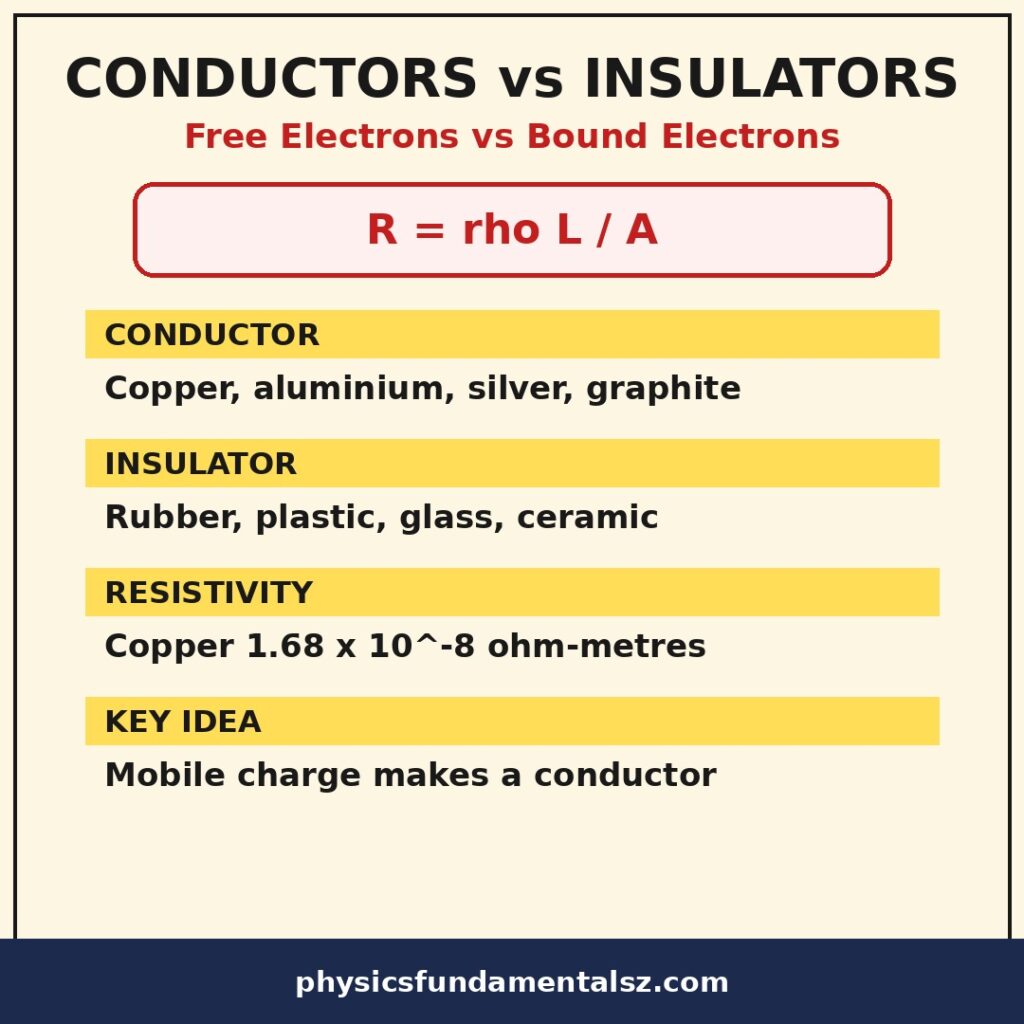
Resistivity is the property that decides whether a material is a conductor or an insulator, independent of its shape. It is denoted by the Greek letter ρ (rho) and measured in ohm-metres (Ω·m). A low resistivity means easy conduction. A high resistivity means hard conduction.
Resistance, by contrast, depends on shape as well as material. A long thin wire has more resistance than a short thick wire of the same material. The formula linking them is R = ρL/A, where R is resistance in ohms, L is length in metres, and A is cross-sectional area in square metres.
Conductivity, denoted σ (sigma), is the reciprocal of resistivity: σ = 1/ρ. It is measured in siemens per metre (S/m). Conductors have high conductivity. Insulators have very low conductivity. Either quantity describes the same property, and questions may give one and ask for the other.
Resistivity values span an enormous range. Copper is about 1.68 × 10⁻⁸ Ω·m at room temperature. Glass is of the order of 10¹⁰ to 10¹⁴ Ω·m. The gap between them is more than eighteen orders of magnitude. No other everyday material property spans so wide a range, which is why the conductor-insulator distinction is so useful in engineering.
| Material | Type | Resistivity at about 20 °C (Ω·m) | Notes |
|---|---|---|---|
| Silver | Conductor | 1.59 × 10⁻⁸ | Best common conductor, costly |
| Copper | Conductor | 1.68 × 10⁻⁸ | Standard for wiring |
| Gold | Conductor | 2.44 × 10⁻⁸ | Tarnish-free contacts |
| Aluminium | Conductor | 2.82 × 10⁻⁸ | Light, used for overhead lines |
| Iron | Conductor | 9.7 × 10⁻⁸ | Poorer than copper, still a conductor |
| Graphite | Conductor | About 10⁻⁵ | Conducts, much less well than metals |
| Silicon (pure) | Semiconductor | About 10³ | Between conductor and insulator |
| Glass | Insulator | 10¹⁰ to 10¹⁴ | Used in insulators and fibre optics |
| Rubber | Insulator | About 10¹³ | Used for cable insulation and gloves |
| Dry wood | Insulator | 10⁸ to 10¹¹ | Varies with moisture; wet wood conducts |
Treat the insulator values as orders of magnitude, not exact constants. They vary with purity, moisture, and temperature far more than metal values do. In an exam, use the value given in the question. If no value is given, use the table values for copper and aluminium and state the assumption.
Worked Example 1: Resistance of a Copper Wire
A copper wire is 10 m long and has a cross-sectional area of 1.0 mm². The resistivity of copper is 1.68 × 10⁻⁸ Ω·m. What is the resistance of the wire?
First convert the area to square metres. 1 mm² = 1 × 10⁻⁶ m². Use R = ρL/A. Substitute: R = (1.68 × 10⁻⁸ × 10) / (1 × 10⁻⁶). The numerator is 1.68 × 10⁻⁷. Divide by 1 × 10⁻⁶ to get 0.168 Ω. The resistance is about 0.17 Ω.
That low value is the point. A 10 m length of household wiring adds only a fraction of an ohm. The resistance of the appliance at the end of the wire dominates the circuit. If the wire were made of a poor conductor, its resistance would waste energy as heat and drop the voltage before it reached the appliance.
Worked Example 2: Copper Against Aluminium
An aluminium wire has the same length and area as the copper wire in Example 1. Its resistivity is 2.82 × 10⁻⁸ Ω·m. What is its resistance, and how does it compare?
Use the same formula. R = (2.82 × 10⁻⁸ × 10) / (1 × 10⁻⁶) = 0.282 Ω. The aluminium wire has about 1.7 times the resistance of the copper wire. For the same current, it would waste about 1.7 times as much power as heat.
Overhead lines accept that penalty because aluminium is much lighter than copper for the same length. A lighter line needs weaker, cheaper towers, and sags less under its own weight. Engineers also use steel-cored aluminium cable, where steel gives strength and aluminium carries the current. Material choice is always a trade-off, and resistivity is only one factor in it.
Worked Example 3: Finding Resistivity From Measurements
A wire of length 2.0 m and cross-sectional area 0.50 mm² has a measured resistance of 0.68 Ω. What is the resistivity of its material?
Rearrange R = ρL/A to ρ = RA/L. Convert area: 0.50 mm² = 0.50 × 10⁻⁶ m² = 5.0 × 10⁻⁷ m². Substitute: ρ = (0.68 × 5.0 × 10⁻⁷) / 2.0 = 1.7 × 10⁻⁷ Ω·m. That value is close to iron, and far from copper, so the wire is probably an iron alloy rather than copper. Resistivity identifies materials in the same way a fingerprint identifies a person.
Ohm’s Law, Current, and Why Conductors Matter in Circuits
Ohm’s law links voltage, current, and resistance: V = IR. In a conductor of low resistance, a small voltage drives a large current. In an insulator of huge resistance, even a large voltage drives almost no current. The same law describes both, with very different numbers.
Our guide to Ohm’s law explains the law, its graph, and its limits in full. Our guide to resistance in a series circuit shows how resistances add when conductors are joined end to end. The resistors in series and parallel guide covers the parallel case, where current splits between branches.
Series and parallel wiring both rely on conductors and insulators together. Conductors form the paths. Insulators separate the paths so current does not leak between them or to a person. A short circuit happens when an insulator fails or a conductor bridges two points that should stay apart, giving current a low-resistance path it should not take. Fuses and circuit breakers protect against the large currents that follow.
The series and parallel circuits comparison explains why household wiring is parallel: each appliance gets the full mains voltage, and one appliance switching off does not break the circuit for the rest. Insulation keeps each parallel branch separate inside walls and inside appliances, where a fault could otherwise energise a metal case.
Temperature Effects: Metals Rise, Insulators Fall
Heat a metal wire, and its resistance rises. The ions vibrate more strongly, electrons collide more often, and drift becomes harder. The effect is roughly linear over everyday temperature ranges, and it is described by a temperature coefficient of resistance. A filament lamp uses this effect: its cold resistance is low, so a surge of current flows at switch-on, then the filament heats, resistance rises, and current settles.
Heat an insulator, and its resistance usually falls. Thermal energy frees a few more electrons from their atoms, creating carriers where almost none existed. The effect is small at room temperature but grows rapidly at high temperatures. A ceramic insulator that is excellent at room temperature may leak noticeably when red hot. Designers allow for this in ovens, kilns, and engine parts.
Semiconductors show the insulator-like pattern more strongly. Heating a semiconductor frees many carriers, so its resistance falls sharply. That property is used in thermistors, temperature sensors whose resistance changes predictably with temperature. The Ohm’s law and temperature guide, listed in the site sitemap, treats this behaviour in depth for filament lamps and thermistors.
Semiconductors: The Middle Ground
Semiconductors sit between conductors and insulators. Silicon and germanium are the classic examples. Pure silicon at room temperature conducts poorly, but adding tiny amounts of other elements, a process called doping, creates extra free electrons or extra holes where electrons are missing. Doped silicon conducts well enough to build transistors, diodes, and integrated circuits.
The band gap explains the position. In a conductor, the conduction band overlaps the valence band, so electrons move freely. In an insulator, a large gap blocks the jump. In a semiconductor, a moderate gap can be crossed with a little thermal energy or with doping. Control the gap and the doping, and you control conduction with precision. That control is the basis of all modern electronics.
Diodes conduct in one direction only, because a junction between two differently doped regions lets charge flow one way and blocks it the other. Transistors use a small control current or voltage to switch a larger current on and off. Neither device could exist with only conductors and insulators. The middle ground is where computation happens.
Our guide to the difference between AC and DC current explains how semiconductor diodes convert AC from the mains into DC for electronics. Rectification is a semiconductor application that every phone charger uses, many times a day, without the user noticing.
Thermal Conductors Are Not Always Electrical Conductors
Heat conduction and electrical conduction both involve the movement of energy through a material, but they are not the same process. In metals, free electrons carry both charge and thermal energy, so good electrical conductors are usually good thermal conductors. Copper pans heat evenly for the same reason copper wires conduct well.
Insulators usually conduct heat poorly as well. The plastic handle of a pan stays cool while the metal pan heats, because its bound electrons cannot carry thermal energy efficiently, and its atomic vibrations transfer energy slowly. That pairing makes plastic handles safe and practical.
Exceptions prove the rule is not a law. Diamond conducts heat better than copper, yet it is an electrical insulator. Its rigid crystal lattice carries vibrations, called phonons, very efficiently, but its electrons are locked in strong covalent bonds. Air is a poor thermal conductor and a good electrical insulator, which is why double glazing traps air to slow heat loss. Water conducts heat better than air but conducts electricity only when it contains dissolved ions. Pure water is a poor electrical conductor.
Our guides to conduction, convection, and radiation and to the difference between heat and temperature explain thermal transfer in full. The metal feels colder than wood guide shows the thermal-conductor idea in a familiar test: metal feels colder because it draws heat from your hand faster, even though both objects are at the same room temperature.
| Property | Electrical conductor | Thermal conductor |
|---|---|---|
| Carries charge? | Yes, easily | Not necessarily |
| Carries heat? | Usually yes (metals) | Yes, by definition |
| Example that does both | Copper, aluminium | Copper, aluminium |
| Example that splits them | — | Diamond: thermal yes, electrical no |
| Example that does neither well | — | Rubber, wood, air |
Use this table to answer “is X a conductor?” questions precisely. Always ask: conductor of what? Electricity or heat? A material can be one and not the other, and examiners set questions that reward that distinction.
Insulators as Dielectrics: Capacitors and Breakdown
An insulator placed between two conducting plates is called a dielectric. It does not let charge flow between the plates, but it does affect the electric field between them. The dielectric polarises: its bound charges shift slightly, reducing the field inside and allowing the plates to store more charge at the same voltage.
That storage device is a capacitor. Its capacitance rises when a dielectric fills the gap, compared with air or vacuum. The factor by which it rises is the dielectric constant, or relative permittivity. Different dielectrics give different factors, and engineers choose them for the capacitance, voltage rating, and stability they need.
Our guide to equivalent capacitance in series and parallel shows how capacitors combine in circuits. Our guide to why capacitors block DC but pass AC explains the dielectric’s role in the time behaviour of a capacitor: charge builds up, current falls to zero for steady DC, and AC keeps the charge sloshing back and forth.
Dielectric breakdown ends the insulator’s job. Above a critical field strength, bound electrons are torn free, a conducting channel forms, and current surges through. In air, breakdown appears as a spark. In a solid dielectric, it can leave a permanent damaged track. Capacitor voltage ratings exist to keep the field well below breakdown, and insulation thickness in cables is chosen the same way.
Electric Fields in Conductors and Insulators
Inside a conductor in electrostatic equilibrium, the electric field is zero. Free electrons move until they cancel any internal field, piling up on surfaces as needed. That is why a metal car body can shield its occupants from lightning: charge stays on the outside, and the field inside stays near zero. The effect is called electrostatic shielding, and a hollow conductor used for it is a Faraday cage.
Inside an insulator, an electric field can exist and persist. The field polarises the material but does not drive a steady current. That is why insulators can hold a static charge on their surface for a long time, while a conductor touched by a hand loses its charge at once. A rubbed plastic rod holds charge. A rubbed metal rod, held in the hand, does not, because the charge flows away through the hand.
Our guides to the difference between electric field and electric potential and to calculating the electric field between two charges give the field mathematics behind these behaviours. The field picture unifies conductors, insulators, and capacitors in one framework.
Superconductors: Conductors With Zero Resistance
Cool some materials to very low temperatures, and their resistance drops suddenly to zero. They become superconductors. Current, once started in a superconducting loop, can flow without a driving voltage and without energy loss to heat. The transition happens at a critical temperature that depends on the material.
Superconductors also expel magnetic fields from their interior, an effect called the Meissner effect. A magnet above a superconductor can levitate, held up by the expelled field. The effect is striking in demonstrations, where a cooled disc floats a magnet steadily in the air.
Practical superconductors need cooling, usually with liquid helium or liquid nitrogen, and they stop superconducting above a critical magnetic field or critical current. They are used in MRI magnets, particle accelerators, and some power applications, where the saving in energy loss justifies the cooling cost. Research into higher-temperature superconductors continues, because a room-temperature superconductor would transform power transmission, transport, and computing.
Do not confuse superconductors with ordinary good conductors. Copper at room temperature has low resistance, not zero resistance. A superconductor below its critical temperature has no measurable resistance at all, for steady current. The distinction is qualitative, not just a matter of degree.
Everyday Uses: Where Each Material Earns Its Place
Conductors and insulators appear together in almost every electrical product. The pattern is always the same: conductors where current must go, insulators where it must not go, and careful design at the boundary between them.
Power transmission uses aluminium or copper conductors held aloft by ceramic or glass insulators on pylons. The insulators keep the high-voltage lines away from the metal towers and from the ground. A cracked or dirty insulator can leak current, so lines are inspected and washed. The power in electrical circuits guide explains why transmission uses high voltage: it keeps current low and heating loss low for the same power delivered.
Household wiring uses copper conductors inside plastic insulation, run through walls in insulated sheaths. Sockets and switches use plastic or ceramic bodies with metal contacts inside. The metal contacts conduct when closed. The plastic body insulates the user from the live parts. A plug with a cracked case should be replaced, because the insulating barrier is the safety barrier.
Electronics use copper tracks on insulating circuit boards, silicon chips, and plastic cases. The board, usually fibreglass and resin, insulates one track from the next. Solder joins components to tracks with a conducting bond. Heat sinks, often aluminium, conduct heat away from hot chips while electrical insulation keeps them from shorting the circuit.
Heating elements invert the usual preference. A kettle element or toaster wire uses a high-resistance alloy, often nichrome, that heats strongly when current flows. The element is a conductor, but a poor one by design. Its insulation, often ceramic or mineral powder inside a metal sheath, keeps the live element away from the water or the user while letting heat through.
Safety: Insulation, Earthing, and Double Insulation
Electrical safety is applied conductor-insulator physics. Three ideas cover most household protection: insulation, earthing, and fuses or circuit breakers.
Insulation is the first barrier. It keeps live conductors away from touchable surfaces. Damaged insulation, frayed cables, and cracked plugs remove that barrier and must be repaired or replaced. Water undermines insulation, because tap water contains ions and conducts. Never handle electrical equipment with wet hands, and never use a damaged appliance near water.
Earthing connects exposed metal parts to the earth through a low-resistance path. If a fault makes a metal case live, current flows to earth through the earth wire instead of through a person touching the case. The large fault current blows a fuse or trips a breaker, cutting the supply. Double-insulated appliances have two layers of insulation and no earth wire, because the extra layer is judged sufficient on its own. Look for the double square symbol on such appliances.
Fuses and breakers limit current. A fuse contains a thin wire that melts when current exceeds its rating, breaking the circuit. A breaker uses a switch that trips on excess current and can be reset. Both rely on conductors heating and on insulation failing safely, in a controlled place, rather than in the appliance or the wall. Never replace a fuse with a higher rating or with a conductor, because that removes the protection the fuse provides.
Common Mistakes to Avoid
Mistake 1: Calling every non-metal an insulator. Graphite, a form of carbon, conducts. Salt water conducts. Some plastics are made conductive by adding carbon. Test the material’s structure, not its appearance. Ask whether mobile charge carriers exist.
Mistake 2: Calling every metal a good conductor. All common metals conduct, but iron and steel conduct much less well than copper. A steel wire of the same size has several times the resistance of a copper wire. “Metal” means conductor, but not “equally good conductor”.
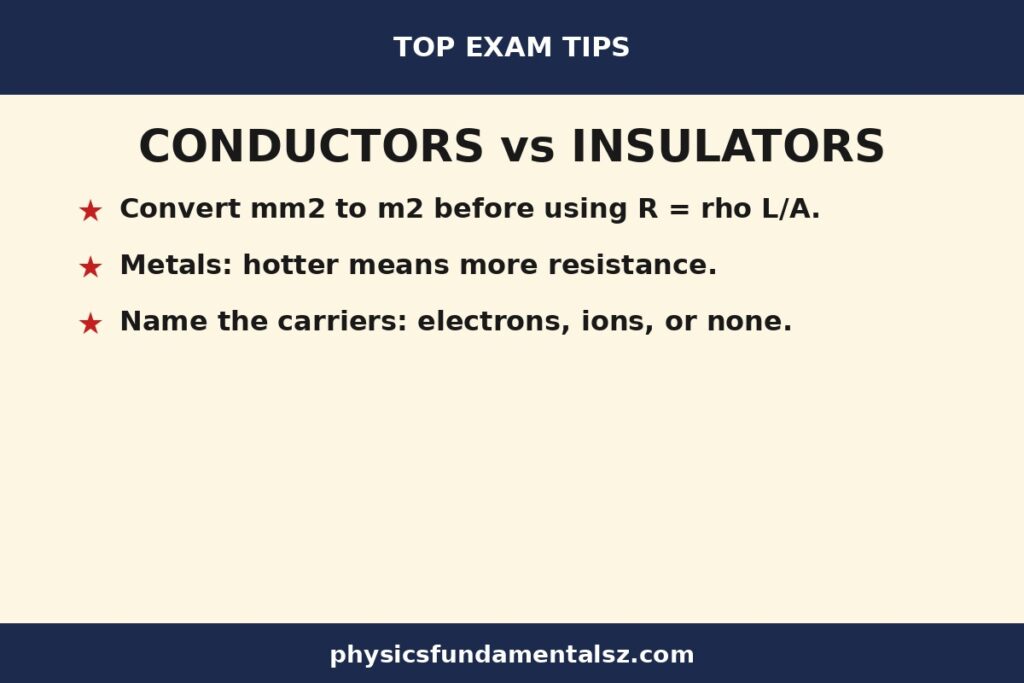
Mistake 3: Forgetting area conversion. In R = ρL/A, area must be in square metres. A cross-section given in mm² must be multiplied by 10⁻⁶. Forgetting that step gives a resistance a million times too large, which is the single most common arithmetic error on this topic.
Mistake 4: Saying insulators conduct no current at all. They conduct almost none, and they break down at high voltage. “Almost no current under normal voltages” is accurate. “Zero current, always” is not, and it fails on breakdown and leakage questions.
Mistake 5: Confusing electrical and thermal conduction. Diamond and air break the simple pairing. Always state which kind of conduction you mean. A question about a pan handle tests thermal conduction. A question about a cable tests electrical conduction.
Mistake 6: Thinking resistance depends only on material. Resistance depends on material, length, area, and temperature. Two wires of the same material can have very different resistances if their lengths or thicknesses differ. Resistivity is the material-only quantity. Resistance is the object quantity.
Expert Tips for Exams
Write the formula R = ρL/A before substituting numbers, and convert mm² to m² on the same line. That visible conversion earns method marks and prevents the million-fold error. State the resistivity value you used, especially when the question gives a choice of values.
Explain conductor behaviour with free electrons, not with vague phrases like “electricity flows easily”. An answer that names free electrons, drift, and collisions shows the model. An answer that repeats the question shows only the label. Examiners reward the model, and the model also answers follow-up questions about temperature and semiconductors.
Use band-gap language for “why” questions. Conductors have overlapping or partly filled bands. Insulators have a large gap. Semiconductors have a moderate gap. Three sentences, one per material class, cover most theory questions on this topic cleanly.
When a question asks for examples, give three of each, from different settings. Copper wire, aluminium lines, and graphite for conductors. Rubber gloves, glass insulators, and ceramic pylons for insulators. Varied examples show breadth, and they protect you if one example is judged borderline.
Check temperature answers by direction, not by number. Metals: hotter means more resistance. Insulators and semiconductors: hotter means less resistance. If your calculation shows the opposite trend for a metal, re-read the question. Direction checks catch sign and concept errors before they cost marks.
Practice Problems With Answers
Problem 1. A copper wire is 5.0 m long with area 2.0 mm². Resistivity is 1.68 × 10⁻⁸ Ω·m. Find its resistance.
Area = 2.0 × 10⁻⁶ m². R = (1.68 × 10⁻⁸ × 5.0) / (2.0 × 10⁻⁶) = 0.042 Ω. The short, thick wire has very low resistance.
Problem 2. A wire has resistance 0.50 Ω, length 4.0 m, and area 1.0 mm². Find its resistivity.
ρ = RA/L = (0.50 × 1.0 × 10⁻⁶) / 4.0 = 1.25 × 10⁻⁷ Ω·m. That is in the range of iron alloys, not copper.
Problem 3. A 2.0 m wire of area 0.50 mm² is replaced by a wire of the same material, double the length and double the area. What happens to resistance?
R = ρL/A. Doubling both L and A leaves the ratio unchanged. Resistance stays the same. Length and area effects cancel exactly.
Problem 4. A current of 3.0 A flows through a 0.20 Ω copper cable. What power is wasted as heat in the cable?
P = I²R = 9.0 × 0.20 = 1.8 W. Low resistance keeps the waste small, but over long runs the total still matters, which is why transmission uses high voltage and low current.
Frequently Asked Questions
What is the difference between a conductor and an insulator?
A conductor lets electric charge flow easily because it has free electrons. An insulator resists charge flow because its electrons are bound to atoms. Copper is a conductor. Rubber is an insulator.
Why do metals conduct electricity?
Metals conduct because their outer electrons are delocalised and form a sea of free electrons. A voltage makes those electrons drift through the lattice, carrying current. The lattice ions stay in place while the electrons move.
Is water a conductor or an insulator?
Pure water is a poor conductor. Tap water, seawater, and rainwater conduct because dissolved salts provide mobile ions. Never assume water is safe around electricity, because real water almost always contains ions.
Is wood a conductor or an insulator?
Dry wood is an insulator. Wet wood conducts, because water and dissolved salts in the wood provide mobile ions. The moisture content decides the behaviour, so a dry wooden handle is safe and a wet one may not be.
Is air a conductor or an insulator?
Air is an insulator at normal voltages. At very high voltages it breaks down and conducts, as in lightning and sparks. The breakdown field strength of air is high, which is why ordinary voltages do not spark across small air gaps.
What is the best electrical conductor?
Silver has the lowest resistivity of common metals, slightly better than copper. Copper is used far more often because it is cheaper and nearly as good. Gold is used for contacts because it resists tarnish, not because it conducts best.
What is resistivity?
Resistivity is a material property that measures how strongly a material opposes current flow, independent of shape. It is measured in ohm-metres. Low resistivity means good conduction. Resistance, by contrast, depends on the object’s length and area as well as its resistivity.
How does temperature affect conductors and insulators?
Heating a metal raises its resistance, because vibrating ions impede electron drift. Heating an insulator or semiconductor usually lowers its resistance, because thermal energy frees more charge carriers. The two classes move in opposite directions.
What is a semiconductor?
A semiconductor is a material with conductivity between a conductor and an insulator, such as silicon. Doping and temperature control its conductivity precisely. Semiconductors are the basis of diodes, transistors, and integrated circuits.
Are all metals good conductors?
All common metals conduct, but their quality varies widely. Copper and aluminium conduct well. Iron, steel, and nichrome conduct much less well. Nichrome’s higher resistance is useful in heating elements, where wasted heat is the goal.
What is dielectric breakdown?
Dielectric breakdown is the failure of an insulator under a very high electric field. Bound electrons are torn free, a conducting path forms, and current surges through. It appears as a spark in air and can permanently damage a solid dielectric.
Why are power lines not insulated like household wires?
Overhead lines use bare conductors held by ceramic insulators, with air as the main insulation. Coating kilometres of high-voltage line in plastic would be heavy, costly, and hard to cool. Distance and air gaps provide the insulation instead, which is why lines are kept high and apart.
What is a superconductor?
A superconductor is a material whose electrical resistance drops to zero below a critical temperature. It also expels magnetic fields. Superconductors are used in MRI magnets and particle accelerators, where zero resistance justifies the cooling cost.
Can an insulator become a conductor?
Yes, under extreme conditions. High voltage causes breakdown. High temperature frees carriers. Intense light or radiation can also free carriers. Under normal voltages and temperatures, however, a good insulator stays insulating for practical purposes.
Why does metal feel colder than wood?
Metal feels colder because it conducts heat away from your hand faster than wood does, even at the same temperature. The sensation measures heat flow, not temperature. Metal is a better thermal conductor, so it cools your skin faster.
What materials are used to insulate wires?
Plastic, rubber, and enamel coatings insulate most household and electronic wires. Ceramic and glass insulate high-voltage lines. Mica and fibreglass insulate high-temperature equipment. Each choice balances insulation, heat resistance, flexibility, and cost.
How do insulators protect people from electric shock?
Insulators keep live conductors away from touchable surfaces and from unintended paths to earth. Plastic cases, cable sheaths, and tool handles all place an insulating barrier between the user and the voltage. Damaged insulation removes that barrier and creates a shock risk.
What is the difference between resistance and resistivity?
Resistance is the opposition to current in a particular object, measured in ohms. Resistivity is the opposition in the material itself, measured in ohm-metres. Resistance depends on length, area, temperature, and material. Resistivity depends on material and temperature only.
Conclusion
Conductors and insulators are defined by mobile charge. Conductors have free electrons that drift under voltage. Insulators hold their electrons tightly and let almost no current through. Resistivity measures the difference, and R = ρL/A turns it into a number for any wire.
Remember the exceptions and the temperature rules. Semiconductors sit between the classes and make electronics possible. Diamond splits thermal from electrical conduction. Heating raises metal resistance and lowers insulator resistance. With the free-electron model, the tables, and the worked examples in mind, conductor and insulator questions become questions about structure, not about memorised lists.