What Is Ohm’s Law? Formula, Triangle Trick & Circuit Examples
Quick answer: Ohm’s law states that the current through a conductor is directly proportional to the voltage across it, provided the temperature stays constant. It is written as V = IR, where V is voltage in volts, I is current in amps, and R is resistance in ohms. Double the voltage and you double the current; double the resistance and you halve the current. It is the single most used equation in all of circuit physics.
Introduction
Every electronic device you own — your phone, your laptop, the lights in your room — runs on circuits, and every circuit obeys Ohm’s law. It is a short equation with an enormous reach: it tells you how much current flows when you connect a battery to a resistor, why a thin wire gets hot, why your phone charger is rated for a particular current, and how engineers choose resistor values so that delicate components do not burn out.
Ohm’s law is named after Georg Simon Ohm, a German physicist who published the relationship in 1827 after painstaking experiments with wires of different lengths and thicknesses. His result was not immediately celebrated — in fact, it was largely ignored for years — but it is now the foundation of electrical engineering and a guaranteed topic on physics exams from high school through university.
In this guide, you will learn the Ohm’s law definition, the formula V = IR and what each symbol means, the triangle trick that lets you rearrange the formula instantly, how to use Ohm’s law in series and parallel circuits, how it connects to electrical power, which materials obey Ohm’s law and which do not, and how to solve circuit problems step by step with worked examples. We will also cover the mistakes that cost students marks and how Ohm’s law appears on the AP Physics exams.
What Is Ohm’s Law? The Definition
Definition box: Ohm’s law states that the current (I) flowing through a conductor between two points is directly proportional to the voltage (V) across those two points, provided the physical conditions — especially the temperature — remain constant. The constant of proportionality is the resistance (R) of the conductor. Mathematically: V = IR.
Three quantities appear in the law, and you must know all three cold before you go further:
- Voltage (V), measured in volts (V), is the electrical potential difference across a component. Think of it as the electrical “push” that drives charges around a circuit — the energy per unit charge. A battery’s voltage rating tells you how much push it provides.
- Current (I), measured in amperes (A), often shortened to amps, is the rate of flow of electric charge past a point. One ampere is one coulomb of charge per second. Think of it as the flow rate of the electrical “river.”
- Resistance (R), measured in ohms (Ω), is the opposition a material offers to the flow of current. A long, thin wire has high resistance; a short, thick wire has low resistance. Resistance is what converts electrical energy into heat — the reason a light bulb filament glows and a phone charger warms up.
A helpful water analogy: voltage is like the pressure pushing water through a pipe, current is like the flow rate of the water, and resistance is like the narrowness of the pipe. Increase the pressure and more water flows; narrow the pipe and less water flows. The analogy is imperfect — real circuits have features water pipes do not — but for building intuition about V = IR, it is excellent.
Khan Academy introduces Ohm’s law as the relationship V = IR, noting that it applies to “ohmic” materials whose resistance stays constant (khanacademy.org). HyperPhysics gives the same relationship and emphasizes that resistance is defined by the ratio V/I (hyperphysics.phy-astr.gsu.edu). The Encyclopaedia Britannica entry on Ohm’s law records Georg Ohm’s original 1827 formulation and its central place in circuit theory (britannica.com).
The Formula: V = IR
Ohm’s law in its standard form is:
V = IR
But exam questions rarely ask for V directly. They ask for current, or for resistance, or for an unknown in a circuit you must analyze first. That means you must be able to rearrange the formula fluently, and the triangle trick makes that automatic.
The triangle trick
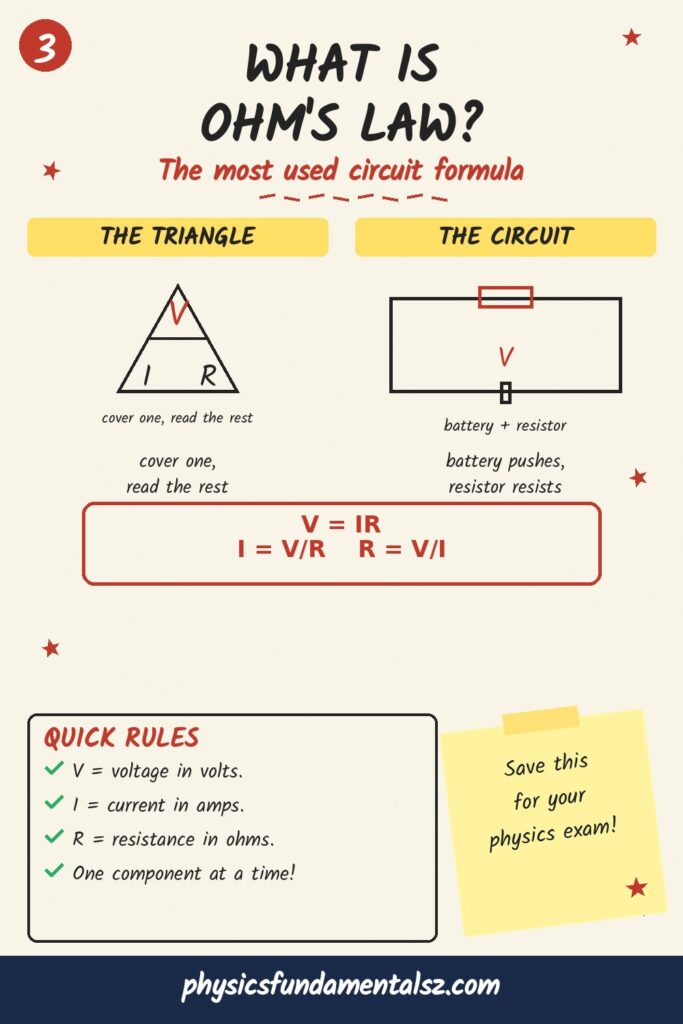
Draw a triangle divided into three sections: V on top, I and R side by side on the bottom. To find any quantity, cover it up with your finger and read off what remains:
- Cover V → you see I × R, so V = IR
- Cover I → you see V over R, so I = V/R
- Cover R → you see V over I, so R = V/I
That is the whole trick, and it is worth practising until it is automatic. In an exam, the seconds you save not rearranging algebra are seconds you can spend on the harder part of the problem — working out which voltage and which resistance belong in the formula for the component you care about. Because that, not the algebra, is where Ohm’s law problems are actually won and lost: you must apply V = IR to one component at a time, using that component’s voltage and that component’s resistance, never mixing values from different parts of the circuit.
Units check
Voltage in volts, current in amps, resistance in ohms: V = IR is consistent because one ohm is defined as one volt per ampere (1 Ω = 1 V/A). If a problem gives current in milliamps, convert first: 1 A = 1,000 mA. A 20 mA LED current is 0.020 A, and forgetting that conversion is one of the most common arithmetic errors in Ohm’s law problems. Similarly, resistances are often given in kilo-ohms: 1 kΩ = 1,000 Ω.
What Determines Resistance?
Resistance is not a mysterious property stamped on a component. It depends on the material and the geometry of the conductor, through the relationship:
R = ρL/A
Where ρ (rho) is the resistivity of the material, L is the length of the conductor, and A is its cross-sectional area. This formula explains everyday observations: a long extension cord has more resistance than a short one; a thick cable has less resistance than a thin one; copper wiring is used in homes because copper has very low resistivity.
Temperature matters too. For most metals, resistance increases as temperature rises, because the vibrating atoms get in the way of the flowing electrons more effectively. This is why Ohm’s law carries the condition “provided temperature remains constant”: if a resistor heats up significantly, its resistance changes, and the simple proportionality between V and I breaks down. A light bulb filament is the classic example — its resistance when glowing hot is many times its resistance when cold, which is why a bulb’s current is not simply proportional to the applied voltage.
Ohmic vs Non-Ohmic Conductors
Not all materials obey Ohm’s law, and the distinction is a favourite exam topic. The test is graphical: plot current against voltage for a component, and look at the shape of the graph.
Ohmic conductors
An ohmic conductor has constant resistance, so its current-voltage graph is a straight line through the origin. Double the voltage and the current doubles exactly. Metal wires at constant temperature are the standard example, as are fixed resistors used in circuits. For an ohmic conductor, the gradient of the I-V graph is 1/R, so a steeper line means a lower resistance.
Non-ohmic conductors
A non-ohmic conductor has resistance that changes with voltage, current, or temperature, so its I-V graph is curved. Examples include:
- Filament lamps: as the filament heats up, its resistance rises, so the current grows more slowly than the voltage. The I-V curve flattens at higher voltages.
- Diodes: these conduct easily in one direction and hardly at all in the other, so their I-V graph is strongly asymmetric — nearly flat for reverse voltages, then rising steeply once the forward threshold is passed.
- Thermistors: their resistance changes dramatically with temperature, which is exactly what makes them useful as temperature sensors.
- Light-dependent resistors (LDRs): their resistance falls as light intensity rises, which is why they appear in automatic street lights and camera exposure systems.
When a question asks whether a component obeys Ohm’s law, it is asking whether the I-V graph is a straight line through the origin. If it is, the component is ohmic and V = IR holds with a constant R. If it is not, V = IR can still define the resistance at a single operating point — R = V/I at that point — but you cannot assume that resistance stays the same at a different voltage.
Ohm’s Law in Series Circuits
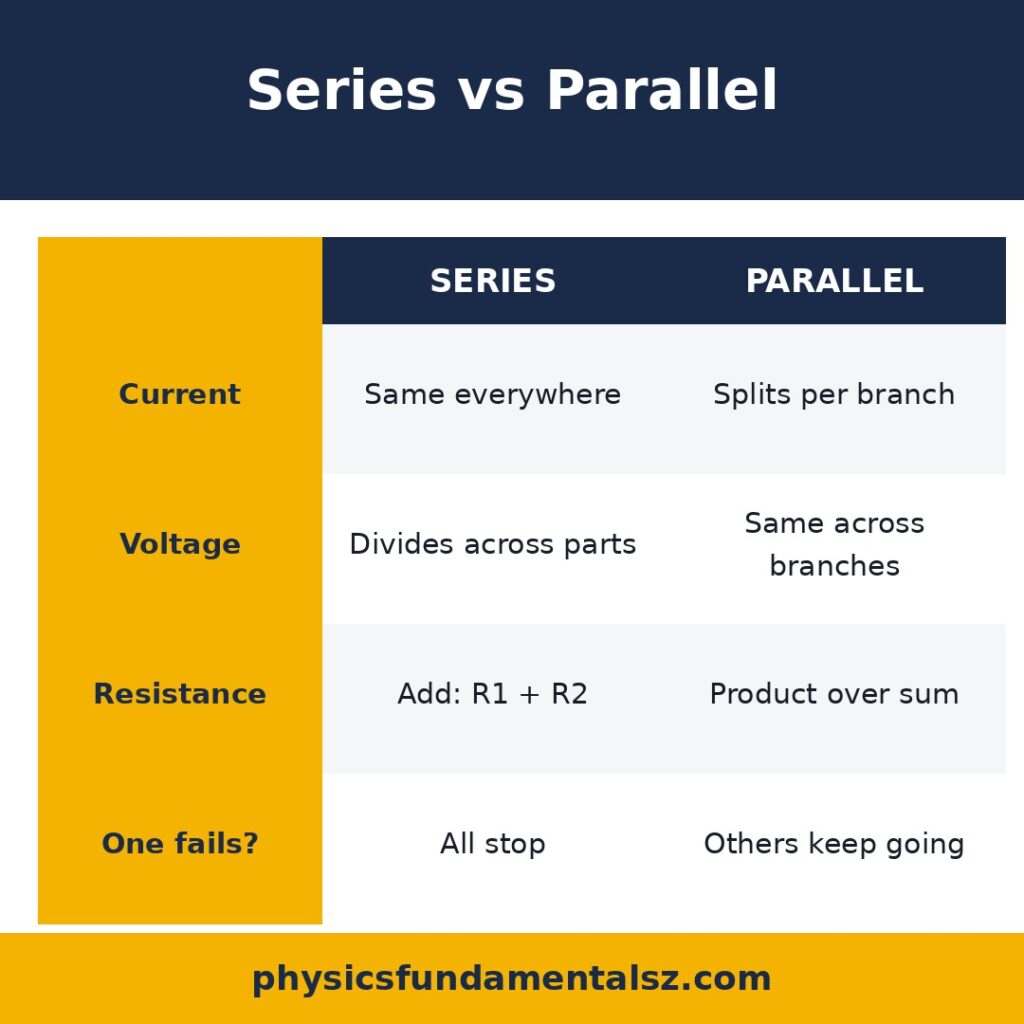
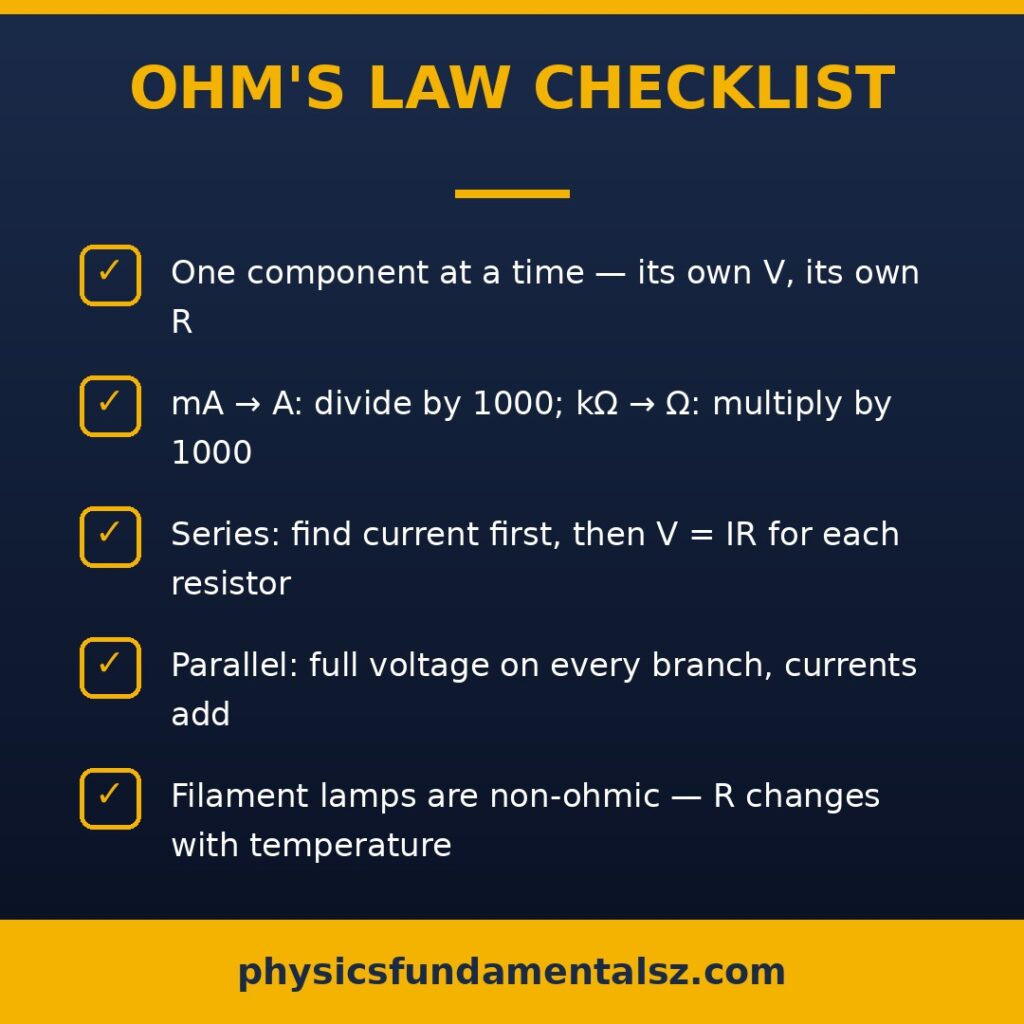
In a series circuit, components are connected end to end, so there is only one path for current. Two rules govern series circuits, and Ohm’s law ties them together:
- The current is the same everywhere. Whatever current leaves the battery flows through every component in turn.
- The voltages add up. The sum of the voltage drops across all components equals the battery voltage: V_total = V_1 + V_2 + V_3 + …
Because the current is common, the total resistance of a series circuit is simply the sum of the individual resistances: R_total = R_1 + R_2 + R_3 + … You can then find the current from I = V_total / R_total, and then find the voltage across any single component from V = IR using that component’s resistance.
Example: a 12 V battery connected to a 4 Ω resistor and an 8 Ω resistor in series. Total resistance = 12 Ω. Current = 12/12 = 1 A everywhere. Voltage across the 4 Ω resistor = 1 × 4 = 4 V; across the 8 Ω resistor = 1 × 8 = 8 V. Note that 4 + 8 = 12 V, matching the battery — a useful check that catches arithmetic errors.
Series circuits are why old strings of Christmas lights went dark entirely when one bulb failed: one break stops the current everywhere. They are also why the voltage divides across components in proportion to their resistances — the larger resistor takes the larger share of the voltage, a principle called the voltage divider, used in sensor circuits everywhere.
Ohm’s Law in Parallel Circuits
In a parallel circuit, components are connected across the same two points, so each has its own path for current. The rules invert:
- The voltage is the same across every branch. Each component sees the full battery voltage.
- The currents add up. The total current from the battery equals the sum of the currents in the branches: I_total = I_1 + I_2 + I_3 + …
Because every branch sees the same voltage, you can apply Ohm’s law to each branch independently: I_1 = V/R_1, I_2 = V/R_2, and so on. The total resistance of a parallel combination is always less than the smallest individual resistance, given by 1/R_total = 1/R_1 + 1/R_2 + 1/R_3 + … For two resistors, this simplifies to R_total = (R_1 × R_2)/(R_1 + R_2), the “product over sum” rule.
Example: a 12 V battery connected to a 4 Ω resistor and a 6 Ω resistor in parallel. Current through the 4 Ω branch = 12/4 = 3 A. Current through the 6 Ω branch = 12/6 = 2 A. Total current = 5 A. Total resistance = (4 × 6)/(4 + 6) = 2.4 Ω, and indeed 12/2.4 = 5 A. The two methods agree, as they must.
Parallel circuits are why your house wiring works: every appliance is connected in parallel across the mains voltage, so each receives the full voltage, and switching one appliance off does not affect the others. The total current drawn is the sum of the branch currents, which is why running too many high-power appliances at once can trip a breaker — the total current exceeds what the wiring can safely carry.
Ohm’s Law and Electrical Power
Ohm’s law becomes even more useful when combined with the power formula, P = VI. Substituting V = IR or I = V/R gives three equivalent forms:
- P = VI
- P = I²R
- P = V²/R
Each form suits a different situation. If you know the current through a resistor, P = I²R is the fastest route to the power it dissipates as heat. If you know the voltage across it, P = V²/R is fastest. This is why a device’s power rating matters: a resistor rated for 0.25 W will overheat and fail if the circuit forces it to dissipate more, and P = I²R tells you exactly when that happens.
Power also explains the economics of electricity transmission. Power lost as heat in a transmission line is I²R, so reducing the current dramatically reduces the loss — which is why power stations step voltage up to hundreds of thousands of volts for long-distance transmission: for the same delivered power, higher voltage means lower current, and lower current means far lower I²R losses. It is Ohm’s law, scaled up to a national grid.
Worked Examples
Example 1: Finding current
A 9 V battery is connected across a 3 Ω resistor. What current flows?
I = V/R = 9/3 = 3 A. This is the simplest possible Ohm’s law problem, and it is the template for everything that follows: identify V and R for the same component, divide.
Example 2: Finding resistance
A lamp draws 0.5 A from a 6 V battery. What is the lamp’s resistance?
R = V/I = 6/0.5 = 12 Ω. Note the division by a decimal: 6/0.5 = 12, not 3. Students frequently stumble on decimal division under exam pressure, so write the calculation out rather than doing it mentally.
Example 3: The LED resistor (a real design problem)
An LED needs 2 V and 20 mA to operate safely, and you have a 9 V battery. What series resistor should you use?
First convert: 20 mA = 0.020 A. The resistor must drop the remaining voltage: 9 − 2 = 7 V. Then R = V/I = 7/0.020 = 350 Ω. In practice you would choose the nearest standard value, 360 Ω, which is why electronics shops stock standard resistor values. This is a genuine engineering calculation, not a textbook abstraction, and it is the kind of problem that appears in project-based exam questions.
Example 4: Series circuit with a twist
A 24 V battery is connected to a 6 Ω resistor and a resistor of unknown value in series. The current is 2 A. Find the unknown resistance.
Total resistance = V/I = 24/2 = 12 Ω. Unknown resistance = 12 − 6 = 6 Ω. This example shows the standard series strategy: find the total first, then subtract what you know.
Example 5: Parallel circuit
A 12 V battery is connected to a 3 Ω resistor and a 6 Ω resistor in parallel. Find (a) the current in each branch and (b) the total current.
(a) Each branch sees the full 12 V. I_3Ω = 12/3 = 4 A. I_6Ω = 12/6 = 2 A. (b) Total current = 4 + 2 = 6 A. Check: total resistance = (3 × 6)/(3 + 6) = 2 Ω, and 12/2 = 6 A. The check confirms the answer.
Example 6: Power and heating
A 10 Ω heating element carries a current of 5 A. How much power does it dissipate as heat?
P = I²R = 25 × 10 = 250 W. If instead you were given the voltage across the element, you would use P = V²/R — choose the form that matches the quantities you know, and always check that your answer has the right order of magnitude.
Common Mistakes to Avoid
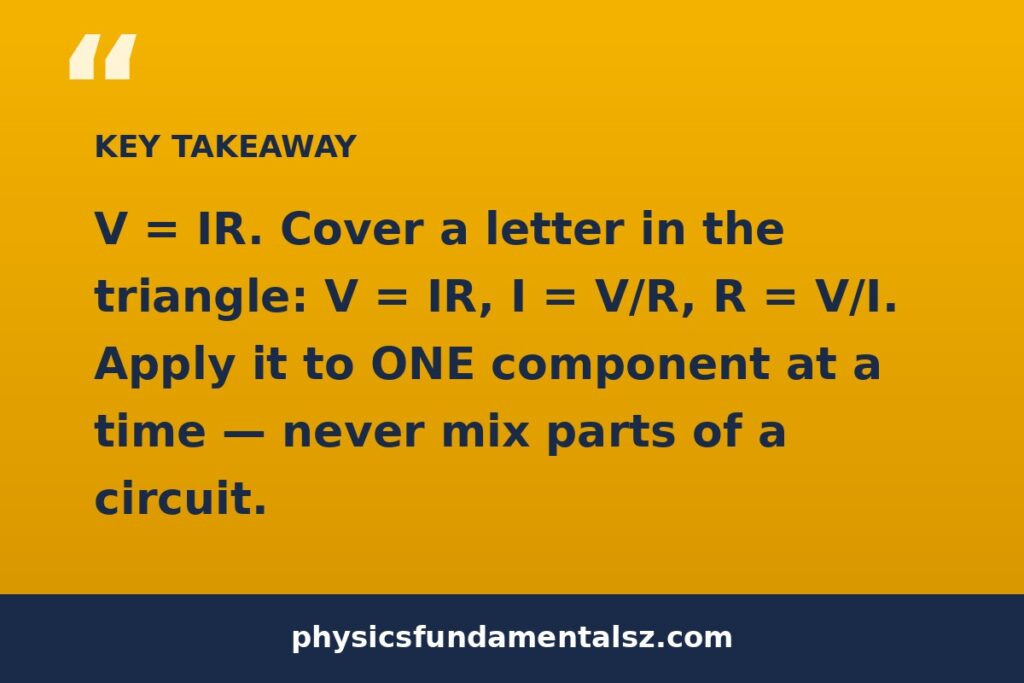
- Mixing components. Ohm’s law applies to one component at a time. Never combine the voltage across one resistor with the resistance of another.
- Forgetting unit conversions. Convert milliamps to amps (divide by 1,000) and kilo-ohms to ohms (multiply by 1,000) before calculating.
- Using total voltage for a single series resistor. In a series circuit, each resistor gets only part of the total voltage. Find the current first, then V = IR for each resistor.
- Using total current for a single parallel branch. In a parallel circuit, each branch gets only part of the total current. Use the branch’s own resistance with the full voltage.
- Assuming resistance is always constant. For filament lamps, diodes, and thermistors, resistance changes with conditions. Check whether the component is ohmic before assuming a constant R.
- Confusing the I-V graph axes. If current is on the vertical axis, the gradient is 1/R, not R. Read the axes before interpreting the gradient.
- Dropping the triangle trick under pressure. When a question asks for current, cover I in the triangle and write I = V/R immediately, rather than rearranging algebra from scratch and risking a sign or division error.
- Forgetting the temperature condition. Ohm’s law in its simple form assumes constant temperature. A resistor that heats up significantly may no longer obey it.
Ohm’s Law on the AP Physics Exams
Ohm’s law appears in AP Physics 1 Unit 9 (Electric Charge and Electric Force) and dominates AP Physics 2 Unit 10 (Electric Circuits). In AP Physics 1, expect simple V = IR calculations and qualitative questions about how changing resistance affects current. In AP Physics 2, expect full circuit analysis: series and parallel combinations, internal resistance of batteries, power dissipation, and questions that combine Ohm’s law with Kirchhoff’s rules for circuits that cannot be reduced by simple series-parallel steps.
A reliable exam strategy: redraw the circuit if it helps, label every known voltage, current, and resistance, and then work systematically — combine series and parallel sections step by step, find the total resistance, find the total current, and then work backward to individual components. Students who jump straight to a formula without labelling the circuit are the ones who mix up components. And remember that AP free-response questions award credit for correct method even when the final number is wrong, so always show the formula, the substitution, and the unit.
Internal Resistance: Why Real Batteries Are Not Perfect
So far we have treated batteries as ideal voltage sources, but real batteries have internal resistance — a small resistance inside the battery itself, caused by the chemicals and materials of its construction. When current flows, some of the battery’s voltage is “lost” across this internal resistance, so the voltage actually delivered to the external circuit — the terminal voltage — is less than the battery’s electromotive force (emf).
The relationship is: terminal voltage = emf − Ir, where r is the internal resistance and I is the current. A fresh AA battery might have an internal resistance of around 0.1 Ω, which matters little for a small torch but matters a great deal for a starter motor drawing hundreds of amps. This is why a nearly flat car battery can still show 12 V on a voltmeter when nothing is connected, yet fail to start the engine: under load, the large current multiplied by the internal resistance drops the terminal voltage below what the starter needs.
Internal resistance also explains why batteries warm up during heavy use and why short-circuiting a battery is dangerous. A short circuit connects the terminals with almost zero external resistance, so the current is limited only by the small internal resistance — and P = I²r means that energy is dissipated as heat inside the battery itself, which can cause swelling, leaking, or fire. Exam questions on internal resistance usually give the emf, the internal resistance, and an external resistor, and ask for the current (I = emf / (R + r)) and the terminal voltage. The method is identical to series circuit analysis, with the internal resistance simply treated as one more resistor in series.
Ohm’s Law Beyond Simple DC Circuits
Ohm’s law as stated here applies to direct current (DC) circuits with steady voltages. In alternating current (AC) circuits, voltages and currents vary sinusoidally, and components such as capacitors and inductors oppose current in ways that depend on frequency. Physicists generalize resistance to impedance, denoted Z, and write V = IZ for AC circuits. The core idea survives — voltage, current, and opposition to current remain linked by a proportional relationship — but the opposition now has both a resistive part and a reactive part, and the voltage and current may be out of phase with each other.
For the level of AP Physics 1 and 2, and for most practical DC electronics work, V = IR is sufficient. But knowing that the law generalizes helps you read datasheets and engineering discussions without confusion: when an engineer talks about the impedance of a speaker (8 Ω, for example), they are using the AC generalization of exactly the resistance concept you have learned here. The intuition you built with the water analogy — push, flow, and narrowness — carries over intact.
Frequently Asked Questions
1. What is Ohm’s law in simple words?
Ohm’s law says that current through a conductor is proportional to the voltage across it: double the voltage, double the current, as long as temperature stays constant.
2. What is the formula for Ohm’s law?
V = IR, where V is voltage in volts, I is current in amps, and R is resistance in ohms. Rearranged: I = V/R and R = V/I.
3. What is the Ohm’s law triangle?
A triangle with V on top and I and R on the bottom. Cover the quantity you want to find, and the remaining symbols show the formula: cover V to get IR, cover I to get V/R, cover R to get V/I.
4. Who discovered Ohm’s law?
Georg Simon Ohm, a German physicist, published the relationship in 1827 after experiments with metal wires of different lengths and thicknesses.
5. What is the unit of resistance?
The ohm, symbol Ω. One ohm equals one volt per ampere (1 Ω = 1 V/A).
6. What is voltage?
Voltage is the electrical potential difference between two points — the energy per unit charge available to drive current around a circuit. It is measured in volts.
7. What is current?
Current is the rate of flow of electric charge past a point, measured in amperes. One ampere equals one coulomb per second.
8. Does Ohm’s law apply to all materials?
No. It applies exactly to ohmic conductors, such as metal wires at constant temperature. Non-ohmic components like filament lamps, diodes, and thermistors have resistances that change with conditions.
9. What happens to current if resistance doubles?
It halves, provided the voltage stays the same, because I = V/R.
10. What happens to current if voltage doubles?
It doubles, provided the resistance stays the same, because I = V/R.
11. How do you calculate resistance in a series circuit?
Add the individual resistances: R_total = R_1 + R_2 + R_3 + … The current is the same through every component.
12. How do you calculate resistance in a parallel circuit?
Use 1/R_total = 1/R_1 + 1/R_2 + … For two resistors, R_total = (R_1 × R_2)/(R_1 + R_2). The voltage is the same across every branch.
13. What is the power formula using Ohm’s law?
P = VI = I²R = V²/R. Use whichever form matches the quantities you know.
14. Why does a filament lamp not obey Ohm’s law?
Because its filament heats up as current flows, and its resistance rises with temperature. Its current-voltage graph is a curve, not a straight line.
15. What is resistivity?
Resistivity (ρ) is a property of a material that determines how strongly it opposes current flow. Resistance is calculated from it as R = ρL/A, where L is length and A is cross-sectional area.
16. How do you convert milliamps to amps?
Divide by 1,000. For example, 20 mA = 0.020 A. Always convert before using V = IR.
17. Why is electricity transmitted at high voltage?
Because power lost as heat in a line is I²R. Higher voltage delivers the same power at lower current, which dramatically reduces the I²R loss.
18. What is the difference between voltage and current?
Voltage is the push that drives charges; current is the flow of charges that results. Voltage is measured across a component, while current is measured through it.
Conclusion
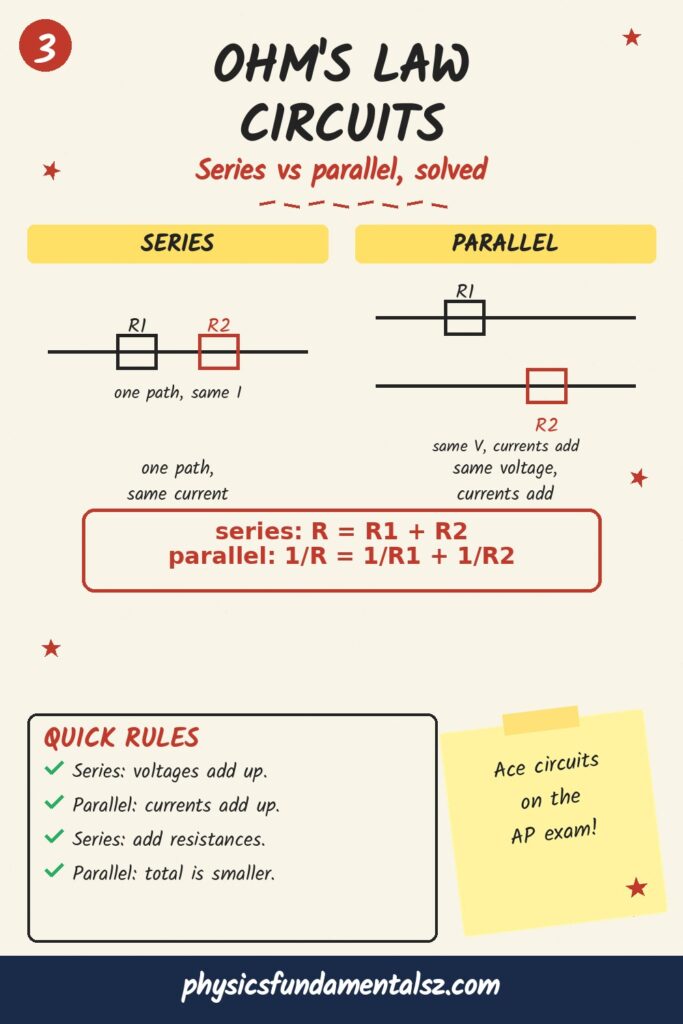
Ohm’s law is short, but it is the key to every circuit you will ever meet. V = IR tells you how voltage, current, and resistance balance each other; the triangle trick lets you rearrange it instantly; series and parallel rules tell you how to apply it to real circuits; and the power formulas tell you what happens to the energy. Master the habit of applying the law to one component at a time, with that component’s own voltage and resistance, and circuit problems stop being intimidating and start being routine.
Keep Learning
- What Is Kinetic Energy? Formula, Examples & Everyday Uses — energy ideas return in circuits: electrical energy becomes heat, light, and motion.
- Speed vs Velocity: Differences, Formulas & Solved Examples — current is a rate of flow, and the speed-versus-velocity distinction sharpens how you think about rates.
- What Is Torque in Physics? Formula, Examples & How to Calculate It — motors turn electrical energy into torque, connecting circuits to rotation.
- Difference Between Work and Power in Physics — electrical power P = VI is the same power concept, applied to circuits.
- Elastic vs Inelastic Collision Difference — conservation laws in collisions mirror the conservation of charge and energy in circuits.