Coulomb’s Law Explained: A Complete Guide With Formula and Examples
Rub a balloon on your hair and hold it near a wall. It sticks, defying gravity, with no glue and no magnet. Two small charges, invisible to the eye, hold it in place.
The force behind that trick is electrostatic force. Coulomb’s law describes it exactly: how strong it is, which way it points, and how it changes with charge and distance.
This guide explains Coulomb’s law in plain language. You will learn the formula, the constant, the inverse-square pattern, and the link to electric field. You will work through examples, compare the force with gravity, and learn the mistakes that cost exam marks.
By the end, you will be able to calculate the force between any two point charges, state whether it attracts or repels, and explain why doubling distance quarters the force.
Quick Answer: What Is Coulomb’s Law?
Coulomb’s law states that the electrostatic force between two point charges is directly proportional to the product of their charges and inversely proportional to the square of the distance between them.
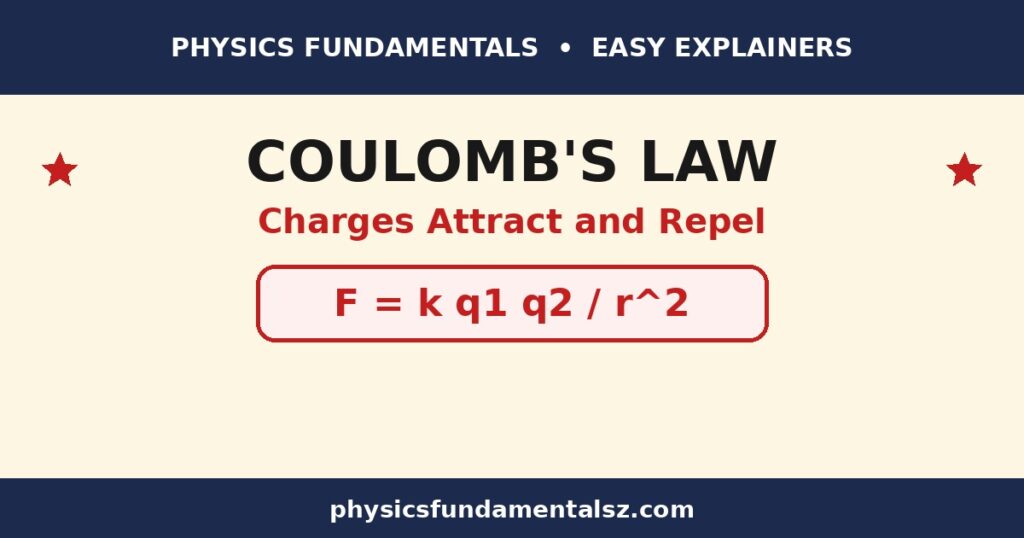
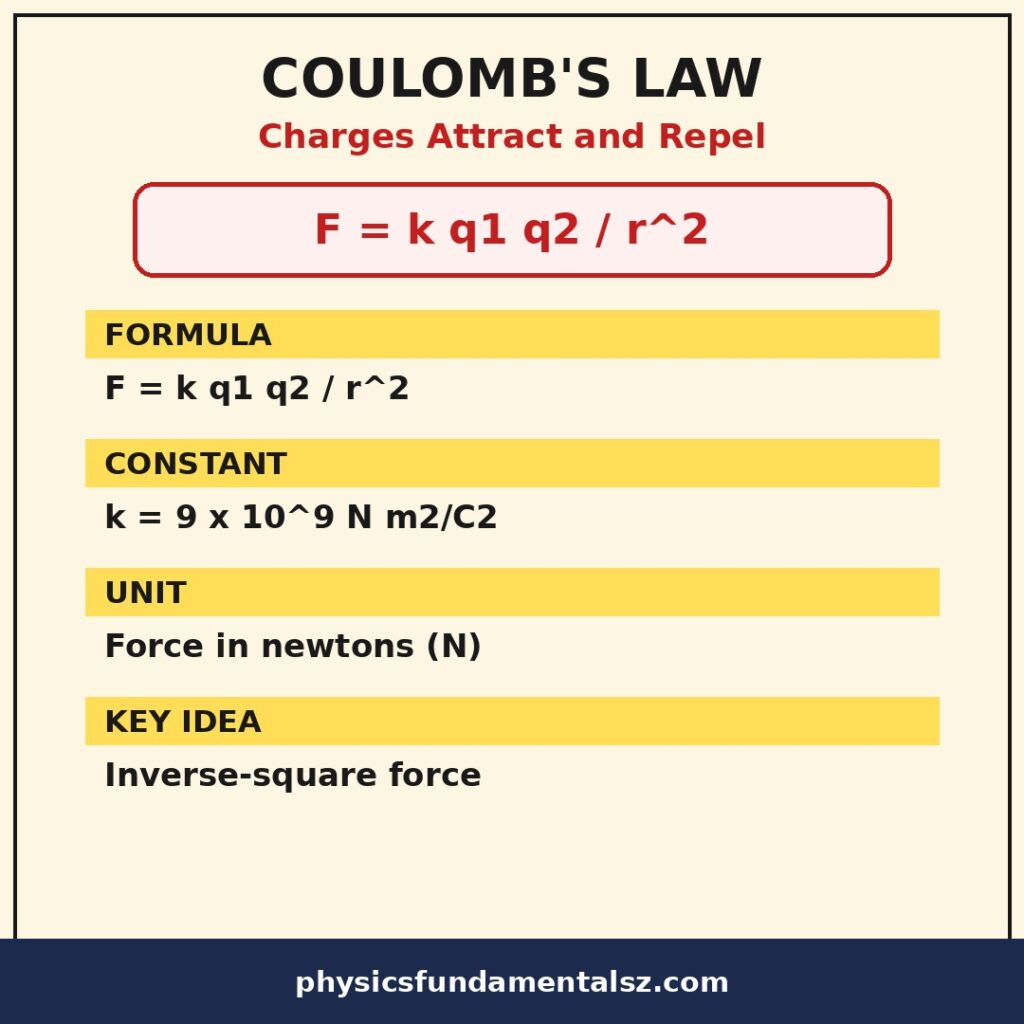
The formula is F = kq₁q₂ / r². Here F is the force in newtons, q₁ and q₂ are the charges in coulombs, r is the separation in metres, and k is Coulomb’s constant, about 8.99 × 10⁹ N·m²/C².
Like charges repel each other. Unlike charges attract each other. The force acts along the line joining the charges, and it obeys Newton’s third law: the force on each charge is equal in size and opposite in direction.
Definition Box — Coulomb’s Law: Coulomb’s law gives the magnitude of the electrostatic force between two stationary point charges. The force is proportional to the product of the charges and inversely proportional to the square of their separation. It acts along the line joining the two charges.
Definition Box — Point Charge: A point charge is an idealised charge concentrated at a single point, with no size. Real charged objects behave like point charges when their separation is much larger than their size. Outside a uniformly charged sphere, the charge acts as if concentrated at the centre.
Definition Box — Coulomb’s Constant: Coulomb’s constant, k, sets the strength of the electrostatic force in a vacuum. Its value is about 8.99 × 10⁹ N·m²/C², often rounded to 9 × 10⁹ N·m²/C² in school problems. It equals 1 / (4πε₀), where ε₀ is the permittivity of free space.
Key Takeaways
- Coulomb’s law: F = kq₁q₂ / r², for two point charges.
- Force grows with the product of the charges: double one charge, double the force.
- Force falls with the square of distance: double the distance, quarter the force.
- Like charges repel; unlike charges attract. The force is always along the line joining the charges.
- Coulomb’s constant k is about 8.99 × 10⁹ N·m²/C² in a vacuum.
- Charge is measured in coulombs (C); one coulomb is a very large charge in everyday terms.
- Electrostatic force is a vector and obeys Newton’s third law: equal, opposite, and acting on different charges.
- A charge creates an electric field; another charge in that field feels a force, F = qE.
- The inverse-square pattern also appears in gravity, light intensity, and sound intensity.
- Sign errors are the most common mistake: use magnitudes for size, then decide direction from the charge signs.
Electric Charge: The Starting Point
Electric charge is a fundamental property of matter. Protons carry positive charge. Electrons carry negative charge. Neutrons carry no charge. Ordinary matter is neutral overall because positive and negative charges balance.
Charge comes in discrete units. The smallest free charge is the elementary charge, e, about 1.602 × 10⁻¹⁹ C. Every charge in nature is a whole-number multiple of e, although macroscopic charges are so large that they look continuous.
Charge is conserved. It cannot be created or destroyed, only moved from one place to another. Rubbing a balloon transfers electrons from hair to balloon, or the reverse, leaving one object positive and the other negative by the same amount. The total charge before and after is unchanged.
Charge is measured in coulombs. One coulomb is the charge carried by a current of one ampere in one second. It is an enormous amount of elementary charge: about 6.24 × 10¹⁸ electrons. Laboratory charges in Coulomb’s law problems are usually microcoulombs (μC) or nanocoulombs (nC), because coulomb-sized charges would produce enormous forces.
Positive, Negative, and Neutral
The signs “positive” and “negative” for charge are conventions, set by Benjamin Franklin long before electrons were discovered. They are labels, not value judgements. What matters is that opposite signs attract and same signs repel.
An object with more protons than electrons is positively charged. An object with more electrons than protons is negatively charged. An object with equal numbers is neutral, even though it contains huge numbers of both kinds of charge.
Neutral does not mean inert. A neutral object can be polarised: its charges shift slightly in an electric field, creating a temporary attraction. That is why a charged balloon sticks to a neutral wall. The wall’s charges rearrange, bringing opposite charge closer to the balloon.
Triboelectric charging, or charging by rubbing, is the oldest known way to separate charge. Different materials hold electrons with different strengths. Rubbing two materials together transfers electrons from the weaker holder to the stronger one. The triboelectric series ranks materials by this tendency, from strongly positive to strongly negative.
The History of Coulomb’s Law
Charles-Augustin de Coulomb published the law in 1785, after a series of careful experiments with a torsion balance. The instrument was sensitive enough to measure the tiny forces between charged spheres, and it let Coulomb vary charge and distance systematically.
Coulomb’s torsion balance hung a charged sphere from a fine wire. A second charged sphere was brought near it, and the electrostatic force twisted the wire. The angle of twist, measured with great care, gave the force. Repeating the experiment at different separations revealed the inverse-square pattern.
The result echoed Newton’s law of gravitation, published a century earlier. Both laws are inverse-square laws. Both involve a product of two quantities divided by distance squared. The parallel is not a coincidence: both describe forces that spread through space from a source.
Coulomb also verified that the force depends on the product of the charges, not on either charge alone. Doubling one charge doubled the force. Doubling both quadrupled it. Halving a charge, by sharing it with an identical neutral sphere, halved the force. Each prediction matched the torsion balance readings.
Coulomb’s Law: The Formula in Detail
The full statement of Coulomb’s law, including direction, is best written in vector form. For school and AP Physics, the magnitude form plus a direction rule is usually enough. Learn both, and use whichever the question requires.
Magnitude Form
The magnitude of the electrostatic force between two point charges is:
F = k |q₁q₂| / r²
The modulus signs remind you to use charge magnitudes for the size of the force. The direction is decided separately, from the signs: like charges repel, unlike charges attract.
Coulomb’s constant in a vacuum is k = 8.99 × 10⁹ N·m²/C². In air, the value is almost identical, so school problems use the vacuum value for air as well. In other materials, the force is weaker, because the material polarises and partially screens the charges. The constant is then replaced by k / εᵣ, where εᵣ is the relative permittivity of the material.
Check the units: N·m²/C² times C² divided by m² gives newtons. The unit check confirms the formula is dimensionally consistent. Any answer in other units signals a substitution error.
Vector Form and Direction
In vector form, the force on charge q₁ due to charge q₂ is F = kq₁q₂ / r² times the unit vector pointing from q₂ to q₁. The signs of the charges decide the direction automatically: a positive product gives a force in the outward direction, repulsion, and a negative product gives attraction.
For two charges, the direction rule is simple. Draw a line between them. If the charges have the same sign, each force points away from the other charge. If the signs differ, each force points toward the other charge. The two forces are equal in size and opposite in direction, as Newton’s third law requires.
With three or more charges, direction becomes a vector addition problem. Calculate the force from each pair separately, resolve each into components, and add the components. Never add magnitudes directly when directions differ. The net force is the vector sum, and its direction follows from the components.
What the Formula Tells You: Proportionality
Proportionality statements let you answer many questions without full calculations. If one input changes by a known factor, the force changes by a predictable factor. Examiners test this reasoning directly, often without numbers.
Changing the Charges
Force is proportional to the product q₁q₂. Doubling q₁ doubles the force. Doubling q₂ also doubles the force. Doubling both multiplies the force by four. Halving one charge halves the force. Tripling one charge and halving the other multiplies the force by 3/2.
These statements assume distance stays fixed. If distance also changes, combine the factors: multiply the charge factor by the distance factor. A systematic approach, factor by factor, prevents the most common proportionality errors.
Signs affect direction, not magnitude, in the proportionality. A product of +2 μC and −3 μC has the same force magnitude as +2 μC and +3 μC at the same distance. The first pair attracts, the second repels, but the sizes are equal.
Changing the Distance: The Inverse-Square Law
Force is inversely proportional to r². Doubling distance divides force by four. Tripling distance divides force by nine. Halving distance multiplies force by four. Moving to one tenth of the distance multiplies force by one hundred.
The square makes distance the most powerful variable in the formula. Small distance changes produce large force changes at close range. At large distances, the force falls rapidly toward zero, although it never quite reaches zero at any finite distance.
A table makes the pattern memorable. At relative distance 1, force is 1. At distance 2, force is 1/4. At distance 3, force is 1/9. At distance 4, force is 1/16. At distance 10, force is 1/100. The pattern is exact, and it appears in every inverse-square law in physics.
| Relative distance | Relative force |
|---|---|
| 1 | 1 |
| 2 | 1/4 |
| 3 | 1/9 |
| 4 | 1/16 |
| 5 | 1/25 |
| 10 | 1/100 |
Combining Changes
Real problems often change charge and distance together. Handle them one at a time. First find the charge factor: new product divided by old product. Then find the distance factor: (old distance / new distance)². Multiply the two factors to get the total force factor.
Example: charges double and distance doubles. Charge factor is 2, distance factor is (1/2)² = 1/4, total factor is 1/2. The force halves. Example: one charge triples and distance halves. Charge factor is 3, distance factor is 2² = 4, total factor is 12. The force grows twelvefold.
This factor method is faster than full recalculation and less prone to arithmetic error. It also shows understanding, which is what proportionality questions reward. Write the factors explicitly in your working so the examiner sees the reasoning.
Coulomb’s Law and Electric Field
Coulomb’s law describes the force between two charges. Electric field describes the influence of one charge on the space around it, whether or not a second charge is present. The two ideas are two views of the same physics.
Electric Field of a Point Charge
The electric field E at a distance r from a point charge Q is:
E = kQ / r²
The field points away from a positive charge and toward a negative charge. Its unit is newtons per coulomb (N/C), which is the same as volts per metre (V/m). The field is a vector, with magnitude and direction at every point in space.
The formula is Coulomb’s law with one charge removed. If a test charge q is placed in the field, it feels a force F = qE. Substituting E gives F = kQq / r², which is Coulomb’s law again. Field and force are consistent by construction.
Field strength follows the same inverse-square pattern as force. Double the distance from a point charge and the field quarters. Double the source charge and the field doubles. The field concept separates the source from the test charge, which makes multi-charge problems easier to organise.
Our guide to how to calculate the electric field between two charges works through field calculations in detail, including the vector addition needed when two fields overlap. Read it alongside this guide for the complete field picture.
Superposition: Adding Fields and Forces
Electric fields and forces obey superposition: the total field or force is the vector sum of the individual contributions. Each charge contributes as if the others were absent, and the contributions add as vectors.
For two charges, calculate each field or force separately, resolve into x and y components, add the components, and find the resultant magnitude and direction. At the midpoint between equal opposite charges, the fields point the same way and add. At the midpoint between equal like charges, the fields point opposite ways and cancel.
Superposition is what makes Coulomb’s law powerful. It extends a two-charge law to any arrangement of charges, from dipoles to charged plates to atoms. The principle holds because electrostatic forces are linear: doubling a source charge doubles its contribution, with no interaction between contributions.
Britannica explains superposition and field lines in its article on electric field. The field-line pictures there are worth studying, because they make vector addition visual and intuitive.
Worked Examples: Coulomb’s Law Calculations
Worked examples show the full method: convert units, write the formula, substitute, calculate, and decide direction. Unit conversion is the step students most often skip, and it is the step that causes the largest errors, because microcoulombs are a million times smaller than coulombs.
Example 1: Two Small Positive Charges
Question: Two point charges, q₁ = +2 μC and q₂ = +3 μC, are 0.10 m apart in a vacuum. Calculate the magnitude of the electrostatic force between them and state whether it is attractive or repulsive. Use k = 9 × 10⁹ N·m²/C².
Solution:
Convert charges: 2 μC = 2 × 10⁻⁶ C, 3 μC = 3 × 10⁻⁶ C.
F = kq₁q₂ / r² = 9 × 10⁹ × (2 × 10⁻⁶) × (3 × 10⁻⁶) / (0.10)² = 9 × 10⁹ × 6 × 10⁻¹² / 0.01 = 0.054 / 0.01 = 5.4 N.
The force is 5.4 N, repulsive, because both charges are positive. Each charge feels 5.4 N away from the other.
Check: The unit is newtons, correct for force. The size is plausible for microcoulomb charges at 10 cm: small charges, small distance, moderate force. Forgetting the micro conversion would inflate the answer by a factor of 10¹².
Example 2: Opposite Charges
Question: A charge of +4 μC and a charge of −6 μC are 0.20 m apart. Calculate the force magnitude and state its nature.
Solution:
F = 9 × 10⁹ × (4 × 10⁻⁶) × (6 × 10⁻⁶) / (0.20)² = 9 × 10⁹ × 24 × 10⁻¹² / 0.04 = 0.216 / 0.04 = 5.4 N.
The force is 5.4 N, attractive, because the charges have opposite signs. Each charge is pulled toward the other with 5.4 N.
Check: The magnitude uses charge sizes only; the negative sign decides direction, not size. The same magnitudes with the same signs would give the same 5.4 N, but repulsive. Direction and magnitude are separate decisions.
Example 3: Finding the Separation
Question: Two charges of +5 μC each repel with a force of 2.25 N. How far apart are they? Use k = 9 × 10⁹ N·m²/C².
Solution:
Rearrange F = kq₁q₂ / r² to give r² = kq₁q₂ / F = 9 × 10⁹ × 25 × 10⁻¹² / 2.25 = 0.225 / 2.25 = 0.10. So r = √0.10 ≈ 0.316 m.
The charges are about 0.32 m apart.
Check: Rearranging before substituting keeps the algebra clean. The answer is in metres, correct for distance. A larger force would mean a smaller separation, which matches the inverse-square pattern.
Example 4: Finding a Charge
Question: A known charge of +2 μC exerts a force of 3.6 N on an unknown charge 0.15 m away. What is the unknown charge? Use k = 9 × 10⁹ N·m²/C².
Solution:
Rearrange to give q₂ = Fr² / (kq₁) = 3.6 × (0.15)² / (9 × 10⁹ × 2 × 10⁻⁶) = 3.6 × 0.0225 / 18,000 = 0.081 / 18,000 = 4.5 × 10⁻⁶ C.
The unknown charge has magnitude 4.5 μC. Its sign cannot be determined from the force magnitude alone; the direction of the force would tell you whether it is positive or negative.
Check: The answer is in coulombs, converted sensibly to microcoulombs. The magnitude is plausible: a few microcoulombs at 15 cm producing a few newtons is consistent with Examples 1 and 2.
Example 5: Doubling Distance
Question: Two charges exert a force of 12 N at a separation of 0.05 m. What is the force if the separation is increased to 0.10 m, with charges unchanged?
Solution:
Distance doubles, so force quarters: 12 / 4 = 3 N. No full recalculation is needed.
Check: The factor method is exact for inverse-square laws. Full calculation would give the same result, with more arithmetic and more room for error. Use factors whenever only ratios are asked for.
Example 6: Three Charges on a Line
Question: Charges A (+3 μC), B (−2 μC), and C (+3 μC) lie on a straight line. A and B are 0.10 m apart, and B and C are 0.10 m apart, with B in the middle. Calculate the net force on B.
Solution:
Force from A on B: A is positive, B is negative, so attraction. F = 9 × 10⁹ × (3 × 10⁻⁶) × (2 × 10⁻⁶) / (0.10)² = 5.4 N toward A, to the left if A is on the left.
Force from C on B: C is positive, B is negative, so attraction. Same magnitudes and same distance give 5.4 N toward C, to the right.
The two forces are equal and opposite, so the net force on B is zero. B is in equilibrium under electrostatic forces, although the equilibrium is unstable: a small displacement toward either charge increases that attraction and decreases the other.
Check: Vector addition, not magnitude addition, gives the answer. Adding magnitudes would wrongly give 10.8 N. Direction decides whether forces add or cancel, and here they cancel exactly.
Example 7: Electric Field From Coulomb’s Law
Question: Calculate the electric field 0.30 m from a point charge of +6 μC, and the force on a +2 μC test charge placed there.
Solution:
E = kQ / r² = 9 × 10⁹ × 6 × 10⁻⁶ / (0.30)² = 0.054 / 0.09 = 600 N/C, away from the positive source charge.
Force on the test charge: F = qE = 2 × 10⁻⁶ × 600 = 1.2 × 10⁻³ N, away from the source.
Check: Direct Coulomb calculation gives the same force: F = 9 × 10⁹ × 6 × 10⁻⁶ × 2 × 10⁻⁶ / 0.09 = 1.2 × 10⁻³ N. The field method and the direct method agree, as they must.
Coulomb’s Law vs Newton’s Law of Gravitation
Coulomb’s law and Newton’s law of universal gravitation are strikingly similar. Both are inverse-square laws. Both involve a product divided by distance squared. Both act along the line joining the bodies. The differences are equally instructive.
Gravitation is always attractive. Mass is always positive, so the product of masses is always positive, and the force always pulls. Electrostatic force can attract or repel, because charge comes in two signs. This sign difference changes the behaviour of the two forces completely.
Gravitation is extremely weak compared with electromagnetism for individual particles, for individual particles. Yet gravity dominates the large-scale universe, because mass always adds up, while positive and negative charges usually cancel in neutral matter. A planet has enormous mass and almost no net charge, so gravity wins at planetary scales.
Both forces are conservative. Work done against either force is stored as potential energy, and the energy depends only on start and end positions. Gravitational potential energy near Earth is mgh; electrostatic potential energy follows a similar 1/r pattern, with electric potential playing the role of gravitational potential.
Our guide to Newton’s law of universal gravitation explains the gravitational side in full. Comparing the two guides side by side is one of the best ways to learn both laws, because each clarifies the other.
| Feature | Coulomb’s Law | Newton’s Gravitation |
|---|---|---|
| Formula | F = kq₁q₂ / r² | F = Gm₁m₂ / r² |
| Constant | k ≈ 9 × 10⁹ N·m²/C² | G ≈ 6.67 × 10⁻¹¹ N·m²/kg² |
| Source quantity | Charge (C) | Mass (kg) |
| Signs | Two signs: + and − | One sign: mass always + |
| Attract or repel | Both possible | Attract only |
| Relative strength | Very strong for particles | Very weak for particles |
| Field | Electric field, N/C | Gravitational field, N/kg |
| Potential | Electric potential, V | Gravitational potential, J/kg |
Coulomb’s Law in Real Life and Technology
Electrostatic forces shape technology at every scale, from photocopiers to particle accelerators. Coulomb’s law is the quantitative tool behind each application, even when the devices themselves look nothing like charged spheres.
Static Electricity in Everyday Life
Lightning is Coulomb’s law on a grand scale. Charge separates inside thunderclouds, building enormous potential differences between cloud and ground. When the electric field exceeds the breakdown strength of air, a discharge channel forms, and the stored energy releases as lightning. The flash, thunder, and heat are all energy conversions from the initial charge separation.
Photocopiers and laser printers use controlled static charge. A drum is charged, light discharges selected areas, toner particles with opposite charge stick to the charged pattern, and heat fuses the toner to paper. Every step is an application of attraction and repulsion between charges.
Air purifiers and electrostatic precipitators charge dust particles and collect them on oppositely charged plates. Power stations use precipitators to remove ash from exhaust gases. The same principle cleans air in homes and factories, with Coulomb’s law setting the collection force.
Common Mistakes to Avoid
Coulomb’s law mistakes follow a short list of patterns. Learn them now, and check for each one before submitting an answer. Most lost marks in this topic come from the list below, not from misunderstanding the law itself.
Mistake 1: Forgetting Unit Conversions
Charges are usually given in microcoulombs or nanocoulombs, but the formula needs coulombs. Forgetting to convert inflates the answer by 10⁶ or 10⁹, and squaring errors in multi-charge problems make it worse. Distances in centimetres must also become metres before squaring.
Fix: convert first, write the converted values in your working, and check the powers of ten. Write “2 μC = 2 × 10⁻⁶ C” explicitly. The conversion is then visible and checkable.
Mistake 2: Using Distance Instead of Distance Squared
The formula divides by r², not r. Using r alone understates the distance effect and gives a wrong force, especially when distance changes are the focus of the question. Doubling distance must quarter the force, not halve it.
Fix: write r² in the formula before substituting numbers, and square the distance value explicitly. If your proportionality check says doubling distance halves the force, you forgot the square.
Mistake 3: Sign Errors in Magnitude and Direction
Using signed charges in the magnitude formula can give a negative force, which students then report as a negative size. Force magnitude is always positive. The signs decide direction, which is reported separately as attractive or repulsive, or as a vector direction.
Fix: take magnitudes for the calculation, then state direction in words or with a vector. Write “F = 5.4 N, attractive” rather than “F = −5.4 N.” In vector calculations, keep signs in the components, where they belong.
Mistake 4: Adding Forces as Scalars
With three or more charges, forces point in different directions. Adding their magnitudes gives a wrong net force. Forces add as vectors: resolve into components, add components, then find the resultant.
Fix: draw a diagram with arrows for each force. Resolve along x and y axes. Add the components separately. The net force magnitude follows from Pythagoras, and its direction from the component ratio.
Mistake 5: Confusing Force, Field, and Potential
Force is measured in newtons and acts on a specific charge. Field is measured in N/C and exists whether or not a test charge is present. Potential is measured in volts and is a scalar energy per charge. Swapping them gives wrong units and wrong numbers.
Fix: check units at the end of every calculation. Newtons mean force, N/C means field, volts mean potential. The unit check catches most confusions immediately.
Mistake 6: Treating Extended Objects as Point Charges
Coulomb’s law in its simple form applies to point charges, or to spheres outside which the charge acts from the centre. Inside a charged sphere, or close to an extended object, the field pattern differs. Applying the point-charge formula inside a conductor or inside a charged sphere gives wrong answers.
Fix: ask whether the separation is much larger than the object size. If it is, the point-charge approximation is valid. If not, the problem will usually give a different model, such as a uniformly charged sphere or an infinite sheet, with its own field formula.
Mistake 7: Assuming the Force Acts on One Charge Only
Coulomb’s law describes a pair interaction. The force on each charge is equal and opposite. Students sometimes calculate the force on one charge and forget the other, or double the force by adding both together as if they acted on one object.
Fix: state both forces explicitly: “force on q₁ is 5.4 N toward q₂; force on q₂ is 5.4 N toward q₁.” Newton’s third law is built into Coulomb’s law, and stating both forces shows you understand the pair.
Expert Tips for Exams
Start with a diagram. Draw the charges, label their signs and sizes, mark the separation, and draw force arrows. A diagram prevents most direction errors, because attraction and repulsion become visible before any calculation begins.
Convert units before substituting. Write microcoulombs as powers of ten, centimetres as metres, and keep the powers of ten in a separate column if needed. Power-of-ten arithmetic is where most Coulomb errors happen, and explicit conversion is the fix.
Use the factor method for ratio questions. If a question asks how force changes when charge doubles and distance triples, answer with factors: 2 × (1/9) = 2/9. Full recalculation wastes time and invites error. Factors show reasoning and give the same answer.
State direction in words. “Attractive” and “repulsive” are complete direction statements for two charges. For multi-charge problems, give a compass direction or an angle. A magnitude without a direction is an incomplete answer for a vector quantity.
Check the size of the answer. Microcoulomb charges at centimetre distances give forces of order newtons or less. Coulomb-sized charges would give billions of newtons. If your answer is 10¹² N for microcoulomb charges, a conversion has been missed. A sense of scale catches the error.
For AP Physics, learn both constant forms. Problems may give k or ε₀. Know that k = 1 / (4πε₀) and be ready to use either form. Also learn the field and potential forms, E = kQ / r² and V = kQ / r, because free-response questions often ask for all three quantities for one arrangement.
Practise superposition with three charges. Two-charge problems are straightforward; three-charge problems test vector addition. Work through line, triangle, and square arrangements until component addition is automatic. The skill transfers directly to gravitation and magnetic force problems.
Our guide to Ohm’s law in physics shows how electric field and charge movement combine in circuits. Coulomb’s law explains the forces; Ohm’s law explains the resulting currents. Together they cover electrostatics and circuits.

Frequently Asked Questions
What is Coulomb’s law in simple terms?
Coulomb’s law says the force between two electric charges depends on how big the charges are and how far apart they are. Bigger charges push or pull harder. Greater distance weakens the force fast, following the inverse-square pattern. Like charges repel, unlike charges attract.
What is the formula for Coulomb’s law?
The formula is F = kq₁q₂ / r². F is the electrostatic force in newtons, q₁ and q₂ are the charges in coulombs, r is the separation in metres, and k is Coulomb’s constant, about 8.99 × 10⁹ N·m²/C². Use charge magnitudes for the size, then decide direction from the signs.
What is Coulomb’s constant?
Coulomb’s constant, k, is about 8.99 × 10⁹ N·m²/C² in a vacuum, often rounded to 9 × 10⁹ N·m²/C². It sets the strength of electrostatic force. It equals 1 / (4πε₀), where ε₀ is the permittivity of free space, about 8.85 × 10⁻¹² C²/(N·m²). In other materials, the effective constant is smaller.
What happens if distance doubles in Coulomb’s law?
The force becomes one quarter as strong. Coulomb’s law follows an inverse-square pattern, so force depends on 1/r². Doubling r multiplies the denominator by four. Tripling distance makes the force one ninth as strong, and halving distance makes it four times stronger.
Do like charges attract or repel?
Like charges repel each other. Two positive charges push apart, and two negative charges push apart. Unlike charges, one positive and one negative, attract each other. The force always acts along the line joining the charges, and the pair of forces obeys Newton’s third law.
What is the unit of charge?
Charge is measured in coulombs (C). One coulomb is the charge delivered by one ampere in one second. It is a large unit: laboratory charges are usually microcoulombs (10⁻⁶ C) or nanocoulombs (10⁻⁹ C). The elementary charge, the charge of one proton or electron, is about 1.60 × 10⁻¹⁹ C.
How is Coulomb’s law related to electric field?
Electric field is force per unit charge. The field of a point charge is E = kQ / r². A test charge q in that field feels force F = qE, which gives Coulomb’s law again. Field describes the influence of one charge on space; force describes what a second charge feels in that field.
Is Coulomb’s law an inverse-square law?
Yes. Force falls as the square of distance increases. The pattern comes from the field spreading over the surface of a sphere, whose area grows as r². Gravity, light intensity, and sound intensity follow the same pattern for the same geometric reason. Doubling distance always quarters an inverse-square quantity.
Can Coulomb’s law be negative?
The signed product q₁q₂ can be negative, which in vector form indicates attraction. The magnitude of the force is always positive. Report force size as a positive number, then state attractive or repulsive separately. A negative force magnitude in an answer signals a sign error, not a physical result.
What is a point charge?
A point charge is an idealised charge with no size, concentrated at one point. Real objects behave like point charges when viewed from far away, at distances much larger than their size. Outside a uniformly charged sphere, the field is the same as if all charge sat at the centre, so the point-charge formula applies.
How do you calculate the force between three charges?
Calculate the force on the charge of interest from each other charge separately, using Coulomb’s law. Resolve each force into components, add the components, and find the resultant. Never add magnitudes directly when directions differ. Superposition guarantees that the total is the vector sum of the pair forces.
What is the difference between Coulomb’s law and Ohm’s law?
Coulomb’s law describes the electrostatic force between stationary charges. Ohm’s law, V = IR, describes current through a resistor in a circuit. Coulomb’s law is about forces and fields; Ohm’s law is about voltage, current, and resistance. Both involve charge, but they answer different questions in different contexts.
Does Coulomb’s law apply inside atoms?
Coulomb’s law describes the electrostatic force between nucleus and electrons, and it sets atomic sizes and energies in combination with quantum mechanics. At very small distances, quantum effects modify the simple classical picture, but the electrostatic force remains the dominant attraction holding atoms together. Gravity is negligible at atomic scales.
Why is electrostatic force so strong?
Coulomb’s constant is very large, about 9 × 10⁹ N·m²/C², and elementary charges are numerous in ordinary matter. A coulomb of charge contains about 6 × 10¹⁸ elementary charges, so coulomb-sized charges produce enormous forces. Everyday charges are tiny fractions of a coulomb, which is why everyday electrostatic forces are modest.
What is electric potential energy in Coulomb’s law?
Electric potential energy for two point charges is U = kq₁q₂ / r. It is the work needed to bring the charges from infinite separation to distance r. Positive U means energy was stored bringing like charges together. Negative U means energy was released bringing opposite charges together. Potential energy is a scalar, unlike force.
Is electrostatic force stronger than gravity?
For individual particles, yes, by an enormous factor, about 10³⁹ for a proton and electron. For large neutral objects, gravity dominates, because mass adds up while charge cancels. The comparison depends on the system: atoms are ruled by electromagnetism, planets and stars by gravity.
What is the difference between electric field and electric potential?
Electric field is a vector, measured in N/C, giving force per unit charge. Electric potential is a scalar, measured in volts, giving potential energy per unit charge. Field is the gradient of potential: field points from high potential to low potential for positive charges. Potential adds by arithmetic; field adds by vectors.
How do I avoid mistakes in Coulomb’s law problems?
Convert microcoulombs and centimetres before calculating, square the distance, use magnitudes for force size, state direction separately, and add forces as vectors. Check units, check powers of ten, and check the size of the answer against expectations. A diagram with labelled charges and force arrows prevents most errors before they happen.
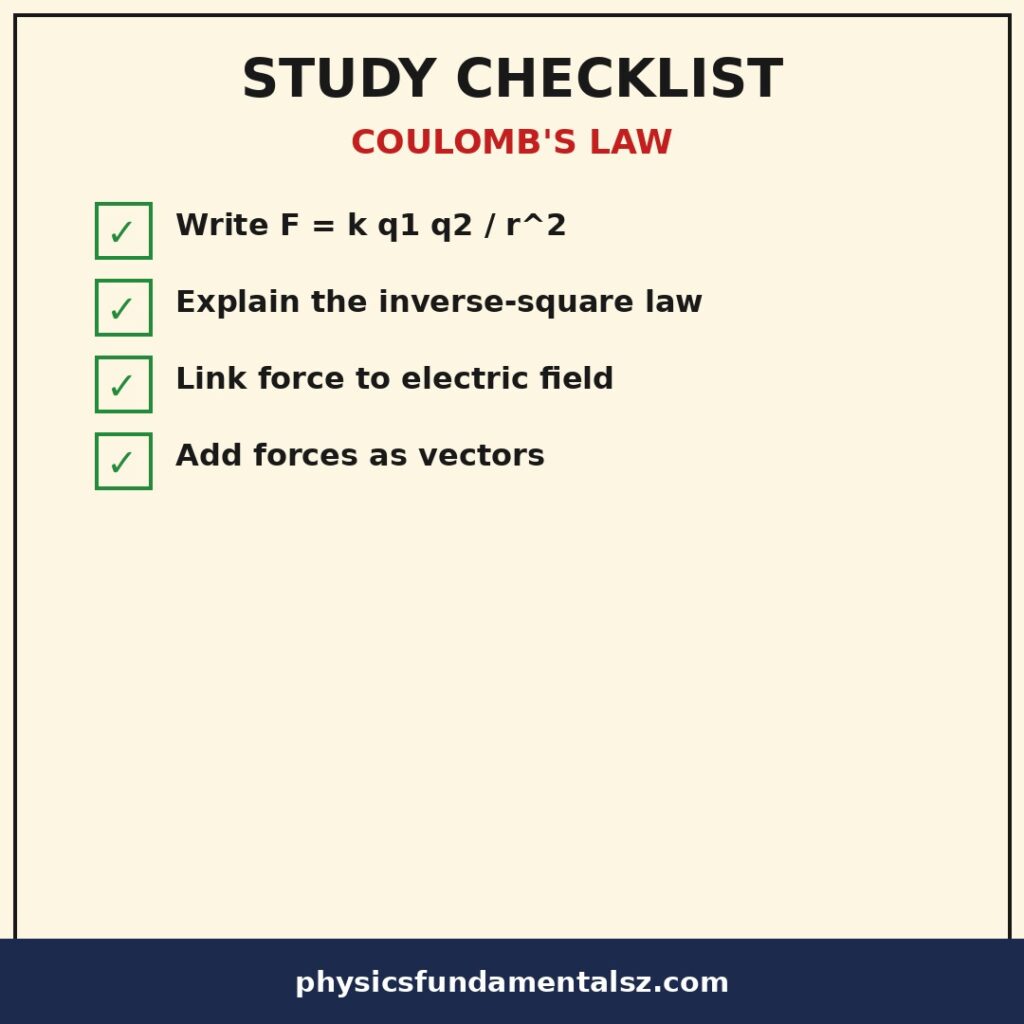
Conclusion
Coulomb’s law is one of the simplest and most powerful laws in physics. A single formula, F = kq₁q₂ / r², describes the force between any two point charges, in any arrangement, at any scale from atoms to thunderclouds.
Remember the three patterns. Force grows with the product of the charges. Force falls with the square of the distance. Like charges repel and unlike charges attract, always along the line joining them. Those three statements answer most qualitative questions without any calculation.
Use the law carefully in numbers: convert units first, square the distance, separate magnitude from direction, and add forces as vectors. Connect force to field with F = qE, and to potential with U = kq₁q₂ / r. Those connections turn one law into a complete electrostatics toolkit.
For the next steps, read our guides to how to calculate the electric field between two charges and the difference between electric field and electric potential. They build directly on Coulomb’s law and complete the electrostatics foundation for AP Physics.