How to Calculate Buoyant Force Step by Step: Formula, Examples, and Practice Problems 2026
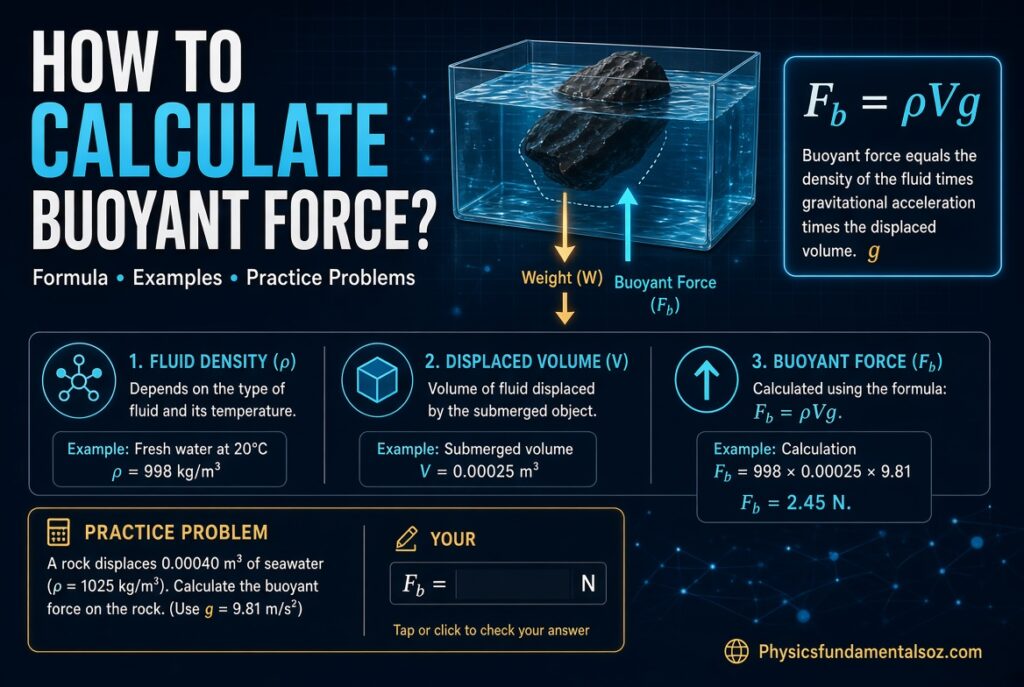
Why does a two-ton steel ship float while a tiny steel nail sinks? The answer is buoyant force, the upward push every fluid gives to anything placed in it.
Once you know how to calculate buoyant force step by step, that puzzle becomes simple arithmetic. You only need three numbers: the fluid’s density, the volume of fluid displaced, and gravity.
Table of Contents
How to Calculate Buoyant Force
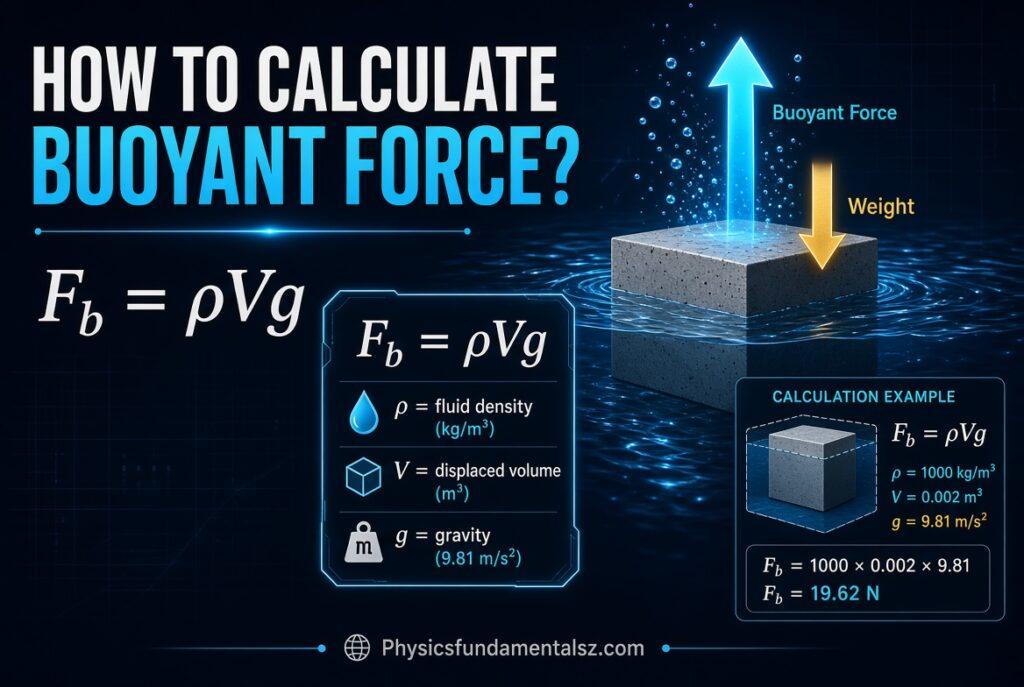
Definition box: Buoyant force is the upward force a fluid exerts on an object that is fully or partly submerged in it. By Archimedes’ principle, its size equals the weight of the fluid the object displaces.
The formula is:
F_b = ρ_fluid × g × V_displaced
Here is the method in five lines:
- Find the density of the fluid (about 1,000 kg/m³ for fresh water).
- Find the volume of fluid the object pushes aside.
- Use g = 9.81 m/s².
- Multiply the three numbers together.
- Write the answer in newtons (N).
What Is Buoyant Force?
Buoyant force is the net upward force created by a fluid’s pressure on a submerged object. Fluids include liquids like water and gases like air.
You feel it whenever you float in a pool or push a beach ball underwater. The ball fights back because the water pushes it up.
Buoyant Force, Buoyancy, and Upthrust
These three terms mean the same thing in most textbooks. American textbooks usually say “buoyant force.” British ones often say “upthrust.” “Buoyancy” is the general name for the effect.
Where Does Buoyant Force Come From?
Buoyant force comes from pressure that changes with depth. Deeper water pushes harder than shallow water.
The bottom of a submerged object sits deeper than its top. So the fluid pushes up on the bottom harder than it pushes down on the top. The difference is the buoyant force.
The Pressure Derivation
Picture a box with a flat top and bottom, each with area A. The top is at depth d and the box has height h.
- Pressure on the top face: P_top = ρ g d
- Pressure on the bottom face: P_bottom = ρ g (d + h)
- Net upward force: (P_bottom − P_top) × A = ρ g h A
Since h × A equals the box’s volume V, the result is F_b = ρ g V. The depth d cancels out completely.
Archimedes’ Principle in Plain English
Archimedes’ principle says the buoyant force equals the weight of the displaced fluid. Imagine replacing your submerged object with an identical blob of fluid.
That fluid blob would sit still, so the surrounding fluid must hold it up with a force equal to its weight. The same fluid pushes the same way on your real object.
The famous “Eureka!” story says Archimedes used this idea to test whether a crown was pure gold. Whether or not the tale is true, the physics is real and still used today.
The Buoyant Force Formula Explained
The core equation is short, but each symbol matters.
F_b = ρ_fluid × g × V_displaced
| Symbol | Meaning | SI unit | Typical value |
|---|---|---|---|
| F_b | Buoyant force | newton (N) | What you are solving for |
| ρ_fluid | Density of the fluid (not the object) | kg/m³ | 1,000 for fresh water |
| g | Gravitational acceleration | m/s² | 9.81 (standard: 9.80665) |
| V_displaced | Volume of fluid pushed aside | m³ | Depends on the object |
Other Ways to Write the Formula
You will meet the same idea in several forms. They all give identical answers.
| Form | When it is useful |
|---|---|
| F_b = ρ_fluid g V_displaced | Standard form for any problem |
| F_b = m_fluid g | When the mass of displaced fluid is given |
| F_b = w_fluid | When the weight of displaced fluid is given |
| F_b = W_air − W_apparent | When a scale reads the object’s weight in air and in fluid |
| F_b = ρ_fluid g V_submerged | For floating or partly submerged objects |
What the Formula Does Not Include
The formula has no term for the object’s mass, material, or depth. Two objects of the same volume feel the same buoyant force in the same fluid.
A hollow steel ball and a solid steel ball of equal outer size get identical push. The solid one is simply heavier, so it sinks more readily.
Before You Start: Units and Constants
Most mistakes in buoyancy problems are unit mistakes. Sort out your numbers first.
Common Fluid Densities
| Fluid | Density (kg/m³) | Notes |
|---|---|---|
| Fresh water | About 1,000 | Slightly lower when warm (about 997 at 25 °C) |
| Seawater | About 1,025 | Varies with salinity and temperature |
| Ethanol | About 789 | Floats on water |
| Olive oil | About 915 | Floats on water |
| Mercury | About 13,534 | Even lead floats on it |
| Air (sea level, 15 °C) | About 1.225 | Cause of balloon lift |
| Helium | About 0.166 | Much lighter than air |
Densities of Common Solids
| Material | Density (kg/m³) |
|---|---|
| Cork | About 240 |
| Pine wood | About 500 |
| Oak wood | About 700 |
| Ice | About 917 |
| Glass | About 2,500 |
| Aluminum | About 2,700 |
| Steel | About 7,850 |
| Copper | About 8,960 |
| Lead | About 11,340 |
| Gold | About 19,300 |
Unit Conversions You Will Need
| Convert | Multiply by |
|---|---|
| 1 liter to cubic meters | 0.001 |
| 1 cm³ to m³ | 0.000001 |
| 1 mL to m³ | 0.000001 |
| g/cm³ to kg/m³ | 1,000 |
| 1 US gallon to m³ | 0.003785 |
| 1 ft³ to m³ | 0.02832 |
| 1 lbf to newtons | 4.448 |
US Customary Units
In the United States, many problems use pounds-force and cubic feet. Fresh water weighs about 62.4 lbf per cubic foot. Seawater weighs about 64 lbf per cubic foot.
In those units, you can skip g entirely. Just multiply the fluid’s weight density by the displaced volume in cubic feet.
How to Calculate Buoyant Force Step by Step
Follow these seven steps for almost any problem.
Step 1: Identify the Fluid
Decide what fluid surrounds the object. Is it fresh water, seawater, oil, or air? The fluid, not the object, sets the density you use.
Step 2: Look Up or Read the Fluid Density
Find ρ_fluid in the problem or use the tables above. If the problem gives g/cm³, multiply by 1,000 to get kg/m³.
Step 3: Find the Displaced Volume
This is the volume of the object that sits below the fluid surface.
- Fully submerged: displaced volume equals the whole object’s volume.
- Floating or partly submerged: displaced volume equals only the part under the surface.
Step 4: Convert All Units to SI
Convert liters, cm³, and gallons to m³. Convert densities to kg/m³. Doing this first prevents most errors.
Step 5: Write the Formula and Substitute
Write F_b = ρ_fluid × g × V_displaced. Then replace each symbol with its number and units.
Step 6: Calculate and Round Sensibly
Multiply the three numbers. Keep as many significant figures as the least precise input.
Step 7: Check the Answer
Ask three quick questions:
- Is the unit newtons?
- Is the force smaller than the object’s weight if it floats, and equal to it at equilibrium?
- Is the number reasonable? One liter of water gives about 9.8 N.
Eight Worked Examples
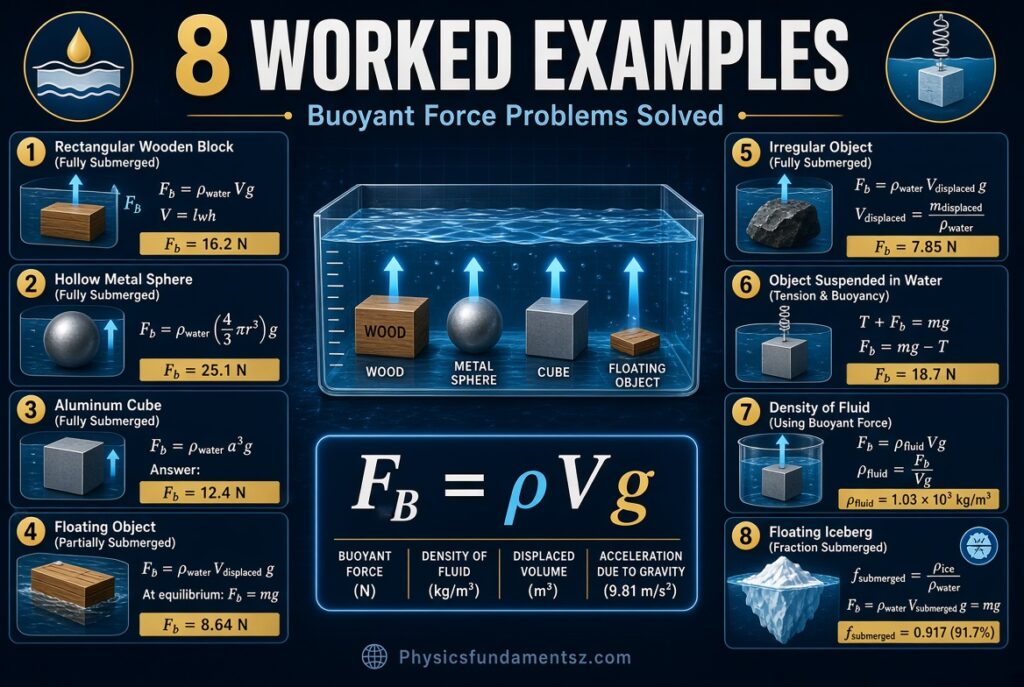
Each example uses g = 9.81 m/s² unless stated otherwise.
Example 1: A Fully Submerged Block in Fresh Water
A 2-liter block is completely underwater in fresh water. Find the buoyant force.
- Volume: 2 L = 0.002 m³
- Density: 1,000 kg/m³
F_b = 1,000 × 9.81 × 0.002 = 19.62 N
Example 2: Volume From Dimensions
A rectangular block measures 20 cm × 10 cm × 5 cm. It is fully submerged in fresh water, then in seawater.
- Volume: 0.20 × 0.10 × 0.05 = 0.001 m³
- Fresh water: 1,000 × 9.81 × 0.001 = 9.81 N
- Seawater: 1,025 × 9.81 × 0.001 = 10.06 N
Seawater pushes about 2.5% harder because it is denser.
Example 3: A Floating Wooden Block
A wooden block has mass 0.60 kg and volume 0.001 m³. It floats in fresh water. Find the buoyant force and the submerged volume.
Floating means the buoyant force equals the weight:
- Weight: 0.60 × 9.81 = 5.886 N, so F_b ≈ 5.89 N
- Submerged volume: F_b ÷ (ρ g) = 5.886 ÷ 9,810 = 0.0006 m³
The block’s density is 600 kg/m³. That is 60% of water’s density, so 60% of the block sits underwater.
Example 4: Using Apparent Weight
A rock weighs 28 N in air and 21 N when fully submerged in fresh water. Find the buoyant force, the volume, and the density.
- Buoyant force: 28 − 21 = 7 N
- Volume: 7 ÷ (1,000 × 9.81) = 7.14 × 10⁻⁴ m³
- Mass: 28 ÷ 9.81 = 2.854 kg
- Density: 2.854 ÷ 7.14 × 10⁻⁴ = 4,000 kg/m³
This is the classic Archimedes method for finding the density of an irregular object.
Example 5: A Partly Submerged Cylinder
A cylinder has radius 5.0 cm and height 20 cm. It floats upright with 12 cm underwater in fresh water.
- Radius: 0.05 m; submerged height: 0.12 m
- Submerged volume: π × 0.05² × 0.12 = 9.42 × 10⁻⁴ m³
- F_b = 1,000 × 9.81 × 9.42 × 10⁻⁴ = 9.25 N
Since it floats, its weight is also 9.25 N. That means its mass is about 0.94 kg.
Example 6: A Steel Boat in Seawater
A steel boat has a total mass of 5,000 kg. How much seawater must it displace to float, and what is the buoyant force?
- Buoyant force at floating: 5,000 × 9.81 = 49,050 N
- Displaced volume: 5,000 ÷ 1,025 = 4.88 m³
Steel is far denser than water. Yet the hollow hull makes the boat’s average density lower than the seawater’s.
Example 7: A Helium Balloon in Air
A spherical party balloon has radius 0.15 m and is filled with helium. Estimate the lift.
- Volume: (4/3) × π × 0.15³ = 0.0141 m³
- Buoyant force from air: 1.225 × 9.81 × 0.0141 = 0.170 N
- Weight of helium: 0.166 × 9.81 × 0.0141 = 0.023 N
- Net lift before the rubber’s weight: about 0.147 N
That is roughly enough to lift 15 grams, including the balloon skin and string.
Example 8: A US Customary Unit Problem
A 2 ft³ block is completely submerged in fresh water. Fresh water weighs 62.4 lbf/ft³.
F_b = 62.4 × 2 = 124.8 lbf
In seawater at about 64 lbf/ft³, the same block feels about 128 lbf.
Which Method Should You Use?
Different problems give you different information. This decision table points you to the right approach.
| You are given | Best method | Formula |
|---|---|---|
| Fluid density and object volume (fully submerged) | Direct formula | F_b = ρ g V |
| Object floats in equilibrium | Weight balance | F_b = W = m g |
| Scale readings in air and in fluid | Apparent weight | F_b = W_air − W_fluid |
| Mass of displaced fluid | Weight of displaced fluid | F_b = m_fluid g |
| Dimensions and submerged depth | Geometry then formula | V_sub = base area × depth |
| Object density and fluid density (floating) | Density ratio | Fraction submerged = ρ_obj ÷ ρ_fluid |
Floating, Sinking, and Neutral Buoyancy
Buoyant force alone does not tell you whether something floats. You must compare it with the object’s weight.
The Three Cases
| Condition | Result |
|---|---|
| F_b (fully submerged) > weight | Object rises and floats |
| F_b (fully submerged) = weight | Neutral buoyancy, hovers in place |
| F_b (fully submerged) < weight | Object sinks |
Because F_b = ρ_fluid g V and weight = ρ_object g V, the comparison reduces to densities. An object floats if its average density is below the fluid’s.
Net Force and Initial Acceleration
For a fully submerged object released from rest, the net force is weight minus buoyant force.
a = g × (1 − ρ_fluid ÷ ρ_object)
A steel ball in water starts with about 9.81 × (1 − 1,000 ÷ 7,850) = 8.56 m/s² downward. Drag then cuts that acceleration quickly, as explained in our terminal velocity guide.
Fraction Submerged
A floating object sinks until it displaces its own weight of fluid. That leads to a neat shortcut:
Fraction submerged = ρ_object ÷ ρ_fluid
A 600 kg/m³ block floats 60% submerged in fresh water. A 917 kg/m³ iceberg floats about 89% submerged in seawater, so roughly 90% of it hides below the surface.
Specific Gravity
Specific gravity is an object’s density divided by water’s density. It has no units. A material with specific gravity below 1 floats in fresh water. One above 1 sinks.
Partly Submerged Objects
Many real problems involve floating objects. The rule is the same, but you must use the submerged volume only.
- Use V_submerged for the displaced volume.
- The volume above the surface does not add to buoyancy.
- At equilibrium, F_b equals the object’s weight.
If the object has a uniform cross-section, submerged volume is base area times depth. Then you can solve for the depth directly.
Buoyant Force in Gases
Air is a fluid, so it pushes up on everything. For most objects, that push is far too small to notice.
It matters for balloons and for very precise mass measurements. Hot air balloons rise because heated air is less dense than the surrounding cool air.
Use the same formula, but with air density (about 1.225 kg/m³ at sea level, 15 °C). Air density falls with altitude, so buoyant force on a balloon falls as it climbs.
Ships, Submarines, and Hollow Objects
A ship floats because its hull encloses lots of air. Its average density, steel plus air, is below the water’s density.
The weight of water the ship displaces equals the ship’s total weight. That is why ships are rated by displacement.
The Plimsoll Line
Ships carry a load line mark on the hull. It shows the maximum safe depth in fresh, salt, and tropical waters. The marks differ because water density changes the volume needed to displace the same weight.
Submarines
Submarines fill or empty ballast tanks. That changes their average density.
- More water in tanks: average density rises, the sub sinks.
- Less water in tanks: average density falls, the sub rises.
- Balanced: neutral buoyancy, the sub hovers.
Fish and Life Jackets
Many fish adjust a gas-filled swim bladder to control their depth. Life jackets use foam of low density to add displaced volume with almost no extra weight.
Stability: Center of Buoyancy
The buoyant force acts through the center of the displaced volume. Physicists call that point the center of buoyancy.
A floating object is stable if tilting it creates a torque that rotates it back upright. Naval architects check this carefully so ships do not capsize.
Real-World Applications
| Application | How buoyant force is used |
|---|---|
| Ships and boats | Displacement equals total weight |
| Submarines | Ballast tanks change average density |
| Hot air balloons and airships | Lighter-than-air gas provides lift |
| Hydrometers | Depth of floating reveals liquid density |
| Life jackets | Low-density foam adds lift |
| Fish swim bladders | Gas volume controls buoyancy |
| Icebergs | About 90% of ice sits underwater |
| Density testing | Compare weight in air and in water |
| Diving | Weights and buoyancy compensators set neutral buoyancy |
What Changes the Buoyant Force?
| Factor | Effect on buoyant force |
|---|---|
| Fluid density up | Force goes up in proportion |
| Displaced volume up | Force goes up in proportion |
| Gravity up | Force goes up in proportion |
| Object’s mass | No direct effect |
| Object’s material | No direct effect |
| Depth (incompressible fluid) | No effect |
| Object’s shape | Matters only through the displaced volume |
| Fluid temperature | Small effect through density change |
Gravity matters, too. In true weightlessness there is no pressure gradient in a fluid, so there is no buoyant force.
Common Mistakes When Calculating Buoyant Force
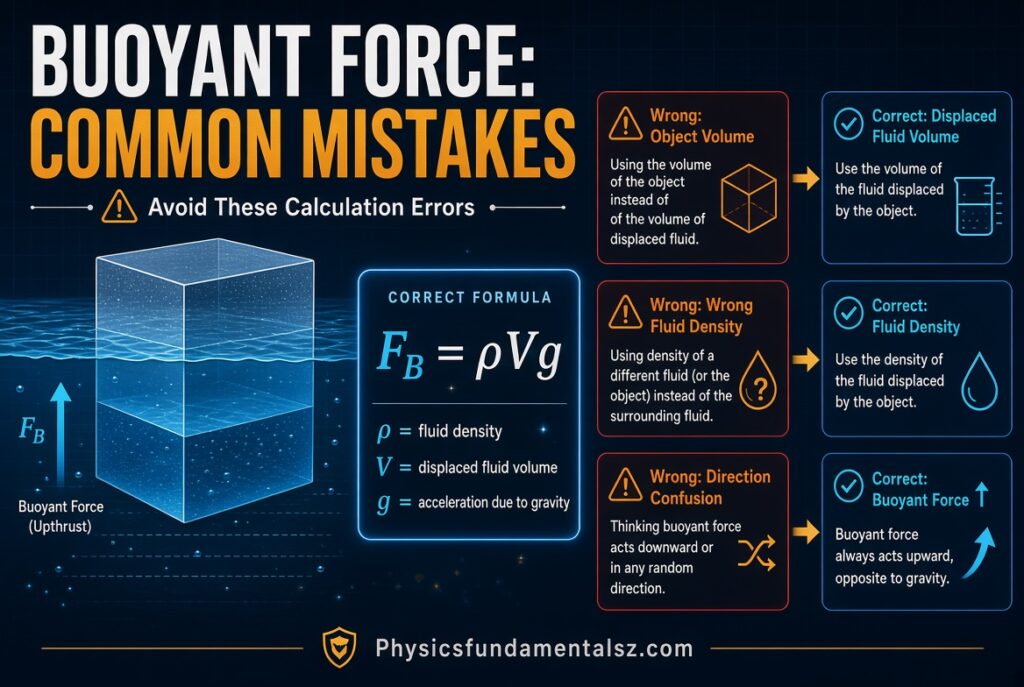
These errors appear again and again on homework and exams.
Using the Object’s Density Instead of the Fluid’s
The formula needs the fluid’s density. The object’s density only tells you whether it floats or sinks.
Using Total Volume for a Floating Object
Only the submerged part counts. A block with 40% above water only displaces 60% of its volume.
Forgetting to Convert Units
Liters and cubic centimeters must become cubic meters. A 2 L object is 0.002 m³, not 2 m³.
Thinking Depth Changes the Force
Going deeper raises pressure but not the buoyant force. The top and bottom pressures both rise by the same amount.
Mixing Up Mass and Weight
Buoyant force is in newtons. If you are given a mass, multiply by g when you compare it with the buoyant force.
Confusing Apparent Weight With Real Weight
An object’s real weight does not change underwater. Its apparent weight is lower because the fluid pushes up.
Using Sea-Level Air Density at High Altitude
For balloons and airships, use the local air density. It can be far smaller high above sea level.
Practice Problems With Answers
Try each one before you open the solution. Use g = 9.81 m/s².
Problem 1. A 0.005 m³ object is fully submerged in fresh water. Find the buoyant force.
Answer: 1,000 × 9.81 × 0.005 = 49.05 N.
Problem 2. The same object is placed in seawater (1,025 kg/m³). Find the buoyant force.
Answer: 1,025 × 9.81 × 0.005 = 50.28 N.
Problem 3. An aluminum block has mass 0.50 kg (density 2,700 kg/m³). Find its apparent weight in fresh water.
Answer: Volume = 0.50 ÷ 2,700 = 1.85 × 10⁻⁴ m³. F_b = 9,810 × 1.85 × 10⁻⁴ = 1.82 N. Weight = 4.905 N. Apparent weight = 4.905 − 1.82 = 3.09 N.
Problem 4. A log of density 700 kg/m³ and volume 0.30 m³ floats in fresh water. Find the buoyant force and submerged volume.
Answer: Weight = 700 × 0.30 × 9.81 = 2,060 N, so F_b = 2,060 N. Submerged volume = 0.70 × 0.30 = 0.21 m³.
Problem 5. A spring scale reads 15 N in air and 11 N in fresh water. Find the object’s density.
Answer: F_b = 4 N. V = 4 ÷ 9,810 = 4.08 × 10⁻⁴ m³. Density = (15 ÷ 4) × 1,000 = 3,750 kg/m³.
A Simple Experiment You Can Try at Home
You can measure buoyant force with a kitchen scale and a cup of water.
- Place a cup of water on the scale and press tare to zero it.
- Hold a small object on a string so it hangs fully in the water without touching the cup.
- Read the scale. The mass shown, times g, equals the buoyant force.
- Compare it with ρ g V using the object’s volume.
The scale reading rises because your object pushes down on the water just as the water pushes up on the object. That is Newton’s third law at work.
How Buoyancy Connects to Other Physics Topics
Buoyancy sits at the crossroads of several core ideas.
- Pressure: the origin of buoyant force is the change in fluid pressure with depth.
- Newton’s laws: floating means the forces balance. Sinking means the net force points down.
- Density: the ratio of densities decides floating or sinking.
- Drag: a falling or rising object in a fluid also feels a speed-dependent drag force.
- Fluid dynamics: moving fluids follow Bernoulli’s principle, a different effect from static buoyancy.
Key Takeaways
- The formula is F_b = ρ_fluid × g × V_displaced.
- Buoyant force equals the weight of the fluid the object displaces.
- Use the fluid’s density, not the object’s.
- Fully submerged objects displace their whole volume; floating ones displace only their submerged part.
- Floating means F_b equals weight. Sinking means F_b is smaller than weight.
- Depth does not change the buoyant force in an incompressible fluid.
- Apparent weight is real weight minus buoyant force.
- Convert everything to SI units before you calculate.
Also Read:
- Bernoulli’s Principle: P + ½ρv² + ρgh = Constant
- Newton’s Laws of Motion
- Newton’s Second Law: F = ma
- What Causes Terminal Velocity in Free Fall Physics?
- Ideal Gas Law: PV = nRT
- What Is Energy?
- Kinetic Energy: Formula, Meaning, and Examples
- Physics Fundamentals: The Complete Guide to Core Concepts, Laws, and Equations
- Conservation of Momentum Real Life Examples
- What Is the Formula for Conservation of Momentum?
- Momentum Calculator Physics: Formula, Steps and Worked Examples
- Angular Momentum Explained
- Entropy Explained for Beginners
- The Doppler Effect Explained
- Projectile Motion Explained
- Transverse Waves Explained
- Wave Speed, Frequency and Wavelength
- Free Fall Calculator and 19 Other Physics Calculators
- Play Physics Games: Gravity Lab and More
- All Physics Articles on Physics Fundamentals
- Physics Fundamentals Home
Frequently Asked Questions (FAQs)
How do you calculate buoyant force step by step?
Find the fluid density, find the displaced volume, and use g = 9.81 m/s². Then multiply: F_b = ρ × g × V. Give the answer in newtons.
What is the formula for buoyant force?
F_b = ρ_fluid × g × V_displaced. It equals the weight of the fluid the object pushes aside.
What is Archimedes’ principle?
It states that the buoyant force on an object equals the weight of the fluid it displaces. It applies to liquids and gases, and to fully or partly submerged objects.
What units is buoyant force measured in?
Newtons (N) in SI units. In US customary units, it is measured in pounds-force (lbf).
Does depth affect buoyant force?
No, not in an incompressible fluid. Pressure rises with depth on both the top and bottom of the object by the same amount, so the difference stays the same.
Does the object’s mass affect buoyant force?
Not directly. Buoyant force depends on displaced volume and fluid density. Mass only matters when you compare weight to buoyant force.
How do you find the volume of displaced fluid?
For a fully submerged object, use the object’s whole volume. For a floating object, use only the submerged part. You can also measure it by collecting the spilled water.
How do you calculate buoyant force from apparent weight?
Subtract the object’s weight in the fluid from its weight in air: F_b = W_air − W_apparent.
How do you calculate buoyant force for a floating object?
Set the buoyant force equal to the object’s weight: F_b = m × g. Then use the formula to find the submerged volume.
What density of water should I use?
Use 1,000 kg/m³ for fresh water and about 1,025 kg/m³ for seawater unless the problem says otherwise.
Why does a steel ship float?
The hull encloses a large volume of air, so the ship’s average density is below the water’s. It displaces water equal to its total weight.
Why do some objects sink even though buoyant force acts on them?
The buoyant force is still there, but it is smaller than the object’s weight. The net force points downward.
How do you find whether an object floats or sinks?
Compare average densities. If the object is less dense than the fluid, it floats. If it is denser, it sinks.
What is neutral buoyancy?
It is the state where buoyant force equals the object’s weight while fully submerged. The object neither rises nor sinks.
What is apparent weight?
It is the weight you measure for an object in a fluid. It equals real weight minus buoyant force.
Can you calculate buoyant force in air?
Yes. Use the same formula with air density, about 1.225 kg/m³ at sea level. The force is small except for large or very light objects such as balloons.
How do you calculate buoyant force in pounds?
Multiply the fluid’s weight density by the displaced volume. For fresh water, use about 62.4 lbf/ft³ times cubic feet.
How much of an iceberg is underwater?
About 90%. Ice has a density near 917 kg/m³ and seawater near 1,025 kg/m³, so the ratio is about 0.89.
Is buoyant force the same as weight?
No. Weight pulls down. Buoyant force pushes up. They are equal only when an object floats or hovers in equilibrium.
What is the difference between buoyant force and upthrust?
There is no difference in meaning. “Upthrust” is the term more common in British textbooks.
Does buoyant force exist in space?
Not in true weightlessness. Buoyancy needs gravity to create a pressure gradient in the fluid.
How do you find density using buoyant force?
Weigh the object in air and in water. Then use density = (W_air ÷ (W_air − W_water)) × ρ_water.
Why does the buoyant force depend on fluid density?
A denser fluid has more mass in the same volume. The displaced portion therefore weighs more, and the fluid supports it with a larger force.
Conclusion
Learning how to calculate buoyant force step by step comes down to one formula and a clear routine. Identify the fluid, find the displaced volume, convert to SI units, and multiply by density and gravity.
Remember the key ideas. Buoyant force equals the weight of displaced fluid. Depth does not matter. Floating means the buoyant force matches the weight.
Practice with the eight worked examples and five problems above. Once the routine feels automatic, ships, balloons, icebergs, and density tests will all use the same simple calculation.