Transverse vs Longitudinal Waves Examples: Full Guide 2026
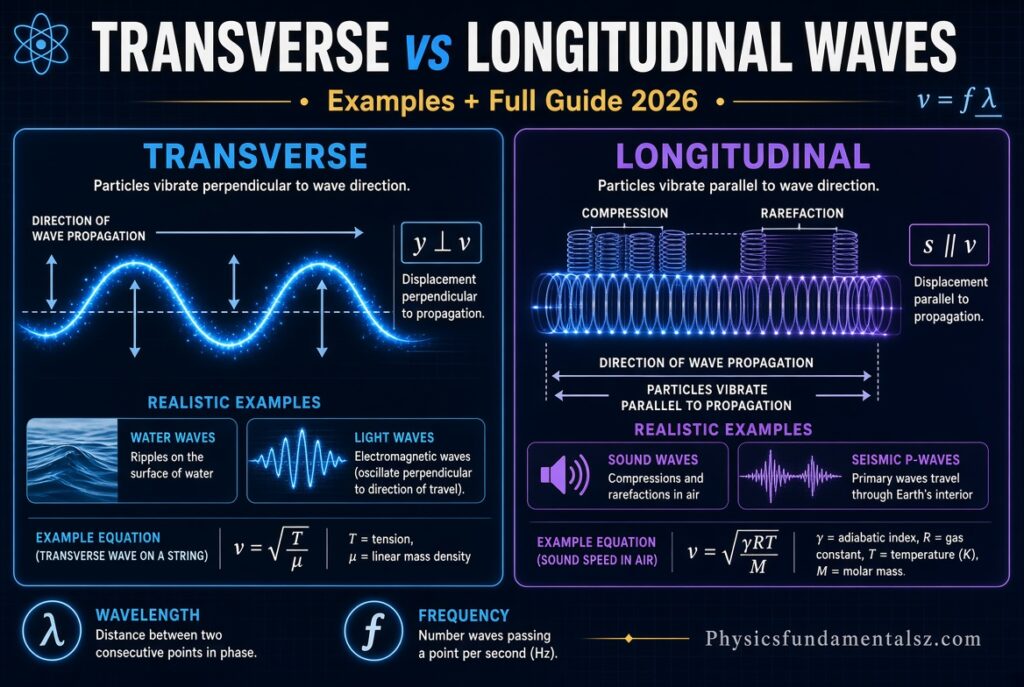
Every wave you have ever felt, heard, or seen falls into one of two families. Understanding transverse vs longitudinal waves examples is the fastest way to tell them apart.
Table of Contents
Transverse vs Longitudinal Waves Examples? What’s the Difference?
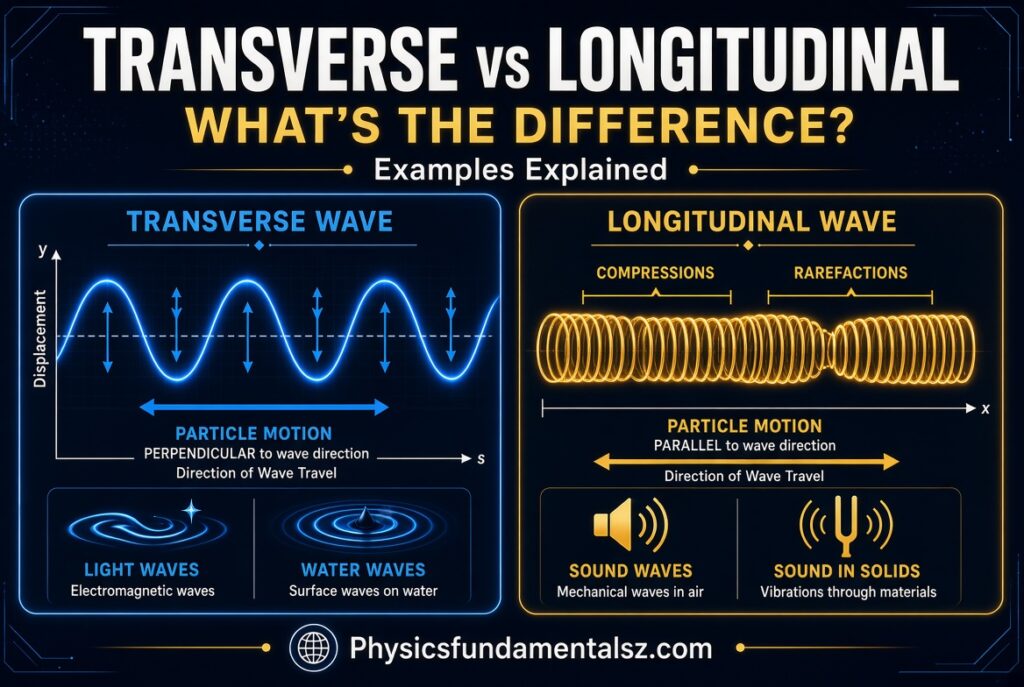
In a transverse wave, particles move perpendicular (sideways) to the direction the wave travels. Think of a flag rippling in the wind.
In a longitudinal wave, particles move parallel (back and forth) to the direction of travel. Think of sound pushing through air.
That single rule of particle direction decides every property that follows, from polarization to wave speed.
What Is a Transverse Wave?
A transverse wave is a disturbance where the medium oscillates at a right angle to the wave’s motion. The wave moves forward, but each particle only moves up and down.
This sideways motion creates two key features: the crest (highest point) and the trough (lowest point). The distance between two crests is the wavelength.
Transverse Wave Examples
- Light and electromagnetic waves – radio waves, microwaves, visible light, and X-rays all travel as transverse waves and need no medium.
- A vibrating guitar or violin string – plucking the string moves it up and down while the wave itself travels along its length.
- Ripples on a pond – water molecules bob up and down as the ripple spreads outward.
- A shaken rope or slinky (side to side) – moving one end up and down sends a visible transverse pulse.
- Seismic S-waves – secondary earthquake waves shake the ground sideways as they move through rock.
What Is a Longitudinal Wave?
A longitudinal wave is a disturbance where particles move in the same direction the wave travels. Instead of crests and troughs, it produces compressions and rarefactions.
A compression is where particles bunch close together. A rarefaction is where they spread apart. This pattern repeats down the length of the medium.
Longitudinal Wave Examples
- Sound waves – a speaker cone pushes air molecules together and pulls them apart, carrying sound to your ear.
- A pushed and pulled slinky – compressing a few coils and releasing them sends a visible longitudinal pulse.
- Ultrasound waves – medical ultrasound uses high-frequency longitudinal waves to image the body.
- Seismic P-waves – primary earthquake waves compress and stretch rock, and they arrive first because they travel fastest.
- A traffic jam ripple – cars bunching up and spreading out mimics compression and rarefaction on a highway.
Transverse vs Longitudinal Waves: Comparison Table
| Feature | Transverse Wave | Longitudinal Wave |
|---|---|---|
| Particle motion | Perpendicular to wave direction | Parallel to wave direction |
| Key features | Crest and trough | Compression and rarefaction |
| Common examples | Light, water ripples, guitar strings | Sound, ultrasound, P-waves |
| Needs a medium? | Not always (light travels in vacuum) | Always needs a medium |
| Can it be polarized? | Yes | No |
| Travels through | Solids and surfaces | Solids, liquids, and gases |
| Speed formula | v = fλ | v = fλ |
Why Some Waves Can Be Polarized and Others Can’t
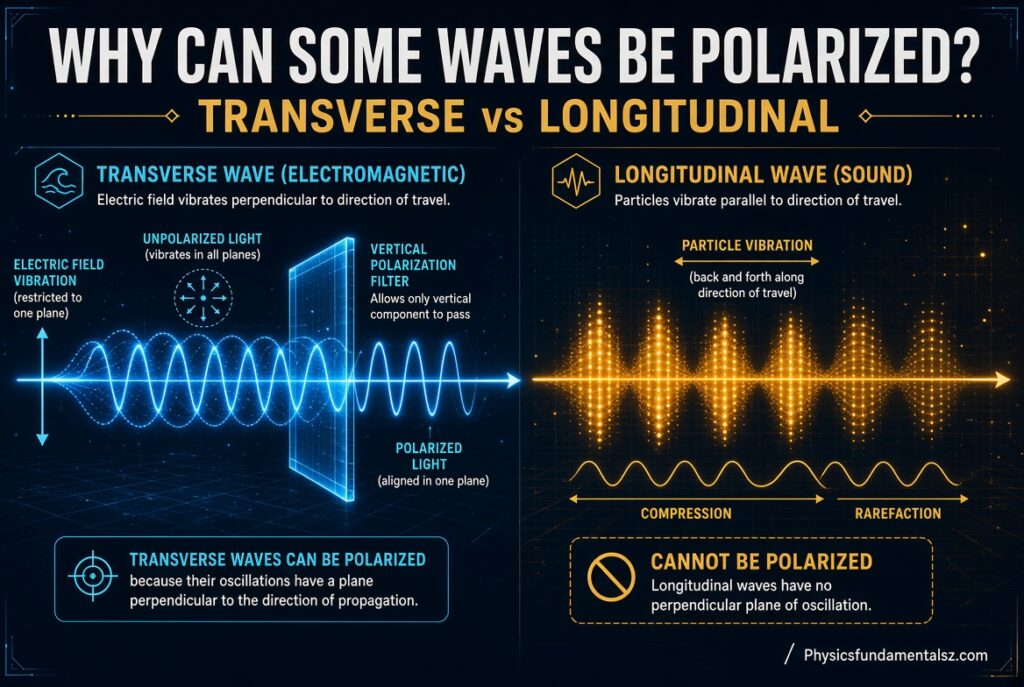
Polarization is the real test that separates the two families. A transverse wave can vibrate up-down or side-to-side, so a filter can block every direction except one.
That is exactly how polarized sunglasses cut glare off water and roads. A longitudinal wave only ever vibrates along its own direction of travel, so there is no second axis to filter.
Wave Speed, Frequency, and Wavelength
Both wave types obey the same core formula: v = fλ, where v is speed, f is frequency, and λ is wavelength. The wave category does not change this equation.
Speed instead depends on the medium. Sound moves faster through water than through air, but that has nothing to do with sound being longitudinal.
Waves That Combine Both Types
Not every wave fits neatly into one box. Ocean surface waves move water in circular paths, blending transverse and longitudinal motion together.
Rayleigh surface waves in earthquakes behave the same way. Particles trace an elliptical path as the wave rolls along the ground’s surface.
How to Identify a Wave Type in Seconds
- Ask which direction the particles move relative to the wave itself.
- Sideways or up-down motion means transverse.
- Back-and-forth motion along the travel path means longitudinal.
- Check if it can pass through a vacuum; only transverse EM waves can.
- Check if it can be polarized; only transverse waves can.
Common Mistakes Students Make
- Confusing wave speed with wave type; both follow v = fλ regardless of category.
- Assuming all mechanical waves are longitudinal; a wave on a string is mechanical and transverse.
- Forgetting that ocean waves are a mixed case, not purely transverse.
- Mixing up compression with crest; compressions belong only to longitudinal waves.
Real-World Applications

Doctors rely on longitudinal ultrasound waves to see inside the human body without surgery. Musicians shape transverse string vibrations to control pitch and tone.
Seismologists use the arrival gap between P-waves and S-waves to locate earthquake epicenters. Photographers use polarizing filters to control the transverse light entering a lens.
Also Read:
- Transverse Waves Explained
- Longitudinal Waves Explained
- Wave Speed, Frequency and Wavelength
- Wave Superposition: Adding Waves, Phase & Interference Patterns
- The Electromagnetic Spectrum
- The Doppler Effect
- Reflection and Refraction
- Snell’s Law: Derivation & Total Internal Reflection
- Young’s Double-Slit Experiment
- Simple Harmonic Motion
- Hooke’s Law and Springs
- Circular Motion and Centripetal Force
- Kinetic Energy
- Potential Energy: Gravitational, Elastic & Electric Forms
- Momentum and Impulse
- Work Done in Physics
- Tension Force
- Friction Force Explained
- Heat Transfer: Conduction, Convection and Radiation
- The Kinetic Theory of Gases
- Entropy Explained
- The First Law of Thermodynamics
- Ideal Gas Law: PV = nRT
- Electric Current: I = Q/t, Drift Velocity & Ohm’s Law Connection
- Physics Fundamentals: The Complete Guide
Frequently Asked Questions (FAQs)
What is the main difference between transverse and longitudinal waves?
Transverse waves move particles perpendicular to travel direction. Longitudinal waves move particles parallel to travel direction.
Is sound a transverse or longitudinal wave?
Sound is a longitudinal wave. Air molecules compress and spread out in the same direction the sound travels.
Is light a transverse or longitudinal wave?
Light is a transverse wave. Its electric and magnetic fields oscillate perpendicular to its direction of travel.
Can longitudinal waves be polarized?
No. Longitudinal waves only vibrate along one axis, so there is no second direction to filter out.
What are examples of transverse waves in daily life?
Water ripples, guitar strings, light, and radio waves are all common transverse wave examples.
What are examples of longitudinal waves in daily life?
Sound, ultrasound, and a pushed slinky are everyday longitudinal wave examples.
Do transverse waves need a medium to travel?
Not always. Electromagnetic transverse waves like light travel through a vacuum with no medium at all.
Do longitudinal waves need a medium?
Yes. Longitudinal waves always require particles to compress and stretch, so they cannot cross a vacuum.
What causes crests and troughs?
Crests and troughs form only in transverse waves, created by particles moving up and down as the wave passes.
What causes compressions and rarefactions?
Compressions and rarefactions form only in longitudinal waves, created by particles bunching and spreading along the travel path.
Are earthquake waves transverse or longitudinal?
Earthquakes produce both. P-waves are longitudinal and arrive first; S-waves are transverse and arrive second.
Why do P-waves travel faster than S-waves?
P-waves compress and expand material directly along their path, which transmits energy faster than the shearing motion of S-waves.
Is a water wave transverse or longitudinal?
Ocean waves are a mix of both. Water molecules move in circular paths, combining up-down and back-forth motion.
What is an example of a wave that shows both wave types?
Rayleigh surface waves during an earthquake move particles in ellipses, blending transverse and longitudinal motion.
Can a slinky show both wave types?
Yes. Shaking a slinky side to side makes it transverse; pushing and pulling it makes it longitudinal.
What is the formula that relates wave speed, frequency, and wavelength?
The formula is v = fλ, and it applies equally to transverse and longitudinal waves.
Why can’t sound travel through a vacuum?
Sound is longitudinal and needs particles to compress and expand, and a vacuum has no particles to carry that motion.
What type of wave is used in ultrasound imaging?
Ultrasound imaging uses high-frequency longitudinal sound waves that reflect off internal body structures.
How do polarized sunglasses work?
Polarized lenses block transverse light waves vibrating in every direction except one, cutting glare from flat surfaces.
Is a wave on a guitar string mechanical or electromagnetic?
It is mechanical and transverse. The string itself is the medium, and it needs no field to propagate.
What is the easiest way to remember the difference?
Picture a flag for transverse (sideways flapping) and a slinky push for longitudinal (forward squeezing).
Are X-rays transverse or longitudinal?
X-rays are transverse. Like all electromagnetic radiation, their fields oscillate perpendicular to travel direction.
Why can transverse mechanical waves not travel through liquids or gases?
Fluids have no shear resistance, so there is nothing to spring particles back into a sideways motion.
What is the difference between a mechanical and electromagnetic transverse wave?
A mechanical transverse wave needs a medium, like a string, while an electromagnetic transverse wave like light needs none.
Conclusion
Transverse and longitudinal waves both carry energy, but the direction of particle motion sets them apart completely. Light, water ripples, and guitar strings show transverse motion, while sound, ultrasound, and P-waves show longitudinal motion.
Once you can spot crests and troughs versus compressions and rarefactions, identifying any wave becomes second nature.