Coulomb’s Law Calculations: F = kQ1Q2/r² Formula & Examples
Two charged balloons pushed apart after rubbing them on your hair is the same physics that keeps every atom in your body from collapsing in on itself.
The rule governing that push or pull between any two charges is Coulomb’s law, and learning to run Coulomb’s law calculations correctly is one of the first real problem-solving skills in electrostatics.
This guide walks through the formula, the constant, the sign conventions, and a full set of worked examples — from simple two-charge problems to multi-charge superposition — so you can solve any Coulomb’s law calculation with confidence.
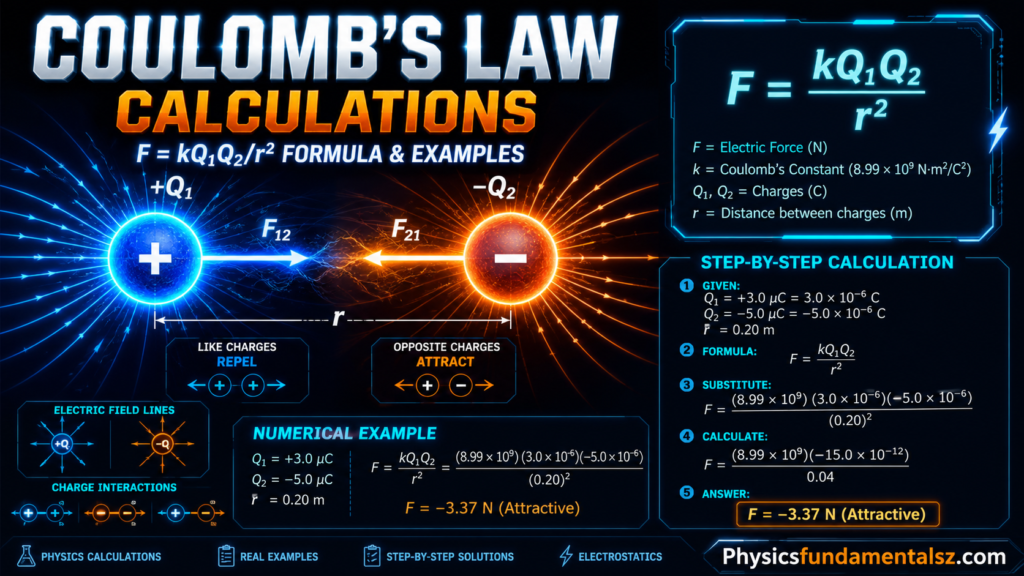
Coulomb’s law calculates the electrostatic force between two point charges using F = kq₁q₂/r², where k is Coulomb’s constant (≈ 8.99 × 10⁹ N·m²/C²), q₁ and q₂ are the charges in coulombs, and r is the distance between them in meters. The force is repulsive for like charges and attractive for opposite charges.
Table of Contents
What Is Coulomb’s Law?
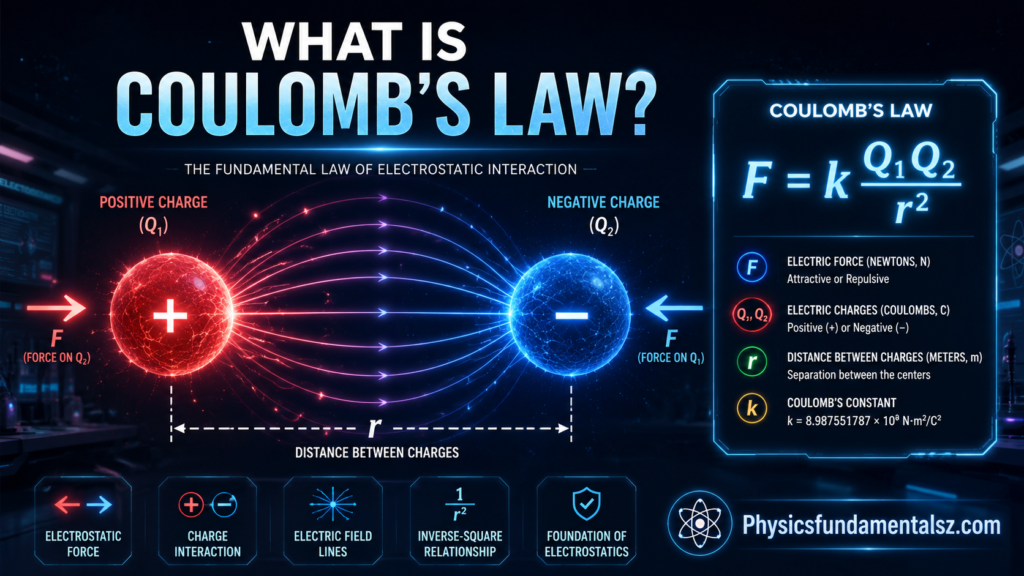
Coulomb’s law is the fundamental law of electrostatics that describes the force between two stationary, electrically charged particles. It states that the force is directly proportional to the product of the two charges and inversely proportional to the square of the distance separating them.
Charles-Augustin de Coulomb first measured this relationship experimentally in 1785 using a torsion balance, and the law has since been verified to extraordinary precision — accurate to roughly one part in 10¹⁶, with no known exceptions, even at the scale of individual atoms.
Key takeaway: Coulomb’s law only applies to point charges (or objects small and symmetric enough to be treated as points) that are not moving relative to each other.
The Coulomb’s Law Formula
The magnitude of the electrostatic force between two point charges is:
F = k|q₁q₂| / r²
| Symbol | Meaning | Unit |
|---|---|---|
| F | Electrostatic force | Newtons (N) |
| k | Coulomb’s constant | N·m²/C² |
| q₁, q₂ | Magnitude of each charge | Coulombs (C) |
| r | Distance between the charges | Meters (m) |
Because the force is an inverse-square relationship, doubling the distance between two charges cuts the force to one-quarter — not one-half. Doubling either charge, meanwhile, doubles the force directly.
Coulomb’s Constant, k
Coulomb’s constant (k), sometimes called the electrostatic constant, has a measured value of:
k ≈ 8.99 × 10⁹ N·m²/C² (often rounded to 9.0 × 10⁹ for quick estimates)
Coulomb’s constant is related to the permittivity of free space (ε₀) by:
k = 1 / (4πε₀)
where ε₀ ≈ 8.85 × 10⁻¹² F/m. This connection is why Coulomb’s law calculations and capacitor or electric field calculations all trace back to the same underlying constant.
Step-by-Step: How to Solve a Coulomb’s Law Calculation
- Identify the known values. Write down q₁, q₂, and r, converting all charges to coulombs and distance to meters.
- Convert charge prefixes carefully. Values are often given in microcoulombs (µC = 10⁻⁶ C) or nanocoulombs (nC = 10⁻⁹ C) — forgetting the power of ten is the single most common error.
- Square the distance. Compute r² before doing anything else with it; the force depends on distance squared, not distance itself.
- Multiply the charges together. Use magnitudes for a straightforward force calculation, or keep signs if you need to know attraction vs. repulsion.
- Apply the formula. Multiply k by the charge product, then divide by r².
- Check the sign or direction. Like charges repel; opposite charges attract. State the direction along the line joining the two charges.
Worked Example 1: Basic Force Calculation
Problem: Two point charges, +3.0 µC and +5.0 µC, are separated by 0.20 m in air. Find the electrostatic force between them.
Solution:
- Formula: F = kq₁q₂/r²
- Convert units: q₁ = 3.0 × 10⁻⁶ C, q₂ = 5.0 × 10⁻⁶ C, r = 0.20 m
- Square the distance: r² = 0.04 m²
- Substitute: F = (8.99 × 10⁹)(3.0 × 10⁻⁶)(5.0 × 10⁻⁶) / 0.04
- Simplify: F = (8.99 × 10⁹ × 15 × 10⁻¹²) / 0.04 = (134.85 × 10⁻³) / 0.04
- Result: F ≈ 3.37 N, directed away from each other (repulsive, since both charges are positive)
Worked Example 2: Solving for Distance
Problem: Two charges of +2.0 µC and −4.0 µC exert a force of 1.8 N on each other. Find the distance between them.
Solution:
- Formula: F = kq₁q₂/r², rearranged to r = √(k|q₁q₂|/F)
- Substitute: r = √[(8.99 × 10⁹)(2.0 × 10⁻⁶)(4.0 × 10⁻⁶) / 1.8]
- Simplify the numerator: (8.99 × 10⁹)(8.0 × 10⁻¹²) = 0.0719
- Divide by force: 0.0719 / 1.8 = 0.03996
- Take the square root: r ≈ 0.20 m, attractive (opposite charges)
Worked Example 3: Solving for Charge
Problem: Two identical charges separated by 0.15 m repel each other with a force of 0.90 N. Find the magnitude of each charge.
Solution:
- Formula: F = kq²/r² (since q₁ = q₂ = q), rearranged to q = √(Fr²/k)
- Substitute: q = √[(0.90)(0.15)² / (8.99 × 10⁹)]
- Simplify: q = √[(0.90 × 0.0225) / (8.99 × 10⁹)] = √[0.02025 / 8.99 × 10⁹]
- Result: q = √(2.253 × 10⁻¹²)
- Final answer: q ≈ 1.5 × 10⁻⁶ C, or 1.5 µC on each charge
Attraction vs. Repulsion: Reading the Sign
Coulomb’s law calculations need more than just a magnitude — the sign of the charges tells you the direction of the force.
| Charge Combination | Force Type | Sign of q₁q₂ |
|---|---|---|
| Positive + Positive | Repulsive | Positive |
| Negative + Negative | Repulsive | Positive |
| Positive + Negative | Attractive | Negative |
Key takeaway: When both charges share the same sign, the product q₁q₂ is positive and the charges push apart. When the signs differ, the product is negative and the charges pull together.
Coulomb’s Law for Multiple Charges (Superposition)
Real problems rarely involve just two charges. When three or more charges are present, the superposition principle applies: calculate the force from each charge on the charge of interest separately, then add the results as vectors.
Key takeaway: Forces from individual charge pairs must be added as vectors — accounting for both direction and magnitude — not simply added as numbers, unless every force happens to act along the same line.
Worked Example 4: Three-Charge Superposition
Problem: Charge A (+2.0 µC) sits at the origin. Charge B (+3.0 µC) sits 0.30 m to the right of A. Charge C (−1.0 µC) sits 0.30 m to the left of A. Find the net force on charge A.
Solution:
- Force from B on A: F_AB = k(2.0×10⁻⁶)(3.0×10⁻⁶)/(0.30)² = (8.99×10⁹)(6.0×10⁻¹²)/0.09 ≈ 0.599 N, pushing A to the left (repulsive, B is to the right)
- Force from C on A: F_AC = k(2.0×10⁻⁶)(1.0×10⁻⁶)/(0.30)² = (8.99×10⁹)(2.0×10⁻¹²)/0.09 ≈ 0.200 N, pulling A to the left (attractive, C is to the left)
- Both forces point in the same direction (left), so they add directly
- Result: F_net ≈ 0.799 N to the left
Coulomb’s Law vs. Newton’s Law of Gravitation
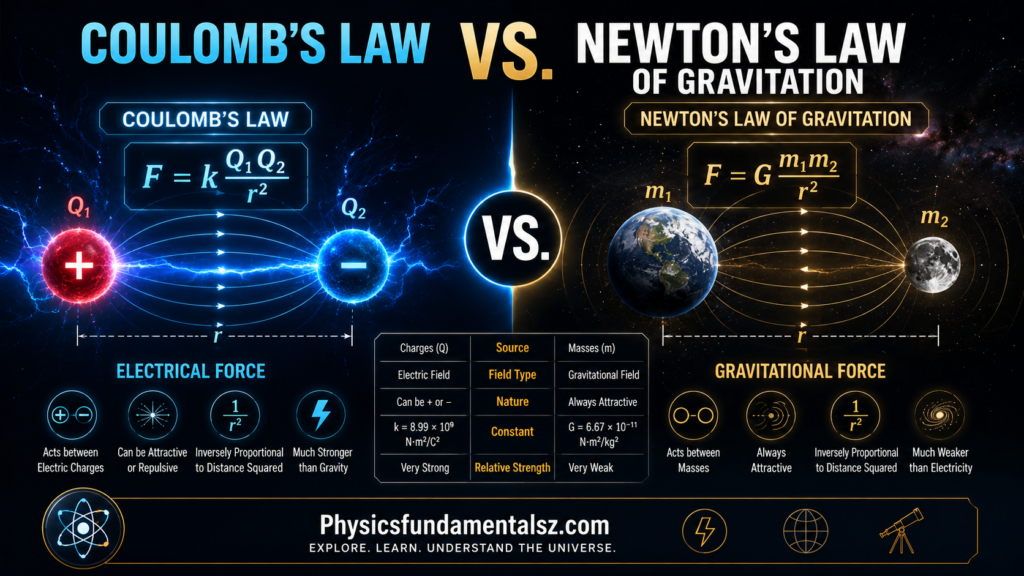
Coulomb’s law and Newton’s law of universal gravitation share the same inverse-square mathematical structure, but they describe very different forces.
| Feature | Coulomb’s Law | Newton’s Law of Gravitation |
|---|---|---|
| Formula | F = kq₁q₂/r² | F = Gm₁m₂/r² |
| Source quantity | Electric charge | Mass |
| Constant | k ≈ 8.99 × 10⁹ N·m²/C² | G ≈ 6.674 × 10⁻¹¹ N·m²/kg² |
| Can be attractive or repulsive? | Yes, depending on charge signs | No, always attractive |
| Relative strength | Vastly stronger at atomic scale | Vastly weaker at atomic scale |
Units and Common Conversions
| Quantity | SI Unit | Common Smaller Units |
|---|---|---|
| Charge (q) | Coulomb (C) | µC (10⁻⁶ C), nC (10⁻⁹ C), pC (10⁻¹² C) |
| Distance (r) | Meter (m) | cm (10⁻² m), mm (10⁻³ m) |
| Force (F) | Newton (N) | — |
Key takeaway: Always convert charge and distance into base SI units — coulombs and meters — before plugging numbers into the Coulomb’s law formula, to avoid errors of several orders of magnitude.
Common Mistakes in Coulomb’s Law Calculations
- Forgetting to square the distance. Using r instead of r² is one of the most frequent errors, and it produces a force far larger than the correct answer.
- Mixing up unit prefixes. Plugging in “3” instead of “3 × 10⁻⁶” for 3 µC throws the result off by a factor of a million.
- Ignoring vector direction with multiple charges. Adding force magnitudes directly, without accounting for direction, gives the wrong net force whenever the individual forces don’t act along the same line.
- Confusing attraction and repulsion. Forgetting that like charges repel and opposite charges attract leads to force directions that contradict the physical setup.
- Using Coulomb’s law for extended, non-symmetric objects. The point-charge formula breaks down for irregularly shaped charged objects where charge isn’t concentrated at a single point.
Real-World Applications

- Photocopiers and laser printers: Use electrostatic attraction, governed by Coulomb’s law, to transfer toner particles onto paper.
- Electrostatic precipitators: Remove pollutant particles from industrial exhaust by charging them and attracting them to oppositely charged collection plates.
- Atomic structure: The attractive Coulomb force between the positive nucleus and negative electrons is what holds every atom together.
- Ion propulsion in spacecraft: Uses electrostatic forces to accelerate charged particles and generate thrust in low-thrust, high-efficiency engines.
Related Articles
- Magnetic Field of a Current-Carrying Wire: B = μ0I/2πr
- Magnetic Flux and Faraday’s Law: Formula, Examples & Applications
- Potential Energy: Gravitational, Elastic & Electric Forms Explained
- Net Force: Definition, Formula & Newton’s Second Law Applied
- Escape Velocity: v = √(2GM/r) Formula, Derivation & Worked Examples
- Mechanical Energy: KE + PE, Conservation & Energy Transformations
- Momentum and Impulse Collisions: Conservation Laws & Examples
- Pressure in Fluids: P = ρgh, Pascal’s Law & Hydraulics Explained
- Circular Motion and Centripetal Force
- Simple Harmonic Motion
- Hooke’s Law and Springs
- Work Done in Physics
- Friction Force Explained
- Angular Momentum
- Torque in Physics
- Kinetic Energy
- Power in Physics
- Momentum and Impulse
Frequently Asked Questions (FAQs)
What is Coulomb’s law?
Coulomb’s law is the physics law that calculates the electrostatic force between two stationary point charges, stated as F = kq₁q₂/r².
What is the formula for Coulomb’s law?
F = kq₁q₂/r², where F is force in newtons, k is Coulomb’s constant, q₁ and q₂ are the charges in coulombs, and r is the distance between them in meters.
What is the value of Coulomb’s constant?
Coulomb’s constant, k, is approximately 8.99 × 10⁹ N·m²/C², often rounded to 9.0 × 10⁹ for quick calculations.
How do you calculate the force between two charges?
Convert both charges to coulombs and the distance to meters, square the distance, multiply the charges together, then apply F = kq₁q₂/r².
Does Coulomb’s law apply to moving charges?
No. Coulomb’s law strictly applies to stationary (static) charges; moving charges introduce magnetic forces that require additional laws to describe fully.
Why is Coulomb’s law called an inverse-square law?
Because the force is inversely proportional to the square of the distance between the charges — doubling the distance reduces the force to one-quarter of its original value.
How do you know if the force is attractive or repulsive?
Like charges (both positive or both negative) repel each other, while opposite charges (one positive, one negative) attract each other.
What happens to the force if you double one of the charges?
The force doubles, since Coulomb’s law states that force is directly proportional to the product of the two charges.
What happens to the force if you double the distance?
The force decreases to one-quarter of its original value, since force is inversely proportional to the square of the distance.
How do you calculate the net force from multiple charges?
Calculate the force from each individual charge pair separately using Coulomb’s law, then add the results as vectors, accounting for both magnitude and direction.
What is the superposition principle in Coulomb’s law?
It states that the total electrostatic force on a charge from multiple other charges equals the vector sum of the individual forces from each charge, calculated independently.
What units should be used in Coulomb’s law calculations?
Charge should be in coulombs (C), distance in meters (m), and the resulting force will be in newtons (N).
How do you convert microcoulombs to coulombs?
Multiply the microcoulomb value by 10⁻⁶; for example, 5 µC equals 5 × 10⁻⁶ C.
What is the relationship between Coulomb’s constant and permittivity of free space?
Coulomb’s constant equals 1/(4πε₀), where ε₀ is the permittivity of free space, approximately 8.85 × 10⁻¹² F/m.
How is Coulomb’s law similar to Newton’s law of gravitation?
Both are inverse-square laws with the same mathematical form, but Coulomb’s law involves electric charge and can be attractive or repulsive, while gravitation involves mass and is always attractive.
Can Coulomb’s law be used for charged objects that aren’t points?
Only if the objects are small and symmetric (like uniformly charged spheres) relative to the distance between them; irregular or large charged bodies require more advanced field calculations.
What is the electrostatic force between two 1-coulomb charges 1 meter apart?
Using F = kq₁q₂/r², the force equals Coulomb’s constant itself, about 8.99 × 10⁹ N — an enormous, physically unrealistic force, which illustrates just how large one coulomb of charge actually is.
Why do students often get the wrong answer in Coulomb’s law problems?
The most common errors are forgetting to square the distance, mismanaging unit prefixes like microcoulombs, and neglecting vector direction when multiple charges are involved.
Is the force in Coulomb’s law a vector or a scalar quantity?
Force is a vector quantity, meaning it has both magnitude and direction, even though the basic Coulomb’s law formula is often first taught using magnitudes only.
How was Coulomb’s law discovered?
Charles-Augustin de Coulomb measured the force between charged spheres using a torsion balance in 1785, establishing the inverse-square relationship experimentally.
How precise is Coulomb’s law?
Modern experiments have verified the inverse-square relationship in Coulomb’s law to an accuracy of about one part in 10¹⁶, with no known exceptions.
What is the difference between Coulomb’s law and an electric field calculation?
Coulomb’s law calculates the force between two specific charges, while an electric field calculation finds the force per unit charge that a source charge would exert at any point in space.
Can Coulomb’s law give a negative force value?
If signed charges are used directly in the formula, a negative result indicates an attractive force; if only magnitudes are used, the sign must be determined separately from the charge types.
Key Takeaways
- Coulomb’s law calculates the electrostatic force between two point charges using F = kq₁q₂/r², with k ≈ 8.99 × 10⁹ N·m²/C².
- The force is an inverse-square relationship — doubling distance cuts the force to one-quarter, while doubling either charge doubles the force.
- Like charges repel and opposite charges attract, determined by the sign of the product q₁q₂.
- For more than two charges, use the superposition principle: calculate each pairwise force separately, then add them as vectors.
- Careful unit conversion — coulombs for charge, meters for distance — prevents the most common calculation errors.
- Coulomb’s law shares its mathematical form with Newton’s law of gravitation, but governs electric charge rather than mass, and underlies technology from photocopiers to atomic structure itself.