Magnetic Fields and Forces

Magnetism feels mysterious because we meet it first as fridge magnets, but its deepest secret is simple: magnetic fields are produced by moving charges and act only on moving charges. A stationary electron feels nothing from a magnet. Set it moving and a force appears — one that points sideways to both the field and the motion, which is what makes magnetism so geometrically rich.
What a magnetic field is
A magnetic field, written B, is a vector field filling the space around magnets and currents. We measure its strength in teslas (T). The Earth’s field is about 50 microteslas; an MRI scanner runs at a few teslas, roughly a hundred thousand times stronger. Field lines run from a magnet’s north pole to its south pole outside the magnet and form closed loops — they never start or stop, because there are no isolated magnetic charges.
The force on a moving charge
The central law of magnetism is the force it exerts on a single moving charge q travelling with velocity v through a field B. The magnitude depends on the angle θ between the velocity and the field.
Three features of this equation are worth dwelling on:
- A charge at rest (v = 0) feels no magnetic force at all.
- A charge moving along the field lines (θ = 0°) also feels nothing, since sin 0° = 0.
- The force is greatest when the charge moves perpendicular to the field (θ = 90°).
The magnetic force is always perpendicular to the velocity. Because it acts at right angles to the motion, it can change a charge’s direction but never its speed. The magnetic force does zero work on a charged particle.
Why charges move in circles
A constant sideways force is exactly the recipe for circular motion. Fire an electron into a uniform magnetic field perpendicular to its velocity and the magnetic force continuously bends its path, curving it into a circle. The radius depends on the particle’s momentum and charge.
Faster or heavier particles trace wider circles; stronger fields tighten the loop. This is the principle behind particle accelerators and mass spectrometers, where physicists identify particles by how tightly a known field curves their paths.
Forces on current-carrying wires
A wire carrying current is just a stream of moving charges, so a magnetic field pushes on it too. For a straight wire of length L carrying current I, the force is:
This is the working principle of every electric motor. Place a current loop in a magnetic field and opposite sides feel opposite forces, producing a twisting torque that spins the loop. Reverse the current at the right moment and the loop keeps rotating — that switching trick is what a commutator does.
Finding the direction: the right-hand rule
The magnitude tells you how hard; the direction needs a rule of thumb — literally. Point your right hand’s fingers along the velocity of a positive charge, curl them toward the field B, and your thumb points along the force. For negative charges like electrons, the force is reversed.
Getting comfortable with this three-dimensional geometry is the single biggest hurdle in learning magnetism. The force, the velocity, and the field are all mutually perpendicular, like the three edges meeting at a corner of a box.
Magnetism and electricity are one thing
Magnetic fields and electric fields are not separate phenomena but two faces of a single electromagnetic field. A field that looks purely electric to one observer can look partly magnetic to another moving past. James Clerk Maxwell unified them in the 1860s, and Einstein’s relativity later showed that magnetism is, in a precise sense, electricity seen from a moving frame.
Frequently asked questions
Why doesn’t a magnetic force do work?
Because it always acts perpendicular to the velocity. Work depends on the component of force along the motion, and a force at 90° to the motion contributes nothing. A magnetic field can steer a charged particle into a circle but can never change how fast it is going.
Why don’t magnets affect a stationary charge?
The magnetic force is proportional to velocity, F = qvB sin θ. With v = 0 the force is zero. Magnetism only grips charges that are moving; to push on a charge at rest you need an electric field instead.
Are there magnetic monopoles?
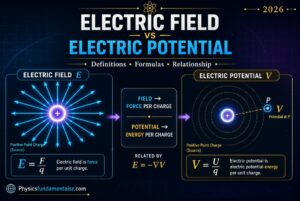
None have ever been found. Every magnet has both a north and a south pole, and cutting one in half just makes two smaller magnets. This is why magnetic field lines always form closed loops with no beginning or end, unlike electric field lines which start and stop on charges.