Half Life Practice Problems With Answers (Step-by-Step) 2026
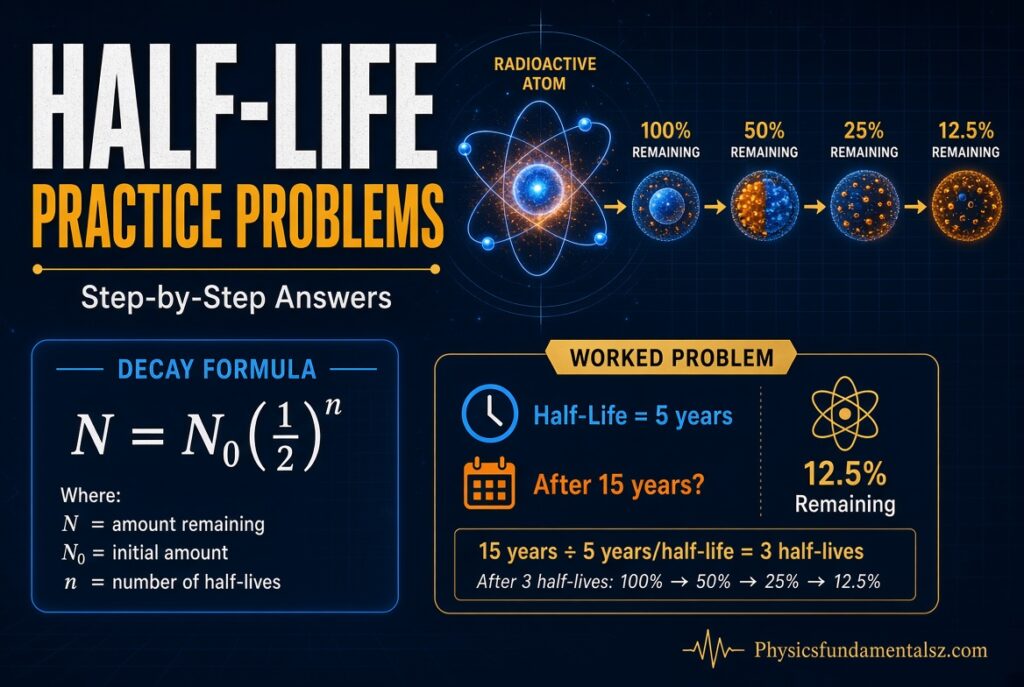
Half Life Practice Problems With Answers provide a practical way to understand how radioactive substances decrease over time and how their remaining amount can be calculated after one or more half-lives.
Half-life is the time required for half of a radioactive sample to decay, making it an important concept in nuclear physics, chemistry, medicine, archaeology, and radiometric dating.
Solving half-life problems involves identifying the half-life, determining the number of elapsed half-lives, and calculating the amount or percentage of material remaining.
Step-by-step practice problems help demonstrate how the half-life formula is applied to different situations, including finding the remaining quantity, elapsed time, or half-life of a substance.
Table of Contents
Half Life Practice Problems With Answers
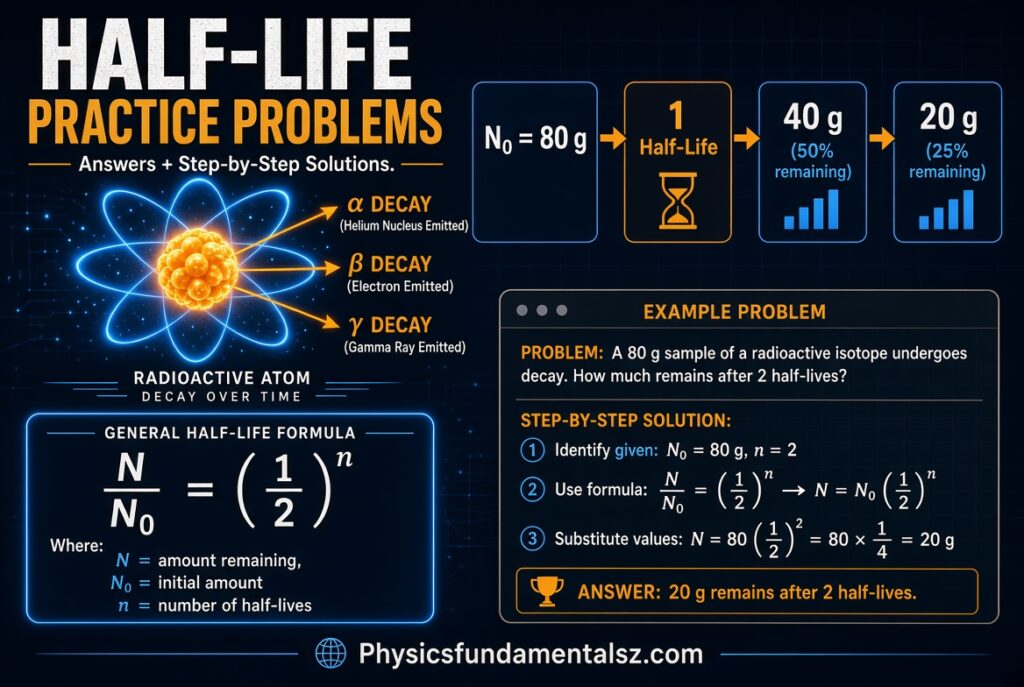
Half-life is the time it takes for half of a radioactive sample to decay.
The core formula is N = N₀ × (1/2)^(t / t½), where N₀ is the starting amount, t is elapsed time, and t½ is the half-life.
Rearranging this formula lets you solve for remaining mass, elapsed time, or the half-life itself, depending on what the problem gives you.
What Is Half-Life?
Half-life is the time required for exactly half of the radioactive atoms in a sample to decay into a different, more stable form.
It’s constant for any given isotope, no matter how much material you start with or what conditions surround it.
For example, Carbon-14 always takes 5,730 years to drop to half its original amount, whether you start with one gram or one kilogram.
The Half-Life Formula
Every half-life problem builds from one core exponential decay equation.
Formula
N = N₀ × (1/2)^(t / t½)
N is the amount remaining, N₀ is the starting amount, t is the elapsed time, and t½ is the half-life of the substance.
Solving for Elapsed Time
t = t½ × log₂(N₀ / N)
Use this version when the problem gives you the starting and remaining amounts but asks how much time has passed.
Solving for Half-Life
t½ = t / log₂(N₀ / N)
Use this version when the problem tells you the elapsed time and asks you to find the half-life itself.
How Many Half-Lives Have Passed?
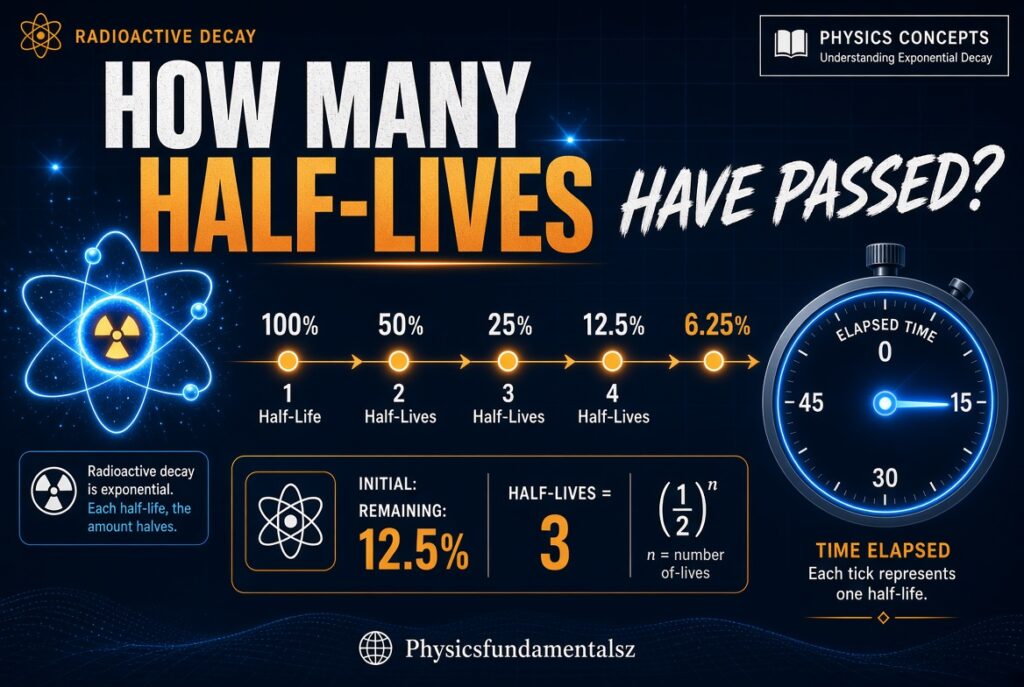
A fast shortcut for many problems is figuring out how many full half-lives have occurred, since each one simply cuts the amount in half.
| Half-Lives Passed | Fraction Remaining | Percent Remaining |
|---|---|---|
| 1 | 1/2 | 50% |
| 2 | 1/4 | 25% |
| 3 | 1/8 | 12.5% |
| 4 | 1/16 | 6.25% |
| 5 | 1/32 | 3.125% |
If a problem’s numbers match one of these exact fractions, you can skip the logarithm and solve it by simple halving.
Practice Problem 1: Finding Remaining Mass
Iodine-131 has a half-life of 8 days. If you start with 80 grams, how much remains after 24 days?
Solution: 24 days divided by 8 days equals exactly 3 half-lives. Starting from 80 g, halving three times gives 40 g, then 20 g, then 10 g.
Answer: 10 grams remain after 24 days.
Practice Problem 2: Finding Elapsed Time
A sample of Cobalt-60 starts at 100 g and decays to 12.5 g. Cobalt-60 has a half-life of 5.27 years. How much time has passed?
Solution: 100 g dropping to 12.5 g means the sample went through 100 → 50 → 25 → 12.5 g, which is exactly 3 half-lives.
Answer: 3 × 5.27 years equals 15.81 years.
Practice Problem 3: Finding the Half-Life
A radioactive sample decays from 60 g to 7.5 g in 36 hours. What is its half-life?
Solution: 60 g to 7.5 g is 3 half-lives (60 → 30 → 15 → 7.5). Divide 36 hours by 3 to find the half-life.
Answer: The half-life is 12 hours.
Practice Problem 4: Non-Whole Half-Lives
A 50 g sample of a substance with a 10-day half-life is left for 15 days. How much remains?
Solution: 15 days is 1.5 half-lives, so use N = N₀ × (1/2)^(t/t½) directly: 50 × (1/2)^1.5 ≈ 50 × 0.354.
Answer: Approximately 17.7 grams remain.
Practice Problem 5: Carbon-14 Dating
A fossil contains 25% of the Carbon-14 found in a living organism. Carbon-14’s half-life is 5,730 years. How old is the fossil?
Solution: 25% remaining equals exactly 1/4, which is 2 full half-lives (100% → 50% → 25%).
Answer: 2 × 5,730 years equals 11,460 years old.
Practice Problem 6: Percentage Remaining
A radioactive isotope has a half-life of 20 minutes. What percentage remains after 1 hour?
Solution: 60 minutes divided by 20 minutes equals 3 half-lives, so the remaining fraction is (1/2)³ = 1/8.
Answer: 12.5% of the original sample remains.
Practice Problem 7: Decay Constant Version
A substance has a decay constant (λ) of 0.0231 per year. What is its half-life?
Solution: Use t½ = ln(2) / λ, which is 0.693 / 0.0231.
Answer: The half-life is approximately 30 years.
Common Mistakes Students Make
- Forgetting to convert time units so the elapsed time and half-life match (days vs. hours vs. years).
- Assuming a non-whole ratio, like decaying to 60%, is a clean number of half-lives.
- Mixing up N₀ (starting amount) and N (remaining amount) inside the formula.
- Using linear subtraction instead of exponential halving to estimate the remaining mass.
- Forgetting that half-life problems require log base 2, not log base 10, unless converted properly.
Half-Life vs Decay Constant
| Feature | Half-Life (t½) | Decay Constant (λ) |
|---|---|---|
| Definition | Time to reduce to half | Probability of decay per unit time |
| Formula link | t½ = ln(2) / λ | λ = ln(2) / t½ |
| Units | Time (seconds, years, etc.) | 1/time |
| Common use | Describing decay speed simply | Used in calculus-based decay equations |
Both describe the same physical process, just from two different mathematical angles.
Real-World Applications of Half-Life
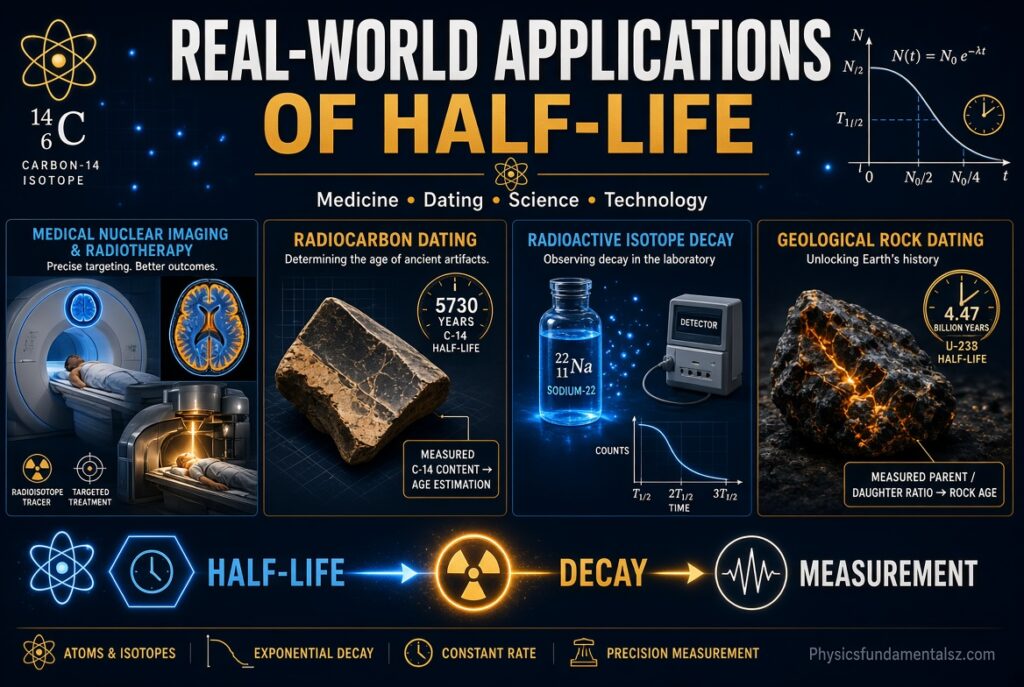
Half-life calculations aren’t just textbook exercises. They power several real scientific fields.
- Carbon dating: archaeologists use Carbon-14’s 5,730-year half-life to estimate the age of fossils and artifacts.
- Nuclear medicine: hospitals use isotopes like Technetium-99m, with a 6-hour half-life, for safe diagnostic imaging.
- Nuclear power plants: engineers track the half-lives of fuel and waste products to manage radiation safety.
- Geology: Uranium-238’s 4.5-billion-year half-life helps scientists date rocks and determine Earth’s age.
Key Takeaways
- Half-life is the time for a radioactive sample to reduce to exactly half its original amount.
- The core formula is N = N₀ × (1/2)^(t / t½), which can be rearranged for time or half-life.
- Whole-number half-life problems can often be solved by simple halving instead of logarithms.
- Fractional half-lives, like 1.5 or 2.3, require the full exponential formula.
- Real isotopes like Carbon-14, Iodine-131, and Cobalt-60 show up constantly in practice problems.
Also Read:
- Physics Fundamentals: The Complete Guide to Core Concepts, Laws, and Equations
- Mass Energy Equivalence Real Life Examples
- Photoelectric Effect Equation Explained
- Entropy Explained for Beginners
- Constructive and Destructive Interference Examples
- Physics Calculators
Frequently Asked Questions (FAQs)
What is the formula for half-life problems?
N = N₀ × (1/2)^(t / t½), where N₀ is starting amount, N is remaining amount, t is time elapsed, and t½ is the half-life.
How do you find remaining mass after several half-lives?
Divide the elapsed time by the half-life to count how many half-lives passed, then halve the starting mass that many times.
How do you solve for elapsed time in a half-life problem?
Use t = t½ × log₂(N₀ / N), plugging in the starting and remaining amounts along with the known half-life.
How do you solve for the half-life itself?
Use t½ = t / log₂(N₀ / N) when the problem gives elapsed time along with starting and remaining amounts.
What percentage remains after 3 half-lives?
12.5% of the original sample remains after exactly 3 half-lives, since (1/2)³ equals 1/8.
What percentage remains after 4 half-lives?
6.25% of the original sample remains after 4 half-lives, since (1/2)⁴ equals 1/16.
How is half-life related to the decay constant?
They’re linked by t½ = ln(2) / λ, where λ is the decay constant and ln(2) is approximately 0.693.
Why is Carbon-14 used in dating fossils?
Its 5,730-year half-life is long enough to date objects thousands of years old but short enough to still be measurable today.
Can half-life problems involve non-whole numbers of half-lives?
Yes, and these require the full exponential formula instead of simple repeated halving.
What’s the difference between half-life and mean life?
Half-life is the time for 50% decay, while mean life is the average time a single atom survives before decaying, and it’s slightly longer.
Does the amount of starting material affect the half-life?
No, half-life is a fixed property of the isotope and stays the same regardless of the starting mass or quantity.
What common mistake do students make with units?
Mixing time units, like using days for elapsed time but years for the half-life, without converting them to match first.
How long does it take for a substance to fully decay?
Technically never, since each half-life only removes half the remaining amount, leaving a tiny fraction indefinitely.
What isotopes commonly appear in half-life practice problems?
Carbon-14, Iodine-131, Cobalt-60, Uranium-238, and Technetium-99m appear most frequently in textbook and exam problems.
Is half-life the same for alpha, beta, and gamma decay?
No, half-life varies widely by decay type and isotope, ranging from microseconds to billions of years.
Conclusion
Half life practice problems with answers become much easier once you recognize whether the ratio matches a clean number of half-lives or requires the full exponential formula.
Start by counting how many half-lives have passed when the numbers divide evenly, and fall back on N = N₀ × (1/2)^(t / t½) for anything fractional.
With the formulas, shortcut table, and worked examples above, you now have a complete toolkit for solving any half-life problem you encounter.